


The first time I saw the dunes of Erg Chebbi rise up behind Merzouga, they looked exactly like the photos that had nudged me toward Morocco for years: apricot sand, a slow sunset, and a line of camels waiting for yet another group of visitors. I had already paid for a standard “camel trek to desert camp” package, but standing there in the late-afternoon heat, watching how the animals were handled and how quickly one group was swapped for the next, I felt my enthusiasm deflate. I did ride that evening, though for a much shorter time than planned, and I ended the night sore, uneasy, and very unsure that I would ever do it again.
My Camel Ride in Merzouga, Up Close
I joined an overnight trip that many Marrakech travel agencies sell as a three-day loop to Merzouga: two long days of driving, one night in a desert camp, camel ride included in the price. In my case, the camel trek was bundled into a mid-range package arranged directly with a Merzouga guesthouse, roughly 450 Moroccan dirhams per person for dinner, breakfast, camp accommodation and a round-trip camel ride into the dunes. It is the sort of offer you will see posted on handwritten boards outside dozens of small hotels lining the edge of Erg Chebbi.
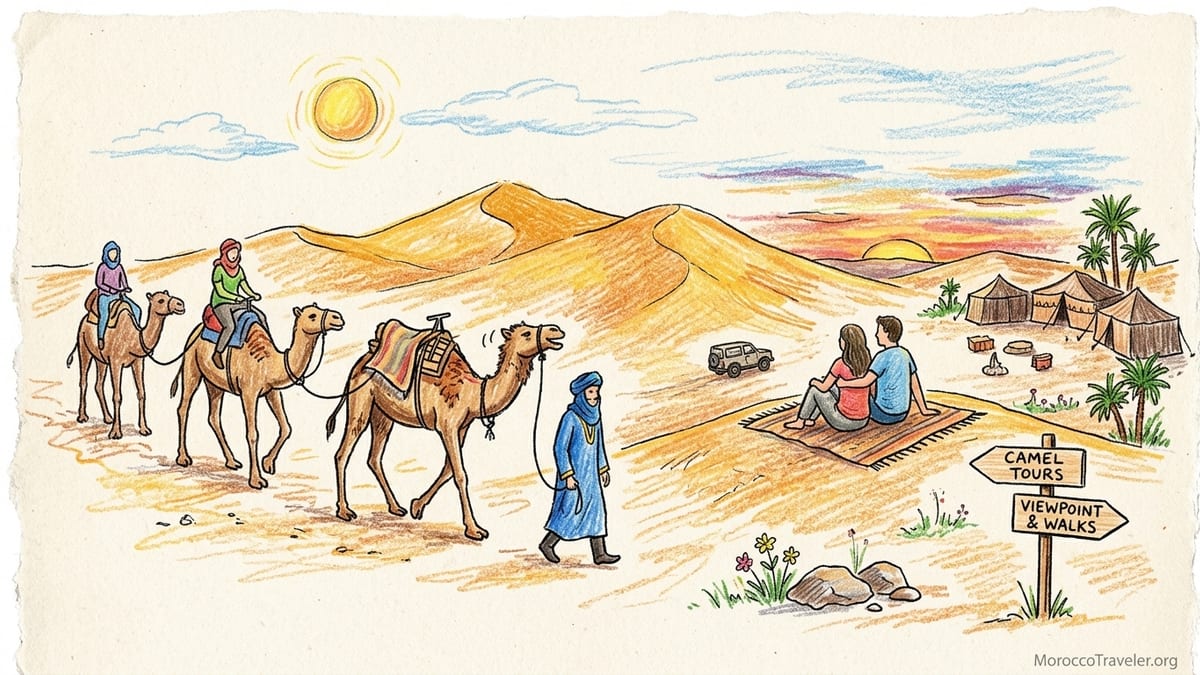
Our group that afternoon was twelve people, matched with twelve camels tied together in two long strings. The plan was to ride about one hour into the dunes to reach a fixed camp, sleep there, then ride back after sunrise. Guides in blue robes moved along the line, adjusting saddles and urging people to keep their bags small. Mounting was straightforward in theory: you swing a leg over while the camel is sitting, lean back as it lurches upright, and then hold tight to a wooden handle as it stands to full height. In practice, several of us yelped as the animals stood up sharply and the front-heavy saddles pitched us forward.
The saddles themselves were the first detail that made me uncomfortable. Each consisted of a simple wooden frame with folded blankets tied on as padding and a metal or wooden bar to grip. On my camel, the blankets had slipped to one side, leaving a hard edge pressing into the animal’s spine. The guide tried to tug them back into place, but in the rush to get everyone moving, it was never fully corrected. As we set off at a slow walk, I could feel the wood shifting against my legs and, I suspected, against the camel’s back as well.
For the first ten minutes, the novelty carried me. The dunes glowed, the air cooled, and cameras clicked non-stop. Then I started to notice how my camel moved its head more than the others, tossing occasionally and grinding its teeth. A patch of hair was missing where the nose rope rubbed, and the skin looked raw. When we paused for photos, I slipped off for a moment and saw shallow but visible rub marks under the tail of the saddle, where the ropes had chafed. None of this qualified as overt cruelty, but it did not match the idyllic images that had sold me the trip.
Where the Experience Went Wrong for Me
The discomfort was not only physical, although by the halfway point my hips and knees were aching. Camel riding uses unfamiliar muscles, and even with loose trousers and closed shoes, I could feel pressure points where the wooden frame dug in. Several riders in our group shifted constantly, one asked if there was any way to walk instead, and a teenager behind me fought tears every time the camel descended a steep dune. The guides kept us safe and never pushed speed, but they did continue to repeat that the ride was “only one hour” and “everyone can do it.”
What unsettled me more were the small welfare red flags I could not ignore. A few camels were in decent body condition, with rounded flanks and smooth, intact humps. Others looked thinner, with prominent hip bones and a slight collapse at the top of the hump that suggested past underfeeding or dehydration. I noticed no fresh open wounds, but several animals had thickened, scarred skin under their girths and at the corners of the mouth, exactly where ropes and metal rings exert the most pressure. None of the camels had access to water during our two-hour round trip, which by itself may not be abnormal for desert-adapted animals, but I did not see any obvious water troughs near the staging area either.
After we arrived at camp, the camels were lined up and tied nose-to-tail along a rope. They remained saddled for at least another hour as people photographed them at sunset, climbed on and off for “just one more” picture, and then moved to the tents for dinner. Only later, when I wandered back out, did I see one of the younger guides loosening girths and pulling blankets off in the half-dark. At no point did I see the animals turned out to roam, roll, or rest without ropes around their front legs.
It is important to say plainly that what I saw in Merzouga that evening does not prove that every camel operator in the region neglects their animals. In fact, other travelers I met later in Morocco had ridden with smaller family-run outfits who proudly pointed out their camels’ names, ages, and feeding routines. My criticism is specific: my own ride, with a mid-priced operator catering to volume more than intimacy, felt rushed, minimally padded for the camels, and driven more by the demand for photos than by any deep respect for the animals or the desert environment.
What Animal-Welfare Experts Say to Look For
My doubts on that ride pushed me to read more sober guidance from organizations that study working animals in tourism. Groups such as ABTA, Working Animals International, and national animal-welfare bodies emphasize that riding animals can sometimes be part of ethical tourism, but only if clear conditions are met. Their guidelines mention basic welfare needs that echo the “Five Domains” model used for many species: good nutrition, comfort, health, freedom to express natural behavior, and a life with minimal stress or fear.
In practical terms, that translates into things a traveler can see before committing money. A healthy camel should be alert, moving soundly on all four legs, with a full but not overfat hump and no major ribs or hip bones sticking through. Welfare guidance for working equids notes that loads and riders must be matched to the animal’s size and condition, and that they should not be worked for long periods without rest, especially in the hottest part of the day. Some tourism guidelines reference a simple rule of thumb: one person per animal, not overloaded with bags, and with regular rest breaks of at least an hour between shifts.
Equipment and handling matter just as much. Reputable advice for tour operators stresses that saddles must be specifically designed for camels, fitted so they do not rub the spine or hips, and regularly checked for wear that could cause wounds. Girths and nose ropes should not cut into the skin. When animals are standing at the staging point, you should not see fresh blood, thick scabs under the saddle line, or obvious limping as they walk. Camels are herd animals, so if possible they should not be kept alone, and they should have access to shade and water during the day, even if they do not drink constantly.
Working-animal specialists also point to signs of stress that a casual visitor can spot with a bit of attention. Repeated head tossing, grinding teeth, pinned-back ears when handled, and obvious flinching at human approach are all red flags. A calm camel may glance around, chew, or gently shift its weight, but it should not look frantic. If you arrive at a desert camp or hotel and see a row of camels tethered tightly, saddled for hours without riders, with no shade in the afternoon sun, that is a clear sign that the operation is prioritizing convenience over welfare.
Not All Camel Use Is the Same
One nuance that matters in Morocco is the difference between camels used as part of long-established livelihoods and those working solely for high-frequency tourist rides. Across southern and eastern Morocco, many families still rely on camels for tasks like seasonal movement, small-scale transport, and milk. In these contexts, the animals represent long-term investment and often move longer distances at a measured pace, with work more closely aligned to their natural endurance abilities.
In Merzouga and similar hubs, by contrast, tourist camels often walk the same short route two or three times per day during high season, carrying a succession of riders primarily interested in photographs at sunset. Several operators in the Erg Chebbi area describe their standard program as a one to one-and-a-half-hour ride to camp, dinner and drumming around the fire, then another early-morning hour back, repeated every night of the week through popular months. While this distance is not huge in camel terms, the repetition, limited variation in terrain, and constant mounting and dismounting can compound minor saddle fit issues into chronic skin problems.
There is also a difference in scale. A small family guesthouse with five or six camels may know each animal’s quirks, working limits, and rest patterns, and be more inclined to cancel rides in extreme heat or when the animals show signs of strain. Larger operations handling bus groups from Marrakech might manage dozens of camels at once and feel more pressure to keep every booking, even if that means a thinner or slightly lame animal still gets tacked up. Neither model is inherently good or bad, but the incentives are different, and as a visitor it helps to be aware of that dynamic.
Importantly, Moroccan guides themselves are not a monolith. I met a young handler in Merzouga who quietly told me he hated seeing camels tied up in full sun and sometimes used his break to lead them to the far edge of the camp where a patch of shade lingered. I also met another who shrugged when asked about a camel with a visible scar across its nose, saying only that “this one is stubborn.” Criticizing practices I saw does not mean dismissing the entire culture around camels here. It means recognizing that tourism money can either reward better care or normalize cutting corners.
How Prices and Alternatives Really Compare
Cost is often presented as a reason to accept camel riding as a package deal. In 2026, a basic overnight camp with a sunset-and-sunrise camel trek in Merzouga often starts around 350 to 500 dirhams per person in simple camps, rising to well over 1,000 dirhams in luxury setups with private tents and en-suite bathrooms. Those prices typically include the camel ride as a default, and it can feel like you are “wasting” value if you decline to ride. Some agencies from Marrakech or Fez bundle the trek into multi-day circuits, so by the time you reach the dunes, the camel is framed as the inevitable next step.
However, a closer look at local offerings shows that skipping the camel does not mean skipping the desert. Several Merzouga guesthouses and tour companies now explicitly offer 4x4 transfers instead of riding, driving guests directly to the same or similar camps for an added fee that is modest compared with the full trip price. In one popular operator’s own FAQ for its Marrakech to Merzouga circuit, the company notes that guests can swap the camel leg for a 4x4 transfer arranged in advance. On the ground in Merzouga village, hiring a vehicle and driver to reach a camp or sunset viewpoint often runs in the range of a few hundred dirhams per vehicle, shared among passengers.
Another underused option is simply staying at a hotel or auberge right at the dune line and walking up into the sand on your own. Many properties sit within a ten- or fifteen-minute walk of low dunes that still deliver a striking sunset or sunrise view without requiring any animal involvement or long transfers. Travelers who arrive by rental car or local bus can check into a fixed lodge in the late afternoon, hike up a nearby dune ridge for golden hour, and be back in time for dinner. The total cost can be comparable to, or even lower than, the full camp package with camel ride, especially outside peak holiday dates.
Then there is guided dune walking. Some local guides, often those who also lead longer treks into less visited parts of the desert, will organize evening or early-morning walks that take in viewpoints, explain local flora and tracks in the sand, and end at a simple fire for tea before walking back. Prices depend on route length and group size, but a short guided walk can rival or undercut the cost of a camel trek while offering more flexibility and fewer ethical qualms.
Comfort and Accessibility: Who Is the Camel Ride Really For?
Even if every camel you encounter looks well cared for, there is a practical question of who can actually enjoy such rides. Camel saddles, particularly the simple wooden ones common around Merzouga, are not kind to people with back problems, hip or knee issues, or limited balance. The mounting and dismounting process involves a sudden tilt as the camel kneels or stands, which can be alarming or unsafe for anyone with mobility challenges. I watched one older traveler in our group cling white-knuckled to the handle as her camel stood up, clearly terrified, while the guide encouraged her from the ground without any additional support equipment such as a mounting platform.
For children, there is the twin concern of safety and the animal’s load. Some operators allow two small children to share a camel if both are under a certain combined weight, while others insist on one rider per animal. Without clear, enforced standards, the decision can come down to the guide trying to keep a family group together. From an animal-welfare perspective, reputable guidance about working equids and camels suggests that they should not carry more than an appropriate proportion of their body weight and should never be ridden when very young. From a parent’s perspective, long periods perched high above the ground, with only a simple handle and no helmet, may not feel worth a few desert photos.
Alternatives are often far more accessible. A 4x4 transfer to camp, for instance, allows older travelers, those with chronic pain, and families with small children to reach the dunes without the strain. Walking to a nearby dune from a hotel can be paced gently, with rest stops, and adjusted to individual ability. For wheelchair users or those who cannot walk on sand, some higher-end camps and hotels are beginning to think about boardwalks, wide-tired transport chairs, or platforms that bring the view closer to the accommodation, though this is still developing and requires careful advance inquiry.
Ultimately, my group’s experience underlined that camel trekking is often sold as universally suitable, when in reality it is a niche activity that many bodies, and possibly many camels, endure rather than enjoy. Before signing up, it is worth asking not only “Can I physically do this?” but “Will I actually like this position, this motion, and this sense of control for an hour or more?”
If You Do Choose to Ride: Concrete Questions to Ask
After my experience, I would never again book a camel trek in Merzouga without a frank conversation with the operator first. Ethically minded travel companies and animal-welfare organizations suggest asking direct, practical questions, not vague ones. I now start by asking how many hours per day, and how many consecutive days, each camel typically works in high season, and what rest periods they have between rides. I also ask whether there are maximum rider weight guidelines and whether children ever double up on one animal.
On the equipment side, I want to know who fits and maintains the saddles, whether they are designed specifically for camels, and how often they are checked for wear or adjusted. I ask whether camels are unsaddled between groups or left tacked up, and where they spend the night. A company that happily explains that their camels live on a family plot near the village, have shade, are checked by a veterinarian when needed, and are not worked in the hottest hours is sending a different signal from one that shrugs off such questions or responds defensively.
Observing on arrival is just as important as what is said. I recommend taking a few minutes before mounting to watch how guides interact with the animals. Calm, patient handling, minimal shouting, and use of soft ropes rather than chains or sharp metal are good signs. Camels that approach the handler willingly, or at least without obvious fear, usually indicate consistent treatment. By contrast, animals that are struck, yanked, or forced into line while lame or obviously injured are a reason to walk away, even if that means sacrificing the ride fee.
For travelers who want more certainty, one pragmatic option is to choose desert experiences through companies that publicly align with international animal-welfare guidelines or who are vetted by larger tour operators with published policies. This does not guarantee perfection, but it often correlates with some level of training and oversight. In Merzouga, that might mean paying slightly more for a smaller, reputation-conscious camp rather than the cheapest last-minute offer on the main road.
The Takeaway
Looking back, my short camel ride in Merzouga gave me what I thought I wanted on paper: a line of footprints over gold dunes at sunset and a night in a Berber-style camp under bright stars. But the uneasy way I watched some of the camels move, the rushed saddling and unsaddling, and the transactional feel of the whole experience left a bitter aftertaste that lingered long after the sand was shaken from my shoes. It was not the worst example of animal exploitation I have seen in travel, but it was enough to make me question whether this particular “bucket list” is one I need to check off ever again.
Would I ride a camel in the Sahara in the future? Possibly, but only under conditions much stricter than those I accepted the first time. I would seek out a small-scale operator where I could see the animals’ living conditions, ask detailed questions about workload and veterinary care, and walk away without guilt if the answers or the body language on the ground felt wrong. I would avoid tours that treat camels as interchangeable props moved in and out for social-media shots.
More honestly, I have discovered that my preferred way to experience the Moroccan desert does not involve a saddle at all. I love staying in a fixed auberge at the dune line, walking up a ridge with a headlamp before dawn, and watching light spill over sand in near silence. I enjoy slow 4x4 drives deeper into stony hammada landscapes, stopping to learn about traditional wells, oases, and local music in nearby villages. None of this feels like a compromise. If anything, it feels truer to why I travel in the first place: to be present, to pay attention, and to leave places, and animals, slightly better off for my passing through, not slightly worse.
FAQ
Q1. Is camel riding in Merzouga always unethical?
Not always. Some family-run operators do keep camels in good condition, limit working hours, and use better saddles. The issue is that standards vary widely, and as a visitor you need to assess each operation individually.
Q2. How long is a typical camel ride to a desert camp near Merzouga?
Most overnight packages include around one hour to one and a half hours of riding each way between the village edge and the camp, often at sunrise and sunset when the light is best and temperatures are cooler.
Q3. What are visible signs of a well-cared-for camel?
A healthy camel usually has a full but not sagging hump, smooth movement on all four legs, no open wounds under the saddle or nose rope, and a calm demeanor without constant head tossing or obvious fear of the handler.
Q4. Can I visit the dunes of Erg Chebbi without riding a camel?
Yes. You can stay at a hotel right at the dune edge and walk into the sand on your own, or arrange a 4x4 transfer to a camp or viewpoint instead of riding.
Q5. Are 4x4 transfers more expensive than camel treks?
Often the camel ride is bundled into the camp price, but many operators will swap it for a 4x4 transfer at a modest additional fee or at no extra cost if arranged in advance, especially when booked directly.
Q6. Is camel riding suitable for travelers with back or joint problems?
Generally it is not ideal. The high, rolling gait and simple wooden saddles can aggravate back, hip, and knee issues, and the mounting and dismounting movements can be risky for anyone with limited mobility.
Q7. What should I ask an operator before booking a camel trek?
You can ask how many hours each camel works per day, what rest they have, how saddles are fitted and maintained, whether there are rider weight limits, and where and how the camels are kept when they are not working.
Q8. Is it acceptable for children to ride camels in the Sahara?
Some operators allow children to ride, but you should consider both safety and animal load. Single riders per camel, clear weight limits, and shorter rides in cooler hours are preferable for both welfare and comfort.
Q9. Are there non-animal-based activities around Merzouga?
Yes. Guided dune walks, 4x4 excursions to nearby oases and villages, sandboarding, stargazing, and cultural visits with local musicians or craftspeople all offer rich experiences without involving animal riding.
Q10. If I feel uncomfortable on the day, can I refuse the camel ride?
In most cases you can decline, though refunds are not always offered because the ride is bundled into the package. It helps to discuss alternatives such as a vehicle transfer when you book, so expectations are clear on both sides.