

Spending a night under the stars near Merzouga is often the highlight of a Morocco trip, but it is also one of the easiest places to be confused by marketing. Hundreds of properties now describe themselves as “Sahara camps” or “desert hotels,” whether they sit deep inside the Erg Chebbi dunes or beside the paved road with a dunes view. This guide explains how the main camp categories really work, compares concrete examples across budgets, and helps you choose a stay that matches your expectations for comfort, silence and price.
Understanding Erg Chebbi and Where Camps Actually Sit
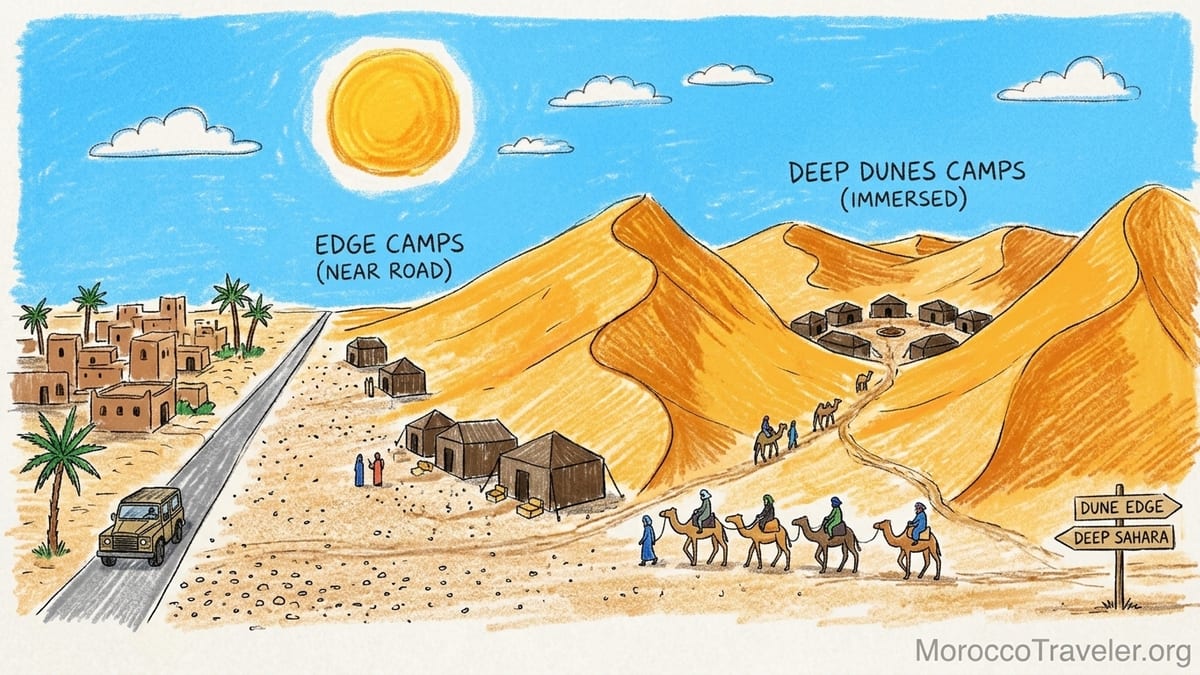
Merzouga is a small village in southeastern Morocco on the edge of Erg Chebbi, a narrow band of high sand dunes about 20 to 28 kilometers long and roughly 5 to 7 kilometers wide. The famous golden slopes that appear in photos rise directly east of the village and the nearby road. Because vehicle access is easy, a dense belt of camps has developed along the western edge of the sand as well as in low-lying areas behind the highest dunes. When a property says it is “in the Sahara,” it may mean anything from a tent pitched several kilometers inside the dunes to a camp set on flat gravel a few hundred meters from the first ripple of sand.
For travelers, the most important distinction is how far the camp sits from the dune edge and any nearby road or cluster of other camps. Many operations position their tents in shallow sand so that luggage can be brought in 4x4s in just a few minutes, and power lines or village lights remain visible. A smaller number push further east into the dune sea, where there is less light pollution and, usually, fewer quads and dune buggies. The experience of silence, darkness and sky feels very different in those deeper locations, even if the tent itself is similar.
In practice, Google Maps and booking sites sometimes show an approximate location rather than where the tents actually stand. Some camps move seasonally to follow more stable sand or adjust to regulations. To get a realistic picture, it is worth asking the camp directly how far their tents are from the main road by 4x4, and how much walking is required on sand. A camp that describes “10 to 20 minutes by 4x4 from Merzouga village” is normally inside the dunes; if they say “2 to 5 minutes,” it is usually at or very near the edge.
This proximity to the road is not automatically a disadvantage. Travelers with mobility issues, young children or heavy camera gear may appreciate a short transfer and firm ground underfoot. The key is to match expectations: if you imagine utter isolation and stars with no glow on the horizon, you will want to prioritize camps that sit further from the road and away from any large neighboring properties.
Camp Types: From Shared Bivouacs to Premium Glamping
Broadly, Erg Chebbi stays fall into five categories: basic shared-facility bivouacs, private standard tents with shared bathrooms, ensuite “luxury” tents, premium glamping suites and conventional hotels that overlook the dunes from the road. Within each category there are large and small operations, quiet and lively atmospheres, and both independent camps and those attached to hotels in Merzouga village.
Basic shared bivouacs are usually the cheapest and are often bundled into low-cost Marrakech to Merzouga group tours. Guests may share large sleeping tents lined with mattresses, use communal bathrooms in a block, and eat set menus at long tables. These camps concentrate near easy access points to control costs. Typical all-inclusive group packages including transport, one desert night and meals can work out to roughly the equivalent of 40 to 70 euros per person from Marrakech, with the desert camping component itself worth in the region of 20 to 30 euros of that price.
Private standard tents step up from this by offering each couple or family their own sleeping tent, usually with proper beds and lockable zips, but bathrooms shared in a separate block a short walk away. An example is the “standard desert camp” products marketed around Merzouga that include a sunset camel ride, dinner, breakfast and music, with private tents but shared facilities at prices advertised from around 40 euros per person on a half-board basis. These camps aim at backpackers and road trippers who want comfort but are content to share bathrooms if it keeps the price low.
Ensuite luxury tents add private bathrooms with flush toilets and hot showers behind each tent, along with thicker mattresses, rugs and often Moroccan lantern decor. Camps such as Desert Luxury Camp and Merzouga Luxury Camp sit in this category, operating 10 to 20 tents each with private facilities, restaurant tents and sometimes lounge areas. Current published price ranges for these kinds of camps near Erg Chebbi run roughly from 1,800 to 3,500 Moroccan dirhams per night for a couple, including dinner and breakfast, depending on season and tent type. Premium glamping pushes things further with suite tents, sometimes air conditioning units powered by generators or solar, and services like private 4x4 transfers from the village, curated excursions and wine service where licensed.
Real Camps, Real Numbers: What You Actually Get
Because operators regularly tweak their offers, any numbers quoted here should be checked at the time of booking, but recent 2026 guides to Merzouga desert camps give a realistic sense of the market. Basic shared-facility camps and simple private-tent bivouacs often price an overnight with camel ride, dinner and breakfast from about 60 to 80 US dollars per person. This usually includes luggage transfer from a meeting point on the road, tea on arrival and a drumming session around the campfire.
Tents with private bathrooms in mid-range “luxury” camps typically cost somewhere around 130 to 180 euros per night for two people on a half-board basis. These rates usually apply to standard luxury tents without air conditioning. Higher-end suite tents or premium glamping options in Erg Chebbi can reach the equivalent of 350 euros per night or more, especially in peak seasons such as late October to early November and March to April. At that level, guests can reasonably expect ensuite bathrooms, higher quality bedding, more stylish communal areas and often a quieter, more exclusive setting.
Another way to look at value is to consider what portion of the rate covers actual desert services versus marketing. For instance, a mid-range ensuite camp charging around 2,000 to 2,500 dirhams per couple including meals is usually operating a cluster of 10 to 20 tents with shared staff and centralized kitchen. In contrast, edge-of-road hotels with attached camps may sell packages where the overnight in the dunes is just one part of a multi-night stay, and the per-night cost in the desert is less transparent. If you are comparing a stand-alone camp to a hotel-plus-camp combination, ask each provider to quote a clear price just for the desert night and what exactly is included.
The most practical approach is to shortlist several camps in different categories, then request written confirmation of key details: tent type, private or shared bathroom, hot water hours, heating or air conditioning, whether dinner and breakfast are included, and the cost of camel or 4x4 transfers. Reputable operators near Merzouga are now accustomed to these questions and able to answer them precisely.
Sample Comparison: Luxury, Mid-range and Budget Options
The table below summarizes typical characteristics for three commonly booked styles of camp around Erg Chebbi. These are based on recent descriptions from established providers and independent comparison guides. Always confirm the latest specifications directly before booking because tent counts, amenities and pricing can shift between seasons.
| Example category | Approximate location | Distance from dune edge | Number of tents | Bathrooms | Hot water | Heating / AC | Electricity & Wi-Fi | Meals | Luggage transfer | Typical cancellation | Approximate price per couple |
| Premium glamping, eg Desert Luxury Camp type | Deep within Erg Chebbi, beyond main belt of camps | Surrounded by dunes; 10 to 20 minutes by 4x4 from road | About 16 luxury tents | Private ensuite in each tent | Yes, generally 24 hours | Gas or electric heaters in winter, some tents with AC | Electricity in tents and common areas, limited or camp-wide Wi-Fi | Dinner & breakfast included; lunch extra | 4x4 from village or hotel, usually included in rate | Often free cancellation up to 7–14 days, then sliding fee | Roughly 1,800–3,500 MAD per night including half board |
| Ensuite luxury camp, eg Merzouga Luxury Camp type | Dune edge or just inside main erg | Short camel or 4x4 ride from road, dunes clearly visible | 10 to 20 tents across categories | Private bathroom per tent | Yes, set hours morning and evening | Portable heaters in winter; fan cooling more common than AC | Lighting in tents, charging points; Wi-Fi usually only in main tent | Half board standard; full board on request | Camel in, 4x4 out or return by camel; normally included | Free cancellation up to a set date, 50–100 percent charge closer in | About 1,400–2,500 MAD per couple on half board |
| Standard private-tent camp, eg “standard desert bivouac” | Near road or at foot of first dunes | 2 to 5 minutes by 4x4 from meeting point | 10 to 30 simple tents | Shared bathroom block | Yes, but sometimes only at peak usage times | Occasional shared heaters; generally no AC | Basic lighting; phone charging in dining tent; Wi-Fi rare | Dinner & breakfast usually included | Short 4x4 or camel ride from parking, typically included | More flexible; some allow cancellation up to 2–3 days | Around 800–1,200 MAD per couple including meals |
Conventional hotels along the edge of the dunes function differently. Many in Hassi Labied and Merzouga have terraces that face the sand and may operate their own private camp inside the erg. In that case, the room rate might only cover the hotel stay, while a separate overnight in the dunes is sold as an add-on. For travelers who want one night in a proper building and one in a tent, this can be a convenient setup, but it does require clarity about where you will actually sleep each night and what transfers are involved.
Why “In the Sahara” Does Not Always Mean In the Dunes
Marketing language around Merzouga has grown creative as competition increased. It is common to see phrases such as “camp in the Sahara,” “Berber camp in Erg Chebbi” or “luxury Sahara bivouac” applied to properties that sit on firm gravel next to the village, sometimes with just a narrow band of sand nearby. Photos can be tightly framed to show dunes behind a single tent, even though out of frame lie dozens of other camps or the village streetlights.
The geography makes this easy. Because the dune field is relatively narrow and hugs the road, almost any property along that stretch can legitimately say it is near the Sahara, which is technically true. What most travelers imagine, however, is not simply proximity but immersion: tents with sand in every direction and minimal man-made noise. To get that immersion, you need to confirm that your chosen camp actually sits away from the main road, not just that it has a view of dunes.
Noise carries far in the desert. A camp positioned in a busy belt of operations may hear quad bikes, 4x4s and music from neighboring properties, particularly on weekends and during holiday periods. Some travelers enjoy the festival feel of drums and song from several fires at once. Others arrive expecting near silence and feel surprised when they hear engines until late evening. Feedback from visitors and local guides regularly highlights this contrast between the romantic image and the semi-urban reality of the dune edge.
A simple way to separate genuine desert immersion from desert-themed marketing is to ask specific, practical questions before you book: Is your camp part of a cluster of neighboring camps or in a more isolated setting. How long is the transfer from the nearest road. Are motorized activities like quad biking permitted directly around the camp or only in designated zones. Camps used to these questions will usually answer straightforwardly, and their replies say more than any brochure text.
Facilities, Comfort and Seasonal Climate
Comfort in Merzouga camps is shaped as much by climate as by tent decor. Nights from November to February can be cold, with temperatures near or below freezing at times. In those months, basic camps may provide extra blankets but limited heating, while mid-range and luxury operations typically offer gas or electric heaters in the tents for a portion of the night. High-end glamping tents sometimes feature insulated walls and thicker bedding, which makes a tangible difference in comfort between sunset and sunrise.
Summer brings the opposite problem. From June through early September, daytime temperatures in the region can rise well above 40 degrees Celsius. Air conditioning units appear in some premium tents but remain relatively rare in the wider camp scene because of power supply constraints. More often, camps rely on shade, good ventilation, fans and the natural cooling that occurs after dark. Travelers planning to visit in peak heat who are sensitive to high temperatures might prefer an edge-of-dune hotel room with full air conditioning and do a shorter evening camel excursion into the sand rather than sleep in a tent.
Hot water availability varies. Fully plumbed camps with private bathrooms usually maintain hot showers in early morning and evening at minimum, sometimes throughout the day if solar and gas systems allow. Shared-bathroom bivouacs may heat water during peak times to conserve resources. Electricity also ranges from simple solar lighting in each tent to full generator-backed systems with power sockets and Wi-Fi in common areas. If you rely on recharging cameras, drones or medical devices, it is important to confirm power access and quiet hours for generators.
Parking and luggage logistics are straightforward but worth clarifying. Nearly all camps ask guests to leave rental cars in a supervised parking area near the road, then transfer luggage by 4x4 or camel. Some charge a modest fee for guarded parking; others include it in the package. For self-drivers in winter, checking whether the parking area is accessible after heavy rain and if there is staff on duty late into the evening adds a layer of reassurance.
Packages, Extra Charges and How to Book
Most Merzouga camps now sell both room-only tent rates and full or half-board packages that bundle meals and activities. On international booking platforms, you will often see the tent price per night listed with breakfast included and dinner as an optional add-on. When booking directly with the camp or through a Moroccan agency, the more common model is a package price per person that includes dinner, breakfast, a sunset camel ride into the dunes, and sometimes basic sandboarding or a short sunrise trek.
Extra charges tend to appear around experiences and comforts beyond that core offer. Camel rides included in overnight packages usually cover a straightforward sunset trip from the edge of the dunes to the camp. Longer treks or private camel outings may be priced separately. Motorized activities such as quad biking or 4x4 dune drives are almost always extra and can add a significant amount to the bill for families or groups. Sandboards are sometimes offered free in mid-range and luxury camps, but at basic camps they may carry a small rental cost.
Cooling, heating and bottled water sit in a grey zone. At premium glamping operations, drinking water is often complimentary and heaters are part of the advertised service. More budget-focused camps may charge for large bottled water and sometimes limit heater use to conserve gas. If you are price-sensitive, it is smart to ask in advance whether the quoted rate includes all taxes, camel transfers both ways, and access to basic activities, and to request a ballpark figure for common extras.
There are three main booking routes. Direct booking with the camp can unlock clearer communication about tent allocation, dietary needs and timing. Booking platforms such as the large global hotel sites offer user reviews, instant confirmation and card payments, but the display rate may not include all elements of a traditional desert package, so read inclusions carefully. Finally, multi-day tours from Marrakech or Fes often package camp stays into a broader itinerary. In that case the per-night desert cost is baked into a total tour price, which may be competitive when you factor in transport, guiding and hotels en route, but you may have less choice over the exact camp unless you negotiate it in advance.
Choosing the Right Atmosphere: Quiet Nights vs Group Entertainment
Beyond location and comfort level, atmosphere shapes whether your desert night feels magical or overwhelming. Many Merzouga camps, especially those catering to groups, build evenings around drums, songs and performances by staff. There may be set times for music around a central fire, opportunities for guests to join in, and in busier belts of camps you can sometimes hear multiple groups playing in the distance at once. Travelers who enjoy social energy, shared experiences and a hint of festival ambience generally appreciate these camps.
Quieter operations, which exist in all budget categories, lean toward simple evenings of dinner, tea by the fire and early stargazing. Reviews and traveler discussions often point out that these camps limit amplified music, discourage late-night noise and choose locations slightly away from the densest concentration of neighboring bivouacs. Couples, photographers and light sleepers frequently prefer these settings, even if it means a slightly higher price or a longer transfer.
Size plays a role. Camps with 20 or 30 tents can feel like small villages on busy nights, with a steady flow of arrivals and departures, whereas those with six to ten tents almost inevitably feel more intimate. Many travelers only realize this on arrival when they see how many tables are set for dinner. Asking about maximum capacity and typical occupancy during your dates is one of the simplest ways to gauge the likely atmosphere.
If silence and a sense of space matter more to you than decorative touches, it can make sense to prioritize small, well-sited standard or mid-range camps that sit deeper in the dunes over more polished but busier luxury sites near the edge. Conversely, if you are traveling in winter and value guaranteed heating, strong logistics and a wide choice of meal options, one of the larger luxury operations may be worth the trade-off in serenity.
Recommendations by Traveler Type
For couples seeking romance and comfort, ensuite luxury camps inside or overlooking the higher dunes offer a strong balance of privacy and atmosphere. Booking a tent with a private bathroom and, in colder months, confirmed heating allows you to enjoy stargazing and sunrise walks without worrying about basic needs. Choosing a camp that emphasizes smaller capacity and a more secluded location will add to the sense of escape even if it costs a little more.
Families often do well in mid-range camps or hotel-and-camp combinations. A hotel night on the edge of the dunes, complete with pool and family rooms, combined with one night in a private tent with shared or private facilities, can keep children comfortable while still giving them the thrill of a camel ride and campfire. Asking about child-friendly meal times, safe sandboarding areas and whether extra beds can be added inside family tents helps avoid surprises on arrival.
Solo travelers weighing cost and sociability may prefer standard private-tent camps attached to group tours or sold as packages from Merzouga. These often include transfers, meals and activities at a lower overall price, and the communal dinners create easy opportunities to meet other travelers. At the same time, it is important for solo guests to check whether a single supplement applies to private tent occupancy and whether there is staff on site all night for security.
Luxury-focused visitors who are willing to spend for comfort and service should look closely at premium glamping camps deep in Erg Chebbi and, if time permits, compare them to even more remote options in other ergs. High-end Merzouga camps provide hotel-grade bedding, private bathrooms and curated excursions, often with flexible dining and more staff per guest. Here, it is reasonable to expect strong communication in advance, clear descriptions of inclusions and, on site, a calm but polished experience.
Finally, travelers whose top priorities are silence and an unspoiled location rather than ornate decor should concentrate on smaller operations that explicitly market themselves as quiet and set away from the main belt of camps. Communicating directly with the owners or managers, asking detailed questions about noise, neighboring camps and quad bike routes, and reading recent independent reviews will do more to deliver the experience you imagine than comparing tent photos alone.
FAQ
Q1. How can I tell if a Merzouga camp is really inside the Erg Chebbi dunes?
Ask the camp how long the 4x4 or camel transfer from the paved road takes and whether you will be surrounded by sand on all sides. Camps that sit directly beside the road usually describe transfers of just a few minutes, while those deeper in the dunes refer to 10 to 20 minutes of travel over sand and less visibility of village lights.
Q2. What is the difference between a basic bivouac and a luxury desert camp?
A basic bivouac generally uses shared bathroom blocks and sometimes shared sleeping tents, with simple bedding and communal meals, often as part of low-cost group tours. A luxury desert camp offers private tents with real beds, ensuite bathrooms with hot showers, improved food and service, and usually a more considered location or atmosphere.
Q3. Are ensuite bathrooms standard in Merzouga desert camps?
No. Ensuite bathrooms are common in mid-range and high-end camps but not universal. Many affordable camps still rely on shared facilities. Always confirm whether your tent has its own private bathroom and what kind of toilet and shower it includes before booking.
Q4. How much should I expect to pay for a night in an Erg Chebbi camp?
As a rough guide in 2026, standard private-tent camps with shared bathrooms often cost in the region of 800 to 1,200 dirhams per couple including dinner and breakfast. Ensuite luxury tents tend to range from about 1,400 to 2,500 dirhams, and premium glamping suites inside the dunes can reach 3,500 dirhams or more.
Q5. Are camel rides and sandboarding usually included in the price?
Most overnight packages include a short sunset camel ride between the road and the camp and sometimes a simple sunrise walk. Sandboards are often provided free at mid-range and luxury camps but may be a paid extra at basic camps. Longer camel treks and motorized activities like quad biking are almost always charged separately.
Q6. Is it better to book my desert camp directly or through a tour?
Direct booking with a camp or hotel gives you more control over the exact property, tent type and inclusions, and can make special requests easier. Booking as part of a multi-day tour from Marrakech or Fes can simplify logistics and sometimes reduce overall costs, but you may have less say over which camp is used unless you discuss it in detail with the operator in advance.
Q7. How noisy are the camps at night?
Noise levels vary widely. Some camps host music and drumming around the fire, and in busy belts of camps you may hear sound from several properties at once. Others advertise themselves as quiet retreats and limit music and motorized activities near the tents. If you value silence, choose a smaller, more isolated camp and state your preference clearly when booking.
Q8. What about safety, electricity and charging devices?
Reputable camps station staff on site overnight and have basic safety measures in place. Electricity might come from solar panels or generators, often providing lighting in tents and common sockets for charging phones and cameras. If you rely on continuous power for medical devices or work, discuss your needs with the camp prior to confirming.
Q9. Do Merzouga camps operate year-round?
Most camps operate throughout the year, but some scale back in the hottest summer weeks or around Ramadan. Conditions feel very different between cold winter nights and hot summer evenings, so both availability and comfort may depend on the month you choose. Checking opening dates and typical temperatures for your travel period is important.
Q10. Can I visit the dunes without sleeping in a tent?
Yes. Many hotels and guesthouses in Merzouga and Hassi Labied organize evening camel rides or 4x4 excursions into the dunes, allowing you to experience sunset on the sand and return to a regular room afterward. This can be a good option for travelers concerned about temperature extremes, accessibility or tent comfort.