


I thought I knew what I was signing up for when I booked a two day “express” tour from Marrakech to Merzouga and the Erg Chebbi dunes. The brochure showed golden sand seas, camels at sunset and smiling travellers by the campfire. What it did not show was the reality of spending nearly the entire forty eight hours in a minibus, racing across Morocco just to stand on the dunes long enough to take a few photos before being shuttled straight back to Marrakech, exhausted and dazed. After retracing this route, checking multiple current tour itineraries and speaking with other travellers who tried the same, I have come to a clear conclusion: for most people, the two day Marrakech to Merzouga tour is a bad deal.
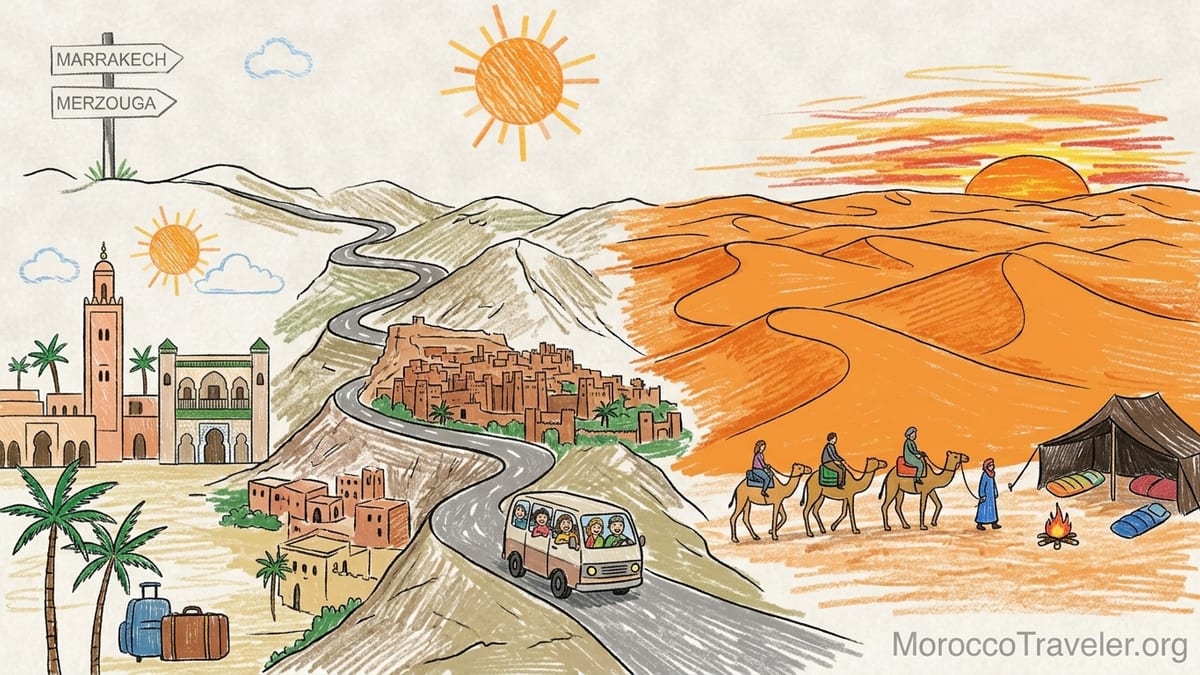
What a Two Day Marrakech to Merzouga Tour Really Looks Like
The sales pitch is seductive: leave Marrakech, cross the High Atlas, reach the real Sahara at Erg Chebbi, sleep in a Berber camp and be back in the city within forty eight hours. Several Moroccan tour operators now market exactly this product, advertised as “2 Days Marrakech to Merzouga Desert Tour” or similar wording, often described as the fastest way to reach the big dunes if your time is limited. It sounds efficient. On paper, it even sounds adventurous.
The geography tells a different story. Merzouga, the gateway village to Erg Chebbi, sits roughly 560 kilometres from Marrakech by road via the N9 and N10, crossing the Tizi n’Tichka pass and running through Ouarzazate, the Dades and Todra regions before reaching the hammada and dunes. Driving time is typically quoted at about nine hours in good conditions, without counting longer sightseeing stops or traffic. That is eighteen hours of driving for a round trip that you are trying to squeeze into two days.
To make this work, tour companies strip the itinerary to its bare minimum. A typical two day Merzouga package will leave Marrakech around 7:00 in the morning, hurry over the High Atlas with short photo breaks, push past Aït Benhaddou and Ouarzazate with little more than a pause for lunch, then drive almost non stop across the mountains and valleys toward the desert. Arrival at the Erg Chebbi edge is usually scheduled for late afternoon, close to sunset. The next morning starts in the dark, with an early camel ride back to the road and an immediate start on the long journey back to Marrakech.
This timing matters, because the clock does not stop while you are weaving over mountain passes or crawling through small-town traffic. Once you factor in toilet and meal stops, roadworks and occasional weather, the reality for many groups is a ten to eleven hour day in the vehicle in each direction. That imbalance lies at the heart of why this particular tour structure fails most travellers who book it.
Inside the Itinerary: Departure, Driving and the Van-Centric Reality
The day one routine is almost identical across the operators currently advertising two day Merzouga tours. Minibuses collect guests from riads and hotels in Marrakech between about 6:30 and 7:30 in the morning, before joining the N9 as it begins winding into the High Atlas. The first three to four hours are spent inching up the Tizi n’Tichka pass, a spectacular but slow road that tops out at roughly 2,260 metres. There are quick photo stops at viewpoints and roadside cafés, but these are essentially leg-stretches, not real explorations.
Around late morning to midday, groups usually pass Aït Benhaddou, the fortified ksar that appears in countless films. On a two day Merzouga itinerary, Aït Benhaddou becomes a rushed hour at best: a brisk walk across the bridge, a short climb to the view, sometimes with a local guide. If the group has already lost time to traffic or late departures, the guide may push for a thirty to forty minute stop so the bus can keep moving. Many travellers step back on board feeling they have barely seen the place, yet it still consumes a significant chunk of the limited non driving time.
After a quick lunch in or near Ouarzazate, the afternoon turns into a straight push along the N10 and then south east. Some itineraries mention Skoura, the Valley of Roses or the Dades and Todra gorges, but seen on a two day Merzouga schedule these are usually drive-by highlights: a viewpoint above a palm oasis, a brief stop on a roadside lay-by overlooking a gorge, a ten minute coffee rest in a small town. What could be the backbone of a rewarding three or four day itinerary shrinks to a string of short pauses designed to keep passengers from complaining about never leaving the van.
By the time you reach the flat hammada leading to Merzouga, you have typically been inside the vehicle for ten hours with only narrow windows of movement. The final transfer to the camels, often near Hassilabied or another edge-of-erg village, can feel more like a change of transportation method than an arrival. Sunset is approaching, stomachs are thinking about dinner and you have not properly walked for an entire day.
How Little Time You Actually Spend in the Erg Chebbi Dunes
The fundamental promise of the tour is time in the Sahara’s big dunes, and this is where the imbalance becomes stark. On many current two day Merzouga packages, guests arrive at the desert edge around 17:00 or even later, especially in winter when daylight is short. There is a quick handover to the camel handlers, a short safety briefing, and then a camel ride that takes roughly forty five to ninety minutes, depending on how far the camp sits inside the dunes.
Once the caravan stops at a mid-dune viewpoint for sunset photos, the clock is already running down. After sunset, you ride or walk the final short stretch to camp. There is a welcome tea, time to drop bags in the tent and perhaps a quick sandboarding attempt or some photos in the blue hour. Within an hour or so, most camps move straight into dinner, often a set tajine or couscous served communally. Musicians appear around the fire, guests are encouraged to clap and dance, then the cold pushes people toward bed earlier than they might expect.
If we quantify this, the numbers are sobering. Out of roughly twenty four hours between leaving Marrakech on the first morning and waking up in the Merzouga camp on the second day, you have probably spent between ten and eleven hours day one in the vehicle and another seven or eight hours sleeping. That leaves a sliver of waking, non transit time, of which only perhaps three or four hours are actually in contact with the dunes: the evening camel ride, sunset, dinner, and a short spell under the stars before bed.
The next morning does not add much. Most operators schedule an early pre dawn wake up so guests can watch the sunrise from a nearby dune. After a rapid breakfast, camels carry everyone back to the road, typically in twenty to forty minutes. Many travellers reasonably choose to walk beside the camels instead, simply to move their legs. By 8:00 or 8:30 in the morning, you are usually back in the minibus, beginning the same long road to Marrakech in reverse. The total genuine dune time for which you have crossed an entire country is roughly five hours, and that includes time spent eating and sleeping inside the camp.
Exhaustion and the Illusion of Sightseeing Along the Way
On paper, these tours promise a roll call of southern Morocco’s highlights: Aït Benhaddou, Ouarzazate, Skoura, Dades, Todra, the Ziz valley and finally the Erg Chebbi dunes. In reality, on a two day Merzouga schedule, you are too tired, rushed or physically constrained by the timetable to appreciate most of them. I remember standing on a viewpoint over the Todra region, bleary-eyed from the road, knowing that somewhere down the side valleys lay walking trails, small ksour and irrigation channels that deserved an afternoon, not a five minute photo stop between bathroom breaks.
By mid afternoon on day one, the mood in the minibus shifts. Even travellers who started the day excited about mountain scenery begin to sag into silence. Families with children start juggling snacks and screens. The same roadside souvenir stalls and café menus roll past. When you finally reach the desert, you do not arrive fresh and curious. You arrive stiff, mildly dehydrated and often with a headache, which is not how anyone imagines meeting the Sahara.
The return journey on day two is worse, because the novelty has worn off. The same bends of the Tizi n’Tichka pass that felt dramatic on the way out become an endurance test on the way back, especially after an early start and a basic camp breakfast. The bus still has to push all the way to Marrakech in a single day, because there is no overnight built into the schedule. Late afternoon traffic near the city can easily add another hour. Many travellers report reaching their riads around 19:00 to 21:00, having left the desert soon after sunrise. That is eleven to thirteen hours in and around the bus for a final day that offers no new experiences.
This is where the illusion of efficient sightseeing becomes clear. The route from Marrakech to Merzouga is rich and varied, but only when given time. Aït Benhaddou rewards at least half a day, if not a night, to wander the alleys once the day trippers leave. Skoura’s palm groves feel very different at dusk compared with midday. The Dades gorges deserve a walk up the valley roads, not just a quick stop at the famous switchback viewpoint. When all of this is compressed into short pauses to keep the driver within legal hours, the tour turns into a list of places you have technically visited, rather than places you have meaningfully experienced.
Who Really Suffers: Children, Older Travellers and Anyone Who Dislikes Long Drives
Even for fit adults who are comfortable with road trips, two consecutive days of nine or more hours in a minibus is tiring. For certain types of travellers, it is much closer to miserable. Parents often underestimate how hard this kind of schedule is on children, especially younger ones. Seat belts can be inconsistent, the road is winding for long stretches, and motion sickness tablets only go so far. The novelty of looking out the window disappears quickly for kids who are not interested in mountain scenery, yet frequent stops long enough to go for a run in a safe open space are not built into the timetable.
Older travellers and anyone with back or joint issues may find the seating uncomfortable after several hours. The High Atlas road includes constant curves, occasional potholes and construction zones. Even on newer vehicles with air conditioning, the combination of altitude, temperature changes and limited legroom can leave people exhausted before they even see a grain of desert sand. For travellers with cardiovascular or respiratory concerns, the rapid changes between Marrakech’s elevation, the Tizi n’Tichka summit and the dry desert heat can add extra strain that a more gradual multi day itinerary would soften.
For travellers who simply dislike being confined to a seat, the psychological toll is obvious. In my own group, several independent travellers who were used to planning their own pace found the enforced rhythm difficult. They would have preferred to stop in a village market or linger at a viewpoint, but the schedule could not flex without jeopardising sunset arrival. By the second day, those same people were counting down hours to reach Marrakech rather than enjoying the scenery. For a trip that is marketed as a highlight of any Moroccan journey, that is a problematic outcome.
It is worth stressing that none of this is a criticism of the drivers or local guides, many of whom work hard to keep groups safe and on time. The issue lies in the structure of the product itself. Trying to cover over one thousand kilometres of mountain and desert driving in two days while promising an authentic Sahara experience is fundamentally flawed. No amount of cheerful commentary from the front seat can disguise that.
The Money Question: What You Pay per Actual Hour in the Desert
Two day Merzouga tours often look good at first glance when you compare prices online. Shared group departures can appear in the range that many budget travellers find manageable, while private versions cost more but still promise a once in a lifetime Sahara night without adding extra hotel days. The problem is not just the headline price, but what that price buys in terms of real desert time.
If your total true Erg Chebbi contact is around five hours, including sunset, dinner, some music and a sunrise, then a basic calculation of cost per hour in the dunes reveals a poor ratio. When you compare this to three and four day itineraries that include Merzouga, the difference is clear. On a typical three day Marrakech to Merzouga tour, you still spend long hours driving, but you gain more breathing room at Aït Benhaddou, a night somewhere like the Dades valley and at least a full afternoon and evening in the dunes, sometimes with part of the next morning free for a short 4x4 excursion or village visit before returning.
Stretch that to four days, and the value increases further. Travellers gain either an extra day based around Merzouga, with time to visit nearby villages, fossil sites or viewpoints, or the chance to break the return journey with an overnight in Skoura, Ouarzazate or Agdz. In other words, you spend more money upfront, but your cost per waking hour spent exploring rather than sitting in a vehicle drops substantially. That is especially true if your overall time in Morocco is limited, because wasting two of your days inside a van has an opportunity cost that no tour brochure spells out.
This is not to argue that everyone should automatically book the longest possible tour. Budgets matter, and time constraints are real. It is simply to highlight that when you are paying specifically for a Sahara experience, the tour that devotes less than a quarter of your total trip time to the dunes themselves is probably not the smartest use of either money or days.
Why Zagora Is a Different Two Day Story
Much of the confusion around two day desert tours from Marrakech comes from mixing together two very different products. The classic two day excursion from Marrakech goes to the Zagora region, following the same N9 over the Tizi n’Tichka pass but turning down the Draa valley rather than continuing all the way east toward Merzouga. On this route, the distance and driving time are shorter, roughly six to seven hours each way in typical conditions, and the desert landscape is more hammada and low dunes than sweeping sand seas.
Tour companies accurately market Zagora as the closest true desert destination to Marrakech that can realistically be done in two days without complete exhaustion. You still spend a large portion of both days in the vehicle, but there is more slack in the schedule for slightly longer stops, and you are not trying to cross almost the entire width of the country. Shared tours to Zagora are widely advertised at accessible prices, with a camel ride at sunset, a night in a desert camp and a sunrise return before heading back along the Draa and over the Atlas.
Even here, though, there are trade offs. The dunes around Zagora and the nearby areas are smaller and less dramatic than the Erg Chebbi giants that appear in glossy photos of Morocco. If your heart is set on towering, orange sand ridges, Zagora may feel like a compromise. But if your main goal is to have a taste of desert camping and a camel ride without committing to a multi day road journey, a well run two day Zagora loop can make sense. Crucially, it does not pretend to deliver quite the same experience as Merzouga, and the distance involved makes the schedule less punishing.
This distinction is important: a two day Zagora tour is essentially what a two day itinerary can reasonably support. A two day Merzouga tour stretches that format beyond what is comfortable, turning what should be a highlight into a test of endurance.
Smarter Alternatives: More Time, Different Routes and Better Use of Flights
If you want to experience Erg Chebbi properly, the solutions are not complicated. The simplest is to add a day. A three day Marrakech to Merzouga tour already improves the equation, giving you at least a full afternoon and night in the dunes with a bit more recovery time after the initial High Atlas crossing. A four day itinerary is better again, offering flexibility to include places like Skoura’s palm oasis, time in the Dades or Todra gorges, or a slower loop back toward Marrakech.
Another alternative is to change your starting point. Many travellers underestimate how much easier it can be to leave for Merzouga from Fez rather than Marrakech. The road distance between Fez and Merzouga is still long, but the route avoids the same extreme High Atlas crossing and can often be broken sensibly with a stop in Midelt or along the Ziz valley. Over three days, you can shape an itinerary that includes cedar forests, high plateaus and then the dunes, without having to race across the south.
For those tight on time but with a bit more budget, using domestic flights can also transform the experience. Flying from Casablanca or Marrakech to Errachidia or another nearby regional airport cuts out a significant chunk of the road journey, leaving more time and energy for the desert itself. From there, overland transfers to Merzouga are straightforward, and you can realistically enjoy one or two full days around Erg Chebbi without sacrificing half your trip in transit. This approach is particularly appealing for families with children and for older travellers who want comfort without missing the dunes.
Finally, if your schedule or budget simply cannot stretch to a longer Merzouga trip or a flight, it may be more honest to accept Zagora as your desert experience and plan to return to Morocco for a deeper Sahara journey another time. A short, well balanced tour to a nearer desert region is far better than a rushed dash to Merzouga that leaves you vowing never to get in a minibus again.
The Takeaway
After tracing the Marrakech to Merzouga route, reviewing current two day Erg Chebbi packages and talking with the people who run them, my verdict is straightforward. If the brochure mentions reaching Merzouga or the big dunes of Erg Chebbi and the trip duration is two days, I would avoid it. The imbalance between driving time and actual dune time is simply too extreme. You are buying a story about the Sahara, but most of what you actually experience is the inside of a vehicle and a blur of scenery that deserves more respect than a quick snapshot through tinted glass.
The two day model works more realistically for Zagora, where the distances are smaller and the expectations are framed as a taster rather than a full immersion in the classic dune landscape. If you know you handle long drives well, are extremely short on time and understand exactly what you are getting a sunset camel ride, one night in a desert camp and a lot of hours on the road then a two day Zagora loop can be a reasonable compromise.
For anyone whose main goal is Erg Chebbi, the towering dunes near Merzouga that appear in every Moroccan tourism campaign, a longer itinerary is not a luxury. It is a requirement if you want the journey to feel like travel rather than transit. Three days is the bare minimum at which the experience begins to breathe. Four days or more allows the south of Morocco to unfold at something closer to its natural pace, with time to walk in valleys, linger in palm groves and sit quietly on the dunes once the camel caravans have gone.
The desert does not reward rushing. Its spaces are vast, its light changes slowly and its charm lies in stillness as much as spectacle. Any tour that asks you to cross an entire country in two days for a few hours on the sand is not serving that reality, or you, particularly well. When planning your own trip, the most important decision is not which camp has the best photos. It is how much of your precious time you are willing to spend watching Morocco through a bus window instead of under the desert sky.
FAQ
Q1. Is a two day tour from Marrakech to Merzouga ever a good idea?
It can make sense only for travellers who tolerate very long driving days, know they will spend most of the trip in a vehicle and still value a brief glimpse of Erg Chebbi over not seeing it at all. Even then, it is a compromise rather than a recommended choice.
Q2. How many hours will I actually spend in the Erg Chebbi dunes on a two day Merzouga tour?
In practice, most travellers get around five hours of real dune contact, including the sunset camel ride, dinner, some time by the campfire and a short sunrise before riding or walking back to the road.
Q3. How long is the drive between Marrakech and Merzouga on these tours?
The road distance is roughly 560 kilometres each way, with around nine hours of pure driving when conditions are good. With toilet, meal and photo stops, that usually stretches to ten or more hours in the vehicle in each direction.
Q4. How is a two day Zagora tour different from a two day Merzouga tour?
A Zagora tour covers a shorter distance, usually six to seven hours of driving each way, and reaches a lower, rockier desert with smaller dunes. It offers a more realistic schedule for two days, though it does not deliver the towering sands of Erg Chebbi.
Q5. Is a three day Marrakech to Merzouga tour enough to enjoy the Sahara?
Three days are still busy, but they finally allow some breathing room, usually including a night in the mountains or a valley and at least one full afternoon and evening in the dunes. It is the minimum duration at which the trip begins to feel like a journey rather than a transfer.
Q6. Would you recommend these tours for families with children?
For Merzouga in two days, no. The driving is simply too long for most children to enjoy. A two day Zagora tour or a three or four day Erg Chebbi itinerary with more breaks and space to move is a safer, more pleasant option.
Q7. Are two day Merzouga tours suitable for older travellers?
Only for those who are very comfortable with long, winding drives and do not have back, joint or balance issues. The combination of many hours in a minibus and the camel ride can be hard on older bodies, especially when rushed.
Q8. How can I reach Erg Chebbi if I have very limited time?
If budget allows, consider flying to a regional airport such as Errachidia and connecting by road from there. This cuts out some of the longest driving days and lets you spend more of your short trip actually in and around the dunes.
Q9. What should I look for when comparing desert tour itineraries online?
Check daily driving hours, where the overnight stops are, how long you get at Aït Benhaddou and other sites, and exactly when you arrive and leave the dunes. Be wary of any two day itinerary that claims to include many major stops and still reach Merzouga.
Q10. If I can only spare two days from Marrakech, what would you personally book?
I would choose a straightforward two day Zagora loop with a reputable operator, accept that it is a sampler rather than the classic Erg Chebbi experience, and plan to return to Morocco another time for a longer Merzouga journey.