

I arrived in Merzouga with the classic fantasy in my head: a quiet camel ride into the sunset, a sky thick with stars, and the soft hiss of wind over the dunes of Erg Chebbi. That first evening almost delivered it. The light turned copper, my camel caravan stretched into elegant silhouettes, and the desert finally began to sound like the desert. Then, as the sun touched the horizon, a convoy of quad bikes and buggies burst over the ridge behind our camp, engines howling, headlamps flaring, and sand spraying in rooster tails that blew straight into our faces. My camel lurched at the noise, the lead quad missed us by what felt like a few metres, and the guides were shouting to keep everyone calm. The Saharan silence I had travelled hundreds of kilometres to find vanished under the drone of motors.
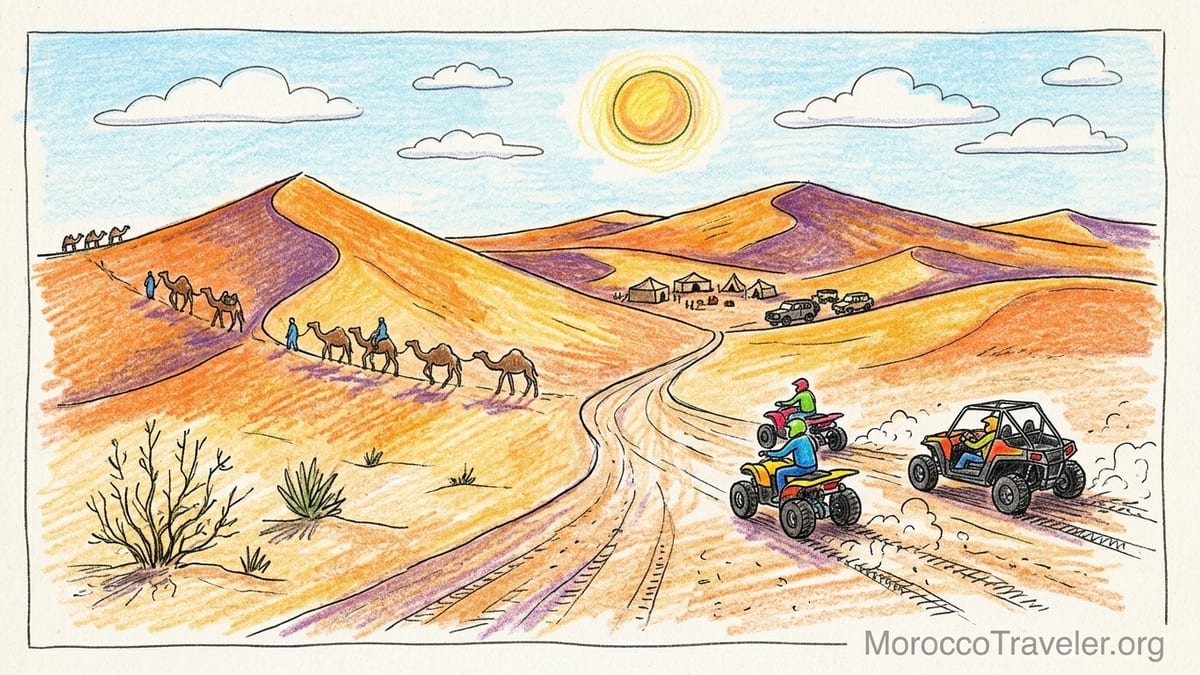
Expectation: A Silent Sea of Dunes
Erg Chebbi, the dune field that rises beside the village of Merzouga in southeast Morocco, is sold around the world as a place of silence. Travel agencies in Marrakech and Fes print brochures with images of lone camels against empty horizons, and tour PDFs describe “a quiet night under the stars” where “only the wind and the rustle of sand break the silence.” Many desert tours emphasise that the camel ride to camp is timed so that guests arrive around sunset, a ritualised moment of stillness after the long drive across the country.
The physical setting supports that promise. Erg Chebbi is one of Morocco’s best known ergs, a sea of wind-shaped dunes rising sharply from the surrounding hammada plain. The high ridges catch the first and last light of the day like a natural amphitheatre. In theory, once you walk a few hundred metres from the edge of the village and the main piste, the only sounds should be wind, the creak of saddles and maybe distant voices from another caravan.
Yet the commercial reality around Merzouga has changed. The dunes have become a motorised playground for quad bikes, side-by-side buggies and 4x4 excursions. Operators in the village and in nearby Hassilabied promote one-hour or two-hour ATV and buggy runs, often marketed as ideal pre-sunset activities. Prices are clearly laid out on glossy websites and WhatsApp menus, and vehicles line up on the hardpack just before the sand begins. As a result, the boundary between the quiet desert and the motor zone is far less distinct than many travellers expect.
When I booked my own camel-and-camp package, the brochure gave one line to quad bikes as an “optional extra.” It did not mention that the main approach route to the camp ran directly across the tracks used by evening buggy tours, or that several nearby camps shuttled late-arriving guests by 4x4 straight across the dunes. The first time I tried to sit alone on a ridge at dusk, the hum of engines arrived before the stars.
Reality: Noise, Dust and Shared Dunes
Spend even a few hours around Merzouga in high season and the soundtrack of Erg Chebbi looks very different from the fantasy. On my second day, I climbed a high dune before sunrise, hoping to photograph the first light over an untouched landscape. The view was beautiful, but the sand at my feet was laced with criss-cross tyre marks. In the half-light I could already see silhouettes of quads warming up on the flats, and by the time the sun cleared the horizon a dozen machines were clawing up a nearby face, engines straining in the thin morning air.
The noise carries a remarkable distance across sand. Even when vehicles are technically out of sight, their constant mid-range buzz sits on the edge of perception. At busy times, especially around late afternoon and early evening, that sound is almost continuous near the main access pistes. Camps concentrated on the closer flanks of the dunes feel this most acutely. Guests stepping out of their tents to watch the sunset might find themselves sharing the ridge with lines of helmets and rental goggles, or breathing fine dust kicked up by repeated passes of 4x4s headed to more remote encampments.
The dust itself is not only an aesthetic problem. Repeated traffic breaks the crust of the upper sand and, on the harder stony approaches, throws up plumes of grit that hang over the landscape. Walking back from the dunes after one sunset, I passed a quad group returning at speed along a compacted track. The lead guide did his best to keep a safe distance from pedestrians, but the cloud his convoy created reduced visibility to a few metres. A family with young children instinctively covered their faces with scarves, and several people stopped until the haze drifted away on the wind.
There is also a subtler effect on perception. Many visitors imagine tracks in the sand as temporary scars that the next storm will erase. Locals remind you that strong winds are indeed frequent in this part of Morocco, and over the course of days or weeks they do smooth the surface. But in the interim, for travellers staying only a night or two, the immediate impression is of a desert thoroughly criss-crossed by machines. The idea of being alone in a vast, untouched space becomes harder to sustain when the dune you just climbed is buzzing with distant engines.
Environmental Concerns: Between Evidence and Emotion
It is important to separate my emotional reaction from what we can actually document. Standing on a dune while a buggy roars past below feels wrong on a visceral level. It jars with every cliché we hold about the Sahara as a fragile, timeless environment. That does not automatically mean that every tyre mark is a permanent ecological disaster, but there is credible concern among researchers and local observers about the cumulative impact of motorised tourism around Erg Chebbi.
Academic work on the area has already flagged “germs of self-destruction” in the way tourism pressure is managed, including specific criticism of rallies and individual motor sports for air and noise pollution and for the stress they impose on residents and animals. Local environmental groups in the wider region have expressed worry about off-track driving damaging fragile vegetation in the transition zones where dunes meet more stable ground. Guides I spoke to pointed out patches near the edge of the erg where shrubs once anchored the sand and now struggle in the wake of constant crossings.
On the flip side, some camp owners argue that in the heart of the high dunes the ecological footprint of quads is less severe than it looks. In their view, the constant movement of sand naturally erases tracks and there is little plant or animal life on the tallest ridges to disturb. They frame the issue more as one of experience than of outright environmental collapse. To them, the bigger threats come from water usage, waste disposal and the rapid proliferation of permanent structures, not from a handful of buggies taking paying guests up a slope.
Both perspectives contain truth. The Sahara is both resilient and fragile, depending on where you look and on what timescale. From a traveller’s standpoint, the most immediate and verifiable damage motorised tourism does is to the sense of remoteness and the acoustic environment. The dunes are no longer quiet where engines routinely run, and wildlife, local communities and visitors alike are forced to adapt to that new normal.
Inside the Motor Market: What Quad, Buggy and 4x4 Trips Really Look Like
To understand the scale of the issue, it helps to look at how quad bikes, buggies and 4x4s are actually sold in Merzouga today. Walk along the edge of the village in late afternoon and you will see rows of ATVs lined up outside small garages and tour offices. Many of these businesses promote clear packages on their websites or printed sheets: one-hour quad adventures for a fixed price per person, two-hour “erg exploration” rides, sunset special runs, and longer half-day loops that combine dunes, black desert plateaus, old mines and visits to nomad families.
Indicative pricing as of 2026 shows one-hour quad tours around Merzouga commonly advertised in the range of roughly 35 to 60 euros per person, with two-hour rides often between 70 and 100 euros. Buggy tours, which place two or four people in a side-by-side vehicle with a roll cage, tend to be priced per vehicle. It is not unusual to see a one-hour two-seat buggy ride around 100 to 120 euros per vehicle, with two-hour circuits closer to 200 to 220 euros. Some operators position buggies as a premium option, using higher-powered machines and stressing comfort and safety.
The structure of these packages matters. A typical one-hour quad run rarely leaves the busier edge of the dunes. Groups wind up and down the first high faces visible from the road, exactly where many camps position their sunset viewpoints. Two-hour tours and half-day circuits go deeper, reaching quieter dunes, rocky plains and small settlements, but still traverse the same corridors that camel caravans and 4x4 transfers use. The “sunset buggy and sandboard” combinations heavily marketed online are usually scheduled so that vehicles are on the ridges at the same time as travellers who arrived by camel for the very same sunset.
Protective equipment is usually included in the price, at least on paper. Helmets are almost always mentioned, sometimes alongside goggles and lightweight gloves. In practice, the condition of this gear varies. On one inspection visit I was offered a helmet with a cracked visor and a strap that would not tighten. When I asked about replacement, the staff dug around and found a better one, but only because I insisted. Many first-time riders lack the experience or confidence to question what they are given, especially when the desert and the fading light are calling.
Insurance and liability are another quiet fault line. Some companies describe “full insurance” in marketing language, but their small print emphasises that clients are responsible for damage to machines and for third-party injury caused by their driving. Standard waivers in the adventure motor industry place significant responsibility on the rider. For a visitor who has never driven off-road or handled a powerful ATV, this combination of powerful machinery, limited briefing and broad liability deserves far more scrutiny than it usually receives at booking time.
Safety: Rollover Risks, Inexperience and Response
The question most travellers ask once they see the machines in action is simple: how safe is this? The honest answer is that, as with skiing or mountain biking, there is an inherent risk that depends heavily on the rider’s experience, the quality of guidance and the terrain chosen. Around Erg Chebbi, the typical quad client has little or no off-road background. Yet they are often handed a machine capable of more than 60 kilometres per hour and pointed at slopes of shifting sand.
On steep dunes, the main danger is rollover. Quads and buggies are stable when ridden straight up or down, but if a rider panics, turns sharply on a slope or crests a ridge too fast, the vehicle can tip. Guides in Merzouga quietly admit that minor rollovers happen every season, particularly when groups include overconfident riders or when evening light makes it harder to read the sand. Leg and shoulder injuries, as well as collarbone fractures, are the kinds of outcomes medical teams associated with other desert rallies have documented in similar terrain.
Collisions are another risk, especially with mixed-use dunes. During my stay I watched a quad group funnel down a narrow gully towards a line of camels ascending from the opposite direction. The guide halted his clients and waved frantically for the caravan to pass before proceeding. It was an example of good judgement in the moment, but it also underlined how easy it would be for a distracted rider to come over a blind ridge and meet a camel or hiker at the worst possible angle. Online discussions among travellers and locals mention incidents where tourists fell from quads after hitting rocks or misjudging speed, even on less extreme terrain.
Emergency response in Merzouga is more robust than romantic images of the “middle of nowhere” might suggest, but it is still constrained. The village has basic medical facilities, and serious cases are stabilised and transferred to larger towns. During large organised events like the Merzouga Rally, professional medical teams deploy 4x4 ambulances and even helicopters. Regular tourist quad tours, however, do not run with that level of backup. Guides carry phones and sometimes first-aid kits, but there is usually no dedicated rescue vehicle shadowing a commercial group of casual riders.
In reviewing tour conditions and talking to travellers, what struck me most was not the lack of any safety measures, but the inconsistency. Some reputable operators insist on a proper briefing, enforce a strict pace and keep group sizes small. Others run informal, almost off-the-cuff outings for guests who ask at the last minute, with minimal screening of ability. In an environment where the margin for error can be a few degrees of angle on a dune face, that patchiness is worrying.
Guides, Briefings and the Question of Responsible Routes
The industry in Merzouga is not monolithic. I met guides who take safety and environmental impact seriously, and others who framed both concerns as nuisances that get in the way of business. One quad operator in Hassilabied described his pre-ride briefing in detail. He walks clients around the machines, checks that helmets fit, demonstrates body position on climbs and descents, and practices emergency stops on flat sand before leading the group towards any serious slopes. He also keeps his standard loop to well-established tracks, avoiding the busiest camel approaches at sunset and steering clear of fragile plant zones by the lake when it holds water.
By contrast, I watched another outfit send a group out in the late afternoon with little more than a helmet toss and a shouted “Gas is on the right, brake on the left.” Within minutes dust was hanging over the low dunes between their base and several camps’ front doors. Guests at one camp stepped aside to let the convoy buzz past within a few metres of the tents, their tea interrupted by engines and grit.
Local and regional authorities have attempted to impose some structure, including expectations that motor activities keep to appropriate routes and respect any zoned restrictions. Some Moroccan tour companies publicly refer to these guidelines in their responsible tourism policies, at least in principle. On the ground, enforcement appears uneven. The dunes are vast, signage is minimal, and many trips are privately arranged by camp owners or fixers rather than formally booked through agencies that advertise environmental charters.
From a traveller’s perspective, the practical question is whether your chosen operator behaves like the first or the second example. You are unlikely to see official permits or GPS route plans, but you can ask direct questions before you ride. Where do you go at sunset? How many other users are on that route? Do you cross camel paths? Do you brief complete beginners differently? The answers, and the attitude with which they are given, reveal a great deal.
Quiet Alternatives: Walking, Sandboarding and Real Stillness
None of this means that every form of adventure on the dunes is incompatible with silence. The problem is not movement itself, but the way engines dominate the shared space. On my most peaceful evening in Merzouga, I left the camp an hour before sunset and simply walked. A local guide suggested a direction that would take me away from the main quad corridors and the access pistes. Within thirty minutes, the sound of engines faded. The only marks I saw were footprints, camel prints and the occasional faint tyre line half-erased by wind.
Sandboarding offered a similar compromise. Instead of hiking to the most popular ridge directly above our camp, where buggies were cresting for sunset selfies, we carried boards to a quieter slope further along the chain. Climbing in soft sand with a board under your arm is exhausting, but the payoff is an almost private amphitheatre of light, with only the rush of sand under the board as you slide down. The same applies to early morning photography. Rising well before the first quad start times, I was able to watch the colours shift from blue-grey to pink and gold without any mechanical interruption.
Guided nature walks are an undervalued option. Several knowledgeable locals offer half-day excursions around the dunes and nearby hamada, focusing on tracks in the sand, the sparse vegetation, and the traces of water systems and settlements that have sustained life here for generations. These walks tread lightly and add a layer of context that noisy laps on an ATV cannot match. They also tend to steer you away from the most eroded or overused slopes.
Ultimately, the core experience many travellers seek in the Sahara is not speed but perspective: the feeling of being small in a vast landscape, hearing your own thoughts against a backdrop of wind and distant animal bells. You can still find that in Erg Chebbi, but it increasingly requires intention, time and the willingness to walk a little farther from the nearest engine.
Choosing Camps and Operators That Respect the Desert
If you want to avoid the worst of the motor noise, where you sleep matters as much as what you book. Desert camps cluster in bands along the foot of the dunes. Those closest to the road and the villages are most exposed to quad and buggy traffic, both because vehicles launch from nearby and because these areas function as shared corridors for 4x4 transfers and camel routes. Camps set a bit deeper into the erg, or tucked behind secondary ridges, often experience significantly less engine intrusion, especially outside the peak evening slots.
When researching, ask prospective camps very specific questions. How far is your camp from the nearest quad or buggy base? Do quads pass directly in front of camp at sunset? How do you transport guests who do not ride camels? Some higher-end operations now actively market their relative isolation from motor routes as a selling point, emphasising camel or on-foot access and limiting on-site motor activities to essential logistics rather than entertainment.
The booking channel also influences your experience. Mass-market Marrakech-to-Merzouga packages often bundle a short quad ride as an almost automatic add-on, sometimes pressing guests to decide on the spot. Independent travellers who self-drive or use regional buses to reach Merzouga have more freedom to choose smaller, quieter camps that do not push motors as a primary attraction. Even within organised tours, there is sometimes scope to opt out of quad sessions and request more time for walking or photography instead.
Identifying responsible operators in the motor segment itself is still possible. Look for companies that cap group sizes, insist on proper gear checks, describe their briefings clearly and reference avoiding sensitive areas or busy camel routes. If an operator’s pitch is all about speed and “adrenaline,” with little mention of safety or the wider desert context, expect their priority to be thrills over tranquillity. Your money amplifies one approach or the other.
The Takeaway: What I Would Avoid, What I Might Still Accept
After several days in Merzouga, I came away convinced that quad bikes, buggies and 4x4s are indeed eroding parts of the classic Sahara experience at Erg Chebbi. The constant noise near the main pistes, the dust clouds that hang over the lower dunes, and the uneasy proximity of powerful machines to camels and pedestrians all chip away at the sense of remoteness and safety that drew me here. For travellers arriving with the same postcard in mind that I once held, the disconnect can be stark.
Personally, I now avoid short, high-traffic motor outings entirely. One-hour quad blasts around the front dunes, sunset buggy parades on the most photogenic ridges, and casual 4x4 dune bashing near camp strike me as the worst of all worlds: maximum disturbance for minimal depth of experience. They crowd the very moments many visitors most want to keep quiet, and they put inexperienced riders in the busiest, least forgiving parts of the landscape.
There are, however, narrow circumstances where I can see a motorised excursion making sense. A well-briefed, small-group buggy or 4x4 journey that uses established tracks to reach distant hamada plains, old mines or remote villages, scheduled well away from sunrise and sunset, can add geographical context without hijacking the shared soundscape of the main dunes. For older travellers or those with limited mobility, such trips may be one of the few ways to see beyond the immediate belt of sand. The key conditions are clear: strong safety practices, honest route descriptions, and a conscious effort to avoid busy viewpoints and fragile transition zones.
If your goal is genuine desert silence, plan with that aim front and centre. Choose a camp set back from the most obvious access corridors, ask direct questions about motor traffic, and resist pressure to add a quad ride just because it is on the menu. Walk further than most people are willing to walk. Climb a less famous ridge. Go out at times of day when engines are idle. The Sahara around Merzouga is no longer a uniformly quiet place, but pockets of deep stillness remain for those determined to find them.
FAQ
Q1. Can I still find quiet areas in Erg Chebbi despite all the quad bikes?
Yes. If you stay in a camp set slightly deeper into the dunes, avoid the closest clusters to the road, and walk 20 to 30 minutes away from main pistes at off-peak times, you can still experience extended periods of real silence.
Q2. Are quad biking and buggy tours in Merzouga safe for complete beginners?
They can be, but only with good guidance, conservative routes and proper protective equipment. Many first-time riders underestimate how easy it is to tip a quad on a slope or lose control on soft sand. If you have no experience, look for an operator that emphasises training runs and small groups.
Q3. How much does a typical quad or buggy tour cost in Merzouga?
As of 2026, one-hour quad tours often run in the region of 35 to 60 euros per person, while two-hour trips can reach 70 to 100 euros. Buggies are usually priced per vehicle, with a ballpark of about 100 to 120 euros for a one-hour two-seat ride and around 200 to 220 euros for two hours, depending on the operator and machine.
Q4. Do quad and buggy operators provide insurance and safety gear?
Most include helmets and basic gear, and some mention insurance in their sales material, but liability for damage and injury often still falls heavily on the rider in the fine print. Always read terms carefully, inspect the equipment you are given, and do not be shy about asking for a better-fitting or undamaged helmet.
Q5. What are the main risks of riding a quad on the dunes?
The most common concerns are rollovers on steep or uneven slopes, collisions in areas shared with camels or pedestrians, and falls caused by sudden changes in sand texture or hidden rocks. Speed, inexperience and poor supervision combine to amplify these risks.
Q6. Are there regulations on where quads and 4x4s can drive in Erg Chebbi?
There are guidelines that expect motor activities to follow appropriate routes and respect local restrictions, but enforcement on the ground is inconsistent. In practice, responsible behaviour depends largely on the ethics of individual operators and guides.
Q7. What quieter activities would you recommend instead of quad biking?
Walking unaccompanied or with a guide, sandboarding on less-used slopes, dawn or dusk photography, and guided nature or culture walks around the dunes and nearby hamada all offer rich experiences with a much smaller acoustic and environmental footprint.
Q8. How can I pick a desert camp that is not surrounded by engines?
Ask camps directly how far they are from quad and buggy bases, whether motor traffic passes in front of the tents at sunset, and how they usually bring guests in from the road. Camps that emphasise camel access and tranquillity in their descriptions are often better bets.
Q9. Is a longer 4x4 excursion into the region more acceptable than short dune bashing?
Often yes, if it stays on established tracks, avoids the busiest ridges at sunrise and sunset, and focuses on visiting villages, viewpoints and geological sites rather than simply sliding up and down dunes for thrills.
Q10. If I really want one motorised experience, what would you suggest?
If you are set on it, consider a small-group buggy or 4x4 outing scheduled away from sunrise and sunset, led by a reputable operator that prioritises safety and explains its route choices, and treat it as a way to reach distant landscapes rather than as an adrenaline chase on the main dunes.