


The dunes of Erg Chebbi near Merzouga are one of Morocco’s most spectacular landscapes, yet reaching them is not as simple as stepping off a plane or train. Merzouga has no commercial airport and no passenger railway station, so every journey to the Sahara finishes by road. This guide explains, with current 2026 information, how independent travelers can plan their own route from Marrakech, Fez or Errachidia to Merzouga without automatically buying a standard Marrakech desert package.
Key Facts About Getting to Merzouga and Erg Chebbi
The first reality to understand is that Merzouga is a true end-of-the-road destination. There is no ONCF railway line to Errachidia or Merzouga, and the national network currently ends far to the north in cities such as Fez and Marrakech. Official planning documents for the Morocco Rail Plan talk about Errachidia as a future hub, but this remains long term. For now, travelers coming from Marrakech or Fez can only get part of the way by train before continuing by coach or road.
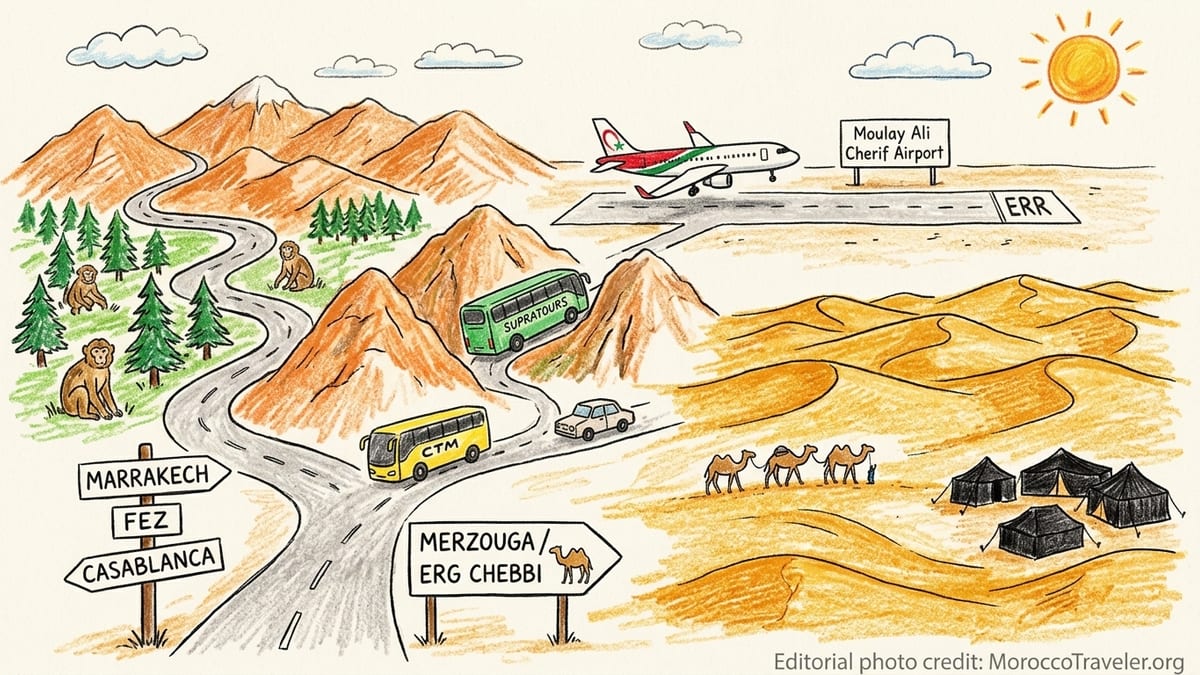
Merzouga also has no commercial airport. The nearest airport with scheduled flights is Moulay Ali Cherif Airport in Errachidia, around 125 kilometers away by road. Flight-tracker data for October 2026 shows Royal Air Maroc departures from Errachidia to Casablanca most days and to Rabat at least twice weekly, but the mix of routes has changed several times in recent years, so you should always check real dates, not assume a daily service.
Because of these structural limits, every route to Erg Chebbi combines at least two legs. You might fly or take the train to a gateway city such as Marrakech, Fez, Casablanca or Rabat, then switch to a long-distance bus or rental car, and finally travel the last stretch by road from Errachidia or Rissani to Merzouga. Even when you see the name “ONCF Supratours” on a timetable, the final section from Errachidia to Merzouga still happens by coach, not by rail.
The upside is that these overland legs cross some of Morocco’s most dramatic scenery: the High Atlas passes between Marrakech and Ouarzazate, the Dadès and Todra regions around Tinghir, and the cedar forests and Ziz Valley between Fez and Errachidia. With a bit of planning, the journey becomes a highlight rather than a chore.
Route 1: Marrakech via Ouarzazate and the Dadès or Tinghir Region
The classic overland route from Marrakech to Merzouga runs southeast across the High Atlas to Ouarzazate, then east to either Boumalne Dadès or Tinghir, and finally through Erfoud or Rissani to Merzouga. Driven in one shot this is roughly 560 to 570 kilometers and at least 10 to 11 hours of driving without long stops. Most independent travelers sensibly split it over two or three days to enjoy the kasbahs and valleys along the way.
By car, you start by crossing the Tizi n Tichka pass between Marrakech and Ouarzazate. This is a long, winding mountain road that now benefits from significant improvement works, but still involves hairpin bends, steep drops and possible snow or ice in winter. From Marrakech to Ouarzazate is about 200 kilometers and usually 4 to 5 hours with a coffee or photo stop. From Ouarzazate to Boumalne Dadès is another 120 kilometers, then about 50 kilometers more to Tinghir, and just under 200 kilometers from Tinghir through Erfoud and Rissani to Merzouga.
For travelers relying on public transport, Supratours and CTM coaches link Marrakech with Ouarzazate, Tinghir and Errachidia. Fall 2026 data from Supratours timetables shows a daytime coach that leaves Marrakech around 08:30 and reaches Merzouga approximately 12 hours later, although availability on specific dates can be patchy. Several CTM departures connect Marrakech and Errachidia, and another line runs Fez to Rissani. You may therefore find it easier to take a Marrakech to Errachidia coach, then connect to a Supratours bus or shared taxi onward to Merzouga.
In practice, a common independent pattern for a couple is to rent a small car in Marrakech, drive to Skoura or Boumalne Dadès for an overnight stay, continue via Tinghir and the Todra Gorge for a second night, then arrive in Merzouga on day three. Fuel for the full drive might come to the equivalent of 50 to 80 US dollars depending on prices and vehicle size, and a basic compact rental, with full insurance, often adds another 30 to 50 dollars per day. Two one-way Supratours tickets on the Marrakech to Merzouga coach are often priced in the region of 230 to 260 dirhams per person, making the bus a cheaper but less flexible option for solo travelers.
Route 2: Fez via the Middle Atlas and Ziz Valley
The overland route from Fez to Merzouga feels very different. Instead of climbing quickly over one big pass, you climb gradually through the Middle Atlas past Ifrane, Azrou and Midelt, then descend into the palm-filled Ziz Valley before reaching Errachidia, Erfoud and finally Merzouga. The road distance from Fez to Errachidia is around 330 to 340 kilometers, and journey-planning tools that factor in real road conditions suggest around 6 hours of pure driving outside of stops. Adding time for fuel, rest and meals, most drivers should allow 7 to 8 hours for Fez to Errachidia and around 9 to 10 hours total to Merzouga.
There is no ONCF rail service to Errachidia. Travelers starting in Fez can take trains only as far as Meknes or other northern cities, but for reaching Merzouga the practical options are buses, private transfers and rental cars. Moroccan bus aggregators and operator sites show several daily coaches on the Fez to Errachidia and Fez to Rissani axes, with indicative fares for long-distance buses often between about 150 and 230 dirhams per person for Fez to Errachidia.
One realistic independent plan is to take a morning CTM or Supratours-style coach from Fez to Errachidia, arriving mid or late afternoon, then overnight there before continuing to Merzouga the next morning by Supratours coach or grand taxi. Another is to arrange a private transfer car from Fez to Merzouga. Transport specialists that focus on this corridor quote, for example, around 2,000 to 2,500 dirhams for a door-to-door sedan transfer for up to three people between Fez and Errachidia, a cost that becomes more attractive if shared by two or more travelers.
Self-drivers often report that the Fez to Merzouga road feels less stressful than the Marrakech to Ouarzazate pass, especially in winter, although it still crosses high sections where snow is possible. The route gives you the chance to stop in Ifrane’s alpine-style town center, see Barbary macaques in the cedar forests near Azrou, and walk a little in the Ziz Valley palm groves near Errachidia.
Route 3: Flying to Errachidia Then Continuing by Road
For travelers short on time or not keen on long bus journeys, flying to Errachidia and then continuing by road to Merzouga can be a very efficient compromise. Moulay Ali Cherif Airport is a small regional terminal, but in late 2026 departure boards still show regular Royal Air Maroc services to Casablanca and code-share flights under other airline numbers. Timetable information for Rabat Sale Airport also lists an Errachidia route in 2026, indicating at least limited non-stop service between Rabat and Errachidia on certain days.
The key point is that these flights are not necessarily daily and the mix of origins can change. A route served in one season may be suspended or moved to a different day of the week the next. Travelers should therefore search real dates on the Royal Air Maroc website or in a mainstream flight search engine, rather than assuming that any particular city pair runs every day.
The distance by road from Errachidia airport to Merzouga is approximately 125 to 130 kilometers, which usually takes around 2 to 2.5 hours by car. The simplest onward option is to pre-book a private transfer through your Merzouga guesthouse, with typical prices for 2026 broadly in the range of 600 to 1,000 dirhams per vehicle depending on size and season. For two people, this often works out at a similar or slightly higher per-person cost than combining a local taxi with a bus, but with far more comfort and reliability.
Budget-minded travelers can use the Supratours coach that links Errachidia and Merzouga, which current guides describe as running at least once or twice daily in each direction, usually one morning service and one evening or night service. If your flight lands early enough, you can sometimes connect directly to the same-day bus; otherwise you overnight in Errachidia and travel on the next departure. Shared grand taxis, which leave once full from taxi ranks near the bus station, provide another flexible, if sometimes cramped, option and can be cost-effective for solo travelers willing to share with locals.
Route 4: Long-Distance Buses and Local Connections
Independent travelers who do not want to drive often rely on a combination of ONCF trains, Supratours coaches and CTM buses to get close to the desert, then switch to local connections for the final stretch. The important nuance is that Merzouga itself currently has regular Supratours services, but most CTM routes stop at Errachidia or Rissani rather than continuing into the dunes area.
For example, autumn 2026 coach data shows that CTM serves Marrakech to Errachidia, Fez to Rissani, Casablanca to Errachidia and other long hauls. Travelers might take a morning CTM bus from Marrakech to Errachidia, arriving around 10 or 11 hours later, and then either board an evening Supratours link to Merzouga or switch to a grand taxi. Supratours, which is the bus arm of ONCF, runs key routes such as Marrakech to Merzouga and Fez to Merzouga, often timed to connect with popular train arrivals in cities like Marrakech, Meknes or Fez.
From Rissani, about 35 to 40 kilometers from Merzouga, local shared taxis and informal minivans run throughout the day toward Hassilabied and Merzouga. These short connections are usually inexpensive on a per-seat basis but may involve waiting until the vehicle is full or nearly full. Many Merzouga guesthouses can help by telling you which stop to ask for and approximately how much locals are paying at the time of your trip.
Using only public transport, a realistic solo itinerary from Marrakech to Merzouga might involve an ONCF Al Atlas train from Casablanca to Marrakech, overnight in Marrakech, a long-distance CTM or Supratours bus across the Atlas to Errachidia or directly to Merzouga, then a short local taxi if your bus terminates in Rissani. Total door-to-door travel time is rarely under 12 to 14 hours even with good connections, which is why many travelers still choose to break the journey in Ouarzazate, Boumalne Dadès or Tinghir.
Comparing Routes: Distance, Time, Connections and Typical Costs
Because real-world prices and schedules change regularly, it is wiser to compare routes in relative terms than to cling to any single sample fare. The figures that follow are illustrative examples based on 2026 schedules and recent traveler reports, intended to highlight patterns and trade-offs rather than exact quotations you can rely on months in advance.
From Marrakech to Merzouga via Ouarzazate and Tinghir, road distance is roughly 560 to 570 kilometers. Driving without major stops takes at least 10 to 11 hours, but most people spread it across 2 or 3 days. Public-transport users can take a through Supratours coach, which is often priced in the ballpark of 230 to 260 dirhams per person one way, or combine different buses. For a solo traveler, that means a total point-to-point transport cost of perhaps 25 to 35 US dollars equivalent, excluding meals and accommodation. For a couple renting a car for three or four days, fuel plus rental might reach the equivalent of 250 to 350 dollars for the whole loop, which can still be good value if they enjoy exploring side valleys.
Fez to Merzouga via Errachidia is slightly shorter in distance and time. Fez to Errachidia is roughly 330 to 340 kilometers and about 6 hours of driving, followed by about 125 kilometers and 2 to 2.5 hours from Errachidia to Merzouga. Bus aggregators suggest Fez to Errachidia coach fares around 150 to 230 dirhams per person. Adding a Supratours bus or shared taxi down the Ziz Valley might bring the total for a solo traveler to around 250 to 350 dirhams. A couple sharing a private Fez to Merzouga transfer could expect to pay significantly more in cash terms, but the per-person differential shrinks if the cost is split in two.
Flying into Errachidia naturally introduces airfares, which can fluctuate sharply with season and demand. On some dates in 2026, economy seats between Casablanca and Errachidia appear from under 700 dirhams one way, while at peak times or closer to departure prices can be several times that figure. Once in Errachidia, a private airport to Merzouga transfer vehicle for two might cost in the approximate range of 600 to 1,000 dirhams, while a Supratours bus ticket should be much cheaper but less flexible. Overall, for travelers who value time over money, the fly plus transfer option can cut total travel time from big cities down to a long half-day.
Across all these routes, independent travelers need to consider not just money but the number of transfers and the risk of missed connections. A one-bus solution such as Marrakech direct to Merzouga is attractive because it involves only one boarding and one disembarking, but only if the service runs on your dates. A more modular route, such as taking a Marrakech to Ouarzazate bus, then another to Tinghir, then another to Rissani, gives more flexibility but also more opportunities for delays.
Why a One-Way Marrakech to Fez Route Often Makes Sense
Travelers who plan to visit both Marrakech and Fez often wonder whether they should book a round-trip desert tour from Marrakech or design a one-way Sahara corridor that connects the two cities. Logically, if Fez is already on your itinerary, it rarely makes sense to return all the way to Marrakech after visiting Merzouga, because that duplicates much of the same driving and uses up extra days.
Consider a simple comparison. A standard group tour that starts and ends in Marrakech might drive from Marrakech to the Dadès or Tinghir area on day one, continue to Merzouga and back to Tinghir or Ouarzazate on day two, and return to Marrakech on day three, covering roughly 1,000 kilometers in total. If you then take a separate train or bus to Fez you are adding another long day of travel that could instead be spent exploring the medina in Fez, relaxing in a desert camp, or breaking up your route more gently.
With a one-way plan, you can travel from Marrakech to the desert over two days, spend a night in Merzouga, then continue north via Errachidia and the Middle Atlas to Fez. You still experience both the High Atlas and the Ziz Valley, but without backtracking. Independent travelers often structure a four or five day route as Marrakech to Skoura, Skoura to Tinghir, Tinghir to Merzouga, Merzouga to Midelt, and Midelt to Fez. The extra overnight in Midelt breaks the return leg and replaces a long bus or train day that would otherwise be spent repeating landscapes you have already seen.
Financially, the difference can also be positive. Instead of paying for a three-day loop tour plus onward transport to Fez, you concentrate your budget on point-to-point costs and accommodations along the way. For couples comfortable with renting a car, the combined fuel, rental and hotel bills for such a one-way traverse sometimes equal or undercut what they would otherwise spend on a Marrakech loop tour followed by post-tour intercity tickets.
Driving Yourself: Insurance, Mountain Roads and Parking at the Desert
Renting a car gives you maximum flexibility for photo stops and side trips on the way to Merzouga, but it comes with responsibilities and fine print that many first-time visitors underestimate. Standard rental agreements in Morocco usually cover paved roads and graded tracks, but they often exclude damage sustained off road or on unpaved tracks beyond a certain quality. The wording varies by company, but if you drive your economy hatchback deep into soft sand and get stuck, the costs of towing and any underbody damage are unlikely to be covered.
For that reason, even local guesthouses in Merzouga usually advise guests to leave standard rental cars on the paved road or in the village and transfer into the dunes area by 4x4 or quad arranged through a camp or agency. Many desert camps include this village-to-dunes transfer in their overnight packages, meeting you at a hotel on the edge of town, organizing secure parking, and driving you in by high-clearance vehicle while you ride a camel or walk for the last stretch.
Mountain sections on the Marrakech to Ouarzazate and Fez to Midelt legs demand particular attention, especially in winter. Snow and fog can both reduce visibility, and even after recent road improvements, rockfalls are not unknown. Rental agreements typically forbid driving in unsafe conditions, and while that clause is hard to enforce in practice, travelers should respect local safety advice. If conditions look marginal, it is always worth asking at your riad or hotel whether buses and trucks are running as normal that day.
On the practical side of car rental, expect to pay a premium for picking up a vehicle in one city and dropping it in another, for example collecting in Marrakech and returning in Fez or Errachidia. One-way fees can be modest with large multinational brands and more substantial with small local agencies. Full insurance or a comprehensive damage waiver will usually raise the daily cost but can provide valuable peace of mind on long mountain drives.
Three, Four and Five Day Plans from Marrakech, Fez and Errachidia
From Marrakech with three days, the most efficient way to include Merzouga without a private driver is usually a structured group tour that returns to Marrakech. For independent travelers set on going without a package, three days is extremely tight. You might spend day one on a long bus ride or drive to the Dadès or Tinghir area, day two reaching Merzouga in time for a sunset camel ride and overnight camp, and day three driving all the way back. This works only for those happy with long hours on the road and little downtime.
With four days starting in Marrakech, more comfortable independent options open up. You can drive or bus to Ouarzazate or Skoura on day one, reach Merzouga on day two, spend day three traveling north to Midelt or Azrou, and arrive in Fez on day four. This creates a one-way Sahara corridor between Marrakech and Fez and avoids repeating scenery. Travelers who prefer to return to Marrakech can instead use day three to get back as far as Ouarzazate or Ait Ben Haddou and day four for the final mountain crossing into Marrakech.
From Fez with three days, a realistic non-flying plan is to travel by bus or private car to Midelt or Errachidia on day one, continue to Merzouga for an overnight desert camp on day two, and return to Fez or continue toward Marrakech on day three. A four or five day window gives you scope to spend an extra night either in the Middle Atlas or the Ziz Valley, which makes the route feel far less rushed. Renting a car and driving Fez to Merzouga in one day is technically possible, but you will likely arrive tired and too late for a relaxed evening on the dunes.
Travelers flying into Errachidia gain a head start. With three days, you can land in Errachidia, transfer directly to Merzouga for a first night in the desert, use day two either exploring local oases or recovering from jet lag, and depart on day three by bus or transfer to Fez or Marrakech. With four or five days, you can combine flying one way and driving the other, for example flying from Casablanca to Errachidia, spending two nights in Merzouga, then traveling overland to Fez via Midelt and Azrou. This mix of modes often balances time, scenery and budget better than using only road or only air.
FAQ
Q1. Can I take a direct train to Merzouga or Errachidia?
There is currently no ONCF rail line to either Merzouga or Errachidia. The closest major rail hubs are Fez, Meknes and Marrakech, from which you continue by road using buses, Supratours coaches, private transfers or rental cars.
Q2. Do Supratours or CTM buses go all the way to Merzouga?
Supratours operates direct coaches that reach Merzouga on certain routes, for example from Marrakech and sometimes from Fez, while CTM services typically terminate in cities like Errachidia or Rissani. Always check up-to-date schedules for your exact travel date.
Q3. How long does it take to drive from Marrakech to Merzouga?
Driving from Marrakech to Merzouga via Ouarzazate, Boumalne Dadès or Tinghir and Rissani is roughly 560 to 570 kilometers and usually at least 10 to 11 hours of pure driving. Most travelers sensibly split this into two or three days with overnight stops en route.
Q4. Is the road from Fez to Merzouga safer than the Marrakech route?
Both corridors are well used by locals and tourists. Many travelers find the Fez to Merzouga route via Ifrane, Midelt and the Ziz Valley less stressful in winter than the Tizi n Tichka pass from Marrakech, but snow, fog or heavy rain can affect either route and local advice is essential.
Q5. Are Royal Air Maroc flights to Errachidia daily?
Royal Air Maroc and its regional arm adjust regional routes according to demand and season, so Errachidia flights are not guaranteed daily from any city. Before you plan around a specific flight, check the airline’s current timetable or a major booking engine for your actual travel dates.
Q6. How much should I budget for a private transfer from Errachidia to Merzouga?
Prices vary by vehicle type, operator and season, but many recent quotes fall somewhere between 600 and 1,000 dirhams per vehicle for a one-way Errachidia to Merzouga transfer. Confirm the exact amount and payment method directly with your chosen provider.
Q7. Can I drive a normal rental car into the dunes to reach my desert camp?
Standard rental cars are not suitable for soft sand and unmarked desert tracks, and damage incurred off road is often excluded from insurance. Most desert camps arrange secure parking on the edge of Merzouga or Hassilabied and provide 4x4 transfers into the dunes.
Q8. Is it better to book a Marrakech round-trip desert tour or travel one way to Fez?
If Fez is already on your itinerary, a one-way Marrakech to Merzouga to Fez route usually makes better use of time than returning to Marrakech, since it avoids repeating the same landscapes and long driving days.
Q9. What is the cheapest way for a solo traveler to reach Merzouga?
For solo travelers, long-distance buses and Supratours coaches are generally the most economical choice, especially if you book standard seats and avoid one-way car rentals. Combining buses with local shared taxis from Rissani or Errachidia helps keep overall costs low.
Q10. How far in advance should I buy bus and train tickets for this trip?
Intercity trains and some long-distance buses in Morocco open for booking only a few weeks in advance. It is usually wise to secure tickets for major legs such as Marrakech to Errachidia or Fez to Errachidia as soon as they become available, while leaving flexibility for short local connections.