


The Atlantic coast of Morocco runs for hundreds of kilometres, but not every golden bay is ideal for a relaxed swim or a first surf lesson. Swell, currents and wind can change dramatically from one village to the next, and many generic beach lists skip the practical details that matter once you roll out your towel. This guide follows the shoreline south from Asilah to Legzira to answer a simple question in detail: which beaches are better for swimming, which shine for surfing, and where will you actually want to stay by the ocean.
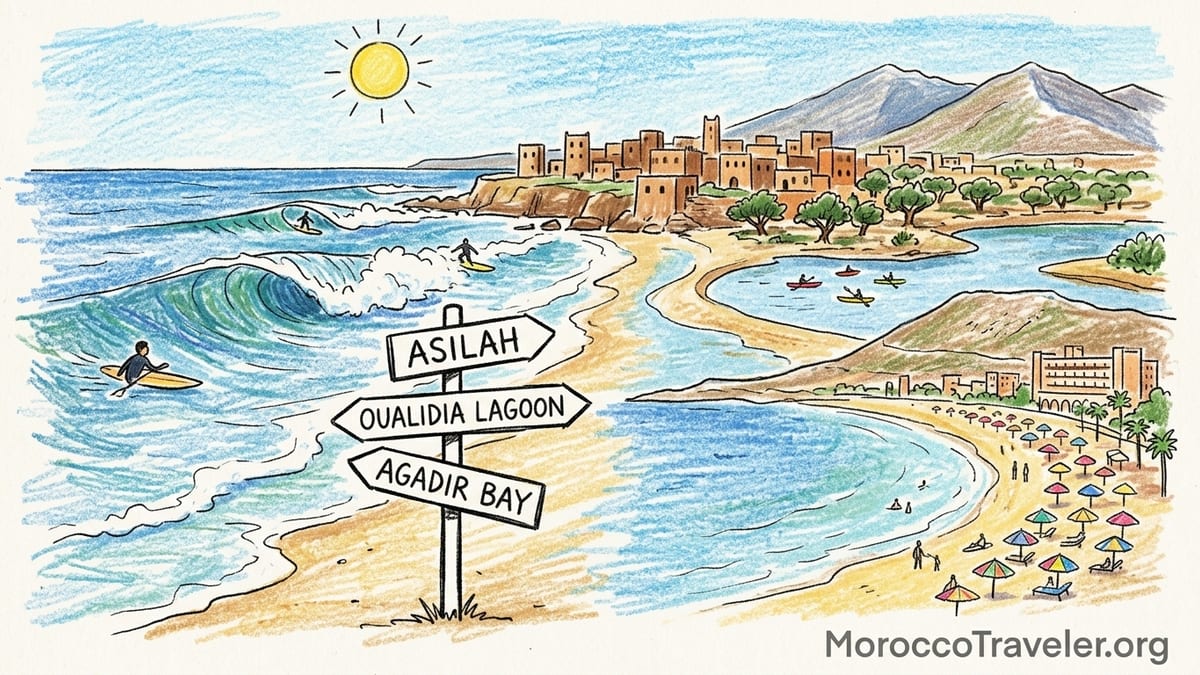
Atlantic vs Mediterranean: What To Expect From the Ocean
Many first-time visitors arrive in Tangier or Tetouan assuming Morocco’s Atlantic will feel like the sheltered Mediterranean. In reality, the two coasts offer very different sea conditions. The Mediterranean shore around Tangier and Al Hoceima is protected from long-period ocean swell, with lighter waves and shorter fetch. The Atlantic coast, by contrast, is open to north and northwest swells rolling in from the North Atlantic, which means more powerful surf, stronger currents and larger tidal ranges along most of the shoreline from Asilah down to Sidi Ifni.
Water temperatures reflect this exposure. Along the Atlantic, average sea temperatures around Essaouira and Agadir tend to hover near the high teens Celsius in winter and low twenties at summer peak, with October often sitting around 20 to 21 degrees. That feels fresh without a wetsuit for long sessions but comfortable for short swims on warm, wind-sheltered days. South of Agadir the influence of the cold Canary Current can keep the sea slightly cooler despite strong sunshine, while the enclosed Mediterranean bays in the north are usually a couple of degrees warmer at the same time of year.
The practical takeaway is important for safety and expectations. Morocco’s Atlantic coast can be wonderful for confident swimmers, surfers and long beach walks, but it should never be assumed safe. Even seemingly calm days can hide rip currents, shifting sandbanks and heavy shorebreak at high tide. Lifeguards are present only on selected urban or resort beaches in high season, and flags or warnings are not uniform. If you want genuinely gentle water, you will need to seek out the most sheltered settings, notably Oualidia’s lagoon or the central stretch of Agadir Bay, and still treat the sea with caution.
What follows is a north-to-south look at key Atlantic beach areas, focusing on how exposed they are to swell, how suitable they are for swimming, and what you will find on the sand in terms of facilities and places to stay right by the ocean.
Asilah and the Northern Atlantic: Wide Sands and Changing Conditions
Asilah is often the first Atlantic stop for travellers heading south from Tangier. The main town beach, just south of the medina walls, is a broad arc of sand that shifts seasonally with winter storms. In summer and early autumn the beach is relatively flat and the shorebreak less severe, making it a popular place for Moroccan families. However, the area is still open to Atlantic swells, and on big days the waves can become dumpy with strong lateral currents, particularly near the river mouth toward the southern end.
Lifeguard presence in Asilah is typically seasonal, concentrated in July and August when the beach is busy. Basic facilities include sunbed and umbrella rentals near the centre of the bay, small snack stalls and casual cafés set just behind the promenade. Parking is straightforward along the seafront road, though it can become crowded in peak summer weekends when day trippers arrive from Tangier. For accommodation, several small hotels and guesthouses sit within a short walk of the sand; a few modern properties near the southern end of the bay offer partial sea views rather than direct beachfront lawns.
For scenery and long walks, the beaches north and south of Asilah are appealing. Southwards, spots like Kaf Lahmam are known among locals for their cleaner sand and more dramatic cliffs, but they tend to be more exposed, with strong swells and little in the way of lifeguard cover. These out-of-town stretches can be beautiful for sunset walks and photography but are better treated as picnic and viewpoint stops rather than primary swimming beaches, especially for families with children.
In practical terms, the Asilah area suits travellers who want a gentle introduction to the Atlantic coast with the option to paddle and swim on calm days, but it is not a guaranteed safe swimming destination. Young children and inexperienced swimmers are better off staying very close to shore on well-flagged sections of the main town beach during lifeguard season or waiting for very small-swell days.
El Jadida & Oualidia: From Ocean Breaks to a Sheltered Lagoon
Continuing south, the coast between Rabat and Casablanca features many long, open beaches with quite powerful surf and changeable currents. El Jadida stands out as a more accessible base, with its long city beach stretching south of the historic Portuguese Cité. The sand here is broad and gently sloping near low tide, but strong Atlantic swells still reach the bay and can generate significant shorebreak at high tide. The beach is popular with local families and joggers, and you will typically find seasonal lifeguards on the busiest sections in high summer along with marked zones for swimming.
Facilities in El Jadida are good by Moroccan standards. Cafés and simple restaurants line the road behind the sand, offering shaded terraces and restrooms for beachgoers. Sunbeds, umbrellas and horse or camel rides are widely available in July and August. Parking is easiest early in the day, with paid parking attendants helping organize cars along the seafront. Several mid-range hotels and apartment-style properties line the promenade, some with direct beach access across the road, making El Jadida convenient for travellers who want an urban base near the water rather than a wild coastal experience.
About 75 kilometres further south, Oualidia offers one of the rare genuinely sheltered swimming environments on Morocco’s Atlantic coast. The town curves around a natural tidal lagoon separated from the open ocean by a sandbar and rocky outcrops. Inside the lagoon, the water is significantly calmer than the open Atlantic, with smaller wind chop and limited swell penetration. On mid to high tide, this creates a broad area of protected shallows that is particularly popular with families and beginner paddlers. Kayak and stand-up paddleboard rentals generally cluster along the lagoon’s eastern edge, with posted per-hour prices that, in late 2026, often start in the lower hundreds of dirhams for small groups including life jackets.
Even in this sheltered setting, conditions are not perfectly static. The tidal current flows in and out through the lagoon entrance, and children should not play unsupervised near the channel. There is limited official lifeguard coverage compared to major resort beaches, and flags may not be obvious. Still, for travellers actively seeking calmer water than the typical Moroccan Atlantic beach, Oualidia’s lagoon is a strong candidate. The ocean-facing side of Oualidia, beyond the sandbar, is a different story with heavier waves and a reputation among local bodyboarders rather than casual swimmers.
Oualidia’s small resort strip has grown steadily, with several boutique hotels and guesthouses perched above the lagoon, offering direct views of the sheltered water and quick foot access to the sand. Many of these properties market themselves as quiet, nature-oriented stays, with seafood lunches served on terraces overlooking the bay. The combination of scenic calm water, availability of small-boat trips and relative quiet in shoulder seasons makes Oualidia a standout option on this list for families and travellers who prioritise swimming and lagoon paddling over surf.
Essaouira & Sidi Kaouki: Windy Bays and Wide Open Walks
Essaouira is one of Morocco’s best-known coastal cities, with a long crescent of sand that begins near the old medina walls and sweeps south toward dunes and argan-covered hills. The bay is very exposed to the prevailing north and northwest winds, which often pick up by late morning, kicking up whitecaps and sand. This same wind has made Essaouira a major centre for kitesurfing and windsurfing rather than a classic sunbathing or gentle swimming destination. Sea temperatures around Essaouira typically sit in the high teens Celsius for much of the year, with cool Atlantic upwelling keeping the water fresher than you might expect for the latitude.
Swimming here can be pleasant on calm mornings or light-wind days, especially near the northern part of the bay where lifeguards sometimes operate in summer. However, strong side-shore currents, wind chop and occasional heavy shorebreak mean that conditions change quickly. Families usually keep children in the shallows near town or shift their plans to sand play and camel or horse rides once the afternoon wind arrives. The sand quality is generally fine and compact, perfect for long walks from the medina down toward the southern dunes, and the spaciousness of the bay means you can easily find room to yourself outside peak holiday weeks.
Facilities in Essaouira are robust. A paved promenade runs the length of the central bay with numerous cafés, juice stands and small restaurants offering shelter from the wind. Board rental for kitesurfing, windsurfing and occasionally surfboards is concentrated near specific centres along the middle of the beach, where you can also arrange lessons. Parking is available in several large lots set slightly back from the seafront, including near the medina gates and along the southern half of the bay. Accommodation ranges from riads within the old town, a few minutes’ walk from the sand, to modern hotels and apart-hotels fronting the promenade with direct sea views.
Roughly 25 kilometres south, Sidi Kaouki feels far more rural. The main beach is a wide, open stretch of sand backed by low development and scattered cafés. Exposure to Atlantic swell is greater than in Essaouira’s semi-sheltered bay, so waves generally break with more power, and currents can be strong, especially near rocky sections and during big winter swells. The trade-off is a quieter setting, excellent scenery and a more relaxed surf vibe. Several small surf hostels and guesthouses cluster behind the main access road, and a handful of surf schools offer lessons and board rental aimed at beginners on smaller days and intermediates when swell picks up.
For swimmers, Sidi Kaouki is best treated as an occasional dipping spot on calm days rather than a primary swim beach. There is usually no formal lifeguard coverage outside peak Moroccan holidays, and sandbanks shift frequently. For walking and photography, however, it is ideal, with long, uncrowded stretches where you can wander between rocky points, watch local fishermen and, in the late afternoon, simply sit above the tideline and take in the view as the sun drops behind the Atlantic.
Agadir Bay: Broad Sands, Gentler Surf and Resort Comfort
Agadir Bay is one of the most accessible and resort-oriented beaches on Morocco’s Atlantic coast, and it offers notably calmer conditions than many other sections of this guide. The bay curves for several kilometres from the harbour area in the north through the main hotel zone and south toward more residential quarters. The combination of its orientation, partial shelter from surrounding headlands and the influence of sandbanks often translates to smaller, more manageable waves compared with more exposed beaches like Sidi Kaouki or Taghazout. On many days outside of stormy winter swells, the central portion of Agadir’s beach offers rolling shorebreak suitable for confident swimmers who stay within lifeguarded zones.
Sea temperatures around Agadir are similar to Essaouira, typically in the high teens Celsius in winter and low twenties in summer and early autumn. The long, gently sloping sand means that at low and mid tide, shallow areas extend quite far, which is helpful for children and less confident swimmers. However, the Atlantic does not lose its character entirely: currents still exist, and swells can rise significantly during storms, turning the bay into a heavy shorebreak that requires caution. Lifeguards are more consistently present here than on many Moroccan beaches, especially in front of larger resort clusters, with flagged swim zones and basic safety signage in high season.
Facilities in Agadir Bay are extensive. A modern seafront promenade runs almost the full length of the bay, lined with cafés, international restaurant chains, juice bars and snack stalls. Public showers and toilets are available at intervals along the promenade. Sunbeds and umbrellas are offered in front of many beachfront hotels and as independent concessions, usually rented on a half-day or full-day basis. Parking is widely available, from open lots behind the main strip to valet or private hotel garages, though peak holiday periods in July and August can still see congestion.
Accommodation is where Agadir truly contrasts with wilder Atlantic stretches. Large resort hotels, all-inclusive properties and branded international chains face directly onto the bay. Many feature pools just above the sand, private sunbed areas and direct gate access out to the public beach. For travellers seeking a holiday where swimming in the sea, wandering back to a pool lounger and dipping into restaurants and nightlife all happen within a compact area, Agadir is a strong fit. It is also a common logistical base for those taking day trips to surf in Taghazout or Imsouane while returning to resort comforts in the evening.
Taghazout, Tamraght & Imsouane: Surf-Focused Villages
North of Agadir, the character of the coast changes quickly. Taghazout and neighbouring Tamraght sit beside a series of exposed point and beach breaks that have made this region Morocco’s best-known surf hub. The main beach in Taghazout itself is relatively small, with a mix of sand and rock, and is not a classic swimming beach. The focus here is surfing. Various peaks such as Hash Point, Panoramas and Anchor Point line the coastline, catching north and northwest swells and delivering waves that can range from gentle learner rollers to powerful point-break walls when winter swells arrive.
For beginners, local surf schools usually select the most suitable spots on a given day, often opting for sandier stretches near Panoramas or the broader beach areas closer to Tamraght when swell is large. Group surf lessons in the Taghazout area in 2026 commonly fall in the approximate range of a few hundred dirhams for a half-day including board, wetsuit and instruction, with private lessons priced higher. Independent board rental for those with experience is widely available from beachside shops and surf camps, often on a daily basis with soft-top longboards and standard wetsuits included.
Swimming here requires more caution than in Agadir Bay. Rip currents near the points are common, and shorebreak can be punchy at higher tides. There is minimal formal lifeguard coverage outside of small local initiatives in busier months. Most travellers dip in to cool off between surf sessions or enjoy waist-deep paddling on small-swell days rather than treating Taghazout as a pure swim destination. Sand underfoot varies from fine to coarser with scattered rocks, especially around the reefs.
About ninety minutes north by coastal road, Imsouane has built a reputation for one of the longest rides in Morocco at its main Bay, a right-hand point-like wave that can peel for hundreds of metres when conditions align. The Bay is partially sheltered by a headland, so waves here are long and relatively gentle, which has turned the village into a favourite for progressing beginners and longboarders. A second spot, known as Cathedral, faces more directly into the swell and suits more advanced surfers. For swimmers, the inside sections of the Bay can feel calmer than many open beach breaks, but rip currents are still present, particularly near the harbour and along the channel used by surfers to paddle back out.
Imsouane remains smaller than Taghazout, with a mix of simple guesthouses, surf camps and a few more polished surf hotels that cluster around the bluff and path down to the Bay. Many surf camps advertise week-long packages that bundle accommodation, daily surf lessons, board and wetsuit rental and some meals for a fixed price per person. Shared dorm beds in surf hostels tend to occupy the lower price range, while private suites with ocean views sit higher. The overall atmosphere is sleepy once the evening sets in, making Imsouane appealing to travellers who prefer early nights, surf-focused days and dramatic sunsets over a dense restaurant and nightlife scene.
Mirleft & Legzira: Wild Cliffs, Arches and Quiet Escapes
Further south again, past Tiznit and Sidi Ifni, the coastline around Mirleft and Legzira feels remote and rugged. Mirleft is a small town perched on a bluff, with several beaches stretching out to either side. The main local spots, such as Aftas and Imin Turga, combine dark golden sand with rocky headlands. Exposure to Atlantic swell is significant, with heavier surf and strong rip currents on bigger days. Many visitors come here for the scenery, the sense of space and the relatively uncrowded line-ups compared with Taghazout rather than for easy swimming.
Facilities on Mirleft’s beaches are modest. A few beach cafés and seasonal restaurants open directly on or above the sand, especially at the more accessible coves. Parking often involves driving down steep access roads and leaving cars on packed dirt or informal lots. There is limited official lifeguard presence, so swimmers must take a self-reliant approach, staying close to shore, avoiding river mouths and rocky channels, and always assessing the conditions from dry sand before entering the water. For surfers, several local guides and small surf camps can arrange guiding sessions to less obvious points when conditions suit.
Legzira, sometimes spelled Lagzira, lies a short drive from Mirleft and is famous for its red sandstone cliffs and dramatic rock arches carved by the ocean. One of the most iconic arches collapsed several years ago, but others and sections of overhanging cliff remain, giving the beach a distinctive, layered appearance at sunset when the rocks glow deep orange. The sand here is coarse and often strewn with rounded pebbles near the cliff base, smoothing out toward the tideline. Waves tend to be powerful, meeting deep water close to shore, and swimming is generally recommended only for strong, confident ocean swimmers on smaller swell days.
Accommodation at Legzira is low-rise and simple, with a handful of guesthouses and small hotels built into the cliff line or positioned just above the beach. These offer immediate access to the sand but relatively few high-end amenities. The reward is direct contact with the coastal landscape: from many terraces you can watch swell lines roll in, see fishermen picking along the rocks at low tide and enjoy virtually empty stretches of sand outside of Moroccan holiday weekends. For travellers seeking a quiet coastal escape with dramatic scenery, long walks and occasional dips in the Atlantic rather than resort comforts, Mirleft and Legzira are compelling final stops on a southbound itinerary.
Which Beach Fits You? Practical Comparison Tables
The Atlantic coast from Asilah to Legzira offers very different experiences depending on whether you prioritise swimming, surfing, walking or resort facilities. The tables below offer a concise, text-based comparison to help match beaches to traveller types. All assessments are general and depend heavily on daily conditions.
Families wanting calmer swimming: Oualidia’s inner lagoon stands out for its sheltered water and gently sloping sand, suitable for supervised children on mid to high tide. The central section of Agadir Bay offers relatively gentle waves on many days with the advantage of lifeguards and wide, shallow areas at low tide. Essaouira can work for families who are more focused on sand play and short paddles rather than extended swims, while Asilah’s main town beach is manageable in small swell with seasonal lifeguards. More exposed beaches such as Sidi Kaouki, Taghazout and Legzira are generally less well suited to young children.
For beginner surfers: Tamraght and Taghazout provide the widest selection of surf schools, group lessons and soft beach breaks, with daily decisions made by instructors about the safest spot based on swell and tide. Imsouane’s Bay is another prime option thanks to its long, mellow right-hand wave that allows plenty of time to stand and ride. Sidi Kaouki also hosts several surf schools that use the open beach for beginners on small days. Oualidia’s lagoon is more about paddling than true surf, though small wind swell can be used for first experiences on soft boards.
For advanced surfers: Anchor Point and other reefs around Taghazout draw experienced riders when long-period winter swells arrive, with powerful walls and occasional barrels. The Cathedral section at Imsouane offers heavier waves for intermediates and advanced surfers on larger swells. Exposed stretches near Mirleft and Legzira also come into their own for those willing to explore with local knowledge, though they lack the convenience and backup options of the Agadir–Taghazout corridor. These spots are not suited to casual swimming when conditions are firing.
Quiet escapes and resort holidays: For a quiet coastal escape, Sidi Kaouki, Imsouane, Mirleft and Legzira all prioritise scenery and slow rhythms over nightlife and shopping. Accommodation leans toward simple guesthouses and surf camps, occasionally with higher-comfort surf hotels in Imsouane. For a resort holiday with structured facilities, Agadir Bay is the clearest choice on this Atlantic stretch, with Oualidia offering a smaller-scale, lagoon-focused alternative where several boutique hotels cluster above the water. El Jadida sits somewhere in between, with an urban beach backed by mid-range hotels rather than dedicated resorts.
Recommendations by Traveler Type, Season and Budget
For families with children who want to swim, the combination of water conditions and infrastructure matters. In high summer from late June to early September, the sea is at its warmest and lifeguard coverage is most widespread. Agadir Bay is well suited to families who prefer a resort base with pool access, kids’ clubs and flagged swim zones on the sand. Oualidia’s lagoon works well for those prioritising calmer water and quiet evenings, particularly in spring and autumn when temperatures remain pleasant but crowds thin. Essaouira lends itself to families who are happy for children to paddle in the morning and then switch to camel rides, medina exploration and wind sports watching once the afternoon gusts rise.
For beginner surfers, the best seasons are generally from autumn through spring, roughly October to April, when more consistent swell arrives without the extremes of mid-winter storms. Taghazout, Tamraght and Imsouane are the most practical bases, offering a concentration of surf camps that bundle lessons, gear and meals into week-long stays. Travellers on moderate budgets can seek shared-dorm packages, while those looking for more privacy can book private rooms in surf houses or small hotels. Day-trippers based in Agadir can still join group lessons in Taghazout arranged through local schools or hotel activity desks.
Advanced surfers chasing bigger swells will focus on mid winter from December to February, when long-period Atlantic systems send heavier waves to point breaks around Taghazout and reefier stretches south near Mirleft. These months are also the least predictable for casual swimming, with stronger currents and heavier shorebreak. Travellers in this category should be comfortable reading ocean conditions or surf with experienced local guides. When swells are too large at exposed points, sheltered corners of Agadir Bay or the inside of Imsouane’s Bay may still offer workable waves or at least safe conditions for a walk along the shoreline.
Budget considerations vary by location. Agadir and Essaouira offer a wide price spread, from budget city hotels and simple guesthouses a few streets back from the sea to mid-range and upscale waterfront properties. Taghazout, Tamraght and Imsouane concentrate more on surf-camp style packages that, by bundling lessons and meals, can provide good value for travellers whose primary aim is to surf every day. Oualidia, Mirleft and Legzira have fewer ultra-budget beds but still offer simple guesthouses that keep costs reasonable if you do not require resort amenities. In all cases, shoulder seasons in spring and late autumn offer a good balance of price, weather and fewer crowds along Morocco’s Atlantic shore.
FAQ
Q1. Is Morocco’s Atlantic coast safe for swimming?
Morocco’s Atlantic coast can be enjoyable for confident swimmers, but it should never be assumed safe. Many beaches are exposed to strong swell, rip currents and changing sandbanks. Safer options such as the inner lagoon at Oualidia or the central area of Agadir Bay still require caution, supervision for children and attention to any local warnings or flags.
Q2. How does the Atlantic coast compare to the Mediterranean for sea conditions?
The Mediterranean coast is more sheltered, with generally smaller waves and slightly warmer, more stable water in summer. The Atlantic coast is open to long-period ocean swells, which means more powerful surf, stronger currents and cooler water influenced by upwelling and the Canary Current, especially south of Essaouira and Agadir.
Q3. What is the best time of year to visit for swimming?
For swimming-focused trips, late June through September usually offers the warmest sea temperatures and the highest likelihood of lifeguard coverage on busy beaches such as Agadir Bay, Essaouira and El Jadida. Even in high summer, conditions on exposed beaches can vary, so it is wise to pick more sheltered spots like Oualidia if calm water is a priority.
Q4. When is the best surf season on Morocco’s Atlantic coast?
Surf is possible year round, but the most consistent swell typically arrives from autumn through spring, around October to April. Winter months bring larger, more powerful waves that suit advanced surfers at point breaks like Anchor Point near Taghazout, while shoulder seasons around October and March often balance decent swell with more manageable conditions for beginners and intermediates.
Q5. Do I need a wetsuit to swim or surf in Agadir and Essaouira?
Most surfers wear wetsuits year round in both Agadir and Essaouira because sea temperatures often stay in the high teens to low twenties Celsius. For casual summer swimming, some people are comfortable without a wetsuit for short dips, but those planning longer sessions, especially outside peak summer, will appreciate the extra warmth and buoyancy a wetsuit provides.
Q6. Are there lifeguards on all Moroccan Atlantic beaches?
No, lifeguards are not present on all beaches. Larger urban and resort beaches such as Agadir Bay, parts of Essaouira, El Jadida and Asilah’s main town beach usually have seasonal lifeguards, especially in high summer. More remote or surf-focused spots like Sidi Kaouki, Imsouane, Mirleft and Legzira may have little or no formal coverage, so swimmers and surfers must assess conditions themselves.
Q7. Which Atlantic beach is best for families with small children?
Families with small children often favour Oualidia’s sheltered lagoon for its calmer water and gently sloping sand, or the central part of Agadir Bay where lifeguards and shallow zones at low tide provide additional reassurance. Both destinations also offer easy access to cafés, toilets and shade close to the sand.
Q8. Where should a first-time surfer base themselves in Morocco?
First-time surfers usually do well in Taghazout, Tamraght or Imsouane, where surf schools and camps are concentrated and daily conditions are carefully monitored by instructors. These villages give access to multiple breaks within short drives, so lessons can be moved to the safest beach each day depending on swell and tide.
Q9. Are Mirleft and Legzira suitable for non-surfers?
Mirleft and Legzira can be wonderful for non-surfers who value quiet, dramatic scenery, cliff walks and uncrowded beaches. However, the sea is often rough, and these areas lack the structured facilities and lifeguards of larger resort towns, so they are better suited to travellers who are satisfied with short, careful dips rather than long swims.
Q10. Can I stay in Agadir and take day trips to surf in Taghazout or Imsouane?
Yes, many travellers stay in Agadir for resort comforts and take day trips to Taghazout or Imsouane for surfing. Local surf schools and tour operators regularly organise transport and lessons from Agadir to nearby breaks, allowing you to enjoy structured surf days while returning to a wider choice of hotels, restaurants and nightlife each evening.