


By the time I finally sat down with a grilled sea bream in Essaouira, I had already spent more hours in a minibus than in the Atlantic wind. My day trip from Marrakech had looked generous on paper, promising "free time" in the medina and a relaxed seafood lunch. In reality, the clock moved faster than the ocean breeze. This is what I actually managed to see on a Marrakech to Essaouira day trip, how the hours really break down, and why next time I will almost certainly stay the night.
Leaving Marrakech: An Early Start That Still Felt Late
My day began with a 7:50 a.m. pickup outside a riad near Bab Doukkala, one of the standard collection points for shared excursions from Marrakech. The tour description had promised a 7:30 to 8:00 a.m. window, and our driver arrived toward the end of it. By the time we had threaded through the medina to collect everyone from different guesthouses, it was almost 8:30 a.m. before the minibus finally pointed west toward the Atlantic.
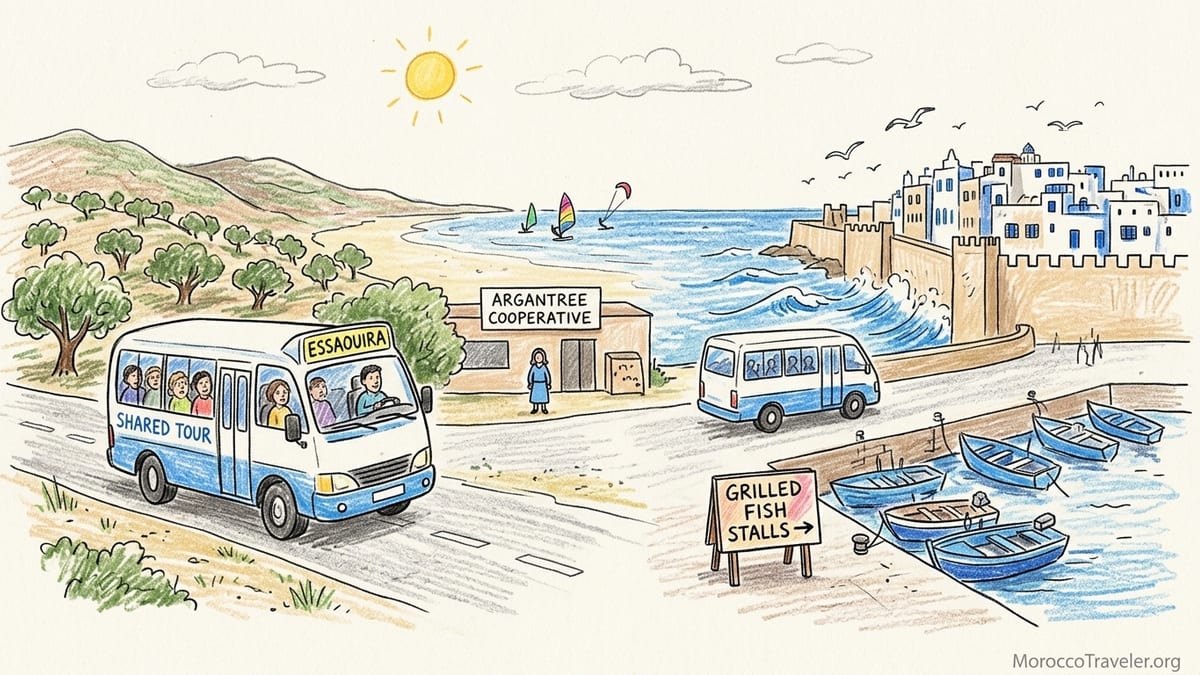
The vehicle was the classic Marrakech day-trip workhorse, a 16-seat minibus with air conditioning. Seats were reasonably comfortable, but it filled completely, which meant limited space for daypacks and little chance of stretching out. The road to Essaouira follows the R207 across gently rolling farmland and argan country. Most tour companies and local guides estimate around 2.5 to 3 hours each way, and that matched my experience: we rolled into Essaouira a little after 11:30 a.m., including one comfort stop and a visit to an argan cooperative.
If I had taken the Supratours bus instead, the timing would have been similar but more predictable. Current Supratours timetables show several daily departures between Marrakech and Essaouira, with journey times of roughly 3 hours and one short stop, and tickets usually start around 100 to 130 dirhams one way in 2026, depending on season and class. Supratours arrives just outside Bab Marrakech, within easy walking distance of the medina walls, which is convenient if you are traveling independently rather than on a tour.
CTM, Morocco’s historic national coach company, now also runs at least one daily bus on the Marrakech to Essaouira route. Reports from recent travelers indicate an early-morning departure around 8:30 a.m., with a similar 3-hour journey and a slightly less central arrival point compared with Supratours. Both companies are generally considered reliable, but they require you to organize transfers to and from the bus stations in each city, whereas my shared tour handled door-to-door pickup and drop-off.
The Argan Cooperative Stop: Insightful but Time-Hungry
About ninety minutes after leaving Marrakech, just as the landscape opened into low argan-covered hills, our driver pulled into one of the many argan oil cooperatives that line the route. Almost every shared excursion between Marrakech and Essaouira includes some version of this stop, often described as a cultural visit. In practice it is part demonstration, part sales pitch, and part toilet break.
Inside, a staff member walked us through the argan story in ten minutes or so: how the trees grow only in this region of southwest Morocco, how the nuts are dried, cracked, and pressed by hand or machine into cosmetic and culinary oils, and how women’s cooperatives have transformed what used to be informal local work into a formal source of income. We were invited to taste argan amlou spread, dip bread into roasted argan oil, and sample creams that promised everything from softer hair to younger skin.
The demonstration itself took around twenty minutes, but the full stop lasted closer to forty-five. Some travelers lined up at the bathroom, others debated purchases of hair serum and cooking oil. For anyone truly interested in argan production, it is a useful and fairly genuine introduction, and most cooperatives do provide clear information about production methods. For those whose primary goal is time in Essaouira itself, however, this detour eats significantly into already limited coastal hours.
On the return journey in the evening, our driver thankfully skipped a second commercial stop and limited the break to a quick roadside café. However, talking later with other travelers in Marrakech, I heard repeated versions of the same complaint: tours that sold themselves on free time in Essaouira, then carved away a full hour or more at an argan shop, leaving only four to five hours by the sea. For me, the cooperative was mildly interesting, but if I were paying for a private driver I would either shorten it to fifteen minutes or skip it entirely in favor of an extra half hour on the ramparts.
First Glimpse of Essaouira: A Different Morocco at the Gate
We finally rolled into Essaouira just after 11:30 a.m., approaching the city along the seafront road with a first glimpse of whitewashed ramparts and the spray of the Atlantic. Compared with the dense heat and red dust of Marrakech, the air felt almost shockingly cool and salt-laden, even in high season. Winds are an almost constant feature here, which is why Essaouira has become so popular with kitesurfers, and you sense that change in climate the moment you step off the bus.
Our drop-off point was just outside Bab Marrakech gate, similar to where the Supratours buses arrive. From there, the medina walls rise in smooth beige and white stone, trimmed with blue shutters and doors that mimic the fishing boats in the harbor. Seagulls circled overhead, and the soundscape shifted from the motorbike buzz of Marrakech to a mix of crashing waves, gull cries, and the call to prayer echoing more softly through narrower streets.
The guide who had traveled with us from Marrakech gave us a quick orientation at the gate and then handed us a meeting time: 4:00 p.m. at the same spot. That meant roughly four and a half hours in Essaouira, including lunch, shopping, and sightseeing. On paper it sounded generous. Standing at the gate, feeling the wind and seeing the clock already pushing midday, it suddenly felt tight.
Had I traveled by public bus on an early Supratours departure, say around 8:00 a.m. from Marrakech and a 3:00 or 4:00 p.m. return, I would likely have had a similar five to six hours in town, but with more flexibility to skip argan stops and to choose my own lunch schedule. A private driver, according to recent tour listings, usually offers a 9:00 a.m. pickup in Marrakech, arrival around noon, and departure between 5:00 and 6:00 p.m., which can stretch Essaouira time closer to six hours, and even more if you start earlier.
Walking the Medina and Ramparts: Where the Time Went
I decided to divide my limited hours strategically. My rough plan was one hour for a first wander in the medina, thirty minutes for the Skala and ramparts, an hour for the fishing harbor, an hour for lunch, and whatever remained for coffee and the beach. In reality, each of those segments expanded, and there was far more city than clock.
The medina itself felt immediately calmer than Marrakech. The streets are narrower, motorbikes are fewer, and the white and blue palette makes everything feel lighter. Tourist shops sell the usual mix of leather poufs, lanterns, and ceramics, but interspersed with more local workshops. I passed a luthier carving an oud, small art galleries with contemporary paintings of Atlantic storms, and tailors working on djellabas. Prices for similar items seemed slightly lower than Marrakech, and shopkeepers were far less insistent. A polite “no, thank you” was usually enough to end the conversation.
From Bab Marrakech I headed roughly west through the souks until I reached the ocean-facing Skala de la Ville, the old rampart lined with bronze cannons looking over crashing waves. Access required a modest entry fee in dirhams, and once inside I lost track of time. The views along the ramparts are some of the most evocative in Essaouira: gulls hovering at eye level, the sea pounding against rocks, the medina’s flat roofs stretching behind. I had planned thirty minutes and stayed almost an hour, lingering over photographs and simply standing in the wind.
By the time I stepped down from the Skala, it was after 1:00 p.m. My four and a half hours in town had silently shrunk to less than three. This is where a day trip demands disciplined choices. A traveler who loves photography or historic architecture could easily spend two or three hours just on the ramparts and adjacent alleys. On an overnight stay, that would be reasonable. On a day trip, it means sacrificing other parts of the city.
The Harbor, Souks, and Seafood: Great Meals, Lost Minutes
From the ramparts I walked toward the fishing harbor, a few minutes downhill through a fort gate. The first impression was color and chaos in the best sense: rows of bright blue wooden boats bobbing side by side, fishermen mending nets on the quay, and thick bands of seagulls that looked almost like smoke rising over the catch. The smell of fish is strong here, but so is the feeling of a working port that still matters to the city’s daily life, not just its postcards.
The classic Essaouira ritual is to pick fresh fish from the market stalls and have it grilled at one of the simple seafood stands near the harbor. These stalls display today’s catch on ice or tiles, often including sardines, sea bream, sole, and sometimes lobster or prawns. Prices in 2026, based on both menu boards and recent traveler reports, hover around 80 to 150 dirhams per person for a generous mixed grill with salad and bread, though bargaining and careful weighing remain important. I chose a modest spread of sardines and sea bream, along with bottled water, and paid just under 120 dirhams.
Lunch, however, cost me more in minutes than dirhams. Between choosing a stall, waiting for the fish to be cleaned and grilled, and eating at a relaxed pace, I spent about an hour and fifteen minutes at the harbor. The atmosphere justified every second: smoky grills, the slap of knives on cutting boards, locals mixing comfortably with day-trippers, and the constant background percussion of waves. But when I checked the time afterward, it was already 2:20 p.m.
That left barely ninety minutes for coffee, the beach, and any last-minute shopping. If you want to maximize sightseeing on a day trip, there is a case for a quicker café lunch instead, perhaps at a medina eatery serving tagine or a sandwich. Simple plates of grilled sardines or calamari at small local restaurants can often be found for 50 to 90 dirhams, and they come without the harbor’s extra delays. Personally, I do not regret my grill experience, but I would plan it more tightly next time, perhaps by choosing a stall as soon as I arrived and eating slightly earlier around noon.
Cafés, Beach, and the Clock: What I Missed
From the harbor I cut back through the medina to Place Moulay Hassan, the central square that opens toward the ocean and the main stretch of beach. Cafés line the square with terraces facing the sea, and on a breezy afternoon it feels like a relaxed Atlantic promenade. I grabbed a table at a café with a view of the ramparts and ordered a nouss-nouss, the half-milk, half-coffee drink that becomes a minor addiction in Morocco. At around 15 to 20 dirhams, it was more expensive than a backstreet café but worth it for the people-watching and seafront setting.
And again, the minutes vanished. A simple coffee, a brief check of messages on hotel Wi-Fi, and a slow watch of children playing on the square consumed another half hour. It was past 3:00 p.m. by the time I finally walked down to the sand. Essaouira’s beach is broad and windswept rather than tropical postcard-perfect, but the light beige sand, endless horizon, and rows of kitesurfing sails give it a unique energy. I kicked off my shoes, walked ten minutes along the shore, and stood ankle-deep in the Atlantic. I did not have time for a camel or horse ride, a surf lesson, or even a long sit on the sand.
Back in the medina, I ducked into two shops to price a leather bag and a small painting. Haggling took ten minutes in one store and fifteen in the other. In a longer stay this would feel like part of the rhythm. On a day trip, it placed me in an awkward race with the clock. When I finally reached Bab Marrakech again, our meeting point, it was 3:55 p.m. I had enough time only for a quick takeaway mint tea in a paper cup.
What I completely missed were some of the smaller pleasures that locals and repeat visitors praise: a slow sunset on the ramparts, a longer wander through the quieter residential quarters of the medina, a traditional hammam session, or a cooking class built around Essaouira’s seafood market. These experiences all require either a very late return to Marrakech or, more realistically, a night or two in a riad inside the walls.
Transport Choices: Shared Excursion vs Bus vs Private Driver
My shared excursion cost the equivalent of around 250 to 300 dirhams per person when booked through a Marrakech travel agency, which aligns with many online listings that advertise group day trips to Essaouira from about 25 euros per person. The price included round-trip transport, hotel pickup and drop-off, and the services of a driver who doubled as a basic guide, but lunch, entry fees, and tips were extra. For a solo traveler or couple on a budget, this is undeniably economical, even after accounting for a coffee, a grilled fish lunch, and small purchases in the souks.
Comparing this with independent travel by bus, Supratours and CTM both have clear advantages. As of late 2026, published Supratours fares on the Marrakech to Essaouira route start from roughly 100 to 130 dirhams each way, so a return journey might total 200 to 260 dirhams per person. CTM fares fall in a similar bracket. Buses are comfortable and air-conditioned, and many travelers appreciate the predictable timetable and absence of commercial argan stops. However, you must add the cost and effort of reaching the bus station in Marrakech and then getting from the bus station into your accommodation in Essaouira, especially if you stay overnight.
Private drivers sit at the other end of the spectrum. Recent price lists from Moroccan tour operators show full-day private transfers from Marrakech to Essaouira and back ranging from about 120 to 200 US dollars or around 230 euros per vehicle for up to four passengers, with higher rates for vans that carry more people. That can work out cheaper per person for a family or small group. Crucially, it buys flexibility. A private driver can collect you directly from your riad, leave Marrakech earlier than group tours, skip the argan shop entirely or shorten it, and allow you to stay in Essaouira until early evening, stretching your on-the-ground time toward seven hours.
Rental cars offer similar freedom but demand more confidence. The route along the R207 is straightforward and generally safe, but driving out of Marrakech’s traffic can be stressful, and parking near Essaouira’s medina is in open lots just outside the walls with varying degrees of crowding. By the time you factor in rental fees, fuel, insurance, and parking, costs may not be far below those of a private driver, especially for short trips, though they can pay off if you are combining Essaouira with longer self-drive explorations of southern Morocco.
Overnight in the Medina: What Extra Time Makes Possible
As I rode back toward Marrakech, watching the sun slide down over argan trees, I browsed riads in Essaouira on my phone and realized how much more an overnight stay would unlock. Current listings show a broad range of medina riads with double rooms, breakfast included, starting from around 400 to 600 dirhams per night in simple but charming guesthouses, with more atmospheric or design-focused riads in the 800 to 1,200 dirham range and upscale options going beyond that. For the cost of my shared day trip and a seafood lunch, I could almost have covered a night in town.
With even one night in Essaouira, the day’s rhythm shifts completely. Instead of racing between ramparts and harbor, you can start with a slow morning coffee on a rooftop terrace, then join a guided walking tour of the medina for an hour or two. Several local guides, often booked through riads or reputable agencies, now offer themed tours that cover the city’s Jewish heritage, its music scene, or its role as a fortified port. A focused guided walk can turn what feels like elegant but anonymous alleys into a living map of craft families, historic warehouses, and hidden synagogues.
The extra time also opens room for more immersive activities. Surf schools on the beach offer half-day or full-day lessons that fit neatly into a two-night stay but are impossible on a rushed day trip. Cooking classes built around the fish market start mid-morning and end in a shared meal that runs into late afternoon, again too long for those watching the clock. Even something as simple as a traditional hammam visit takes at least an hour and is far more enjoyable when you are not checking your watch for a minibus departure.
Perhaps most importantly, an overnight allows you to experience Essaouira in its quieter hours. After the day trippers leave, the medina cools and calms further. Locals stroll the seafront, shopkeepers chat in doorways, and the souks take on a gentler pace. Dinner at a rooftop seafood restaurant or a small bistro near Place Moulay Hassan feels less like a quick refueling stop and more like the centerpiece of the day. Add a second night and you can layer in side trips to surrounding beaches, horseback rides along the dunes, or simply more empty time on the sand.
The Takeaway
Looking back, my day trip from Marrakech to Essaouira delivered the headlines it promised. I walked the white and blue medina, stood on the cannons of the Skala, watched blue boats crowd the harbor, ate freshly grilled sardines, and felt the Atlantic wind on my face. I did all of that in roughly four and a half hours on the ground, framed by about six hours of driving and two short stops. It was a full, satisfying snapshot of the city. It was not, in any honest sense, enough.
If I repeated the trip as a pure day excursion, I would make several changes. First, I would choose my transport based on priorities. On a tight budget, I would consider Supratours or CTM, book the earliest outbound and latest reasonable return, and accept the need to manage my own transfers. With more flexibility, I would split the cost of a private driver with friends, insist on either skipping the argan cooperative or capping it at fifteen minutes, and push for at least six hours free in Essaouira itself. Either way, I would keep lunch tighter, choosing a simpler grill or café meal and reserving no more than an hour for it.
I would also be more selective with sights. On a day trip, I would prioritize three core experiences: a walk along the ramparts for the Atlantic views, unhurried time in the harbor and fish market, and at least one café pause on Place Moulay Hassan or a beachfront terrace to simply feel the difference from Marrakech. Shopping would move to the background, and I would resist the temptation to negotiate for that extra 20 dirhams on a leather bag while the sun sets behind the towers.
Yet even with those optimizations, I now see Essaouira as a place that deserves at least one night and ideally two. The city’s calm, the softness of its light, and the breadth of its beach all push against the compressed rhythm of a day trip. My verdict is that a day trip is worthwhile if Essaouira is your only realistic option for a taste of the Atlantic coast and you accept that you will see headlines rather than chapters. If you can spare the time and budget, however, I would reserve an overnight stay without hesitation. The city feels made for slow mornings, long walks, and late dinners, and that is something no minibus timetable can deliver.
FAQ
Q1. How long is the drive from Marrakech to Essaouira?
The road journey usually takes between 2.5 and 3 hours each way by bus, shared minibus, or private car, depending on traffic and stops.
Q2. How many hours do you actually get in Essaouira on a day trip?
Most shared excursions provide around four to five hours in Essaouira, once you subtract pickup time, argan cooperative stops, and the return journey.
Q3. Is it cheaper to take Supratours or a shared tour from Marrakech?
Supratours return tickets typically cost around 200 to 260 dirhams per person, while shared tours often start near 250 to 300 dirhams, including hotel pickup.
Q4. What does a private day trip from Marrakech to Essaouira cost?
Recent price lists show private full-day transfers between roughly 120 and 200 US dollars or about 230 euros per vehicle for up to four passengers.
Q5. Are the argan oil cooperative stops worth it?
The cooperatives offer a short explanation of argan production and a chance to sample products, but they can consume 30 to 45 minutes of your limited city time.
Q6. What should I prioritize seeing in Essaouira on a day trip?
Focus on the medina and Skala ramparts, the fishing harbor and fish market, and at least one café or short beach walk to feel the coastal atmosphere.
Q7. How much should I budget for food on a day trip to Essaouira?
A grilled seafood lunch near the harbor often costs around 80 to 150 dirhams per person, with coffees and snacks adding another 30 to 60 dirhams through the day.
Q8. Is Essaouira less hectic than Marrakech?
Yes. Essaouira’s medina has fewer motorbikes, wider sightlines, and a cooler climate, which together create a noticeably calmer and more relaxed atmosphere.
Q9. Is it better to stay overnight in Essaouira instead of doing a day trip?
If you can spare the time, at least one night in a medina riad lets you enjoy sunsets, quieter evenings, and activities like surf lessons or cooking classes.
Q10. Can I visit Essaouira independently without booking a tour?
Yes. You can take Supratours or CTM buses, hire a private driver, or rent a car, then explore Essaouira on your own or hire a local guide on arrival.