


I have not yet kitesurfed in Dakhla myself, and that is exactly why I am cautious about the dreamy lagoon photos that fill my social feeds. Over the past few years I have kited elsewhere in Morocco, spoken with riders who did commit to Dakhla, and pored over current prices, flight options, political briefings and resort packages. The more I researched, the more I felt that the glossy marketing of Dakhla as an easy, affordable kitesurf paradise hides some hard trade offs in cost, remoteness and flexibility that many travelers only discover after they have paid in full.
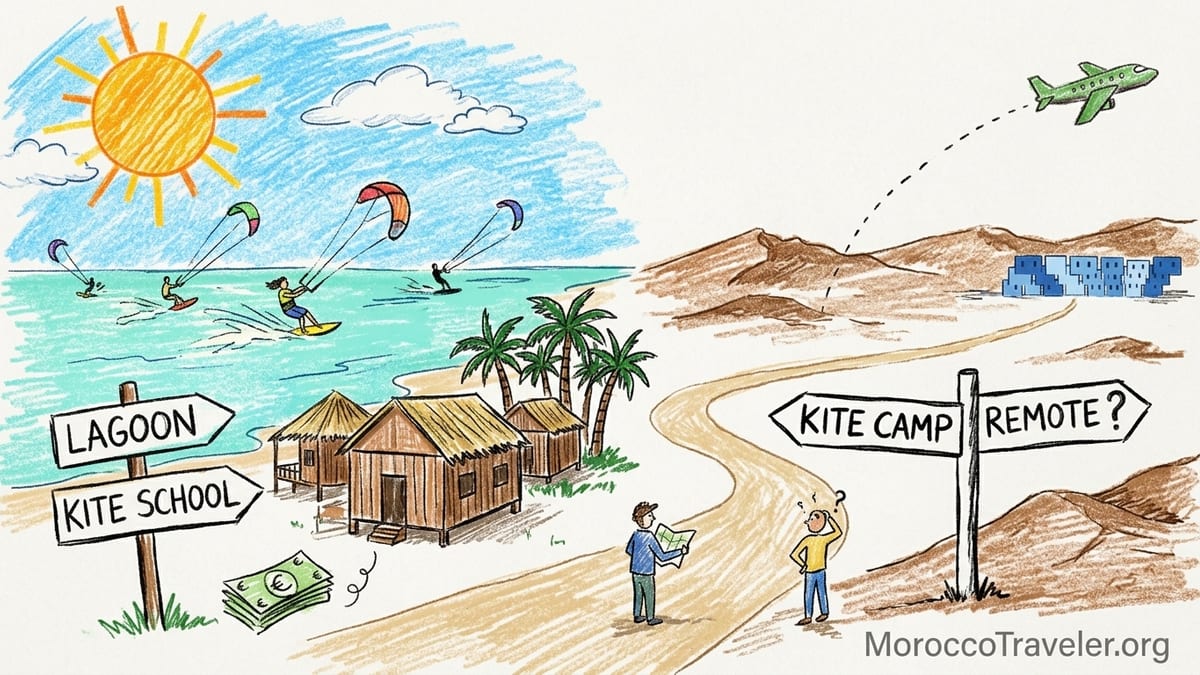
Between Marketing Fantasy and a Remote Reality
On paper, Dakhla looks perfect. A long, sheltered lagoon, year round wind charts painted in deep green, and sleek images of kiters carving glassy water in front of stylish wooden bungalows. Several major European kitesurf tour operators now push Dakhla packages as the logical upgrade from crowded Canary Islands or overdeveloped Egyptian spots. The photos are not fake. The lagoon exists, and in the right wind it really can be that smooth. What is often missing is an honest picture of what it takes to get there, how much you will really pay, and how little margin you have if the conditions or your own learning curve do not cooperate.
Geographically, Dakhla sits near the southern tip of Western Sahara, on a narrow peninsula where the Atlantic cuts inland. Administratively, Morocco runs it as a southern province and promotes it aggressively as a sport and conference hub. For you as a traveler, that translates into a destination that is much more dependent on a thin chain of flights, transfers and resort services than somewhere like Essaouira or Agadir. You are not simply booking a beach hotel with a kite school attached. You are buying into an ecosystem that has grown up around a few lagoon-side camps and the airport, with relatively few independent alternatives once you arrive.
That tight ecosystem is what can make Dakhla feel almost all inclusive in the old package holiday sense. Many lagoon resorts bundle full board, airport transfers and kitesurf services into one quote that looks reassuringly fixed. Weekly published rates for 2025 and 2026 at well known camps such as Lagon Energy Dakhla or Dakhla Camp typically combine accommodation, three meals per day and shared airport shuttles, then add on lesson packages on top. Some current public rate sheets show full board accommodation starting in the region of several hundred euros per week, with lesson bundles adding another few hundred, depending on whether you choose 10, 12 or 20 hours of instruction. That already puts a one week beginner trip in four figure territory before you have even bought flights.
None of this means Dakhla is a bad destination. Many advanced riders love it. The problem, especially if you are still learning or traveling with non kiters, is that the marketing of turquoise, empty water can disguise how committed and narrow a trip like this becomes once you factor in distance, cost and the near total focus on kiting inside those lagoon resorts.
Remoteness, Flights and the Dakhla Town vs Lagoon Divide
From a map, Dakhla does not look outrageously far from Europe, but the way you reach it tells a different story. Dakhla Airport (IATA code VIL) is a relatively small facility that serves the town and nearby resorts. Royal Air Maroc connects Dakhla with Moroccan cities such as Casablanca, Marrakech, Agadir, Rabat and Laayoune, while a European low cost carrier currently runs a seasonal direct route from Paris Orly that takes around four and a half hours. Most visitors from elsewhere in Europe, North America or the Gulf still route through Casablanca or Marrakech, often with overnight layovers or tight connections that drive up both cost and travel time.
The distance on the ground is even starker. Dakhla is roughly 1,200 kilometers south of Agadir, and several hundred kilometers from Laayoune along a largely empty desert road. There is now a modern bus station in Dakhla town and long distance coaches connect to cities further north, but the overland journey from, say, Marrakech takes well over a day. Once you land, the lagoon camps are usually 25 to 40 minutes by car from the airport along the peninsula, depending on whether you are at well known spots around PK25 or a little further. Many camps include this transfer in their packages, but if not, you are relying on prebooked taxis and the resort itself. Walking or cycling into town from most of the lagoon-side properties is realistic only for the very determined.
This is where the divide between staying in Dakhla town and staying right on the lagoon becomes real. In town you can find regular hotels and guesthouses at a broad range of prices, eat in local restaurants, wander markets and feel that you are in an actual city. You can shuttle to the lagoon each day with a kite school or taxi, which some independent travelers on kitesurf forums recommend as a way to reduce costs and add variety. The trade off is commuting time and less of that step out of your room and launch feel.
Lagoon resorts, by contrast, offer the dream of waking up on the spot, with equipment storage and rescue boats right in front. Many are purpose built camps strung out along the shore, managing their own stretch of beach and jetty. But they are often literally in the middle of nowhere. Beyond your camp and neighboring ones, there is little you can reach on foot. The “nightlife” is the bar and restaurant at your own camp, plus whatever acoustic jam or slide show the staff put on after dinner. If you value local cafes, independent restaurants and the ability to explore, that isolation can feel stifling after a few days, especially for anyone in your group who is not as obsessed with wind and water time as you are.
The Real Cost of a So Called All Inclusive Kitesurf Week
Kitesurfing has never been a cheap sport, but Dakhla’s package model concentrates a lot of the costs into a single week. Public 2025 and 2026 price benchmarks from lagoon camps and tour operators show that a full board stay with a beginner lesson package commonly lands in the broad range of 900 to 1,300 euros per person for seven nights if you are traveling solo, and somewhat less per person if you are in a shared room. One well reviewed camp promotes seven nights full board with 10 hours of lessons from around 900 euros for a solo traveler, and closer to 650 to 900 euros per person for two sharing, while 20 hour lesson packages or higher room categories can push the price closer to 1,300 euros.
Those headline prices usually include your room in a bungalow or tent, three daily buffet style meals, basic drinking water, airport transfers and access to the kite center’s facilities and rescue boat as long as you are renting or taking lessons. Some offer free beginner theory sessions or yoga classes. What they often do not include is rental equipment after you finish your lesson bundle, premium kit upgrades, optional downwinders, tips for instructors and boat drivers, alcoholic drinks, and any excursions into the desert or to the ocean side waves. A half day sandboarding or White Dune trip, for example, can easily cost the equivalent of 100 euros or more in local currency once you factor in transport and guiding.
Flights are the wildcard that marketing rarely highlights. From larger European hubs, return fares to Dakhla that involve one or more domestic Moroccan legs can fluctuate sharply with season and availability. In shoulder periods you might find return tickets in the 300 to 500 euro range if you book well ahead and accept a long layover. In prime European holiday windows, or from smaller airports, published fares often climb above 600 or 700 euros. Add checked baggage for your own board bag and harness, and airline sports equipment fees can easily add another 100 to 200 euros.
Once you factor in travel insurance that covers kitesurfing, which many generic policies exclude until you pay for an add on, plus airport meals during connections, on the ground spending and potential COVID or disruption related costs, it is not hard for a “1,000 euro Dakhla week” to end up closer to 1,800 or 2,000 euros per person by the time you are home. That final bill can be a shock if you budgeted purely off the lagoon resort’s package page.
Wind Statistics, Weather Variability and the Risk of a Short Prepaid Trip
The great promise of Dakhla is wind reliability. Climatic data and kite travel guides consistently show strong trade wind seasons, with many months of the year recording a high proportion of days where average wind speeds fall within standard kitesurfing ranges. Operators emphasize that you can ride almost all year, with peak conditions from roughly spring through early autumn and a second solid period across many winter months. Forums are filled with riders who boast of five or six straight days on the water.
Yet even the strongest seasonal pattern cannot guarantee the exact week you booked will be ideal. Local weather systems, pressure gradients and Atlantic swell still create lighter or gustier spells, fog, sandstorms and tidal quirks. Several recent trip reports describe full days where the lagoon was underpowered until late afternoon, then suddenly hit by overpowered gusts. Others mention sessions cut short by dense fog rolling across the water, which forces rescue boats to stay close to shore or suspend activity. Camps publish wind calendars, but those graphs are averages pulled from years of data. They are not a promise.
This matters most when you have prepaid a short, intensive package. If you have committed seven nights with 10 or 12 hours of lessons tightly scheduled, losing even two days to marginal wind dramatically changes the cost per hour of usable time. Instructors will usually try to reschedule, but there are only so many slots, and safety policies limit how hard they can push tired beginners when wind finally appears late in the stay. Several Dakhla visitors on kitesurf forums recount finishing a week feeling only half confident at riding upwind, despite having paid for a full beginner course, purely because the conditions did not line up neatly with their dates.
There is also the more subtle issue of progression versus fatigue. In an isolated lagoon resort you may feel pressure to kite every possible hour to “get your money’s worth,” especially when the water is right in front of your room and there is very little else to do. That temptation can lead to long, exhausting days that are counterproductive for learning. By contrast, in more flexible destinations with town life around you, it is easier to take a genuine rest day when conditions look marginal or you are mentally tired, without feeling that half of your trip is going to waste.
Non Kiting Companions and Life Inside an Isolated Lagoon Camp
If every member of your group eats, sleeps and breathes kitesurfing, the all consuming focus of a Dakhla lagoon camp can feel like a dream. For partners, children or friends who do not kite, it can be a very different experience. The isolation that keeps the lagoon uncrowded also limits the range of alternative activities. Many camps now advertise yoga sessions, stand up paddle boards, occasional horse rides, dune trips and spa treatments. Some publish excursion menus where you can book half day tours to desert hot springs, the White Dune or the ocean side surf beaches.
These options are real, but they are usually organized and priced through the camp itself. A basic two hour introductory lesson in another sport, such as stand up paddleboarding, might be priced around the equivalent of 20 to 30 euros, while more involved excursions can climb higher. A recent excursions brochure from a Dakhla area hotel lists rates above 1,000 Moroccan dirhams for certain dune and boat tours, which is roughly 100 euros at current exchange rates, for a single half day outing. None of this is outrageous for a remote location reliant on dedicated vehicles and staff time, but it does mean that keeping a non kiting partner entertained all week can materially add to your bill.
Even simple pleasures like walking into town for a coffee, browsing shops or choosing a different restaurant for dinner are not readily available from most lagoon camps without arranging paid transport. After sunset, the atmosphere is closer to that of an isolated ski lodge than a coastal town: you socialize with other guests over the same buffet, drink at the only bar on site, and repeat. Some travelers love this community feel. Others report cabin fever after four or five nights, particularly in poor weather when sitting on the terrace watching people ride is not very appealing.
Families with children should look closely at how child friendly the specific camp really is. Flat water and gentle lagoon edges can be ideal for kids’ lessons, but wind chill, sand blowing across the beach and a lack of shaded, wind protected play areas between sessions can all wear thin quickly. Without a rental car, a family that discovers on day two that their child is not interested in kiting has limited alternatives beyond whatever kids’ club or ad hoc games the camp staff can offer.
Dakhla and Western Sahara: Location, Politics and Practicalities
Any honest evaluation of Dakhla has to acknowledge where it is. Dakhla lies in Western Sahara, a territory along the Atlantic coast of North Africa whose status has been contested for decades. Morocco administers around 80 percent of Western Sahara, including Dakhla and the more northerly city of Laayoune, and refers to these areas as its Southern Provinces. The United Nations, however, continues to list Western Sahara as a non self governing territory and notes that its final status is subject to an unresolved process of decolonization and negotiation.
Various UN Security Council resolutions over the years have called for a mutually acceptable political solution and have referenced proposals such as Moroccan autonomy plans as a possible basis for talks. A UN supervised ceasefire between Morocco and the Polisario Front, which seeks independence for Western Sahara, held for many years but has come under strain in recent times. International human rights organizations and research bodies describe a complex situation involving questions of self determination, resource exploitation and the rights of local Sahrawi people. None of this directly interferes with day to day tourist activity in Dakhla’s lagoon resorts, which sit inside the area firmly controlled and administered by Morocco, but it is a reality that underpins the territory you are visiting.
Travel advisories from foreign ministries tend to distinguish between Moroccan cities and parts of Western Sahara closer to the berm and more remote desert interior. Some, such as the United Kingdom’s Foreign, Commonwealth and Development Office, advise against all travel to certain areas of Western Sahara while accepting that travel to coastal cities that function under Moroccan administration, including Dakhla, is common. It is important to check the latest advisory for your own passport before booking, as it may have implications for insurance coverage.
Insurance is a concrete issue rather than a theoretical one. Some travel insurers treat trips to Morocco and trips to Western Sahara differently, even if your arrival airport is marketed as being in Morocco. Others exclude kitesurfing and similar sports from standard policies unless you pay for a sports upgrade. Before you commit to a non refundable Dakhla package, it is worth calling your insurer and explaining that you will be kitesurfing in Dakhla, Western Sahara, administered by Morocco, and asking them to confirm in writing that both the location and the activity are covered. That extra layer of clarity can protect you if you later need to claim for a medical evacuation, gear theft or trip interruption.
Price and Flexibility: Dakhla Compared with Essaouira and Other Moroccan Coasts
To really understand whether Dakhla is worth it, you need to compare it with other Moroccan destinations that offer strong wind and surf but are easier to reach and more flexible. Essaouira, on the Atlantic coast roughly two and a half hours by road from Marrakech, is the most obvious point of comparison. It has a long, windy bay that has attracted windsurfers and kiters for decades, and a dense ecosystem of independent schools, budget guesthouses, boutique riads and mid range hotels. Multiple airlines fly directly into Essaouira’s small airport from European cities in season, and Marrakech, with its large international airport, is a straightforward overland gateway.
Current price sheets from several Essaouira kitesurf schools show group lesson rates starting around 50 euros for a two to three hour session, including full equipment, with multi day beginner packages spanning three to five days priced in the low hundreds of euros. Some schools and local surf houses advertise combined accommodation and lesson offers such as four nights with eight hours of kitesurf instruction from roughly 280 to 400 euros per person, depending on room type and the season. One surf operator based near Essaouira, for example, currently promotes all inclusive surf weeks starting around 380 euros per person for six nights, including meals, lessons and transfers. Even allowing for some price differences between pure surf and kite specific packages, the overall budget you need for a week in Essaouira is often significantly lower than in Dakhla.
Critically, your fixed costs are also lower. If you arrive in Essaouira and hit an unseasonal lull in the wind, you can surf, take a day trip to Sidi Kaouki or Imsouane, explore the medina, or simply enjoy cafe culture and markets without feeling you are wasting an expensive full board resort. Accommodation spans everything from simple hostels around 10 to 20 euros per night to stylish riads at 60 to 120 euros or more. You can shorten or extend your stay without overhauling your entire flight plan, because there are frequent buses to Marrakech and other coastal towns, and domestic flights are not mandatory.
Taghazout, Tamraght and the stretch of coast north of Agadir offer another alternative. These villages have developed into year round surf hubs with growing kitesurf scenes, aided by good road connections and proximity to Agadir’s international airport. Surf camps in this area commonly offer weeklong packages in the 400 to 700 euro range including accommodation, meals and lessons. The wind is less reliable than Dakhla in some seasons, but the trade off is choice: if the wind is down, the waves are often up, and non surfers have easy access to cafes, yoga studios and coastal walks.
When you compare total trip budgets, real flexibility and opportunity cost across these destinations, the picture that emerges is clear. For the same 1,500 to 2,000 euros that a fully loaded Dakhla week might ultimately cost once flights and extras are counted, a solo traveler or couple could realistically spend two weeks in Essaouira or a combination of Essaouira and Taghazout, mixing kitesurf lessons with surf days and cultural exploration, while retaining the ability to pivot plans if weather or personal energy levels demand it.
Who Really Benefits from Dakhla, and When to Choose Somewhere Else
Dakhla does deliver something special when the pieces line up. If you are already a confident kitesurfer craving long, flat water sessions with less crowding than classic European lagoons, and you can afford a tightly focused week around wind, then the peninsula’s camps may suit you perfectly. The remoteness, the lack of distractions and the fully catered nature of the resorts allow you to fall into a surf camp rhythm: wake, eat, ride, rest, repeat. Advanced freestyle or foil riders who want to drill tricks or rack up hours on the water often come home glowing about Dakhla’s lagoon.
It can also work for very committed beginners who understand the risks. If you are willing to accept that wind and fatigue may not allow you to extract every paid lesson hour, and you value immersion over variety, a structured beginner week in Dakhla could give you a strong jump start. You will meet other learners, have immediate rescue support and avoid the logistics of coordinating lessons in a busy town. Just budget realistically for the full door to door cost and treat any non kiting activities as optional bonuses rather than built in entitlements.
For many other travelers, however, Dakhla’s remoteness and expense tilt the balance toward other Moroccan coastal destinations. If you are traveling with a non kiting partner, or with children who may or may not take to the sport, a more conventional beach town such as Essaouira, Agadir, Taghazout or even smaller spots like Sidi Kaouki will often be the smarter choice. These places still offer credible wind and waves, certified schools and modern equipment, but combine them with walkable streets, independent cafes and the ability to change your plan without throwing away a prepaid all inclusive package.
The final deciding factor should be how you feel about committing to a single, isolated resort driven holiday whose success hinges on weather, health and flight logistics all cooperating during one specific week. If that excites you, and you have your heart set on Dakhla’s famous lagoon, then go in with open eyes and a realistic budget. If it makes you uneasy, there is no shame in choosing a more forgiving, flexible destination for your next kitesurf trip and keeping Dakhla as a possibility for the future, when your skills, expectations and companions are better aligned with what this remote spot actually is.
The Takeaway
Dakhla is not a scam or a mirage. It is a remarkable kitesurf spot located in a politically complex, physically remote corner of North Africa, built around a narrow band of lagoon resorts and an airport that tie almost everything together. Its wind statistics are good, its water conditions can be exceptional, and many dedicated kiters love it. Yet the full, honest picture is far more nuanced than the turquoise lagoons and “from 699 euros per week” slogans imply.
If you decide to go, do so with clear eyes. Add up every component of the trip, from flights and insurance to tips and optional excursions. Think hard about how your group, not just you, will handle several days in an isolated camp if the wind is uncooperative. Understand the political and legal context of Western Sahara and verify how it affects your insurance. Then compare that picture not with abstract averages, but with concrete, alternative itineraries in more accessible Moroccan coastal towns.
In my own planning, that comparison has so far led me to keep returning to places like Essaouira, where I can blend kitesurfing with street life, food, culture and backup activities, all at a lower and more flexible total cost. Dakhla remains on my radar as a potential specialist trip for a future season when I am ready for a focused, wind obsessed week, ideally with fellow riders who share that single minded goal. Until then, whenever I see the dreamy lagoon photos, I remind myself of the invisible price tags that sit just outside the frame.
FAQ
Q1. Is Dakhla a good choice for complete beginner kitesurfers?
For very motivated beginners who want an intensive, focused week and accept the risk of poor wind, Dakhla can work. However, for most first timers, more accessible spots like Essaouira or Taghazout offer cheaper packages, more flexible scheduling and backup activities if you need rest days or conditions are marginal.
Q2. How much should I realistically budget for a one week Dakhla kitesurf trip from Europe?
If you include a lagoon resort package with lessons, return flights, kitesurf friendly insurance, baggage, tips and some on site spending, a realistic total for many travelers falls somewhere between 1,500 and 2,000 euros per person. You might spend less in off season with careful booking, but planning around that range will reduce the risk of financial surprises.
Q3. Are the Dakhla lagoon resorts truly all inclusive?
Most lagoon resorts provide full board meals, airport transfers and basic rescue support when you are renting or taking lessons. They typically do not include alcohol, premium equipment, extended rentals beyond your lesson package, spa treatments or off site excursions, which can add significantly to your final bill.
Q4. What happens if there is no wind during my Dakhla stay?
Camps will usually try to reschedule lessons within your stay or offer alternative light wind activities, but they rarely provide refunds purely for lack of wind. Because trips are short and prepaid, several low wind days can sharply reduce your time on the water and the value you get from a lesson package.
Q5. Is Dakhla safe to visit given its location in Western Sahara?
Dakhla itself lies in an area administered and controlled by Morocco, and lagoon resorts operate much like those in other Moroccan coastal towns. However, Western Sahara remains a disputed territory, and some foreign ministries issue more cautious advisories for parts of it. You should check the latest advice for your nationality and confirm your insurance covers both the region and kitesurfing.
Q6. How does Dakhla compare with Essaouira on price and experience?
Dakhla is usually more expensive once flights and full board packages are included, and it offers a more isolated, camp based experience focused almost entirely on kiting. Essaouira tends to be cheaper and more flexible, with a busy town, independent schools, a mix of surf and kite options and plenty for non kiting companions to do.
Q7. Is it better to stay in Dakhla town or at a lagoon resort?
Staying in town is generally cheaper and gives access to local restaurants and everyday life, but requires daily transfers to the lagoon. Lagoon resorts are more expensive yet far more convenient for riding, as you are directly on the spot. Your choice should depend on budget, how much you value immediate water access and whether you want urban life around you.
Q8. Do non kitesurfers enjoy Dakhla lagoon resorts?
Some do, especially if they are happy reading, relaxing, doing yoga and joining occasional excursions. Others find the isolation and kite centric routine boring after a few days. Couples and families with non kiting members should be realistic about how limited independent activities are compared with towns like Essaouira or Agadir.
Q9. Should I bring my own kite gear to Dakhla or rent on site?
Bringing your own gear can make sense for confident riders staying a full week or more, but airline sports baggage fees add cost and hassle. Rental packages in Dakhla are not cheap, yet they save you the risk of airline damage and allow you to adjust kite sizes to local wind without owning a full quiver.
Q10. Who is Dakhla really best for?
Dakhla best suits intermediate and advanced kiters, or very committed beginners, who want a concentrated week of lagoon riding, can afford higher total costs, and are comfortable in a remote, resort based setting with little non kite infrastructure. Travelers seeking a broader Moroccan experience, nightlife, varied dining and cultural exploration will usually be happier and better served in more accessible coastal towns.