


My first real disappointment with Agadir came on a warm March evening, walking the famous beachfront promenade that glossy brochures praise as Morocco’s premier seaside escape. The Atlantic surf rolled in, palm trees were strung with fairy lights and the sky glowed pink. Yet the scene felt strangely interchangeable with any mid‑range Mediterranean resort: chain cafés serving burgers and milkshakes, hotel bars pumping generic lounge music, souvenir stalls selling the same fridge magnets and keyrings I had already seen in Spain and Turkey. After several weeks wandering Morocco’s medinas, from Marrakech’s frenzy to Essaouira’s salty, lived‑in alleys, Agadir suddenly felt less like Morocco and more like a packaged idea of “the beach” that could have been almost anywhere.
A Modern Resort Built After Disaster, Not a Historic City
To understand why Agadir feels so different from cities like Marrakech, Fez or Essaouira, you need to know what happened here in 1960. A devastating earthquake largely destroyed the old city, killing thousands and wiping out much of its traditional architecture. Modern Agadir was rebuilt a little further south as a planned, low‑rise resort city with wide roads, concrete hotels and residential blocks designed to withstand future tremors. The result is practical and, in many ways, successful for tourism numbers, but it does not offer that dense historic center many travelers expect when they picture Morocco.
Walking around central Agadir, I saw roundabouts, palm‑lined boulevards and boxy white apartment buildings that could belong to a new town in southern Europe. There is no sprawling old medina to get lost in, no centuries‑old city walls or maze of courtyard riads hidden behind wooden doors. Even the main mosque, elegant as it is, sits in generous open space rather than being organically woven into a centuries‑grown neighborhood. After the warm chaos of Fez and the atmospheric ramparts of Essaouira, Agadir’s ordered grid and broad avenues felt very controlled, functional, almost suburban.
Package‑holiday marketing rarely lingers on this backstory. Brochures and tour operator PDFs focus on the sunshine statistics, the sheltered bay and the “Moroccan charm” of hotel interiors. In reality, much of that charm is imported in the form of decor: brass lamps, zellige‑style tiles, carved wooden screens. The city’s soul is newer and more fragmented. You can absolutely find Moroccan life here, especially in markets and side streets away from the beach, but it is framed within a purpose‑built resort landscape that can leave culture‑seeking visitors underwhelmed.
I arrived with an image of a coastal Marrakech, imagining lazy afternoons exploring a historic harbor quarter before walking down to the sand. Instead, I found a largely car‑dependent city where many attractions are spread out and separated by long, sometimes dull stretches of modern development. Without the visual drama and density of older Moroccan cities, the atmosphere depends heavily on what your hotel creates for you.
The Beachfront: Polished Promenade, Limited Personality
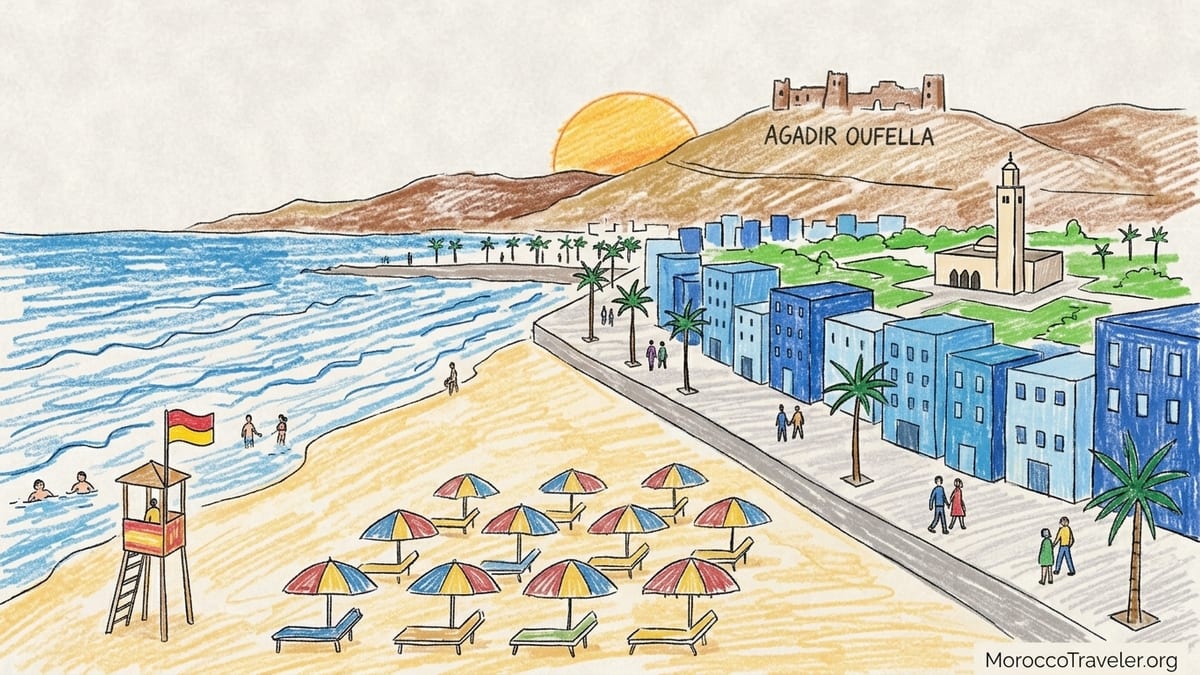
Agadir’s three‑kilometer crescent of sand is the city’s showpiece, and on paper it is impressive. The beach is long, relatively wide and framed by dunes and low hills. The seafront promenade is flat and easy to walk, with bike lanes, palm trees and plenty of benches. Early in the morning it can be beautiful: joggers weaving between families, fishermen tending to lines, the call to prayer drifting faintly from inland. At these times, I did feel a muted, gentle charm.
By late morning, however, the atmosphere changes. Large sections of the sand are lined with sun loungers reserved for the bigger hotels, creating fenced‑off strips that feel more like private pool decks than a shared public beach. Behind them, the promenade is lined with restaurants and cafés whose menus look almost interchangeable: pizzas, club sandwiches, ice creams, “international” breakfasts, a few token tajines. You can certainly find fresh grilled fish and Moroccan dishes, but you often have to seek them out behind the front row of promenade venues, or further into town.
What struck me most was how similar much of it felt to other mass‑market seaside destinations. On one stretch of promenade, I passed a Starbucks‑style coffee bar on one side and a sports bar showing European football on the other, while touts promoted jet‑ski rides and quad‑bike excursions. If your main benchmark is sunshine and a wide sandy beach, this is all perfectly fine. If you came hoping for a coastal city that feels distinctly Moroccan, the branding and international chains can create a sense of placelessness.
In the evening, the promenade gets busier again. Families with strollers, teenagers on e‑scooters, couples hovering around the small funfair at the northern end. There is a safe, relaxed feel, which families will value. For me, after two or three sunset walks, the repetition set in. Without a truly historic quarter or varied waterfront neighborhoods to explore, I found myself looping the same polished, somewhat generic strip, wondering if I should have allocated more days to Essaouira instead.
How Enjoyable Is the Beach Itself?
As a beach destination, Agadir succeeds in some basic, practical ways. The sand is generally soft and golden, and the bay is sheltered enough that even on breezy days, swimming areas remain accessible. When I visited in late spring, the shoreline looked mostly clean. Waste bins were reasonably frequent, and while cigarette butts and occasional plastic scraps did appear, the overall standard felt higher than on many urban beaches I have seen elsewhere around the Mediterranean.
However, the Atlantic does not offer bathtub‑warm water. Sea temperatures on Morocco’s Atlantic coast around Agadir tend to sit somewhere in the mid to high teens Celsius in winter and can rise into the low twenties in late summer and early autumn. In practical terms, I found the water bracing without being unbearable. I could comfortably swim for ten or fifteen minutes at a time during the day, but it was never that languid, stay‑in‑for‑hours experience you might get in parts of the Mediterranean or Southeast Asia. Several people around me wore short wetsuits for longer dips or paddleboarding.
The waves are another mixed blessing. On calmer days, the sea is quite manageable, especially near the central lifeguard towers where families congregate and red‑and‑yellow flags mark supervised zones. On windier afternoons, the shore break can be dumpy enough that less confident swimmers hesitate, and parents have to watch small children closely. I enjoyed body‑surfing on a couple of days, but there were just as many occasions when the choppy conditions and cool water made me retreat to the sand sooner than planned.
Across a week‑long stay, I realised I was not spending full beach days in Agadir. Instead, I drifted down to the water for an hour or two at a time, then returned to the hotel pool or retreated indoors during the strongest afternoon sun. This might suit travelers who like variety or have young kids that tire quickly, but anyone imagining long, dreamy beach marathons may find the combination of water temperature, wind and crowding less idyllic than the brochures suggest.
Hotels, Packages and the Feeling of a Bubble
Agadir’s accommodation scene is dominated by mid‑range to upper‑mid‑range resort hotels, all‑inclusive complexes and a smattering of newer upscale properties near the marina. Many European package operators sell week‑long bundles that include flights, airport transfers, a room in one of these large hotels and some form of half‑board or all‑inclusive catering. On my dates, a typical one‑week package from a major European city to a four‑star beachfront property in Agadir, with half‑board, was priced in the region of several hundred euros per person, including flights, if booked outside the absolute peak season. Standalone hotel nights for similar properties showed online around the mid‑double‑digit to low‑triple‑digit euros per night for a double room, depending on board basis and view.
Those numbers will fluctuate by season and departure city, but the overall pattern is recognizable: Agadir is marketed as a very good “value sun” option within a four‑hour flight radius of Europe. What is less prominent in the marketing is how bubble‑like many of these hotels feel. Several times, I looked around a lobby or pool terrace and realized that most guests seemed to spend almost all their time on‑site, drifting between the buffet, bar and sun loungers, venturing out only for an organized excursion or a brief walk along the promenade.
Inside the bubble, things are comfortable: substantial buffets heavy on grilled meats, salads and pastries, big pools, kids’ clubs, entertainment teams organizing aqua‑aerobics and quiz nights. If your goal is to relax by the pool with minimal decisions to make, this is not a criticism. My frustration came from realizing how little of Morocco I felt I was actually experiencing once I settled into this rhythm. Even when hotels decorate with lanterns and local textiles, the repetitive soundtrack of Western chart hits and the familiarity of buffet staples kept pulling me out of any sense of place.
When I compared prices with stays in Essaouira or in smaller properties around Taghazout, the value equation felt less straightforward. In Essaouira, for example, average double‑occupancy hotel prices tend to cluster around the mid‑two‑digit US dollars per night for atmospheric riads inside or near the old medina, where you step out directly into traditional lanes and a working fishing port. In Taghazout, surf camps and guesthouses often bundle rooms, meals and daily surf guiding for per‑day rates that can rival or undercut some Agadir packages, particularly outside peak surf months. For a similar outlay, I felt I could access environments with a stronger sense of character and local rhythm than what my Agadir resort provided.
Eating Out: Repetition on the Promenade
Food is usually one of my favorite parts of traveling in Morocco: smoky sardines grilled in tiny harbor joints, slow‑cooked lamb and prune tajines in tiled courtyards, glasses of mint tea poured theatrically. In Agadir, I had to work harder than expected to find meals that felt anchored in place. Along the main seafront, many restaurants target international tourists with laminated menus heavy on pizzas, burgers, pastas and generic “world cuisine”. Tajines and couscous appear, but often more as obligatory nods to local food than as the proud centerpiece.
Over a week, my meals risked blurring into one another. One evening I ordered a fish tajine on the promenade and received a dish that was perfectly edible yet strangely bland, with vegetables steamed to uniform softness and fish that tasted as if it had been frozen. The price was not outrageous by European standards, but it felt high compared with the richer, more memorable meals I had enjoyed for less in other parts of Morocco. Another night, I tried a mixed grill at a different beachfront restaurant and could barely distinguish it from versions I have eaten in generic tourist strips around the Mediterranean.
Better experiences usually came when I left the seafront. In local neighborhoods a taxi ride away, small grill houses and family‑run cafés served tastier chicken brochettes, kefta and fresh juices at more modest prices. Around Souk El Had, snack stalls piled with flatbreads, olives and seasonal fruit felt closer to the everyday Moroccan food culture I had come for. The trade‑off was time and effort: each worthwhile meal required planning, transport and navigating back after dark, which casual resort guests may be reluctant to do.
Compared with Essaouira’s compact medina, where atmospheric restaurants, local bakeries and coffee spots cluster within easy walking distance of most riads, Agadir’s modern sprawl made me feel more dependent on taxis or ride‑hailing apps. I began to understand why many visitors simply default to their hotel buffet or stick with the nearest promenade restaurant. Unfortunately, that also means many leave without sampling the most enjoyable versions of Moroccan cooking available in and around the city.
Souk El Had and Other Excursions: Enriching or Just Escaping?
Souk El Had is routinely billed as one of Agadir’s unmissable experiences. It is indeed impressive in scale. Enclosed behind long ochre walls punctured by multiple gates, the market covers well over ten hectares and contains thousands of stalls selling everything from crates of oranges and pyramids of spices to textiles, carpets, electronics and tourist souvenirs. Walking its alleys gave me, finally, a sense of Moroccan bustle that the beachfront lacked.
Yet even here, the contrast with older medina markets elsewhere in the country was striking. Souk El Had is divided into fairly organized sections with numbered entrances, straight or gently curving aisles and clear groupings by product type. It felt more like an enormous, semi‑open shopping mall than a centuries‑old bazaar. A portion of the souk clearly caters to tourists, with long runs of stalls selling near‑identical slippers, argan oil bottles and decorative lamps. I enjoyed wandering, bought fruit and spices, but I did not come away with the sense of discovery or layered history I felt in Fez’s chaotic lanes or Marrakech’s dimly lit caravanserai courtyards.
Other popular excursions from Agadir include drives up to Agadir Oufella, the restored hilltop kasbah site that overlooks the bay, and day trips to Paradise Valley, the Souss‑Massa National Park or the surf town of Taghazout. Reaching any of these requires either renting a car, booking a tour or haggling with a taxi driver. Costs vary widely, but by the time I added up transport and guide fees for a couple of outings, I realized I was spending a noticeable amount each day simply to feel like I had briefly escaped the resort corridor.
Were these trips enriching? In parts, yes. The view from Agadir Oufella at sunset is undeniably beautiful, with the city, port and long curve of beach laid out beneath you. In the Souss‑Massa area, I appreciated seeing more traditional villages and coastal scenery. Paradise Valley, on the other hand, felt overcrowded and commercial during my visit, with multiple snack shacks and groups lining what promotional photos had suggested would be a tranquil river gorge. Taghazout, about twenty kilometers north, offered more of the surf‑hostel energy and compact village feel I had expected from the region, though its own recent development has brought larger resorts and a polished beachfront zone.
After a few days, a pattern emerged: much of my enjoyment around Agadir came from leaving Agadir. That might be acceptable if the city were simply a convenient base for varied day trips, but the marketing sells the resort itself as the highlight. If you are prepared to budget extra money and time for excursions, your stay can certainly be more interesting. If you imagined that simply walking out of your hotel would immerse you in uniquely Moroccan streetscapes and daily life, you may feel shortchanged.
Transport and Practicalities: Not Built for Aimless Wandering
One of the pleasures of older Moroccan cities is how much you can experience on foot. In Fez el Bali, you might spend entire days winding through car‑free alleys, discovering tanneries, mosques and tiny workshops within a few hundred meters. Essaouira’s walled medina similarly invites aimless strolling, with the port, sea ramparts and small squares all within easy walking distance. Agadir, by contrast, felt like a place where walking is mainly for the beachfront and short hops between hotels and nearby cafés.
Beyond the promenade, the city stretches inland along wide boulevards. Distances between areas of interest can be long, and many streets have a utilitarian, through‑traffic feel. I often found myself hailing petit taxis or using ride‑hailing apps just to move between neighborhoods. Fares are not ruinous, but they add up, and there is a mild mental drain that comes from having to plan each simple outing instead of wandering spontaneously.
Public transport exists, with local buses connecting Agadir to surrounding towns and suburbs, including services north toward Taghazout and south toward smaller communities. However, routes and schedules were not always intuitive for a short‑term visitor, and buses could be crowded at peak times. For some popular excursion spots, organized tours or private drivers are heavily promoted, again nudging visitors toward pre‑packaged experiences rather than independent exploration.
This layout reinforces that resort bubble feeling. In Essaouira, I could step out of my riad, walk to the harbor, browse the fish market, explore craft workshops and be back in my room within an hour, without ever needing a vehicle. In Agadir, spontaneous strolls away from the beachfront often delivered long, anonymous stretches of road and modern apartment blocks. It is not an unsafe environment, and everyday Moroccan life certainly happens there, but it rarely felt compelling to explore purely for enjoyment.
Comparing Costs and Character: Agadir vs Essaouira and Taghazout
When choosing where to spend limited holiday days and budget on Morocco’s Atlantic coast, it helps to think not only in terms of price per night, but in what kind of experience that price buys you. In Agadir, many visitors are drawn by package deals promising a week of sun, flights included, for a competitive total cost. Once on the ground, that money delivers substantial hotel facilities but often at the expense of distinct local atmosphere outside curated spaces like the souk.
By comparison, Essaouira has a smaller number of large resort‑style properties and far more intimate riads and guesthouses tucked inside the fortified medina or just outside its walls. Average nightly rates there, based on recent traveler cost collations, often land around the equivalent of several dozen US dollars for a double room in a mid‑range riad. That may be similar to or slightly cheaper than a room‑only rate in an Agadir resort, though obviously without the all‑inclusive buffets and expansive pool complexes. What you gain, in my view, is immediate immersion: a harbor lined with blue fishing boats, seagulls wheeling overhead, narrow alleys full of artisans and cafés, all right outside your door.
Taghazout presents a different type of comparison. Historically a small fishing village around 19 kilometers north of Agadir, it has grown into a surf‑oriented hub with hostels, surf camps and small hotels crowding the hillside above a beach and point breaks. Here, weekly surf camp packages that include accommodation, lessons, equipment and most meals can represent strong value for active travelers. Room‑only stays in simple guesthouses or apartments can also run at competitive nightly rates, especially outside peak surf months. The trade‑off is that Taghazout has become busier and more international in feel, though it still offers a more compact, village‑like environment than Agadir’s resort sprawl.
For my money, if I were returning to this stretch of coast specifically for culture and sense of place, I would likely split time between Essaouira and a smaller property in or near Taghazout, using Agadir perhaps only as an arrival and departure hub. The prices I saw in Agadir did not feel unfair in isolation, but when measured against the depth of experience elsewhere, the resort premium yielded comfort more than character.
The Takeaway: Who Will Enjoy Agadir and How I Would Do It Differently
After a week in and around Agadir, my overall view is cautious. I did not hate the city. I enjoyed some mornings on the sand, a couple of sunsets from Agadir Oufella, and a long, sensory wander through Souk El Had. I appreciated the safety and ease of the beachfront promenade at night, particularly for families. Yet I also left feeling that Agadir delivered less distinctiveness and cultural texture than I had hoped, especially when compared with Essaouira, Fez, Marrakech or even smaller Atlantic towns.
Who is most likely to be disappointed? Solo travelers and couples who prioritize atmosphere, walkable historic areas and immersion in everyday Moroccan life may find Agadir too resort‑oriented and geographically spread out. If you picture yourself sipping coffee in centuries‑old squares, browsing small galleries in converted riads and watching working ports at close range, your time and money will probably go further in Essaouira or in medina neighborhoods elsewhere in the country. Those sensitive to repetitive buffet food and generic beachfront dining may also tire quickly of the promenade strip.
On the other hand, Agadir will genuinely suit certain visitors. Families with young children who want a straightforward, sun‑and‑sand week with big pools, kids’ clubs and low‑stress logistics could be very happy here. Travelers who value predictability, modern infrastructure and a clear separation between relaxing hotel time and occasional pre‑arranged excursions may find Agadir more manageable than older, more intense cities. For winter sun seekers escaping colder climates, the simple pleasure of a long sandy beach within relatively easy reach of European airports should not be underestimated.
If I were to design a better stay next time, I would shorten my Agadir base to perhaps two or three nights, use it mainly as a landing spot, and put the bulk of my coastal days into Essaouira and a smaller property around Taghazout or nearby villages. In Agadir itself, I would deliberately choose a hotel within easy walking distance of both the beach and good local eateries away from the main promenade, and I would budget specifically for a couple of targeted excursions rather than improvising day by day. Above all, I would arrive with recalibrated expectations: not for an Atlantic Marrakech, but for a modern, reconstructed resort city whose strengths lie in simple seaside downtime rather than in delivering Morocco’s most memorable cultural experiences.
FAQ
Q1. Is Agadir worth visiting if I am interested in traditional Moroccan culture?
For deep immersion in traditional Moroccan culture, Agadir is not the strongest choice. The city was largely rebuilt after the 1960 earthquake, so it lacks a historic medina core. You can experience aspects of local life in places like Souk El Had and in neighborhoods away from the beachfront, but the overall feel is that of a modern resort city rather than a historic cultural center.
Q2. How does Agadir compare to Essaouira for a first‑time visitor to Morocco?
Essaouira offers a compact, walkable medina, an active fishing harbor and stone ramparts that immediately feel atmospheric, with many riads and cafés woven into the old town. Agadir, by contrast, spreads out along a modern beachfront and wide boulevards, with most tourists staying in resort hotels. If you want character and history, Essaouira is typically more rewarding. If you prefer a resort environment with larger hotels and a long sandy bay, Agadir may suit you better.
Q3. Is the beach in Agadir good for swimming and sunbathing?
Agadir has a long, sandy beach that is generally pleasant for walking and sunbathing, with lifeguard‑supervised swimming areas. The Atlantic water can feel cool, especially outside late summer, and the waves are sometimes choppy, so swims may be shorter and less languid than in warmer seas. Many visitors alternate between the beach and hotel pools rather than spending entire days on the sand.
Q4. Are package holidays to Agadir good value compared with staying independently?
Package holidays often bundle flights, transfers and resort accommodation for prices that can look attractive, especially outside peak season. However, that value mostly buys comfort and on‑site facilities. Independent stays in places like Essaouira or surf towns around Taghazout can sometimes offer comparable or better nightly rates while delivering a more distinctive local setting, though without the same all‑inclusive structure.
Q5. Is Souk El Had in Agadir worth a visit?
Souk El Had is worth visiting if you are staying in Agadir. It is large and lively, with sections for fresh produce, household goods and tourist items, and it gives a clearer sense of local commerce than the beachfront does. It still feels more modern and organized than older medina markets elsewhere in Morocco, so it is interesting rather than essential if you are already visiting cities like Fez or Marrakech.
Q6. How easy is it to explore Agadir without a car?
Within the beachfront area, it is easy to get around on foot. Beyond that, distances between neighborhoods and attractions can be long, and many visitors rely on petit taxis or ride‑hailing apps. Local buses run to outlying areas and nearby towns, but routes may be confusing for short stays. For day trips to spots like Paradise Valley or Souss‑Massa, most people use organized tours or private drivers.
Q7. Are there better places than Agadir for surfing nearby?
For surfing, many travelers base themselves in or around Taghazout, a surf‑focused village around 20 kilometers north of Agadir, or in neighboring communities such as Tamraght. These areas offer a range of surf camps, hostels and small hotels with easier access to well‑known breaks, and the villages have a more intimate feel than Agadir’s resort strip, even as they become busier and more developed.
Q8. Is Agadir a good choice for families with children?
Agadir can be a good option for families. Many hotels have large pools, kids’ clubs and entertainment, and the beachfront promenade feels safe and relaxed in the evenings. The trade‑off is that you experience less of traditional Moroccan urban life than in historic cities. For families prioritizing simple sun, sand and straightforward logistics, however, Agadir often works well.
Q9. How many days should I spend in Agadir on a longer Morocco trip?
If your focus is culture and historic sights, two or three nights in Agadir can be enough to enjoy the beach, visit Souk El Had and perhaps take one excursion. The rest of your time may be better spent in cities like Marrakech, Fez or Essaouira, or in smaller coastal towns. If your main aim is to relax in a resort setting, you could comfortably stay a week, building in a couple of day trips.
Q10. What would be an ideal itinerary that includes Agadir but does not depend on it?
An appealing approach is to fly into Agadir, spend two or three nights there to unwind from travel and visit the beach and souk, then continue north to Taghazout or similar villages for surfing or a more intimate coastal stay. From there, you might travel on to Essaouira for several days of medina exploration before heading inland to Marrakech. This way, Agadir serves as a convenient entry point and brief seaside pause rather than the main focus of your Moroccan trip.