

I first went to Imsouane in November 2022, long before bulldozers arrived on the cliffs above Cathedral and the low houses of Tasblast. Back then the village felt like the soft landing point of Morocco’s Atlantic surf coast, a place where pointbreak lines wrapped lazily into the bay and evenings smelled of grilled sardines and wax. That visit shapes how I remember Imsouane, but it no longer fully matches what you will find today. Since January 2024, demolitions around the Cathedral side have altered not only the skyline, but the social and economic fabric that made this place famous among surfers. The question now is not whether Imsouane was magical. It is whether the version that survives in 2026 still justifies the journey, and how carefully you need to book if you decide to go.
What I Saw Before the Bulldozers: Bay, Harbor and Slow-Time Surf Culture
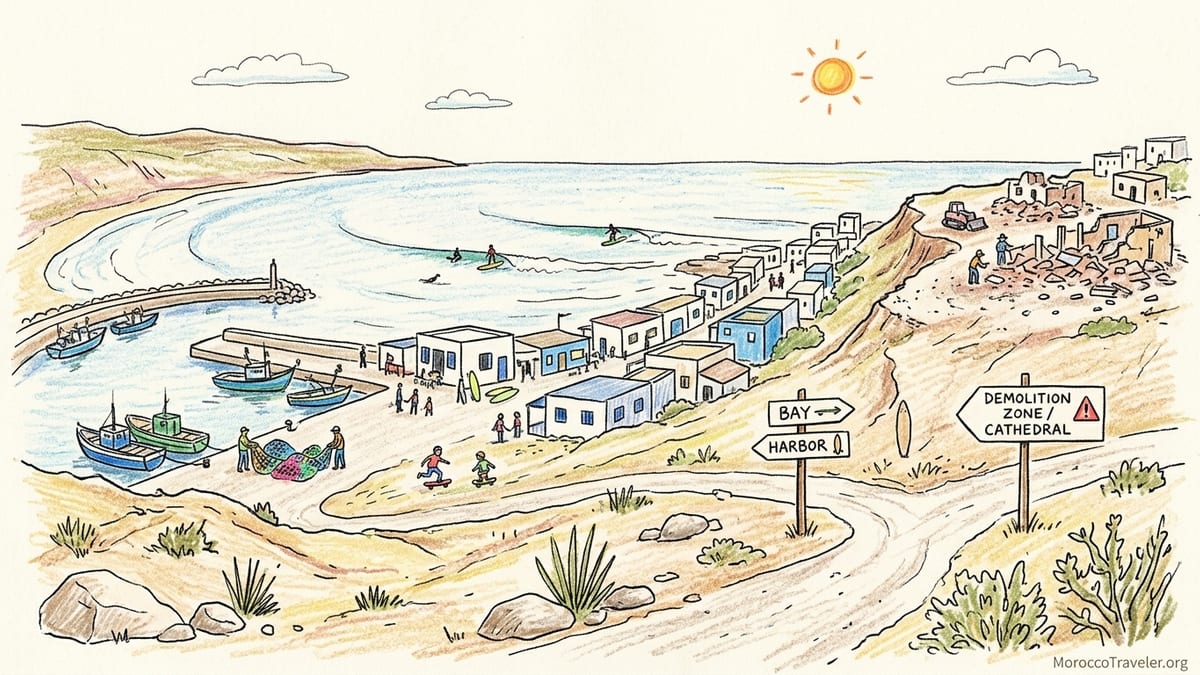
When I arrived in Imsouane in November 2022, the road from Agadir rose and fell through dry hills before suddenly revealing the bay. From above, the wave looked like a loose piece of string curling along the edge of the harbor wall and inside sandbar. Fishing boats painted blue and green rested below, and the long white line peeled past them in slow motion. It was not a powerful wave that day, but it was impossibly long. I watched a surfer trim all the way from the outside section near the harbor mouth to the inside beach, stepping forward and back on a heavy longboard until he finally eased into the shorebreak.
The village itself felt compact. On the bay side there were a handful of cafes with plastic chairs facing the water, a small mosque, and a cluster of surf shops renting sun-yellow softboards and beaten fiberglass longboards. On windy afternoons local kids rode skateboards down the gentle slope behind the harbor while fishermen mended nets in the shade of simple, often unpainted houses. There were no high-rise hotels. At sunset everyone seemed to move to the cliffs or the harbor wall to watch the light drain out of the Atlantic.
Surf culture here, as I experienced it, revolved around tide charts scribbled on cafe chalkboards and WhatsApp messages from local instructors. Group lessons at the bay typically meant six to eight beginners with one instructor, learning to pop up in the whitewater, while more experienced surfers paddled wide around them to chase the cleaner, unbroken sections. The pace was unhurried. If the tide was wrong, you waited, drank mint tea and watched. If the swell dropped, people took day trips to Cathedral, on the other side of the headland, where a more exposed beachbreak and point picked up extra energy.
Accommodation options at that time ranged from simple guesthouses, some little more than family homes with shared bathrooms, to mid-range surf houses offering full-board packages. I stayed in a small bay-side guesthouse with tiled floors, a basic roof terrace and a room that smelled faintly of salt and incense. Nights were quiet apart from wind and waves. The strongest impression I left with was that Imsouane worked because tourism and local life were still tightly braided together: fishing, surfing, and small-scale hospitality sharing the same narrow streets.
What Happened in January 2024: Demolitions at Tasblast and Cathedral
That version of Imsouane changed abruptly in January 2024. Moroccan outlets and regional media reported that on January 17 residents in the Tasblast area around the Cathedral side were told orally by local authorities that they had 24 hours to leave before demolitions began. Bulldozers then moved in around January 18 and over the following days they tore down houses and small businesses along the cliff and near Cathedral beach. Reports described residents dismantling what remained of their own homes after machines had passed, trying to salvage doors, windows and tin roofs before everything was flattened.
Coverage in Moroccan magazines and international surf media painted a similar picture: Tasblast, the traditional neighborhood overlooking Cathedral, was targeted as part of a broader effort to clear what authorities framed as illegal construction on maritime public domain. Many of the structures had started decades earlier as fishermen’s houses and later evolved into informal guesthouses, cafes and surf-related businesses that gave Cathedral its unique character. In the space of a week, a large concentration of these low-slung, improvised buildings disappeared, leaving dust, rubble and stunned residents behind.
Some surf-industry journalism focused on the shock among visiting surfers who woke to the sound of bulldozers above the break. Others highlighted the legal and political context, noting that coastal regulation around public maritime land has been tightening in Morocco and that Imsouane was not the only place where informal seafront construction faced demolition. What made this case stand out was the short notice reportedly given to residents, the scale of removal in such a celebrated surf town, and the way the operation seemed to erase the very community that had helped put Imsouane on the global surf map.
Since then, there has been persistent talk online about future luxury hotels, branded surf resorts and large-scale tourism infrastructure moving into the cleared area. Official strategic documents published before the demolitions do identify Imsouane as part of a wider tourism development zone along the Agadir coast, with plans for more structured surf and adventure facilities. However, concrete, on-the-ground projects replacing Tasblast remain speculative at the time of writing. It is important not to present rumors as fact. What is clear today is that the simple homes and small businesses that once clung to the Cathedral cliffs are gone, and what replaces them will significantly influence Imsouane’s identity.
Who Lost What: Residents, Guesthouses and the Character Around Cathedral
The immediate human impact of the January 2024 demolitions fell on the families and small entrepreneurs who lived and worked in Tasblast and the Cathedral area. Interviews with residents published in Moroccan media, along with testimonies gathered by regional outlets, describe a mix of full-time inhabitants and seasonal business owners. Some had built basic houses decades ago when Imsouane was still a quiet fishing village. Others had expanded ground floors into small eateries or added rooms to rent to visiting surfers as tourism boomed in the 2010s.
When the demolitions came, these homes and hybrid spaces were often treated in the same way as more recent, purely commercial structures. Residents described being left with limited options and unclear information about compensation or rehousing. For travelers, this matters because the intimate, family-run character of Cathedral side was a big part of why people chose to stay there. A room above a local cafe, where the owner’s children played in the alley and where dinner might be whatever fish came in that morning, is very different from a standardized hotel with reception desks and corporate branding.
Economically, the loss of these businesses has meant fewer independent cafes, informal restaurants and surf rentals directly on the Cathedral front. Some former operators appear to have shifted their activity elsewhere in the village or to nearby surf hubs like Taghazout and Tamraght, where demand for experienced instructors and hosts remains strong. Others have likely left the tourism sector altogether. For visitors, this translates into fewer ultra-budget, cliff-edge options near Cathedral and more reliance on remaining bay-side guesthouses, structured surf camps, or day trips organized from other towns.
Culturally, the demolitions have removed a visible layer of the improvised, lived-in architecture that gave Cathedral its rough charm. Where there were once uneven stairways between houses, painted wooden balconies and ad hoc terraces, visitors now report open ground and construction fences. That does not mean Imsouane has become a sterile resort overnight. Large parts of the village remain intact and lived in. But the removal of Tasblast has tilted the balance slightly away from a purely organic fishing-and-surf settlement and toward a place waiting to be reimagined by outside planners.
What Still Stands: Bay, Surf Schools and Independent Businesses in 2026
Despite early social media posts in January 2024 that made it sound as if the entire town had been flattened, current reports and recent traveler accounts from 2024 to 2026 confirm that Imsouane as a destination continues to function. The bay still wraps its long right-hand lines into the harbor. The harbor itself is still active, with fishermen launching traditional wooden boats and selling part of their catch locally. On the bay-front streets, many guesthouses, small hotels and cafes remain open, and new surf camps have emerged to replace some lost capacity.
Several independently owned surf camps and guesthouses now market themselves explicitly as being on the bay side, away from the demolished Cathedral cliff. They typically offer dorm beds and private rooms bundled with breakfast, dinner and surf lessons or guiding. While exact prices fluctuate with season and demand, recent listings show mid-range surf camps in Imsouane charging in a similar band to those in Taghazout and Tamraght. For example, weeklong packages that include accommodation, full board and daily lessons often sit in a range roughly comparable to mid-market camps elsewhere on the coast, although ultra-cheap, semi-legal rooms above Cathedral are no longer on offer.
Independent restaurants, particularly those serving tajine, grilled fish and simple breakfasts, continue to line streets leading to the bay. Much of this core remained outside the January 2024 demolition zone. Visitors since mid-2024 describe being able to eat at family-run places whose owners have been in the village for years, even if some relatives or friends lost businesses near Cathedral. For travelers who value supporting locals, it is still possible to choose these kinds of venues, but it requires more deliberate selection and up-to-date research than before.
On the surf services side, there are still multiple schools and freelance instructors operating in Imsouane. Some camps based in Taghazout and Tamraght also run full-day trips up to the bay when conditions justify it, bundling transport, equipment and lunch into a single price. That means you can access Imsouane’s waves without staying overnight, although doing so shifts more economic benefit to businesses based outside the village. The key shift after 2024 is that Imsouane has moved from a place where many surfers based themselves for the entirety of their trip to one node in a larger, more centrally managed surf circuit along the Agadir coast.
Crowded Lineups, Environmental Pressure and Rising Prices
Even before the demolitions, crowding was emerging as a serious issue in Imsouane, particularly at the bay. The wave’s gentle slope and forgiving sections make it ideal for surf schools, which in turn attract beginners from across Europe. By late 2022, I regularly saw twenty or more soft-top learners jockeying for waves in the inside section while experienced longboarders waited further out. On good swell days, the takeoff zone could feel thick with boards, and etiquette varied widely.
Since 2024, the combination of reduced local accommodation at Cathedral, more structured surf camps, and day trips from Taghazout and Tamraght appears to have concentrated even more surfers into specific windows. Reports from instructors and recent visitors describe morning and late-afternoon sessions packed with surf camp groups. Camps along the coast advertise day trips to Imsouane as a highlight of their weekly schedule, often timing arrivals around tides. This imported crowding adds to pressure on the bay, especially when conditions are marginal elsewhere.
Rising demand has also contributed to upward pressure on prices. Along the coast, up-to-date price checks in 2026 show typical group surf lessons in Taghazout and Tamraght costing around 250 to 350 Moroccan dirhams for a two- to three-hour session, with board and wetsuit rental for a day often priced between 100 and 150 dirhams. Multi-day coaching and camp packages add accommodation and meals, pushing total weekly costs into the hundreds of euros. While Imsouane does not yet command a consistent premium above these levels, the loss of the cheapest informal stays and the need to comply more strictly with regulations mean there are fewer ultra-low-cost options than in the past.
Environmental pressure is harder to quantify, but visible signs include more plastic waste during peak weeks, erosion where informal paths have been widened by foot traffic, and strain on limited water resources. Some newer surf camps and hotels along the coast market eco-credentials, from water-saving devices to beach cleanups, but there is still a gap between branding and measurable impact. With parts of Imsouane’s coastline cleared and awaiting future development, there is a real risk that new construction will harden more of the shoreline, disrupt drainage and add to light and noise pollution if not carefully managed.
How Reliable Are Old Photos, Reviews and Destination Guides?
For would-be visitors, one of the most practical consequences of the 2024 demolitions is that many photos and reviews online no longer match reality. Pre-2024 travel guides often show Cathedral from above, with a patchwork of whitewashed and stone houses clinging to the hillside, cafes perched on the edge, and a maze of alleys leading directly to the sand. Reviews praise staying “steps from the break” in tiny guesthouses built almost on the cliff. Much of that specific built environment no longer exists.
If you search for Imsouane accommodation today, you will still find platforms listing properties with photographs taken years before the demolitions. In some cases, businesses located in the Cathedral area have closed or been physically removed, but their listings linger due to slow updates or owners hoping to relocate and reopen under the same name. Travelers have reported booking rooms only to be told later that the property has changed address, reduced capacity, or stopped operating. This disconnect makes it essential to confirm location and current status directly with the host before committing.
Destination articles and guidebooks published before early 2024 can also mislead in more subtle ways. Many describe Cathedral as a village within the village, buzzing with simple restaurants and budget surf camps. They frame Imsouane as an almost entirely grassroots surf town, with minimal formal planning. While the spirit of that description remains partly true around the bay, it glosses over the regulatory push that has since reshaped the coastline and removes mention of ongoing uncertainty about future development. Reading these guides without context can set unrealistic expectations for atmosphere and price.
When planning a 2026 trip, treat any praise that hinges on staying in cliff-edge shacks above Cathedral or dining in makeshift terrace restaurants with skepticism. Those experiences may belong to a version of Imsouane that is now gone. Focus instead on recent accounts that mention bay-side streets, established guesthouses, or surf camps that provide clear, updated details about their location and facilities. Contact hosts to ask when the photos on their listing were taken and whether any part of their property was affected by the 2024 demolitions.
Comparing Imsouane with Taghazout and Tamraght in 2026
In 2026, surfers considering Morocco’s Atlantic coast usually weigh Imsouane against two other main hubs: Taghazout and Tamraght, both north of Agadir. Taghazout has long been the country’s best-known surf town, with famous breaks such as Anchor Point and Killer Point. Tamraght, a little further south, has grown into a dense cluster of surf camps and coworking-friendly guesthouses. Both have benefitted from improved coastal infrastructure and are firmly integrated into Morocco’s tourism strategy.
Recent price surveys and surf school listings in Taghazout and Tamraght show relatively consistent figures. Group surf lessons for two to three hours often cost around 250 to 350 dirhams per person, including board and wetsuit. Private one-on-one coaching can range higher, from about 400 up to 800 dirhams depending on the level of service. Full-day guided trips to spots like Imsouane or Tamri frequently fall in the region of 450 to 600 dirhams, with transport and lunch bundled in. Weekly surf camp packages in these towns, which include accommodation, meals and daily lessons, can start a little above budget hostel prices and rise substantially for boutique stays.
Imsouane, by contrast, tends to have fewer large, internationally marketed camps and more small-scale operations, although this is changing as outside operators expand. Where you may notice a difference is in the structure of offers. In Taghazout and Tamraght, it is easy to find tightly scheduled packages with airport transfers, yoga, coworking spaces and photo analysis built into a fixed weekly program. In Imsouane, options lean a bit more toward simple bed-and-board packages with daily lessons decided according to conditions, as well as independent instructors offering flexible sessions to walk-in guests.
Transport and cancellation rules also contrast. Taghazout and Tamraght sit close to Agadir, with frequent taxis, buses and private transfers linking them to the city and its airport. Many camps there include airport pickup in their package price and apply standardized cancellation policies that resemble those of European hostels and hotels. Imsouane lies further north along a more winding road, and while it is served by buses and shared taxis, getting there with bulky surfboards is less straightforward. Some surf schools and camps in Taghazout now market Imsouane as a day-trip, sparing guests the logistics of independent travel. Cancellation policies for Imsouane-based stays can be more idiosyncratic, especially for smaller guesthouses that rely heavily on each booking, so reading terms carefully and confirming via direct message is important.
If your priority is variety of waves and nightlife, Taghazout and Tamraght still offer more options: multiple breaks within a short drive, dozens of cafes and restaurants, and a wider social scene. If your focus is long, mellow rights and a quieter setting, Imsouane remains compelling despite its scars. The trade-off lies in accepting a more fragile, changing environment and taking extra steps to ensure your booking aligns with current realities on the ground.
The Takeaway
So is Imsouane still worth visiting in 2026? The honest answer is that it depends on what you are looking for and how willing you are to navigate a place in transition. The wave at the bay is still there, still one of the longest and most forgiving rights on Morocco’s coast. The harbor remains a working fishing port, and many long-time residents continue to host guests, cook for visitors and guide surfers into the lineup. If your dream is to trim for what feels like forever on a longboard as the village rises behind you, Imsouane can still deliver that experience.
Yet it is no longer the same Imsouane that filled magazines and Instagram feeds in the late 2010s. The demolition of Tasblast and homes and businesses around Cathedral removed a significant portion of the built, lived-in community that made this place feel like more than a surf product. It also revealed the tension between informal, community-led tourism and top-down development plans along Morocco’s Atlantic coast. Travelers who arrive expecting a frozen-in-time surf village untouched by regulation will be disappointed. Those who approach with open eyes, up-to-date information and a willingness to support surviving local businesses may find a more complex, but still rewarding destination.
Practically, this means doing more homework than before. Verify that any accommodation you book is currently operating in its advertised location. Ask hosts directly how the 2024 demolitions affected them, how recent their photos are, and whether their rooms overlook the bay or lie closer to Cathedral’s cleared zone. Check recent traveler reports to gauge crowding and seasonal conditions. Compare surf-lesson and camp prices with those in Taghazout and Tamraght, not to chase the absolute lowest fee, but to understand what level of service and local benefit you are paying for.
If you decide that Imsouane’s waves are worth the journey, go with the intention to give something back. Choose independently owned guesthouses and restaurants where possible, hire local instructors rather than exclusively joining imported camp groups, and respect the fact that you are surfing in a place where people are still dealing with the aftermath of sudden loss. Imsouane today is neither a ghost town nor a polished resort. It is a surf village in flux, with a legendary bay that still peels and a community that deserves careful, thoughtful visitors.
FAQ
Q1. Was the entire village of Imsouane demolished in January 2024?
Only specific areas, particularly around Tasblast and the Cathedral side, were demolished. The bay, harbor and many streets with guesthouses, restaurants and surf schools remain intact and active.
Q2. Can I still surf the famous Imsouane bay right now?
Yes. The long right-hand point at the bay continues to break much as it did before, and surf schools and camps still organize lessons and guiding there, although crowds can be heavy on popular days.
Q3. Are there still places to stay directly in Imsouane?
There are still guesthouses, small hotels and surf houses operating in the village, especially on the bay side. What disappeared were many informal cliff-edge houses and businesses above Cathedral that once offered simple rooms.
Q4. How do surf prices in Imsouane compare with Taghazout and Tamraght?
Current reports suggest that group lesson and rental prices in Imsouane are broadly similar to Taghazout and Tamraght, where a half-day group lesson often costs a few hundred dirhams. Ultra-cheap informal deals are less common than they were before 2024.
Q5. Is it better to stay in Taghazout or Tamraght and visit Imsouane as a day trip?
Staying in Taghazout or Tamraght offers easier transport and more varied nightlife, and many camps include day trips to Imsouane. Staying in Imsouane itself gives you quieter evenings and dawn access to the bay, but with fewer services and some ongoing change.
Q6. How can I check if a hotel or surf camp listing in Imsouane is still accurate?
Always contact the host directly, ask when their photos were taken, and confirm whether their property or former location was affected by the 2024 demolitions. Recent guest reviews and social media updates are more reliable than old guidebooks.
Q7. Are rumors of luxury resorts being built in Imsouane confirmed?
Imsouane features in regional tourism plans, but as of now widely shared talk of specific luxury resorts replacing Tasblast remains speculative. You should treat such rumors with caution and focus on verified, current information.
Q8. What can I do to support local residents if I visit?
Choose independently owned guesthouses and restaurants, hire local surf instructors, buy from small shops, and be respectful when asking about the demolitions, recognizing that for many people this is still a painful topic.
Q9. Is Imsouane suitable for beginner surfers after all these changes?
The bay remains one of Morocco’s most beginner-friendly waves, but lineups can be crowded with surf camps and schools. Beginners who value space might prefer quieter days, smaller groups, or alternative breaks on crowded weekends.
Q10. If I care most about atmosphere, should I still prioritize Imsouane over other Moroccan surf towns?
If you dream of a low-key village focused on one iconic wave and can accept a more fragile, changing setting, Imsouane can still be compelling. If you want a busier social scene, more restaurants and varied waves, Taghazout or Tamraght may better fit your expectations.