


I had planned to drive straight from Casablanca down the Atlantic coast, chasing the surf towns and sunsets everyone talks about in Essaouira and Agadir. But somewhere after leaving the tangle of Casablanca traffic, the highway signs for El Jadida and then Safi started to feel less like throwaway names and more like quiet invitations. I decided to slow down, step off the well-worn tourist track and see what these two often-overlooked Atlantic cities still held of Morocco’s layered past and everyday life.
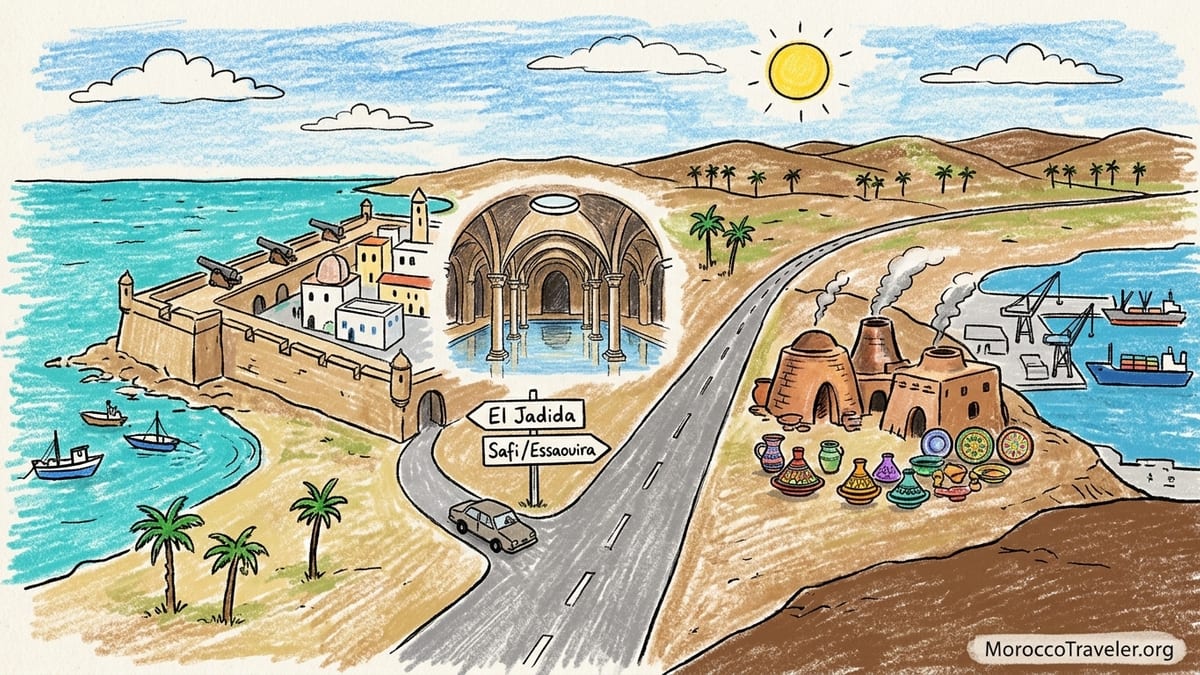
Why I Chose To Stop Instead Of Driving Straight Through
The decision to pull off at El Jadida began with something unromantic: road fatigue. The Atlantic highway south from Casablanca is efficient, but after an hour of concrete and toll booths, I wanted somewhere walkable and human-scaled. El Jadida is roughly 95 kilometers from Casablanca, an easy 1.5-hour drive, or about the same by CTM or Supratours bus for around 50 to 80 dirhams depending on departure time and operator. Knowing I could arrive before lunch and still have a full afternoon to explore made it an obvious pause point rather than just a service-station stop.
I was also curious about Mazagan, the old Portuguese fortified city that now forms El Jadida’s historic core. UNESCO listed it as the Portuguese City of Mazagan in 2004, recognizing how this 16th century Atlantic outpost became a testing ground where European Renaissance fortification ideas met local Moroccan building traditions. That sounded like much more than a photogenic medina backdrop, and worth seeing before the coastal road blurred into one long run of beaches and resorts.
Friends in Casablanca had framed El Jadida and Safi the same way: “nice, but you will probably just drive through on the way to Essaouira.” When several people repeat that about a place, I tend to suspect there is something interesting hiding in plain sight. I reworked my plan, penciled in one night that could be spent in either El Jadida or Safi, and promised myself to judge with my own eyes whether they were worth slowing down for.
Instead of gunning the car south, I exited toward El Jadida just before midday, following signs for the Cité Portugaise. Within minutes the wide road narrowed into streets that suddenly felt older, saltier and far more intriguing than anything along the highway.
First Steps Inside El Jadida’s Portuguese City
El Jadida’s Portuguese City is compact enough that you can cross it on foot in 10 minutes, but the first impression is dense. You enter through a tunnel-like stone gateway and emerge into a grid of narrow streets lined with chipped pastel facades, laundry strung overhead and the occasional carved stone doorway that hints at 16th century ambitions.
Unlike many Moroccan medinas, this one follows a recognizably European plan, a small rectangle of streets hemmed in by 7.5 hectares of walls and four bastions. It feels less like a maze and more like a small town perched above the ocean. Walking in, I passed a primary school letting out for the day, kids spilling onto the cobbles with backpacks and footballs. The sound of their shouting bounced off stone that once heard Portuguese soldiers calling commands from the ramparts. That blending of ordinary present and layered past is what makes El Jadida feel quietly special.
From the main street I climbed onto the ramparts by a worn set of steps near the Bastion of Saint Sebastian. Up on the walls, the city dropped away on one side and the Atlantic surged below on the other, waves hitting the base of the fortifications that were built to command this very stretch of ocean trade. You can walk along most of the ramparts freely, cannon mouths pointed out to sea, and look back onto flat-roofed houses, church towers and minarets that tell the story of how Mazagan became El Jadida, Portuguese colony becoming Moroccan coastal town.
It is one thing to read that El Jadida represents an early experiment in Renaissance bastion design adapted to Africa. It is another to stand where those ideas were literally poured into stone and then gradually absorbed into a Moroccan city that grew up around and through them. Even without a guide, the story is legible as you loop from bastion to bastion under the Atlantic light.
The Portuguese Cistern and Other Architectural Highlights
The most famous interior space in El Jadida hides behind an unassuming wooden door on a side street: the Portuguese Cistern. I arrived mid-afternoon and found the entrance open, with a small ticket desk just inside. Recent information on site and from local tourism offices aligned. The cistern is currently open daily, generally from 9:00 to 13:00 and again from 15:00 to about 18:30, though hours can shift slightly in winter or during Ramadan. Entry was posted at 20 dirhams for foreign visitors when I visited, paid in cash.
Inside, the temperature dropped and the air turned cool and faintly damp. The cistern is a vaulted stone hall lit by a single circular oculus overhead, its columns and arches reflected in a thin layer of water that covers the floor. It is an almost impossibly photogenic space, used as a filming location more than once, but in person it feels less like a movie set and more like a hushed, accidental cathedral to hydraulic engineering. You walk along narrow raised edges or step carefully through shallow water, hearing drops fall and echo.
From the cistern I wandered toward the former Church of the Assumption, a late Gothic structure whose simple facade now fronts a cultural space that is occasionally used for exhibitions and events. Around the corner, a small mosque with a square minaret rises almost within sight of the church tower. There is no plaque spelling it out, but the skyline itself shows how Portuguese Catholic architecture was layered into, and then gradually overtaken by, Moroccan Islamic forms as the town changed hands in the 18th and 19th centuries.
Not every building is pristine. Some facades are peeling and cracked, doors patched with scrap wood, and satellite dishes crowd roofs that once held only sentries. Yet that patina is part of what keeps the Portuguese City from feeling like an open-air museum frozen in 1514. It is still a lived-in neighborhood where families argue from windows, fishmongers shout the afternoon catch and teenagers sit in the shade of centuries-old stone to scroll on their phones.
Walking, Eating and Everyday Life in El Jadida
I spent the rest of the afternoon doing what El Jadida rewards most: slow, aimless walking. From the ramparts I dropped down to the Portes de la Mer, the Sea Gate, where the fortified walls open to the harbor. Here small fishing boats cluster in a tangle of nets and plastic buckets, and men repair lines while radio music seeps from open doorways. There are no choreographed tourist photo points, just the rhythms of a working Moroccan port scaled to a town rather than a metropolis.
For a late lunch, I followed the smell of grilling sardines to a simple café just outside the old walls, the kind with plastic chairs and a menu hand-written in marker. A plate of freshly grilled sardines, salad and bread came to 45 dirhams, with a glass of mint tea for 8 dirhams. The fish had likely been landed that morning just across the quay. Eating them with my fingers, watching local families drift in for their own plates, felt like a much more grounded coastal experience than the polished seafood terraces of larger resort cities.
Later, in the new town, I stopped at a patisserie for a strong espresso and a selection of Moroccan almond biscuits for about 15 dirhams. The clientele was a mix of well-dressed locals leaving offices, students in football jerseys and a couple of other travelers consulting maps. El Jadida does not yet have the café-as-destination culture of Essaouira, but you can feel a gentle confidence in these spaces, a city serving itself first and visitors second.
Back inside the Portuguese City around sunset, the stone of the ramparts warmed to a deep gold, and teenagers practiced parkour moves off low walls while an older man cast a fishing line straight from the fortifications into the Atlantic. Several guesthouses within the old city had their doors open. I checked one simple riad-style place where rooms started around 400 to 500 dirhams per night for a double in low season, with breakfast. Comfort here is more about atmosphere and sea air than high design, but for travelers who like to ease into Morocco at a slower pace than Casablanca allows, El Jadida makes a soft landing.
Onward to Safi: First Impressions of Morocco’s Pottery Capital
The next morning I continued south toward Safi, about 200 kilometers from El Jadida by coastal road. You can drive the stretch in roughly three hours, or connect buses between the two cities for around 40 to 70 dirhams depending on company and schedule. The landscape between them shifts gently from farmland to glimpses of sea and industrial plants, then finally to Safi’s mix of old medina honeycomb and port infrastructure.
Safi has two reputations that matter to travelers: as one of Morocco’s main commercial fishing ports and as a historic center for pottery and ceramics. As you approach, both are visible. The port bristles with cranes and stacks of containers, while above it the medina climbs the hill, crowned by the outlines of a kasbah and Portuguese-era walls that once guarded the bay.
My first stop was not the historic quarter but the Potters’ Hill on the northern edge of town. This is where many of Safi’s artisan workshops cluster, their chimneys and piles of clay unmistakable as you arrive. The taxi from the city center cost 10 dirhams, and I was dropped off near a lane of low, earth-colored buildings that looked more like rural farm structures than shops.
Unlike in some heavily touristed craft centers, I found no touts aggressively steering me to particular workshops. Instead, doors stood open and artisans glanced up from their wheels or kilns, ready to greet but not to hustle. It felt like approaching a cluster of small family businesses rather than a performance laid on for visitors.
Inside Safi’s Pottery Workshops and Markets
In the first workshop I entered, a potter in a clay-spattered djellaba was shaping a tall vase on a foot-powered wheel. He nodded me in, and without much ceremony, shifted his stance so that I could see both his hands and the slowly rising form. The clay was sourced from nearby deposits, he explained in French, mixed and aged in open pits behind the workshop. Firing happens in traditional wood-fueled kilns, still visible as dome-shaped ovens blackened with smoke.
Finished pieces lined the walls, from tiny spice dishes to large tagines painted in Safi’s trademark cobalt blue and emerald green. Prices were clearly marked in dirhams on small labels. Simple, undecorated bowls started around 20 to 25 dirhams. Hand-painted medium plates were typically between 60 and 140 dirhams depending on complexity, while decorative platters in intricate polychrome designs often ran from 200 to 400 dirhams. A set of six small bowls, stacked and tied with twine, was priced at 180 dirhams. Bargaining was gentle, more a matter of rounding down a little on multiple pieces than dramatic haggling.
I chose a practical souvenir: a medium-sized serving tagine with a deep blue pattern, solid and clearly made to be used, for 120 dirhams after a brief, friendly negotiation. The potter wrapped it thoroughly in recycled cardboard and newspaper, clearly used to the fact that many buyers still travel onward by bus. When I asked about shipping, he shook his head. For export orders, he said, buyers usually arrange their own freight or purchase through larger cooperatives in town that can pack for international transport.
Further along the lane, another workshop had a small space set aside for visitors to try the wheel. A sign announced short hands-on sessions, typically 30 to 60 minutes, for around 70 to 100 dirhams per person including the clay. Some tour operators and guesthouses in Safi now package this into 3 to 5 hour pottery experiences that include a visit to Potters’ Hill, demonstrations and the chance to paint a plate or small tagine, usually starting around 300 to 450 dirhams per person depending on group size and inclusions.
Back in the medina later that day, pottery spilled out of doorways and onto steps, carried through the lanes on handcarts and mopeds stacked implausibly high. Here, prices were more variable and negotiation more necessary, but you could still find small tagines for around 30 to 60 dirhams and larger serving pieces under 200 dirhams if you were willing to chat and compare. What struck me was less the mechanics of buying and more the sense that ceramics here are woven into daily life. Safi is not a pottery theme park. It is a city where clay has long been an economic backbone.
Portuguese Echoes and Port Life in Safi
Safi’s Portuguese-era traces are more fragmentary than El Jadida’s intact fortress, but they are present if you take the time to look up. Near the top of the medina sits the Kechla, a fortified complex with thick walls, bastions and a small internal garden. Originally part of the Portuguese fortifications, it later served as a Moroccan citadel. Today sections house a modest ceramics museum, where showcases hold historical Safi pieces that echo the designs you see in the workshops but with older glazes and forms.
Entry to the Kechla and museum was posted around 20 dirhams, though staffing and opening hours can be irregular and are worth confirming on arrival with your accommodation or the local tourist office. When open, the reward is a quiet courtyard and ramparts that look down over the port, providing a satisfying visual link between Safi’s defensive past and its current maritime economy.
Down at the harbor in the early morning, the scale of that economy becomes more concrete. Safi is one of Morocco’s largest sardine ports, and between roughly 6:00 and 9:00 the docks buzz with landings, auctions and loading. At the fringes of the port, a row of informal grill stands sets up over simple charcoal braziers. Here you can sit on a plastic stool and eat sardines or mixed fish, grilled to order and served with bread and a squeeze of lemon, often for between 20 and 50 dirhams per person depending on appetite and selection.
It is not a scenic, manicured harbor stroll. Trucks back up to the wharf, seagulls circle and shout, and the smell of fish is as present as the sound of waves. Yet if you want to feel how a Moroccan Atlantic port actually works today, Safi’s docks in the morning deliver a sense of immediacy that polished seaside promenades cannot match.
Infrastructure, Guides and Where To Stay
Both El Jadida and Safi fall into a middle category of Moroccan destinations. They are large enough to have solid basic infrastructure, but not so tourism-driven that every street is geared around visitors. For independent travelers, that balance can be attractive, as long as expectations are tuned correctly.
In El Jadida, accommodation ranges from simple guesthouses inside the Portuguese City to modern business hotels in the new town. Mid-range rooms in centrally located hotels or riad-style houses often fall in the 350 to 700 dirham range for a double, depending on season, with higher prices at beachfront properties along Sidi Bouzid beach a short drive away. I found it easy to book a last-minute room on the same day outside peak summer, though coastal weekends and July-August can be busier with domestic visitors.
Guides for the Portuguese City can typically be hired informally near the main gate or arranged through hotels. Expect to pay somewhere around 150 to 250 dirhams for a 2-hour private tour in French or Arabic, with English often available in busier periods. A guide adds context to the fortifications and cistern but is not essential if you prefer to wander and read up on the history yourself. The site is compact, signed at key points, and safe to explore independently during daylight.
In Safi, accommodation is more spread out. Within or close to the medina you find modest guesthouses and small hotels, some in restored traditional buildings, with doubles often in the 250 to 550 dirham range. A few newer hotels on the waterfront or hills above town aim at business travelers and short stays, with slightly higher prices reflecting more modern amenities. Safi receives fewer international tourists than Essaouira. Staff in smaller places may not all speak English, but French and Arabic are widely spoken and communication is usually eased by patience and gestures.
For pottery-focused visits, some local agencies and national operators now offer structured Safi pottery experiences that bundle transport, guided medina walks and workshop time, often priced from around 500 to 900 dirhams per person from larger hubs like Marrakech or Casablanca, depending on group size and inclusions. Booking through your riad or a reputable agency within Morocco helps ensure you actually visit working ateliers rather than just showrooms.
Practical Transport From Casablanca and Essaouira
Reaching El Jadida and Safi along the Atlantic corridor is straightforward by public transport. From Casablanca, frequent trains run toward El Jadida, with standard-class tickets generally priced around 40 to 60 dirhams and journey times of roughly 1.5 hours. Buses with companies such as CTM or Supratours also link Casablanca and El Jadida, often in a similar price range, with at least a couple of departures per day around mid-morning and late afternoon. Recent timetables show fares from about 48 dirhams for the route, with precise departure times and prices best confirmed a few days before travel at stations or through official operator channels.
Continuing to Safi, direct intercity buses connect Casablanca to Safi in around four hours for roughly 90 dirhams, while routes from Marrakech and Essaouira are similarly priced for their respective distances. From Essaouira, Safi is around 130 kilometers north. Buses typically take about two and a half hours, with one-way fares often starting from 40 to 70 dirhams depending on company and demand. There is no direct train to Safi, so buses and shared grands taxis are the dominant options.
If you are driving, toll motorway links Casablanca to just north of El Jadida, after which a non-toll coastal road continues toward Safi and Essaouira. The drive between El Jadida and Safi can also be broken up with brief detours to smaller coastal spots. Fuel stations and basic roadside cafés are regular enough that planning is low-stress. In both El Jadida and Safi, parking near the medinas is generally on-street and supervised by informal guardians who expect a few dirhams for watching your car.
For travelers with limited time, one practical pattern is to take an early train or bus from Casablanca to El Jadida, explore for the day, then continue south by afternoon bus or a rental car, arriving in Safi by evening. Alternatively, Safi can be tackled as a day trip from Essaouira, though this makes for a longer day and less unhurried pottery shopping.
El Jadida vs Safi: Which Deserves Your Overnight?
Spending time in both cities made their different personalities clear. El Jadida feels quieter and more self-contained, its main attractions concentrated within the walled Portuguese City and along the seafront. If your primary interests are historic architecture, gentle coastal walks and easing into Moroccan street life without much hassle, an overnight in El Jadida works well. You can stroll the ramparts by dusk, visit the cistern before the day trip crowds, and still have time for a swim or coffee in the new town.
Safi rewards travelers who enjoy slightly rougher edges and more immersion in a working Moroccan city. The medina streets are steeper and more hectic, the port district more industrial, and the focus on ceramics means more direct engagement with craftspeople and production spaces. If you want to understand how Morocco’s celebrated pottery actually comes into being, and you are comfortable with fewer polished tourist services, then Safi is a strong candidate for the overnight stop.
In terms of tourism infrastructure, El Jadida currently has the edge in choice of accommodation near its main sights and in the ease of independent exploration. Everything in the Portuguese City is walkable, and signage plus the grid layout make it hard to get truly lost. Safi, while navigable, benefits more from a guide or at least a good offline map if you want to locate specific workshops, the Kechla, or the most atmospheric corners of the medina without wasting time.
If I had to choose only one city for an overnight stay on a tight schedule, I would lean slightly toward Safi for travelers interested in living craft traditions and port life, and toward El Jadida for those who prefer evocative architecture and softer landings into Morocco. On a flexible road trip, however, giving each at least half a day, with one overnight split between them, makes for a satisfying contrast to the more internationally known charms of Essaouira and Agadir further south.
Suggested One- and Two-Day Coastal Routes
For a one-day detour between Casablanca and Essaouira, the most realistic option is to pick a single city. One workable route is to leave Casablanca by early train or bus, arriving in El Jadida by mid-morning. Spend three to four hours walking the Portuguese City, visiting the cistern, having a seafood lunch and looping the ramparts. By mid-afternoon, either continue south by car toward Essaouira, or return to Casablanca if you are based there. This keeps driving or bus time manageable while still allowing a meaningful look at UNESCO-listed Mazagan.
A more rewarding plan, especially for those traveling overland toward Agadir or Marrakech, is a two-day circuit. On day one, travel from Casablanca to El Jadida in the morning, explore through late afternoon, and sleep inside or just outside the Portuguese City. Enjoy a slow evening walk on the ramparts and dinner either in a simple medina restaurant or in the new town. On day two, depart mid-morning for Safi, arriving around lunchtime. Head to Potters’ Hill in the afternoon to visit workshops and perhaps take part in a short pottery session, then spend the early evening in the medina or watching the harbor as the fishing fleet returns.
From Safi you can continue the next day to Essaouira, arriving by midday if you leave early, or cut inland toward Marrakech. This staggered route adds one or two nights to popular coastal itineraries but replaces some anonymous highway kilometers with concrete experiences: fingers dusted in clay at a Safi wheel, seawater spray on your face atop El Jadida’s bastions, and the taste of 3-dirham mint tea sipped in cafés where the only other travelers are also those who chose to slow down.
What these stops will not give you is a high-convenience resort experience or a densely packaged list of must-see attractions. Instead, they offer glimpses of Morocco’s Atlantic story in transitional spaces, where Portuguese engineering slowly became Moroccan everyday fabric, and where an old craft still actively shapes a city’s economy and identity.
The Takeaway
After two days zigzagging between fortifications and kilns, I understood why so many travelers bypass El Jadida and Safi, and also why I am glad I did not. These are not destinations built around spectacle. You will not find choreographed sunset camel caravans or continuous rows of concept riads. You will find stone ramparts that still protect an ordinary neighborhood, a cistern where light and water turn engineering into quiet drama, and pottery workshops where a plate you might later see in a Marrakech boutique is being thrown by hand in a space that smells of clay and woodsmoke.
For travelers short on time or seeking only Morocco’s headline experiences, it is understandable to prioritize places like Fes, Marrakech, Chefchaouen, Essaouira or the Sahara. But if your idea of a satisfying journey involves pausing in working cities, watching local kids use UNESCO-listed walls as a playground, eating grilled fish elbow to elbow with dockworkers, and talking with artisans whose craft is measured in generations rather than seasons, then El Jadida and Safi deserve a line on your map.
The Atlantic road between Casablanca and Essaouira will still be there. The surprise is what you might miss if you stay on it the whole way. I chose to turn off, and came away with a tagine wrapped in Safi newsprint, salt still on my shoes from El Jadida’s ramparts, and a deeper sense of how Morocco’s coastal history is still being lived in streets that most travelers never quite see.
FAQ
Q1. Is the Portuguese Cistern in El Jadida currently open to visitors?
The Portuguese Cistern is presently open to visitors with typical hours around 9:00 to 13:00 and 15:00 to 18:30, though times can vary slightly by season and during Ramadan. A small entry fee, most recently about 20 dirhams for foreign visitors, is payable in cash at the door, so it is wise to check exact hours locally just before you go.
Q2. How much time do I need to see the main sights in El Jadida?
You can cover the essentials of El Jadida’s Portuguese City, including a walk on the ramparts and a visit to the cistern, in three to four unhurried hours. Adding a meal by the port or time in the new town stretches this to a full day, and staying overnight lets you experience the old city in the quieter early morning and evening light.
Q3. Are El Jadida and Safi good destinations for first-time visitors to Morocco?
Both cities can suit first-time visitors who are comfortable with a more low-key, less touristed environment. El Jadida is particularly gentle as an introduction, with compact sights and a relaxed coastal feel. Safi is livelier and more industrial, better for travelers who already feel at ease navigating Moroccan medinas and are especially interested in crafts and port life.
Q4. What are realistic prices for pottery in Safi?
In Safi’s workshops, small bowls often start around 20 to 25 dirhams, medium hand-painted plates around 60 to 140 dirhams, and decorative platters roughly 200 to 400 dirhams depending on size and complexity. Everyday tagines suitable for cooking typically fall somewhere around 80 to 150 dirhams. Prices in medina shops may be slightly higher but are usually negotiable.
Q5. Do I need a guide to explore Safi’s pottery district and medina?
You can visit Potters’ Hill independently and will find many workshops open to casual visitors. However, a local guide can help you navigate Safi’s steeper medina streets, locate specific ateliers and understand more of the city’s history. Guides can be arranged through accommodations or agencies, with half-day walking tours typically costing the equivalent of a few hundred dirhams for small groups.
Q6. How do I travel between Casablanca, El Jadida and Safi by public transport?
Trains and intercity buses link Casablanca with El Jadida in around 1.5 hours, with recent fares generally around 40 to 60 dirhams for trains and from roughly 48 dirhams for buses. From El Jadida or Casablanca to Safi, buses are the main public option, often taking three to four hours with typical fares from about 40 to 90 dirhams depending on route and operator.
Q7. Is it worth staying overnight, or can I visit as a day trip?
El Jadida works well both as a day trip from Casablanca and as an overnight stop on a longer coastal journey. Safi can be visited in a long day from Essaouira or Casablanca, but staying one night makes it easier to experience the pottery workshops without rushing and to see the port when it is most active in the early morning.
Q8. Are there beaches near El Jadida and Safi?
El Jadida has a town beach and a more extensive stretch of sand at Sidi Bouzid a short drive away, where locals swim and stroll, especially in summer. Safi has coastal areas popular with surfers, though many visitors focus on the medina, pottery and port rather than on beach time. Neither city is a pure beach resort in the way Agadir is.
Q9. What should I know about buying and transporting pottery home?
When buying pottery in Safi, choose pieces without visible cracks and ask artisans to wrap them well in cardboard and paper. If you plan to fly, consider packing ceramics in your carry-on, cushioned with clothing. Larger orders or fragile items may be better arranged through cooperatives or shops that can help organize shipping, although this adds cost and requires clear discussions about insurance and delivery times.
Q10. Is independent travel in El Jadida and Safi safe?
El Jadida and Safi are generally considered safe for independent travelers who take normal urban precautions, such as avoiding deserted areas late at night and keeping valuables discreet. Petty theft can occur in crowded markets as in any city, so a money belt or secure bag is sensible, but daytime exploration of main sights, medinas and pottery districts is typically straightforward and welcoming.