


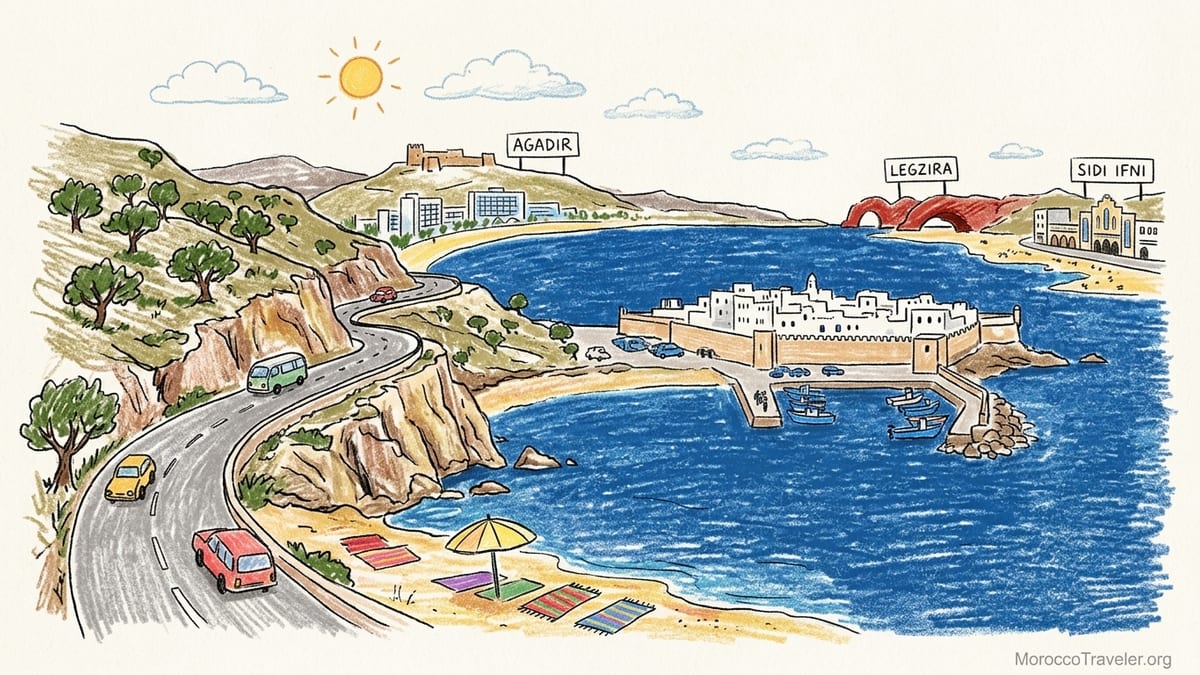
The Atlantic coastline of Morocco is one of North Africa’s most rewarding road trip routes. Between Casablanca and Sidi Ifni you move from historic port towns to oyster farms, surf beaches, ochre ramparts and red sea cliffs, all framed by the constant crash of the Atlantic. This guide focuses only on the coast, avoiding the classic combination with Marrakesh or the Sahara, and instead goes deep into El Jadida, Oualidia, Safi, Essaouira, Agadir and the smaller surf and fishing towns further south.
How to Plan an Atlantic Coast Road Trip in Morocco
The Atlantic coast between Casablanca and Sidi Ifni is straightforward to drive, with a mix of toll motorways, national roads and coastal stretches. Casablanca to Essaouira is roughly 360 kilometres and about 4.5 hours by the fastest inland route, while Agadir to Essaouira is about 180 kilometres and around 3 hours on the coastal N1. Slower shoreline sections between El Jadida, Oualidia, Safi and Essaouira add time but deliver sea views, villages and access to beaches that you would miss on the motorway.
For car rental, recent checks at Casablanca Mohammed V Airport on 26 October 2026 show small cars advertised from around 240 to 260 dirhams per day with basic insurance and unlimited mileage, and a midrange compact in the 600 to 700 dirham range when booked at short notice in mid-season. One-way drop fees for picking up in Casablanca and dropping in Agadir or Marrakesh often add 600 to 1,200 dirhams, so keeping your start and end points the same will usually bring the total down.
Fuel prices have fluctuated in 2026, with media reports of several increases during the spring. By late 2026 many travellers report paying roughly 13 to 15 dirhams per litre of petrol or diesel, so you can budget around 1,000 to 1,300 dirhams of fuel for a 1,200 to 1,500 kilometre coastal circuit in a small or mid-size car. Motorway tolls between Casablanca and Agadir add roughly 200 to 300 dirhams if you use the fast routes; the classic coastal N1 between El Jadida, Safi, Essaouira and Agadir is toll-free.
Accommodation and food along the coast cover all budgets. Simple guesthouses in places like El Jadida, Oualidia or Mirleft can cost 250 to 450 dirhams for a double, midrange riads and modern hotels in Essaouira or Agadir often sit around 700 to 1,200 dirhams, and higher-end seafront stays or stylish eco-lodges can range from 1,800 dirhams up to several thousand. Meals in local seafood grills or simple cafés often range from 40 to 80 dirhams for tagines or grilled sardines, while a seafood platter for two in Oualidia or Essaouira might cost 250 to 400 dirhams depending on the catch.
7-Day Coastal Itinerary: Casablanca to Agadir
This one-week itinerary focuses on the stretch between Casablanca and Agadir, passing via El Jadida, Oualidia, Safi and Essaouira. It assumes a round-trip starting in Casablanca with a rental car and keeps daily driving manageable, usually 2 to 4 hours, to allow time for walking medinas, tasting seafood and exploring the beaches.
Day 1: Casablanca to El Jadida | Driving: about 100 km, 1.5 hours via A3 or N1. Collect your car at Casablanca airport or city, then head south for El Jadida. The motorway is faster and easier, but the N1 gives a first taste of the coast around Dar Bouazza and Azemmour. In El Jadida, your stop is the UNESCO-listed Portuguese City, a compact fortified quarter with thick sea walls and the famed cistern with its reflections of the vaulted ceiling. Stay inside or just outside these walls to be able to walk everywhere. Budget around 600 to 1,000 dirhams for a midrange hotel in or near the old town, 300 to 450 dirhams for a basic guesthouse and 1,500 dirhams or more for a restored riad with sea views. Daily spending, including food and fuel, often lands around 900 to 1,400 dirhams for two people.
Day 2: El Jadida to Oualidia | Driving: about 80 km, 1.5 to 2 hours on the coastal N1. Take the slower coastal road via Azemmour rather than rejoining the motorway, as this section hugs the Atlantic cliffs and offers detours to beaches and viewpoints. Oualidia itself sits beside a protected lagoon separated from the ocean by sandbanks. The calm water, shellfish farms and soft beaches make it one of Morocco’s most relaxing coastal stops. Kayak rentals, small boat tours around the lagoon and birdwatching are the main activities, alongside tasting locally farmed oysters and clams at casual seaside cafés. A basic room in town may cost 300 to 500 dirhams, while lagoon-front boutique hotels and ecolodges can range from 1,200 to 2,500 dirhams. With meals and activities, a realistic daily budget is 1,000 to 1,800 dirhams for two.
Day 3: Oualidia to Safi | Driving: about 65 km, 1.5 hours via N1. Continue on the coast road to Safi. The scenery becomes wilder, with high cliffs and stretches of empty beach, and this is a section where staying on the coastal N1 rather than diverting inland truly adds value because of the views and small fishing villages. Safi is less polished than Essaouira or Agadir but famous within Morocco for its pottery district, where you can visit workshops, see traditional kilns and buy ceramics directly from the makers. The old kasbah and clifftop viewpoints above the port are worth a late-afternoon stroll. Expect to spend 250 to 450 dirhams for a simple central hotel or 700 to 1,000 dirhams for a more comfortable seafront property. Daily costs, including food and some souvenir shopping, usually fall between 900 and 1,500 dirhams for two.
Day 4: Safi to Essaouira | Driving: about 125 km, 2 to 2.5 hours via N1 expressway. This is one of the most scenic coastal drives of the trip. The N1 here is a designated express route that still feels like a coastal road, bending past cliffs, beaches and argan-covered hills. Taking a faster inland detour would save little time and cost you the best views, so stick to the shore. Arrive in Essaouira by midday if you leave Safi early. The walled medina, sea bastions and fishing port are the main attractions, with blue boats, gnawa music venues, art galleries and windy ramparts facing the Atlantic. For accommodation, budget travellers can find simple guesthouses from 250 to 450 dirhams, midrange riads within the medina run around 700 to 1,200 dirhams, and stylish courtyard hotels or seafront suites reach 1,500 to 2,500 dirhams. Plan to spend one or preferably two nights here; for the 7-day version you will stay two nights.
Day 5: Essaouira at leisure | No long driving. Spend the day wandering the medina’s lanes, walking the Skala de la Ville ramparts, watching the fish arrive in the small port and riding or walking along the long beach south toward Diabat. Essaouira is also a convenient place to book surf lessons or kitesurfing sessions, though the wind can be strong, especially from spring to autumn. Local restaurants offer excellent grilled fish; a simple lunch at the port might cost 80 to 120 dirhams per person, while a dinner in a comfortable medina restaurant with wine for two could reach 300 to 500 dirhams. Including accommodation and incidental shopping, daily costs for two people often land between 1,200 and 2,000 dirhams depending on your hotel category.
Day 6: Essaouira to Agadir via coast | Driving: about 180 km, 3 to 3.5 hours via N1 and Taghazout. South of Essaouira you can stay on the N1 along the shoreline rather than heading inland toward the A3 motorway. This section offers sweeping ocean views, argan cooperatives and beach towns like Tamri and Taghazout, one of Morocco’s best-known surf hubs. If you stick to the coast, allow time for at least one coffee stop in Taghazout and possibly a walk along the beach. In Agadir, modern seafront hotels line the bay. Budget options in town start around 300 to 500 dirhams, midrange seafront hotels often sit between 900 and 1,500 dirhams, and upscale resorts can rise over 2,500 dirhams. Add 300 to 600 dirhams for food and incidentals for two.
Day 7: Agadir beach time and departure | Minimal driving aside from the airport or return to Casablanca. Use your final day for a relaxed beach walk along Agadir’s long crescent bay, a visit to the hilltop kasbah overlooking the city, or a taxi trip to nearby villages. If you must return the car to Casablanca, it is about 460 kilometres and 5 to 6 hours via the inland motorway. A realistic overall spending estimate for the entire 7-day trip for two people, sharing a car and choosing midrange accommodation, is in the region of 11,000 to 16,000 dirhams, covering rental, fuel, tolls, parking, lodging, food and basic activities.
Extending to 10 Days: Taghazout, Mirleft, Legzira and Sidi Ifni
With three additional days you can extend the trip beyond Agadir into a quieter stretch of coast that many travellers never see. This southern section takes you past Taghazout’s surf breaks and south to Mirleft, the red cliffs of Legzira and the old Spanish outpost of Sidi Ifni. It suits travellers who are happy with simple infrastructure, are not in a rush and want more dramatic landscapes.
Day 8: Agadir to Taghazout and on to Mirleft | Driving: Agadir to Taghazout about 20 km, 30 minutes; Taghazout to Mirleft about 120 km, 2.5 hours. You can visit Taghazout as a half-day stop or stay the night if you prefer a surf-town atmosphere. The short drive from Agadir hugs the bay and passes smaller beaches. North of Taghazout, some sections are built up with surf camps and cafés, but the mood remains relaxed outside peak holiday periods. Continuing south past Agadir, the N1 follows the coast through fishing villages and headlands. Mirleft has become a low-key favourite thanks to its cliff-backed beaches and mellow cafés. Basic guesthouses and surf lodges cost around 250 to 500 dirhams per night, with midrange small hotels perhaps 700 to 1,000 dirhams. Daily costs including food and fuel are often 900 to 1,600 dirhams for two.
Day 9: Mirleft, Legzira and Sidi Ifni | Driving: short hops, Mirleft to Legzira about 20 km, 25 minutes; Legzira to Sidi Ifni about 15 km, 20 minutes. The coastal road between these three points is one of the most beautiful of the entire trip, with steep cliffs, red and ochre rock formations and deserted beaches. Legzira is known for its sea cliffs and stone arches, and while storm damage has affected some famous arches in the past, it remains a spectacular place for a long shoreline walk at low tide. Sidi Ifni, a former Spanish enclave, retains art deco facades and a slightly sleepy atmosphere around its hilltop square. You can base yourself in Mirleft or Sidi Ifni and visit the other spots as day trips. Simple hotels are widely available from 250 to 500 dirhams; more stylish seafront guesthouses can reach 900 to 1,400 dirhams. Daily spending for two might sit between 900 and 1,700 dirhams depending on your choices.
Day 10: Return north to Agadir or onward travel | Driving: Sidi Ifni to Agadir about 180 km, around 3.5 hours via N1. To end the 10-day itinerary, drive back to Agadir for a final night or connect inland if you plan to continue to Taroudant or the Anti-Atlas. If you need to reach Casablanca quickly, you can drive from Agadir to Casablanca in roughly 5 to 6 hours on the toll motorway, adding around 200 to 250 dirhams in tolls. For a full 10-day circuit for two people in a midrange style, a realistic budget lands somewhere around 16,000 to 22,000 dirhams.
Rabat and Asilah, popular stops further north, work better as the focus of a separate coastal short break of three to four days, linked to Tangier, rather than being bolted onto this Casablanca to Sidi Ifni route. Trying to include them within a single 7-day trip will reduce time in the historic Portuguese City of El Jadida, the lagoon at Oualidia or the medina of Essaouira, which are the main highlights of this particular section of coast.
Driving vs Motorways: Choosing the Best Roads
Between Casablanca and El Jadida you can choose the A3 motorway or the N1. The motorway is faster and smoother, saving perhaps 20 to 30 minutes, and can make sense if you pick up your car late in the day or after a long flight. If you have daylight and want a softer start, the N1 allows detours to beaches near Dar Bouazza and Azemmour and gives more of a sense of leaving the city behind. South of El Jadida, the real coastal character begins, and taking the coastal N1 rather than jumping inland to the motorway is where the slower route really pays off.
From El Jadida through Oualidia and on to Safi the N1 rolls past fields, dunes and stretches of sea. You share the road with local traffic, including trucks and farm vehicles, and average speeds drop, which means you should not plan more than 60 to 70 kilometres per driving hour once stops are included. In return you can pull over at viewpoints, visit small fishing ports, or stop at roadside grills serving grilled sardines or fish tagines for 50 to 80 dirhams. The same is true between Safi and Essaouira, where the express N1 still tracks close enough to the shore that you regularly glimpse the Atlantic.
Between Essaouira and Agadir, you face a clearer choice. Staying on the coastal N1 provides access to surf spots, argan cooperatives and beach towns like Taghazout, with journey times in the 3 to 3.5 hour range. Cutting inland toward the main motorway via Chichaoua and then back to Agadir is somewhat faster but removes almost all sea views and becomes more of a functional transfer than a road trip. For a holiday focused on the Atlantic, the coastal route is strongly recommended in both directions.
Further south toward Mirleft and Sidi Ifni, the N1 again hugs the coast. Both the scenery and traffic conditions encourage unhurried driving, with plenty of curves and occasional livestock near the road. It is not a good place to drive at night, so plan to arrive at your next base before sunset, especially outside summer when days are shorter. Most coastal hotels and guesthouses along this stretch offer free or inexpensive parking, occasionally with a small nightly charge of 20 to 40 dirhams in tighter historic quarters like Essaouira’s medina-adjacent streets.
Costs, Car Rental, Insurance and Practicalities
Car rental agencies at Casablanca airport and in the city include both international brands and Moroccan companies. In late 2026, aggregators comparing more than 400 offers at Casablanca airport report the lowest prices around 230 to 260 dirhams per day for a week-long rental of a small manual car, rising to about 600 to 700 dirhams per day as an average price across all categories when booked close to departure in busier months. Most offers now come with unlimited mileage, and many require only a moderate or no deposit, but terms differ by company so you must check the small print when booking.
Basic insurance, often a form of collision damage waiver with a sizeable excess, is generally included in headline prices. To reduce your excess or cover windows, tyres and underbody damage, you can either buy additional coverage from the rental company, typically for 80 to 200 dirhams per day, or use a separate car hire excess policy bought before travel. When comparing, look carefully at the total cost over 7 or 10 days. For a midrange compact for a week with reduced excess, a realistic full cost might be between 3,000 and 5,000 dirhams depending on season and advance booking.
Fuel prices are liberalised and have risen and fallen during 2025 and 2026, with increases reported in early 2026. By late 2026, paying around 13 to 15 dirhams per litre is a reasonable working assumption for road-trip budgeting. A complete 10-day road-trip from Casablanca to Sidi Ifni and back to Agadir or Casablanca can cover roughly 1,400 to 1,700 kilometres. In a compact gasoline car averaging 6 to 7 litres per 100 kilometres, that means about 90 to 120 litres of fuel, or an estimated fuel cost of roughly 1,200 to 1,800 dirhams. Motorway tolls between Casablanca, Marrakesh and Agadir, if used, add about 200 to 300 dirhams; sticking to the N1 and other non-toll roads largely removes this expense.
Parking is usually included or inexpensive along the coast. Medinas and beach promenades often have guarded parking areas where attendants charge a small daily or overnight fee, commonly 20 to 40 dirhams. In Essaouira, for example, you typically leave the car in the guarded lots outside the walls and walk into the pedestrian medina, while in Agadir many modern hotels have private parking under or behind the building. In smaller towns like Oualidia, Mirleft or Sidi Ifni, guesthouses often provide street-side parking in front of the property, occasionally with an informal local guard in exchange for a small tip.
One-way rental fees can be a significant hidden cost. Dropping the car in a different city from where you collected it within Morocco often adds a flat fee in the range of 600 to 1,200 dirhams, depending on the distance and company. If you plan a pure coastal route starting and ending in Casablanca, returning the car there is usually best value. If you want to finish in Agadir and fly out, build that extra charge into your budget calculations.
Doing the Route Without a Car
You can follow most of this Atlantic itinerary using trains, buses and private transfers, though you will need to be selective with stops. The coastal railway serves Casablanca and El Jadida directly, with frequent trains taking roughly 1 hour 20 minutes. Buses and long-distance coaches link El Jadida with Safi and Essaouira, but Oualidia is most easily reached by regional buses or shared grand taxis from El Jadida or Safi, which means a bit more effort with luggage.
From Casablanca to Essaouira without a car, many travellers either take a direct long-distance bus, taking around 6.5 to 7.5 hours, or combine train and bus. For example, you can take a train from Casablanca to El Jadida, spend a night exploring the Portuguese City, then continue south by coach to Safi and Essaouira. Companies running the main routes change schedules fairly often, so it is important to check current departure times a few weeks before travel and again the day before each leg, either online or at the station.
South of Essaouira, buses and grand taxis run to Agadir along the N1, passing through or near coastal towns. Agadir itself is a major hub, with bus connections to Mirleft, Tiznit and Sidi Ifni. For more flexibility between smaller surf towns or to time sunset visits to spots like Legzira, private transfers booked through guesthouses or local agencies are very useful. Prices depend on distance and vehicle size, but as an example, a private transfer between Essaouira and Agadir for two to four people can cost in the range of several hundred dirhams, while longer custom itineraries that include multiple stops will be higher.
Travelling this route without a car generally increases journey times but reduces logistical stress for those who are uncomfortable driving. It also removes the need to worry about parking, tolls and one-way rental fees. If you plan a 7-day trip by public transport, choosing a smaller number of bases is sensible. A workable non-driving plan might focus on Casablanca, El Jadida, Essaouira and Agadir, with optional day trips from each base arranged through local agencies or taxis. For 10 days, you can add Mirleft or Sidi Ifni, but you will need to be comfortable with long bus rides and timetable changes.
The Takeaway
For travellers with a week, the 7-day Casablanca to Agadir itinerary concentrates on the strongest highlights of Morocco’s central Atlantic coast. You get the UNESCO-listed Portuguese City at El Jadida, the calm lagoon and seafood culture of Oualidia, the pottery kilns and clifftops of Safi and the whitewashed medina and ramparts of Essaouira, before finishing on the beach in Agadir. Distances are manageable, you avoid rushing, and you still experience a clear progression in landscapes and atmosphere.
With 10 days, continuing south beyond Agadir to Taghazout, Mirleft, Legzira and Sidi Ifni creates a more complete sense of the Moroccan Atlantic. The red cliffs and quieter beaches here are a contrast to the more visited central coast, making the additional driving worthwhile for those who value space, scenery and small-town rhythms. If you are deciding between the two, the 7-day version is more realistic for first-time visitors who also want time to enjoy their hotels, while the 10-day route suits repeat visitors or travellers who prioritise wild coastlines and are comfortable with extra hours behind the wheel.
Whichever version you choose, this is a road trip where the slower seaside routes almost always repay the extra time with better views, easier stops and more contact with everyday coastal life. Rather than squeezing in imperial cities or the Sahara, staying focused on the Atlantic between Casablanca and Sidi Ifni allows the trip to breathe, and lets the changing light on the ocean become the main thread running through your journey.
FAQ
Q1. Is it safe to drive the Moroccan Atlantic coast between Casablanca and Sidi Ifni?
Driving the Atlantic coast is generally considered safe for careful drivers who are used to two-lane roads, but you must watch for slow trucks, pedestrians, animals and occasional potholes. Avoid driving after dark on rural stretches, stick to speed limits, and use guarded parking in towns and medinas for extra peace of mind.
Q2. How much should I budget per day for a Morocco coast road trip?
For two people sharing a rental car and staying mostly in midrange accommodation, a common daily budget is roughly 1,600 to 2,200 dirhams, including car rental, fuel, basic insurance, accommodation, meals and small activities. Travelling on local buses and choosing simple guesthouses can bring this closer to 900 to 1,300 dirhams per day for two.
Q3. Do I really need a car, or can I rely on buses and trains?
You can follow much of the route using a mix of trains, long-distance buses and grand taxis, especially between Casablanca, El Jadida, Safi, Essaouira and Agadir. However, having a car gives you far more flexibility to stop at viewpoints, visit quieter beaches and reach smaller places like Oualidia, Mirleft or Legzira without depending on infrequent services.
Q4. When is the best time of year for this Atlantic coast itinerary?
Spring from March to May and autumn from late September to November are generally the most comfortable times, with mild temperatures and lower chances of heatwaves inland. Summer brings sea breezes that keep the coast cooler than the interior but can make Essaouira and some surf spots very windy, while winter is quieter and often pleasant, though rain and Atlantic storms are more likely.
Q5. Can I swim along the Atlantic coast, or are currents too strong?
You can swim in many places, especially in the sheltered lagoon at Oualidia and on main beaches with lifeguards, but the Atlantic often has strong waves and currents. Always check local conditions, respect flags and lifeguard advice where present, and be cautious on more remote beaches where there is no supervision or rescue service.
Q6. Are automatic rental cars easy to find in Casablanca?
Automatic cars are available but form a smaller share of fleets than manual vehicles, and they are usually more expensive. If you need an automatic, book as far in advance as possible and confirm the transmission type on your voucher, especially during school holidays and peak travel weeks when demand is higher.
Q7. How many hours a day will I spend driving on the 7-day and 10-day itineraries?
On the 7-day itinerary, most driving days involve around 2 to 3 hours behind the wheel, with only one or two days reaching 4 to 5 hours if you include a return to Casablanca. On the 10-day version that continues to Sidi Ifni, you add a couple of longer coastal legs of around 3.5 hours, but there are also days with only short hops between nearby towns.
Q8. Do I need an international driving permit in Morocco?
Many visitors drive using their home country licence, and rental companies often accept this if it is printed in Roman script and still valid. However, some travellers prefer to carry an international driving permit in addition to their licence to avoid any doubt during police checks, and it is a relatively easy and inexpensive document to obtain before travel.
Q9. Is it easy for vegetarians or vegans to eat along the coast?
Seafood dominates many menus, but vegetarians can usually find vegetable tagines, salads, omelettes and couscous with vegetables. Vegans have a smaller selection and may need to explain their requirements carefully, but simple dishes such as lentil or bean stews, vegetable tagines and salads are commonly available, especially in more tourist-oriented towns like Essaouira and Agadir.
Q10. Should I try to include Rabat and Asilah on the same trip?
Rabat and Asilah are rewarding destinations further north and work well as part of a separate short break linked to Tangier. Trying to combine them with a single 7-day Casablanca to Agadir or Sidi Ifni itinerary usually forces you to rush and reduces time in core coastal stops like El Jadida, Oualidia, Safi and Essaouira, so it is better to focus on one coastal section per trip.