


The first time I drove south out of Agadir before sunrise, the city was still rubbing its eyes. The neon of the beachfront hotels faded in the rear-view mirror, and the road climbed gently above the last resort blocks. Within twenty minutes the soundtrack changed from beach bar bass to the low rumble of trucks and the call to prayer from villages tucked back from the highway. I remember rolling down the window, smelling dust and sea salt at the same time, and realizing that this was the point where the Moroccan Atlantic stops trying to entertain everyone and simply becomes itself.
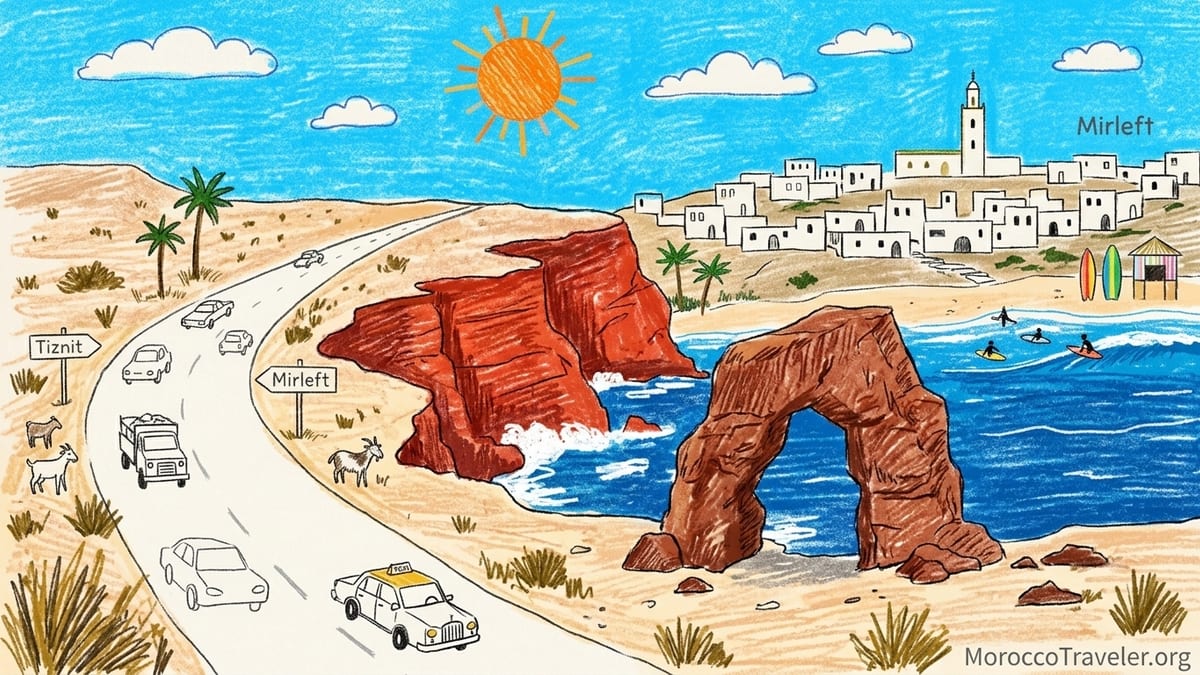
Leaving Agadir: From Resort Strip to Open Atlantic
Leaving Agadir by car feels like exiting one Morocco and entering another. The city’s palm-lined corniche and wide, ordered avenues give way surprisingly quickly to the utilitarian rhythm of the N1 highway. Signposts for Tiznit appear within minutes, and once you clear the last roundabouts, the traffic thins. Long-haul trucks share the road with battered grand taxis and the occasional rental car with an unfamiliar foreign plate. The ocean is somewhere off to the right, unseen but unmistakable whenever the wind shifts and the air tastes of brine.
The official distance from Agadir to Mirleft is roughly 120 to 130 kilometres, depending on where you start in the city, and most local guides now quote a driving time of about two hours in normal conditions. The road is paved and in good shape, with a fast expressway section toward Tiznit and more relaxed two-lane stretches beyond. Police speed checks appear at town entrances, so it pays to follow local traffic rather than trying to make up time. If you are used to driving in Southern Europe, the rhythm feels familiar: a mix of patient truck overtakes, sudden scooters joining from side roads, and the occasional wandering goat.
What stays with me from that first drive is the steady stripping away of urban gloss. Agadir’s hotel towers shrink behind you. The billboards thin out, then disappear. You begin to see open, scrubby hills cut by dry riverbeds and, every so often, a glimpse of white surf under cliff edges. When the road finally bends closer to the sea, around Aglou and the approach to Mirleft, the landscape feels both bigger and emptier. It is not showy scenery. It is long views, low villages, and the sense that the Atlantic has more room to breathe down here.
Route Options: Tiznit, Aglou and the Coastal Road
The classic route runs from Agadir to Tiznit on the N1, then out toward the coast and down through Aglou to Mirleft, Legzira and Sidi Ifni. Recent driving guides put Agadir to Legzira at around 155 kilometres, with Agadir to Mirleft at roughly 125 kilometres and Agadir to Sidi Ifni about 170 kilometres, depending on which coastal deviations you take. In practice, that translates to about two hours to Mirleft, two and a half to Legzira, and just under three to Sidi Ifni for an unhurried driver.
Road quality has improved over the past few years. The expressway between Agadir and Tiznit is smooth and straightforward, with petrol stations, cafés and service areas at regular intervals. South of Tiznit the route narrows to a standard two-lane road that clings closer to the coastline. You still find paved surfaces and lane markings, but with sharper bends, more local traffic and the occasional section where the tarmac feels a little patched. It is not an off-road adventure. It is, however, the kind of road where you slow down out of both caution and appreciation.
Fuel logistics are simple if you plan ahead. Filling up in Agadir or Tiznit removes any anxiety. There are stations at the edge of Tiznit and smaller ones dotted in the direction of Mirleft and Sidi Ifni, but they can be basic and occasionally busy. On my last trip in 2026, a full tank from Agadir was more than enough for the return journey as long as I topped up lightly in Tiznit on the way back. Mobile navigation apps plot the route clearly, yet I still found that watching for physical signs to “Tiznit,” “Aglou Plage” and “Mirleft” mattered once cell coverage dipped along the cliffs.
If you want a slower, more coastal approach, one variant leaves the N1 earlier to drop toward Tifnit and the smaller seaside communities, before reconnecting with the main road near Tiznit. That route adds time and a few rougher stretches but offers more glimpses of empty beaches and roadside tajine stands. For a first visit, though, the straightforward N1 to Tiznit and on to Aglou and Mirleft remains the most relaxed and predictable choice.
Mirleft: Low-Slung Village, High Atlantic Energy
Mirleft appears almost by surprise. After a series of modest headlands and dry valleys, the town spills over a low hill between the main road and the ocean. The centre is compact: a crossroads, a mosque, a cluster of cafés with plastic chairs facing the traffic, a few grocery shops, bakeries, and hardware stores that seem to sell everything from surf wax to gas canisters. Above it all, the crumbling shell of an old French fort looks out toward the Atlantic, a reminder that this coast has long been watched but rarely crowded.
Beaches are Mirleft’s real draw. Instead of one central stretch of sand, there is a chain of coves and bays on both sides of town. Plage Mirleft sits closest, a gentle arc of sand beneath low cliffs where families picnic at weekends and beginner surfers take first lessons. A few minutes’ drive south lies Imin Turga, more exposed and wilder, with heavier waves and fewer facilities. To the north, beaches like Aftas and Sidi El Ouafi catch different wind and swell angles, so on days when one bay is blown out, another can be clean. Surfers I met on my last visit talked casually of “seven beaches within ten minutes’ drive,” each with its own personality.
The village atmosphere is relaxed but not polished. Mirleft is not a resort with a promenade. It is a working Moroccan town that happens to sit above remarkable coastline. There are small guesthouses, surf lodges and a handful of more design-conscious riad-style stays. On recent price checks, simple rooms in local guesthouses started around 300 to 400 dirhams per night for a private double, rising to 600 or 700 dirhams for sea-view rooms with a pool or more refined decor. A couple of long-established guesthouses near the cliff edge charge more but repay it with Atlantic panoramas at breakfast and the sound of surf rolling in after dark.
Surf culture is firmly embedded. Several schools based in and around Mirleft now advertise two to two-and-a-half hour lessons, often including transport to whichever beach suits the day’s conditions. In 2026, published prices for group lessons typically cluster around 350 to 450 dirhams per person, including board and wetsuit, with private coaching costing more. Over a tajine of sardines in the small market, I met a French-Moroccan instructor who described Mirleft as “where Taghazout was fifteen or twenty years ago,” meaning a place still grounded in local life, with enough visitors to sustain surf businesses but not enough to dominate them.
Eating, Sleeping and the Edges of Comfort in Mirleft
Meals in Mirleft reflect both the sea and the hinterland. In the centre of town, small cafés turn out omelettes, brochettes and mint tea throughout the day for prices that would not surprise anyone used to inland Morocco. A plate of grilled sardines with salad and bread in a simple spot near the souk came to the equivalent of a few euros. In more atmospheric restaurants run by Franco-Moroccan or European hosts, menus tilt toward fusion, with local fish paired with herbs and vegetables from nearby farms. One of those dining rooms, tucked inside a colourful house off the main street, served the best coriander-heavy fish tagine I ate all trip.
Accommodation runs from barebones, surf-hostel mattresses in shared dorms to quietly stylish cliffside villas. I stayed once in a basic but clean family-run hotel just off the main square, where hot water was reliable, the Wi-Fi less so, and the rooftop terrace offered a wide strip of horizon that made up for everything. On another trip I splurged on a guesthouse with a small pool, tiled patios and breakfast baskets heavy with oranges and fresh bread. That shift in nightly budget moved the experience from “unpolished fishing town stopover” to “slow-coast retreat” without leaving Mirleft’s orbit.
Yet it is worth being candid about the limits. Outside the few better-known guesthouses, heating in winter can be minimal, and bathrooms are often compact and functional rather than spa-like. English is spoken in some places but not consistently, so French or basic Moroccan Arabic goes a long way. If you expect the dense restaurant and bar options of Agadir or Essaouira, Mirleft will feel sparse. The upside is quiet nights, skies full of stars and the sense that you are in a real community rather than a resort designed to seal you off from one.
Legzira: Red Cliffs, One Remaining Arch and the Reality of Tides
Driving south from Mirleft, the road leans even more insistently toward the ocean. After thirty to forty minutes of headlands and agricultural plots, a signed turning drops you toward Legzira. The approach is unassuming: a few low buildings, roadside parking, and the sound of surf rolling up from somewhere below. Then the path cuts down a steep slope, and you step onto one of the most visually distinctive beaches in Morocco.
Legzira is famous for its red sandstone cliffs and the natural arch that frames the Atlantic. For years, the iconic postcard view showed two huge arches. Every café wall between Agadir and Western Sahara seemed to carry the image. That picture is now history. One of the arches collapsed in September 2016, leaving a jumbled pile of rock that nature and time are slowly reshaping. Only one main arch remains, standing high and solid-looking where the tide runs in and out beneath it. Many websites still recycle the old double-arch picture without updating the text. Arriving in person corrects that instantly: there is something undeniably beautiful here, but it is no longer the twin-gate spectacle of older guidebooks.
Access is simple but physical. From the parking level, you walk down a steep path or concrete steps to the sand. Small cafés and guesthouses cluster at the base, set directly against the cliffs. At low tide, the beach is broad, and it is possible to walk along the foot of the cliffs to the main arch. Several local guides and online resources stress the importance of timing your visit with the tide. Low tide is a condition for access along the rockier sections, not a guarantee of safety. Sections of the cliff show clear signs of erosion and rockfall. Standing beneath the remaining arch, it is tempting to press in close or linger directly under the span for the perfect photo. Given the history here and the visible cracks in the surrounding rock, I found it more comfortable to admire it from a respectful distance on firm, wet sand.
Swimming at Legzira is for strong, careful swimmers only. The Atlantic here is powerful, with shore breaks and currents that can shift quickly. There are no formal lifeguards on duty during much of the year, and surf schools tend to favour more manageable coves nearer Mirleft for beginner lessons. I contented myself with ankle-deep wading and long, slow walks along the sand, watching local kids skim across the shallows on improvised bodyboards. A mint tea under one of the simple beachfront awnings, with spray drifting through the air and the arch lit orange by late afternoon light, felt more fitting than any bravado in the water.
Sidi Ifni: Faded Spanish Outpost on the Edge of the Sahara
Ten kilometres or so south of Legzira, the road crests one last rise and drops toward Sidi Ifni. From above, the town looks like a tilt-shift model: white and pastel blocks arranged on a plateau above a long, brown beach. Up close, it reveals a strange, compelling mix of Moroccan life wrapped in Spanish-colonial geometry. Sidi Ifni was a Spanish enclave until the late 1960s, administered from Madrid and envisioned as a strategic outpost on the Atlantic. Much of that era’s architecture still stands, repurposed but recognizable, with art deco curves, rounded corners and stylised motifs.
The central square is the clearest expression of that legacy. A large, open plaza sits facing the ocean, framed by low civic buildings with arches and colonnades. A former Spanish administrative building now serves Moroccan purposes, and a once-ecclesiastical structure works as a courthouse. Wandering those streets in late afternoon, with older residents shuffling between cafés and children chasing footballs under colonial-era balconies, felt like slipping into a half-remembered film set. The paint peels in places, and some facades have seen better days, but the overall effect is one of gentle decay rather than abandonment.
Modern Sidi Ifni is quiet. There are cafés along the main streets where a coffee or mint tea costs only slightly more than in Mirleft, and a few restaurants focus on grilled fish, calamari and simple Moroccan staples. Accommodation options are more limited than in Agadir or even Mirleft, with a handful of small hotels and guesthouses offering basic but adequate rooms. On my last stay, I paid the equivalent of around 400 to 500 dirhams per night for a clean double with hot shower and an Atlantic view from a shared terrace. Heating and air conditioning were functional rather than luxurious, but sunlight and sea breeze did most of the work.
The town beach stretches below the plateau, accessible via ramps and steps. It is long and largely empty on weekdays, used more by local families and surfers than by package tourists. Again, swimming requires caution. Waves can be heavy, and currents unpredictable, particularly outside the calmer summer window. A few independent surf coaches now base themselves between Mirleft and Sidi Ifni, offering guiding to experienced surfers seeking less crowded line-ups, but this is not a mass-market surf resort. Sidi Ifni is, above all, a place to sit, watch the light change on the Atlantic and feel time slow down.
Day Trip from Agadir or Overnight in Mirleft?
The numbers tell part of the story. Agadir to Legzira and back in a day is roughly 300 kilometres of driving, much of it on two-lane roads. Several recent itinerary suggestions describe it as doable as a long day trip with an early start, a brief stop in Tiznit, a couple of hours at Legzira, perhaps a quick coffee in Mirleft, then the run back to Agadir before dark. If you are determined, rested and used to long driving days, it is possible.
From my own trips, though, the coastline south of Agadir only shows its character when you slow down. The most satisfying pattern has been to treat Mirleft as a base rather than a waypoint. Arriving from Agadir by early afternoon on day one leaves time to settle into a guesthouse, walk down to the nearest beach for sunset and eat grilled fish in town. Day two can then be devoted to Legzira and Sidi Ifni without the pressure of a long return drive: a morning at Legzira timed to low tide, a lazy lunch facing the cliffs, and an afternoon wander through Sidi Ifni’s art deco streets before heading back to Mirleft for the night.
In practical terms, staying overnight also spreads your spending into a local economy that benefits from longer visits. A typical two-night stay for two people in Mirleft in 2026 might look like this: 800 to 1,400 dirhams for accommodation in a mid-range guesthouse, 300 to 500 dirhams total for a couple of surf or yoga sessions or a half-day coastal walk with local guiding, and perhaps 400 to 600 dirhams for meals across the stay, depending on how often you opt for simple cafés versus sit-down dinners. For travelers used to European resort prices, that makes a slow-coast detour surprisingly accessible.
Attempting it all in one push from Agadir often means spending as many hours behind the wheel as you do by the sea. On my one true day-trip experiment, I found myself checking the time at Legzira rather than watching the tide, calculating the drive back through Tiznit rather than absorbing Sidi Ifni’s quiet streets. The overnight version, by contrast, allowed room for unplanned pauses: a stop at a roadside stall to buy oranges, a detour down a dirt lane just to confirm that, yes, there was another empty beach at the end.
Costs, Safety and Managing Expectations on the South Coast
Budgeting for this stretch of coast in 2026 remains straightforward. Fuel from Agadir to Mirleft and back in a compact rental car sits at the level of a moderate European tank of petrol, helped by Morocco’s comparatively lower fuel prices. Accommodation in Mirleft and Sidi Ifni, as noted, is generally more affordable than in polished resort towns, with many simple guesthouses clustered in the 300 to 600 dirham range for a double room. Surf lessons, where available, tend to fall between 350 and 450 dirhams for a group session of around two hours, including board and wetsuit, with private guidance and multi-day packages scaling from there.
What money cannot buy is guaranteed comfort or safety around the water. The Atlantic south of Agadir is powerful, and lifeguard coverage outside peak summer is patchy. Rip currents, shore breaks and sudden changes in swell are part of the character here. On one windy afternoon at Imin Turga, I watched an experienced local surfer cut short his session and wave a visiting bodyboarder back in from a section where the current had strengthened unexpectedly. The beach itself remained as beautiful as ever, but it reinforced my sense that this coastline rewards humility. Swimming is possible, certainly, but it should be approached with an honest assessment of your own abilities and a preference for caution over bravado.
Tourist facilities are present but modest. You will not find long lines of branded beach clubs or chain hotels. In Mirleft, card payment is increasingly accepted but still not universal, so carrying cash in dirhams is wise. In Legzira, some of the small cafés and guesthouses accept mobile payments or cards, but outages and connection issues are not rare. Sidi Ifni’s offers are somewhat more consolidated, yet many businesses remain family-run operations tuned to local rhythms rather than international expectations. For some travelers, that is precisely the charm. For others expecting slick, turn-key service everywhere, it can come as a surprise.
It is also fair to acknowledge that not every corner lives up to glossy social media images. On my first visit to Sidi Ifni, I arrived with mental pictures of perfectly preserved art deco avenues. In reality, some of the most photographed buildings were partially scaffolded or flaking under the salt air. At Legzira, the shock for first-time visitors who only know the double-arch photographs can be real. Yet these imperfections and absences become part of the story. You are not visiting a curated open-air museum. You are stepping into a real coastline that continues to change, sometimes dramatically and without consulting the tourism office.
The Takeaway
Driving from Agadir to Mirleft, Legzira and Sidi Ifni is less a string of headline sights and more a gradual immersion into Morocco’s quieter Atlantic coast. The urban sprawl of Agadir falls away into scrubland and cliffs, the villages thin out, and the ocean grows louder and more elemental. Mirleft emerges as the natural hub: a small town with enough guesthouses and surf schools to make staying comfortable, but still rooted in local life. Legzira delivers the drama of red cliffs and one stubborn, surviving arch, provided you approach it with respect for tides and erosion. Sidi Ifni adds a layer of history and architectural curiosity, its Spanish-colonial lines fading slowly under Moroccan skies.
If you have two days, spend one night in Mirleft, visiting Legzira as a side trip and leaving Sidi Ifni for another journey. With three days, use Mirleft as your base for two nights, adding a slow afternoon in Sidi Ifni to walk its streets and linger in a café on the square. In every version, the point is not to collect places but to travel at the south coast’s own pace. That might mean fewer swimming hours than you imagined and more time stretched out on a terrace, watching long Atlantic lines roll in. It might involve detours, missed turns and weather that refuses the perfect sunset. Yet if you let the road south of Agadir work on you, kilometre by kilometre, it repays the patience with something rarer than a checklist of sights: a sense of space, salt and silence that follows you long after the city lights reappear in your mirrors.
FAQ
Q1. Is it realistic to visit Mirleft, Legzira and Sidi Ifni in a single day from Agadir?
It is physically possible if you start early and are comfortable with around 300 kilometres of driving, but you will spend more time on the road than at the sea. For most travelers, at least one overnight in Mirleft makes the experience far more relaxed and rewarding.
Q2. How long does it take to drive from Agadir to Mirleft?
In normal conditions the drive takes about two hours, using the expressway section toward Tiznit and then the coastal road. Traffic, police checkpoints and photo stops can lengthen that slightly, so it is wise to allow extra time rather than rushing.
Q3. What is the current situation with the arches at Legzira Beach?
One of the two famous red sandstone arches collapsed in September 2016 and no longer exists, despite older photos still circulating online. A single main arch remains, and visitors can see it at low tide by walking along the beach, ideally keeping a cautious distance from the eroding cliff base.
Q4. Are the roads from Agadir to Mirleft and Sidi Ifni suitable for an inexperienced driver?
The route uses paved highways and normal two-lane roads, so it does not require off-road skills. An inexperienced but confident driver who is used to Southern European conditions should manage fine as long as they avoid driving after dark, respect speed limits and stay alert for sudden entries from side roads and occasional animals on the verge.
Q5. How expensive are surf lessons in Mirleft and nearby beaches?
In 2026, group surf lessons of around two to two-and-a-half hours, including board and wetsuit, typically cost in the region of 350 to 450 dirhams per person. Private coaching and multi-day surf packages are more expensive but remain good value compared with many European surf destinations.
Q6. Is swimming safe on the beaches around Mirleft, Legzira and Sidi Ifni?
Swimming is possible but requires caution. The Atlantic here is powerful, with strong waves and rip currents, and lifeguards are not always present outside peak season. Strong, experienced swimmers who choose sheltered moments and avoid rough conditions tend to fare best, while less confident swimmers are usually safer staying in shallow water or simply enjoying the shore.
Q7. What kind of accommodation can I expect in Mirleft and Sidi Ifni?
Most options are small guesthouses, surf lodges and simple hotels rather than large resorts. Rooms typically offer private bathrooms, basic furnishings and sometimes terraces or sea views. A few properties are more design-focused, with pools and carefully styled interiors, but overall the atmosphere is homely and informal rather than luxurious.
Q8. Do I need to book accommodation in advance, or can I arrive and look around?
Outside peak holiday periods you can often find a room on arrival, especially in Mirleft, where there is a cluster of small guesthouses. During Moroccan school holidays, long weekends or European winter breaks, it is safer to reserve at least the first night in advance so you are not searching in the dark after a day of driving.
Q9. Is there public transport from Agadir to Mirleft, Legzira and Sidi Ifni if I do not want to rent a car?
There are shared grand taxis and regional buses linking Agadir to Tiznit and onward to Mirleft and Sidi Ifni, sometimes with changes along the way. However, services can be infrequent, slower than driving and less convenient for reaching outlying beaches like Legzira, which is why many visitors either rent a car or join a small-group excursion for at least part of the route.
Q10. When is the best time of year to drive this coastal route and visit these towns?
Spring and autumn offer a good balance of manageable temperatures, consistent surf and quieter roads. Winter can bring bigger swells and cooler evenings, appealing to experienced surfers, while summer has calmer seas and warmer water but more domestic visitors. Whatever the season, the key is to watch weather and tide forecasts and to build enough slack into your itinerary to adjust plans if conditions change.