


Morocco’s Atlantic coast has become one of Europe’s favorite winter surf escapes, with direct flights, reliable swell from October to April, and a huge range of surf camps clustered around a few key towns. Yet Taghazout, Tamraght, Aourir, Imsouane, Essaouira and Sidi Kaouki all feel very different in the water and on land. Choosing the wrong base can mean battling point-break crowds when you really wanted cruisy whitewater, or being stuck on a beginner sandbar when you were dreaming of heavy reef and long right-hand walls.
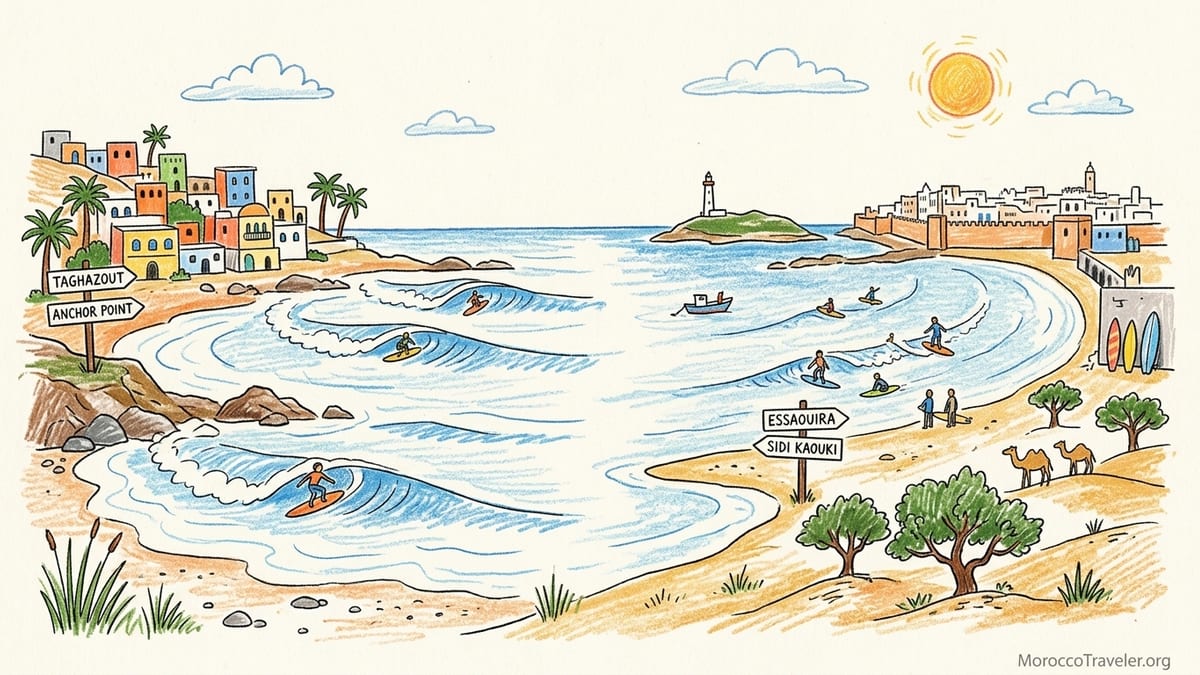
Overview: How Morocco’s Main Surf Hubs Compare
Stretching between Agadir and Essaouira, Morocco’s core surf zone splits naturally into two clusters. Around Agadir airport you have Taghazout, Tamraght and Aourir, a short drive from world-famous point breaks like Anchor Point and Killer Point. Further north, focused around Essaouira airport, are the windier beaches of Essaouira Bay and the more exposed sandbars of Sidi Kaouki. Between these two hubs sits Imsouane, a fishing village built around what many call the longest right-hand point in Africa.
In practical terms this means you can tailor a surf holiday to your level and travel style. Taghazout and Tamraght offer the highest density of surf camps and easy step-up options from beach break to points, which suits ambitious beginners and lower intermediates who want coaching every day. Imsouane is a natural wave machine for longboarders and anyone craving long, forgiving rides. Essaouira and Sidi Kaouki feel more spread out and mellow, combining softer waves, fewer crowds and a medina-city break that appeals to couples and mixed-ability groups.
Flight and transfer logistics also differ. Taghazout, Tamraght and Aourir sit about 45 to 60 minutes’ drive north of Agadir Al Massira Airport, where budget carriers from Europe land daily in the main season. Imsouane is roughly two hours from Agadir or three hours from Essaouira by road. Essaouira is closer to Marrakech than Agadir in airline terms, and Sidi Kaouki lies around 30 to 40 minutes south of the Essaouira medina by car or minibus. These transfer times matter when you compare all-inclusive surf camp packages that include airport pickup against booking rooms and lessons separately.
Wave Types, Seasons and Who Each Area Suits
Morocco’s Atlantic coast is powered by North Atlantic swells that peak from October to April. During this window, long-period groundswell wraps into the right-hand point breaks around Taghazout and Imsouane, producing the classic images of endless walls at Anchor Point and the Bay. The same winter energy can turn open beaches like Sidi Kaouki into powerful, overhead peaks that are far beyond the comfort zone of most first-timers. From late spring through summer, swell drops and periods shorten, which beginners often prefer because waves are smaller and more forgiving.
Around Taghazout, the coastline is a patchwork of points and beach breaks. Anchor Point, Panorama and Killer Point are right-hand reef and point setups that start working properly once the winter swell arrives. Nearby sand-bottom spots such as Banana Beach near Aourir and K11 and K12 along the coastal road give instructors the flexibility to move complete beginners to gentler waves when the main points are too heavy. This is why many Taghazout surf camps advertise “mobile lessons” rather than promising one specific break each day.
Imsouane revolves around two main waves. The Bay is a long, mellow right-hand point that peels along the inside of the harbor and is regarded as one of Morocco’s longest rides, with some sources describing rides of several hundred meters on good days. It suits beginners and longboarders when the swell is not too large. Across the headland, Cathedral is more exposed to swell. It mixes a punchier beach break with a point section that lights up under solid winter swells, making it more suitable for confident intermediates and advanced surfers than for first-timers.
Essaouira and Sidi Kaouki see more wind and more open-ocean energy. The island off Essaouira partly shelters the town beach, so the waves there are usually softer and smaller, especially on lower-swell days. This is why most Essaouira surf schools start novices on the main bay and only run day trips south to Sidi Kaouki when conditions and skill levels allow. Sidi Kaouki’s long, sandy beach and exposed sandbars make it one of the more reliable year-round surf spots in the area, with beginner-friendly options on smaller days and more powerful peaks in the main winter season.
Taghazout, Tamraght and Aourir: Point-Break Energy and Busy Lineups
Taghazout is the original surf town of Morocco’s Agadir region, and it remains a magnet for experienced surfers drawn to Anchor Point, Hash Point and nearby breaks. In peak winter swells, Anchor Point can produce hollow take-offs and fast walls that run along a rocky ledge, suiting shortboarders and advanced longboarders with strong positioning and paddle fitness. When these points are firing, surf camps do not usually teach complete beginners there, both for safety and to avoid adding extra crowds to already busy lineups. Instead, vans shuttle learners to softer sand-bottom spots according to the day’s tide, wind and swell.
Tamraght and Aourir sit just south of Taghazout, effectively sharing the same stretch of coastline but offering a quieter base. Tamraght has several mid-range guesthouses and surf houses that include rooftop breakfasts, daily coaching and yoga on the terrace. Aourir, often called Banana Village, is more of a local market town with surf lodges sprinkled between fruit stalls and tajine cafes. From these villages, instructors commonly drive guests to Banana Beach, Devil’s Rock, Panorama or K11, choosing breaks with deeper channels and gentler whitewater for lessons.
Surf-camp pricing in this southern cluster varies from budget to boutique, but recent comparisons of Taghazout and Tamraght camps indicate that a basic one-week package in a shared dorm with group lessons and breakfast often starts in the region of 350 to 400 euros per person, with more established brands and hotel-style stays closer to 500 to 600 euros for a week depending on room type and season. These packages typically bundle accommodation, daily surf guiding or lessons, equipment hire and beach transfers, with optional add-ons like yoga or day trips to Paradise Valley.
Crowding is the main trade-off. In peak season, the lineup at Anchor Point can be packed with visiting intermediates, local hotshots and surf-camp guests vying for limited take-off spots. Reputable schools manage this by limiting group sizes and maintaining low instructor-to-student ratios, particularly for beginners and kids. It is common to see ratios of around one instructor to four to six students in group lessons, and asking specifically about maximum group size and whether separate groups are run by level is essential before you book.
Imsouane: Long Rides, Two Very Different Breaks
Imsouane’s reputation rests on the Bay, a sand and rock point where swell wraps into the harbor and peels for long distances. On smaller to medium winter swells, waves here are slow, rolling and incredibly forgiving, allowing learners to stand up, adjust stance and practice turns on the same wave rather than constantly paddling back out. Longboarders, in particular, prize the Bay for its length and the way it continues to reform down the line, often allowing nose-riding and cross-stepping sections that are rare on more powerful points.
Cathedral, on the opposite side of the peninsula, feels entirely different. Facing more directly into the Atlantic, it combines a punchier beach break with a point section that benefits from stronger swell. Waves are faster and steeper, and rip currents can be more pronounced, which is why many surf schools in the village reserve Cathedral for returning guests and more experienced students. Some operators explicitly describe a progression model where first lessons run in the inside section of the Bay, with later sessions moving to Cathedral once students show consistent take-offs and control.
Lesson structure in Imsouane tends to be more time- and tide-dependent than in the Agadir area. Several local schools advertise sessions around two to two and a half hours door to door, including beach briefing, in-water coaching and post-session feedback. Boards and wetsuits are generally included, and spot transfers between the Bay and Cathedral are bundled into the price. Because the Bay is very tide-sensitive, instructors often confirm exact start times the evening before, which can be an adjustment if you are used to fixed lesson schedules in other destinations.
Accommodation here remains more low-rise and relaxed than in Taghazout. Surf houses and small camps group around the harbor and hillside, often with simple rooms, communal dinners and shared terraces rather than hotel-style amenities. Weekly surf-camp packages in Imsouane commonly include six nights’ accommodation, breakfast and dinner, daily surf coaching, equipment, and transfers between the two main breaks, with private-room packages for solo travelers or couples generally landing somewhere in the mid-range bracket between budget Taghazout dorms and premium Essaouira riads.
Essaouira and Sidi Kaouki: Wind, Space and Softer Vibes
Essaouira offers a very different feel from Taghazout or Imsouane. The town is a walled Atlantic port with a lively medina, seafood stalls and a broad, crescent-shaped bay. Because offshore islands shelter part of the bay, the surf in front of town is usually smaller and less powerful, making it a natural classroom for first pop-ups and whitewater practice on soft-top boards. Several local surf schools operate directly from the sand, running half-day group lessons that bundle board, wetsuit and instruction in the shore break.
Once beginners are standing consistently, or when the swell drops in summer, many operators switch focus to Sidi Kaouki, around 25 kilometers south of Essaouira. Here the coastline opens to more swell and the beach is long, sandy and largely undeveloped. Surf camps and schools base guests in Sidi Kaouki village or in Essaouira itself and run day trips that include a roughly 30 to 40 minute drive, a two-hour coached session, lunch and supervised free surf in the afternoon. Recent examples of day-trip packages from Essaouira to Sidi Kaouki describe all-inclusive days that run from around 10 in the morning to late afternoon, with equipment, guiding and meals included.
For those who want to commit fully, several surf camps in Sidi Kaouki and Essaouira market one-week packages that include six nights’ accommodation, all meals, daily lessons or guided sessions, equipment, and airport or city transfers. Budget-oriented options for shared or simple private rooms tend to start in the high 300 to mid-400 euro range for a week, with surf-and-yoga retreats or boutique guesthouses asking more, especially if they include riad-style accommodation in the medina. Because the wave energy in this zone can be more variable, it is common for week-long camps to split sessions between Essaouira Bay and Sidi Kaouki based on that day’s wind and swell.
One of the key selling points here is space. Even in winter, Sidi Kaouki’s lineup usually feels far less crowded than the points around Taghazout, simply because the peaks spread along a long beach and most visiting surfers base themselves in Essaouira rather than in the village. This makes it attractive for nervous beginners, solo female travelers and couples who prefer softer social energy. On the flip side, advanced surfers who want guaranteed, mechanical point-break waves every day might find the mix of wind and sandbars less consistent than in the Agadir or Imsouane areas.
Surf-Camp Packages vs Booking Separately
Across all these towns, you face the same underlying decision: book an all-inclusive surf camp or arrange accommodation and lessons separately. All-inclusive packages in Morocco typically cover your room, breakfast and often dinner, daily surf lessons or guiding, equipment hire and daily transport to the best spot of the day. Many camps also include airport pickup from Agadir or Essaouira and occasional extras like yoga or a trip to Paradise Valley. For example, in Taghazout and Tamraght it is common to find week-long camp offers that bundle six days of coaching, shared dorm accommodation and breakfast for somewhere in the mid-hundreds of euros.
Booking separately gives you more control but demands more organization. In Taghazout you might stay in a standalone guesthouse or apartment for, say, a competitive nightly rate, then book individual group lessons at around the market price for two-hour sessions that include board and wetsuit. Over a week, six such lessons can approach or even exceed the price of a budget camp package, especially when you add taxis or rental cars to reach more distant breaks and factor in the cost of meals that would otherwise be included.
In Essaouira and Sidi Kaouki the calculation is similar. A solo traveler could base themselves in a medina riad, paying per-night room rates and joining day trips to Sidi Kaouki at a fixed per-day price that includes a two-hour lesson, equipment and lunch. Over six or seven days that spend often adds up to a similar figure to the more economical all-inclusive camps, which fold meals and airport transfers into a single weekly rate. Several operators openly promote this comparison, arguing that their all-in price undercuts the sum of separate hotel, restaurant, transport and surf-school bills.
For couples, private rooms in camps usually carry a per-person rate that is lower than two solo bookings, since airport transfers and guiding are shared. The main reason to book separately as a pair is if one partner does not surf or wants complete independence from the camp schedule. In that case, a flexible mix of a medina stay in Essaouira, with only a few surf days in Sidi Kaouki or Imsouane, may make more sense than a full week locked into a surf-only program.
Quality of Instruction, Safety and Practical Details
Morocco’s surf industry has grown rapidly, and while much of it is professional, standards do vary. When comparing camps in Taghazout or Imsouane, look beyond the photos and focus on concrete details of instruction and safety. Many reputable operators highlight qualifications from bodies such as the International Surfing Association, as well as Moroccan surf federation accreditation and certified lifeguard training. If qualifications are not clearly stated, it is reasonable to ask who will be teaching you and what formal training they hold.
Lesson length is another key variable. In the Agadir cluster, group lessons are often marketed as around two hours, with some schools specifying one and a half hours in the water plus beach briefing and a warm-up. In Imsouane, several schools advertise slightly longer sessions of around two to two and a half hours including feedback. In Essaouira and Sidi Kaouki, day-trip packages frequently include a two-hour coached block plus additional supervised free surf time. This matters if you want maximum water time or, conversely, if you prefer shorter, more focused coaching blocks to avoid fatigue.
Equipment quality is generally good across established camps. Soft-top boards dominate beginner fleets, backed by a range of modern epoxy shortboards and mid-lengths for intermediates. Wetsuits are usually full-length suits suitable for Moroccan water temperatures in winter. Ask how often suits are replaced, whether booties are available for rockier entries, and if there are smaller boards for lighter surfers and kids. On the beach, look for simple, practical infrastructure: shaded areas for briefings, drinking water, and somewhere to store valuables. In Essaouira, some operators provide lockers at their beach bases as well as storage at the camp or hostel.
Insurance and cancellation terms are easy to overlook but important. Responsible operators carry liability insurance and provide clear guidance on what is and is not covered. For example, a camp might insure its instructors and equipment but expect guests to arrange separate travel insurance that covers surf-related injuries. Cancellation policies vary from strict no-refund windows to more flexible arrangements that allow date changes or partial refunds if flights change or conditions turn unsurfable. Given the Atlantic’s variability, clarifying how a camp handles flat or dangerously large days is worth doing before you pay a deposit.
Costs, Group Sizes and Airport Access: A Practical Comparison
To visualize the trade-offs between these destinations, it helps to compare a few core metrics. Beginner suitability is highest in Imsouane’s Bay and on the smaller days at Essaouira Bay and Sidi Kaouki, followed closely by the beach breaks used by Taghazout and Tamraght camps when winter swells are manageable. Intermediate progression is strongest where you can move naturally from beach break to point, which makes Taghazout, Tamraght and Imsouane attractive, while Essaouira and Sidi Kaouki favor those content to stay mostly on sandbars with occasional steeper peaks.
Advanced breaks cluster around Taghazout and Imsouane. Anchor Point, Killer Point and the heavier days at Cathedral attract experienced surfers seeking power and barrel potential. Lesson availability is most concentrated in Taghazout, Tamraght and Essaouira Bay, where multiple schools run daily groups, with Imsouane and Sidi Kaouki offering a smaller, more local mix of operators. Group sizes differ: established camps often cap beginner groups around six students per instructor, while independent beach schools sometimes work with slightly larger groups, particularly in high season, which can affect individual feedback.
Surf-camp prices remain relatively competitive across the coast. Budget shared-room packages in Taghazout and Tamraght often land in the mid-300 to mid-400 euro range for a week of coaching and breakfast, with more upscale properties charging more. In Imsouane and Sidi Kaouki, week-long rates that include all meals and daily surf typically come out slightly higher per person but include more food and, in some cases, private rooms as standard. Essaouira-based camps that include medina accommodation and day trips to Sidi Kaouki often sit alongside these mid-range figures, reflecting the higher costs of restored riads and city services.
Airport access is straightforward in the Agadir triangle, where most camps sit under an hour from Agadir Al Massira Airport. Imsouane is more remote, requiring roughly two hours’ transfer from Agadir or three from Essaouira, which some camps include in their weekly rate. Essaouira’s surf providers can arrange pickups from Essaouira airport itself, typically under half an hour to the medina, or from Marrakech for a longer overland transfer that might be priced separately. Sidi Kaouki camps usually include transfers from Essaouira town or airport and quote separate rates for pickups in Marrakech or Agadir.
When you convert weekly packages into daily cost, you often find that a solo traveler in a dorm-based surf camp pays less per day than someone booking a riad plus separate lessons, while couples sharing private rooms narrow that gap or undercut it, especially if non-surfing partners use fewer services. Asking for a sample seven-day breakdown that includes room, meals, surf sessions, transfers and equipment is the most transparent way to compare operators side by side.
The Takeaway
Choosing between Taghazout, Tamraght, Aourir, Imsouane, Essaouira and Sidi Kaouki is less about finding a single “best” surf town and more about matching waves, atmosphere and logistics to your level and travel style. Taghazout and its neighboring villages suit ambitious beginners and intermediates who want lots of surf-camp options, access to famous right-hand points, and a busy, social scene. Imsouane is ideal if your dream is unhurried, very long rides in a small village setting with a simple rhythm built around tides and meals. Essaouira and Sidi Kaouki appeal to travelers who want surf balanced with culture, space on the beach and a softer, more relaxed vibe.
For complete beginners, the friendliest introductions usually happen on the Bay in Imsouane, on smaller days in Sidi Kaouki, or on the sheltered sections of Essaouira Bay, with mobile lessons from Taghazout and Tamraght also providing solid options when they choose the right beach. Progressing intermediates who want to step from forgiving walls to more defined point breaks may find the best progression ladder in Taghazout, Tamraght and Imsouane, where coaches can vary spots day by day.
Longboarders are especially well served in Imsouane’s Bay and, on the right days, in the longer walls of Sidi Kaouki and the softer sections of Taghazout-area points. Advanced surfers hunting for stronger point breaks and heavier sections gravitate naturally toward Anchor Point, Killer Point and Cathedral in a solid winter swell cycle, often using surf camps primarily for logistics, guiding and a place to sleep rather than for structured beginner lessons.
Whichever base you choose, the essentials remain the same. Prioritize camps and schools that are transparent about instructor qualifications, group sizes, lesson length and safety. Clarify what is included in any package, from meals and airport transfers to equipment and insurance. Then decide whether you want the community and structure of an all-inclusive surf camp or the freedom of a self-planned stay with lessons added as needed. With that groundwork in place, Morocco’s mix of winter swell, approachable culture and relatively short flight times from Europe can deliver one of the most rewarding surf holidays you can take.
FAQ
Q1. Which Moroccan surf town is best for complete beginners?
For first-time surfers, Imsouane’s Bay, Essaouira’s main beach and smaller days in Sidi Kaouki are usually the most forgiving, with long, rolling waves and plenty of space.
Q2. When is the best season to surf Morocco if I am an intermediate?
From October to April you get more consistent swell and the right-hand points around Taghazout and Imsouane activate, giving intermediates ideal conditions to progress.
Q3. Are Taghazout’s famous point breaks suitable for surf lessons?
Anchor Point and similar breaks are generally too powerful and crowded for first-timers, so reputable schools move beginner lessons to nearby sand-bottom beaches instead.
Q4. How long are typical surf lessons in Morocco?
Group lessons are usually around two hours including briefing, with some Imsouane schools running up to about two and a half hours including feedback and spot transfers.
Q5. Do Moroccan surf camps include boards, wetsuits and transport?
Most all-inclusive camps bundle boards, wetsuits and daily beach transport into the weekly price, and many also include airport pickup from Agadir or Essaouira.
Q6. What instructor-to-student ratio should I look for?
For safety and quality, aim for beginner groups capped around four to six students per instructor and ask camps to confirm their maximum group sizes in high season.
Q7. Is Imsouane really suitable for both beginners and advanced surfers?
The Bay suits beginners and longboarders with long, mellow rights, while Cathedral on the other side of the headland offers faster, more powerful waves for experienced surfers.
Q8. How do prices compare between surf camps and booking separately?
Once you add accommodation, meals, lessons, equipment and transfers, a week in a budget or mid-range surf camp often works out cheaper than arranging everything independently.
Q9. Which area is best for couples who want culture as well as surf?
Essaouira and nearby Sidi Kaouki combine surfable beaches with a historic medina, cafes and galleries, which tends to suit couples and mixed-ability groups.
Q10. Do I need travel insurance that specifically covers surfing?
Yes. Camps usually insure their own operations, but you should carry personal travel insurance that explicitly covers surfing and medical costs in case of injury.