


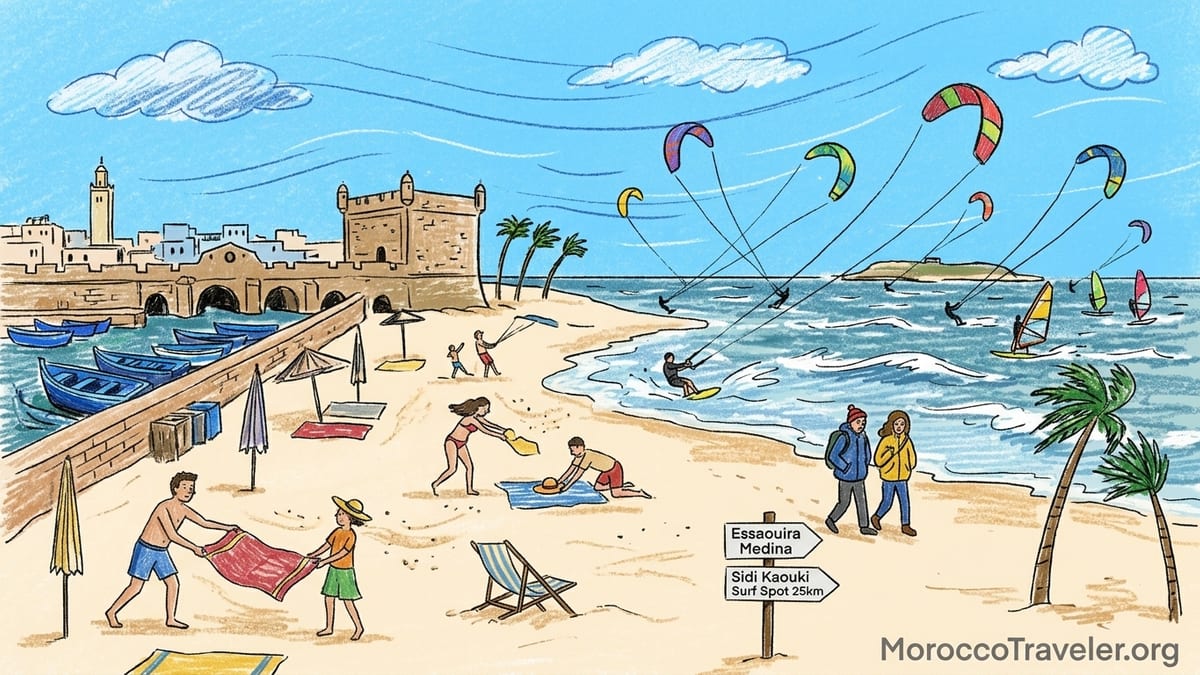
I realised I had misjudged Essaouira the moment I tried to settle on my towel. The Atlantic wind hit harder than it had any right to, driving fine sand into my eyes, my book and the last dry corner of my t-shirt. It was early afternoon in June, the sky was blue, and the air temperature sat in the low twenties Celsius, yet I was zipped into a light jacket, watching kite lines carve the sky while my own beach day plans quietly deflated.
When Your “Sunny Beach Break” Turns Into A Wind Lesson
I had booked Essaouira with a simple image in mind: long, lazy days on a wide sandy bay, swimming without thinking about currents, wandering back to a seafront hotel for sunset drinks. The reality on my first full day was very different. By early afternoon, the famous Alizé trade wind had ramped up, gusting well over 20 knots along the bay. That might sound abstract until you feel it. Sitting on the sand was like being exfoliated against your will. Every attempt to lie back on the towel ended with sand blowing into my ears and between the pages of my book.
The air temperature hovered around 22 to 23 degrees Celsius, which looks pleasantly warm on paper but feels cooler with constant wind and the cold Atlantic current. Even in June and July, the sea off Essaouira usually sits around 18 to 20 degrees, cooled by upwelling from the Canary Current. Locals pulled on full 3/2 or 4/3 wetsuits to surf. I tried wading in wearing only swim shorts and lasted less than a minute before my legs went numb and I retreated, shivering, to the towel I could not comfortably sit on.
What really surprised me was how quickly the conditions changed during the day. Mornings were calmer and almost matched the mellow brochure shots. By around midday, the wind built steadily along the bay, funnelling between land and ocean. Flags along the promenade snapped taut, beach cafés started packing away parasols, and a forest of kites appeared offshore. The moment I saw instructors switch from surfboards to kitesurf gear, I understood that my idea of a classic “lie in the sun all afternoon” holiday did not match the reality of this coastline.
It was not that the weather was bad. The sun shone more often than not, the sky stayed remarkably clear outside the winter months, and the temperatures were pleasantly moderate compared with inland Morocco. The disappointment came from the mismatch between the gentle-sounding climate statistics and what it actually feels like for a regular beachgoer when a strong, cool ocean wind blows almost every afternoon for large parts of the year.
Why Essaouira Is A Dream For Wind Sports And A Challenge For Families
Once I stopped fighting the conditions and watched the water, Essaouira’s strengths became obvious. The bay opens broadly to the Atlantic, with the Island of Mogador and sandbanks only partially breaking the swell. The same wind that sandblasts sunbathers creates textbook conditions for kitesurfers and windsurfers. Local schools explained that they count many days each main season month with usable wind in the 15 to 25 knot range, enough to keep intermediate riders happily powered for long sessions.
From the promenade, the scene in peak season is almost cinematic: dozens of kites arcing over choppy, steel-blue water, riders carving across the bay and launching from kickers formed by the afternoon wind chop. There are several schools along the main beach offering beginner packages with group lessons, gear and rescue support. A common example in 2026 is around 70 to 90 euros for a half-day introductory kitesurf lesson, or 300 to 400 euros for a three-day beginner course, including equipment. For travellers whose main goal is to learn or progress in wind sports, this combination of consistent wind and long, shallow beach is close to ideal.
For families with small children or travellers picturing calm turquoise swimming, it is a different story. Even on mellower days, the water off Essaouira rarely feels warm, especially outside high summer. The chop builds quickly as the wind increases, and while the bay is not a heavy-breaking surf spot, there is usually at least a rolling swell to contend with. Strong side-onshore winds push inflatables and weak swimmers toward the beach rather than out to sea, which is safer in one sense, but standing in waist-deep water with waves slapping your chest and cold spray hitting your face is not everyone’s idea of relaxation.
Child-friendly beach time requires strategy rather than spontaneity. That often means going down early, enjoying an hour or two of milder conditions, then retreating to a café or the medina by midday. For many visitors who booked a seafront hotel at higher cost specifically to maximise beach lounging, that schedule can feel like a poor return on investment, especially when they discover that Essaouira’s real charm lies a ten-minute walk inland among the alleys and cafés of the old town.
Climate Reality: Wind, Temperatures And Seasonality Explained
Look at the long-term climate data for Essaouira and it initially seems gentle. Average daytime highs climb from the mid-teens Celsius in winter to the low-to-mid twenties in summer, with nights remaining comparatively mild. The city’s weather is moderated by the cold Atlantic current, so it almost never reaches the extreme inland heat that cities like Marrakech endure. Official climate normals show summer highs near 22 to 24 degrees, with winter highs still often around 17 to 18 degrees. On paper, that sounds like a comfortable, almost Mediterranean beach climate.
What those numbers do not clearly show is the role of the wind and sea temperature. The upwelling offshore keeps sea surface temperatures low for the latitude, often around 16 to 17 degrees in winter, rising to roughly 19 to 21 degrees in late summer. The combination of cool water and significant humidity can make the air feel fresher than the thermometer suggests. Add a regular afternoon sea breeze that often strengthens to more than 20 knots on many days between roughly April and October, and you get a climate that suits active sports far more than idle basking.
Seasonally, there are subtle differences. Spring and early summer typically see a strong, reliable trade wind pattern, which is why many wind and kite schools suggest April to September as prime time. Winter brings more variability, with some calmer days mixed in, but also cooler air and a higher chance of rain or cloud between November and March. From a pure sun-and-sea perspective, a visitor might target late summer as a compromise, yet even then the wind does not simply switch off for beachgoers’ benefit.
It is important to stress that these are long-term patterns rather than precise predictions. Individual days can be glassy calm or unseasonably stormy at any time of year. I experienced a couple of rare, almost windless mornings in June when the bay looked inviting, and one overcast afternoon when a frontal system muted conditions. However, basing your expectations on the averages means planning for the wind to be there, not hoping to be the lucky exception.
Essaouira Town Beach Versus Sidi Kaouki: Different Flavours Of Exposure
Essaouira’s town beach runs in a generous crescent directly in front of the city. The inner part of the bay benefits slightly from the shelter of Mogador Island and offshore sandbars, which can tame wave size compared with more open stretches. The slope is gentle, so you can wade out gradually, and life on the sand feels busy but civilised: horse and camel rides, football games, surf lessons near the river mouth, and cafés behind the promenade where you can escape the gusts behind glass.
Travel about 20 to 25 kilometres south and you reach Sidi Kaouki, a smaller village facing directly onto the Atlantic with far less interruption between ocean and shore. Various surf and kite resources describe it as a classic wind-and-wave spot, with beach breaks and sandbanks that shift with tide and swell. The same wind that makes Essaouira breezy can feel more intense here, especially in the afternoons, because there is little urban development or headland structure to diffuse it. For confident surfers, kitesurfers and windsurfers, this extra exposure is an advantage.
On practical terms, Sidi Kaouki feels wilder. The beach is broad and open, and although there are cafés and surf schools by the water, there is far less in the way of infrastructure. Surf schools often advise beginners to surf in the morning, when the wind tends to be lighter and the ocean surface smoother. By mid-afternoon, stronger side-shore winds and larger wind chop can make conditions more challenging for learners and less appealing for casual swimmers. It remains a beautiful place to walk or watch the waves, but expecting a sheltered family paddling spot here is a recipe for frustration.
By comparison, Essaouira’s town beach is slightly more forgiving. The wind is still a factor, yet there are more protected corners behind dunes, beach bars and low walls where you can retreat. For non-surfing partners or children, that can make a noticeable difference. Even then, many families I spoke to ended up spending as much or more time exploring the medina, fishing port and city walls as they did sitting on the sand. The beach becomes part of the backdrop to the trip rather than the central attraction.
Is Beachfront Accommodation In Essaouira Really Worth Paying For?
When I booked my trip, I intentionally chose a seafront hotel. The nightly rate was roughly 30 to 50 percent higher than many very decent riads inside the medina, but I justified it as the premium for sunrise walks, easy beach access and evening drinks overlooking the bay. After a week in town, I felt conflicted about that decision. I loved the view from the room, especially at first light when the bay was quiet and mist hovered over the sand. Yet in day-to-day use, I spent surprisingly little time on the actual beachfront.
High wind and blowing sand made long afternoon sessions on the hotel’s sun loungers a battle with grit. The hotel’s own pool area, set slightly back and partially shielded, became far more practical than the beach just below the terrace. Meanwhile, most of my favourite moments in Essaouira took place inside the walls: sipping mint tea in small cafés, watching fishermen mend nets by the port, listening to Gnawa musicians in the square and getting happily lost among blue doors and whitewashed alleys.
There is also a value question. In 2026, comfortable seafront hotels in Essaouira often start somewhere around 90 to 120 euros per night for a double room, with more upscale options climbing well above that. Inside the medina, you can find charming riads with character and excellent breakfasts from roughly 50 to 80 euros per night, sometimes less outside peak periods. If you are unlikely to spend long stretches actually lying on the sand because of wind and cold water, that price difference becomes harder to justify.
For travellers focused on kitesurfing, windsurfing or jogging along the bay, being directly on the seafront can still make sense. Having quick access to the beach, a secure place to store wet gear and the ability to watch conditions from your balcony carries genuine value. For visitors whose main expectation is relaxed sunbathing and swimming, however, I would seriously consider a medina base. You can still walk to the beach in ten to fifteen minutes when the conditions look inviting and otherwise enjoy a more atmospheric, often better-value place to sleep.
Comparing Essaouira With Oualidia And Agadir For Easier Swimming
If your primary goal is comfortable swimming rather than chasing wind or waves, other Moroccan coastal towns offer different trade-offs. Oualidia, several hours north of Essaouira, is built around a sheltered lagoon separated from the open Atlantic by a sandbar and rocky outcrops. Scientific monitoring of the lagoon has recorded surface water temperatures that range from around 15 degrees in winter to more than 25 degrees Celsius in late summer inside the shallow, protected basin. In practical terms, that means the lagoon can feel significantly warmer than the open ocean, particularly from late spring through early autumn.
From a swimmer’s perspective, this makes a big difference. The water inside the lagoon is usually calmer, with only a gentle tidal current in most accessible areas, making it suitable for children and less confident swimmers when conditions are normal. Paddleboards and pedalo rentals line parts of the shore, and you can wade or float without being battered by chop. The downside is that Oualidia is relatively small, and at busy periods Moroccan families from cities like Casablanca and Marrakech flock to the lagoon. Recent traveller reports mention overcrowding and litter issues on sections of the main beach in high season, along with a limited range of evening activities compared with larger towns.
Agadir, further south, offers yet another profile. It sits on a deep, sweeping bay with a long sand beach that is more sheltered than Essaouira’s but still open to Atlantic swells. Official climate data for the Agadir area using NOAA normals show summer daytime highs typically in the mid to high twenties Celsius, with sea temperatures roughly in the 18 to 21 degree range between winter and late summer. The wind is present but tends to feel less relentless than in Essaouira, and the bay often has smaller, more manageable shore break, especially near the central town beach.
For classic resort-style holidays, Agadir has clear advantages: large beachfront hotels, extensive promenades, pools and kids’ clubs, plus more predictably warm air for lying by the water. There are surfing beaches to the north around Taghazout and Tamraght for those seeking waves, and conditions between November and March can be particularly consistent for surf. The drawbacks are of a different kind. Agadir is more developed and feels less intimate or atmospheric than Essaouira, especially if you are looking for a historic medina or traditional architecture. Parts of the beachfront can feel generic, with large international-style hotels and a focus on all-inclusive packages.
Choosing between these options comes down to priorities. If you mainly want safe, relatively warm water and gentle conditions, Oualidia and Agadir generally beat Essaouira. If your idea of a good holiday includes wandering a compact old town, eating fresh sardines in a working port and watching kites trace patterns in the sky, Essaouira delivers more character, even if it means spending less time in the sea than you originally imagined.
What The Trip Taught Me About Expectations And Planning
My disappointment with Essaouira as a conventional beach destination was real, but it had more to do with my assumptions than with the place itself. I saw photos of a wide golden bay and applied my mental template of Mediterranean or southern European resorts: sun-warmed water, parasols barely moving, and hours spent half-asleep on a lounge chair. I skimmed the climate charts and saw “mild, dry, sunny” without paying attention to sea temperature or wind roses. The city did not hide its nature; I simply did not read it closely enough.
Talking with instructors and long-time residents helped reframe things. For them, the afternoon trade wind is not an inconvenience but the engine of the town’s modern tourism. Kitesurfers, windsurfers and wavesailors come precisely because they can rely on that daily pulse of air. For casual surfers, early mornings before the wind fills in are often magical, with peeling, glassier waves at nearby spots like Sidi Kaouki. For non-surfers, the pattern suggests a simple planning rule: schedule beach walks and potential swims for the first part of the day, then treat the afternoons as time for culture, food and exploration away from the open sand.
The experience also sharpened my approach to future trips. Now when I consider a coastal destination, I check average sea temperatures month by month, look for information on local wind patterns and read recent on-the-ground trip reports instead of relying on generic marketing copy. I weigh up the cost of beachfront accommodation against how likely I am to sit outside comfortably during the hours I am paying to be there. That may sound obvious, yet I met more than one fellow visitor in Essaouira who admitted they had pictured something very different from the breezy, cool reality they found.
None of this means you should avoid Essaouira. It means you should arrive knowing what it is: a semi-arid Atlantic city shaped by cool water and strong wind, not a sheltered tropical cove. If you plan with that in mind, you are far more likely to enjoy what it offers instead of resenting what it cannot change.
The Takeaway
By the end of my stay, I stopped trying to force Essaouira into the role of classic beach resort and enjoyed it on its own terms. I still never spent more than a brisk ten minutes in the chilly Atlantic, and I never managed a long, uninterrupted afternoon of sunbathing without being chased off the sand by the wind. From the perspective of a conventional beach holiday, that is a fair criticism, and one that prospective visitors should hear clearly before they book a week of seafront accommodation in the hope of bathtub-warm water and motionless parasols.
Yet the same conditions that undermined my initial plans created other pleasures. The wind made for spectacular daily shows on the bay as kitesurfers and windsurfers threaded between each other under a sky bristling with color. The cool air was a relief after inland heatwaves, allowing comfortable exploration of the medina even in high summer. The Atlantic light, sharpened by the dry atmosphere, turned the white-and-blue city into a photographer’s dream every evening as the sun dropped behind lines of fishing boats and squabbling gulls.
If your heart is set on warm, gentle water and long, lazy swims, consider Oualidia’s lagoon or Agadir’s resort bay before Essaouira. Accept that each of those alternatives has its own drawbacks, from crowds and limited nightlife to more generic development. If, however, you can live with the fact that you may spend more time in a wetsuit or a windbreaker than in a swimsuit, Essaouira rewards you with rich culture, excellent seafood, live music, day trips to wild surf beaches and a sense of atmosphere that polished resort towns struggle to match.
In other words, Essaouira failed my original brief but still won me over. It is not the place I would choose for a child’s first paddling holiday or a week of lying motionless on a sun lounger. It is the place I would happily return to for a few days of Atlantic air, tagines in tiny restaurants, and the daily spectacle of a city that has learned to lean into the wind instead of pretending it does not exist.
FAQ
Q1. Is Essaouira suitable for a classic family beach holiday with small children?
For some families, yes, but only with adjusted expectations. The beach is wide and sandy, yet the afternoon wind is often strong and the water stays cool even in summer. Families who visit typically focus on short morning beach sessions, then spend afternoons in the medina or at hotel pools rather than expecting calm, all-day swimming.
Q2. How cold is the sea in Essaouira compared with other Moroccan beach towns?
The Atlantic off Essaouira is cooled by an upwelling current, so sea temperatures usually range from roughly the mid-teens Celsius in winter to around 19 to 21 degrees in late summer. That is noticeably cooler than sheltered lagoon water in Oualidia and comparable to, or a little fresher than, the sea around Agadir, which tends to feel slightly milder in late summer.
Q3. When is the best time of year to visit Essaouira if I still want some beach time?
Late spring to early autumn generally offers the most reliable sunshine and comfortable air temperatures. If you want the best chance of combining strolls on the sand with manageable wind, targeting late summer can help, but you should still expect breezy afternoons. No period guarantees calm, warm water suitable for long swims without a wetsuit.
Q4. Are kitesurfing and windsurfing lessons in Essaouira expensive?
Prices vary by school and season, but as of 2026 many operators charge in the rough range of 70 to 90 euros for a half-day introductory kitesurf lesson, including all equipment. Multi-day beginner courses often fall somewhere around 300 to 400 euros. Windsurf and surf lessons are usually somewhat cheaper. It is worth checking what is included, such as rescue support and insurance.
Q5. How does Essaouira compare with Oualidia for swimming and paddling?
Oualidia’s sheltered lagoon is generally better for relaxed swimming and paddling, especially from late spring to early autumn. Shallow, protected water inside the lagoon warms up more than the open Atlantic, and there is usually less chop. However, Oualidia is smaller, can feel crowded in peak season, and offers fewer cultural sights and evening options than Essaouira.
Q6. How does Essaouira compare with Agadir for a resort-style beach break?
Agadir typically offers warmer air, slightly milder sea temperatures and more sheltered conditions, alongside large resort hotels and long promenades. It is generally a safer bet for classic sun-and-sea holidays with substantial pool time and easier swimming. Essaouira, by contrast, is windier, cooler and more atmospheric, with a compact medina and working port but less of a conventional resort feel.
Q7. Is paying extra for a beachfront hotel in Essaouira worth it?
It depends on your priorities. If you are coming primarily for kitesurfing, windsurfing or jogging along the bay, being on the seafront offers clear advantages and may justify higher rates. If you mainly care about atmosphere, food and culture, a riad in the medina often provides better value and more shelter, with the beach still only a short walk away.
Q8. Can you swim comfortably in Essaouira without a wetsuit?
Some people do, especially in late summer or for quick dips, but “comfortable” is relative. Many visitors find the water bracing to cold and prefer short swims rather than long sessions. Locals and surfers commonly wear full wetsuits outside the warmest weeks, which gives a realistic sense of how chilly the ocean often feels.
Q9. Is Sidi Kaouki a better choice than Essaouira for learning to surf?
Sidi Kaouki offers more exposed waves and a wilder setting, and many surf schools rate it highly for lessons, particularly on calm mornings when the wind is light. However, conditions can become challenging as the afternoon wind rises, and there is less infrastructure and shelter than in Essaouira. For complete beginners, combining instruction in both spots based on daily forecasts can work well.
Q10. If I dislike strong wind, should I avoid Essaouira altogether?
If persistent wind really bothers you and your ideal holiday centers on still air and long hours of sunbathing, Essaouira is unlikely to be a perfect match. You might be happier in places like Agadir or Oualidia. That said, many travellers who are ambivalent about wind still enjoy Essaouira immensely by focusing on its medina, food scene, port, and day trips, treating the beach and bay more as a dramatic backdrop than the main event.