


The first time I saw Al Hoceima from the cliff road I actually pulled over and turned off the engine. Below me, the city spilled down pale rock toward a bay so intensely turquoise it looked closer to Greece than to the Morocco I thought I knew. Instead of the long, wind-brushed Atlantic breakers of Agadir or Essaouira, here the Mediterranean folded gently into narrow coves, under white hotels, pine-topped headlands and the faint outline of a Spanish islet offshore. I had come to beach-hop for three days, and by the end of it I had sandy flip-flops, a sunburned nose and a clear sense of how very different each small strip of coast really feels.
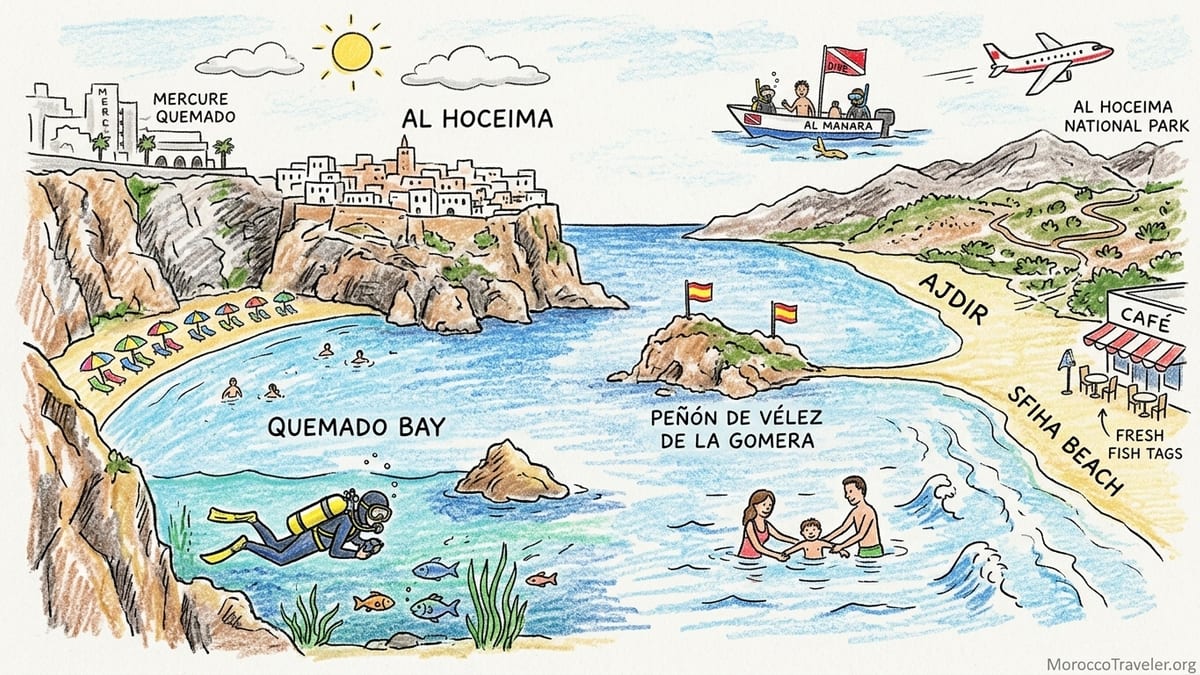
First Impressions of a Mediterranean Morocco
Driving into Al Hoceima from the hills of the Rif, the contrast with Morocco’s Atlantic coast is immediate. Instead of broad, rolling beaches and constant wind, the Mediterranean lies almost still, a tight curve of blue framed by cliffs. From the corniche above Quemado Beach, I could see the town perched on its rocky platform and a string of coves bending away toward the Al Hoceima National Park. The sensation was not of arriving at a big resort, but at a compact seaside town wedged between mountains and sea.
On the Atlantic, I am used to needing a windbreaker in the evening and watching surfers chase messy beach breaks. In Al Hoceima, even in the late afternoon, the air stayed warm and the sea looked glassy. Water temperatures in summer typically reach the low twenties Celsius, which feels brisk at first touch but quickly becomes comfortable once you are swimming. Clarity is the other surprise. Looking down from the Mirador above Quemado, I could pick out pale sand patches and darker rock gardens beneath the surface, the sort of visibility that makes you want to grab a mask and see what is living down there.
That cliff setting shapes almost every practical aspect of a beach day in Al Hoceima. Access often involves stairs, switchback roads or short hikes, parking is rarely right on the sand, and the best coves remain hidden unless you know where to look or hire a boat. My plan was simple: use Quemado as a base for my first swims, then spend the next two days pushing farther out toward Sfiha, Cala Bonita, Espalmadero and a couple of quieter, unnamed coves recommended by locals.
Quemado Beach: Convenience, Crowds and a Mediterranean Dive
Quemado is Al Hoceima’s signature beach and my first swim of the trip. It sits directly below the town, under the cliff-top Mohammed V hotel and the Mercure Quemado resort, tucked into a tight crescent that fills quickly once the sun climbs. Getting there from central streets like Boulevard Mohammed V is a matter of a few minutes by car or about ten minutes on foot down fairly steep roads and stairways. Parking is limited along the seafront road and fills by late morning in July and August, so on busy days I left the car higher up and walked down.
On the sand, Quemado is a mix of fine sand and some small pebbles at the waterline. Underfoot, the seabed feels soft for the first few meters, then dotted with smooth stones as you move out. The water is clear enough that fish are visible around your ankles when the sun is high. Swimming comfort is excellent on calm days: the bay is sheltered by headlands on both sides and by the offshore rocky islet of Alhucemas, so waves stay low. There is no lifeguard station in the style of big Atlantic resorts, but in summer you see municipal staff and police circulating, and families treat the near-shore zone as very safe for confident children with supervision.
Quemado is where I tried my first dive in Al Hoceima. Al Manara Diving operates directly from the beach with a small base set back from the sand. A standard “baptism” dive cost 350 Moroccan dirhams per person when I visited, including full equipment and a short boat ride out of the bay. A cave-focused route was listed at about 550 dirhams per person, again with gear included and a small discount for groups. Before getting in the water, we had a 10 to 15 minute safety briefing on shore that covered hand signals, equalizing, regulator use and what to do if anything felt uncomfortable. We suited up in wetsuits, masks, fins and buoyancy jackets, with tanks carried to the boat for us. This is available to beginners without a certification, provided you are reasonably comfortable in the sea and follow the instructor closely.
Facilities at Quemado are the most complete in town. There are basic changing cabins, pay toilets, showers, and plenty of snack bars and cafes either at beach level or just above on the corniche. In peak season, deck chairs and umbrellas can be rented for small daily fees, often per chair rather than per set. The trade-off for this convenience is noise and crowding. By early afternoon the beach can feel packed, with music from a couple of cafes and jet skis audible from the port side of the bay. If your priority is a quick swim between sightseeing or an easy family day with everything on hand, Quemado is ideal. If you want quiet, you will probably stay only for an early-morning dip before driving farther out.
Sfiha Beach and the Long View toward Peñón de Vélez de la Gomera
The next morning I drove east toward Sfiha, a straighter stretch of sand in the village of Ajdir, a short drive from Al Hoceima town. Leaving the cliffs behind, the road drops to a flatter coastal plain, and suddenly the landscape feels more open. Sfiha Beach is famous for its unusual view: directly offshore sits the small rocky peninsula of Peñón de Vélez de la Gomera, a Spanish territory connected to the Moroccan mainland by a narrow sandbar. Even if you have no interest in border curiosities, it is an extraordinary sight during a simple beach day.
Sfiha’s sand is softer and more uniform than Quemado’s, with fewer pebbles and a gentler slope into the water. The sea here is very shallow for quite a distance, which makes it especially attractive for families teaching children to swim. When I walked in up to my shoulders, the bottom was still mostly sand with only the occasional patch of sea grass. Visibility remained good, although not quite as clear as in the sheltered coves near the cliffs. Because Sfiha is more exposed along the coast, small wind-driven waves can pick up in the afternoon, but they are usually playful rather than intimidating.
In terms of facilities, Sfiha sits between the urban comfort of Quemado and the wild feel of the national park beaches. There are several simple cafes and grills set back from the sand where you can get fresh fish, tagines and cold drinks. Sunbeds and umbrellas are available, though in fewer numbers than at Quemado, and there are basic toilets. Parking is easier thanks to the flatter terrain, with informal lots near the sand that were still manageable even in high season when I arrived before 11 a.m. The downside is that shade is scarce unless you pay for an umbrella or bring your own, since there are no cliffs immediately behind the beach to cast afternoon shadow.
Sfiha is not a snorkeling hotspot in the technical sense, but with a mask you can still enjoy watching small fish along the sandy bottom and near small rocky outcrops. For more dramatic underwater relief and rock formations, local divers pointed me back toward the coves closer to the Al Hoceima National Park. Still, as a long, relaxed, family-friendly beach with a distinctive view, Sfiha easily justified half a day in my beach-hopping plan.
Cala Bonita and Espalmadero: Smaller Coves, Bigger Character
Back on the western side of town, Cala Bonita and Espalmadero (also known locally as Isri) are where the coastline shifts from urban promenade to something more intimate. Both are relatively small coves surrounded by rock, and both demand a willingness to walk and to accept basic facilities in exchange for character and scenery. I visited Cala Bonita first, driving out of town along a winding road, then following signs for a small campground and parking area set back from the cliffs.
The descent to Cala Bonita involves a dirt path and some irregular steps. This makes it unsuitable for anyone with mobility issues and requires decent sandals or trainers rather than flimsy flip-flops. Once you reach the cove, you are rewarded with a narrow strip of mixed sand and pebbles, backed by low cliffs with scrub vegetation. There are patches of natural shade in the morning where the rock overhangs slightly, but by midday most people rely on umbrellas. The seabed here turns quickly from sand to pebbles and larger rocks, which means water shoes are helpful. In return, the water is very clear, and with a simple mask and snorkel I spotted clusters of small colorful fish around the submerged stones, as well as sea urchins clinging to the rock faces. It felt like a natural swimming pool carved into the cliff.
Espalmadero sits closer to town, roughly three kilometers away in the same general bay as Al Hoceima. The approach road descends sharply toward the water, with limited space for cars near the beach. When I arrived in mid-afternoon, latecomers were already double-parking and turning around was tight. The beach itself is a small curved cove of coarse sand and gravel, framed by rocky arms on both sides. It is quieter than Quemado in terms of development, with perhaps one basic refreshments stand and no formal line of sunbeds. Locals tend to bring their own mats and umbrellas, and the atmosphere is more low-key, with families and small groups talking quietly or napping.
Swimming at Espalmadero feels more wild than at Quemado. The entry is steeper, and depths increase quickly a few meters out. On my visit the surface stayed calm, but a slight longshore current was perceptible once I swam closer to the cove edges. The reward is excellent visibility and interesting underwater relief. I followed the rock wall on one side of the cove with a mask and fins and saw cracks, ledges and small overhangs sheltering fish and invertebrates. For anyone not interested in a full scuba outing, this is a very satisfying compromise: real Mediterranean rock snorkeling, reached from shore in under 15 minutes’ drive from central Al Hoceima.
Hidden Coves and Boat Trips along the National Park Coast
Some of Al Hoceima’s most appealing beaches do not have names that appear on most maps, or they are better known by local nicknames than by the labels in guidebooks. These are the narrow coves cut into the limestone cliffs inside the Al Hoceima National Park, where access on foot is either very steep or practically impossible. To see a few of them, I joined a small boat trip from the port, booked via a local operator advertising two to four hour cruises.
The shared coastal and sea cave tours typically cost in the range of 100 to 150 dirhams per person for a one to two hour ride, depending on duration and whether you leave from the main port or from the smaller Quemado-side jetty. Private motorboat hire for a small group tends to range from roughly 300 to 400 dirhams per hour, with full-day excursions toward the more distant sections of the park rising to around 600 to 800 dirhams. These prices reflect 2026 checks and can vary slightly by season and negotiation. In all cases, life jackets were provided, and the captain gave a basic safety briefing and an outline of the route before departure.
My boat followed the cliffs westward, slipping into several sea caves where the water turned an electric blue under narrow openings in the rock. We passed coves that could only be reached from the water, each with a sliver of pale shingle at its base and water so clear that the anchor line seemed to float in mid-air. At one stop, the captain offered a 20-minute swim break. The seabed here dropped quickly; even close to the boat the depth felt significant, and the water stayed cooler than in the more enclosed town beaches. Masks and simple snorkel sets were included for anyone who wanted them, and several passengers slid into the water to watch fish and inspect the cave walls below the surface.
While these boat trips are not formal diving excursions, they are an excellent way to scout future swimming spots. The captain pointed out one or two coves that, with effort, can be reached by hikers starting from inland trails and descending to the coast, but he stressed that many of the most picturesque inlets are best left to boats because of rockfall risk or lack of safe paths. For visitors with limited mobility, this is also the most comfortable way to appreciate the wildest part of the coastline without scrambling.
Diving and Snorkeling: Operators, Conditions and Requirements
Beyond my introductory dive at Quemado, I spent time talking with local scuba operators to understand what is realistically available for visiting divers. Al Manara Diving on Quemado focuses on beginner-friendly shore and boat dives, with prices around 350 dirhams for a standard baptism and 550 dirhams for a cave-focused route, all equipment included. Sessions begin with a 10 to 15 minute briefing and then about 15 minutes underwater on a shallow guided route. Underwater photos and videos were offered as part of the package, which is a nice bonus if you do not have your own camera.
Elsewhere in town, several clubs operate with PADI or CMAS recognition. A typical certified dive with full equipment in the Al Hoceima area starts at roughly 300 to 500 dirhams per dive, with prices increasing for longer boat excursions into the national park or for small-group trips with two dives in one outing. Introductory “Discover Scuba” style experiences for complete beginners often sit slightly higher, sometimes from the mid-300s upward, because they require extra instructor attention and shallow practice time. Multi-day PADI Open Water courses in Morocco as a whole tend to fall somewhere in the 3,500 to 4,500 dirham band, including theory sessions, pool or confined water practice and four to five open water dives, with Al Hoceima following similar patterns.
For all organized diving, operators require basic health questionnaires and, for deeper certified dives, proof of existing qualification such as a PADI Open Water card or equivalent. For baptism dives and beginner cave tours, no certification is required, but you are expected to listen carefully during the briefing and to declare any serious medical conditions in advance. Most centers provide all core gear: tank, regulator, buoyancy jacket, mask, fins, wetsuit and weights. It is worth bringing your own mask or at least trying several on shore to ensure a good seal before heading out.
Snorkeling is much more informal. Several boat operators include masks and snorkels in their prices for sea cave or island trips, especially those that visit the small offshore islands and coves where the water is clearest. If you are serious about surface exploring, bringing your own well-fitting mask and a pair of short fins is worthwhile. Sea conditions are generally calm in summer, with visibility often reaching ten meters or more near the rocky headlands, but can deteriorate quickly in strong afternoon winds. Local captains are quick to cancel or shorten routes if swell rises or storms threaten, and you should treat their judgment as final.
Sleeping by the Sea: Hotels at Quemado vs Central Apartments and Outlying Stays
Choosing where to sleep in Al Hoceima shapes how easily you move between beaches. Staying right above Quemado in one of the seafront hotels offers the classic balcony-over-the-bay experience. From these hotels you can walk down to the sand in minutes for a dawn swim, then retreat to your room or hotel pool at midday when the beach is busiest. You also have easy access to the cliff-top cafes and restaurants of the corniche, which becomes lively in the evening as locals stroll, snack and enjoy the views.
In practical terms, however, this convenience comes at a premium. Beachfront hotels above Quemado are among the priciest beds in town and book out quickly in July and August, especially when Moroccans from inland cities and expatriate families return for holidays. Noise from traffic on the corniche and from crowded beach days can also reach upper floors, particularly on weekends. Parking, while usually available through hotel arrangements, can feel tight when the town is full.
Renting an apartment in central Al Hoceima shifts the balance. There is no traditional medina, but streets around the main squares offer a mix of modern blocks where locals live and short-term rentals are increasingly common. From here, Quemado is a short walk or drive, and you are well positioned to drive in either direction toward Sfiha or Cala Bonita without constantly climbing back to a clifftop hotel. Prices tend to be lower per night, especially outside of August, and you gain access to neighborhood bakeries, markets and small restaurants that feel more local than seaside-facing establishments.
Farther out, accommodation near Sfiha and along the road toward the national park beaches caters to visitors who prioritize quiet nights and easy car access over walking distance to town. Small guesthouses and roadside hotels offer parking space and quick drives to more remote beaches, but you will need to plan dinners more carefully, either eating early at nearby beach cafes or driving back into Al Hoceima after dark. For a dedicated beach-hopping trip with a rental car, this can work well, but if you are relying on taxis, being based in town is more efficient since there is no dense network of public transport shuttling between all coves.
Practical Realities: Parking, Summer Congestion and Less-Perfect Spots
Al Hoceima’s romantic cliffs and small beaches come with some down-to-earth frustrations that are worth mentioning honestly. Parking is the most obvious. At Quemado, the strip of road close to the beach fills very quickly on summer days. Late arrivals circle repeatedly or end up parking far uphill, then walking down in the heat. At Espalmadero the small area near the water becomes chaotic by mid-afternoon, with double-parked cars making it difficult for anyone to leave. If you are visiting in July or August, aim to arrive at your chosen beach by 10 or 10:30 a.m. or in the late afternoon when some locals head home.
Summer congestion is not just about cars. On peak days, Quemado’s sand becomes densely packed, especially close to the waterline, and music from different groups can overlap. Once or twice I moved my towel simply to escape loud portable speakers. Sfiha also gets busy during school holidays, though the longer shape of the beach spreads people out more. Cala Bonita and the smaller coves attract fewer visitors, but because they are physically small, they can feel crowded when only a few dozen people share the same narrow strip of shore.
Not every cove is as idyllic in person as in photos. Some of the more accessible pull-off points along the park road show signs of litter left by picnickers, especially closer to town. In one unnamed cove that I scrambled down to, the first impression of clear water and dramatic rock was slightly spoiled by plastic bottles trapped in the drift line. Facilities can also be rudimentary. At Cala Bonita, there were no permanent toilets at the shoreline; you rely on simple facilities at the campground above or plan ahead before descending. Shade structures, showers and changing cabins are limited or absent outside the main town beaches, so anyone sensitive to sun needs to come prepared.
Finally, some of the most photogenic inlets seen from the boat are realistically off-limits to casual visitors on foot. Steep, crumbling paths, lack of signage and the risk of rockfall make them best admired from the water. Locals occasionally mention informal tracks, but unless you have detailed local guidance and proper footwear, the risk-reward balance is not favorable. In practice, focusing on a mix of easily accessed beaches and one or two boat-access-only stops gives you a satisfying taste of the coast without courting trouble.
My Favorite Spots and a Realistic Two to Three Day Beach-Hopping Plan
After three days of exploring, certain beaches stood out clearly in my mind. For pure swimming comfort, my favorite was still Quemado early in the morning. At 8:30 or 9 a.m. the sand is quiet, the sea inside the bay is calm and glassy, and the cliffs give partial shade before the sun rises high. Being able to walk down from town, slip into the water for twenty minutes, then grab coffee on the corniche made it the easiest daily ritual.
For scenery, Cala Bonita edged out the others. Standing on the path above, the contrast of pale rock, dark green scrub and clear blue water feels almost like a postcard from a Mediterranean island. The small scale of the cove, the way the rock wraps around you while you swim, and the simple rhythm of waves against pebbles create a sense of enclosure that the broader beaches do not match. I would not choose it for an all-day family outing with grandparents and toddlers, but for a half-day swim and snorkel with friends who do not mind walking, it is near perfect.
In terms of value, the shared boat trip along the national park coast stands out. For roughly 100 to 150 dirhams per person, you gain access to multiple coves, sea caves and swim spots that would otherwise require much more time and effort to reach. Life jackets and basic snorkeling gear were included, and the experience of seeing the cliffs from water level gave me a far better sense of the region’s geography. If you have a bit more budget and a group to share costs, hiring a private boat for a few hours enables you to linger in your favorite cove, but even the standard group trip feels like a strong bargain.
Based on my own experience, a realistic three-day plan could look like this. On Day 1, arrive in Al Hoceima, settle into a hotel or apartment in or near town, and head down to Quemado for an afternoon swim, followed by an evening stroll and dinner on the corniche. On Day 2, book a morning boat trip from the port to explore the cliffs and sea caves, with swimming stops included, then spend the late afternoon at Cala Bonita or Espalmadero, choosing based on your appetite for walking and your need for facilities. On Day 3, drive out to Sfiha for a slower, long-beach day with softer sand and that unusual view of Peñón de Vélez de la Gomera, returning to Quemado for a final sunset swim before departure. If you only have two days, combine Sfiha and a shorter boat trip on one day and devote the other to Quemado plus one smaller cove.
None of these beaches are perfect in every category. Each involves trade-offs between access, comfort, crowds and wildness. What unites them is the feeling of being squeezed between mountain and sea, where each cove has its own orientation to sun and wind. Compared with Morocco’s Atlantic resorts, Al Hoceima’s coastline demands a bit more planning and walking, but it repays the effort with clarity of water, variety of settings and, above all, a sense that you are discovering a compact, self-contained world of cliffs and coves rather than a long, anonymous strip of shore.
FAQ
Q1. Is Al Hoceima suitable for a first-time beach trip to Morocco?
Yes, if you prefer clear Mediterranean water and smaller coves over big Atlantic surf. Facilities are good at main beaches like Quemado and Sfiha, but you should be comfortable with some walking and stairs.
Q2. Do I need a car to explore beaches like Sfiha, Cala Bonita and Espalmadero?
A car makes beach-hopping much easier, especially for Sfiha and the more remote coves. Taxis can reach some spots, but regular shuttles between beaches are limited, and returning from small coves late in the day can be difficult without your own vehicle.
Q3. How safe is swimming in Al Hoceima’s coves for children?
Main beaches such as Quemado and Sfiha have gentle entry and are widely used by local families in summer, though parents supervise closely. Smaller coves like Cala Bonita and Espalmadero deepen more quickly and have rockier seabeds, so they are better for confident swimmers and older children.
Q4. Can complete beginners try scuba diving in Al Hoceima?
Yes. Several local operators offer introductory dives for beginners without certification, typically including a short safety briefing, instructor accompaniment and shallow routes. You should disclose any health issues in advance and follow their guidance on weather and sea conditions.
Q5. What does a typical boat trip to the sea caves cost?
Shared boat trips along the cliffs and into sea caves usually cost around 100 to 150 dirhams per person for one to two hours, with life jackets included and sometimes basic snorkeling gear. Private boat rental for small groups costs more but offers greater flexibility on stops.
Q6. Are there sandy beaches, or are they mostly pebbles?
Quemado and Sfiha offer predominantly sandy shores, with some pebbles near the waterline at Quemado. Coves such as Cala Bonita and Espalmadero have a mix of coarse sand, gravel and rocks, and water shoes are helpful there.
Q7. When is the best time of year to visit for beach-hopping?
Late spring through early autumn, from roughly May to September, offers the warmest water and calmest seas. July and August bring the biggest crowds and highest accommodation prices, while June and early September balance pleasant conditions with more space on the sand.
Q8. What should I pack specifically for Al Hoceima’s beaches?
Good walking sandals or trainers for steep paths, water shoes for rocky coves, a reliable sunhat and sunscreen, and if you enjoy snorkeling, your own mask and fins. A light dry bag is useful for boat trips and for carrying valuables when you cannot leave them unattended on the sand.
Q9. Are there lifeguards on duty at the beaches?
Presence of formal lifeguards can vary by season and beach. Quemado is the most monitored area, especially in peak summer, while smaller coves and more remote stretches typically have no official supervision. You should always assess conditions yourself and stay within your comfort zone.
Q10. Is Al Hoceima a good base for longer trips along the Mediterranean coast?
Yes, it works well as a hub for exploring other nearby beaches and parts of the Al Hoceima National Park, especially if you have a rental car. However, public transport options along the coast are limited, so independent exploration beyond the immediate area takes more planning.