


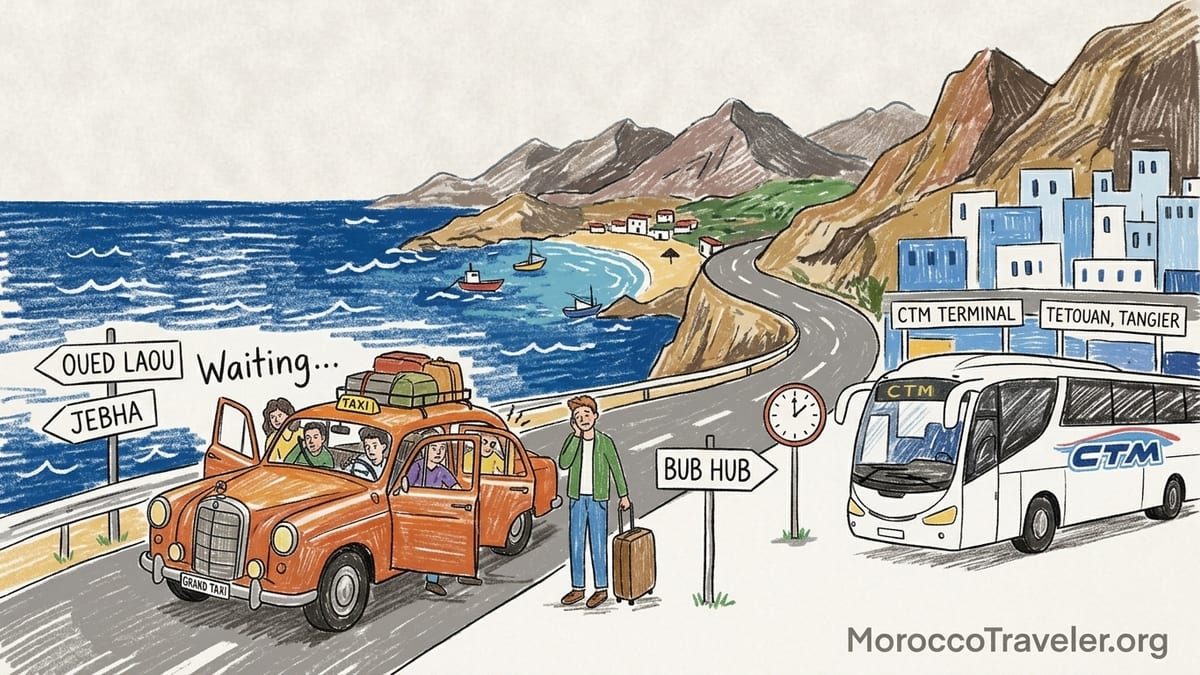
I knew I was in trouble when the last shared taxi back from Oued Laou simply did not materialise. The Tetouan-bound seats had supposedly "just left" three times already according to the café owner who took pity on me, and my quick afternoon escape to a quiet cove had turned into a three-hour wait, an improvised ride in a stranger’s car for a premium price, and a nerve-racking race against dusk on the winding N16. That day summed up my attempt to beach-hop along Morocco’s Mediterranean coast without a car: possible on paper, occasionally delightful, but full of dead time, missed beaches and hidden costs that online advice rarely spells out.
When Public Transport Stops Being Part of the Adventure
On maps and on travel forums, the north coast of Morocco looks wonderfully stitched together. Names like Tangier, Tetouan, Martil, M’diq, Al Hoceima, Nador and Saïdia line up neatly, threaded by the N16 highway that hugs the Rif mountains and the sea. Buses run between the big hubs, grand taxis fan out from the cities, and there is always someone saying, "You can get anywhere by taxi for a few dirhams." That is technically true for some stretches, but the gaps between theory and reality grow wider the closer you get to fishing coves, national parks and lonely viewpoints.
My Oued Laou mishap did not happen in complete isolation. It was the end of a day that had started with a delayed CTM bus leaving Tangier for Tetouan, a sprint through Tetouan’s grand taxi chaos to find the stand for the coast, and a negotiation with a driver who would only leave immediately if I paid for the remaining empty seats. The ride south through the Rif was gorgeous. The lost time and doubled cost were not. By the time I finally reached the pebble beach I had been daydreaming about, half my day and a good chunk of my daily budget were gone.
I went into this trip expecting some bumps. I have used Moroccan public transport before and usually enjoy the informality. On the Mediterranean coast though, the combination of seasonal services, sparse timetables and hub-and-spoke taxi routes meant that I was constantly calculating. Could I risk one more swim and still find a return shared taxi. Would the last bus actually run that day. Should I buy all the seats to leave now or wait and hope. The mental load turned what could have been a string of relaxed beach days into a project-management exercise in Arabic, French and hand gestures.
By the end of two weeks trying to rely on buses, shared taxis and the occasional private transfer, I would still recommend the region to travelers. I would simply not tell anyone that every beach is "easily reachable by public transport" unless they genuinely enjoy uncertainty and have generous time buffers baked into their plans.
Big-City Hubs vs Hard-to-Reach Coves
Across the main cities, public transport works reasonably well. Tangier and Tetouan are linked by frequent CTM and other intercity buses, with online aggregators still showing multiple departures most days and sample tickets in the range of the low tens of dirhams one way depending on operator and season. CTM services into Tetouan’s dedicated station are generally comfortable, air-conditioned and bookable in advance, even if timetables sometimes shift or a midday departure vanishes between the time you check and the day you actually travel.
From Tetouan, Martil and M’diq begin to feel like true beach suburbs. City buses and grand taxis run short hops to Martil for the cost of a local fare that, as of this year, still comes in at the kind of price you can pay with a handful of coins. Local sources describe Tetouan’s grand taxi station at Al Shallal as the main hub for the seaside towns, with separate points for Martil, M’diq and Fnideq. In summer the flow is constant enough that you rarely wait long for Martil, and even though official tariffs exist, real-world fares are still subject to gentle haggling and the driver’s assessment of how touristy you look.
The contrast appears the moment you try to push beyond this first coastal strip. Oued Laou, about 50 to 60 kilometers from Tetouan along twisty cliffs, is served by grand taxis and minibuses that depart from a different stand under a flyover, a detail that is easy to miss until you are wandering between parking lots with your beach bag. Jebha is further still, and Cala Iris sits on an even more fragmented stretch of the N16 between Jebha and Al Hoceima. On maps these places are just dots along one road. On the ground, each leg requires a separate negotiation, a new vehicle, and a tolerance for sitting on plastic stools at roadside cafés until enough passengers appear.
Connections between the eastern cities are somewhat similar. Al Hoceima links by bus to Nador and, more sporadically, to Tetouan and Tangier, although checking the CTM website and third-party aggregators from one day to the next reveals how often routes are seasonal or sold out. Once in Al Hoceima, reaching nearby beaches such as Quemado or Sfiha is straightforward by petit taxi. Reaching more remote coves inside Al Hoceima National Park or the villages around Cala Iris is where you run up against the limits of a system designed primarily for locals commuting between home, market and city, not for visitors chasing hidden bays at off-peak times.
City Personalities: Tangier, Tetouan, Al Hoceima, Nador and Saïdia
Tangier serves as the main gateway for most travelers, with high-speed trains, a busy airport and a major port. From a transport perspective it is the most forgiving place to start a car-free trip. You can land at Tangier Ville train station, take a petit taxi to the combined bus and grand taxi hub, and find a CTM bus or shared taxi onward to Tetouan, Chefchaouen or the Atlantic coast. Petit taxis within Tangier are metered, relatively easy to hail and regulated by color and city, which keeps most journeys predictable even if you still need to insist on using the meter at night.
Tetouan is the pivot point between inland Rif towns and the Mediterranean. Buses connect it to Rabat, Casablanca and Fez, but the more interesting connections for beach-goers are local. Grand taxis fan out to Martil, M’diq, Cabo Negro and Oued Laou. City buses, increasingly run under delegated management by CTM-linked companies, form dense routes inside Tetouan and between the medina and the beach suburbs. For straightforward base-and-day-trip holidays focused on Martil or M’diq, Tetouan plus taxis can work well, especially in high season when demand keeps vehicles moving.
Al Hoceima feels very different. Wedged between cliffs and the sea, it is connected by regional roads that snake through the Rif and are more vulnerable to landslides or slow traffic. The city has its own network of blue petit taxis and a local operator that runs buses in the province. Grand taxis link it with Imzouren and Ajdir and then further east toward Nador, but services thin out as you move away from the main axes. For nearby town beaches, taxis are simple. For places like Tala Youssef or more secluded park coves, locals mention arranging 4x4s or hiring fishermen’s boats from villages such as Torres or Bades when the sea conditions allow it, which means planning and flexibility rather than spontaneous day trips.
Nador and Saïdia, on the far eastern stretch, add another layer. Nador is more of a working port city with road links inland and north to the Spanish enclave of Melilla, and petit taxis are easy to find in town. Saïdia is a purpose-built resort area near the Algerian border with large all-inclusive complexes. Here, the challenge is not so much getting to the main beach, which is walkable from most accommodations, but leaving the resort bubble without your own wheels. Public buses and grand taxis exist between Nador, Berkane and Saïdia, yet schedules are irregular enough that hotel staff often suggest pre-booked drivers for day trips to Cap des Trois Fourches or back toward the interior.
The Hidden Difficulty of Oued Laou, Jebha, Cala Iris and Wild Corners
Attempting to reach secondary spots along the coast without a car exposed the real fault lines. Oued Laou, which looks like "just down the coast" on Tetouan tourist maps, required me to first find the correct grand taxi station under an overpass, then wait until six seats filled in a shared car. Official tariffs for the route exist, but the posted sheets are not always on display, and there is a grey area between paying the per-seat price and effectively chartering the car by buying every seat so that you can leave immediately. On my outbound trip the car filled in about 30 minutes. On the return, as afternoon turned to early evening and most weekenders had already gone back to town, I watched would-be passengers give up and phone friends or walk away toward unmarked minibuses.
Jebha is harder again. It lies part way between Oued Laou and Al Hoceima, and public transport consists largely of regionally licensed grand taxis and occasional local buses that favor market days and school timetables. Spoken to villagers at cafés along the way, my impression was that you can usually find transport out of Jebha in the morning, especially toward Tetouan, but you cannot assume that you will find a convenient return later in the afternoon if you are only there to poke around for a few hours.
Cala Iris occupies a particularly awkward position. The hamlet sits on the coast with a small beach and pier, but the public road access from the N16 involves smaller routes serving nearby villages. Drivers in Al Hoceima described transport to Cala Iris as "possible" with a chain of shared taxis, first to Imzouren, then to another intermediate village, then finally to Cala Iris itself, each leg with its own waiting time and negotiation. Several people also mentioned that many visitors simply hire a private car with driver from Al Hoceima for the day and choose a mix of coves and viewpoints along that stretch instead of committing to just Cala Iris, precisely because so few shared vehicles run in and out during daylight hours outside peak summer weekends.
Al Hoceima National Park is officially accessible by road from the city in around half an hour along the coastal highway, with additional access tracks leading down toward coves and viewpoints. In practice, without a rented car or a pre-booked driver, you are either joining a specific excursion offered by local agencies or negotiating directly with a taxi for a charter. Standard shared-taxi rules do not really apply to a one-off detour down a rough track and a wait while you hike or swim. The same pattern repeats further east around Cap des Trois Fourches, a dramatic headland some 20 to 25 kilometers north of Nador and Melilla. There is a lighthouse and incredible coastal scenery, but the final approach is via unpaved roads. Locals casually mention "4x4" when talking about going there, and that is a hint that relying on normal shared taxis or buses for there-and-back day trips is optimistic at best.
How Shared Grand Taxis Really Work on the Coast
Understanding grand taxis is essential if you intend to explore without renting a car. These are usually older sedans or more modern multi-people vehicles that run fixed intercity or regional routes. They do not cruise for fares. Instead, they wait at designated stands, load up with passengers headed broadly in the same direction, and leave only when every designated seat is sold. The official model still assumed six passengers squeezed into a standard sedan, though newer vehicles sometimes improve comfort slightly.
On the Mediterranean coast, every town of any size has at least one grand taxi rank. In Tetouan there are separate stands for destinations like Martil, M’diq, Oued Laou and Chefchaouen. In Al Hoceima, taxis to Imzouren or Ajdir cluster at predictable points known to locals. The base per-seat fares on common routes are set by local authorities and posted on boards or laminated sheets, but it is not unusual to find that the sign is missing, hidden or out of date. That opens the door to small overcharges, especially for visitors who do not speak Arabic.
Because the vehicles only leave when all seats are sold, time and money are constantly traded against each other. If you are heading from Tetouan to Martil on a summer afternoon, the taxi will fill almost instantly and you pay your seat price and go. If you are in Oued Laou midweek in shoulder season and you are the only person at the stand, you may wait an hour for others to appear or you can buy all remaining seats and effectively convert the shared taxi into a private car. Paying for six seats on a modest route can suddenly turn a cheap-seeming day trip into a single expensive hop that rivals the cost of renting your own car for 24 hours.
Return transport from remote places is almost always harder than getting there in the first place. Morning flows are predictable. People travel into town for work, markets or school. Afternoon and evening flows back toward the city are more uncertain, especially away from weekends. Beach villages like Oued Laou generate plenty of traffic on a sunny Sunday, but far less on a cloudy weekday in May. Jebha and Cala Iris are even more variable. A comfortable-looking flow of taxis en route in the morning says almost nothing about your ability to find one later that day when you are sunburned, tired and suddenly conscious of the hairpins on the N16 you would prefer not to walk.
Case Study: A Two-Day Beach Hop, Three Different Ways
To make this more concrete, imagine a two-day beach-focused break in early summer starting from Tangier. The plan: travel to Tetouan on the first morning, drop bags, hop to Martil for an afternoon on the city beach, then on day two attempt a longer outing to Oued Laou for a quieter stretch of coast. I tried versions of this route using public transport alone, a mix of public transport and a private driver, and later, on a separate trip, with a rental car.
Using only public transport, day one went approximately like this. Petit taxi across Tangier to the CTM or intercity bus station, then a bus to Tetouan scheduled for around 1.5 hours but in practice closer to two due to traffic and a late departure. Another petit taxi to my riad inside the Tetouan medina, then a walk back out to the grand taxi stand for Martil. The Martil taxi filled quickly in mid-afternoon and cost little, depositing me on the corniche in about 20 minutes. Including waiting and transfers, door-to-door from my Tangier hotel to Martil beach took around five hours and involved four different vehicles.
Day two with public transport alone was more fragile. I walked back to Tetouan’s Oued Laou taxi stand and arrived shortly after nine in the morning. Enough passengers were already waiting that a car left within 25 minutes. The ride along the N16 was under two hours with stops. On arrival I had a leisurely lunch and a swim, but when I went back toward the taxi area around four in the afternoon, there were more people hoping to return than there were cars. Several drivers preferred to negotiate full-car fares with families rather than sell single seats. I eventually teamed up with two other travelers to pay for the remaining seats in one car at a per-head price closer to what a private transfer might charge for the whole vehicle from Tangier to Tetouan. In time terms, it worked, but in cost terms it undercut the idea that this was a cheap way to explore.
On another pass along the same route, I experimented by hiring a private driver in Tangier for 24 hours. The quoted prices for a licensed driver with a standard car for Tangier to Tetouan, then Tetouan to Oued Laou and back the following day, landed in the bracket of what you might expect to pay for a mid-range European taxi for a similar total mileage, varying by company and season. It was undeniably more expensive than hopping in shared taxis, but my door-to-door time from Tangier to Martil on day one shrank to under three hours including a coffee stop, and day two’s round-trip to Oued Laou was entirely on my schedule with no waiting at stands. Split between two people, the cost began to look reasonable in exchange for regaining half a day of vacation.
With a rental car, the equation shifted again. Daily rates quoted in Tangier for a small manual car outside peak August weeks were often comparable to the combined price of a couple of paid-up grand taxi rides where I bought all remaining seats. Fuel along the north coast is not ruinous, and there are service stations along the N16 at regular intervals near larger towns. A self-drive version of the two-day trip let me leave Tangier after a leisurely breakfast, stop for photos wherever I liked along the cliffs, detour into Martil and M’diq en route, then continue to Oued Laou early the next morning without worrying about other passengers’ schedules. The downside was the driver fatigue and the need to be fully alert on a road where rockfall, erratic overtaking and livestock are not rare.
Why Online Advice About “Cheap Taxis Everywhere” Misleads
Before this trip I read plenty of breezy advice that "you can reach every beach by cheap taxi" along Morocco’s Mediterranean coast. Stripped to the bare facts, there is a kernel of truth here. There are indeed grand taxi routes linking most towns, and in some cases, small buses or minibuses as well. In everyday conversation, many Moroccans are genuinely surprised that visitors worry about getting around because their own reference point is that a shared taxi eventually comes if you wait long enough.
The problems start when that local perspective is translated directly into travel tips for visitors with fixed hotel bookings and only a few days to play with. A thirty-minute wait at a taxi rank is trivial if you are heading home after a family lunch and have no onward plan. It feels very different when you have booked non-refundable accommodation in another town, the last bus you know about is in an hour, and every driver at the rank keeps suggesting you buy all the seats at several times the official per-seat fare to be sure of getting there.
Many online write-ups also blur the line between city-adjacent beaches and truly remote coves. Martil and M’diq are functionally suburbs. Someone saying "just grab a taxi" for those is describing a reality where vehicles come and go all day and there is almost always an empty seat within fifteen minutes, especially in July and August. Extrapolating that logic to Oued Laou, Jebha, Cala Iris, Al Hoceima National Park or Cap des Trois Fourches glosses over the fact that services there are thinner, more seasonal and much more tailored to local rhythms than to the expectations of short-stay visitors.
Finally, these glib lines almost never address the return journey. You can usually find someone willing to take you to a beautiful spot in a taxi, even as a charter. The market for getting tourists out to somewhere scenic is always there. The market for picking them up at a precise time later that afternoon is another story, especially where mobile coverage is patchy or you do not have a local driver’s number. On the Moroccan Mediterranean I found that "getting there" stories are easy to collect. "Getting back" stories are the ones that involve three-hour waits, friendly strangers who intervene on your behalf, and prices that creep steadily upward as the sun drops.
Driving the N16: The Other Side of the Trade-Off
All of this might sound like a straightforward argument to rent a car the moment you arrive, but driving the N16 is not a casual undertaking. The road is stunning, with cliffside views, glimpses of hidden beaches from above, and meandering villages. It is also narrow in places, unlit at night and prone to sudden slowdowns where trucks grind up hills or goats decide to cross. Anyone used to wide motorways and strict lane discipline will need a period of adjustment.
Rain can trigger small rockfalls or leave gravel on the road surface. Sharp bends sometimes come without much warning signage. Overtaking practices from local drivers can feel optimistic, especially around Jebha and the central Rif sections. If you are new to manual transmission or mountain driving, this is not the place to learn. Add fatigue from early starts and long days in the sun and it can become a safety issue as much as a comfort one.
Preparation matters. Traveling only in daylight, avoiding peak summer weekends when local traffic balloons, and keeping distances modest each day all help. So does accepting that you may need to slow dramatically behind a truck for several minutes rather than mimicking local overtakes you are not comfortable with. Mobile coverage along much of the N16 is present but not universal, so offline maps and a basic understanding of where the next town with fuel and mechanics lies are useful.
If you are not confident driving in these conditions, a compromise solution can be more appealing. That might mean using trains and buses for the long hauls between Casablanca, Rabat, Tangier and Tetouan, then hiring a driver only for one or two targeted coastal days around Oued Laou, Jebha or Al Hoceima. You still avoid the stress of handling unfamiliar roads yourself, but you gain the freedom to choose exactly which beaches and viewpoints you stop at, instead of only those that happen to sit on a shared-taxi route.
The Takeaway
After two weeks of experimenting my conclusion is not that you must have a car to enjoy Morocco’s Mediterranean coast. It is that you should be realistic about what a car-free trip can and cannot do. If your idea of a holiday is staying in Tangier, Tetouan, Martil, M’diq, Al Hoceima, Nador or Saïdia, using petit taxis and the occasional grand taxi to shuttle between town and nearby beaches, public transport works quite well. These cities and large resorts function as hubs, and the systems there are designed around the everyday movements of thousands of people, which gives them a resilience you can lean on.
If, on the other hand, you picture yourself hopping unhurriedly from Oued Laou to Jebha, from Cala Iris to random unnamed coves inside Al Hoceima National Park, or to lonely viewpoints near Cap des Trois Fourches, relying only on buses and shared taxis, expect a trip shaped just as much by waiting and negotiation as by swimming and sun. You may find yourself skipping places simply because the transport puzzle looks too risky that day or because you have already blown your time cushion on an unexpectedly long wait for a taxi to fill.
Shared taxis make particular sense on short, dense routes that locals also use in large numbers, like Tetouan to Martil or M’diq, Tangier to Tetouan, or Al Hoceima to Imzouren. They are less reliable as a planning tool where services thin out and where the return leg is never guaranteed. Those are exactly the situations where paying for a private driver or biting the bullet and renting a car, even for a short period, can reclaim entire days that you would otherwise lose to uncertainty.
If I were planning the same journey again, I would still savor the grand taxi rides between Tangier, Tetouan and the closer beach suburbs, but I would reserve a car or driver for any serious exploration between Oued Laou and Al Hoceima and for detours to places like Cap des Trois Fourches. The Moroccan Mediterranean rewards those who make the extra effort to reach its wild corners, but reaching them entirely at the mercy of shared taxis is a gamble I am not keen to repeat.
FAQ
Q1. Can I visit Martil and M’diq from Tetouan without a car?
Yes. Martil and M’diq are among the easiest coastal towns to reach from Tetouan using shared grand taxis or local buses, and services run frequently, especially in summer.
Q2. Is it realistic to day-trip to Oued Laou from Tetouan using public transport?
It is possible but requires flexibility. Getting to Oued Laou in the morning is usually manageable, but finding a timely shared taxi back in the afternoon can involve long waits or paying extra to fill a car.
Q3. How safe is it to drive the N16 along Morocco’s Mediterranean coast?
The N16 is generally in decent condition but is winding, partly unlit and shared with slow trucks and local traffic. Confident drivers with some mountain-road experience usually cope well in daylight; nervous drivers may find it stressful.
Q4. Are grand taxis cheap for longer coastal routes?
Per-seat fares on popular routes are affordable, but costs rise quickly if you pay for extra seats to avoid waiting. On longer or less busy stretches, chartering a grand taxi can approach or exceed the daily price of a rental car.
Q5. Can I reach Al Hoceima National Park without renting a car?
You can, but it typically involves arranging a private driver from Al Hoceima or booking a local excursion. Standard shared taxis are not ideal for the smaller access roads and for waiting while you explore.
Q6. Is Cap des Trois Fourches accessible by public transport?
Public transport will get you as far as Nador and nearby towns. For the final approach along unpaved roads to the cape and lighthouse, most visitors arrange a 4x4 or private driver, since shared taxis rarely go all the way.
Q7. How far in advance should I book intercity buses like Tangier to Tetouan?
Schedules and availability can change, especially in high season. Checking timetables a few days ahead and buying tickets as soon as your dates are fixed is wise, though last-minute seats are often still possible.
Q8. Do petit taxis in Tangier and Al Hoceima use meters?
Yes, petit taxis in cities such as Tangier and Al Hoceima are supposed to use meters within city limits. It is sensible to confirm the meter is on when you start and to have small bills or coins ready for payment.
Q9. Is it worth hiring a private driver for just one or two days?
For complex coastal days involving several remote beaches, a private driver can be good value compared with the cumulative cost and time of multiple shared taxis, especially when the expense is shared between two or more travelers.
Q10. Which coastal bases work best without a car?
Tangier, Tetouan, Martil, M’diq, Al Hoceima, Nador and Saïdia all function well as car-free bases, with taxis and local transport linking city centers to main beaches and nearby attractions.