


I first arrived in Nador on a hazy late-summer afternoon, stepping off the ferry with the same assumption many travelers have: this was a transit point rather than a destination. Yet as the taxi climbed a gentle rise and the view opened onto the wide sheet of Marchica Lagoon, framed by low Rif hills and the pale line of the Mediterranean beyond, I realized I had underestimated this corner of northeastern Morocco. Over several days split between the city and the lagoon, I discovered a place that is more than a ferry port, but still very much in transition.
Meeting Nador, the Lagoon and the Hills
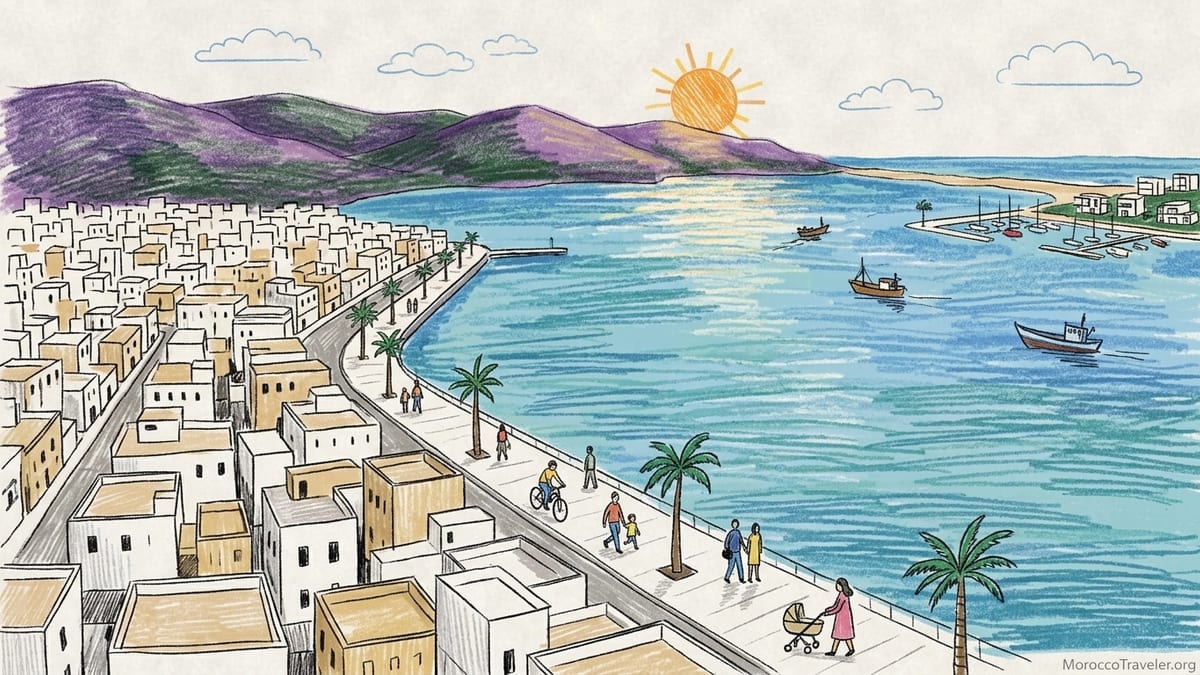
From the moment you enter Nador, the relationship between city, lagoon and hills is obvious. The urban grid presses right up to the edge of Marchica, while behind it the Rif foothills form a soft amphitheater that seems to cradle both. Driving in from the port, my driver pointed out the old industrial shoreline where ore once washed into the water and then gestured toward the new corniche, where families now stroll in the evening. It felt like I was looking at two stories at once: a working-class city still dependent on migration and trade, and a waterfront steadily being reshaped for visitors.
Marchica itself is huge when you see it from the road. The lagoon covers around 115 square kilometers and is separated from the open Mediterranean by a 25-kilometer sandbar. The water can look almost landlocked, more like an inland sea than a typical bay. When the light is low, the hills on the far side of the lagoon catch the sun and the city’s white and sand-colored buildings reflect softly on the surface. Depending on the wind, the lagoon ranges from glassy stillness to small chop, but even on breezy days it remains calmer than the open sea beyond the barrier beach.
Staying in central Nador for my first night, I could sense how the lagoon shapes everyday life. Many of the side streets slope gently toward the water, and gaps between buildings reveal flashes of silver blue. At sunset, people naturally drift in that direction: couples walking hand in hand, teenagers with ice creams, older men heading toward the cafes to watch football on television. The hills in the distance turn purple as the last light leaves their ridges, and it is easy to forget you are in a city that, for most foreign travelers, is still little more than a dot on the map next to the Spanish enclave of Melilla.
This physical closeness between town, water and mountains is what ultimately convinced me that Nador and Marchica deserve more than a cursory look. It is not a substitute for Agadir’s endless beaches or Tangier’s cafe culture, but it is its own small world, with its own rhythm and its own blend of maritime, migratory and Rif influences.
Walking the Corniche from Day to Night
My first real introduction to the lagoon came on foot, along Nador’s corniche. In daylight, the promenade feels almost overbuilt for the number of people using it, which is one of its charms. Wide, tiled walkways run parallel to the shore, broken up by palm trees, benches and the occasional playground. On a weekday morning I shared it mostly with joggers, mothers pushing strollers and fishermen in faded caps hauling simple hand lines and plastic buckets.
Parts of the waterfront are fully landscaped, with low walls and easy steps down toward the rocks, while other stretches remain under development or fenced off, where new housing blocks and hotel projects are still rising. I passed several empty plots where smart billboards showed renderings of future marinas and residences. In practical terms, it meant that my walk alternated between polished promenade, short dusty detours and then another section of finished corniche. It was not seamless, but it did feel real, a glimpse of a place mid-transformation rather than a staged resort strip.
By late afternoon the character of the corniche changed. Street vendors appeared near the busier stretches, selling roasted peanuts and paper cups of juice. Small groups of young men leaned on the railings, watching the water and scrolling their phones. A few fishing boats nosed close to shore, their low engines puttering as they crossed the lagoon toward makeshift moorings. Closer to the center, a handful of cafes set out more chairs facing the lagoon, and the air filled with the smell of grilling sardines from a tiny stand where the cook worked over a simple charcoal brazier.
Night on the corniche was when Nador surprised me most. Strings of lights reflected in the lagoon, and the promenade filled with families in slow circulation, children weaving between adults on scooters or small bicycles. I ate at a casual seafood restaurant overlooking the water, ordering grilled dorade and a tomato and onion salad. The fish, caught in the lagoon or just beyond the sandbar, tasted clean and lightly smoky. With a bottle of water and mint tea afterward, the bill came to the equivalent of around 12 US dollars for one person. It felt like excellent value for a waterfront meal, especially compared with Morocco’s more famous coastal cities.
Atalayoun, Marina Zones and Hidden Viewpoints
If the corniche is where Nador meets Marchica, Atalayoun is where the lagoon tries on the look of a Mediterranean resort. The peninsula, once scarred by industrial use, has been redeveloped into a zone of golf greens, modern villas and the Marchica Lagoon Resort, a low-slung complex of airy buildings and pools that faces directly onto the water. From central Nador, I took a petit taxi to Atalayoun, negotiating a fare that worked out to roughly 3 US dollars for the 15 to 20 minute ride, which is typical for a short city-to-lagoon hop when the meter is used or the price is agreed in advance.
Arriving at Atalayoun during the late morning, the atmosphere was almost quiet enough to hear the wind in the reeds. Pathways curve between manicured lawns, and from several points you can look across both the lagoon and back toward the city’s low skyline. Not all of the planned development is finished; some plots remain empty behind construction fences, and a few stretches of waterfront are not yet accessible on foot. But the parts that are open give a sense of what the planners are aiming for: an upscale, semi-secluded waterfront neighborhood that feels a world away from the bustle of Nador’s markets.
Near the marina area, where a modest number of leisure boats are moored, I found one of my favorite viewpoints. Standing on the quay, I could watch small fishing craft cross paths with sleek motorboats, all set against the hazy outline of the hills. There are a couple of cafes here that cater to both locals and guests from the resort. I sat on a terrace with a simple espresso and a still-warm croissant, paying the equivalent of about 3 to 4 US dollars. It was more than I paid for coffee in the city, but the change in setting was significant: quieter, with more open sky and the feeling of being in a private cove.
For travelers who like to explore on foot, one of the pleasures of the Atalayoun side of the lagoon is the ability to follow small roads and paths to informal viewpoints. In some places these are little more than dirt clearings at the end of a track, where local families park their cars to picnic. From there you get low, uninterrupted views across the reeds and shallow water, which are especially beautiful in the late afternoon when the light catches every ripple and bird silhouette. This is also where you start to realize that Marchica is not only a backdrop, but a living wetland.
Markets, Everyday Nador and What I Ate
Spending time around the lagoon can make it easy to forget that Nador is first and foremost a working city. To reconnect with that side of things, I spent a morning in and around the central market area, where stalls overflowed with produce from the surrounding Rif countryside. Piles of tomatoes, peppers and oranges shared space with crates of sardines and anchovies, whose smell cut through the heavier scent of spices and olives. The rhythm was brisk but not aggressive, and many vendors were happy to chat once they realized I was more curious than hurried.
Lunch that day came from a small grill near the market, a narrow shop with four metal tables where the owner worked behind a counter. I ordered a plate of kefta skewers, salad and fries, along with a soda. The total came to the equivalent of around 5 US dollars. It was the kind of neighborhood place you would never find in a resort catalog, but the meat was well seasoned, the bread came still warm, and the television in the corner quietly played a Spanish football match that everyone half-watched between bites.
Another evening I tried one of the more polished restaurants along the lagoon-facing part of town, closer to the corniche. Here the menu tilted more toward grilled fish and mixed platters for couples and families. I chose a mixed seafood plate with calamari, shrimp and fish fillets, along with a bottle of still water and a simple dessert. With service, it came to just under 18 US dollars. The clientele was a mix of local families, returning Moroccans from Europe visiting relatives, and a few clearly identifiable visitors like me, clutching cameras and guide notes.
The contrast between city eateries and lagoon-side venues is noticeable. In Nador proper, many cafes and snack bars are oriented toward residents and returning diaspora, with prices that reflect local incomes. Around Atalayoun and the resort zones, the setting and room rates push food and drink costs upward, though even the more expensive meals usually feel competitive when measured against European beach towns. Moving between the two gives you the sense that Nador is trying to balance its existing community with a new, tourism-facing identity.
Staying in Nador City vs a Lagoon Resort
To understand Nador and Marchica more fully, I split my time between a mid-range hotel in the city and a night at the Marchica Lagoon Resort. In central Nador, I chose a locally run three-star hotel near the corniche. Recent price checks for similar properties in the city show double rooms commonly available in the range of 40 to 90 US dollars per night, depending on season and category, with some simpler hotels and guesthouses dropping closer to 30 dollars for basic rooms. This puts Nador’s city accommodation well below the price levels of Morocco’s better-known tourist cities.
The advantages of staying in town were clear. I could walk to markets, grab inexpensive street food, and be on the corniche within minutes. Petit taxis were plentiful, and even late at night I did not struggle to find a ride back to the hotel. The trade-off was that most city hotels are functional rather than atmospheric. Rooms are typically simple and clean, with air conditioning and Wi-Fi, but you are unlikely to get lagoon views unless you pay for one of the larger, better-situated properties facing the water.
The night I spent at Marchica Lagoon Resort felt like shifting into a different world. Recent booking data suggests that standard rooms at this five-star property often fall in a band of roughly 190 to 240 US dollars per night, before taxes and local city fees, with variations depending on season, demand and promotions. That means you can easily be paying at least twice, and sometimes three times, the rate of a comfortable mid-range hotel in central Nador. For that price you get landscaped pools, direct lagoon frontage, spacious rooms and a sense of seclusion that the city cannot match.
In terms of access, the resort lies only a short drive from Nador Ville train station and about 10 to 15 minutes by taxi from central neighborhoods. My taxi rides between the city and resort typically cost the equivalent of 3 to 5 US dollars one way. While that is reasonable for a short hop, over several days the cost can add up if you shuttle back and forth often. The resort itself feels somewhat self-contained; if you stay there without a car and do not make an effort to go into town, you might leave with the impression that Marchica is purely a polished waterfront enclave rather than part of a larger, complex lagoon ecosystem and city.
Marchica as a Wetland: Ramsar Status, Birds and Restoration
Behind the glossy marketing of Marchica as a new Mediterranean destination lies a more important story. Ecologically, this lagoon is one of the most significant in the southern Mediterranean. It has been recognized as a site of biological and ecological interest since the 1990s and was officially designated a Ramsar wetland of international importance in 2005. The protected area covers roughly 14,000 hectares, making it a major node along the migration routes of countless waterbirds moving between Europe and Africa.
Spending slow time along the less manicured sections of shore, especially near reed beds and mudflats, makes this status tangible. Even without specialized equipment, I saw herons, egrets and various waders working the shallows, along with flocks of smaller shorebirds that lifted and turned in unison when disturbed. Bird surveys highlight Marchica as an important wintering and stopover site for species such as ducks, grebes and gulls, as well as for more sensitive species that prefer quiet, undisturbed corners of the lagoon. Flamingos are sometimes present here, but I did not see them on my own visits, and travelers should never expect or be promised guaranteed flamingo sightings.
The lagoon’s current calm appearance masks a troubled environmental history. For decades, Marchica received pollution from several directions, including discharges linked to mining and urban wastewater. By the early 2000s, scientific assessments described worrying levels of contamination in sediments and water quality. In response, authorities launched a broad restoration effort that combined the construction of a new wastewater treatment plant for the Grand Nador area, the creation of a controlled landfill, and the opening and reshaping of a new pass between lagoon and sea to improve water exchange.
Today, monitoring studies indicate that overall water quality has improved compared with pre-restoration conditions, although pressures remain from urban growth and runoff. Walking along the shore, you can still find pockets where litter accumulates or where unfinished construction leaves raw edges of rubble at the waterline. At the same time, projects like the ornithological park on former wastewater basins show how parts of the degraded infrastructure have been reimagined as habitat. Marchica is therefore both a recovering wetland and a development zone. Visiting with that dual identity in mind makes it easier to appreciate its beauty while also understanding its vulnerability.
Boat Trips, Birdwatching and an Optional Escape to Cap des Trois Fourches
On the water itself, my experience remained modest and personal. I did not join any large organized cruises, but instead arranged a short outing with a local boat owner who usually ferries people across small sections of the lagoon. For the equivalent of about 20 US dollars shared between two of us, we spent a little over an hour motoring slowly near the reed beds, cutting the engine at times so we could listen to the birds and the slap of small waves against the hull. Without binoculars or a guide who specializes in ornithology, it was more about atmosphere than species lists, but it deepened my sense of the lagoon as a living system rather than just a backdrop.
For travelers serious about birdwatching, the best opportunities generally come at dawn and late afternoon around the quieter stretches of Marchica, including areas that function as informal observation spots for local nature enthusiasts. Access sometimes involves walking along unpaved tracks, so good footwear helps. It is worth keeping expectations flexible. Weather, season and water levels all influence what is visible on any given day. While it is entirely possible to encounter flocks of striking birds, there are also days when the lagoon feels more subtly alive, with activity dispersed across reeds and distant sandbars.
As an excursion beyond the immediate urban lagoon, I drove out toward Cap des Trois Fourches, a rugged headland that juts into the Mediterranean roughly 25 kilometers north of Nador. The road out of town initially passes new construction zones and small villages before winding into more exposed coastal terrain. Parts of the route are paved and in reasonable condition, while other sections show wear, with potholes and loose gravel that require slow, careful driving, particularly after bad weather. I would hesitate to recommend this trip at night or in heavy rain to anyone not comfortable with rural roads.
The reward, on a clear day, is a dramatic meeting of cliffs, sea and distant mountain outlines. Cap des Trois Fourches is valued not just for views but also for its ecological sensitivity, with marine and terrestrial habitats that support wildlife. There are no large-scale visitor facilities, and that is precisely its strength. Walking carefully along the paths near the cape, keeping well back from cliff edges, you feel the exposure to sun and wind in a way that contrasts sharply with the shelter of Marchica’s inner waters. It is a good reminder that this stretch of Morocco’s coast still holds wild corners, and that any future tourism development will need to be weighed against environmental impact.
Development Gaps, Transport Limits and Who Nador Suits
Spending several days around Nador and Marchica makes it clear that what is finished and what is still aspirational coexist side by side. Along the lagoon, polished promenades can abruptly give way to fenced-off building sites. Some advertised waterfront projects remain empty plots, waiting for investment or regulatory clarity. On a practical level, this means that you may not be able to walk continuously along the water’s edge in every direction. At times I had to cut inland, follow dusty side streets, and then find another access point to the waterfront.
Public transport options, while sufficient for residents who understand the system, are not especially intuitive for short-stay visitors. Petit taxis are the main tool for getting around, and fares within the city and to the lagoon are generally affordable, often just a few dollars per ride. However, there is no integrated tourist shuttle that conveniently links downtown hotels, Atalayoun, the resort and more remote viewpoints around the lagoon. Without your own car, you rely on negotiating with drivers, occasionally waiting longer during peak times or late at night.
Language and tourism infrastructure also reflect Nador’s status as a secondary destination. Arabic and Tarifit are the primary spoken languages, with French and Spanish more common than English in signage and casual conversation. I managed with a mix of French and basic phrases in Arabic, but travelers who are used to the English-friendly environments of Marrakech or Chefchaouen may find Nador more challenging. Organized tours, especially nature-focused outings, exist but are less visible and less standardized than in major hubs.
All of that shapes who Nador currently suits best. If you want nightlife, shopping districts and a dense cluster of sights, you may be underwhelmed. If, on the other hand, you are curious about Morocco beyond the classic circuits, comfortable navigating with limited tourist scaffolding, and interested in the interplay between environment and development, Nador and Marchica offer something more original. They feel like a frontier between everyday Morocco and a possible future of eco-conscious, lagoon-focused tourism, even if that future is still being negotiated plot by plot.
A One or Two Day Itinerary and Whether Nador Merits a Night
Looking back, I can imagine two realistic ways to fold Nador and Marchica into a broader northern Morocco trip. The first is a focused overnight stay that breaks up a journey between cities or serves as a pause after a ferry crossing. Arriving in the afternoon, you could check into a central hotel, spend sunset on the corniche, and enjoy a simple seafood dinner overlooking the lagoon. The next morning, a walk along the waterfront, a visit to the market and perhaps a taxi ride out toward Atalayoun would give you a feel for both city and lagoon before moving on by train or road.
The second option is to stretch your stay to two full days, perhaps by spending one night in town and the next at Marchica Lagoon Resort or another lagoon-side property. Day one could be urban and practical: markets, local cafes, casual lunches and corniche strolls. Day two could pivot toward nature and seclusion, with unhurried time along the quieter stretches of shore, a short boat outing, and a late-afternoon drink or coffee watching the light fade over the hills from a lagoon-facing terrace. If you have access to a car and are confident on rural roads, you might weave in a half-day trip toward Cap des Trois Fourches for sea cliffs and open sky.
For budget-conscious travelers, an entirely city-based stay will deliver most of Nador’s essence at relatively low cost, using taxis to dip into the lagoon areas for specific outings. Mid-range city hotels and guesthouses offer comfortable bases for under 100 US dollars per night, while meals in local eateries can stay well below 10 to 15 dollars per person unless you intentionally seek out higher-end venues. By contrast, building your time around the resort experience will raise your daily spend significantly, especially once you factor in room rates, on-site dining and repeated taxi rides if you venture into town.
So does Nador deserve an overnight stay rather than a straight-through transit? For me, the answer is yes, particularly if you care about landscapes and want to see how Morocco is grappling with the tension between ecological restoration and waterfront development. One night allows you to feel the shift from day to evening on the lagoon, watch families reclaim the corniche, and taste fish that quite literally comes from the waters in front of you. Two nights let you slow down enough to glimpse Marchica not as a photo stop, but as an evolving wetland city. It may not be polished, and some projects remain frustratingly half-finished, but that very in-betweenness is what makes Nador and Marchica worth more than a glance from a ferry deck.
FAQ
Q1. Is Nador safe for an overnight stay near Marchica Lagoon?
Nador felt generally calm and manageable during my stay, including evening walks along the corniche. As in any city, basic precautions apply, such as keeping valuables discreet and using licensed taxis at night, but I did not experience situations that made me feel unsafe.
Q2. How many nights do you recommend in Nador and around Marchica?
If you are passing through, one night is enough to experience the lagoon at sunset and sample local seafood. Travelers who are interested in wetlands, birdlife or slower exploration may appreciate two nights, especially if they divide their time between a city hotel and a lagoon-facing resort.
Q3. Are there budget accommodation options close to the lagoon?
Most of the true waterfront properties, such as high-end resorts in Atalayoun, are priced in the upper range. More affordable stays, including two and three-star hotels and simple apartments, are concentrated in Nador city within a short taxi ride of the lagoon, often in the range of 40 to 90 US dollars per night.
Q4. Do I need a car to explore Marchica Lagoon properly?
You can see a lot without a car by using petit taxis to reach the corniche, marina areas and Atalayoun. However, a car makes it easier to access quieter lagoon viewpoints and to attempt a side trip to Cap des Trois Fourches. Drivers who are not comfortable with rural roads may prefer to stay within the main urban and lagoon-front zones.
Q5. Can I swim in Marchica Lagoon or should I stick to nearby beaches?
While you may see locals entering the water in some places, I treated Marchica primarily as a scenic and ecological area rather than a swimming spot, partly because of its wetland status and the history of pollution. For classic beach swimming, it is better to head to nearby Mediterranean beaches outside the lagoon itself.
Q6. How expensive is Marchica Lagoon Resort compared with Nador city hotels?
Recent checks show that rooms at Marchica Lagoon Resort often fall roughly between 190 and 240 US dollars per night before taxes, while comfortable hotels in Nador city can be found for under 100 dollars. The resort delivers lagoon-front luxury and facilities, but at roughly double or triple the city price.
Q7. Is birdwatching possible without joining an organized tour?
Yes. Even casual observers can enjoy birdlife by walking or taking short boat rides near reed and mudflat areas, especially at dawn and late afternoon. You do not need a formal tour, but binoculars and a field guide will significantly enhance the experience.
Q8. How easy is it to find alcohol in Nador and at the lagoon?
Nador is more conservative than major tourist cities, so alcohol is less visible and often confined to certain hotels, higher-end restaurants and the lagoon resort. If access to bars and nightlife is a priority, you may find options limited compared with places like Tangier or Agadir.
Q9. What is the best season to visit Nador and Marchica Lagoon?
Spring and autumn offer mild temperatures and softer light, ideal for walking and birdwatching. Summers can be hot but are moderated somewhat by the lagoon and sea breezes, while winters are cooler and quieter, which can suit travelers looking for a less crowded experience.
Q10. Is Cap des Trois Fourches worth adding to a short Nador stay?
If you have a car, are comfortable with occasionally rough roads and enjoy dramatic coastal landscapes, Cap des Trois Fourches is a striking half-day excursion. For travelers on tight schedules or relying only on taxis, it may be simpler to focus on the lagoon, corniche and Atalayoun areas.