


The Mediterranean coast of Morocco is one of North Africa’s most under-appreciated road trip frontiers. Between Tangier and Saïdia you will find whitewashed medinas, Rif mountain villages clinging to cliffs, quiet fishing ports and long, empty strands of sand that feel a world away from the classic Marrakech and Sahara circuit. This guide focuses on two genuinely different self-drive itineraries along the coastal N16 highway, explaining where the coast road itself is the experience and where it makes sense to cut inland, with realistic times, costs and practical advice based on current local information in late 2026.
Understanding the Tangier to Saïdia Mediterranean Coast
The Mediterranean “rocade” between Tangier and Saïdia is officially National Route 16 (N16), a roughly 500 kilometre corridor that links most of the Rif coastline in a single sweep. The road runs east from Tangier past the Tanger Med port and the Strait of Gibraltar, then drops south toward Tetouan and the beach towns of Martil and M’diq before curling back along the sea through Oued Laou, Jebha, Al Hoceima, Nador and finally Saïdia, near the Algerian border. It is a landscape shaped by mountains that fall almost directly into the Mediterranean, so you are rarely driving on flat land.
On maps, N16 can look like a convenient sea-level alternative to the inland N2 expressway that also connects Tangier with Nador and Oujda. In reality, the character of the two roads is very different. Large sections of N2 between Tangier, Tetouan and on toward Oujda have been widened and improved as an expressway-style route with faster average speeds and more overtaking opportunities. The N16, in contrast, is often a narrow, winding two-lane road carved into cliffs, with tight bends, steep drops and frequent slow trucks servicing ports and villages along the Rif coast.
Driving times on N16 catch many visitors by surprise. While the full Tangier to Saïdia distance is a little over 500 kilometres by road, you cannot treat it like a European-style motorway. Expect average speeds of around 50 to 60 kilometres per hour on much of the coast, sometimes less in summer when local traffic and beach access increase. Many Moroccans recommend avoiding the most curvy stretches between Oued Laou, Jebha and Al Hoceima after dark because of blind corners, rockfall risk and the lack of lighting.
For trip planning purposes, consider N16 itself one of the attractions rather than a fast transit route. The reward for slower progress is a succession of headlands, coves and viewpoints you would not see from an inland highway, from wild beaches west of Oued Laou to the dramatic cliffs of Al Hoceima National Park and the quieter lagoons and wetlands around Nador and Marchica. To cover the entire coast without rushing, you should plan at least seven days, and ideally ten if you want meaningful time on the beach and out on the water.
When to Use the Coast Road and When to Cut Inland
Deciding where to stay on N16 and where to switch to faster inland roads is the key to designing a realistic itinerary. Between Tangier and Tetouan, you have a choice of staying on the N16 via Ksar Sghir and the resorts near Fnideq, or using the more direct N2 south, which is built to a higher standard on this segment. The coastal option is prettier, with views toward Spain and Ceuta, but also more sinuous and slower. If you are picking up a car in Tangier the same day you land and feeling jet-lagged, taking N2 to Tetouan is usually the safer and calmer choice.
South and east of Tetouan, the N16 becomes the only direct coastal route, while N2 swings inland through Chefchaouen and the Rif interior before eventually rejoining near Nador and Oujda. This inland N2 corridor is the right tool when you need to make up time. For instance, if you have already explored Al Hoceima and decide to finish your trip in Oujda for an onward flight, you can avoid the slower coast by dropping inland from Ait Kamra or Imzouren toward Taza or Berkane and joining N2’s improved sections that feel more like an expressway.
At the far eastern end of the coast near Nador, there are also newer expressway-style sections that bypass urban congestion. Recent road investments have added a dual-carriage section connecting Nador West Med port and the Kariat Arekmane area, and a separate express link from nearby Beni Ensar to Al Aroui on N15 and N2. Locals use these faster links to move between Nador, Marchica and the inland N2 without crawling through older town centres, something self-drivers can also take advantage of once they have had enough of hairpin bends on the coastal cliffs.
In terms of scenery, the most rewarding stretches to linger on N16 are generally Tetouan to Oued Laou, Oued Laou to Jebha and Jebha to Al Hoceima. These segments hug the Rif shore with repeated views of small fishing villages, isolated coves and steep terraced hillsides. East of Al Hoceima the coast gradually softens and straightens toward Nador and Saïdia, where the landscape opens into low dunes and the wide Marchica Lagoon, and average driving speeds improve accordingly.
Seven-Day Tangier to Saïdia Road Trip: Highlights in One Week
The seven-day itinerary below focuses on covering the full length of the coast while still allowing time for a few well-chosen beaches, historic centres and viewpoints. It assumes a mid-range self-drive trip for two people, renting a compact car, staying mostly in 3-star guesthouses and small hotels, and eating a mix of café lunches and simple sit-down dinners.
Day 1: Tangier to Tetouan via Martil and M’diq
Departure: Tangier
Arrival: Tetouan (overnight)
Distance: approximately 70 to 90 kilometres depending on route
Driving time: 1.5 to 2 hours including coastal detours
Pick up your rental car at Tangier Ibn Battuta Airport or a downtown office and head east. If you want a quick start, follow the N2 to Tetouan. Travellers seeking coastal views can drop onto N16 toward Ksar Sghir and Fnideq, then follow resort signage toward M’diq and Martil before turning inland to Tetouan. Plan a relaxed seaside lunch in M’diq’s marina area or on Martil’s beachfront promenade, where cafés serve grilled fish, salads and tagines at prices that remain moderate by European standards.
Arriving in Tetouan by late afternoon leaves time to explore its UNESCO-listed medina, which is less touristy than those in Fes or Marrakech but rich in Andalusian architecture and traditional craft workshops. Stay within walking distance of the medina walls in a restored riad or simple city hotel, budgeting around 70 to 120 US dollars per night for a comfortable double room depending on the season. Including meals, local taxis and minor expenses, two people can expect to spend around 180 to 230 dollars on this first day, excluding the car rental itself.
Day 2: Tetouan to Oued Laou, Rif Beaches and Clifftop Views
Departure: Tetouan
Arrival: Oued Laou (overnight)
Distance: approximately 45 kilometres
Driving time: 1 to 1.5 hours
Leave Tetouan late morning on N16 toward Azla and Oued Laou. Although the distance is short, the road is winding and scenic, tracing the base of the Rif foothills with repeated glimpses of the sea. Spend the afternoon between the wide beach at Oued Laou and smaller coves a short drive east, such as those near Targha. Facilities are modest but adequate in season, with beachfront cafés renting sunbeds and umbrellas.
Overnight options in Oued Laou range from simple apartments to small hotels. Expect to pay around 50 to 90 dollars for a clean mid-range stay. With affordable seafood dinners on the promenade and low-cost parking along the seafront, daily spending for two, not counting fuel and the rental itself, typically stays under 170 dollars here, even with a generous restaurant budget.
Day 3: Oued Laou to Jebha via Stehat
Departure: Oued Laou
Arrival: Jebha (overnight)
Distance: approximately 90 kilometres
Driving time: 2 to 3 hours
This is one of the most beautiful yet slowest sections of N16. The road climbs and descends repeatedly, often running high above the sea with protective barriers but limited shoulder space. Drive in daylight and allow time for photo stops at lay-bys overlooking small bays. Stehat makes a practical lunch halt, with local grills serving sardines and brochettes near the beach.
Jebha itself is a small fishing town that also marks roughly the mid-point of the western and eastern Rif coast. Accommodation is limited but charming, usually family-run guesthouses or basic hotels around the harbour and waterfront. Two travellers should budget around 40 to 80 dollars for lodging here and a similar amount for meals and small purchases, keeping the day’s non-rental costs in the 120 to 160 dollar range.
Day 4: Jebha to Al Hoceima via the Rif Cliffs
Departure: Jebha
Arrival: Al Hoceima (overnight)
Distance: approximately 170 to 190 kilometres
Driving time: 4 to 5 hours
Continue east on N16 through one of the wildest corners of the Rif. Services are sporadic, so start with a full tank from Jebha or an earlier station and carry snacks and water. As you approach the Al Hoceima area, the coastal cliffs become more dramatic, with deep blue water far below. The approach roads gradually improve closer to town.
Base yourself in Al Hoceima for two nights to break the coastal drive. The city sits atop cliffs above several bays, including popular beaches such as Quemado and Tala Youssef. Mid-range hotels and modern apartments close to the seafront generally range from about 70 to 130 dollars per double, with some higher-end options slightly more. Expect a daily food and incidentals budget of 70 to 100 dollars for two, depending on how often you choose sit-down restaurants versus café snacks.
Day 5: Al Hoceima and Al Hoceima National Park
Departure: Al Hoceima
Arrival: Al Hoceima (second night)
Distance: local driving only
Driving time: 1 to 2 hours spread through the day
Use this day to explore both the city and the surrounding Al Hoceima National Park, which protects a rugged mix of marine and terrestrial ecosystems along this part of the Rif shore. Several small local operators and cooperatives offer seasonal boat trips from Al Hoceima to nearby coves and beaches within the park boundaries, depending on sea conditions. Prices evolve over time, but as a rough indication, travellers in recent seasons have reported paying the local equivalent of 25 to 50 dollars per person for shared boat outings, with private hires costing more.
If you prefer to stay on land, you can drive short distances to viewpoints and trailheads on the edges of the park, then return to Al Hoceima for a late afternoon on Quemado Beach or at a café overlooking the bay. Parking near the beaches usually involves a small informal fee handed to an attendant. Combined daily costs for two, including a moderate excursion, meals and parking, typically fall between 150 and 250 dollars excluding the car rental itself.
Day 6: Al Hoceima to Nador and Marchica Lagoon
Departure: Al Hoceima
Arrival: Nador or Marchica area (overnight)
Distance: approximately 250 kilometres via N16
Driving time: 5 to 6 hours
Set out early for one of your longer driving days, continuing on N16 eastward. The road gradually straightens and flattens after leaving the most mountainous terrain, though there are still bends and slower trucks. Depending on how often you stop, plan on arriving in the Nador and Marchica Lagoon area by mid or late afternoon. The Marchica site is a large coastal lagoon recognized for its ecological importance, with ongoing projects to develop marinas, promenades and resort-style districts along its shores.
Staying near the Marchica waterfront, such as around the Atalayoun hill and marina area, gives you easy access to evening walks and cafés overlooking the lagoon. Mid-range hotels and apartments here are often similar in price to those in Al Hoceima, generally between 60 and 120 dollars per night for two. With restaurant dinners, coffees, and small activities, budget around 160 to 220 dollars for the day on top of fuel and car costs.
Day 7: Nador to Saïdia via the Oriental Coast
Departure: Nador
Arrival: Saïdia (overnight or onward departure)
Distance: approximately 110 to 130 kilometres depending on route
Driving time: 2 to 3 hours
On your final day, follow N16 east toward Saïdia. This last section passes low-lying coast and farmland rather than high cliffs. If time allows, you can make brief stops near Kariat Arekmane or coastal viewpoints before continuing toward Saïdia, which is known for its long sandy beach near the Algerian border. Once in town, drop your bags and enjoy a last swim or stroll along the seafront.
Saïdia has large resort hotels as well as smaller pensions. Two people can find mid-range options for around 70 to 130 dollars per night. Restaurants focus on grilled fish, tagines and international fare aimed at both Moroccan families and visitors. Combined with parking and beach extras, daily non-rental spending for two is typically in the range of 180 to 240 dollars here. From Saïdia you can either return the car in nearby Oujda, if your rental company allows it, or loop back inland toward larger hubs on N2 to connect with trains or internal flights.
Ten-Day Tangier to Saïdia Road Trip: Beach Time, Villages and Boat Trips
If you have ten days, you can slow the pace, add extra nights in Tetouan and Al Hoceima, and include more time on the sand and out on the water. The ten-day itinerary below still begins in Tangier and ends near Saïdia but leaves room for genuine downtime.
Day 1: Tangier Arrival and Overnight
Arrival: Tangier
Distance: minimal city driving
Arrive in Tangier and collect your rental car, or arrange delivery to your hotel if a local agency offers that service. Rather than start driving the coast immediately after a flight, take an evening to settle in. Wander Tangier’s renovated seafront, perhaps visit the Kasbah and its viewpoints over the Strait of Gibraltar, and enjoy dinner in the city centre. Mid-range hotels in Tangier for two people generally cost around 80 to 150 dollars per night depending on location and season, with daily meals and local taxis adding roughly 60 to 100 dollars.
Day 2: Tangier to Tetouan via Coastal N16
Departure: Tangier
Arrival: Tetouan (first of two nights)
Distance: approximately 70 to 90 kilometres
Driving time: 1.5 to 2.5 hours
With no need to rush, use the N16 via Ksar Sghir and Fnideq to enjoy your first real taste of the Rif coast. Pause at viewpoints where locals park to look toward Spain on clear days. Have lunch around M’diq’s marina or on Martil’s beachfront, then continue up to Tetouan in the afternoon. Having a second night in Tetouan allows a deeper wander through the medina, including time to visit artisan workshops and perhaps the ethnographic museum housed in a restored fortress.
Daily expenses for two here, excluding the car and fuel, average perhaps 170 to 230 dollars for lodging, meals and museum visits. Parking is usually inexpensive around the medina, but choose guarded lots or hotel garages where available for peace of mind.
Day 3: Tetouan to Martil and M’diq Beach Day
Departure: Tetouan
Arrival: Tetouan (second night)
Distance: approximately 30 to 40 kilometres round-trip
Driving time: under 1 hour total
Use your car lightly today. Drive back down to Martil or M’diq for a relaxed beach day on the calmer western Rif coast. These resort towns are popular with Moroccan families and offer a more developed beach infrastructure than some of the wilder stretches further east. You can rent loungers, enjoy long seaside walks and sample ice creams and fresh juices without watching the clock.
Given the short driving distances, your main costs will be parking, loungers and meals. Two people might spend 60 to 100 dollars across the day, in addition to their Tetouan accommodation, making this one of the less expensive legs of the route.
Day 4: Tetouan to Oued Laou
Departure: Tetouan
Arrival: Oued Laou (overnight)
Distance: approximately 45 kilometres
Driving time: 1 to 1.5 hours
Follow the same route as in the seven-day plan, but with no need to rush onward the next day. Check into a seafront apartment or small hotel for a single night and devote your time to swimming, short walks and watching local fishing boats come and go. Because accommodation and restaurant prices remain modest here, two people can comfortably keep total daily spending below 180 dollars before fuel and car costs.
Day 5: Oued Laou to Jebha
Departure: Oued Laou
Arrival: Jebha (overnight)
Distance: approximately 90 kilometres
Driving time: 2 to 3 hours
Drive this scenic section in the late morning when light is good and traffic is moderate. Arrive in Jebha with enough time for a simple seafood lunch and an afternoon swim or stroll around the harbour. This is still very much a working fishing community, so services are basic but authentic. Accommodation and meals for two, as in the seven-day version, will typically total around 120 to 160 dollars for the day, plus fuel and any small extras.
Day 6: Jebha to Al Hoceima
Departure: Jebha
Arrival: Al Hoceima (first of three nights)
Distance: approximately 170 to 190 kilometres
Driving time: 4 to 5 hours
Follow N16 east again, allowing for several short stops at viewpoints to break up the windy drive. Aim to reach Al Hoceima by mid-afternoon to check into your hotel and stretch your legs on Quemado Beach or the seafront promenade. As before, expect mid-range lodging for two in the ballpark of 70 to 130 dollars per night, with meals and incidental costs adding 70 to 120 dollars per day depending on your choices.
Day 7: Al Hoceima National Park Boat or Hiking Day
Departure: Al Hoceima
Arrival: Al Hoceima (second night)
Distance: minimal driving
Dedicate this day fully to the national park. In suitable weather, arrange a boat excursion to explore nearby coves, sea cliffs and small beaches accessible only from the water. Local cooperatives and small operators typically sell these trips from Al Hoceima’s harbour or through hotels. Exact prices fluctuate and are sometimes negotiated on the day, but recent travellers have reported paying the equivalent of roughly 25 to 50 dollars per person for several hours on the water in a small group.
Back on land, enjoy a late lunch and perhaps a second swim at one of the accessible beaches. Given the added cost of a boat excursion and sit-down meals, two people can easily spend 200 to 280 dollars this day on activities, food and drinks, plus the fixed costs of accommodation and the car.
Day 8: Al Hoceima Slow Day or Inland Excursion
Departure: Al Hoceima
Arrival: Al Hoceima (third night)
Distance: optional local or inland driving
The extra day gives you flexibility. You might simply enjoy another quiet beach day at a less central bay or take a short inland drive toward Rif villages above Al Hoceima for a different perspective on the landscape. Alternatively, if seasonal conditions or personal preference limit your time on the water, you can use this day for an unhurried exploration of the town’s markets and cafés without needing to think about a long drive.
Spending can be dialled up or down based on activity choice, but for planning purposes, budget 150 to 230 dollars for two, covering food, small purchases, entry fees and local transport, on top of accommodation and car costs.
Day 9: Al Hoceima to Nador and Marchica Lagoon
Departure: Al Hoceima
Arrival: Nador or Marchica area (overnight)
Distance: approximately 250 kilometres
Driving time: 5 to 6 hours
Repeat the longer driving day east to Nador as in the seven-day plan. With more time overall, you can afford to stop at viewpoints and small towns along the way without worrying about reaching Saïdia the same day. Once you arrive around the Marchica Lagoon, take an evening stroll along one of the new promenades or marina areas and enjoy a waterfront dinner. Total non-rental costs again sit in the 160 to 220 dollar range for two, including a comfortable room and restaurant meals.
Day 10: Marchica Lagoon to Saïdia
Departure: Nador / Marchica
Arrival: Saïdia (final night or departure)
Distance: approximately 110 to 130 kilometres
Driving time: 2 to 3 hours
Make the short hop along N16 to Saïdia, arriving with enough time to experience at least an afternoon and sunset on its wide Mediterranean beach. With a ten-day schedule, you are less likely to feel you are “just passing through.” Enjoy your final Moroccan dinner in one of the beachside restaurants, then either spend a last night in Saïdia or continue inland to Oujda if your flight leaves early the following morning.
To estimate a complete ten-day budget for two excluding international flights, add your car rental, fuel and road costs to daily lodging and living expenses. A realistic mid-range figure for food, lodging and activities comes out to several hundred dollars per day for two, with the coastal towns outside Tangier generally cheaper than Morocco’s big tourist centres.
Flying, One-Way Rentals and Drop Fees
For both itineraries it makes sense to fly into Tangier and depart from either Nador or Oujda, which both have airports serving domestic and some international routes. This avoids a long return drive and frees up days to spend on the coast. Internal flights and schedules change frequently, so it is worth checking current options well before you lock in your car hire, particularly for departures from Nador or Oujda.
One-way rentals within Morocco are widely offered by both international brands and local agencies, but usually involve an extra “drop fee” to cover the cost of returning the vehicle to its origin city. Recent policy information from major car rental brands indicates that these fees can range from the local equivalent of a couple of hundred dirhams for short one-way transfers within a region up to several thousand dirhams for long cross-country drops, depending on the car class and season. Some local agencies quote these charges as a flat additional amount in euros or US dollars for routes such as Tangier to Marrakech, and similar pricing logic applies to Tangier to Nador or Tangier to Oujda.
Because these fees vary and can change quickly, the key is to confirm the total cost of a one-way rental before you book. When comparing offers, look for quotes that clearly separate the daily rental rate from any one-way surcharge and airport delivery or pickup fees. In practice, paying a one-way fee often still makes financial sense compared with doubling your driving distance and fuel just to return the car to its original city.
At the eastern end, some travellers drop their car in Nador and then use a taxi or pre-arranged transfer to reach Saïdia or Oujda, especially if their rental company does not maintain an office in Saïdia itself. While this adds another step, road transfers between Nador, Saïdia and Oujda are relatively short on modern inland routes, particularly once you connect with improved sections of N2.
Road Costs, Fuel, Insurance and Mountain Driving Safety
Fuel prices in Morocco fluctuate with global markets and government policy, but as of 2026 they remain lower than average prices in much of Western Europe and North America. Modern petrol stations with card payment are found in all larger towns along the N16 corridor, including Tangier, Tetouan, Al Hoceima and Nador. On the quieter stretches between Oued Laou, Jebha and Al Hoceima, stations are less frequent, so filling up before you leave the bigger centres is sensible.
Most of the N16 itself is not a toll motorway, which keeps direct road charges low, but you may use short sections of toll expressway near Tangier or when detouring inland. Moroccan tolls are payable in cash dirhams at booths and are modest by international standards over short distances. Budget a small daily amount for these charges if your route includes expressways, although for the coastal focus described here, toll costs are unlikely to be a major budget line.
Insurance and deposits are critical considerations when renting a car. Many Moroccan agencies require a security deposit that is held on a credit card or taken in cash. It is common for rental offices to promote optional extra coverage that reduces your liability in case of damage, although conditions differ. Before agreeing to these add-ons, read the terms to understand any exclusions and consider how they interact with the coverage included on your own credit card, if applicable. Reports from recent travellers suggest that taking an insurance package that avoids very high deposits can reduce stress, provided it is from a reputable company and clearly documented in the contract.
On the driving side, N16’s mountain segments demand patience and defensive habits. Outside towns, you will encounter slow trucks, herds of goats near the roadside and local drivers who know every curve. Plan your days so that you avoid the twistiest sections between Tetouan, Oued Laou, Jebha and Al Hoceima after dark. Not only are there no overhead lights, but rockfalls after heavy rain are harder to spot at night. Use engine braking on long descents and keep speeds conservative. When overtaking, wait for long clear sightlines and do not assume that drivers behind you are content with your pace.
Parking in coastal towns is usually straightforward. Many hotels have small private lots or arrangements with nearby guarded car parks. Elsewhere, informal attendants watch over curbside parking for a small fee. Keeping a supply of small notes for these situations helps, and it is worth asking your hotel or host where they recommend leaving the car overnight.
Self-Drive versus Hiring a Private Driver
Driving yourself along the Rif coast offers maximum flexibility and the satisfaction of discovering small coves and viewpoints at your own pace. It also tends to be the cheaper option for two people if you are comfortable with mountain roads and Moroccan traffic habits. Daily car rental rates for compact vehicles booked in advance from known agencies are typically competitive, especially outside the busiest summer weeks, and fuel is relatively affordable compared with many European countries.
However, self-drive is not for everyone. If you are unused to narrow mountain roads with minimal shoulders, frequent bends and occasional livestock, hiring a private driver can make sense. Local drivers understand the nuances of the N16, know where passing is safe and are adept at navigating town traffic. They also remove the stress of police checkpoints, parking negotiations and route finding, leaving you free to focus on the scenery.
Private drivers are usually arranged through licensed transport companies or via guesthouses that work with regular partners. Pricing models vary between a flat daily rate that includes the vehicle, driver and fuel, and a per-stage charge based on distance and time for specific transfers. While exact costs depend on the season and vehicle size, for two people a private driver will usually cost significantly more than a basic rental car once fuel is included, but less than hiring separate taxis and transfers for each section of the route.
A hybrid approach is also possible. For instance, nervous drivers might choose to self-drive only the softer eastern part of the coast between Nador and Saïdia, while hiring a driver or using public transport for the more challenging western section between Tangier, Tetouan and Al Hoceima. Whichever option you choose, building realistic travel times into your daily plans is more important than maximising the number of towns you can list at the end of your trip.
The Takeaway
A road trip along Morocco’s Mediterranean N16 from Tangier to Saïdia is less about ticking off iconic landmarks and more about settling into the rhythm of the Rif coast. The seven-day itinerary described here allows you to traverse the full length of the Mediterranean shore while still pausing at Tetouan, the Rif beaches around Oued Laou and Jebha, the cliffs and protected waters of Al Hoceima National Park, and the evolving lagoon landscapes at Marchica and Saïdia. You will be busy but not frantic, with at least one full day set aside to enjoy the park and beaches around Al Hoceima.
With ten days, you gain the luxury of time: two nights in Tetouan with a relaxed day on the Martil and M’diq beaches, three nights in Al Hoceima that permit multiple boat trips or hikes and a buffer for weather changes, and gentler driving days overall. Even with this longer schedule you will not be able to stop in every fishing village or explore every hidden cove, but you will come away with a fuller sense of how the mountains and sea shape life along Morocco’s northern edge.
In both cases, the honest truth is that you cannot treat N16 as a high-speed corridor. Average speeds are modest and the most beautiful stretches are precisely where the road is most winding. Using inland expressways such as N2 strategically, especially at the start and end of your trip or if you need to reach an airport quickly, allows you to reserve your energy and daylight for the scenic segments where the coast road itself is the experience. Combined with a realistic budget for one-way rental fees, fuel and a few boat trips, this approach turns a line on the map into a rewarding, manageable coastal journey.
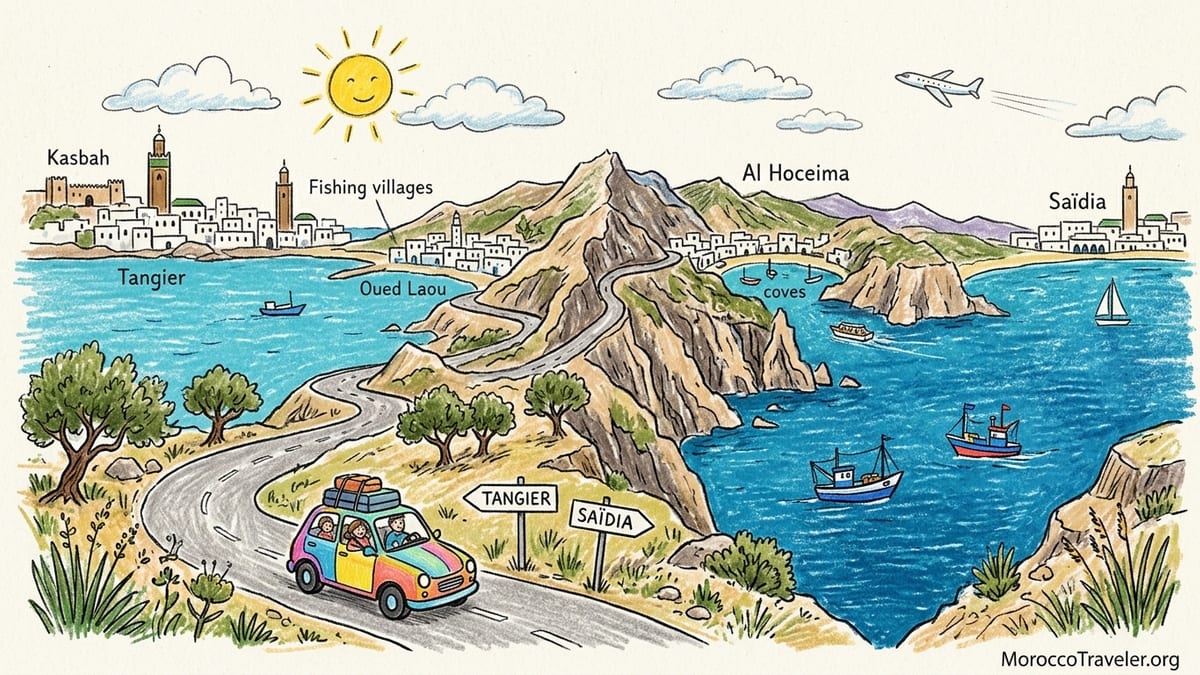
For visualising the route, picture a broad arc along the top of Morocco, starting at Tangier, dipping to Tetouan and the beaches of Martil and M’diq, then tracing the rugged shoreline past Oued Laou and Jebha into the cliffs and coves of Al Hoceima National Park, before softening into the lagoon and dunes of Marchica and the long beach of Saïdia. Whether you choose the tighter seven-day loop or the more expansive ten-day version, you will cover a substantial share of that coastline, with enough time to feel the changing character of the Rif from west to east without treating the journey as a race.
FAQ
Q1. Is it realistic to drive from Tangier to Saïdia in one day on N16?
No, it is not advisable to attempt the full Tangier to Saïdia coastal route in a single day. While the distance is a little over 500 kilometres, the winding nature of N16, slow trucks and the lack of lighting on mountain sections mean average speeds are low. Planning at least two or three full driving days, or better a week with sightseeing stops, is much safer and more enjoyable.
Q2. Which sections of the N16 coastal road are the most challenging to drive?
The stretch between Tetouan, Oued Laou, Jebha and Al Hoceima contains some of the most winding and exposed segments, with frequent bends, steep drops and occasional rockfall. These areas are beautiful but should be driven in daylight and at conservative speeds. East of Al Hoceima the road gradually becomes gentler and easier, though drivers should still remain alert.
Q3. Do I need a 4x4 vehicle for the Morocco Mediterranean coast road trip?
You do not need a 4x4 for the N16 route described in this article. The main roads between Tangier, Tetouan, Oued Laou, Jebha, Al Hoceima, Nador and Saïdia are paved. A regular compact or mid-size car is sufficient as long as you drive cautiously, especially on mountain bends. A higher-clearance vehicle can be useful if you plan to explore rougher side tracks, but it is not essential for the standard itinerary.
Q4. How expensive is fuel along the Rif coast compared with Europe or North America?
As of late 2026, fuel in Morocco is generally cheaper per litre than in much of Western Europe and similar to or somewhat lower than prices in many parts of North America, although exact figures change with global markets and policy. This makes a multi-day coastal road trip relatively economical in fuel terms. It is still wise to factor fuel into your daily budget and refill in larger towns where competition keeps prices reasonable.
Q5. Is parking difficult in Tetouan, Al Hoceima and Nador?
Parking in these coastal cities is usually manageable with some local knowledge. Many mid-range hotels offer small private lots or can direct guests to nearby guarded car parks. In busy areas near medinas or beaches, informal attendants watch cars for a modest fee. Asking your accommodation for advice on where to park safely overnight is the most reliable strategy.
Q6. Are there tolls on the Tangier to Saïdia coastal route?
The N16 coastal road itself is not a toll motorway, so you will not pay tolls for most of the route described. However, if you choose to use nearby expressways around Tangier or inland segments of the national road network to save time, you may encounter toll booths that charge in dirhams. These tolls are usually modest for short distances, but it is sensible to keep some cash ready.
Q7. How much should two people budget for a seven-day self-drive trip?
Exact costs depend on accommodation choices and the season, but for a mid-range seven-day itinerary, two people might plan for several hundred US dollars per day covering lodging, meals, small activities and occasional excursions, plus car rental, fuel and any one-way drop fee. Coastal towns such as Oued Laou and Jebha are typically cheaper than larger cities, while boat trips and higher-end hotels in Al Hoceima and Marchica will raise daily spending.
Q8. Is it safer to hire a private driver instead of self-driving?
Hiring a private driver can be a safer and less stressful option if you are not confident on mountain roads or in dealing with local traffic habits and police checkpoints. Local drivers know the curves, passing spots and customary speeds on N16. The trade-off is higher overall cost and less flexibility to change plans at the last minute. For experienced drivers who go slowly and plan to avoid night driving, self-drive remains a practical option.
Q9. Can I easily find accommodation without booking ahead along the coast?
Outside the peak Moroccan summer holiday period, many smaller coastal towns such as Oued Laou and Jebha have simple guesthouses and apartments that can often be found on arrival. However, for popular dates, weekends and for stays in places with limited capacity like Al Hoceima National Park’s immediate surrounds, it is wise to book at least your first choice in advance, especially if you prefer specific standards or sea views.
Q10. How much of the coastline can I realistically experience in ten days?
In ten days you can drive the full Tangier to Saïdia arc, spend multiple nights in Tetouan and Al Hoceima, enjoy at least one full day on Martil or M’diq’s beaches, take a boat trip in Al Hoceima National Park and still have time to explore Marchica Lagoon and Saïdia without feeling constantly rushed. You will not see every village or bay, but you will experience a representative cross-section of the Rif coast’s changing landscapes and communities from west to east.