

I arrived on the Tetouan coast one Saturday in mid August, still clinging to the postcard image I had been sold of Martil and M'diq. Wide blonde sands, calm Mediterranean water, fresh fish lunches on shaded terraces and children playing in the shallows. By the time I finally sat down under a rented umbrella, two and a half hours after first seeing the sea, any illusion of an easy summer escape had evaporated into exhaust fumes, suncream and the relentless call of beach vendors weaving through a crowd so dense I could barely see the sand at my feet.
Arriving in August: From Seaside Daydream to Traffic Jam
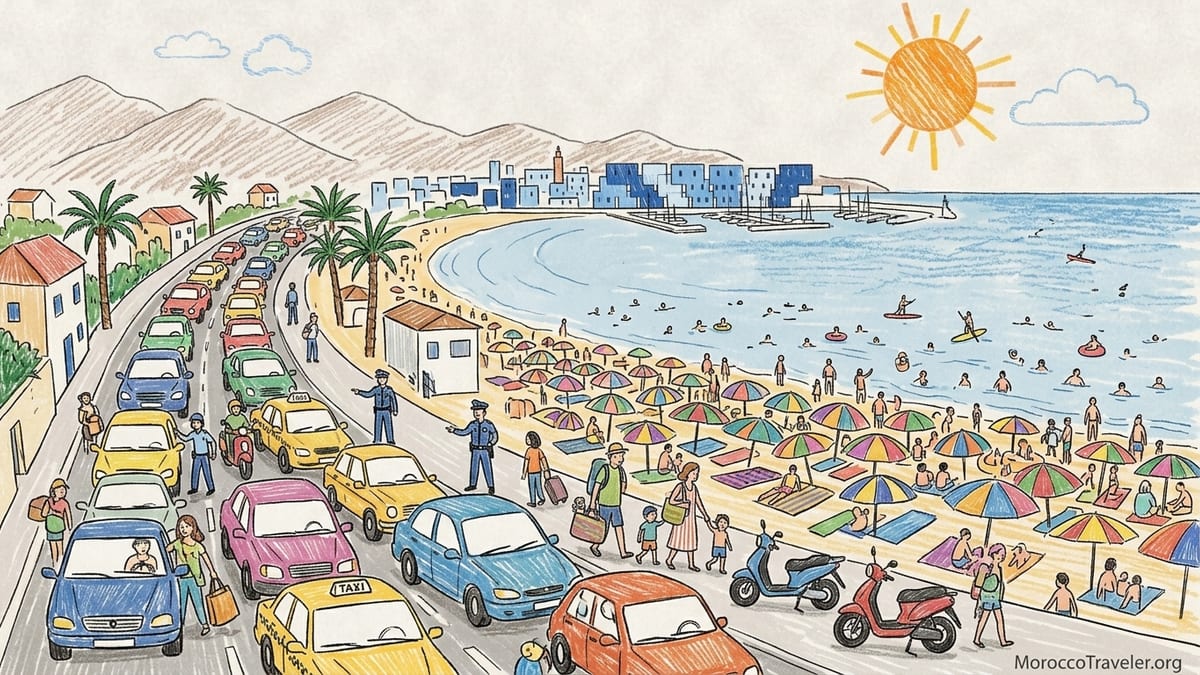
My August visit began like many Moroccan family holidays: a car loaded in Tetouan just after 8 a.m., the hope of “beating the rush,” and the easy 12 to 20 kilometer drive that, on paper, makes Martil and M'diq such attractive escapes. Instead of a breezy half hour, it took close to 80 minutes to cover the last stretch to Martil, as cars from Fez, Meknes, Tangier and beyond all squeezed into the same narrow coastal axis. The final three kilometers into town were a rolling standstill, with police trying to wave traffic into overflowing side streets and drivers stopping wherever a gap appeared, legal or not.
By 9:30 a.m., long before the fiercest afternoon sun, the main Martil seafront was already ringed with double parked cars. I circled the same blocks several times before accepting that anything within sight of the water was either full, reserved for residents or informally “managed” by young men waving fluorescent vests. When I finally accepted a spot wedged between a wall and a second row of cars, the going rate demanded by the self appointed guard was 20 to 30 dirhams for the day, noticeably higher than the 10 dirhams I had paid in June on a weekday.
Reaching the sand with children and bags turned what should be a five minute stroll into a slow, frustrating obstacle course. Pavements were choked with parked scooters and people, and every crossing meant squeezing past parked cars and barrels set up to “hold” space. By the time we reached the waterfront, the beach that looks so vast in promotional photos already felt visually saturated with parasols, plastic chairs and beach mats.
On the Sand: When a Wide Beach No Longer Feels Wide
The Tetouan coast has the raw ingredients of a classic Mediterranean holiday: Martil’s long, gently shelving bay and M'diq’s soft sand and usually calm water. It is very tempting to assume that such broad beaches can effortlessly absorb peak season crowds. In mid August, that assumption fails. Standing on Martil’s promenade at 10 a.m., I counted no more than one or two umbrella widths between each group, and in sections close to the main cafés, towels overlapped like scales on a fish.
Seeking some shade, I tried to rent a parasol and two plastic loungers from one of the informal operators. By this point in August 2026, rates were clustering around 40 to 60 dirhams for a basic set for half a day and 70 to 100 dirhams to keep it until sunset, depending on your bargaining skills and how desperate you looked. The first vendor I approached simply refused to take my money because he had no space left; every one of his umbrellas was already planted so close to its neighbor that getting in or out meant stepping over someone else’s towel.
We eventually found a set at the far southern end of Martil, a full 35 minute walk from where we had parked. It was technically on the same “wide sandy beach,” but the experience bore little resemblance to the relaxed scenes imagined in winter. Beach football games bisected walking paths, vendors selling inflatable toys shouted over each other, and portable speakers leaked competing playlists. Even in the water, there was barely a pace of clear space between bathers. I found myself constantly scanning for my children’s heads among hundreds of others, hardly the serene swim I had pictured.
M'diq, visited the following day, offered slightly finer sand and a more postcardworthy curve of bay, but the density in August was similar. Here, rows of umbrellas ran almost unbroken from the marina to beyond the central lifeguard station, and the back of the beach was lined with jet ski rental stands and food stalls. The sea itself remained relatively clean and inviting, but entering or exiting involved nudging through tight clusters of people and avoiding children’s rubber rings and bobbing paddle boards.
Queues, Prices and the Hidden Costs of Peak Season Popularity
Beyond the physical crush on the sand, what surprised me most in Martil and M'diq was how every small pleasure of a seaside day developed a queue of its own. Coffee on the promenade became a strategic mission. In Martil, the first three cafés I tried around 11:30 a.m. had no available tables facing the sea, and even interior tables came with a wait. When we finally found seats, a simple round of coffee, juice and water for four came to around 80 to 100 dirhams, a noticeable jump from shoulder season prices and higher than similar orders in inland Tetouan.
Lunch was more punishing. In M'diq, a fish restaurant opposite the beach quoted us a 40 minute wait for a shaded terrace table. By the time we sat, hungry children in tow, nearly an hour had passed. A meal of grilled sardines, calamari, salad and soft drinks for four landed between 250 and 350 dirhams, which is not unreasonable for fresh seafood but stings more when you know that, had you driven 15 minutes inland to Tetouan or the surrounding villages, you might have paid 30 to 40 percent less and eaten in relative quiet.
Accommodation followed the same logic. In August, even very simple apartments several streets back from the beach were being advertised from roughly 600 to 900 dirhams per night, with seafront units and serviced residences pushing well beyond 1,000 dirhams. Local residents I spoke to described rents doubling or even tripling compared to June or September, driven by domestic tourism from hotter inland cities as well as Moroccans returning from Europe and a smaller but visible number of foreign visitors. The result is an atmosphere where every meter of shade, every parking space and every sea view feels monetized and contested.
Some of this is the normal cost of a popular summer resort. Yet on the Tetouan coast, I was struck by how little of the high season revenue seemed to be reinvested in easing the strain. Bin clusters filled by mid morning and overflowed by late afternoon in some busy sections, even though Martil and M'diq both benefit from beach cleaning efforts supported by national programs. Public toilets were hard to find and often poorly maintained. Official parking lots felt overwhelmed, which in turn encouraged the semi organized curbside parking economy that adds cost without adding order.
Crowded Does Not Mean Dirty, But Management Matters
It is important to separate overcrowding from water quality and to avoid lazy stereotypes about Moroccan holidaymakers “spoiling” their own beaches. Morocco monitors bathing water at hundreds of sites along its Mediterranean and Atlantic coasts, with annual reports that typically show high overall compliance with national standards for bacteria levels. In recent years, many beaches around Martil, M'diq, Cabo Negro and Oued Laou have been classified as suitable for swimming in these official assessments.
However, these national statistics cover long stretches of coast and several years of data, and they can easily lull visitors into a false sense of security about the specific spot where they happen to spread their towel. In Martil, for example, the river of the same name reaches the sea nearby, and scientific studies of the western Moroccan Mediterranean have highlighted river inputs as major vectors for pollutants and occasional spikes in bacteria or metals, especially in summer when flows are low and recreational pressure is high. That does not mean the sea is dangerously dirty on any given August day, but it does mean that checking the most recent local information at the beach itself is more relevant than quoting a national compliance rate.
On both Martil and M'diq beaches during my August visit, the water appeared visually clean, clear enough to see my feet and free of obvious scum. The main impact of the crowd was not pollution but the simple impossibility of giving each swimmer adequate personal space. Lifeguards stationed at the busiest sections had a daunting job, scanning a sea full of inflatable rings and children who all blended into each other. In quieter months such as June or late September, those same lifeguards can focus more easily on a smaller number of bathers, and swimmers can choose spots with better spacing away from river mouths or boat traffic.
Blaming summer visitors themselves for using the beaches is neither accurate nor fair. Families from inland cities, local Tetouanis escaping the heat and Moroccans returning from Europe all have as much right to enjoy their coastline as any foreign tourist. The real criticism lies with infrastructure and management that have not kept pace with the scale of demand. Limited public transport, ad hoc parking, insufficient shaded public seating, inconsistent waste collection and a lack of clear zoning for quiet versus activity areas all amplify the sense of chaos once numbers rise into the tens of thousands per day.
Traveling With Children: The Long March to the Water
Everything about Martil and M'diq in August becomes harder if you add small children, a pushchair or even heavier beach gear to the equation. The distance from a realistic parking spot to a realistic patch of sand lengthens considerably when central streets fill. On one August morning, I timed it at over half an hour of walking from where we finally managed to park on a side street in Martil to the part of the beach where we could actually find a rented umbrella with space around it.
The walk itself was not pleasant. Pavements were blocked by cars pulled partly onto the sidewalk to squeeze in a few more spaces. The overflow of street vendors selling toys, hats, towels and refreshments added further obstacles. Crossing the main seafront road with children required patience and a strong grip, as drivers pushed to claim any recently vacated slot and taxis wove between them. On the sand, moving from one part of the beach to another resembled a slow zigzag between towels, chairs and coolboxes.
Shade is another hidden challenge. Public shade structures were virtually nonexistent in the busiest stretches, which pushes every family into the arms of private umbrella rental operators. For a group of four, paying around 70 to 100 dirhams per day for a parasol and two loungers quickly adds up over a week. Add parking at 20 to 30 dirhams, and a basic day “just sitting on the beach” can easily cost a family 100 to 150 dirhams before they have eaten anything or rented any equipment. For many local families this is a real burden, yet the alternative sitting for hours in full sun with children is neither pleasant nor safe.
Compare this to early June or late September, when driving from Tetouan to M'diq can still take only 20 to 30 minutes, pavements are navigable and you can carry a foldable umbrella and mat and simply choose a spot. In those shoulder months, you might skip rentals entirely or negotiate lower prices because there is no shortage of space. The same coastline that felt hostile and exhausting in mid August becomes manageable and even charming when freed from the extreme pressure of peak school holiday weeks.
Beyond Martil and M'diq: Cabo Negro, Oued Laou and Al Hoceima
After two suffocating days on the main Tetouan beaches, I went looking for alternatives that locals recommended. Cabo Negro, a short drive north of Martil, is often portrayed as a more upscale resort, with manicured gardens, holiday apartments and a golf course. Its main beach is smaller than Martil’s but attractive, framed by lowrise white buildings. In August, though, it was no secret haven. The stretch in front of the main complexes was dense with umbrellas and sunbeds, and prices for rentals and nearby cafés ran somewhat higher than in Martil or M'diq. It felt slightly more controlled, but just as busy.
Driving further east to Oued Laou did bring some relief. The road itself immediately thinned the crowd, and the village’s beach, flanked by green hills, offered noticeably more breathing space. Even then, arriving after midday on an August weekend meant parking in dusty overflow lots or along the access road and walking. Umbrella rentals were comparable in price, often around 30 to 60 dirhams depending on how central you wanted to be. It was easier to find gaps between groups for children to play, but this was still a popular summer resort for Moroccans from inland cities rather than an undiscovered cove.
Farther afield, Al Hoceima on the central Mediterranean coast often comes up in conversations as a cleaner, better managed alternative with dramatic cliffs and smaller coves such as Quemado or Tala Youssef. Water quality studies have highlighted environmental pressures in the broader region, yet many of its individual bathing sites score well in bacteriological monitoring. Practically, the key difference for a stressed August beachgoer is not that Al Hoceima is empty it is that getting there requires a long drive or internal flight, which naturally caps the number of weekenders. Even there, however, main town beaches on an August holiday still fill up and accommodation prices spike.
The lesson is not that you can escape all crowds by simply picking the right spot on a map. In northern Morocco today, any beach with road access, services and soft sand will draw numbers in August. The more honest conclusion is that where you choose in time (month, weekday, hour) matters more than where you choose in space once school holidays, domestic migration and returning diaspora all converge on the coast.
Timing the Tetouan Coast: August Versus June, September and Early Mornings
Spending time on the Tetouan coast across several months made the contrast with August particularly stark. In early June, Martil and M'diq were already lively. Weekends brought families, and sunny days filled the central sections of the beach. Yet you could still park within a reasonable walk of the sea without paying inflated informal fees, lay down your own umbrella without bumping another, and pick a café without joining a waiting list. Accommodation was also more forgiving, with basic apartments near the coast often available under 500 dirhams per night.
September felt like the sweet spot. The sea was still warm enough for comfortable swimming, the days were long, and many Moroccans had already returned home for work or study. Both beaches retained a buzz, especially around weekends, but the oppressive sense of being hemmed in on all sides had eased. Restaurants still opened, though some seasonal pop ups closed earlier at night. For anyone flexible enough to travel outside school holidays, late May, June and September offer a qualitatively different experience of the same physical places.
Even within August, there are strategies that help, though they do not erase the underlying problem of overcapacity. Several Tetouan residents told me they “give the beaches” of July and August to the rest of the country, or, if they cannot, they go very early. On one experimental day, I reached M'diq before 8 a.m. The difference was impressive: easy parking within a few streets of the water, long patches of empty sand, a calm swim in a sparsely populated sea. By 11 a.m., however, the beach had transformed into the familiar mosaic of umbrellas, speakers and queues. Early mornings buy you three or four hours of relative peace, at the cost of a very early start and a midday retreat inland.
Put simply, the idea of a peaceful, open horizon beach holiday on the Tetouan coast in mid August is more fantasy than achievable goal. With realistic expectations and careful timing, you can still enjoy the Mediterranean light, the taste of fresh fish and the sight of families savoring their brief weeks by the sea. But you cannot conjure private space on a shore that now routinely welcomes tens of thousands of people on the same day.
The Takeaway
My August days in Martil and M'diq left me with more fatigue than fondness. The Tetouan coast is beautiful, its soft sands and mountain backdrops fully deserving of their popularity. The problem is not that Moroccans flock there in summer, but that the physical and administrative systems around those beaches have not been scaled to match the numbers. Visitors are left to compete for basics: curbside parking controlled by informal guards, gaps in the sand, patchy shade and restaurant tables that turn over with the urgency of a downtown lunch rush.
If I return, it will not be in mid August for a full week on the seafront. Instead, my strategy would be precise. I would avoid weekends and the national holiday periods around mid August altogether. I would base myself in Tetouan city or a nearby inland town, where accommodation is calmer and better priced, and treat the beaches as early morning or late afternoon excursions rather than all day occupations. I would aim for June or September if at all possible, or accept that in August my beach time would run from sunrise to 11 a.m., followed by a quiet siesta inland while the coast endures its daily crush.
On the sand itself, I would bring my own light umbrella and mats, using rentals only when absolutely necessary. I would budget for paid parking but still arrive early enough to use official lots instead of improvised rows on narrow streets. For meals, I would eat my main lunch in Tetouan or in less saturated inland villages, saving seafront cafés for quick coffees or ice creams outside peak lunch hours. Before swimming, I would check local noticeboards and talk to lifeguards about current water conditions at that specific segment of beach rather than relying on general national water quality assurances.
Above all, I would adjust my expectations. Martil, M'diq, Cabo Negro and Oued Laou in August are not quiet retreats. They are the shared backyard of a large part of northern Morocco, intense, convivial and sometimes overwhelming. If you dream of strolling onto an empty stretch of sand at noon, waves softly lapping at your feet, this is simply not the month or place to find it. With open eyes and a realistic plan, you can still appreciate the energy and beauty of the Tetouan coast without being crushed by it, but achieving that requires swimming firmly against the tide of peak season habits.
FAQ
Q1. Is it worth visiting Martil and M'diq in August at all?
It can be, but only if you accept that the beaches will be very crowded and structure your days around early mornings or short visits rather than long, lazy sessions on the sand.
Q2. How much should I expect to pay for umbrellas and sunbeds in August?
Along the Tetouan coast in recent summers, basic sets of one parasol and two plastic loungers often cost around 40 to 60 dirhams for a half day and 70 to 100 dirhams for a full day, with some variation depending on location and negotiation.
Q3. What about parking costs near the beach?
Informal attendants on streets close to Martil and M'diq seafronts commonly ask for around 20 to 30 dirhams to “watch” your car for the day in August, while official parking areas can be slightly cheaper but fill quickly.
Q4. Are the beaches actually dirty in summer?
Official monitoring generally classifies many beaches in the region as suitable for swimming, but local conditions near river mouths or harbors can vary, so it is important to check signs and ask lifeguards at the specific stretch of beach where you plan to swim.
Q5. When are Martil and M'diq least crowded?
Outside school holidays, particularly in June and late September, as well as on weekdays and early in the morning. Even in August, arriving before about 8 a.m. can give you a few quieter hours.
Q6. Are Cabo Negro, Oued Laou and Al Hoceima quieter alternatives?
They can feel less intense than Martil and M'diq, especially Oued Laou and some of Al Hoceima’s coves, but in August they are also busy and should not be expected to be empty.
Q7. Is it better to stay in Tetouan city than directly on the beach?
For many travelers, yes. Tetouan often offers better value accommodation, more diverse food options and a calmer atmosphere, with the beaches reachable by car or taxi for a few targeted visits.
Q8. How family friendly are the beaches in peak season?
The beaches are full of families and children, but pushing a stroller, keeping track of kids in the water and finding shade all become more difficult in August, so extra planning and early starts are helpful.
Q9. Can I rely on public shade and facilities?
Public shade, toilets and showers are limited on the busiest stretches. Most people either rent umbrellas and loungers or bring their own, and it is wise to plan for basic self sufficiency.
Q10. What is the single most important tip for enjoying the Tetouan coast?
If your dates are fixed in August, treat the beach as a sunrise activity and base yourself inland. If your dates are flexible, choose June or September instead of the absolute peak weeks.