


I left Tetouan just after 8 a.m., the last call to prayer still hanging in the air as I steered onto the N16 and pointed the car east. In less than an hour I would reach Oued Laou, where the Rif Mountains begin to lean into the Mediterranean and the coastal drive becomes one of the most distinctive stretches of road I have driven anywhere in Morocco. This is not a journey about ticking off big-name resorts or famous monuments. It is about the bends in the asphalt, the tiny fishing villages, the smell of grilled sardines at roadside cafés and the feeling of the sea on one side and mountains on the other, all the way to Jebha.
Setting Out from Tetouan for the Mediterranean Edge
Leaving Tetouan on the N16, the city faded quickly in the rearview mirror. Within fifteen minutes apartment blocks gave way to vegetable stalls and small workshops, then to olive groves climbing the lower slopes of the Rif. Traffic thinned after the last suburbs and I settled into a steady pace. The N16 here is a standard two-lane national road, about 12 meters wide with a lane in each direction, resurfaced in recent years as part of a broader upgrade of the "rocade méditerranéenne" that links Tangier to Saidia. It is in generally good condition, but it is not a highway. There are no hard shoulders, you pass through villages, and you share the road with slow trucks and aging Mercedes grand taxis that overtake with the confidence of people who drive this route every day.
About half an hour out of Tetouan the landscape begins to open. To my right, the valley of the Oued Laou river broadens toward the sea; to my left, the mountains rise in a patchwork of terraced fields and scrubby forest. Buses from Tetouan and Chefchaouen also run this way, setting down passengers at junctions and roadside cafés, but the car gave me the freedom to stop whenever a view caught my eye. I had a full tank from Tetouan, which I recommend. Fuel stations are clustered around the cities and larger towns, and while you can usually find a pump in Oued Laou, Stehat and Jebha, the small independent stations in between sometimes sit empty or closed outside summer weekends.
By the time the first glimpse of the Mediterranean appeared on the horizon, a flat slash of silver under a pale sky, I could already feel the air cooling. In total, the 44 kilometers from Tetouan to Oued Laou usually take just under an hour in light traffic. It is tempting to push on, knowing that the really dramatic coastal driving lies between Oued Laou and Jebha, but I always make time to pause in Oued Laou itself. It is here that the Rif valleys finally step into the sea.
Oued Laou: Where Rif Valleys Meet the Sea
Oued Laou is often described as a simple beach town, which is accurate as long as you add that it is one of the few places on this part of the coast where a river valley, a pebble-and-sand beach and the mountains come together so cleanly. The town spreads along a long, curved bay, fronted by a corniche lined with cafés and low-rise apartment blocks. In summer it fills with Moroccan families from Tetouan, Chefchaouen and farther inland, but outside July and August it returns to a slower routine of fishermen, schoolchildren and a few travelers who have chosen the coastal road over the faster inland routes.
I parked just behind the seafront and walked onto the pebbles, the car’s tires crunching over broken shells. Parking in Oued Laou is easier out of high season; in July and August cars fill every patch of dust near the beach and you may need to circle a few times or accept a spot several blocks inland. On my autumn visit I paid a local attendant the equivalent of a few dirhams to watch the car, a small price for peace of mind when you have luggage inside. This is a recurring theme on the N16: formal parking lots are rare, but there is usually someone unofficially keeping an eye on cars where most people stop.
Coffee came from Miramar, one of the simple cafés on the corniche. Inside, men watched football highlights on a muted television while families took the tables that faced the sea. An espresso cost around 10 to 12 dirhams, a fresh orange juice slightly more. For an early seafood lunch, places like Andalucia café & restaurant and other small grills along the waterfront offer plates of fried sardines, calamari and a tomato salad for about 60 to 90 dirhams per person, depending on the catch of the day. The fish is landed nearby, sometimes from small blue boats that you see pulled up at the eastern end of the bay.
Accommodation in Oued Laou is still mainly in the form of simple hotels and furnished apartments. Outside high season, a clean room with a private bathroom in a modest guesthouse commonly starts under 300 dirhams, while seafront apartments can be higher, especially if booked through intermediaries. On this trip I chose not to stay, because my aim was the full coastal run to Jebha, but on previous visits I have used Oued Laou as a base, and I would recommend it for families who want an easier beach with lifeguards in summer and plenty of snacks and shops within walking distance.
Climbing Out of Oued Laou: The Road Turns Wild
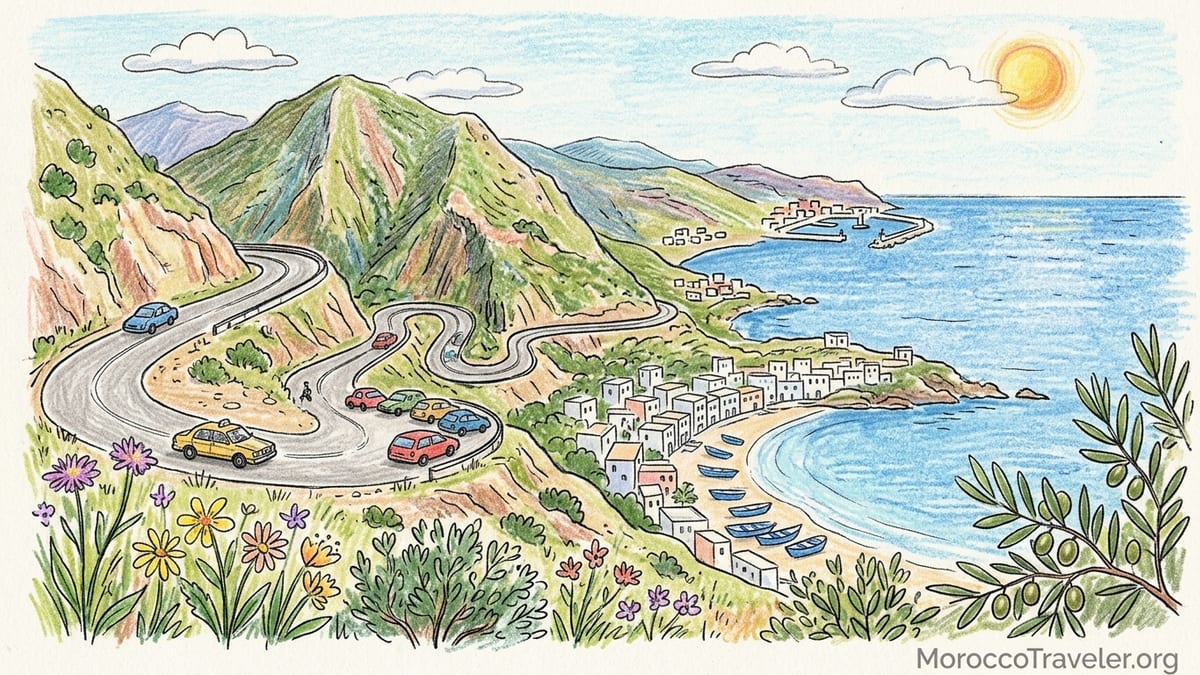
Leaving Oued Laou eastward, the character of the road changes almost immediately. The N16 begins to climb the first serious slopes of the Rif as they fall into the Mediterranean, twisting up from sea level in a series of switchbacks that live long in the memory. Within minutes, the town shrinks behind you and the view broadens into one of the classic coastal panoramas of northern Morocco: a jagged line of headlands stepping out into the water and the faint haze of distant villages clinging to the hillsides.
This section, between Oued Laou and the twin villages around Stehat, is where I realized why some travelers choose to hire a private driver. The tarmac is generally in good shape, but the combination of steep drops, tight bends and drivers who know the road too well can be intimidating. For those uncomfortable with winding mountain roads, it is reasonable to ask a Tetouan or Chefchaouen based agency or hotel to arrange a driver for the day. Prices vary with season and negotiation, but a full-day private car and driver for this stretch and back typically runs in the range you would expect for an intercity excursion rather than a simple transfer, because of the hours and concentration involved.
The reward lies in the views. At several unofficial lay-bys where the asphalt widens just enough for a car to pull aside, I stopped to look back over Oued Laou, now framed by the river valley like a postcard. There are no formal miradors with railings or information boards. You share these pauses with a handful of other drivers and sometimes with shepherds who cross the road with flocks of goats. Mobile signal along this stretch was intermittent on my Moroccan SIM. I could send messages in some bends and then be without coverage for ten or fifteen minutes. For navigation, I had downloaded offline maps earlier, and I recommend doing the same.
From a pure driving perspective, the roughly 70 kilometers between Oued Laou and Jebha can take from two to three hours, depending on how often you stop and how comfortable you are on mountain roads. Straight through, the time seems short, but that would miss the point. This is not a road to rush, and the next significant pause, in my case, was Stehat.
Stehat: A Quiet Beach Village Worth Slowing For
Stehat appears almost suddenly, a small cluster of low buildings and a bridge over a wide, sandy river mouth. The official spelling on maps sometimes differs, but on the ground you see signs for Stehat or Steha, and you know you have arrived when the valley widens again and the sea flattens into a long beach. This is one of the few points on the route where the N16 drops almost to sand level and you can walk onto the beach without climbing down a path or scrambling over rocks.
I parked just off the main road, again in an informal dirt area supervised by a couple of young attendants who waved arriving cars into place. A short walk brought me to the beach, a broad arc of pale sand and shingle backed by tamarisk trees and a few scattered houses. Even in late morning it remained quiet, with only a handful of families and fishermen. In summer, Stehat attracts more visitors but still feels far from mass tourism. There are no large resorts, no branded hotels, and no beach clubs with booming music. Instead, you find simple rooms to rent, seasonal apartments and a handful of cafés just above the shore.
For lunch, I chose Café Restaurant Thamaris in the village center, one of the better known addresses among local drivers and visitors. The terrace offered a sliver of sea view and a rotating menu based on whatever had come from nearby boats. A grilled fish plate with salad, bread and olives cost around 70 to 90 dirhams, while mint tea or coffee added less than 15 dirhams. Service was unhurried but warm; the owner chatted about the state of the N16 and confirmed what I had already seen. The road is fully paved and passable, but after heavy winter rains occasional rockfalls or minor damage can appear, so in the wet season it is wise to check local news or ask in Tetouan or Oued Laou before setting out.
Stehat also illustrated one of the key trade-offs of this coastal route. I asked about staying the night and learned that while there are a few guesthouses and apartments, many only operate in the main summer season. In shoulder months you might find one or two rooms available for 250 to 400 dirhams, but without online booking or clear signs, you have to ask around. For spontaneous travelers this can feel like an adventure. For families with children or people with heavy luggage who prefer to know where they will sleep, it is a source of stress. If you plan to overnight between Oued Laou and Jebha outside peak season, it is safer to pre-arrange a room in Jebha, or to base yourself in Oued Laou and explore this stretch as an out-and-back day trip.
Onward to Jebha: Cliffs, Coves and Narrow Margins
Beyond Stehat, the N16 tightens again into one of the most scenic and concentration-demanding sections of the drive. The road snakes along cliffs that plunge directly into the Mediterranean, with small coves and pocket beaches far below. In some points the lane feels barely wide enough for two vehicles to pass comfortably, especially when you meet a loaded truck or a grand taxi that has decided to overtake a slower car on a blind bend. The posted speed limits drop before tighter curves, and it is worth respecting them. Not because the police are visible, but because one lapse of attention here could have serious consequences.
From the driver’s seat, the scenery unfolds as a repeating rhythm of ascent and descent. You climb away from sea level, passing roadside shrines and tiny hamlets where children wave at passing cars, then drop again toward another river mouth or bay. Occasionally, a concrete track peels away from the main road toward an isolated beach. Many of these tracks lead to coves that are known locally but lack formal names or signage. I chose one that appeared well used and not too steep, descending cautiously toward a stony beach with half a dozen parked cars and no fixed infrastructure. Families picnicked under umbrellas they had brought from home. It was beautiful, but it underlined another reality of this coast: accessible beaches often come with no facilities. There were no toilets, no lifeguards, and no bins beyond a single rusting drum.
Parking along this section is mostly informal. Small bays in the road have become de facto viewpoints and rest areas, but you must always check that your car is fully off the driving lane, especially on blind bends. I saw several spots where drivers had left just enough of a bumper in the road to force others into the oncoming lane. Mobile signal remained patchy, sometimes disappearing altogether between valleys. Anyone relying on ride-hailing apps will be disappointed; this is traditional taxi and private-car territory. For travelers without their own vehicle, grand taxis from Oued Laou or Chefchaouen can sometimes be hired to go as far as Jebha, but you need to negotiate an all-in rate that includes the driver’s time waiting or returning empty.
The last stretch before Jebha brings a change in atmosphere. The mountains open slightly, and the village appears ahead in a sheltered bay, a cluster of white and pastel houses backed by rugged slopes. The approach reveals why many Moroccans speak fondly of Jebha as a place that still feels like a fishing port first and a small resort second.
Jebha: A Small Port Between Mountain and Sea
Jebha, sometimes written El Jebha, is both an end point and a good overnight break on this route. The town wraps around a compact harbor where fishing boats bob alongside a modest commercial quay. Along the waterfront, a narrow promenade is lined with basic cafés and pastry shops, with the occasional small hotel or guesthouse above. It is a place where you are more likely to hear the clatter of crates and the sound of engines from returning boats than loud music from bars.
Finding a room here required a little walking. Jebha does not yet have large, internationally branded hotels. Instead, it offers locally owned establishments and seasonal apartments. On my visit, after asking in two closed-looking places, I found a small guesthouse on an upper floor near the main street, offering a clean double room with a private bathroom and a partial sea view for the equivalent of roughly 300 to 350 dirhams. In high summer the same room might cost more, especially if demand from Moroccan holidaymakers outstrips supply. There was no online booking system or glossy reception desk, but the owner’s welcome more than compensated. Over a pot of mint tea, he shared stories of winter storms that batter the harbor and summer weekends when city families spill onto the town’s main beach until late at night.
For dinner, I followed his advice and walked to a simple seafood restaurant by the port. The menu was written on a board and changed daily. That evening’s choice was between sardines, small dorade and calamari. I ordered a grilled mixed plate for around 80 to 100 dirhams, which arrived piled high, accompanied by a tomato and onion salad, bread and olives. The fish was not dressed up; it did not need to be. It tasted of the sea I had been following all day. In Jebha the atmosphere in such places is relaxed but busy from early evening onward, especially when locals arrive to break up their promenade with a plate of fried fish.
Staying the night in Jebha also solved a practical issue. Attempting to drive the entire Tetouan to Jebha section and back in one day is feasible in summer, when daylight stretches well into the evening, and for confident drivers comfortable with repeated hairpins. With stops in Oued Laou, Stehat and viewpoints, I had already spent most of the day in motion and at rest. Pushing on after dark would have meant missing the scenery and adding stress on unlit, winding roads occasionally used by pedestrians and animals. For most travelers, especially those with children or anyone unused to mountain driving, breaking the trip with a night in or around Jebha is the more enjoyable choice.
One Long Day or a Slower Journey: How to Plan the Drive
Looking back on the drive, the key planning decision is whether to treat the Oued Laou to Jebha section as a long day trip or stretch it over two days with a night in Jebha. With an early start from Tetouan, it is physically possible to reach Jebha by mid-afternoon, spend an hour or two exploring, and then return the same way before it is fully dark, especially around late spring and early summer. That would mean roughly three to four hours of pure driving time plus stops, which quickly turns into eight to ten hours on the road and at viewpoints. It is doable but leaves little margin for unexpected delays like minor rockfalls, roadworks or long lunches.
Breaking the trip allows a different rhythm. Day one can focus on Tetouan to Oued Laou, with time for a swim and lunch, followed by a relaxed drive to Stehat and scenic stops before reaching Jebha in the late afternoon. After a night there, day two can begin with a walk around the harbor, a visit to nearby beaches accessible by short drives or walks, and then a return along the same coastal road, seeing it in different light. For photographers, this is particularly rewarding; the angle of sun on the sea and mountains changes the color of the cliffs and the mood of the villages.
There are trade-offs. By staying overnight, you must deal with limited accommodation options and the possibility that in shoulder seasons not every guesthouse is open. In return, you gain a more relaxed schedule and the chance to see Jebha and Stehat without watching the clock. Attempting the loop in one day suits confident drivers traveling light and outside winter. Families, travelers carrying large suitcases or camera gear, or anyone who already finds the idea of narrow cliff roads intimidating, will likely enjoy the experience more if they treat Jebha as an overnight objective, not just a turning point.
Whatever the timing, it is wise to start with a full tank from Tetouan or another larger town and, if possible, top up in Oued Laou. Small stations between Oued Laou and Jebha exist but can be inconsistent in supply outside the busiest weeks. Cash also matters. While some restaurants and hotels in Tetouan and Oued Laou accept cards, many of the cafés, guesthouses and informal parking attendants along the N16 work only with cash. ATMs are present in Oued Laou, but you should not assume you will find one in every village.
Strength and Inconvenience: A Coast Without Big Resorts
One of the reasons this stretch of the N16 feels so special is precisely because it lacks the large-scale resort infrastructure found on parts of Morocco’s Atlantic coast or closer to Tangier. There are no all-inclusive complexes dominating the hillsides, no multi-story hotels lining the bays. For travelers seeking authenticity, this is a strength. It means the cafés in Oued Laou and Stehat are still primarily serving locals, the fishermen in Jebha are still fishing first and catering to visitors second, and the beaches between villages remain largely undeveloped, framed more by tamarisk and eucalyptus than by sun lounger grids.
The absence of big resorts also means fewer services. Beach access can involve clambering down rough tracks rather than strolling along boardwalks. Public toilets are rare outside towns, and showers are usually available only at some beach cafés in peak season. For families with small children, this can complicate the day. Packing your own shade, snacks, water and basic first aid is essential on this route, because once you leave Oued Laou you will not pass a supermarket-sized shop until you reach Jebha or return.
For independent travelers, the small-scale infrastructure fosters real interaction with residents. I remember ordering tea at a roadside café between Oued Laou and Stehat where the owner, surprised by an outsider traveling in the shoulder season, pulled up a chair and asked about the rest of my itinerary. In large resorts, such conversations are often replaced by standard service scripts. Here, even with language gaps, you feel more like a guest in someone’s town than a customer passing through a standardized tourist machine.
Yet the very qualities that preserve the coast’s character can be inconvenient. Accommodation is limited and not always well signposted. Online reviews exist for only a handful of places, and advance bookings may require phone calls in French, Arabic or Spanish rather than instant confirmations. In bad weather there is no alternative highway to bypass the N16 cliffs. Anyone who needs absolute predictability and a full range of amenities on their doorstep might find the region frustrating. For those willing to accept a little uncertainty in exchange for empty beaches, fishing harbors at dusk and mountain light changing over the sea, it feels like a bargain.
Practical Advice for Drivers, Families and Nervous Passengers
Driving this section of the N16 is not technically difficult in dry conditions, but it demands attention. The road is paved and generally at least 7 meters wide between lane markings, yet many bends have no guardrails, and you should be prepared to slow behind trucks grinding uphill or vans that stop to pick up passengers. Starting early in the day helps avoid the heaviest local traffic around villages. I kept my speed well below the limit on blind corners, more for comfort than necessity, and I was glad I did when a herd of goats wandered onto the asphalt near a crest.
For families, the key is pacing. Plan shorter hops between substantial stops: Tetouan to Oued Laou for a breakfast or beach break, then Oued Laou to Stehat for lunch, followed by a gentler afternoon toward Jebha. Snack breaks double as leg-stretches for children who may not enjoy long hours of curving road. Car sickness can be an issue for some passengers on the tighter sections, so having anti-nausea tablets or ginger sweets on hand is sensible. Many of the roadside cafés serve simple omelettes, tagines and sandwiches for 20 to 50 dirhams, which keeps food affordable even for larger families.
Travelers carrying bulky luggage or expensive equipment should think about how comfortable they are leaving it in the car. While this part of Morocco generally felt safe, I preferred to keep valuable items out of sight and park where there were other vehicles and, ideally, an attendant. When overnighting in Jebha, I chose a guesthouse with the option to park directly in front of the building on a lit street, adding a layer of reassurance. Asking your host where they recommend parking is an easy habit that pays off along the N16.
For those who do not want to drive themselves, arranging a private driver is a realistic alternative. Agencies in Tetouan, Chefchaouen or Tangier can organize day trips or one-way transfers along the N16. The cost depends on distance, waiting time and negotiation, but solo travelers or couples who are anxious about narrow roads may consider the expense worthwhile for a day of relaxed sightseeing without focusing on every curve. Another option is to use grand taxis between towns, though these usually run on shared, straight-forward routes and may not be keen to linger at viewpoints. Whatever your choice, communicate clearly where you want to stop and whether you expect the driver to wait while you swim or eat.
The Takeaway
When I replay this drive in my mind, certain images return first. The river valley opening to reveal Oued Laou’s long crescent of beach in the morning light. The sudden view, just beyond the town, where the N16 clings to the cliffs and the sea appears impossibly far below. The hush of Stehat’s sandy river mouth, broken only by children shouting at waves and the low murmur of a café where fish sizzled on a grill. The mirror-surface water in Jebha’s harbor at dusk, dotted with small blue boats and framed by mountains that seemed to hold the town in a loose embrace.
Not everything was perfect. A promising track to a secluded cove turned rough halfway down, and I decided not to risk scraping the underside of the car for a beach that, glimpsed from above, looked beautiful but offered no facilities. In Stehat, one guesthouse I had read about was shuttered for the season, and another could only offer a room without hot water that evening. Those small disappointments were reminders that this coast still runs on its own rhythm, not on travelers’ expectations.
If I had to choose one exact section to drive again, it would be the stretch from Oued Laou to just beyond Stehat, taken slowly in both directions. In that zone, the mountains lean closest to the sea, the viewpoints multiply, and the balance between raw scenery and access to a good meal or coffee feels just right. I would start from Tetouan with a full tank, linger in Oued Laou over a late breakfast, stop for swims and photographs whenever the road allowed, and end the first day in Jebha with grilled fish overlooking the harbor, ready to see every bend in reverse the next morning. The N16 here is not the fastest road, nor the easiest, but it is one of those routes that transform a simple transfer into a journey you measure in memories rather than kilometers.
FAQ
Q1. How long does it take to drive from Tetouan to Jebha along the N16?
In light traffic, the direct drive from Tetouan to Jebha via Oued Laou and Stehat usually takes around three hours without long stops, but most travelers should allow a full day to include breaks for views, meals and beach time.
Q2. Is the road between Oued Laou and Jebha safe to drive?
The N16 is paved and generally in good condition, but it is narrow and winding with some steep drops and limited guardrails. It is safe for cautious drivers in dry weather, though those uncomfortable with mountain roads may prefer a private driver.
Q3. Are there fuel stations between Tetouan and Jebha?
There are reliable fuel stations around Tetouan and at least one in Oued Laou, with smaller independent stations near some villages. It is wise to start with a full tank in Tetouan and top up in Oued Laou, as pumps between Oued Laou and Jebha are less frequent and may not always be stocked.
Q4. Can I find ATMs and pay by card along this route?
ATMs are available in Tetouan and Oued Laou, but are limited or absent in smaller villages and in parts of Jebha. Many cafés, guesthouses and informal parking attendants accept only cash, so carrying enough Moroccan dirhams is important.
Q5. Is this coastal drive suitable for families with children?
Yes, provided you plan regular stops and consider the winding nature of the road. Towns like Oued Laou and Jebha offer family-friendly beaches and simple restaurants, but facilities at smaller coves are minimal, so families should bring snacks, shade and basic supplies.
Q6. What kind of accommodation is available in Stehat and Jebha?
Stehat and Jebha mostly offer small guesthouses and seasonal apartments rather than large hotels. Outside peak summer, some places close, so it is sensible to inquire in advance or be flexible, especially if you need specific comforts like hot water, private parking or family rooms.
Q7. Is there mobile phone coverage along the N16 coast?
Mobile coverage is generally good in and around Tetouan, Oued Laou, Stehat and Jebha, but can be intermittent or absent on the more remote cliff sections between villages. Downloading offline maps and not relying on constant connectivity is recommended.
Q8. Can I reach this area without driving myself?
Yes. Buses and shared grand taxis run between Tetouan and Oued Laou, and grand taxis can often be hired onward toward Stehat and Jebha. For flexible stopping and photography, arranging a private driver through an agency or hotel in Tetouan, Chefchaouen or Tangier is often the most comfortable option.
Q9. When is the best time of year to do the Oued Laou to Jebha drive?
Late spring, early summer and early autumn are ideal, offering long daylight hours and generally dry roads without the intense crowds and heat of peak July and August. Winter can bring heavy rain and occasional rockfalls, which may affect comfort and safety on the mountain sections.
Q10. Are the beaches between Oued Laou and Jebha equipped with facilities?
The main beaches in Oued Laou and Jebha offer services such as cafés and, in summer, lifeguards and rental umbrellas. Many smaller coves and stretches of sand between them have little or no infrastructure, so visitors should be prepared for a more natural setting without toilets, showers or rubbish collection.