


Morocco’s Mediterranean north is closer to Europe than many travelers realize. From whitewashed Tangier to the beaches of Tamuda Bay, the cliffs of Al Hoceima and the long sands of Saïdia, you can reach the region in just a few hours by air or sea. The challenge is choosing the right airport or ferry route, understanding seasonal schedules, and avoiding costly transfer mistakes, especially around Tangier’s two different ports. This guide walks European travelers through the main options with up-to-date examples so you can book with confidence.
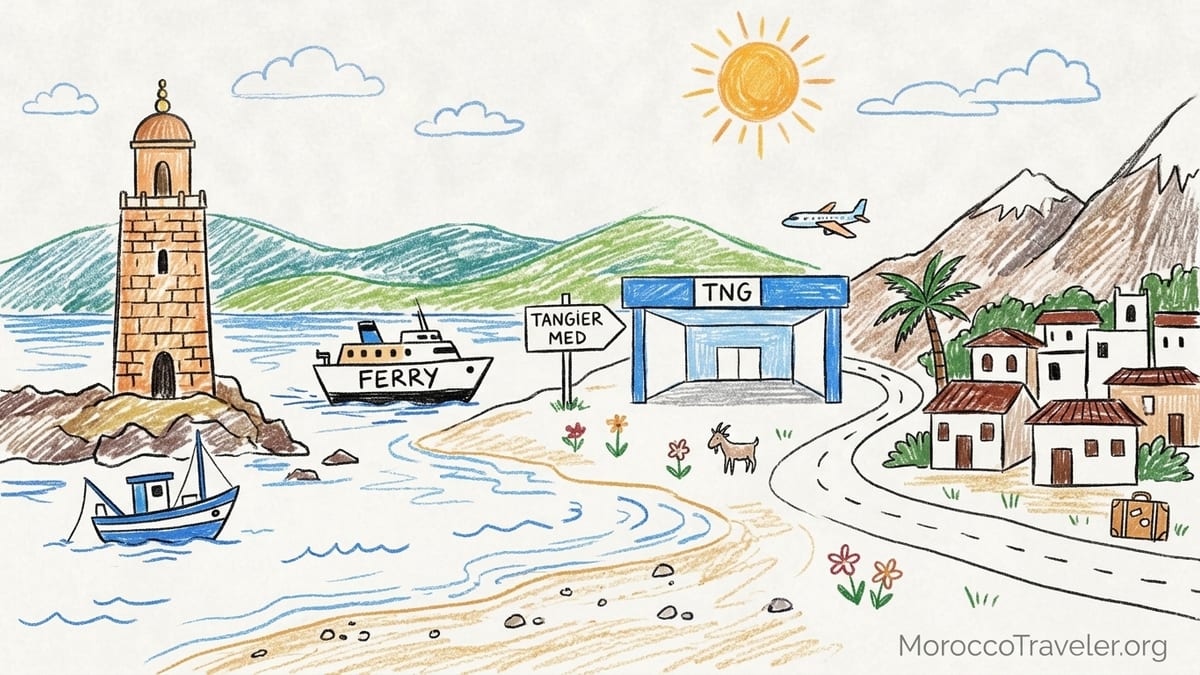
Key Gateways to Morocco’s Mediterranean North
For the Mediterranean coast and Rif region, five airports matter most: Tangier Ibn Battouta (TNG), Tetouan Sania Ramel (TTU), Al Hoceima Cherif Al Idrissi (AHU), Nador El Aroui (NDR) and Oujda Angads (OUD). All are on or near the Mediterranean or in the adjacent Oriental region, and all act as gateways to specific stretches of coastline.
Tangier and Tetouan serve the western part of the Moroccan Mediterranean, including Tangier city, Cape Spartel, the Strait coastline and the resort strip known as Tamuda Bay near M’diq and Martil. Al Hoceima sits roughly in the middle of the Mediterranean shore, backed by Rif mountains. Nador and Oujda serve the northeastern Oriental coast, including the beaches around Nador, the resort development of Marchica, and the long Saïdia bay close to the Algerian border.
If you are planning a road trip with your own car, ferry ports become equally important: Tangier Med and Tangier Ville in the west, Nador port in the northeast, and the European ports of Algeciras, Tarifa, Almería and Sète. Choosing the correct combination of airport or port with your final resort can save several hours on the road and significant transfer costs.
Because schedules and routes change frequently, especially outside summer, you should always confirm the latest flights and sailings before booking accommodation. The examples in this article reflect information available in October 2026, but operators regularly adjust frequencies and seasonal services.
Comparing the Main Airports: Routes and Seasonality
Tangier Ibn Battouta is by far the busiest airport in northern Morocco. It has extensive low cost links with Europe, particularly through Ryanair and Air Arabia Maroc, with multiple daily flights to Spanish cities such as Malaga and Madrid, to French cities including Paris Orly, Bordeaux and Marseille, and to hubs like Brussels and Barcelona. A departure board snapshot for late October 2026 shows morning departures to Bordeaux, Milan Bergamo, Paris Beauvais, Brussels, Malaga, Madrid, Barcelona, Geneva, Paris Orly, London and more on a typical day, which illustrates how easy it is to reach Tangier directly from many European airports.
Tetouan Sania Ramel is smaller but strategically important for Tamuda Bay resorts. Flight databases for autumn 2026 show non stop services from several European cities on airlines such as Royal Air Maroc, Ryanair, Air Arabia Maroc and TUI fly, often concentrated in the summer and shoulder seasons. Typical links include Brussels, Charleroi, Madrid and some French regional cities, though frequencies may drop to weekly or suspend entirely in winter. If you are booking Tetouan, always check your exact travel dates rather than assuming year round service.
Nador El Aroui has become a major gateway for the Rif diaspora in Europe. Recent timetables show around 80 weekly departures to about 19 cities, with non stop flights to Brussels, Amsterdam, Cologne Bonn, Barcelona, Montpellier and other European destinations operated by carriers such as Air Arabia Maroc, Royal Air Maroc, Ryanair, Vueling and TUI fly. Many of these flights cluster between late spring and early autumn, when demand from visiting families is highest.
Oujda Angads, inland but close to the Mediterranean Saïdia coast, offers a mix of domestic and European flights. Official and schedule sources list direct flights to Brussels, Marseille, Paris Charles de Gaulle and sometimes other European points, mainly with Air Arabia Maroc and seasonal services from ASL Airlines France and others. As with Nador, most international traffic is concentrated in the busy Marhaba summer period, when Moroccans living abroad return home.
Al Hoceima Cherif Al Idrissi is the smallest and most seasonal of these airports. It serves the mid Rif coast and can be extremely convenient if your dates line up. In recent years it has had limited international service, sometimes from European cities such as Brussels or Amsterdam in peak season, plus domestic links via Casablanca. However, schedules change regularly, and some past routes have not been renewed. For 2026 you should check current schedules directly with airlines such as Royal Air Maroc or Air Arabia Maroc, rather than relying on old forum posts or tourism brochures.
Ferries to Morocco’s Mediterranean Coast: Routes and Durations
For many European travelers, especially those bringing their own car, the ferry is the most practical way to reach Morocco’s Mediterranean. Three core short sea routes matter most: Algeciras to Tangier Med, Tarifa to Tangier Ville, and Almería to Nador. In addition, there are longer sailings from Sète in southern France to Tangier Med and Nador, and a mix of Spanish and Italian ports served seasonally by long distance ferries.
The Algeciras to Tangier Med route is the workhorse of the Strait. Several companies, including Baleària, Africa Morocco Link and FRS or DFDS affiliated operators, run multiple daily departures. Crossing times for standard ferries are typically around 90 minutes, with check in cut offs often between 60 and 90 minutes for vehicles and around 60 minutes for foot passengers. Algeciras is easily reached from much of Spain by motorway, which makes this route particularly popular with drivers from France, Belgium, the Netherlands and Germany heading to Morocco.
The Tarifa to Tangier Ville service historically provided a fast catamaran link straight into Tangier’s city center with a scheduled crossing time of about 1 hour. However, operator announcements in 2025 indicated that FRS / DFDS would stop running the route, and during 2026 travelers have reported inconsistent availability and changing arrangements. Some booking platforms and operator pages still show services, sometimes with a free shuttle bus from Algeciras to Tarifa provided by Baleària for passengers connecting to the Tarifa to Tangier Ville ferry. Because of these changes, anyone specifically needing Tangier Ville should verify on the operator’s site whether direct ferries are running for their dates and what brand is operating them.
The Almería to Nador route is the main maritime gateway to Morocco’s northeastern Mediterranean shore. Port information from Almería and booking aggregators show that several companies serve the line, including Naviera Armas Trasmediterránea, Baleària, Grandi Navi Veloci and Africa Morocco Link. Crossing times vary from around 6 to 8 hours depending on vessel and schedule, with some overnight sailings. For example, some listings for 2026 show fast ferries scheduled in around 6 hours and conventional ferries around 7 to 8 hours, with several departures each week and more frequency in summer.
From France, the port of Sète now plays a key role. Official port information states that Sète has regular sailings to Tangier Med and Nador operated by GNV and Baleària. In autumn 2026, ferry comparison sites describe crossings from Sète to Tangier Med in roughly 42 hours direct or about 48 hours with a call at Barcelona, and routes from Sète to Nador of roughly 39 to 47 hours depending on ship and intermediate stops. These are classic long distance ferries where passengers book cabins for two nights at sea. Some Italian ports such as Genoa and Civitavecchia are also linked to Morocco on GNV routes that continue to Tangier Med and Nador, although schedules are strongly seasonal and concentrated around summer.
Historically there have also been seasonal ferries to Al Hoceima, but several of these lines have been suspended or rearranged over the last decade. As of late 2026, the most consistently advertised Mediterranean ports in Morocco for international ferries are Tangier Med, Nador and, to a much lesser extent, Al Hoceima. Because reliable public timetables for Al Hoceima are limited and often outdated, travelers who need that port should confirm directly with any operator claiming to serve it and be prepared to reroute via Nador or Tangier Med if no sailing is available.
Tangier Ville vs Tangier Med: Avoiding the Classic Mistake
One of the most expensive booking pitfalls in northern Morocco is confusing Tangier Ville with Tangier Med. Tangier Ville is the historic port located on the edge of Tangier city, a short walk or taxi ride from the old medina and the modern marina area. It is mainly used by fast ferries from Tarifa or occasional other passenger services. Tangier Med, by contrast, is a huge container and ro ro port built around 40 kilometers east of the city, closer to the Strait’s narrowest point and linked to Algeciras and other Spanish ports.
Arriving at Tangier Med when your hotel or pre booked tour expects you at Tangier Ville can be a costly surprise. Tangier Med is connected to the city by a toll motorway and serves large volumes of freight traffic. There are buses and shared taxis, but frequencies vary and services can be crowded during the Marhaba summer peak. Travelers in 2026 report that waiting times for buses can be long outside peak arrival bundles and that taxis at the terminal often quote higher prices to foreigners.
A private taxi from Tangier Med to the urban center commonly costs the equivalent of 30 to 40 euros or more for a couple with luggage, depending on negotiation and time of day. Even a shared grand taxi, if available, will be a noticeable extra cost compared with walking off a ferry at Tangier Ville and reaching many hotels on foot or with a short city taxi ride costing less than 5 to 10 euros. If you are traveling with a rental car booked in Tangier city, arriving at Tangier Med might mean paying for a taxi, then another fare back to the port if you later collect a car near the harbor.
Because of this, you should always double check the port name on your ticket before confirming a ferry booking. If your hotel directions refer to “port de Tanger Ville” or “Tanger city port,” you should target Tangier Ville. If you are coming from Algeciras with a vehicle, most sailings go to Tangier Med, so make sure your accommodation or onward plans account for the 40 kilometer transfer. Some ferry operators that serve both routes offer a free shuttle bus between Algeciras and Tarifa to connect with Tarifa to Tangier Ville services, which can be a smart choice if your main goal is to arrive right in Tangier city without a long overland transfer.
Fares, Check In, Border Formalities and Vehicle Rules
Prices on the Strait and Almería to Nador routes fluctuate significantly by season, day of week and how early you book. Recent examples from booking engines in October 2026 show foot passenger fares between Algeciras and Tangier Med starting around 35 to 60 euros one way in low season, often higher at short notice or around holidays. Vehicle packages, including one car and two adults, on the same route commonly start around 150 to 220 euros one way outside peak periods, with summer Marhaba sailings often much more expensive.
On the Almería to Nador line, guide fares in 2026 for two adults with a standard car and cabin on an overnight sailing can range roughly from 250 to 400 euros one way depending on date, cabin category and operator. Basic deck or seat only tickets for foot passengers can sometimes be found from around 70 to 120 euros one way on quieter departures, again rising sharply during school holidays and peak migration weeks.
Check in deadlines are critical. Major operators such as Baleària and Naviera Armas typically state that foot passengers should check in at least 60 minutes before departure on international routes, and vehicles often 90 minutes or even 2 hours in advance on busy days. For long distance routes from Sète or Italian ports, recommended check in for vehicles can be 3 hours or more, because queues at passport and customs control are longer and boarding involves large numbers of cars and trucks.
Border procedures are usually handled partly on board. When traveling from Spain to Morocco, you will clear Spanish exit checks in the port and then Moroccan entry checks either in the terminal at Tangier Med or Nador, or at a passport control desk on the ship itself, where officers stamp passports during the crossing. On arrival, vehicles may be inspected by customs, especially if you declare goods or are driving a foreign registered car into Morocco.
Traveling with your own vehicle requires some extra paperwork. You must carry the original vehicle registration document and proof of insurance that is valid in Morocco. Many European insurers do not cover Morocco as standard, so you may need to purchase a green card extension or buy Moroccan border insurance at the port. If the car is financed or leased, you may also need a letter of authorization from the leasing company allowing you to take it abroad. Moroccan regulations also require that the driver listed on the temporary import form is present when the vehicle leaves the country; you cannot leave the car behind without formalities.
Onward Transport from Airports and Ports
From Tangier Ibn Battouta airport, the city center and train station are roughly 12 kilometers away. Taxis from the official rank outside arrivals usually operate on fixed tariffs rather than meters for airport trips; recent traveler reports suggest fares in the range of the equivalent of 10 to 15 euros into central Tangier, depending on time and negotiation. There is no direct rail link from the airport, but once in the city you can connect to the high speed Al Boraq line for onward travel to Kenitra, Rabat or Casablanca, or take buses and shared taxis eastwards along the Mediterranean coast.
Tetouan Sania Ramel airport sits just a few kilometers from Tetouan city and around 30 to 40 minutes by road from Tamuda Bay resorts such as M’diq, Martil and Fnideq. Many hotels in this area can arrange private transfers, often charging roughly 20 to 30 euros for a one way transfer from the airport to a resort hotel for a couple. Local taxis are cheaper but may not have large luggage space; for example, a petit taxi into Tetouan itself may cost the equivalent of only a few euros.
Al Hoceima Cherif Al Idrissi lies south of the city, with a transfer time of about 20 to 30 minutes to most beachfront hotels in town. Taxis are the primary onward option, and rates are usually arranged on a flat fare from the airport. Because visitor numbers are smaller than in Tangier or Nador, it is sensible to pre arrange a pickup with your accommodation, especially for late night arrivals or shoulder season flights when airport activity is light.
Nador El Aroui airport is about 25 kilometers from Nador city and similar distance from the coastal resort zone along the Marchica lagoon. Taxis line up outside arrivals and serve both Nador city and nearby towns such as Beni Ensar near the port. If you arrive by ferry at Nador port, you will find taxis and some local buses serving the city; from there, grand taxis and buses run along the coastal road to smaller resort areas. Long distance buses and shared taxis also link Nador with Al Hoceima and with Oujda, though schedules can be sparse outside summer.
Oujda Angads airport is inland, approximately 12 kilometers from Oujda city and around 60 to 70 kilometers from Saïdia on the Mediterranean. Taxis from the airport to Oujda are straightforward and relatively inexpensive. To reach Saïdia, your main options are a pre booked private transfer, a rental car or a combination of taxi to Oujda and then shared taxi or bus to Saïdia. Many Saïdia resort hotels routinely arrange airport transfers; a private car for two from Oujda to Saïdia might cost in the order of 40 to 70 euros depending on provider and season.
From Tangier Med, buses and grand taxis connect to Tangier city, but service levels fluctuate and traffic congestion through the port complex can cause delays during peak arrival waves. If you are heading east along the Mediterranean, you can drive directly from Tangier Med onto the national roads or motorways towards Tetouan and then on to Al Hoceima or Nador. From Nador port, the coastal highway provides access east to Saïdia via Berkane and west towards Al Hoceima, though travel times can be longer than they look on the map due to winding mountain sections in the Rif.
Destination by Destination: Best Transport Choices
For Tangier city itself, the simplest options from Europe are direct flights into Tangier Ibn Battouta or a ferry that lands at Tangier Ville. A couple flying from London, Paris, Barcelona, Brussels or several German cities can often find non stop services to Tangier on low cost carriers at competitive fares. For example, off peak one way fares between major European cities and Tangier sometimes appear around 40 to 80 euros per person if booked well in advance, while peak summer dates can be much higher. If you want to arrive with your own car, the classic route is to drive to Algeciras, take a ferry to Tangier Med with the car on board, and then drive 40 kilometers into Tangier, or use a shuttle and second ferry to arrive at Tangier Ville if available.
For Tetouan and Tamuda Bay resorts, flying into Tetouan Sania Ramel is ideal when seasonal flights are operating from your departure country. For example, families in Belgium or northern France often choose seasonal charters or low cost flights that land directly at Tetouan, cutting transfer time to the beaches to under an hour. If no suitable flights are available, an alternative is to fly into Tangier, then transfer by road along the coast to Tetouan or M’diq, a journey of about 60 to 90 minutes. Travelers with cars can arrive at Tangier Med and drive east on the motorway past Tetouan towards M’diq and Martil.
For Al Hoceima, the most convenient but often hardest to match option is a direct flight to Cherif Al Idrissi. Where no workable flights exist, many visitors fly to Nador or Tangier and then travel by rental car or long distance taxi through the Rif mountains, which can take several hours but offers spectacular scenery. Another option is to arrive by ferry at Nador and then drive west along the coastal road to Al Hoceima. The road is improved in many sections but still slow in others, so you should plan generous daylight hours and avoid night driving in mountain stretches.
For Nador and the surrounding coast, including the growing Marchica resort area, flights into Nador El Aroui from European cities with large Rif communities, such as Brussels, Amsterdam, Barcelona or Frankfurt, are often the most efficient. For those driving, the Almería to Nador ferry allows you to arrive within a short drive of most coastal accommodations. Long distance ferries from Sète or Italian ports that call at Nador are particularly attractive for travelers from France, Switzerland, Belgium and northern Italy who prefer to avoid the drive through Spain.
For Saïdia and the Oriental Mediterranean, Oujda Angads is usually the best airport choice, with shuttle or private transfers east to the coast. Some travelers also fly to Nador and then drive or take a taxi east from there, though road connections from Nador to Saïdia are longer and less direct than from Oujda. For drivers from Europe, taking a ferry to Nador and then driving east to Saïdia is a popular choice, especially for extended summer stays in self catering accommodation or second homes.
Costed Examples: Flying vs Driving and Ferry
To illustrate the financial tradeoffs, consider a couple in Paris traveling to Tamuda Bay in late May, outside the absolute peak but still in a busy season. Option one is to fly directly from Paris to Tetouan if a seasonal low cost flight is operating. Suppose they find return tickets at around 160 euros per person including basic luggage. Their total air cost would then be about 320 euros, plus perhaps 60 euros each way for a private transfer from Tetouan airport to their resort, bringing the total transport cost to roughly 440 euros.
Option two would be to fly Paris to Tangier on a low cost carrier. Advance purchase return fares outside peak season sometimes fall around 120 to 180 euros per person. If they secure tickets at, say, 140 euros each, total air cost would be 280 euros, plus a road transfer from Tangier airport to Tamuda Bay. Assuming a private transfer price in the region of 80 to 100 euros one way for the couple, their round trip ground cost might be 160 to 200 euros, yielding a total transport budget of around 440 to 480 euros, similar to the direct Tetouan option but with more flight frequency and backup options if something changes.
Now consider a Belgian couple with their own car heading to Nador for three weeks in August. Option one is to fly from Brussels to Nador and rent a car for the full three weeks. Summer airfares on busy diaspora routes can be significantly higher than in shoulder season, and realistic return ticket prices might be 300 to 450 euros per person in August if booked late. With two passengers, that could mean 600 to 900 euros for flights, plus perhaps 900 to 1200 euros for a three week car rental with full insurance, taking the total close to or above 1500 euros.
Option two is to drive from Belgium through France and Spain to Almería and sail to Nador with their own car. Fuel and tolls for a round trip across Europe might easily reach several hundred euros. Ferry fares for a car and two adults on Almería to Nador in peak August weeks can reach 400 to 600 euros one way when demand is highest, and sometimes more if you add a private cabin, so a realistic ferry budget could be 800 to 1200 euros return. Adding road costs, the couple might spend 1200 to 1600 euros overall but avoid rental fees and have their own vehicle, which is valuable for long stays and transporting luggage and gifts. These rough examples show why early booking and comparing both approaches carefully is worthwhile.
The Takeaway
Reaching Morocco’s Mediterranean north from Europe is straightforward once you understand the geography of its airports and ports. Tangier and Tetouan serve the western Strait and Tamuda Bay; Nador, Al Hoceima and Oujda give access to the central and eastern Rif and the Oriental coast. On the maritime side, Algeciras to Tangier Med, Tarifa to Tangier Ville and Almería to Nador are the main short crossings, supplemented by longer sailings from Sète and some Italian ports for those who prefer not to drive across Spain.
The crucial practical point is to match the correct airport or port to your chosen destination and to pay close attention to labels such as Tangier Ville versus Tangier Med on ferry tickets. Misreading these can add 40 kilometers of unexpected transfer and an unplanned taxi bill. It is also vital to respect check in deadlines, especially with a vehicle, and to bring the proper documentation for car import and insurance.
Flight and ferry prices can vary dramatically by date and booking timing, but by using recent schedules from airlines and operators, and by booking well in advance for peak Marhaba weeks or school holidays, European travelers can reach Morocco’s Mediterranean coast efficiently and often at reasonable cost. Whether you choose a quick city break in Tangier or a long summer stay in Saïdia or Nador, investing a little time up front in comparing these routes will pay off in a smoother arrival and more time on the beach.
Before hitting the book button, use the checklist below as a final cross check, especially if you are bringing your own car.
FAQ
Q1. What is the main difference between Tangier Ville and Tangier Med?
Tangier Ville is the small passenger port right in Tangier city, often used by fast ferries from Tarifa, while Tangier Med is a large commercial and passenger port about 40 kilometers east of the city linked mainly to Algeciras and long distance routes.
Q2. Which airport is best for Tamuda Bay (M’diq, Martil, Fnideq)?
Tetouan Sania Ramel is closest when seasonal flights operate, but Tangier Ibn Battouta with a road transfer of around 60 to 90 minutes is often more reliable year round.
Q3. How long does the ferry from Algeciras to Tangier Med take?
Typical published crossing times are around 90 minutes, although loading and unloading can add extra time, especially during busy summer departures.
Q4. Is there still a direct ferry from Tarifa to Tangier Ville?
The Tarifa to Tangier Ville route has seen changes and temporary suspensions, so you must check directly with current operators for your specific dates to confirm if services are running.
Q5. Which airport should I use for Saïdia?
Oujda Angads is usually the best choice, with road transfers of roughly an hour to Saïdia, though some travelers also arrive via Nador or Nador port and then drive east.
Q6. Do I need special insurance to take my European car to Morocco?
Yes, you must have insurance valid in Morocco. Either request a green card that covers Morocco from your insurer or buy Moroccan border insurance at the port on arrival.
Q7. How early should I arrive at the port before my ferry?
For international routes, aim for at least 60 minutes before departure as a foot passenger and 90 minutes or more with a vehicle, and even earlier for long distance sailings from France or Italy.
Q8. Are there direct flights to Al Hoceima from Europe?
Al Hoceima has had limited and often seasonal European flights. Availability changes frequently, so you should verify on current airline timetables for your exact travel period.
Q9. Is it cheaper to fly and rent a car or to drive from Europe and take a ferry?
The answer depends on season, family size and stay length. For short trips, flying and renting is often cheaper; for long summer stays with several passengers, driving and taking a ferry with your own car can be more economical.
Q10. Can I rely on old blog posts for ferry and flight information?
No. Routes, operators and schedules change regularly. Use current information from airlines, ferry companies and official ports rather than relying on older personal blogs.