


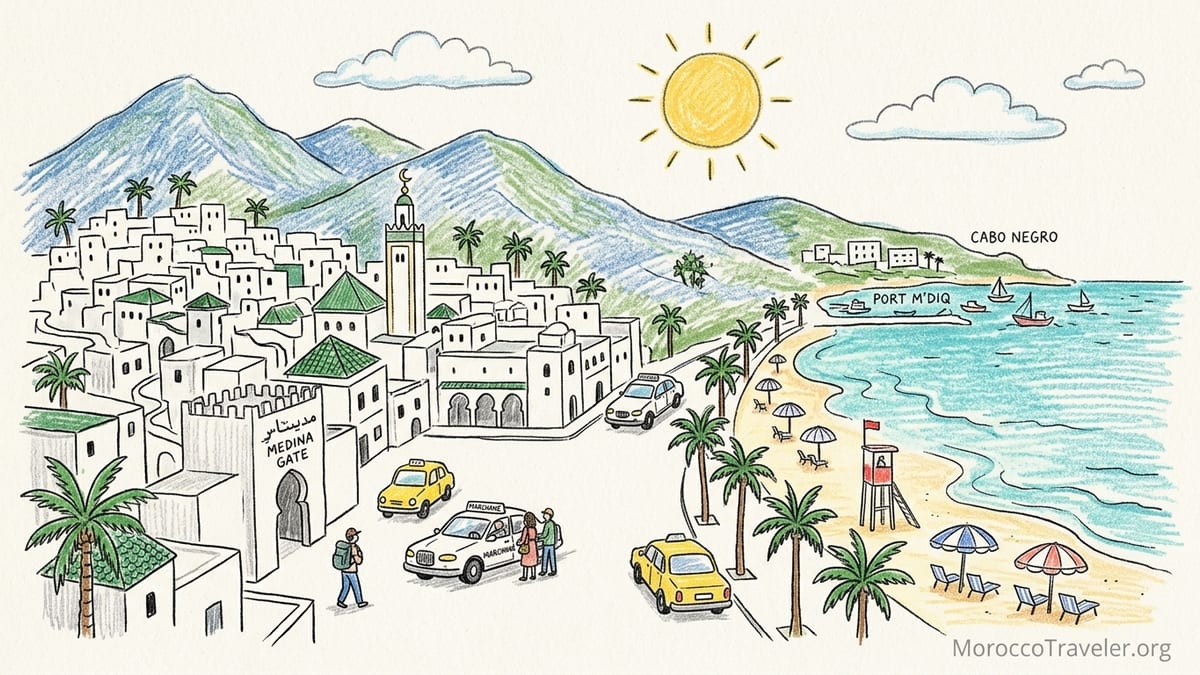
I still remember the moment the taxi swept around the last bend and Tetouan appeared below me, a cascade of white houses spilling down the hillside. Behind them, the jagged Rif Mountains framed a dense, historic medina, while a soft haze on the horizon marked the Mediterranean, only a short drive away. I had come for a simple weekend, but that contrast between Andalusian old town and bright shoreline ended up defining one of my favorite short trips in Morocco.
Arriving in Tetouan: First Impressions of a White City
I arrived on a Friday afternoon, coming from Tangier by grand taxi. At the Tangier train station, drivers clustered outside the exit calling out destinations, and Tetouan was one of the loudest names. The going rate for a shared grand taxi seat on this route was around 50 to 60 dirhams per person in 2026, in line with what local travelers reported, so I waited until five other passengers had squeezed in before we set off. The road south cut along the foothills, and just over an hour later we rolled into Tetouan’s main bus and taxi hub.
From there, a yellow petit taxi took me up toward Place Hassan II, the vast square that forms the hinge between modern Tetouan and its old city. The driver turned on the meter without my asking, which I appreciated, and the short ride cost just under 10 dirhams, matching what residents described as a fairly standard minimum daytime fare in the city. We stopped within sight of the Royal Palace, an elegant complex that dominates one side of the square, its ornate gates and tiled facades facing the open plaza.
Standing on Place Hassan II, I could see how Tetouan earned its reputation as the “white dove.” On one side spread the new town, with mid-century apartment blocks and busy traffic; on the other, the medina rose in overlapping planes of whitewashed walls, green-tiled mosques and sloping alleys. It felt compact but intricate. Somewhere beyond the hills behind it, the Mediterranean coast curved past Martil and M’diq, but for that first evening I stayed firmly on the medina side of the city.
I had chosen to sleep inside the old town rather than at the beach. My guesthouse, a restored riad near one of the medina’s main gates, offered a double room with breakfast for about 450 dirhams a night, noticeably cheaper than most beachfront hotels at Tamuda Bay. The owner told me many summer visitors now stay by the sea and only visit Tetouan as a half-day excursion, but I wanted the reverse: nights in the medina, days shuttling to the water.
Walking Tetouan’s UNESCO-Listed Medina
The next morning I stepped out early, before the alleys filled. Tetouan’s medina is recognised by UNESCO for its unusually intact Andalusian urban fabric, and you notice that as soon as you duck through one of its gates. The streets fall into a clear hierarchy: wider commercial spines with arcaded shops, then narrower lanes, then tiny dead-end alleys that lead to private homes. Many facades have the sober, white planes and green roofs associated with Andalusian architecture, and wooden balconies lean out above steep lanes.
I began near the main gate that opens off Place Hassan II, then followed a sloping street into the heart of the medina. On both sides, hardware shops, cloth merchants and tiny groceries were just opening their shutters. A man hauling a cart of mint brushed past me, leaving a fresh, herbal scent in the still-cool air. When I paused to look at a carved wooden door, a woman passing by slowed down and told me, in a mix of Darija and Spanish, that the house belonged to a family originally from Granada. Stories like that are common here, but hearing it from a local tied the architecture directly to the waves of Andalusian refugees who rebuilt Tetouan centuries ago.
As the street narrowed, I entered one of the artisan quarters. In a sequence of low workshops, men shaped brass trays and teapots using simple tools, the loud, rhythmic tapping echoing between the walls. One elderly craftsman noticed me peering in and waved me over. He showed me a set of small engraved tea glasses holders and, switching to hesitant French, explained that his father had taught him the craft. I bought one brass cup for 70 dirhams. There was no hard sell, just quiet pride, and he wrapped it in old newspaper before tucking it into my daypack.
Further in, the medina opened onto a small square lined with butchers and vegetable stalls. This was where Tetouan’s medina felt most lived-in. Women bargained over piles of tomatoes and peppers, young boys carried fresh bread from the communal oven, and a vendor squeezed oranges to order. I ordered a glass of juice and a msemen, the flaky square flatbread fried on a hot plate, from a tiny stand; the two together came to around 10 dirhams. Eating breakfast surrounded by the noise and scent of the market felt far more vivid than any cafe in the new town.
Details, Detours and a Glimpse of the Royal Palace
My wandering eventually drew me back toward the edge of the medina near Place Hassan II. Here the lanes widen and there is more light, and it did not take long before the open expanse of the square appeared in front of me again. From this side, the Royal Palace is particularly striking, with its spacious forecourt, enormous gates and carefully preserved plasterwork. The building is closed to the public, and there is a visible security presence, so I admired it from a respectful distance along with a handful of local families and a group of schoolchildren on an outing.
From the square, I detoured into a neighborhood known for textiles and tailors. Shops displayed vivid rolls of fabric, from deep indigo wool for djellabas to lighter cottons printed with floral patterns. In one store, a tailor invited me in and showed off a half-finished white djellaba with green piping, destined for a wedding. We chatted about Tetouan’s reputation for quality embroidery and he pointed out the difference between machine-stitched and hand-stitched details on a sleeve. He quoted around 700 dirhams for a custom djellaba in mid-range fabric, which struck me as good value considering the hours of work.
By late morning the medina’s main streets were busier. I slipped into a small café on the edge of the old town, one of those long, narrow spaces with a few metal tables and a television mounted in the corner. A short, intense coffee cost roughly 6 dirhams, and the waiter automatically brought a glass of water alongside. I watched a mix of regulars come and go: older men in traditional djellabas, younger people scrolling their phones, a street vendor who parked his cart of prickly pears outside and came in for a quick espresso. From the doorway, I could see the flow of people entering and exiting the medina gate, framed by the white walls and the shadow of the palace behind.
That afternoon, I stepped briefly out of the medina to visit a small crafts cooperative nearby. Several artisans shared a space where they sold pottery, carvings and woven baskets. Here the prices were labeled, which made browsing easier; simple painted bowls started around 40 to 50 dirhams. I bought a small, lopsided bowl, knowing it would remind me of Tetouan each time I used it at home. By the time I walked back through the old city to my riad, the light in the alleys had turned golden and the smell of dinner preparations, especially frying fish and simmering tagines, drifted through the open windows.
From Medina to Mediterranean: Taxi to Martil
Early the next morning, I headed for the coast. Tetouan is connected to its seaside satellites Martil, M’diq and Cabo Negro by a mix of buses and grand taxis. Most grand taxis for Martil and beyond leave from a hub locals call Al Shallal, just outside the center. I reached it by petit taxi from the medina for about 10 dirhams, then followed the stream of people toward a line of aging white Mercedes, each marked with a destination sign in the windshield.
The shared grand taxi fare between Tetouan and Martil was posted at around 5 to 10 dirhams per seat in recent years; in 2026, drivers were mostly charging 7 to 10 dirhams depending on where exactly you boarded along the route. I paid 10 dirhams, took the last available spot in the back, and we set off as soon as all six passenger seats were filled. The ride took roughly 20 minutes, snaking down the valley toward the sea, past newly built apartment blocks and glimpses of the river.
We were dropped on a busy street a short walk from Martil’s seafront. There was no train station or formal bus terminal here, just a slightly chaotic knot of taxis, small buses and pedestrians. Within five minutes on foot, I reached the promenade and my first clear view of the Mediterranean, a long crescent of pale sand with apartment buildings marching along behind it.
Stepping from Tetouan’s steep medina alleys onto Martil’s flat, palm-lined corniche felt like entering a different world. Instead of the clatter of brass and vendors calling out prices, there were shouts from children playing football on the sand, the squeak of plastic beach chairs being dragged into the shade and the smell of sunscreen and grilled sardines. The architecture lost its Andalusian intricacy and shifted to boxy, modern facades with balconies facing the water, catering to Moroccan families from inland cities who come here each summer.
Martil’s Lively Family Beach and a Simple Seafood Lunch
By late morning, Martil beach was already busy. Families had staked out spots with striped umbrellas and plastic mats, young men rode rented jet skis near the swimming area, and vendors walked up and down selling everything from cold water to inflatable flamingos. Lifeguard posts were visible along the shore, and designated swimming zones were clearly marked. I walked the length of the promenade first, passing a mix of cafes, juice bars and seafood restaurants.
Many of the seafront places advertised set menus on signs in Arabic and French. I settled on a modest seafood restaurant a block back from the busiest stretch, chosen more for the smell of fresh fish than for any glossy decor. Inside, families and groups of friends filled the tables. I ordered a simple grilled sardine plate, a side of Moroccan salad and a bottle of water. The server brought out a metal tray so I could choose the fish, then returned around fifteen minutes later with a generous portion, accompanied by bread and olives. The bill came to about 90 dirhams: roughly 60 for the fish, 20 for the salad and 10 for the water. It was not the cheapest meal in Morocco, but considering the freshness and the location near the beach, it felt fair.
After lunch I rented a sun lounger and parasol from one of the licensed operators on the sand. These services are among the few that legitimately charge on Moroccan public beaches, and the man running the loungers quoted 30 dirhams for the afternoon. He wrote the number of my lounger on a small scrap of paper and checked in a couple of times, but there was no pressure to order drinks. Other vendors occasionally approached selling snacks or tea, yet a polite “no, thank you” was enough for them to move on.
Martil in the afternoon was noisy but good-natured. Music from portable speakers overlapped with children’s shouts, and an almost continuous line of people walked the waterline. If you value a quiet, contemplative beach, Martil in peak season is not where you will find it, but if you enjoy people-watching and a very local, family-focused atmosphere, it is an excellent window into summer in northern Morocco. After a few hours, though, I was ready to see whether the mood changed further up the coast.
M’diq’s Harbor and Waterfront: A Different Mood
From Martil I flagged another shared grand taxi, this time toward M’diq. The route between the two towns is short, and local guidance put the shared fare in the range of roughly 5 to 15 dirhams per seat, depending on exact stops and recent adjustments. I paid 10 dirhams, mindful that there had been recent official reminders in the region about respecting regulated taxi fares. The drive followed the curve of the coast, giving occasional glimpses of the sea before dipping back between low hills and residential developments.
M’diq itself felt more focused around its working harbor and the adjacent beach. Coming into town, we passed signs for larger beach resorts strung along Tamuda Bay, but I asked the driver to let me off near the port. At the harbor, small fishing boats were lined up along the quayside, their blue hulls reflecting in the water. In the early morning, this area comes alive when the night’s catch is unloaded and auctioned, but even in the later afternoon there was a distinct maritime feel: the smell of fish, coiled ropes, and men mending nets on the dock.
The seafront promenade here was narrower than Martil’s but calmer. There was still a stream of evening strollers, particularly around sunset, yet the vibe skewed slightly more towards couples and groups of friends than extended family clans. The cluster of seafood restaurants facing the water looked more polished too, some attached to resort hotels further along the bay. Menus reflected that. Whole grilled fish could easily run 120 to 180 dirhams in the smarter spots, and mixed seafood platters were priced even higher, a noticeable jump from Tetouan’s inland eateries and from simpler joints in Martil.
I chose a mid-range place facing the harbor rather than a luxury resort restaurant. They offered a “menu poisson” that included a fish soup starter, a main of grilled sea bream with vegetables and a dessert of seasonal fruit. The fixed price was 150 dirhams, plus another 15 for a small bottle of mineral water. Service was more formal than in Tetouan: the waiter pulled out the chair, changed cutlery between courses and checked on me unobtrusively. The fish was perfectly cooked, with crisp skin and tender flesh, and the view of the harbor lights coming on as the sky faded made the higher price feel worthwhile for one evening.
Where to Sleep: Tetouan, M’diq or Cabo Negro?
Over the weekend I split my time between Tetouan and the coast but kept my bed in the medina. That decision shaped the trip. Staying in Tetouan meant I woke to the sound of roosters and the distant call to prayer instead of traffic on the corniche, and I could step straight into the medina at quiet times when day-trippers from the resorts had not yet arrived. It also meant my evenings were calmer and cheaper. Dinner in a traditional palace restaurant in Tetouan, with couscous, a tagine and mint tea, might cost 120 to 180 dirhams per person, significantly less than most comparable meals in the Tamuda Bay resorts.
On the other hand, not sleeping by the sea came with trade-offs. Each beach day began and ended with at least one taxi ride. Returning from M’diq to Tetouan at night, when grand taxis were less frequent, I sometimes had to negotiate for a whole car rather than a single seat, which could push the fare up to around 80 to 120 dirhams total depending on the driver and hour. Splitting that between two or three people would still be reasonable, but solo it becomes a noticeable extra expense. Parking would have been another consideration if I had rented a car; several people I spoke with complained that in July and August, finding a legal space near the waterfront in Martil or M’diq could be frustrating and sometimes involved paying a local guardian to watch the car.
For travelers who care more about being on the beach than in the medina, M’diq and Cabo Negro are tempting bases. Cabo Negro, a short taxi ride from Martil, is known for its holiday apartments and golf course, and several owners advertised nightly rentals starting from around 600 to 800 dirhams for a one-bedroom in mid-season, climbing higher in August. These offer immediate beach access and modern comforts but little sense of historic Morocco. M’diq has a broader mix, from budget guesthouses set a few streets back from the water for roughly 350 to 500 dirhams a night, to upscale resorts in Tamuda Bay running into several thousand dirhams for a sea-view room.
If I were to choose again for a short weekend focused on both culture and sea, I would still sleep in Tetouan. The value felt better, especially outside peak summer, and the atmosphere at night was more distinctive than that of a generic beachfront strip. For a longer stay purely dedicated to sun and sand, though, basing myself in M’diq or Cabo Negro and treating Tetouan as a day trip could make sense, especially for families who want to minimize daily transfers.
Practical Transport, Costs and Crowds
Moving between Tetouan and the coast turned out to be straightforward but required a bit of awareness. Shared grand taxis are the backbone of local transport in this part of Morocco. They follow fixed routes between city hubs and coastal towns, departing once all seats are filled. The per-seat fares I encountered on my weekend were roughly 7 to 10 dirhams between Tetouan and Martil, another 7 to 10 between Martil and M’diq, and around 10 to 15 dirhams between Tetouan and M’diq directly, in line with the ranges local guides and municipal notices described.
At busier times, especially late morning in summer, taxis filled quickly and I never waited more than ten minutes to depart. In the evenings, especially on Sunday when many people were returning inland, the queues grew longer and some drivers tried to charge above the posted or customary rates, particularly to foreign visitors. On one occasion a driver quoted me 50 dirhams for a single seat back to Tetouan from M’diq, several times the usual price. When I politely refused and joined a group of local passengers walking to the official taxi rank, another car loaded at the standard fare. It is a reminder to ask locals about current prices and to confirm whether you are paying per seat in a shared car or for a private ride.
Within Tetouan, petit taxis made it easy to move between the medina, the bus station and newer neighborhoods. These small yellow cars run on meters in principle, though a few drivers tried to suggest a flat fare without turning it on. In those cases I insisted gently on using the meter or stepped out and tried another cab; there were enough around that this was never a problem. Typical rides within the city center cost under 15 dirhams in daytime, a bit more at night when surcharges applied.
In terms of crowds, timing mattered. In April and May, when I visited, the beaches were busy on weekends but not overwhelming. Locals warned me that in July and August, particularly during school holidays, Martil and M’diq could feel saturated, with heavy traffic, packed sand and rising prices for everything from beachfront coffees to parking. Several people who worked in hospitality mentioned that some cafes and parking attendants attempted to charge for access to parts of the beach, something authorities have pushed back against by reminding the public that the shoreline itself is free. I did not encounter that directly, but it is worth being alert to and willing to walk a little further along the sand if a fenced-off section seems to be bending the rules.
My Ideal Two-Day Tetouan and M’diq Itinerary
After this first-hand weekend, I have a much clearer idea of how I would structure a return trip. If I had two full days again, I would still base myself inside Tetouan’s medina at a traditional guesthouse. The combination of relative quiet at night, easy access to the old town and better value for money outweighs the convenience of waking up directly on the beach. I would budget around 450 to 600 dirhams per night for a comfortable double including breakfast in the medina, slightly more for stylish riads with rooftop terraces.
On Day One, I would devote the morning to a focused walk through Tetouan’s medina, starting from Place Hassan II, pausing to admire the Royal Palace exterior from the edge of the square and then diving into the artisan lanes. I would revisit the brass workshops where I bought my cup, linger in the textile district to watch tailors at work and stop again in the food market for a simple breakfast of fresh juice and msemen. After a midday rest back at the riad, I would spend the late afternoon on a cafe terrace just outside the medina gate, watching the ebb and flow of local life, then seek out a palace restaurant for a traditional dinner and live Andalusian music if available.
Day Two would be the coastal day, starting early with a shared grand taxi from Tetouan to Martil. I would arrive on the seafront before the heat built, walk the length of the promenade and choose a spot on the sand away from the densest cluster of umbrellas. After a swim and a few hours of people-watching, I would head to a modest seafood place set slightly back from the main strip for lunch, again aiming for a grilled fish plate and salad in the 80 to 120 dirham range. In the mid-afternoon I would continue by taxi to M’diq, timing my arrival to wander the harbor and then settle on the waterfront for an early dinner as the fishing boats returned.
If budget allowed, I might splurge on one night by the sea at a simple guesthouse in M’diq or an apartment in Cabo Negro, using it as a base for sunrise or sunset walks along the shore. Overall though, the heart of the trip would still be Tetouan’s medina. It is the place where the region’s layered history is most visible, and waking within its walls, then fanning out to the coast for the day, felt like the best way to balance cultural depth with the easy pleasures of the Mediterranean.
The Takeaway
What I loved most about this weekend was how compact everything felt. Tetouan’s medina is dense but walkable, and within less than half an hour you can trade its narrow, history-soaked alleys for open beaches and a sea breeze. The practicalities were manageable: affordable shared taxis, reasonably priced local food and a clear contrast between inland and coastal accommodation choices. When small frustrations appeared, such as attempts to overcharge for late-night taxi rides or the crowds bunching on Martil’s central strip, they were easy to sidestep with a bit of patience and local advice.
If your idea of a perfect short break combines the texture of a lived-in Moroccan city with the possibility of swimming in the Mediterranean before lunch, this corner of northern Morocco delivers. Base yourself where the white walls of Tetouan catch the morning light, keep a stash of small bills in your pocket for taxis and market snacks, and let your days pendulum between medina and sea. It is a simple formula, but for me, it was one that turned a modest weekend into a trip I still think about whenever I smell fresh mint or grilled sardines.
FAQ
Q1. Is it better to stay in Tetouan or on the coast for a weekend?
For a weekend that balances culture and sea, I recommend staying in Tetouan’s medina and visiting Martil or M’diq as day trips. You get richer atmosphere and often better value in town, while the beaches are only a short taxi ride away.
Q2. How much does transport between Tetouan and Martil or M’diq cost?
On my trip, shared grand taxis between Tetouan and Martil cost around 7 to 10 dirhams per seat, and Martil to M’diq about the same. A seat directly between Tetouan and M’diq was usually around 10 to 15 dirhams, with higher prices only if you paid for the whole car.
Q3. Are the beaches at Martil and M’diq suitable for families?
Yes, both are very family-focused, especially in summer. Martil is livelier and often more crowded, with lots of activities and vendors, while M’diq feels slightly calmer around the harbor and seafront, with good facilities and lifeguard presence in season.
Q4. How expensive is seafood on the coast compared with Tetouan?
Seafood is generally cheaper at simple places in Tetouan and Martil, where a grilled fish plate with salad might cost around 80 to 120 dirhams. In M’diq and the Tamuda Bay resorts, waterfront restaurants often charge more, and a set seafood meal can easily reach 150 dirhams or higher.
Q5. Is it easy to move around Tetouan without a car?
Yes. The medina is walkable, and petit taxis are plentiful and relatively inexpensive for trips between the bus station, Place Hassan II and other districts. For the coast, shared grand taxis and local buses cover the main routes, so a private car is helpful but not essential.
Q6. What is the atmosphere like in Tetouan’s medina compared with Chefchaouen or Fez?
Tetouan’s medina feels more lived-in and less touristy than Chefchaouen or Fez. You still find artisans, markets and traditional houses, but many visitors are Moroccans, and souvenir shops are fewer. It can feel quieter at night, with a stronger sense of everyday local life.
Q7. When is the best time of year for this Tetouan and M’diq combination?
Late spring and early autumn are ideal, when the sea is warm enough for swimming but the beaches and roads are less crowded than in July and August. Winter can still be pleasant for medina walks, though the water is cooler and some seasonal beach businesses close.
Q8. Are there any safety concerns in Tetouan, Martil or M’diq?
I felt generally safe in all three, even walking alone during the day and early evening. Usual city precautions apply: keep an eye on belongings in crowded areas, be cautious crossing busy streets and double-check taxi fares. I avoided very dark, empty alleys late at night.
Q9. Can you visit Tetouan and the coast as a day trip from Tangier?
It is possible, but it makes for a long day. With about an hour each way between Tangier and Tetouan, and more time to reach the beaches, you would only get a brief taste of each. For a more relaxed experience of both medina and sea, I found at least one or two nights locally worthwhile.
Q10. How much cash should I carry for a weekend like this?
For a basic weekend excluding accommodation, I was comfortable carrying the equivalent of 600 to 800 dirhams in cash for taxis, small meals, market snacks and tips. Many smaller places, taxis and markets are cash-only, while some mid-range and higher-end coastal restaurants and hotels accept cards.