


Morocco’s Mediterranean coast offers three very different bases for a beach holiday: polished Tamuda Bay near Tetouan, cliff-framed Al Hoceima, and the long sandy strip of Saïdia close to the Algerian border. Choosing the right one comes down to how you like to spend your days, how much you want to move beyond the resort, and what kind of accommodation really suits your travel style and budget.
Tamuda Bay, Al Hoceima and Saïdia at a Glance
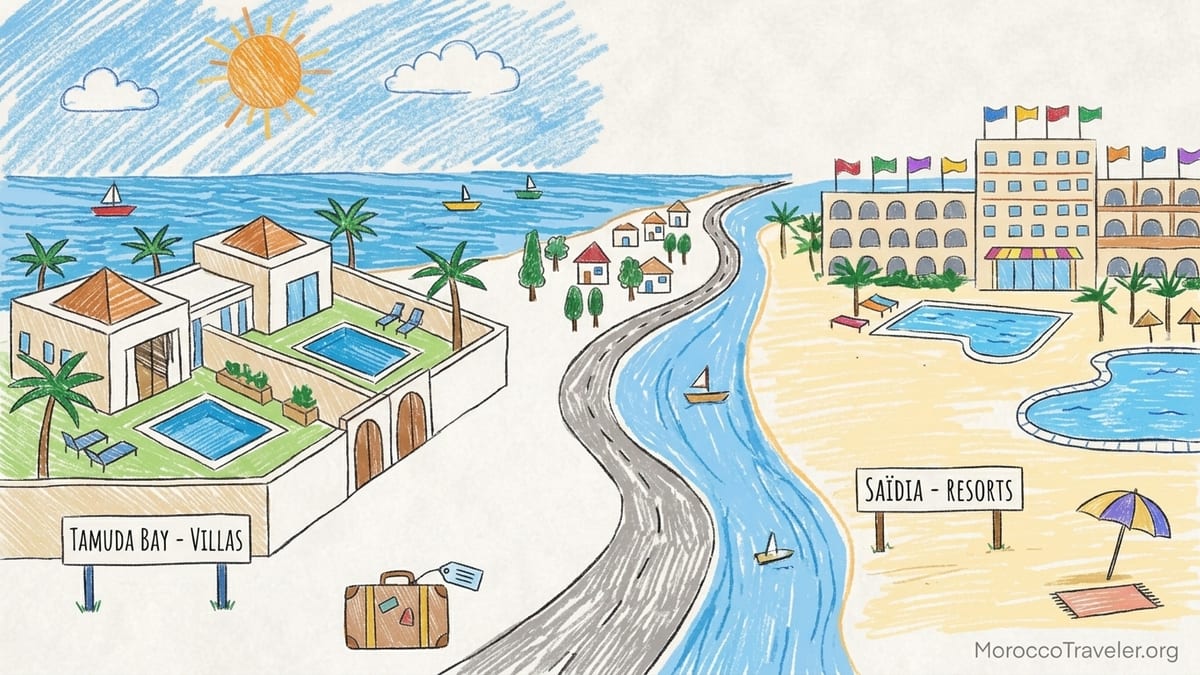
Tamuda Bay is the country’s most polished Mediterranean resort zone, a string of high-end hotels and villas between M’diq and Fnideq. Here you find international names such as Banyan Tree Tamouda Bay, the St. Regis La Bahia Blanca Resort and Sofitel Tamuda Bay Beach & Spa, set along quiet coves with views toward Spain. Tetouan’s whitewashed medina is within about 30 minutes by car, and Tangier is roughly an hour away, which makes Tamuda Bay the best Mediterranean choice for travelers who want five-star comfort without giving up easy access to “real” Moroccan cities and day trips.
Al Hoceima, farther east in the Rif region, feels very different. The town sits above a sweep of cliffs and headlands, with small sandy coves such as Quemado and Tala Youssef tucked between rocky promontories. Accommodation here tends to be midrange rather than ultra-luxury, with properties like Mercure Quemado Resort built into the cliff above the main beach. The setting is dramatic, and there is a more local, small-town atmosphere than in purpose-built resort zones. It suits travelers who like to mix simple beach time with hiking, boat trips and informal seafood dinners on town squares.
Saïdia, close to the Algerian border, is Morocco’s flagship Mediterranean resort development. A huge arc of pale sand backs onto large all-inclusive complexes like Iberostar Waves Saïdia, Be Live Collection Saïdia and Radisson Blu Resort Saïdia Beach. Here, the experience is about big pools, kids’ clubs, buffets and activities inside the resort, with a marina, golf courses and a modest town nearby rather than a major historic city. It works especially well for families and groups who want predictable pricing and are happy to spend much of their time within the resort perimeter.
Overlaying these three main choices are lower-cost alternatives in nearby towns. Around Tamuda Bay, Martil, M’diq and Cabo Negro offer simpler hotels and apartments on or near the beach with a more local feel and noticeably lower nightly rates. Near Saïdia, the city of Nador on the Marchica Lagoon offers conventional city hotels and self-catering flats that can undercut resort prices while still keeping you within about an hour’s drive of Saïdia’s beaches.
How Resort Types Actually Differ on the Ground
The main resort areas on Morocco’s Mediterranean coast offer four broad styles of accommodation that feel very different once you are on site: all-inclusive beach resorts, private-pool villas, beachfront apartments and conventional city hotels. Understanding how these play out in Tamuda Bay, Al Hoceima and Saïdia can help you avoid paying for features you will not use.
All-inclusive resorts dominate Saïdia’s shoreline. Be Live Collection Saïdia, Iberostar Waves Saïdia and Radisson Blu Resort Saïdia Beach all market packages where your room, meals, snacks, soft drinks and usually local alcoholic drinks are bundled into a single nightly rate. Public information from hotel and tour-operator sites indicates that entry-level “from” prices in shoulder season often start somewhere around 90 to 190 US dollars per night for two adults at Saïdia’s five-star properties, with higher rates for summer school holidays. In practice, that means families can budget quite accurately, but dining options outside large buffet and themed restaurants are limited, and these resorts are designed more as self-contained bubbles than as gateways to nearby towns.
Private-pool villas are Tamuda Bay’s defining high-end product. At Banyan Tree Tamouda Bay, for example, even the lead-in “Bliss Pool Villa” category includes its own small private pool and breakfast-included rates that recent public listings suggest can climb from the low- to mid-400 US dollar range in quieter periods to higher levels around peak summer and prime weekends for two adults. Each villa is walled and self-contained, so couples and families have privacy, but there are also resort restaurants, a spa and beach services. This setup is geared toward travelers who want space, seclusion and high service standards, and who may be content making only a few excursions.
Beachfront apartments and apart-hotels are a good halfway house. In Saïdia Marina, listings show two-bedroom apartments with shared pools and kitchen facilities priced around the high double-digit US dollar range per night outside peak season, which can make a week-long stay for a family much cheaper than a full all-inclusive package, especially if you plan to self-cater and eat in town as well. Similar apartment complexes in Cabo Negro and Martil offer comparable value on the western side of the coast, often within a short walk of the beach and promenade.
Conventional city hotels come into play if you base in Tetouan, Nador or Al Hoceima town itself. Here, you typically pay separately for bed and breakfast, and sometimes half board. Midrange city hotels in Tetouan and Nador can often be found in the range of low to mid double-digit US dollars per night outside the peak summer rush, leaving budget for restaurant meals and excursions. In Al Hoceima, Mercure Quemado Resort sits between the city-hotel model and the resort concept, with a cliffside pool and beach access but a more compact footprint than the enormous all-inclusive complexes.
Price Patterns Through the Year
On all three parts of the Mediterranean coast, prices differ sharply between high season in July and August and the shoulder months of June and September. Data aggregated by hotel and flight search engines for Saïdia, for example, consistently describe July and August as peak and most expensive months, with September still busy and priced on the higher side, while October is already calmer and moderately priced for room-only apartments and some hotels. In practical terms, that means that the same Saïdia five-star all-inclusive room that might be advertised around the 90 to 190 US dollar per night range outside school holidays can cost significantly more per night during late July and early August, particularly when bundled with charter flights from European markets.
In Tamuda Bay, five-star properties see the same seasonal pattern. Specialist Morocco travel agencies tracking Tamuda Bay hotels have recently quoted starting rates “from about 195 euros per night” for Sofitel Tamuda Bay Beach & Spa in shoulder periods, compared with starting prices around “from 805 euros per night” at Banyan Tree Tamouda Bay, where every unit is a private pool villa. Public third-party listings show that at certain autumn dates, a breakfast-included private pool villa at Banyan Tree can be listed in the low- to mid-400 US dollar range per night for two. Those same villas move considerably higher when demand spikes during summer months, especially if you are booking at short notice.
Al Hoceima has a shorter international tourist season but still feels the peak squeeze in July and August, particularly at seafront properties such as Mercure Quemado Resort where availability can become tight on weekends. Outside of those two months, room-only or bed-and-breakfast rates often fall back to more modest levels that compete with inland city hotels while still delivering sea views and quick walks down to the beach.
The practical takeaway is that if your travel dates are flexible, shifting your stay from late July to mid-June or from mid-August to late September can unlock much better value. For instance, a family comparing a week at an all-inclusive Saïdia resort in August with a similar week in mid-September may find that per-night rates drop enough in September to cover part of their airfare or to allow an upgrade from a standard room to a family suite with more space.
Comparing Key Resorts: Facilities, Access and Atmosphere
Banyan Tree Tamouda Bay is the flagship for private-villa luxury on this coast. The resort consists of one- and two-bedroom villas, each with its own pool and enclosed garden, and a beachfront location a short drive from M’diq and Fnideq. Recent public listings show breakfast-included Bliss Pool Villas and Serenity Pool Villas priced in the hundreds of US dollars per night for off-peak dates, rising considerably for two-bedroom and sea-view categories. Facilities include several restaurants, a spa that features Banyan Tree’s signature treatments, non-motorized water sports and a kids’ club. There is direct access to a quiet stretch of beach, but the layout and price point make it most appealing to couples and families planning substantial time inside the resort, using private transfers or rental cars for occasional day trips to Tetouan’s medina, Chefchaouen in the Rif mountains, or even Tangier.
The St. Regis La Bahia Blanca Resort, Tamuda Bay is one of the newest entrants, set right on the beach near Allyene. Official information confirms an outdoor pool, spa facilities, several dining venues and complimentary parking, with Sania Ramel Airport at Tetouan around 23 kilometers away. Recent online rates for early autumn sample dates have started from roughly the mid-300 US dollar range per night for two adults, including taxes and fees, on a room-only or breakfast basis, with options to add half board. The St. Regis feels like a classic luxury beach hotel, with butler-style service, but it is less villa-like and more oriented toward travelers who like a formal hotel atmosphere and may be combining a few days of beach time with a circuit around northern Morocco.
Sofitel Tamuda Bay Beach & Spa occupies a prime position on the sand at M’diq, with a design-heavy, “French Riviera in Morocco” style. Official descriptions emphasize romance, spa and wellness, and family-friendly facilities along with proximity to a golf course inland. Recent specialist agency quotes list starting prices from around 195 euros per night in shoulder season for standard rooms. There is a large outdoor pool, spa, several restaurants and direct beachfront access, plus secure parking. Some recent guest reports mention occasional construction noise and the need to clarify charges such as premium sun loungers and local tourist tax at booking, which underlines the importance of checking exactly what is included before you commit.
In Al Hoceima, Mercure Quemado Resort is perched on the cliffs directly above Quemado beach, with an outdoor pool, bar-restaurant and lifts or stairways leading down toward the sand. As a branded mid- to upper-midrange property, it usually prices well below the Tamuda Bay ultra-luxury resorts but above basic town lodgings. Rooms can include balconies with sea views, and there are family units as well. The hotel can serve as a base for exploring the wider Al Hoceima National Park coastline and the Rif interior, but facilities are less extensive than at the massive Saïdia all-inclusive complexes and there is typically no full meal-plan structure beyond breakfast or optional half board.
Saïdia’s big three resorts are all large beachfront properties in the main resort strip. Be Live Collection Saïdia is a five-star all-inclusive set on Parcelle H7 of the beach development, directly on the sand, with multiple pools and family-friendly programming. Iberostar Waves Saïdia, also categorized as five stars, combines indoor and outdoor pools with direct beach access, a spa and buffet and à la carte restaurants. Radisson Blu Resort Saïdia Beach offers both indoor and outdoor pools, a spa and an all-inclusive option, and is associated with nearby golf facilities. Public hotel and aggregator sites often describe these three as including full board and snacks under all-inclusive packages, though some premium services and branded drinks may carry surcharges. For families, the key attractions are the shallow beach, kids’ clubs, water slides at some pools and organized entertainment that fills entire days without needing to leave the complex.
Lower-Cost Mediterranean Bases: Martil, M’diq, Cabo Negro and Nador
Travelers who find Tamuda Bay’s signature names out of budget can still enjoy the same stretch of coast by basing in neighboring Martil, M’diq or Cabo Negro. Martil, closer to Tetouan, has a long beach with a seaside promenade lined with simple cafés and seasonal amusement rides. Accommodation runs from basic guesthouses a few streets back from the front to modern self-catering apartments and small hotels that might charge the equivalent of modest double-digit US dollars per night outside July and August for a double room or studio, rising in high season when domestic visitors flood in from inland cities.
M’diq and Cabo Negro sit slightly closer to the core of the Tamuda Bay resort zone yet still offer plenty of midrange and budget-friendly addresses. In M’diq, you can often find small hotels and apart-hotels within walking distance of the beach, with parking that is easier and cheaper than at the biggest five-star properties. Cabo Negro, a short drive away, has extensive apartment complexes wrapped around a golf course, with shared pools and landscaped gardens. Many units are privately owned and rented out on nightly or weekly terms, suited to families or groups who are comfortable driving to reach supermarkets and to explore Tetouan and the nearby Rif.
On the eastern side of the coast, Nador functions as the practical city base for Saïdia. While Nador does not have Saïdia’s long open Mediterranean beach, it fronts the calmer Marchica lagoon and has a growing crop of business and midrange hotels. Nightly rates outside peak periods are often lower than those on Saïdia’s beachfront, especially once you factor in that you will usually be paying only for bed and breakfast rather than for all-inclusive meal plans. Driving time from Nador to Saïdia is typically under an hour, which makes day trips to the beach straightforward if you have a rental car or arrange a transfer.
For travelers on a tighter budget, a workable strategy is to combine a few nights at a full-scale resort in Saïdia or Tamuda Bay with a longer stay in an apartment or city hotel in Martil, M’diq, Cabo Negro or Nador. This lets you experience the full-service pools and spas without committing to the higher nightly cost for your entire trip, while still keeping you close to the same stretches of sand.
Beach Time vs Sightseeing: Which Bases Work Best
If your priority is combining Mediterranean downtime with easy access to historic cities and mountain scenery, Tamuda Bay is the strongest all-round base. Sofitel Tamuda Bay and the St. Regis La Bahia Blanca Resort sit within roughly a 30-minute drive of Tetouan’s atmospheric medina, which is a UNESCO World Heritage site, and within about an hour of Tangier, with its renovated port, kasbah museum and café-lined Corniche. Private drivers and taxis can cover these routes, and resort concierges at properties such as Banyan Tree and the St. Regis are used to arranging day trips to Chefchaouen, known for its blue-painted streets in the nearby Rif. That makes Tamuda Bay particularly attractive for first-time visitors to northern Morocco who do not want to choose between culture and comfort.
Al Hoceima works better for travelers who enjoy quieter town life and nature. Mercure Quemado Resort and smaller local hotels sit in or very close to town, so you can walk to cafés and restaurants where the clientele is a mix of locals and visitors from within Morocco. Boat excursions along the coast highlight coves only reachable from the sea, and inland, the Rif mountains offer less crowded hiking than the better-known trails near Chefchaouen. The trade-off is that you are far from large historic cities and major museums, and public transport connections along this part of the coast are relatively slow.
Saïdia is ideal if you care more about an extended, predictable beach holiday than about intensive sightseeing. While there is a small town and a marina with some cafés and restaurants, most visitors spend the bulk of their stay inside their chosen resort, venturing out only occasionally for a walk along the sand or a look around the marina. Nador and the inland town of Oujda offer more urban flavor and can be reached by road, but they do not have the dense medina life of Tetouan or Tangier. This makes Saïdia less compelling as a cultural base but very straightforward if your goal is pool time, kids’ clubs and structured activities.
For travelers who want a taste of local Moroccan town life right outside their door, the lower-key centers of Martil, M’diq, Cabo Negro and Al Hoceima are more suitable than enclosed resort zones. Staying in a simple hotel on Martil’s promenade, for example, means morning walks to a local bakery, evenings in family-run fish restaurants and direct contact with Moroccan holidaymakers from cities like Fès and Meknes who flock to the coast in summer. You sacrifice some of the spa and pool features of high-end properties, but you gain immediacy and lower prices.
When Is a Premium Resort Worth the Price?
Premium resorts on Morocco’s Mediterranean coast start to make financial sense in certain situations. For couples on a short break, paying for a high-end property such as Banyan Tree Tamouda Bay or the St. Regis La Bahia Blanca Resort can be worthwhile because the resort itself becomes a key part of the experience. If you have only three or four nights, the combination of private pool, full-service spa, fine dining and concierge-organized excursions compresses a lot of comfort into a short window. In those cases, the higher nightly rates can be seen as replacing separate spending on high-end restaurants, standalone spa visits and transfers.
For families, the calculation is different. In Saïdia, comparing an all-inclusive week at a property like Be Live Collection Saïdia or Iberostar Waves Saïdia with a week in a self-catering apartment plus restaurant meals can show that the resort option is competitive once you include three meals a day, snacks and drinks for several people. Large pools, slides and kids’ entertainment also reduce the need for paid excursions. The premium becomes less attractive if your children are older and you plan to spend substantial time off-property, in which case a base in Nador, Martil or Cabo Negro with occasional paid access to beach clubs can save money.
In shoulder months like June and September, premium resorts can offer particularly strong value compared with July and August. When rates at Sofitel Tamuda Bay or Saïdia’s five-star properties dip closer to their low-season “from” prices, upgrading from a three-star or basic apartment to a five-star with spa and multiple restaurants may add noticeably less to your total budget than in peak weeks. Sea temperatures along the Mediterranean coast remain swimmable into October in many years, so a late-September stay can deliver summer-like conditions at significantly better prices.
Travelers who prioritize immersion in local life and who are comfortable arranging their own logistics often find that lower-cost hotels and apartments in Martil, M’diq, Cabo Negro, Nador or central Al Hoceima deliver the best overall value. In these places, paying for a premium resort is less about “value” and more about whether you genuinely want the seclusion, status and full-service environment it entails. If you expect to be out exploring most days, a well-located, comfortable but simpler base will usually be the smarter choice.
The Takeaway
Choosing between Tamuda Bay, Al Hoceima and Saïdia hinges on what kind of Mediterranean holiday you have in mind. Tamuda Bay is the right fit if you want polished five-star resorts and private-pool villas combined with easy access to Tetouan, Tangier and even Chefchaouen. Al Hoceima suits travelers who value scenery, smaller coves and a quieter, more local atmosphere over big-resort amenities. Saïdia is for those who want long sandy beaches, large-scale all-inclusive hotels and the convenience of having most costs wrapped into your room rate.
Budget also shapes the decision. In high summer, Saïdia’s all-inclusive giants and Tamuda Bay’s ultra-luxury villas come at a premium, while Martil, M’diq, Cabo Negro and Nador provide more affordable alternatives whose prices drop significantly in June, September and the shoulder periods. Looking carefully at what is actually included in each rate from meal plans to spa access, parking and kids’ activities will help you avoid unexpected extras and choose a property that matches your travel style rather than simply chasing a brand name.
For families, Saïdia’s all-inclusive resorts or a midrange base in Martil, M’diq or Cabo Negro tend to work best, depending on your budget. Couples and honeymooners usually gravitate toward Tamuda Bay’s private-pool villas and design hotels, especially outside peak weeks. Luxury travelers who still want to see something of Morocco’s cities and mountains will do well basing at Sofitel Tamuda Bay, the St. Regis or Banyan Tree and using them as comfortable hubs for day trips. Visitors who want both beach time and immediate access to authentic town life should look hard at Al Hoceima and the smaller coastal towns, where the sea is just as blue, but the pace feels more Moroccan and less resort-driven.
Ultimately, paying for a premium resort on Morocco’s Mediterranean makes sense when the resort itself is your destination, you value the extra space, service and amenities, and you are visiting in a shoulder season when rates soften. If your priority is stretching your budget, eating in local cafés and exploring beyond the resort gates, the simpler hotels and apartments along this coast will reward you with more contact with everyday Morocco and enough savings to extend your trip or add a second region to your itinerary.
FAQ
Q1. Which Mediterranean area in Morocco is best for a first-time visitor?
For a first-time visitor, Tamuda Bay is usually the best choice because it mixes comfortable, modern resorts with straightforward access to Tetouan, Tangier and excursions into the Rif, so you can experience both the beach and classic Moroccan city life without long transfers.
Q2. How do summer prices compare between Tamuda Bay and Saïdia?
In July and August, nightly rates at top Tamuda Bay properties with private pools can run significantly higher than Saïdia’s big all-inclusive hotels, where competition between Iberostar, Be Live and Radisson Blu helps contain prices, but both areas become measurably more expensive than in June or September.
Q3. Is Al Hoceima suitable for families with young children?
Al Hoceima can work for families who prefer quieter surroundings and do not need huge water parks or constant entertainment; its small coves and town beaches are appealing, but facilities and kids’ clubs are more limited than at Saïdia’s large resorts, so it suits easygoing families comfortable planning their own activities.
Q4. Are all-inclusive resorts in Saïdia really good value?
All-inclusive resorts in Saïdia often represent good value for families or groups who will eat most meals on site and make full use of pools and activities; if you plan to dine out frequently or take many day trips, a self-catering apartment or city hotel base in Nador or Saïdia town itself may work out cheaper overall.
Q5. When is the best time to visit for lower prices but good weather?
June and late September into early October usually offer a sweet spot of warm sea temperatures, long daylight hours and noticeably lower room rates compared with late July and early August, particularly in Saïdia and Tamuda Bay where domestic and European school holidays drive peak-season pricing.
Q6. Do I need a car to enjoy these Mediterranean resorts?
You can enjoy a car-free stay if you plan to remain mainly inside a resort in Saïdia or Tamuda Bay and rely on airport transfers and organized excursions, but renting a car or hiring a private driver gives you far more flexibility to explore Tetouan, Chefchaouen, inland Rif villages or smaller beaches around Al Hoceima.
Q7. What is the main difference between a private-pool villa and a standard hotel room?
A private-pool villa, common at Banyan Tree Tamouda Bay and some upscale complexes, gives you your own small pool and walled outdoor space, effectively turning your accommodation into a mini-residence, while a standard hotel room shares pools and terraces with other guests and typically offers less privacy and outdoor space.
Q8. Is it easy to combine a Mediterranean stay with other parts of Morocco?
Yes, the Mediterranean resorts link well with inland cities such as Fès and Meknes and with Atlantic hubs like Tangier; many travelers spend a few nights in Tamuda Bay or Saïdia after a circuit through imperial cities or the Sahara, using domestic flights or half-day road transfers to connect regions.
Q9. Are there nightlife options outside the big resorts?
Outside the big resorts, nightlife along the Mediterranean coast is fairly low-key, focusing on seafront cafés, casual bars and seasonal beach clubs in places like Martil, M’diq and Al Hoceima, so travelers seeking late-night clubs and high-energy venues will usually find more options in Tangier than on the Mediterranean itself.
Q10. How far in advance should I book for July and August?
For stays in July and August, particularly at popular Saïdia all-inclusives or high-end Tamuda Bay resorts, it is wise to book several months in advance to secure family rooms or private-pool villas, both because these categories are limited and because early booking usually brings better availability and more favorable rates.