


I went to Tamuda Bay expecting the classic five-star fantasy: flawless service, silky sand outside my suite, serene pools and the sense that every extra dirham bought something genuinely special. What I found instead was a very good beach destination wrapped in very expensive packaging, where the actual value of the headline resorts did not always match their glossy marketing. After a recent three-night stay split between a big-name beachfront resort and a midrange base in nearby M’diq, plus a day visit to another flagship property, I came away convinced that many travelers are overpaying for the privilege of staying inside the resort bubble.
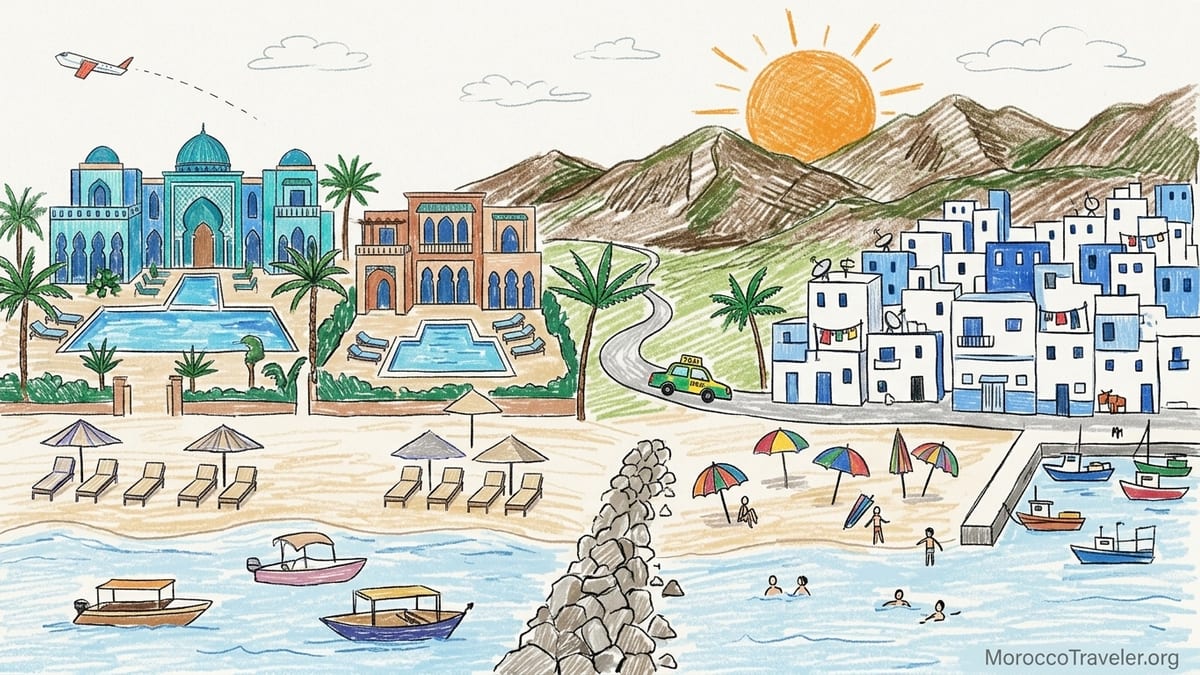
Where Tamuda Bay Luxury Promises Collide With Reality
Tamuda Bay, on Morocco’s Mediterranean coast between Fnideq and M’diq, has been repositioned as a discreet luxury enclave, anchored by brands such as The St. Regis La Bahia Blanca Resort, Banyan Tree Tamouda Bay and Sofitel Tamuda Bay Beach and Spa. On paper, it is an alluring combination: international names, private pool villas, white-sand beachfront and easy access to Tetouan and Tangier. In practice, the experience depends heavily on how much you are paying for your room and how often you are willing to step outside the resort gates.
During a recent early-autumn trip, I booked three nights in the area and deliberately mixed it up. I spent time at a flagship beachfront resort on a paid stay, visited another for the day to see how its public areas, beach and dining matched the marketing, and then moved to a midrange hotel in M’diq while also viewing a modern apartment in Cabo Negro. The contrast between the prices and what I actually received was striking. Room hardware and design were often excellent at the luxury properties, but the overall value equation became murkier once I factored in food, transport and the true quality of the beach and shared spaces.
The glossy images promise intimacy, exclusivity and an effortless, frictionless stay. The reality, at least in high season or on pleasant weekends, can include crowded pools, noticeable upselling, and a surprising amount of time and money spent in taxis to reach Tetouan’s medina or even the livelier corners of M’diq. The five-star label is real, but that does not automatically make these stays good value for every traveler.
Room Quality and Privacy: Beautiful Spaces, Imperfect Peace
The most immediately impressive aspect of Tamuda Bay’s top-tier resorts is the hardware. At The St. Regis La Bahia Blanca Resort, typical nightly rates for two adults over the next month start around 4,000 to 4,500 Moroccan dirhams, roughly 400 to 450 US dollars, for an entry-level room including taxes and fees on major booking platforms. At Banyan Tree Tamouda Bay, a Serenity Pool Villa was recently priced around 1,100 US dollars per night for a three-night stay for two, plus local taxes and service charges, placing it firmly in aspirational territory. Even Sofitel Tamuda Bay often sits in the 250 to 350 US dollars per night band for standard rooms in busy periods. At those prices, you rightly expect something special when you open the door.
In fairness, the resort rooms mostly deliver on first impressions. My beachfront resort room was generously sized, with cool marble floors, a balcony facing the Mediterranean and a bed that would shame many European city five-stars. At Banyan Tree, all accommodation consists of villas with private pools rather than regular rooms, and the brand’s own descriptions of Andalusian Moorish architecture and individual pools are borne out in person. These are not places where you feel short-changed on square footage or finishes.
Yet privacy is more complicated. In my own resort, I could hear furniture scraping and balcony chatter from the room above late into the evening. On the balcony, other guests on either side were in plain view, and conversations carried easily. At Banyan Tree, the high walls and enclosed gardens of the entry-level villas offer stronger seclusion than a typical hotel balcony, but some plots sit near internal paths, so pool time is not always as private as the brochure suggests. When you are paying four figures per night for a pool villa, the occasional staff shortcut past your wall or a gardener’s early-morning work can feel more intrusive than it would in a 100 dollar apartment.
This is where the question of value bites. For around 90 to 120 US dollars per night, a modern one-bedroom apartment in Cabo Negro with a shared pool and partial sea view can offer quiet, thick walls and a sense that the space is truly yours. The materials may be less luxurious, and there is no butler or turn-down service, but for some travelers, genuine peace matters more than branded textiles or a signature scent in the corridor.
The Beach and Pools: Premium Sand or Just Premium Prices?
Most people come to Tamuda Bay for the sea, so the beach and pools are central to any value calculation. The marketing photos of these resorts are heavy on empty loungers, teal water and stylish umbrellas. In shoulder season weekdays, that image can be accurate: I enjoyed several quiet hours by the pool at my resort where the ratio of guests to loungers felt almost indulgent, and the staff had time to be proactive with towels and drinks.
On sunny weekends and during peak summer weeks, however, the equation changes. At my property, the beachfront area narrowed considerably where private resorts met public sections of sand. The resort’s loungers were comfortable, with padded mattresses and attentive service, but they were tightly packed in rows. Privacy on the beach felt limited, and the boundary between public and private space was mostly symbolic. I spoke to a couple who had chosen the resort specifically for what they thought would be a very quiet beach, and they were surprised to find a livelier, more family-oriented atmosphere with music from neighboring establishments drifting over.
The pool scene at Sofitel Tamuda Bay, which I visited for an afternoon, was even more social. The design is attractive, and the pool faces the bay, which is a clear step up from inland hotels along the roadside. But during a weekend visit the soundtrack leaned towards party rather than spa, and loungers filled quickly. For travelers who enjoy that energy, the premium price might be justified as the cost of being in the center of the action with direct sea access. For anyone seeking a peaceful, restorative break, similar or better tranquility was easily found around Cabo Negro’s apartment complexes and smaller midrange hotels set slightly back from the water.
It is important to stress that Tamuda Bay’s sand and water are shared resources. The actual quality of the beach and sea does not improve simply because a resort’s logo is on the back of a lounger. Paying triple the nightly rate for a luxury badge buys you curated access, monitored cleanliness and nicer facilities immediately behind the beach, but the sand between your toes is essentially the same as a few hundred meters down the shore in front of a far cheaper hotel or self-catering complex.
Breakfast, Dining and the True Daily Cost of Eating In
If room rates are the visible tip of the luxury iceberg, food and drink are the heavy mass below the waterline. This became obvious from the first morning of my stay. At my five-star resort, breakfast was included in the rate, which initially felt generous. The buffet was extensive, with Moroccan pastries, fresh fruit, eggs to order and a few unexpected touches. The quality was high enough that I would have been annoyed to pay separately. At Sofitel Tamuda Bay, however, current booking information shows cooked-to-order breakfast often priced around 350 Moroccan dirhams per adult if not included in the room rate, approximately 35 US dollars. For a couple, that can add roughly 70 US dollars a day to the bill before you have eaten anything else.
Lunch and dinner at on-site restaurants follow a similar pattern. At the resort where I stayed, main courses in the signature restaurant typically ran between 220 and 320 dirhams, with starters often 90 to 140 dirhams. Two courses, a shared dessert, a bottle of midrange Moroccan wine and water easily pushed the total into the 900 to 1,100 dirham range for two, close to 90 to 110 US dollars. Sofitel’s on-site dining roster includes several restaurants and bars, and online menus and recent guest reports indicate comparable pricing. Banyan Tree, which intentionally positions its outlets as destination restaurants, can edge higher still, especially if you combine a multi-course dinner with cocktails.
Compare this to dining in M’diq or Tetouan. One evening in M’diq’s marina area, I paid about 220 dirhams total for two grilled sea bream, salads, sides and soft drinks at a simple but spotless local restaurant with a mainly Moroccan clientele. In Tetouan, a traditional lunch of tagine, salads and mint tea for two in the new town came to under 180 dirhams. Both meals were fresh, filling and atmospheric in their own way. The gulf in cost between eating inside the resort and outside it quickly becomes enormous over a three- or four-night stay.
For travelers who value convenience over exploration, resort pricing can be a tolerable premium. You stroll downstairs, choose between restaurants and charge everything to the room. For budget-conscious travelers, food and drink can quietly double the real cost of a luxury stay. I found that by the end of my three nights, the memory of the breakfasts was positive, but the bar bills and dinner totals felt disproportionate to what was on the plate compared with local alternatives.
Spa, Extras and The Hidden Price of Relaxation
Luxury branding in Tamuda Bay leans heavily on wellness. Banyan Tree’s own materials describe an extensive spa offering with hammam rituals, massages and hydrotherapy in a dedicated pavilion. Spa brochures and package descriptions show typical 60-minute massages priced in the mid to high double digits in US dollar terms per person, climbing for longer or more elaborate treatments. Couple packages, which combine massages with baths or rituals, can reach several hundred US dollars for a two-hour experience, even before service charges or taxes.
At Sofitel, the full-service spa and wellness center is a key selling point, with massage, facials and body treatments that mirror prices in other coastal five-stars. During my trip, a 60-minute massage at my resort’s spa, booked on-site rather than through a discounted package, cost the equivalent of roughly 95 US dollars. The therapist was skilled, and the facilities were polished, but the overall experience did not feel far superior to a well-regarded independent hammam in Tetouan where a full scrub-and-massage ritual runs closer to 400 to 500 dirhams, around half the cost.
Beyond the spa, extras accumulate relentlessly. Resort laundry is often priced per item, with a simple laundry bag easily surpassing the cost of doing a full load at a local laundrette. Beach cabanas, branded float rentals and certain water activities may attract surcharges. At some properties, late check-out beyond 2 p.m. is chargeable, even at rates exceeding 400 US dollars per night, unless you hold elite status or booked through a premium agency that negotiates benefits.
After this trip, there are several upgrades and services I would refuse to pay for again in Tamuda Bay. I would skip resort-run private transfer packages from Tangier airport in favor of arranging a reputable local driver or taxi at a fixed rate. I would avoid spa packages bundled with champagne or elaborate add-ons and instead book a straightforward treatment at either the resort or a trusted independent hammam. Most importantly, I would resist expensive private beach cabanas in favor of the perfectly adequate standard loungers that are already included for in-house guests.
Transport, Isolation and the Taxi Meter Problem
Location is another critical piece of the value puzzle. Tamuda Bay’s luxury resorts often emphasize their seclusion. Banyan Tree, for example, highlights its position on a quiet stretch of coast, with the Rif Mountains to one side and the Mediterranean on the other. That sounds idyllic, and it can be, on days when you simply want to float between your villa pool, the main pool and the beach. However, that same seclusion quickly becomes a cost multiplier when you want to experience the region beyond the gates.
In my experience, very little of what makes northern Morocco culturally compelling lies within walking distance of the resorts. Tetouan’s beautiful UNESCO-listed medina is about a 30-minute drive away. Tangier is roughly a 60- to 90-minute drive depending on traffic. Even the most interesting stretches of M’diq’s seafront can require a short taxi ride unless you are comfortable with long walks along the main road. During my three nights, I found myself taking taxis or private cars almost every day, and the fares began to add up.
Typical local taxi rides between M’diq and the main resort strip, or between resorts, can fall in the range of 40 to 80 dirhams per trip if booked directly on the street. Pre-arranged transfers via the hotel, which some guests prefer for perceived reliability and language support, can cost several times that. A return trip to Tetouan booked through a five-star concierge can edge into the equivalent of 80 to 120 US dollars once waiting time and potential guiding services are added. Over three or four days, a couple who wants to see more than the resort pools might easily spend 200 to 300 US dollars on local transport alone.
This is the irony at the heart of Tamuda Bay’s luxury proposition. If you plan to stay inside the resort bubble, you are paying a high nightly rate largely to replicate the experience of any well-managed seaside resort, with only glimpses of Morocco beyond the gate. If you intend to engage meaningfully with Tetouan, Chefchaouen or Tangier through day trips, you pay again and again in taxi fares and transfer fees simply because your chosen resort is isolated by design. From a pure consumer-value perspective, it can make more sense to base yourself closer to M’diq or Tetouan in a midrange property and treat the luxury resorts as optional day-visit destinations rather than home base.
Three-Night Cost Comparison: Resort vs M’diq Hotel vs Cabo Negro Apartment
To put real numbers on this, I built a simple three-night comparison for two adults sharing a room or apartment in mid-September, a common time for Mediterranean breaks. Prices shift regularly, but the broad relationships between them are consistent enough to illustrate the value gap.
First, consider a five-star beachfront resort such as The St. Regis La Bahia Blanca Resort or Sofitel Tamuda Bay. Recent searches on major booking engines for mid-September show entry-level rooms, fully flexible, around 4,000 to 4,500 dirhams per night, roughly 400 to 450 US dollars, including taxes and fees. Over three nights, that is about 12,000 to 13,500 dirhams, or 1,200 to 1,350 US dollars, just for the room. If breakfast is not included and you add it at 350 dirhams per person per day, that can add 2,100 dirhams, or about 210 US dollars, bringing the accommodation plus breakfast total to roughly 1,400 to 1,550 US dollars. Add modest on-site dining, drinks and two local taxi days, and a realistic total for the stay edges into the 1,800 to 2,000 US dollar band for two guests.
Next, look at a solid midrange hotel in or by M’diq, somewhere with clean modern rooms, a simple pool and perhaps partial sea views but no global brand. Current rates for such properties generally fall between 80 and 120 US dollars per night in September. Taking 100 US dollars as a representative figure, three nights come to about 300 US dollars. Breakfast might be included or cost the equivalent of 10 to 15 US dollars per person per day. Even assuming you pay for it separately at 15 US dollars each, that totals about 390 US dollars for three nights and breakfast for two. Dining in town, with a blend of local restaurants and cafe meals, plus a couple of taxi rides to the resort strip for an afternoon drink, might reasonably add another 160 to 200 US dollars, resulting in a total in the 550 to 600 US dollar range.
Finally, factor in a good apartment in Cabo Negro. Data from hotel and rental price aggregators puts the average nightly cost of midrange accommodation in Cabo Negro around 90 to 100 US dollars in main season, with high-season peaks going higher. Using 100 US dollars per night again for comparison, three nights cost about 300 US dollars. You self-cater breakfast from the local supermarket for perhaps 10 US dollars per day, or 30 US dollars for the stay, and dine mainly in local restaurants or cook simple dinners at home. Combined food costs can easily stay under 150 to 200 US dollars for three days for two people if you avoid high-end tourist venues. Local taxis between Cabo Negro, M’diq and occasional resort bar visits might total 80 to 100 US dollars. That puts a realistic three-night total around 530 to 600 US dollars, broadly similar to the midrange hotel but with more space and independence.
These are approximate figures, not fixed quotes, but they reveal the core point. A three-night stay for two in a Tamuda Bay five-star beachfront resort can cost roughly three times as much as a comfortable midrange option nearby once you include breakfast, basic dining and local transport. Banyan Tree’s private pool villas, currently listed at well over 1,000 US dollars per night for certain dates, can push the multiplier even higher. That premium is not automatically unjustified, but it does demand careful thought about how much of your holiday budget you want consumed by the room key alone.
What I Would Not Pay For Again in Tamuda Bay
After this trip, several spending patterns stand out as poor value for money in Tamuda Bay’s luxury resorts. The first is paying rack-rate for basic rooms without breakfast in peak periods. If a resort wants 400 to 450 US dollars per night and then another 70 US dollars per couple for breakfast, I would either look for a package that bundles breakfast at a reasonable incremental cost or stay elsewhere. The gulf in value between a luxury buffet and a very decent local cafe breakfast in M’diq is too large to ignore.
The second is overpaying for captive transport. While I appreciate the convenience of a resort-organized transfer, the mark-up compared to arranging a reputable local taxi or driver is hard to justify when journeys are relatively short and the roads are straightforward. I would now pre-arrange airport and intercity transfers through a local agency or ride-hailing platform where available, and use official taxis for shorter hops rather than defaulting to the hotel car every time.
Third, I would avoid multiple on-site dinners in a row. One special dinner at a resort’s signature restaurant can be a worthwhile indulgence, especially if it showcases regional ingredients in imaginative ways. Beyond that, repeating the same high-priced menus night after night quickly blurs into sameness and erodes the sense of occasion. The culinary heart of this region beats harder in Tetouan’s streets and in family-run places around M’diq than in resort dining rooms with international playlists.
Lastly, I would resist the temptation to “upgrade for the view” unless I planned to spend most of the day in my room. In practice, I spent surprisingly little time on my balcony compared with the pool, beach and town excursions. Paying several hundred extra dollars over a long weekend to move from a partial to a full sea view would not have improved my holiday in any meaningful way.
When a Five-Star Resort or Private-Pool Villa Does Make Sense
All of this is not to say that Tamuda Bay’s marquee resorts never justify their premiums. They can, under the right circumstances and for the right traveler profile. If you are celebrating a milestone birthday or honeymoon and can comfortably afford the rates, a private-pool villa at Banyan Tree or a top-floor suite at a beachfront resort delivers a kind of self-contained sanctuary that an apartment in Cabo Negro cannot replicate. You step out from your bedroom into your own pool, call for room service breakfast, and watch the light change over the water without worrying about housekeeping schedules or shared corridors.
Families who value secure, enclosed environments with kids’ clubs, lifeguarded pools and on-site medical contacts may also see genuine value in the resort model. Sofitel’s children’s pool, kids’ club and adjacent entertainment options, combined with beach access, simplify logistics in a way that a stand-alone apartment might not. In such cases, paying more for peace of mind, structured activities and one-stop convenience can be a rational choice, especially for shorter trips where every hour of hassle saved feels valuable.
There is also an argument for using five-star resorts strategically rather than as the default. One approach that makes sense in Tamuda Bay is to book one or two nights in a luxury resort at the start or end of a longer trip that otherwise relies on midrange hotels or apartments in Tetouan, Chefchaouen or Tangier. This lets you sample the pools, spa and pampering without committing your entire budget to resort pricing. Another strategy, for those with hotel points or elite status, is to use awards or favorable loyalty rates, which can dramatically change the value equation compared with paying cash at full rates.
What these examples share is intentionality. When you choose a private-pool villa knowingly, as a splurge to mark a special moment or to serve a specific need, its cost can feel proportionate to the experience. When you drift into a five-star booking simply because it appears first in the search results and you assume it must be “worth it,” you are more likely to resent the bill.
The Takeaway
For all its glossy branding, Tamuda Bay is still, at heart, a pleasant stretch of Moroccan coastline anchored by Tetouan and M’diq. Its luxury resorts provide space, polish and curated calm, but they also wrap a fundamentally simple beach holiday in layers of cost that are not always matched by equivalent gains in experience. After a three-night stay that spanned a top-tier beachfront resort and a midrange base, I came away convinced that many travelers would enjoy their time here more, and spend far less, by decoupling “beautiful location” from “expensive room.”
If I were returning with friends for a relaxed long weekend, I would almost certainly book a good apartment in Cabo Negro or a comfortable M’diq hotel, rent a car or use taxis, and treat the big-name resorts as places to visit for a drink or spa treatment rather than as home base. For a once-in-a-decade splurge or tightly focused wellness retreat, I might invest in a two-night villa with a private pool, book one signature dinner and a carefully chosen spa ritual, and accept that I was paying a premium for atmosphere and convenience rather than strict monetary value.
The key is to ask, before you book, where you want your money to go. If your ideal Tamuda Bay holiday centers on the region’s culture, food and landscapes, your room only needs to be clean, comfortable and well located. If your dream is to float undisturbed in a private pool and watch the sea in near silence, then a high-end resort can deliver that, albeit at a steep price. Tamuda Bay’s five-star hotels are not inherently poor; they are simply poor value for many travelers who could redirect a large slice of their accommodation budget into memorable local experiences instead.
FAQ
Q1. Are Tamuda Bay’s five-star resorts ever good value for money?
They can be good value if you use them intentionally, for example for a honeymoon, short wellness break or special celebration where you plan to spend most of your time on-site and genuinely use the pools, spa, restaurants and services you are paying for.
Q2. How much more do luxury resorts cost compared with midrange hotels nearby?
In current searches, a Tamuda Bay five-star beachfront room for two often costs around three times as much as a solid midrange hotel in M’diq or a good apartment in Cabo Negro once you factor in breakfast and basic daily spending.
Q3. Is the beach really better in front of the luxury resorts?
The sand and sea are broadly similar along this stretch of coast. What you pay extra for at a five-star resort is managed access, loungers, towels and service, not fundamentally different water or sand quality.
Q4. How expensive is food and drink inside the resorts?
On-site restaurants commonly charge prices that can push a simple dinner for two towards 90 to 110 US dollars with drinks, while breakfast, if not included, may add around 70 US dollars per day for a couple at some properties.
Q5. What about spa treatments at Banyan Tree or Sofitel?
Expect to pay international luxury-resort prices, with 60-minute massages often in the mid to high double digits in US dollars per person and couples’ or multi-step rituals costing more. Local hammams away from the resorts are typically far cheaper.
Q6. Is it necessary to rent a car to stay in a Tamuda Bay resort?
Not strictly, but without a car you will likely rely on taxis or resort-organized transfers for almost every outing beyond the hotel, which can become expensive if you want to visit Tetouan, M’diq or Tangier more than once or twice.
Q7. Are midrange hotels in M’diq and apartments in Cabo Negro safe and comfortable?
Many midrange hotels and modern apartment complexes are clean, comfortable and feel secure, especially those in established developments. They may lack the polished branding of big resorts but can offer better day-to-day value.
Q8. Should I book a sea-view upgrade in a luxury resort?
Only if you know you will spend a lot of time in your room or on the balcony. Otherwise, the extra cost for a marginally better view is often not justified compared with spending that money on local experiences or dining.
Q9. When would you personally choose a private-pool villa in Tamuda Bay?
I would reserve a private-pool villa for a short, special occasion trip when privacy, quiet and convenience mattered more than budget, and I was prepared to accept higher food, spa and transport prices as part of that choice.
Q10. If I want culture as well as beach time, where should I base myself?
If culture is a priority, basing yourself in or near Tetouan or M’diq, with occasional day visits to Tamuda Bay’s resorts, usually provides a better balance of medina exploration, local food and manageable costs than staying full-time inside an isolated luxury property.