


I arrived in Saïdia in late October 2025 expecting a quieter version of Morocco’s self-styled “Blue Pearl” on the Mediterranean. What I found was something more complicated: a resort area caught between ambitious year-round tourism plans and a deeply seasonal reality. The result, at least outside the July and August rush, can feel like paying for a Mediterranean mega-resort but receiving half a product.
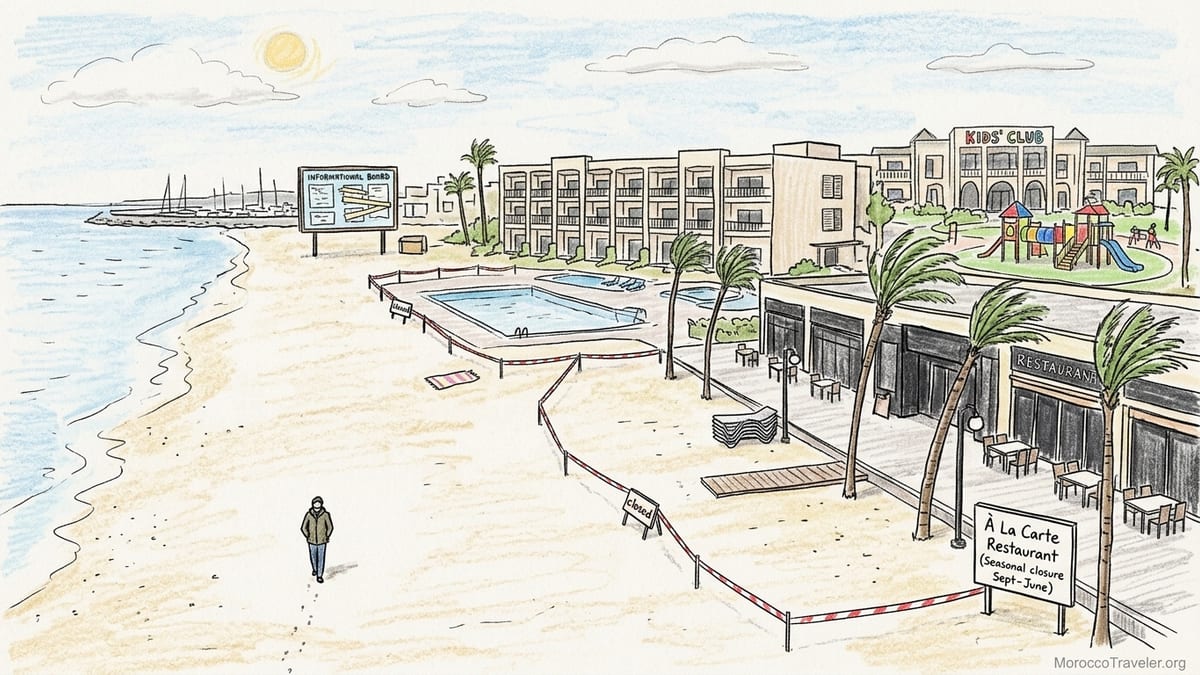
My Late-October Stay: A Resort Built for July in an October Mood
I based myself at one of the large all-inclusive resorts at Saïdia Resort in the last week of October 2025, just after most European school holidays. Daytime highs hovered between 20 and 23 degrees Celsius, with cooler evenings that called for a jacket along the seafront. The wide, pale sand that looks so inviting in summer brochures was almost empty. From a distance, the vast hotel complexes still looked impressive, but on closer inspection the mood was subdued and many facilities had quietly slipped into hibernation.
The first hint that things were different from the glossy summer brochures appeared at check in. The entertainment board in reception still listed daily activities, but several lines had been taped over. Staff were open that the full entertainment program only runs from mid-April to mid-October, and that outside these dates shows, kids’ activities and some sports depend heavily on occupancy. One of the à la carte restaurants that features prominently in marketing photos was already closed for the season, with a sign explaining that it only opens between mid-June and mid-September. Another was open only two or three nights a week.
The beachfront promenade, built to host thousands of Moroccan holidaymakers and families from France, Spain and Belgium, felt strikingly underused. Hardware was not the problem. Saïdia Resort has an impressive marina, long car-free walkways and rows of shopfronts and cafes. The issue in late October was people. By 9 p.m. on a Friday, I could count open venues on one hand, and many units around the Medina Center mall stood dark or shuttered. A few hotel bars hummed quietly, but this was a far cry from the lively Mediterranean resort atmosphere implied in peak-summer marketing.
I knew before traveling that Saïdia is a strongly seasonal destination, but experiencing that seasonality first hand underscored how sharply the mood changes once major European tour operators scale back flights and Moroccan families return home. The region’s development agency has spoken publicly about trying to stretch the season, and some hotels now remain open year-round, yet the contrast between late October reality and high-summer promise remains jarring.
Quiet Promenades and Closed Doors: What Actually Operates Outside Summer
When you look at Saïdia’s major resort fact sheets, an important pattern emerges. At Be Live Collection Saïdia, for example, the official description notes that the entertainment program “generally runs from mid-April to mid-October” and that both activities and restaurant schedules may be adjusted depending on occupancy. That final caveat turns out to be key in autumn. In the week of my stay, the main buffet restaurant was open normally, but one of the advertised à la carte options was closed entirely and another was operating on a much-reduced schedule. A beachfront fish restaurant that is clearly labeled as operating only between mid-June and mid-September had already shut its doors.
The story was similar at other large properties. Iberostar’s Saïdia resort advertises six outdoor pools, multiple bars, themed restaurants and a full program of shows, live music and sports. Yet recent guest feedback in early October 2026 already mentions a clear reduction in animation and a feeling that the resort no longer delivers a five-star atmosphere once the main summer crowds have gone. Travel agent descriptions also include small but telling notes that some bars or restaurants operate only in high season or “depending on weather and occupancy,” which in practice often means significantly reduced choice by late October or early spring.
Walk beyond the hotel complexes and the sense of partial shutdown becomes more visible. The marina promenade, with its mix of cafes, ice-cream parlors and holiday shops, has increasingly struggled outside summer. Local coverage has noted ongoing efforts to refresh the Medina Center commercial zone and attract new tenants, precisely because many premises have fallen dormant once the July-August rush ends. On a mild Saturday afternoon in late October, I found a handful of open cafes serving decent coffee and pastries, but a large share of units remained closed with “for rent” signs or metal shutters.
None of this means Saïdia literally closes in the off-season. Supermarkets and basic services operate year-round, and some hotels keep at least one property open over winter. That is an important nuance. The problem for resort-focused travelers is that the full Mediterranean-holiday package, with busy promenade life, a wide choice of bars, late-night entertainment and a buzzing marina, simply does not exist once you step outside the core summer months.
Water, Weather and the Reality of Off-Season Swimming
Marketing images for Saïdia are dominated by turquoise pools and a shining Mediterranean. In high summer, sea temperatures off the Oriental coast reach the mid-twenties Celsius, and you can comfortably float in warm water well into the evening. By late October, the picture changes. Historical climate data for Saïdia shows average sea temperatures dropping toward the 20 degree mark in late autumn. During my stay, the Mediterranean was still swimmable around midday for hardy bathers, but certainly brisk, and very few people were in the water.
Most large resorts keep at least one outdoor pool open into October, often the main activity pool closest to the bar. However, the atmosphere around the water bears little resemblance to the families-and-fun scenes shown in peak-season brochures. Lifeguard hours may be shorter, poolside snack bars sometimes close entirely on cooler days, and water slides or children’s features may be turned off. At my hotel, two of several outdoor pools were closed for cleaning and “maintenance” for the rest of the season, cordoned off with tape.
The good news is that a couple of Saïdia’s larger resorts have indoor pools within their spas, and at least one explicitly notes that the indoor pool is heated in winter. This can make a shoulder-season stay more comfortable, but access is not always free. In my case, the indoor pool belonged to the spa and required either a day pass or treatment booking, which added unwelcome extra cost to what is marketed as an all-inclusive product. Before booking shoulder-season dates, it is worth confirming in writing whether the heated pool is included or treated strictly as a spa facility.
Weather also adds subtle stress to off-season days. Cloudier skies, brisk afternoon winds and earlier sunsets shorten the usable time outdoors. On two evenings, a cool northeasterly breeze made the seafront promenade feel almost empty by 8 p.m., even though it was not yet winter. For travelers expecting long, lazy beach days, this shift alone can significantly alter the feel of the holiday.
Kids’ Clubs, Shows and “Animation”: What Disappears After October
Families are a major target market for Saïdia, and brochures emphasize children’s pools, slides, kids’ clubs and evening mini-discos. Be Live Collection Saïdia and Iberostar Saïdia both list distinct clubs for different age groups, from mini-clubs for younger children to teen clubs that run organized activities. These are genuine strengths in July and August, when hotels are close to full and animation teams are at full staffing.
Outside summer, those same facilities often exist more on paper than in practice. At my resort in late October, a colourful kids’ club building stood unlocked but empty, with a printed weekly program still dated from early October. The animation team had been cut back to a skeleton crew, who did their best to run a few low-key games and an evening quiz for adults. Several families I spoke with mentioned that the children’s club was open only a couple of hours per day, and sometimes not at all if there were too few children in-house.
Evening entertainment follows a similar pattern. Tour operator descriptions made clear that live shows, theatre and disco nights officially run only from mid-April to mid-October. After that, guests are guided toward quieter bar evenings, with music through speakers rather than full productions. On one night during my stay, the advertised “show” turned out to be a karaoke session with fewer than a dozen participants. If you are happy with calm nights and a drink in a relatively empty lobby bar, this is fine. If you booked based on images of packed amphitheatres and full production shows, you will feel short-changed.
Some travelers actively prefer this calmer rhythm and dislike noisy animation. The key problem is not the lack of activity itself, but the mismatch between year-round marketing language and a very seasonal reality. For a family paying several hundred euros per night even at a discounted autumn rate, the absence of consistent kids’ clubs and organized fun can turn an appealing bargain into a poor-value stay.
Discounted Prices That Stop Looking Like Bargains
One of Saïdia’s big draws outside July and August is price. A family room at a five-star all-inclusive resort that might command a high nightly rate in late July can drop sharply by early October. During my research, I found double rooms at major resorts priced around the equivalent of 120 to 160 US dollars per night all-inclusive for late October midweek dates, compared with noticeably higher rates in the peak of summer. Larger family rooms were often listed around 200 to 250 dollars instead of much higher high-season levels.
At first glance, these discounts look irresistible. However, once you factor in the reduction in operating facilities, the value equation becomes murkier. If your autumn stay effectively gives you one buffet restaurant instead of a choice of four, two functioning pools instead of six, no meaningful kids’ club, minimal entertainment and a half-closed promenade beyond the hotel gate, you are no longer comparing like with like. You are comparing a full-summer product with a trimmed-down version that quietly drops many of the perks that justified calling the resort “five-star” in the first place.
Costs beyond the room also matter. Transfers from Oujda or Nador airports to Saïdia typically involve private taxis or pre-arranged shuttles. A one-way taxi from Oujda airport to Saïdia, roughly an hour’s drive, can cost in the region of 40 to 60 dollars depending on negotiation and time of day. If you prefer to avoid haggling and book a transfer through a tour operator or hotel, expect to pay a similar or slightly higher price, especially if you need a larger vehicle for a family. Add this both ways and a shoulder-season trip for four quickly absorbs 80 to 120 dollars just in transfers.
While all-inclusive packages cover most food and basic drinks, you may still spend extra on spa access, branded alcohols, kids’ activities that are outsourced, or taxis into Saïdia town and nearby Oujda if you want more going on. Over a week in late October, a realistic shoulder-season resort budget for a family of four might include 1,400 to 1,700 dollars in room costs at a mid-discounted rate, around 100 dollars in transfers, and another 150 to 250 dollars in extras like coffees away from the resort, spa visits or outings. For that total outlay, you will need to decide whether Saïdia’s quiet off-season infrastructure really offers better value than alternative Moroccan coasts with more year-round life.
Peak-Season Crowds vs Off-Season Inconvenience: Is There a Sweet Spot?
It would be misleading to suggest that Saïdia only has an off-season problem. In high summer, particularly during late July and August when Moroccans from the interior and expatriate families return, the resort faces the opposite challenge. Reviews and local commentary describe packed beaches, full hotels and queues for buffet meals. Temperatures inland often soar, making the coast a magnet for domestic tourism, and the long beach can feel very busy in front of the big hotels.
That contrast creates a real dilemma for prospective visitors. In July and August you get the full line-up: all pools open, every restaurant functioning, kids’ clubs buzzing, bars alive late into the night and a promenade that finally feels used as intended. The price you pay is heat, noise, crowding and a struggle for sunbeds or dining slots at peak times. Outside those months, you win space, mild temperatures and lower prices, but lose much of the life that justifies choosing a purpose-built resort over a simpler seaside town.
From my October vantage point, the most promising compromise months for Saïdia looked like late May to June and perhaps the first half of September. In those windows, the entertainment programs are typically running, specialty restaurants are open or mostly open, and occupancy is high enough to justify kids’ clubs and evening shows. At the same time, temperatures are more comfortable and prices are often below August’s peaks. The risk, of course, is weather volatility in spring and the chance that tour operators scale up or down flights in response to demand, which can change from year to year.
The current development strategy for Saïdia explicitly aims to smooth these extremes by attracting more golfers, conference groups and off-season events, and by keeping at least some hotels open through winter. That may gradually improve the shoulder-season experience. For now, though, visitors need to choose consciously which set of compromises they are more willing to accept: summer crowds with full services, or calmer months with significant cutbacks.
How Saïdia Compares With Al Hoceima, Tamuda Bay and Agadir
Looking beyond Saïdia helps put its seasonality in context. On Morocco’s northern Mediterranean coast, Al Hoceima and Tamuda Bay also experience strong summer peaks. However, they function in slightly different ways. Al Hoceima is a real town first and a resort second, with a year-round local population that supports cafes, daily markets and basic services even in winter. Tamuda Bay, near Tetouan and Martil, benefits from its proximity to larger urban centers and a string of smaller resorts rather than a single purpose-built complex.
In practice, that means a spring or autumn visit to Al Hoceima or Tamuda Bay still feels like time in a living region where locals go about their daily business, even if certain beach clubs and seasonal restaurants close. You might find fewer watersports and quieter promenades, but you can still rely on a core of open eateries, functioning town centers and some local nightlife. Visitors who value authentic atmosphere over a pure resort bubble often prefer this setup, even if facilities are simpler than Saïdia’s large all-inclusive hotels.
Agadir, on the Atlantic coast, is the main Moroccan counterexample to Saïdia’s sharp seasonality. Its milder winter climate and long-established tourism industry mean that hotels, restaurants and cafes remain active throughout the year. The city has a significant permanent population, business travel and a broader mix of visitors, including European retirees escaping winter. While January days can still be cool and occasionally rainy, you will find far more year-round surf schools, beachfront cafes, open bars and cultural activities than in Saïdia in the same months.
Against this backdrop, Saïdia stands out as a destination whose modern tourism infrastructure has outpaced its year-round demand. If your priority is guaranteed resort atmosphere outside July and August, Agadir is currently a safer choice. If you specifically want the Mediterranean rather than the Atlantic, Al Hoceima or Tamuda Bay may offer a more organic experience in the shoulder seasons, even if individual hotels there are smaller and less “all-inclusive” in style. Saïdia’s greatest strengths still cluster around high summer, which is precisely when some travelers may find it uncomfortably crowded and hot.
Month-by-Month Checklist and a Realistic Shoulder-Season Budget
Based on climate data, hotel operating calendars and firsthand experience, it is possible to sketch a practical, if approximate, month-by-month view of what Saïdia offers.
From January to early March, Saïdia is at its quietest. A few hotels remain open, but tour operators largely withdraw, sea temperatures are cool and the promenade feels semi-dormant. This period may appeal only if you specifically want low-key walks, occasional sunny days and rock-bottom hotel prices, and are willing to accept that many advertised resort features are inactive.
From late March into April, some resorts restart animation programs, though not necessarily at full strength from day one. Pools are filled, but water can still be chilly. By May and June, Saïdia starts to resemble the brochures: more flights, fuller hotels, all pools open, kids’ clubs active and a good mix of nationalities. Early July through late August is the critical peak: everything is open, beachfronts are busy and prices spike. September gradually winds down. The first half of the month retains much of the summer atmosphere, but by late September and October operations become more patchy. Entertainment teams shrink, select restaurants close or rotate, and some beachfront units beyond the hotels shut until the following spring. November and December slide further toward the low winter baseline.
For a concrete shoulder-season budget, take a family of four considering a one-week stay in the second half of October at a major all-inclusive resort. Suppose they find a family room at 230 dollars per night all-inclusive, reflecting an off-season discount from higher summer pricing. Seven nights would therefore cost about 1,610 dollars. Round-trip private transfers from Oujda airport might add 100 to 120 dollars. If the family plans one or two taxi trips to Oujda or Nador for shopping or a change of scene, that could add another 60 to 80 dollars.
Inside the resort, they may still incur extra costs for spa access, branded drinks, or activities like quad biking or horseback riding run by independent operators. A cautious estimate could be 150 to 250 dollars in extras over the week, depending on how often they leave the all-inclusive bubble. Altogether, this shoulder-season holiday could land in the region of 1,900 to 2,000 dollars. In return, the family would enjoy fewer crowds and milder temperatures, but also a reduced selection of restaurants, thinner entertainment and a largely quiet promenade after dinner.
The key is to compare that same figure with what the family might spend for a similar period in, say, Agadir in late October. There, slightly higher room rates might be offset by far broader dining and activity options within walking distance, a real city to explore and more consistent year-round operations. When viewed through that comparative lens rather than through raw discount percentages, Saïdia’s shoulder-season bargains become less obvious.
The Takeaway
Saïdia is not a scam, nor is it a ghost town outside summer. The beach is genuinely beautiful, many hotels are well equipped and the resort’s long-term vision of a more balanced year-round tourism economy is serious. The problem, from a traveler’s point of view, is that the present-day off-season reality still lags far behind the promise implied by glossy, season-neutral marketing. When you book in spring or autumn based on midsummer images, you risk arriving in a resort where key pieces of that picture have been quietly removed.
Who should avoid an off-season stay in Saïdia? Families with young children who rely heavily on kids’ clubs, water slides and daily animation will almost certainly be disappointed outside roughly mid-June to mid-September, and especially once you move past early October. Travelers who value lively promenades, bar-hopping, late-night shows and people-watching should also look elsewhere in shoulder and winter months, or shift their Moroccan plans toward Agadir, Casablanca or even Tangier.
On the other hand, some travelers may actually enjoy Saïdia’s quieter months. Couples who want uncrowded beaches, long daytime walks and simple all-inclusive comfort might appreciate late May, early June or late September, when the atmosphere is softer but the core resort facilities are still broadly running. Independent travelers who simply want an inexpensive base for exploring the Oriental region may also find value in off-season rates, provided they do not expect much happening on their hotel doorstep.
If I were booking again, I would personally choose either early to mid-June or the first half of September for Saïdia. In those windows, you are most likely to find a working compromise between active facilities and manageable crowds, at prices lower than August’s peak. For October, my experience in 2025 makes me far more cautious. Tolerant, self-sufficient travelers ready for a semi-closed resort and limited nightlife may still be content. For anyone else, especially those swayed by energetic summer imagery, Saïdia outside summer is a destination I would now book only with eyes very wide open.
FAQ
Q1. Is Saïdia completely closed outside July and August?
Saïdia is not completely closed outside summer. Several hotels and basic services remain open year-round, but many resort facilities, seasonal restaurants and entertainment options significantly scale back or shut between roughly November and March.
Q2. Which months offer the best balance between price and open facilities in Saïdia?
The most balanced periods are usually late May to June and the first half of September, when entertainment programs and restaurants generally operate, but prices and crowds are softer than in late July and August.
Q3. Are kids’ clubs and animation available in October?
In early October some hotels still run kids’ clubs and evening shows, but availability often depends on occupancy. By late October, programs are frequently reduced to a few activities or suspended entirely if there are not enough children.
Q4. How cold is the sea in Saïdia during spring and autumn?
Sea temperatures off Saïdia in late spring and early autumn are cooler than in high summer but still swimmable for many people, often around the low twenties Celsius. By late autumn the water feels noticeably brisk and fewer guests choose to swim for long.
Q5. Do resorts in Saïdia heat their pools in winter?
Most large resorts rely on unheated outdoor pools, which can feel cold outside peak summer. Some properties have heated indoor pools within their spas, though access may require a paid pass or treatment booking, so it is important to check conditions before arrival.
Q6. How does Saïdia compare to Agadir for an off-season beach holiday?
Agadir generally offers more consistent year-round activity, with open cafes, surf schools and city life even in winter. Saïdia, by contrast, remains heavily focused on the July and August peak, so an off-season stay there usually feels much quieter and more limited.
Q7. Is it easy to reach Saïdia in the shoulder seasons?
Access to Saïdia typically involves flights to Oujda or Nador followed by a taxi or transfer of about an hour. In shoulder seasons, there may be fewer direct charter flights from Europe, so you may need to connect via Casablanca or another hub and budget for private ground transport.
Q8. Can I rely on marina and promenade restaurants being open in spring or autumn?
You can usually find a handful of open cafes and eateries, but many promenade and marina units operate only in high season or keep irregular hours off-season. If varied dining options within walking distance are essential, Saïdia may disappoint outside peak months.
Q9. Is Saïdia a good choice for travelers who dislike crowds?
Outside high summer, Saïdia can be very quiet, which suits travelers who want empty beaches and peaceful hotels. The trade-off is limited nightlife, sparse entertainment and fewer open venues, so crowd-averse visitors should be comfortable with a subdued atmosphere.
Q10. For a first visit to Saïdia, which month would you personally choose?
For a first visit aimed at combining resort facilities with manageable crowds, I would choose either early to mid-June or the first half of September, when most services operate yet the experience remains more relaxed than during the peak of July and August.