


My introduction to Marrakech did not smell of orange blossom and rooftop mint tea. It began with a stiff neck after a delayed evening flight, a queue at passport control that crawled past midnight, and the uneasy realisation outside Marrakech Menara Airport that I now had to find my medina riad in a city I did not yet understand. On paper, it looked simple: six kilometres from the airport to the old town. In reality, my first airport‑to‑riad journey at night was far more stressful than I expected, and almost every difficulty was avoidable.
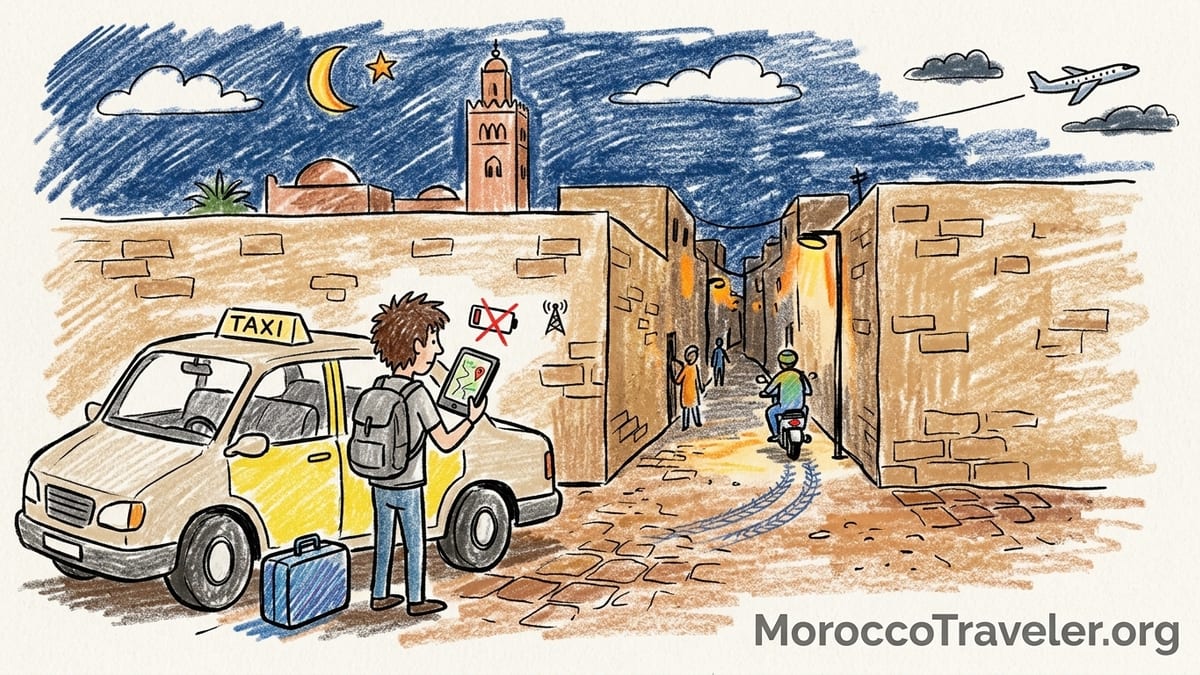
Touching Down Tired: How a Simple Transfer Became Complicated
By the time I walked out of Marrakech Menara’s Terminal 1, it was almost 00:30. The air was warm, the courtyard brightly lit, and the usual post‑flight fog had set in. I had not eaten a proper meal since lunchtime, my phone battery was under 20 percent, and the eSIM I thought I had activated over Europe was stubbornly refusing to connect. In that state, you do not make your best decisions, yet this is the moment many visitors first meet Marrakech’s airport taxi ecosystem.
Just past the sliding doors, a handful of drivers were holding printed name boards for pre‑booked passengers. Behind them, a loose crowd hovered around the exit, offering “taxi, taxi” in English and French. To the right was the official taxi rank, a line of beige grand taxis and white minivans. Somewhere beyond, I knew, was the stop for airport bus line 19 that runs between Menara Airport and Jemaa el Fna, roughly every 20 to 30 minutes during the day for around 30 dirhams per person. At half past midnight, that bus was no longer a real option.
I had read that Marrakech Menara is only about six kilometres from the medina, and that an official airport taxi fare to the old town should be posted at the rank. The national airports authority confirms that fares are displayed in the taxi parking area for all destinations, and recent travellers report signs indicating 75 dirhams for destinations within 2 kilometres and around 150 dirhams for central districts including the medina for up to three passengers. In my fatigue, I did not go looking for any sign. I simply wanted a door that locked and a bed.
The First Mistake: Accepting a Taxi Without a Clear Price
As I hesitated between the rank and the crowd, a driver stepped forward and asked, “Medina? Riad?” I said the name of my riad, showed him the booking on my phone, and he nodded as if he knew it well. “Taxi, come,” he said, already taking my suitcase. I followed him, because it was late and he was decisive and I did not want to argue in front of an audience.
What I did not do, and what matters enormously in Marrakech at night, was to agree a total, final price for the journey before he put my bag into the boot. At the airport, taxis operate on a fixed or negotiated fare basis, not on the metered city rates. Guides that track real‑world practice describe 150 to 250 dirhams per taxi as typical for tourists arriving at the airport rank and heading to the medina, depending on the hour and your bargaining. Pre‑booked private transfers to medina riads, by comparison, run around 18 to 28 euros per vehicle for up to three passengers, often with a supplement for late‑night arrivals, and you see the price when you book.
My driver did not mention a figure. When I asked, already half into the car, he smiled and said, “No problem, good price, medina is close.” It was the answer I should have treated as a red flag. Without a number, “good price” can mean 150 dirhams or 400. I told myself I would sort it out on arrival. This was mistake number one, and the stress it sowed coloured the rest of the journey.
Reaching the Medina by Car Is Not the Same as Reaching Your Riad
The drive itself took about fifteen minutes. At night, the road from Menara into town feels surprisingly short. We passed the illuminated city walls and entered through a gate that I later learned was Bab Doukkala, one of several access points where vehicles can approach the edge of the old town. My assumption, as someone used to hotels with street numbers and front doors on roads, was that the taxi would drop me at the riad’s door. It did not occur to me that much of Marrakech’s historic centre consists of pedestrian‑only alleys where no car or even scooter can pass.
My riad’s address mentioned a derb, a narrow residential lane branching off one of the medina’s main arteries. Online, it looked like a simple pin on a map. On the ground, after midnight, the taxi stopped at a dimly lit square full of parked motorbikes and handcarts. “Medina, finish,” the driver said, switching off the engine. He pointed into a corridor‑like alley and added, “Your riad inside, five minutes.” As far as he was concerned, his job was done. The car had taken me as far as any vehicle could reasonably go.
This is a crucial distinction first‑time visitors often miss. Almost every guide now mentions that riads in the medina are hidden behind unmarked doors in pedestrian lanes. Many transfer companies clarify that they drop guests “at the nearest gate accessible by car” and that a porter or riad staff member meets you there with a cart. In practice, unless your riad has arranged an escort, reaching “the medina” by taxi is not the same as reaching the actual accommodation. The last five to ten minutes on foot, through a maze of similar‑looking passages, is where confusion and opportunism often begin.
Google Maps, “Helpers” and the Stress of Navigating Lanes at Midnight
When I stepped out of the taxi, the driver finally named his price: “Three hundred.” That is roughly double the higher end of what local sources consider a fair airport taxi fare to the medina. I pushed back, citing 150 dirhams, and we quickly compromised on 220, still more than necessary but not worth prolonging the argument. With my small victory behind me and my suitcase back in hand, I turned to the dark alley the driver had indicated.
Google Maps showed a blue dot and a twisting path towards the riad. Theoretically, it was a three‑minute walk. In reality, GPS reception in the medina’s canyon‑like lanes is unreliable, and at night the app lagged or jumped, placing me alternately in courtyards and on rooftops I was not actually standing on. Within two corners, I had lost my sense of direction. Street names were either absent or written in Arabic and French on small tiles high up on walls. My booking confirmation mentioned a nearby mosque as a landmark, but in the quiet of after‑hours the minaret was not visible.
It did not take long for my obvious confusion to attract attention. A teenager on a scooter slowed down and asked in English, “Riad? Which one?” When I told him, he said, “It is closed, but I show you another riad, very good.” This is a widely reported tactic in Moroccan tourist centres, where some unofficial guides claim a booked riad or hotel is closed or full and steer visitors towards a cousin’s or friend’s business that pays them commission. In other cases, they may lead you to your booked riad but demand a tip far beyond anything agreed, insisting on payment once you are standing in front of the door with your luggage.
I declined, but within another minute a second would‑be helper appeared, this time on foot and more insistent. He walked ahead, gesturing that my riad was “this way,” despite my protests. When we reached a dead end, he pointed to another alley, then another, before arriving at a completely different guesthouse and ringing the bell. The night porter there waved us away and pointed us further down the lane. By this point I was tired, embarrassed and thoroughly disoriented. I finally called my riad through the airport Wi‑Fi signal that was still barely alive on my phone, and the night watchman walked out to fetch me from a nearby square I could not have named myself.
Recurring Problems Versus Isolated Bad Luck
Not every night arrival in Marrakech descends into this kind of wandering. Many visitors report straightforward trips, fair taxi fares and helpful locals who walk them to their door without asking for anything in return. It is important not to portray every driver or young man in the medina as dishonest. At the same time, certain patterns recur often enough in traveller reports and local advice that they deserve to be treated as systemic weaknesses rather than one‑off misfortunes.
At the airport, the most common complaints involve taxis offering rides without mentioning a price, then demanding a much higher amount on arrival; drivers claiming that official fares do not apply at night; or suggesting that a riad cannot be reached by vehicle and therefore charging extra for a friend who walks guests through the lanes. Inside the medina, recurring issues include unsolicited “guides” who intercept lost passengers, walk ahead without asking for permission and then insist on being paid, sometimes aggressively, once the destination is reached. A smaller number of cases involve claims that a booked riad is closed or overbooked, only for guests to discover later that this was untrue.
Local regulations attempt to address some of this. Official taxi fares are set by the city, and the airports authority insists that prices are displayed in the airport taxi park. Riad owners frequently recommend pre‑arranged transfers precisely to avoid the taxi rank negotiation altogether. Yet enforcement on the ground is inconsistent, especially late at night when fewer staff are present and tired travellers are more likely to accept the first offer. In that context, the best defence is preparation and a willingness to walk away from vague arrangements.
What a Transfer Really Costs: Taxi, Private Pickup, Hotel Car and Bus
To understand why my improvised taxi felt stressful, it helps to compare the main options both by price and by what you actually get. The numbers below reflect late 2026 information from local operators and recent travellers; they can shift with fuel prices and exchange rates, but they give a realistic order of magnitude.
For a standard beige grand taxi at the official airport rank, expect a posted fare in the region of 150 dirhams for journeys from Menara to central areas such as the medina or Gueliz, for up to three passengers. Some visitors report being quoted 250 or even 300 dirhams on first approach, and negotiating down towards 150 once they mention having seen the sign. There is no meter in use for this airport route; the price is per car, not per person, and it should be agreed clearly before your luggage is loaded.
Pre‑booked private transfers, sold by local agencies and international booking platforms, cost more in cash terms but less in anxiety. Typical current prices for a private sedan from the airport to a medina riad sit between 150 and 280 dirhams equivalent for one to three passengers, depending on the company, vehicle and time of day. A minivan for four to seven passengers often ranges from about 250 to 450 dirhams per vehicle. That usually includes flight tracking, a driver waiting inside arrivals with a name board, and coordination with your riad so that a porter or staff member meets you at the closest car‑accessible gate. Late‑night arrivals after 22:00 sometimes attract a modest supplement, but you see this at the time of booking.
Many riads and hotels in the medina also arrange their own transfers through a trusted driver. Prices are similar to other private services, often around 200 to 300 dirhams per car depending on distance and hour, and the key benefit is integration: the riad knows when you land, can send your driver precise walking directions, and will often have someone on WhatsApp ready to check that you have been collected. In my case, I declined the riad’s suggested transfer because I believed a taxi would be “easy enough.” In hindsight, the small saving was not worth the uncertainty.
The airport bus, line 19, is the budget daytime choice. Until very recently it was operated by the Spanish company Alsa and cost 30 dirhams one way or 50 dirhams return; the urban bus network has since changed operator, and while fares were reportedly still around that level in late 2026, the official tariff grid has not always kept pace online. The bus runs roughly every 20 to 30 minutes between early morning and late evening, linking the airport with Jemaa el Fna, Bab Doukkala, Gueliz and the railway station in about 20 to 40 minutes depending on traffic. The price is per person, paid in cash to the driver. For daytime arrivals travelling light and staying near the square or in the modern city, it is remarkably good value. For a first late‑night arrival with luggage and a hidden riad, it is not.
Why Paying Extra for Door‑to‑Door Help Can Make Sense
Before my trip, I instinctively resisted paying more than the base airport taxi fare. The distance is short; why should I spend the price of a nice dinner just to be driven six kilometres? After that midnight wander through the medina, I see the calculation differently, especially for solo travellers, families and anyone carrying more than a cabin bag.
For a solo visitor arriving at 23:30 on a low‑cost carrier, the difference between 150 dirhams at the taxi rank and, say, 220 dirhams for a pre‑booked transfer with a confirmed meeting point is about the cost of two coffees in a European capital. In return, you have a driver holding your name, an agreed price paid in advance or fixed in writing, and someone who knows where in the city your riad actually sits. When combined with the riad sending a staff member to walk you from the nearest gate, this removes not only negotiation stress but also the risk of being diverted by unsolicited “helpers” along the way.
For families, the value is even clearer. A couple arriving with two small children and two large suitcases does not want to argue over 50 dirhams at the rank or drag wheels across broken cobbles at midnight. A private minivan at 300 to 400 dirhams spread across four people is, per person, similar to the airport bus but with seats reserved, child‑seat options on request, and luggage stowed safely beneath the floor. Importantly, you step from the vehicle into a short, supervised walk to your accommodation rather than spilling out into a busy square to re‑gather everyone.
Travellers with heavy luggage, mobility issues or jet lag from long‑haul flights face another layer of strain. The medina’s lanes often include uneven paving, sudden steps and occasional puddles. Wheeling a 23‑kilogram suitcase through this at night while watching for scooters in narrow alleys is not the romantic start most people have in mind. Spending an extra hundred dirhams on a transfer that includes a handcart porter and clear instructions may not feel glamorous, but it does make the difference between arriving flustered and arriving functional.
A Practical Checklist for Late‑Night Arrivals
Looking back, I can trace my difficulties to a series of small oversights rather than one catastrophic error. Each of the following would have simplified my journey considerably. Together, they form a practical checklist for anyone landing in Marrakech after dark.
First, connectivity. An eSIM that activates the moment you land or a local SIM picked up earlier in Morocco gives you access to maps, translation and WhatsApp. Airport Wi‑Fi at Menara can be patchy near the taxi rank, and relying on it outside the building is optimistic. If you cannot arrange data in advance, download offline maps of Marrakech, including the medina, before your flight. Save your riad’s exact location in the app, not just its name.
Second, communication with your accommodation. Almost every riad now uses WhatsApp as the default channel. Before you travel, ask explicitly whether the riad recommends an airport transfer, what it costs, and where a driver or staff member will meet you. Request a landmark‑based description such as “we meet guests at Bab Doukkala gate, next to the small pharmacy,” rather than only a pinned location. Confirm whether someone will be on duty if you arrive after 22:00 and how to reach them if your flight is delayed.
Third, cash and emergency numbers. While more taxis and transfer services accept online payment, airport drivers are still predominantly cash‑based. Withdraw a modest amount of dirhams from an ATM inside the terminal, enough to cover a taxi fare and a small tip. Keep the phone number of your riad, your transfer company if you have booked one, and a local emergency or tourist police contact stored in your phone and written on paper in case your battery fails. Even mentioning that you have your riad on the line can deter an over‑enthusiastic “guide” from pushing their assistance.
Finally, the address itself. Do not stop at the riad’s poetic name. Have the full address in French, ideally with the nearest gate or square, and take a screenshot. Names can repeat or be confused; several Marrakech riads incorporate words like “Dar,” “Zohra” or “Amour.” A driver will often recognise a gate such as Bab Doukkala, Bab Laksour or Bab Agnaou more readily than a brand‑new guesthouse name.
The Takeaway
If there is a lesson in my first night in Marrakech, it is that the stress was not inevitable. The city is not out to trick visitors by default, and many residents take pride in helping guests feel welcome. My problems came from landing late, underestimating the complexities between an airport tarmac and a hidden medina door, and assuming that the cheapest or most spontaneous option would also be the simplest.
Next time, I would pay for a pre‑booked, door‑to‑gate transfer coordinated directly with my riad. I would send my flight number and arrival time a few days in advance, ask for the driver’s name and car description, and request that a staff member meet me at the gate with a handcart for my luggage. I would confirm the total price in writing, carry that confirmation on my phone and on paper, and have small bills ready so there is no debate about change at the end of a long travel day.
I would still use taxis in Marrakech, and I would still walk the medina’s alleys at night, but on my own terms rather than as a newly arrived and disoriented target. I would continue to greet offers of help politely, decline firmly when I do not need them, and reserve tips for those whose assistance I actually requested. With these adjustments, the same short journey from Marrakech Menara Airport to a riad could become what it ought to be: a brief, grounded introduction to a city that is at its best when you arrive feeling alert enough to enjoy it.
For first‑time visitors, especially those landing after dark, my recommendation is simple. Treat the airport‑to‑riad leg as part of your trip worth planning, not an afterthought. Budget a little extra for a reliable transfer, choose accommodation that offers clear arrival support, and give yourself the tools to say no when an offer does not feel right. Marrakech will still be intense and exhilarating, but your first hour in the city does not have to be a test of nerves.
FAQ
Q1. Is it safe to arrive in Marrakech late at night and take a taxi to the medina?
For most visitors, yes, provided you use the official taxi rank or a pre‑booked transfer, agree the fare in advance, and avoid following unsolicited “guides” into alleys. The main risks are overpaying or feeling harassed rather than serious crime.
Q2. How much should I expect to pay from Marrakech Menara Airport to a medina riad?
Recent reports and local operators suggest a fair airport taxi fare around 150 dirhams per car to the medina, while pre‑booked private transfers typically range from about 150 to 280 dirhams per vehicle for up to three passengers, with clear pricing in advance.
Q3. Does the airport bus run late enough for night arrivals?
Airport bus line 19 connects Menara with Jemaa el Fna and Gueliz roughly every 20 to 30 minutes from early morning until the evening, but it does not reliably cover very late‑night arrivals, so a taxi or transfer is safer if you land close to or after midnight.
Q4. My riad is inside the medina. Will the taxi drop me at the door?
Often not. Many riads sit down pedestrian‑only lanes where cars cannot enter. Taxis and transfers usually leave you at the nearest gate or square, from which you walk a few minutes on foot, ideally accompanied by riad staff or a porter arranged in advance.
Q5. How can I avoid being overcharged by an airport taxi?
Walk to the official taxi rank, check for the posted fare board, and agree a total price before your bags go into the boot. If the quote is much higher than around 150 dirhams to central areas, negotiate politely or step back and ask another driver.
Q6. Are the unofficial “guides” who offer to show me my riad always a scam?
Not always. Some locals genuinely enjoy helping and may accept or refuse a small tip. Others, however, lead visitors in circles and then demand a large payment. To stay in control, only accept help you have requested or that your riad has arranged, and clarify any tip expectations in advance.
Q7. Should I rely on Google Maps alone to find my riad at night?
It is better to treat Google Maps as a rough guide rather than a precise navigator in the medina. GPS can drift in narrow lanes, so combine the app with written directions, landmarks provided by your riad and, if needed, a phone call or WhatsApp share of your live location.
Q8. Is a pre‑booked transfer worth it for budget travellers?
If you arrive during the day with light luggage, the airport bus or a carefully negotiated taxi can save money. For late‑night arrivals, first‑time visitors or solo travellers, spending a bit more on a fixed‑price transfer often buys disproportionate peace of mind.
Q9. Can I get a local SIM card or eSIM on arrival at Marrakech Airport?
Yes, there are kiosks from major Moroccan operators in the arrivals hall during normal hours, and several providers sell eSIMs you can activate before landing. For very late arrivals, buying or activating an eSIM in advance is more reliable than counting on an open shop.
Q10. What should I do if my taxi claims my booked riad is closed and tries to take me elsewhere?
Stay calm, insist on calling the riad using the number on your reservation, and verify its status directly with staff. If the driver refuses to take you to the address on your booking, ask to be dropped at a nearby gate, pay the agreed fare and contact your accommodation yourself.