


On my first trip to Marrakech, I ate my way through tagines, fluffy couscous and endless glasses of mint tea, yet I still felt like an outsider to Moroccan food. Dishes arrived at restaurant tables fully formed and polished, but the stories and techniques behind them remained hidden. So on a return visit in 2026, I signed up for a Moroccan cooking class in Marrakech, determined to move from spectator to participant and to figure out which of the city’s many classes are actually worth booking.
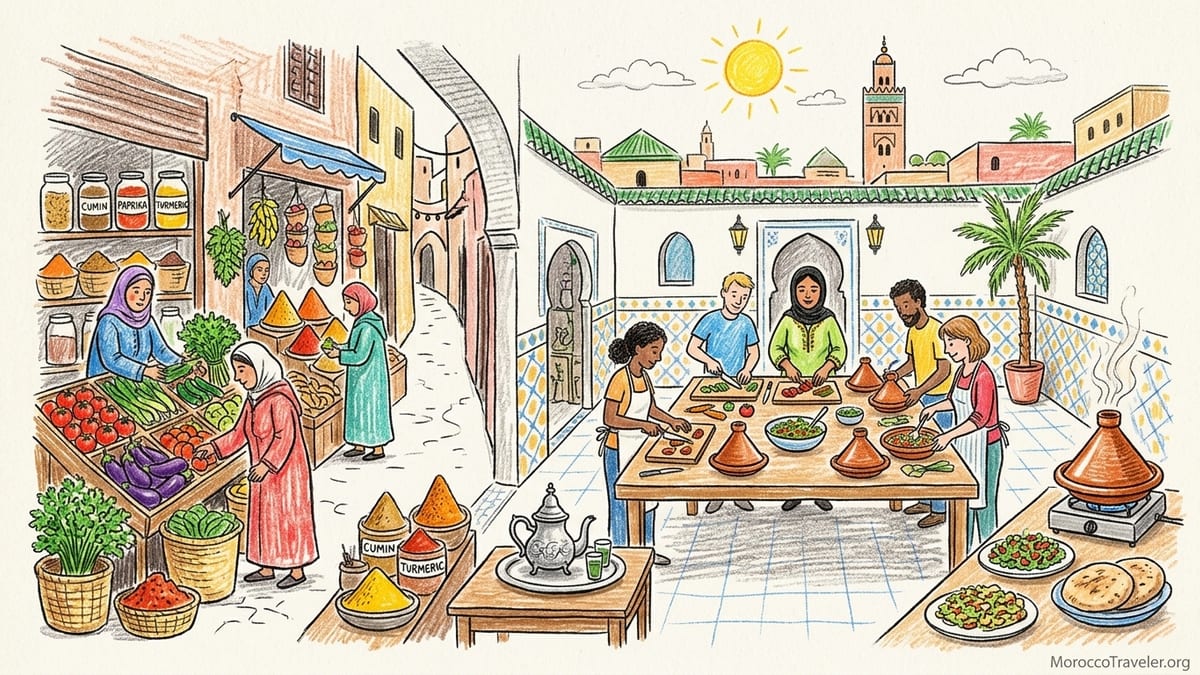
Why I Chose a Market-Based Cooking Class in Marrakech
I knew I wanted a class that went beyond a hotel kitchen and into the real shopping streets where Marrakchis actually buy their vegetables, meat and spices. After a lot of browsing on booking platforms and riad recommendation sheets, I settled on a small-group experience called “Cook in Marrakech,” which several riads in the medina arrange with a local team of cooks. The class combined a morning visit to a neighborhood market followed by hands-on cooking in a riad-style kitchen. The advertised price was about 350 Moroccan dirhams per person in late 2026, roughly 35 US dollars, including the market visit, ingredients and lunch.
I considered better-known names like La Maison Arabe or the charitable Amal Women’s Training Center, but for my first attempt I wanted something more modest in scale and price. “Cook in Marrakech” capped groups at around eight participants, which felt small enough for real interaction with the instructor. By contrast, La Maison Arabe’s regular workshops now accept up to 20 to 26 people in a session, according to recent descriptions, which can make things feel more structured and less intimate. I was also curious to see how a grassroots-style class compared with the more polished, hotel-based options that dominate many guidebooks.
Booking was straightforward. My riad host messaged the organizer the night before to confirm availability, then handed me a slip with the meeting time and cash price in dirhams. There was no slick online portal or card payment, just a WhatsApp confirmation and the reassurance that if the minimum of three people was not reached, I would be informed by 8 p.m. the night before. Cancellation was extremely simple: I could back out up to the previous evening without penalty, but after that I would owe the fee because the ingredients would already have been purchased.
Going in, my expectations were mixed. Reviews mentioned a “hands-on” experience, but that phrase gets used very loosely in travel marketing. What I really wanted to know was whether I would actually chop, season and stir, or spend most of the morning watching someone else cook while I took photos. I also wondered how frank the instructor would be about the realities of Moroccan home kitchens, which often look very different from the romantic tiled spaces shown on social media.
From Riad Courtyard to Local Market: The Start of the Day
The day began just before 9:30 a.m. in the tiled courtyard of a small riad on the northern edge of the medina. Our instructor, a Moroccan cook named Khadija, greeted us in French-accented English, helped herself to our phones for a quick group photo and immediately poured everyone a glass of mint tea. Before we touched a knife, she spent about 20 minutes explaining what we would cook and why these dishes matter in everyday Moroccan life.
We would prepare a chicken tagine with preserved lemons and green olives, a classic tomato and aubergine salad known as zaalouk, a cucumber and tomato salad with chermoula-style dressing and a plate of seasonal oranges sprinkled with cinnamon for dessert. There would also be a demonstration of traditional khobz, the round everyday bread that Moroccans often bake at home or in communal ovens. This was already more variety than most restaurant meals I had eaten, which tended to focus on one heavy main and perhaps a bowl of olives on the side.
Then we stepped out into the street and headed to the local market, a short walk away from the riad and noticeably more low-key than the touristy lanes around Jemaa el-Fna square. There were no souvenir stalls here, just pyramids of tomatoes, bunches of coriander and parsley tied with red string, crates of onions and potatoes, hanging sides of beef and sheep, and stores where women bought spices in quantities measured by the spoonful rather than by the pretty cone for Instagram.
At the vegetable stall, Khadija made a point of buying ingredients as a Moroccan family would. She rejected a few shiny aubergines that looked too large and watery for proper roasting, felt the weight of tomatoes in her hand, and explained that for zaalouk she prefers the ones that smell sweet even before cooking. She taught us a new phrase in Darija Arabic, “mzyan bzzaf,” which roughly means “very good,” and coached us to say it when the vendor handed over particularly nice produce. It was a tiny, human moment I never experienced by simply ordering zaalouk in restaurants.
Spices, Mint Tea and the First Real Lesson
Our next stop was a small, slightly dim spice shop perfumed with cumin, paprika and dried rosebuds. Many visitors only encounter spices in aggressively staged piles in the central souks; this shop felt different, more like a neighborhood pharmacy. Khadija ordered ground cumin, sweet paprika, turmeric and ginger, then pulled down a jar of ras el hanout, the complex spice blend that literally means “head of the shop.” The vendor invited us to smell it and try to identify components. I picked up cinnamon and something floral; another participant thought there was clove. Khadija used this to illustrate how every spice merchant has a slightly different formula and why recipes that call for ras el hanout can taste so different from house to house.
Back at the riad, we began with a ritual nearly every Moroccan kitchen starts the day with: preparing mint tea. Instead of just pouring us a glass, Khadija had one participant measure out the gunpowder green tea, another rinse it with hot water to “wake it up,” and a third add the fresh spearmint and generous sugar cubes. The key detail I learned was the importance of aerating the tea by pouring it from high above the small glasses, then pouring the first glass back into the pot to mix the infusion evenly. I had watched this elegant high pour in cafés, but never understood until that morning that it is both for show and for taste.
The tea break was more than a welcome caffeine hit. It framed the class as a window into hospitality rituals, not just recipes. Khadija explained that in many homes, the youngest capable person is asked to pour tea for visitors because it is considered both an honor and a small test of grace. No restaurant menu had ever told me that, yet it instantly changed how I looked at the choreography of tea service throughout the rest of my trip.
As we sipped, she also addressed hygiene and cleanliness, a topic that can be awkward for travelers to bring up. She pointed out the big bottle of diluted bleach used to clean chopping boards between raw meat and vegetables, the habit of rinsing parsley and coriander three times in cold water to dislodge grit and the way meat is always cooked until fully done in tagines, partly for flavor but also for safety in a hot climate. These are the kinds of practical details you rarely think about when repeating phrases like “slow-cooked for hours” in restaurant reviews.
Hands On With Tagine and Zaalouk: What I Actually Cooked
When it was time to cook, each participant was assigned a station around a big central table. This was where I discovered whether “hands-on” really meant something. In this class, it did. We chopped our own vegetables, seasoned our own tagines and stirred our own salads, with Khadija circulating constantly, correcting knife grips and salt levels with quiet authority.
For the chicken tagine, we layered sliced onions on the bottom of the clay dish, then massaged chicken pieces with a paste of garlic, salt, pepper, cumin, ginger, turmeric and a touch of paprika mixed with olive oil. The act of rubbing the spices into the meat by hand felt intimate and messy, more like working dough than marinating. Two preserved lemon quarters and a handful of green olives went on top, along with a little water. Khadija explained that many home cooks use far less liquid than restaurants do, trusting the sealed, cone-lidded tagine to create its own steam and sauce.
For the zaalouk, we learned a trick I had never seen in cookbooks. Instead of dicing the raw aubergine straight into a pan, we charred whole aubergines directly over a gas flame until their skins blackened and collapsed. Only then did we peel and mash them with stewed tomatoes, garlic, cumin, paprika, olive oil and a little vinegar. The result was a smokier, silkier dip than any I had eaten in restaurants, which often tasted more like straightforward tomato sauce with a bit of eggplant mixed in. That one adjustment, the commitment to really blistering the skins, is something I brought home and now use for other vegetables.
Participants were never relegated to passive watching. When the tagines went onto the flame, we did not simply sit back. We rotated tasks: chopping herbs, seasoning salads, learning to score oranges for dessert and, in my case, kneading dough for khobz. This bread lesson was brief but revelatory. Moroccan cooks often judge the dough not by time or measurements but by feel, aiming for something “like a baby’s cheek,” soft and elastic without sticking to the fingers. Khadija pressed my palm into the dough, guiding me to recognize that point. In restaurants, bread often appears as a neutral backdrop to the main dish; here it was a living, responsive thing.
What I Learned That Restaurants Never Taught Me
By the time we sat down to eat around 1 p.m., I realized how many assumptions I had carried from restaurant plates that did not match what I saw in the kitchen. One of the biggest surprises was how herb-heavy everyday cooking really is. We used big fistfuls of fresh coriander and flat-leaf parsley in nearly everything, far more than the decorative sprinkles I was used to seeing. In Moroccan home kitchens, these herbs function almost like an additional vegetable, not just a garnish.
I also learned that many restaurant tagines are richer and heavier than what people cook for themselves. To appeal to tourist palates and justify higher prices, some kitchens add more oil, butter or sugar than is typical in a weekday family meal. Our chicken tagine used modest amounts of fat and relied instead on onions melting down to create the sauce. The preserved lemons were cut small to distribute their flavor without overwhelming each bite. When I compared that to restaurant versions I had eaten, which sometimes featured thick, glossy sauces and enormous chunks of lemon, the difference in subtlety was striking.
The class also demystified spice use. In menus and food writing, ras el hanout and “Moroccan spice mix” can sound exotic and complicated. Watching Khadija, I saw how often she reached instead for single spices: cumin for depth, ginger for warmth, paprika more for color than for heat. She seasoned in layers, adding a pinch at the start and a little more near the end, tasting and adjusting with an instinct honed over years. It was far from the fixed tablespoon measurements in many tourist-oriented cookbooks. Yet she was also pragmatic, reassuring us that if we could not find preserved lemons at home, we could approximate their effect by marinating thin lemon slices in salt and lemon juice for a few days.
Finally, I came away with a better understanding of the social side of cooking. In Morocco, kitchen work is often shared among generations and neighbors, especially around religious holidays when enormous quantities of couscous, pastries and grilled meat are prepared. Our little group of strangers, chopping and stirring side by side while trading stories about our travels, felt like a faint echo of that communal rhythm. Eating at restaurants had shown me Moroccan generosity at the table; the class revealed the collaborative effort that precedes it.
Teaching Quality, Cleanliness and Value for Money
Measured against its modest price, the “Cook in Marrakech” class felt like excellent value. For around 350 dirhams, I received more than three hours of guided instruction, a full lunch with multiple dishes, and a small printed recipe sheet to take home. Group size stayed at eight, which was small enough for Khadija to correct individual mistakes without slowing the entire class. Language skills were solid; she switched between English and French smoothly and used a bit of Spanish when one participant struggled to follow.
The teaching style was relaxed but structured. Rather than deliver a formal lecture, Khadija used the flow of the recipes to introduce cultural details. When we rubbed spices into the chicken, she talked about how tagines differ regionally. As we rinsed herbs, she shared stories of learning to cook from her mother and grandmother. Questions were encouraged, including practical ones about ingredient substitutions abroad. At no point did I feel rushed, yet we finished near the promised time, around 1 p.m., which is important if you are planning afternoon sightseeing.
On the subject of cleanliness, I was reassured. The kitchen was not a sterile hotel environment, but it was organized and clearly well maintained. Cutting boards for meat and vegetables were kept separate, knives were washed frequently, and hands were scrubbed before and after handling raw chicken. Vegetables were washed in several changes of water, and any dropped utensil was immediately rewashed. Given that many travelers worry about food hygiene in unfamiliar settings, this visible attention to cleanliness mattered almost as much as the taste of the food.
Portion sizes were generous without being wasteful. Each pair shared one tagine, plus more than enough salads and bread. There was enough food for seconds, but not so much that plates came back half eaten. Soft drinks were not included, but there was endless mint tea and water. Overall, the price felt well justified, especially compared with the cost of a mid-range restaurant lunch in Marrakech, which can easily reach 150 to 200 dirhams per person for a tagine, starter and drinks.
How My Class Compares to La Maison Arabe, Amal, Café Clock, Souk Cuisine and Chef Khmisa
After my own experience, I researched several of Marrakech’s better-known cooking classes to see how they compare. La Maison Arabe is perhaps the city’s most famous option. Set inside a historic riad hotel, it offers morning and afternoon workshops, generally around four hours, where a traditional dada cook leads the session with an interpreter. Each guest has an individual workstation and a small screen that shows close-up views of the cooking. Prices for the standard group workshop currently hover around 600 dirhams per person, with private classes costing several thousand dirhams for a small group. There is no market visit; ingredients are prepared in advance and the focus is on technique and presentation in an elegant setting.
Amal Women’s Training Center, by contrast, is a non-profit organization that trains disadvantaged women for work in hospitality. Its Targa center, in a residential district west of the city center, hosts cooking classes where participants cook alongside trainees. Prices are similar to or slightly below hotel-based classes, typically the equivalent of 45 to 60 US dollars for a half-day with lunch, and proceeds support vocational training. Classes tend to be smaller and more conversational, and the atmosphere is informal. There may not be a full souk market tour, but you spend time in a working training kitchen that reflects how many new professionals in Morocco learn their craft.
Café Clock, a cultural café with branches in several Moroccan cities, runs longer workshops that usually start at 10 a.m. and last around four and a half to five hours. In Marrakech, the day often begins with choosing a menu, shopping for ingredients in the nearby souks and then returning to the café’s kitchen to cook a three or four course meal, which might include salads, a main such as lamb tagine or chicken pastilla, and dessert. Prices are generally in the mid-range, and there are clear vegetarian and sometimes vegan options. The vibe is youthful and creative, which suits travelers who like a community café atmosphere more than a hotel environment.
Souk Cuisine is another long-established name that emphasizes the market experience. Participants shop in the medina, sometimes visiting a communal bakery, before cooking a series of dishes in a restored riad. Recent reports suggest prices around 60 to 70 euros per person for a full-day experience that includes a wide variety of recipes. Group sizes tend to be moderate, often around 10 people, and the focus is on demystifying everyday shopping and cooking rather than delivering luxury surroundings.
Finally, there are independent instructors like Chef Khmisa, who host classes either in their own homes or in small rented kitchens. Many of these offer especially small groups, often six people or fewer, and focus on specific dishes like couscous or pastilla. Prices can vary from about 35 to 60 euros depending on whether transport and market visits are included. These experiences can feel deeply personal, with plenty of time for conversation, but they depend heavily on the individual host’s teaching skill and organization.
Luxury Hotels vs Community Workshops: Is Paying More Worth It?
Comparing these options side by side, the key differences fall into three categories: setting and comfort, depth of cultural exchange, and how your money circulates in the local economy. Luxury venues like La Maison Arabe or certain palace hotels offer immaculate kitchens, air-conditioned dining rooms and polished service. If you value comfort, reliable structure and a strong emphasis on classic presentation, the higher price can feel justified. You are effectively paying for a controlled, elegant environment and a hotel-level hospitality team along with the cooking.
Community-based workshops and grassroots classes, such as those at Amal or my “Cook in Marrakech” experience, trade some of that polish for intimacy and social impact. The kitchens may be more basic, and you might share equipment or work in pairs, but the conversations can be richer and less scripted. In a place like Amal, your fee supports tangible training opportunities for women who might otherwise struggle to access formal employment. If you are interested in the social context of Moroccan food and not just its flavors, this gives your spending a clear purpose beyond your own entertainment.
From a purely educational standpoint, paying more does not automatically guarantee more learning. At La Maison Arabe, each person has a personal station and good visibility thanks to the screens, which is excellent for visual learners and for those who want precise, replicable recipes. Yet group sizes can be larger, which may reduce one-on-one correction. In smaller, community settings, the techniques may be less standardized, but you often get more direct feedback and more flexibility to ask off-script questions, such as how families adapt recipes during Ramadan or what they actually cook on weeknights when time is short.
Dietary needs are increasingly well handled across the board. Higher-end schools are used to adapting menus for vegetarians, vegans and gluten-free eaters, though strict celiacs should always double-check about flour handling in shared kitchens. Café Clock and Amal are particularly accustomed to accommodating vegetarian and vegan diets, often substituting vegetable tagines and lentil dishes. Cancellation policies tend to be relatively traveler friendly through booking platforms, often allowing free cancellation up to 24 or 48 hours before the class, though privately arranged classes like mine may be more informal and rely on mutual trust and communication.
The Takeaway: What I Would Book Again and Who Each Class Suits
Looking back, the “Cook in Marrakech” class delivered exactly what I wanted from a first foray into Moroccan cooking. It was hands-on, grounded in a real neighborhood market and generous with cultural context. I walked away confident that I could reproduce a basic chicken tagine, zaalouk and mint tea at home, and I understood details that restaurants had never revealed, from the true role of herbs to the subtleties of tea etiquette. For travelers who care more about connection and learning than polished surroundings, I would happily recommend a similar small-group, market-based class in the 300 to 400 dirham price range.
If I were planning another visit, I would probably combine that grassroots style with at least one more structured class. La Maison Arabe appeals to the part of me that enjoys precise instruction and the atmosphere of a historic riad. I would likely book its morning workshop on a day when I wanted something comfortable, predictable and photogenic, treating it almost like a special-occasion lunch. I would go in understanding that I might share the kitchen with a larger group and that there would be no market visit, but I would expect high teaching standards and refined recipes.
For couples, especially on a short break, a luxury or boutique hotel class can be a romantic choice. The setting is beautiful, time is limited, and you will leave with recipes you can recreate for dinner parties back home. Families with older children or teens might enjoy Café Clock or Souk Cuisine, where the market element and varied dishes keep things lively. For families with younger kids, a shorter class or one based entirely in a single venue may be less tiring than a long market tour.
Solo travelers and serious food enthusiasts, in my view, get the most out of community-oriented or small independent classes. Places like Amal or instructors like Chef Khmisa foster conversation, encourage questions and offer glimpses into everyday life that a hotel cannot always match. You might spend a little extra time figuring out transport or coordinating by message, but the reward is a feeling of genuine exchange. If budget allows, pairing one community class with one higher-end experience offers a well-rounded introduction to Moroccan cooking, from the tiled courtyards of the riads to the hum of the local markets.
FAQ
Q1. How far in advance should I book a Moroccan cooking class in Marrakech?
For popular schools like La Maison Arabe, Souk Cuisine or Amal, it is sensible to book at least one to two weeks ahead for high season dates, especially if you have specific days in mind or dietary requirements. Smaller independent classes may have more last-minute availability, but groups can also fill quickly when several riads recommend the same experience.
Q2. What does a typical Moroccan cooking class in Marrakech include?
Most half-day classes include a welcome tea, instruction on two to four dishes such as a tagine, salads and dessert, and a shared meal at the end. Some also incorporate a market visit to buy ingredients, while hotel-based classes usually have everything prepared in the kitchen beforehand. Water or tea is often included; soft drinks and wine usually cost extra.
Q3. How much does a good quality cooking class cost in Marrakech in 2026?
In late 2026, expect to pay roughly 300 to 400 dirhams per person for a small-group, market-based class, and around 600 dirhams or more at higher-end venues like La Maison Arabe. Full-day or very small private classes can reach 1,000 dirhams or above, especially if hotel transfers and extensive menus are included.
Q4. Do I really get to cook, or is it mostly watching demonstrations?
This varies by provider. In my own “Cook in Marrakech” experience, every participant chopped, seasoned and cooked their own dishes under supervision. Some larger hotel classes combine individual stations with central demonstrations, where you might watch key steps on a screen and then repeat them at your station. Before booking, it is worth checking reviews and descriptions for phrases like “individual workstations” and “hands-on” rather than purely “demonstration.”
Q5. Are Moroccan cooking classes suitable for vegetarians or vegans?
Yes, many classes can accommodate vegetarians, and an increasing number offer vegan options. Dishes like vegetable tagines, lentil stews, zaalouk and other salads adapt well. When booking, make sure to mention your dietary needs clearly; some providers, such as Café Clock and Amal, are particularly accustomed to working with plant-based diets, while smaller operations may need more notice to plan alternatives.
Q6. Is a market visit essential to the experience?
A market visit is not strictly essential, but it adds considerable depth. Shopping alongside your instructor shows you how locals choose ingredients, what seasonal produce looks like and how spice blends are actually bought. If you are short on time or prefer a more controlled environment, a hotel-based class without a market visit can still be rewarding, but you will miss that slice of everyday life.
Q7. How child-friendly are Marrakech cooking classes?
Many providers welcome older children who can safely handle basic kitchen tasks, but not all are set up for very young kids. Classes with long market walks or sharp knives and open flames may be tiring or unsafe for small children. Families should look for shorter sessions, smaller groups and hosts who explicitly mention experience with children, and should always supervise closely during cooking.
Q8. What should I wear to a Moroccan cooking class?
Comfortable, modest clothing and closed-toe shoes work best. Kitchens can be warm, so light, breathable fabrics are ideal, and long sleeves protect against the occasional oil splatter. Aprons are usually provided, but it is wise to avoid wearing clothes you would be upset to stain with turmeric or tomato.
Q9. Can I take recipes home and recreate the dishes easily?
Most classes provide printed recipes or digital copies after the session. You may need to adapt them slightly, especially if you cannot find ingredients like preserved lemons or specific varieties of olives. However, the core techniques, such as layering flavors in a tagine or charring aubergines for zaalouk, transfer well to home kitchens in Europe or North America.
Q10. Are cooking classes a safe choice in terms of food hygiene?
Reputable providers pay close attention to hygiene, from washing produce properly to separating boards for raw meat and vegetables. If you are concerned, look for recent reviews mentioning cleanliness and do not hesitate to ask about their practices before booking. Classes attached to well-known hotels and established centers like Amal follow clear standards, and smaller riad-based classes often go out of their way to reassure guests.