


Morocco is one of North Africa’s easiest countries to enter, but first-time visitors are often surprised by the mix of visa-free rules, eVisa procedures and strict customs controls. This essential predeparture guide, updated to regulations in force as of October 26, 2026, walks you through exactly what you need before boarding your flight or ferry, with special notes for U.S., UK and EU travelers, Indian passport holders, residents of Europe and visitors arriving from Spain.
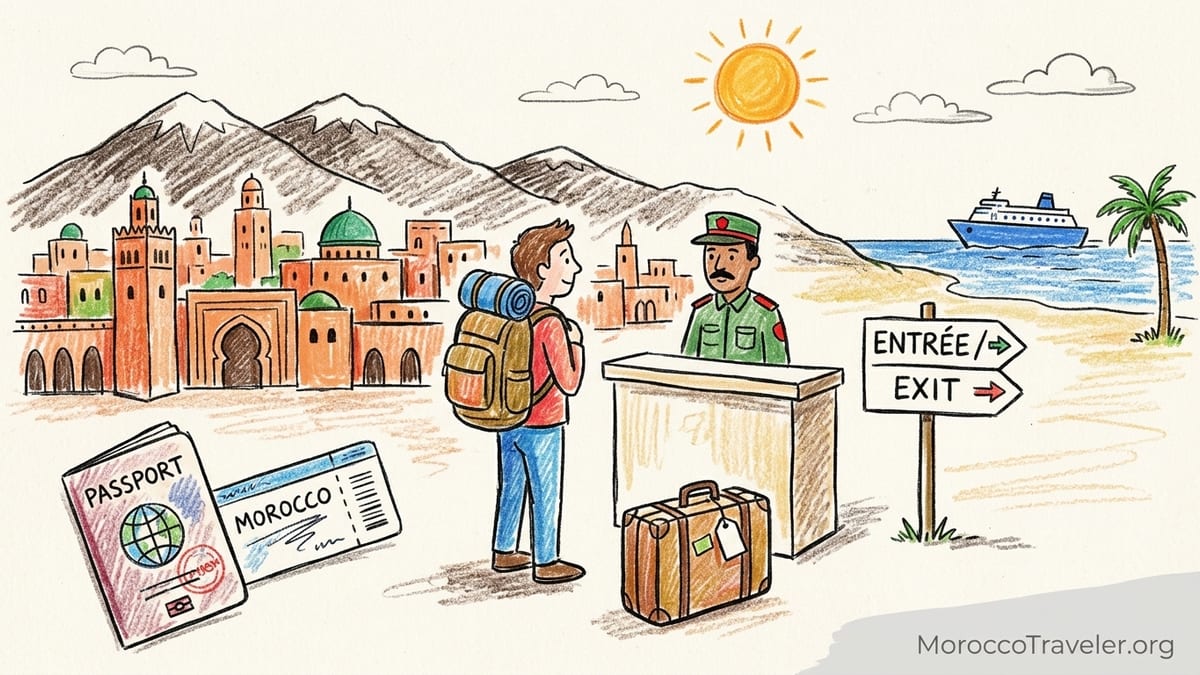
Quick Answers: Morocco Entry Requirements at a Glance
Regulations can change, but as of October 26, 2026, most short-stay visitors experience fairly smooth entry to Morocco provided they meet a few core conditions. The table below summarises the main points for typical tourists arriving by air or ferry for up to 90 days. Always verify your own situation directly through the official Accès Maroc system or a Moroccan consulate before you travel.
Passport validity: Many official sources state that your passport must be valid for at least the duration of your stay, but several governments, including the United States, advise having at least six months’ validity remaining on the day you enter Morocco. In practice, airlines often adopt the six‑month rule, so it is safest to renew if you are close to expiry.
Visa exemptions: Citizens of many countries, including the United States, United Kingdom and most EU and Schengen states, may enter visa-free for tourism for up to 90 days. Others must use Morocco’s official Accès Maroc platform to obtain an electronic visa (eVisa) or an electronic travel authorization (AEVM) before departure.
Tourist stay limit: For all nationalities, the standard limit for a tourist visit is 90 days in Morocco. The Moroccan National Tourist Office and the Ministry of Foreign Affairs confirm that this applies whether you are visa-exempt or hold a visa or eVisa, unless your visa specifies a shorter period. Extensions of up to another 90 days may be possible in-country, but are not automatic and must be requested from local authorities.
Onward or return tickets and accommodation: Airlines commonly ask to see a return or onward ticket before boarding. At the border, Moroccan officials may also ask for proof of where you intend to stay, such as hotel bookings covering at least the first few nights or a written invitation and address if you are staying with friends or family. These documents are especially important if you are entering under an eVisa or AEVM.
Health and vaccinations: There is no routine vaccine requirement for travelers arriving from most countries. However, if you are arriving from a country where yellow fever or polio is a public health concern, you may be asked for proof of vaccination. Health agencies such as the CDC and the Moroccan Institut Pasteur strongly recommend being up to date on core vaccines like MMR, tetanus, and hepatitis A, and suggest additional vaccines such as typhoid depending on your itinerary and length of stay.
Visa-Free Entry: Who Does Not Need a Visa for Morocco?
Morocco maintains a long list of nationalities that may enter without a visa for short tourism and similar visits. The Ministry of Foreign Affairs and official tourism sites confirm that citizens of the United States, the United Kingdom, Canada, Australia, New Zealand and most EU and Schengen states, including France, Germany, Spain, Italy, Ireland, the Netherlands and the Nordic countries, are exempt from obtaining a visa for stays of up to 90 days for tourism or family visits.
In practice, this means that a U.S. tourist flying from New York to Casablanca with a valid U.S. passport and a return flight within three weeks does not need to apply for anything in advance. The same is true for a British passport holder taking the ferry from Algeciras to Tangier or a French traveler flying from Paris to Marrakech for a long weekend. At the Moroccan border, their passports are stamped with a date and usually a handwritten code or number. That stamp becomes the legal reference for calculating their 90-day stay.
Visa-free entry does not remove other obligations. Even if you are exempt, you may still be asked by airline staff to show your return ticket, your first hotel reservation in Marrakech or Fes, or proof of funds. Moroccan border police may also ask brief questions about your plans, particularly if you say you are staying near the Western Sahara region or in more sensitive border areas. Travelers who plan to work, volunteer long term or study must obtain the correct type of visa or residence authorization; visa-free entry covers tourism and similar short visits only.
Different rules can apply to non-tourist trips and for people with special statuses, such as diplomatic or service passports. Those travelers should follow instructions from their own foreign ministry and the Moroccan Ministry of Foreign Affairs. For most ordinary tourists, however, traveling on a standard national passport from a visa-exempt country is straightforward provided that the 90-day limit is respected.
Accès Maroc, eVisa and AEVM: Who Needs Them and How They Differ
Morocco operates an official digital system known as Accès Maroc, accessed through the government’s eVisa platform. This system is used to issue two main types of electronic documents. The first is a classic eVisa, a fully fledged visa that is issued electronically. The second is an electronic travel authorization known by its French acronym AEVM, which functions similarly to the United States’ ESTA or Canada’s eTA. Eligibility depends on your nationality, where you live and, in some cases, whether you already hold a visa or residence permit for certain countries.
For example, an Indian national who holds a valid residence permit in Germany or France may discover, after entering their details into Accès Maroc, that they qualify for an eVisa under a special category for residents of specific countries including many in the European Union, the United States, Canada, the United Kingdom, Japan and others. They must then complete an online application, upload a recent passport photo, scan of their passport and residence permit, proof of accommodation such as a hotel booking in Casablanca or Chefchaouen, and pay the fee by card. Processing times are sometimes as fast as one to three days but can take longer during busy periods.
By contrast, certain nationalities that are relatively low risk but not fully visa-exempt may be directed by Accès Maroc to obtain an AEVM electronic travel authorization instead of an eVisa. In this case, the process can be simpler and the authorization may be valid for multiple trips within a set period, though the maximum stay per visit still typically remains 30 to 90 days depending on the authorization. Travelers from these countries do not have a visa sticker or PDF labelled as a visa; rather, they carry their AEVM approval notice and their passport, and airline staff verify it before boarding.
The key point is that you should never assume your status. Someone traveling on an Indian passport with a Schengen residence card, a Nigerian passport with a U.S. green card, or a Filipino passport with a long-term UK residence permit may all be treated differently by the system. Before buying non-refundable tickets, go to the official Accès Maroc site, enter your nationality and country of residence, and check whether you are visa-exempt, eligible for an AEVM, or must apply for a full eVisa. Be wary of third-party websites that charge extra fees or give outdated information; the Moroccan government’s own platform is the definitive reference, even if it can occasionally be slow or temporarily unavailable.
Special Cases: Indian Nationals, EU Residents, Dual Citizens and Ferry Arrivals
Indian passport holders are not on Morocco’s visa-exempt list, so they must secure permission before travel. Many Indian travelers now do this through Accès Maroc, which allows some applicants to obtain a tourist eVisa for stays that are often up to 30 days. Eligibility and documentation depend on their situation. An Indian IT professional living in Dubai with a UAE residence permit, for instance, may be processed under slightly different criteria than an Indian student living in Spain or Germany. In all cases, a valid ordinary passport, sufficient remaining validity, and a residence permit that remains valid for at least several months beyond the planned trip are typically required for eVisa eligibility.
Travelers holding European residence permits or visas are another important category. Accès Maroc recognizes certain long-term residence cards or valid visas for places such as the Schengen Area, the United States, Canada, the United Kingdom, Australia, New Zealand, Japan, Norway, Switzerland and the United Arab Emirates for the purpose of simplifying eVisa applications for some otherwise visa-required nationalities. To take one concrete example, a Pakistani engineer living in Italy on a long-term EU residence card who wishes to spend a week in Agadir will likely use the eVisa route. They must upload scans of both their passport and their Italian residence permit and may be asked for recent bank statements, hotel bookings and return tickets.
Dual nationals should use the passport that offers the simplest legal route. A British citizen who also holds Moroccan nationality is normally expected to enter and exit Morocco using their Moroccan passport, especially if they live there or plan to stay for extended periods. By contrast, a traveler with both Canadian and Indian citizenship would be far better off using their Canadian passport for a short tourist trip, since it is visa-exempt for Morocco. Mixing passports, such as entering on one and trying to leave on another, can cause complications at exit, including demands for a police report to explain the discrepancy.
Visitors arriving by ferry from Spain or France must meet the same entry conditions as those arriving by air. The ferry from Algeciras to Tangier Med, for example, is popular with vanlifers and road trippers driving down from Germany, Belgium or the UK. Border checks take place either on board or inside the ferry terminal at Tangier Med. A German campervan driver entering visa-free must still have a passport that meets validity rules, proof of vehicle ownership or authorization, and an insurance green card for the van. A traveler subject to the eVisa or AEVM system must carry their approval printout or PDF, and customs officers will inspect luggage and vehicles for restricted items, including drones and large quantities of electronics.
Length of Stay, Extensions, Overstays and Passport Stamps
For tourism, the standard permitted stay in Morocco is 90 days. Official tourism and government sites describe this as three months for visa-exempt visitors and up to the duration of the visa validity for those using visas or eVisas, which are often issued for shorter periods such as 30 days. The countdown normally begins from the date stamped in your passport on arrival. That small entry stamp, often marked with a port code such as "TGR" for Tangier or "CMN" for Casablanca Mohammed V Airport, is more important than most travelers realize.
If you plan to stay longer than 90 days, you must either leave the country and re-enter later, or apply for an extension or a more permanent status. Extensions can in theory be granted for an additional 90 days, and travelers report applying at local police headquarters or immigration offices in larger cities such as Rabat, Casablanca and Marrakech. Authorities typically ask for a compelling reason, such as medical treatment, study or family circumstances, along with proof of accommodation and funds. Decisions are discretionary and processing can take time, so it is not something to leave until the last week of your permitted stay.
Overstaying can carry real consequences. Foreign ministries, including those of the United States and several European countries, warn that travelers who remain in Morocco beyond 90 days without authorization may need to appear before a judge before being allowed to leave. This process can involve court paperwork, a fine and delays that may cause you to miss your intended flight. In more serious or repeated cases, you could face a ban on re-entry. For example, a digital nomad who decides to spend a full winter in Taghazout and simply ignores the 90-day rule because "no one checks" may discover at the airport that they cannot board their flight to London until they have been to court, paid a penalty and obtained exit permission.
To avoid issues, check your entry stamp shortly after arrival. Make sure the date is legible and matches the actual day you entered. If you entered by ferry and your passport was not stamped for some reason, politely insist on receiving a stamp or seek clarification from border police. When checking out of hotels, remember that chains and riads often register your stay with local authorities based on your passport details, so inconsistencies between their records and your actual exit date can raise questions if you are already close to the limit.
Customs, Medications, Drones, Currency and Travel Insurance
Moroccan customs rules are stricter than some travelers expect, especially concerning drones, professional camera gear and currency. Several official customs and trade documents classify drones as controlled items that require special authorization. In practice, tourists carrying consumer drones in their luggage frequently report having them confiscated at airports such as Marrakech or Casablanca. Travelers have described being stopped at baggage x-ray machines and asked to open bags so officers can check for drone controllers. As of late 2026, bringing a drone for recreational use is risky and often results in the device being held by customs, sometimes until departure, and sometimes permanently.
With currency, Morocco uses the dirham, and importing or exporting large amounts is tightly controlled. Official customs information states that foreign currency can be brought in without limit, but if you arrive with an amount equal to or greater than 100,000 Moroccan dirhams in cash, you must declare it to customs in writing when you enter. Export of Moroccan dirhams themselves is largely prohibited, so most visitors change only what they need and convert leftover cash back into foreign currency before leaving at airport or city exchange offices. A traveler arriving from Canada with the equivalent of 5,000 Canadian dollars in euros and dollars, for instance, would be under the declaration threshold, but someone carrying 15,000 or 20,000 euros in cash for a long overland trip would need to declare the funds on arrival.
Prescription medications for personal use are allowed, but they should be kept in their original packaging and accompanied by a doctor’s prescription or medical certificate. Customs guidance for travelers notes that people bringing in medications for their own treatment should be able to present documentation if asked. In practical terms, that means a traveler with ADHD medication, strong painkillers or insulin should bring a printed prescription and, ideally, a letter from their doctor explaining the dosage and purpose, especially if they need to carry a three-month supply. If you rely on refrigerated medicines, inform your airline and accommodation in advance about refrigeration needs.
Comprehensive travel insurance is strongly recommended, even though it is not a formal entry requirement for most tourists. Medical care in Morocco ranges from modern private clinics in cities like Casablanca and Rabat to more basic facilities in rural areas. A typical travel insurance policy that covers emergency medical care up to at least several hundred thousand dollars, plus medical evacuation, theft and trip interruption, can be invaluable if you are injured while hiking in the Atlas Mountains or involved in a traffic accident on the road between Marrakech and Essaouira. Some eVisa or AEVM application processes may ask you to upload proof of travel insurance alongside hotel bookings and flight itineraries, so purchase your policy before you start the application.
Health Rules: Mandatory Vaccines vs Recommended Precautions
Health regulations change over time, particularly in response to outbreaks, but as of October 26, 2026, Morocco does not usually require proof of vaccination for tourists arriving from most countries in Europe, North America or East Asia. There are, however, two clear categories to keep in mind. The first consists of strictly mandatory requirements that may apply in specific circumstances, while the second consists of medical recommendations intended to protect your health during travel.
Mandatory requirements primarily concern travelers coming from countries with certain diseases. International health regulations and foreign travel advisories indicate that travelers arriving from areas with active yellow fever transmission may be asked to present a valid yellow fever vaccination certificate on arrival in Morocco. There are also rules for polio. For example, travelers coming from countries where polio remains a concern, or those who have spent time there before arriving in Morocco, may need to show proof of a recent polio vaccine dose. In practice, this means that someone flying directly from London or New York does not face these checks, but a traveler arriving from a West or Central African country with yellow fever risk, or transiting there for more than a short layover, should carry the appropriate certificates.
Recommended vaccines and health precautions are broader and apply to nearly all visitors. Organizations such as the U.S. Centers for Disease Control and Prevention advise all travelers to be up to date on routine vaccines including measles-mumps-rubella, polio, diphtheria-tetanus-pertussis, and seasonal influenza. For trips to Morocco, they commonly recommend hepatitis A due to possible contamination of food and water, and they may recommend typhoid, especially if you plan to eat at local street food stalls in medinas in Fes or Marrakech, or travel in smaller towns where hygiene standards can be variable. Hepatitis B, rabies pre-exposure shots or other vaccines may be discussed for long stays, animal-focused work or remote trekking.
There is no generalized malaria risk in the main tourist areas of Morocco, including the imperial cities and coastal resorts, so malaria tablets are not routinely needed for most itineraries. However, insect bite prevention still matters. Packing a DEET or picaridin-based repellent, long sleeves for evenings in mountain villages, and basic first-aid items such as antiseptic wipes and bandages reduces the need for clinic visits. It is wise to carry any personal medications, including asthma inhalers, antihistamines and gastrointestinal remedies, because brand names in Morocco may differ from those at home and pharmacists may not always stock equivalent products outside major cities.
Timeline Checklist: One Month, One Week and Arrival at the Border
About one month before departure, start by checking your passport. Confirm that it will remain valid for at least six months beyond your planned date of entry, even if official Moroccan rules only require validity for the period of stay. This buffer significantly reduces the risk of airline staff refusing boarding. At the same time, go to the official Accès Maroc site and run an eligibility check for your nationality and country of residence. If you discover that you need an eVisa or AEVM, you will still have time to assemble documents such as hotel bookings in Rabat or Fez, roundtrip flights, bank statements and proof of residence.
Also around one month out, schedule any medical appointments you may need. If your doctor recommends hepatitis A or typhoid vaccines, they sometimes require two to three weeks to reach full protective effect. Discuss any chronic conditions, such as diabetes or heart disease, and obtain enough medication for the entire trip plus a few extra days. Order or update travel insurance and read the policy wording carefully to confirm that Morocco is covered and to understand exclusions related to activities like quad biking in the desert or guided treks in the Atlas Mountains.
In the last week before departure, print or download all critical documents. That includes your passport identity page, flight reservations, hotel confirmations, eVisa or AEVM approval if applicable, travel insurance certificate and emergency contact numbers. Many Moroccan accommodations, from riads in Marrakech’s medina to surf camps in Taghazout, will ask to see your passport at check-in and may take a copy; having a spare printout can make you more comfortable about handing over the document briefly. Notify your bank that you are traveling so card transactions in Morocco are less likely to be blocked, and plan how you will access cash, whether by ATM withdrawal on arrival at Casablanca airport or currency exchange using euros in Tangier.
On the day of travel and at arrival, keep all key documents in your carry-on. Before you land, cabin crew usually hand out small white arrival forms or direct you to passport queues divided between Moroccan nationals and foreigners. Fill out any forms completely, including the address of your first hotel or riad, for example "Hotel in Gueliz, Marrakech" or "Guesthouse in Chefchaouen" if you do not yet have a detailed itinerary. At passport control, answer questions briefly and truthfully, and check your entry stamp before you walk away from the window. After immigration, proceed to baggage claim and then customs. Use the green lane if you have nothing to declare, but remember that carrying a drone, large professional cameras or very high amounts of currency may require using the red lane and declaring them. Once outside, use official taxi stands or prearranged transfers, keeping in mind that some airport taxi drivers accept only cash in dirhams.
The Takeaway
Entering Morocco in 2026 is generally straightforward for most tourists, especially those from visa-exempt countries such as the United States, the United Kingdom and much of Europe. Success rests on a few essentials. First, travel with a passport that has generous validity and verify your status on the official Accès Maroc platform before buying flights. Second, respect the 90-day limit and pay close attention to your entry stamp. Third, prepare for customs with sensible quantities of personal medication and electronics, and do not bring drones unless you are willing to risk having them held or confiscated.
Health and safety preparation is just as important. While Morocco does not usually demand vaccine proof from travelers arriving from Europe or North America, staying current on routine immunizations, considering hepatitis A and typhoid shots, and purchasing robust medical travel insurance all help you enjoy your time in the souks, deserts and mountains with peace of mind. Document organization, from printed hotel bookings in Marrakech and Fes to digital copies of insurance and eVisa approvals, smooths your route through check-in, boarding and immigration.
Finally, remember that rules can evolve. The information in this guide reflects official sources and widely reported practice as of October 26, 2026. Before you depart, always double-check entry requirements with your airline, your own foreign ministry and, where relevant, a Moroccan consulate or the Accès Maroc portal. A small investment of time before you fly pays off greatly when you step into the arrivals hall in Casablanca, Marrakech or Tangier ready to start your Moroccan adventure without administrative surprises.
FAQ
Q1. Do I need a visa to visit Morocco for a one or two week holiday?
For many nationalities, including U.S., UK and most EU passport holders, no visa is needed for tourist visits of up to 90 days. Travelers from countries that are not on Morocco’s visa-exempt list must usually apply in advance through the official Accès Maroc platform for either an eVisa or an electronic travel authorization, depending on nationality and residence.
Q2. How long must my passport be valid to enter Morocco?
Moroccan regulations state that your passport should be valid at least for the duration of your stay, but several governments advise that it should have at least six months’ validity remaining on the day you enter. Because airlines often follow the six‑month rule when deciding whether to board passengers, it is safest to renew a passport that will expire soon after your trip.
Q3. What is the maximum time I can stay in Morocco as a tourist?
The general limit for tourists is 90 days in Morocco per visit. Visa-exempt travelers and those with eVisas or AEVM approvals are expected to respect this 90-day maximum unless their visa explicitly grants a shorter stay. Longer stays require an extension or a residence status, and overstaying can lead to fines, a required court appearance and potential future entry problems.
Q4. Can I extend my stay beyond 90 days without leaving the country?
Extensions are sometimes possible but are not guaranteed. Travelers normally apply at police or immigration offices in major cities before their initial 90 days expire and may be asked for a strong reason for staying longer, such as study, medical treatment or family matters, plus documents proving funds and accommodation. Each case is judged individually, and you should not assume approval.
Q5. Do I need proof of onward or return travel to enter Morocco?
While Moroccan law does not always specify a universal requirement for onward tickets, airlines frequently request proof of return or onward travel before boarding, especially for those entering visa-free. Border officials may also ask how and when you plan to leave. Carry a printed or digital copy of your return flight or ferry ticket to avoid delays at check-in or immigration.
Q6. Are any vaccinations mandatory for Morocco?
For most visitors arriving from Europe, North America or East Asia, Morocco does not require any specific vaccines as a condition of entry as of October 26, 2026. However, travelers coming from countries with yellow fever or polio concerns may be asked to show relevant vaccination certificates. Regardless of mandates, health authorities recommend being up to date on routine vaccines and often advise hepatitis A, and sometimes typhoid, depending on your itinerary.
Q7. Can I bring prescription medicine into Morocco?
Yes, you may bring prescription medications for personal use, ideally in quantities that match the length of your stay. Keep them in original packaging and carry a copy of your prescription or a doctor’s letter that explains the medicine and dosage. This documentation is important if you are carrying controlled drugs, large quantities or injectable medications such as insulin.
Q8. Are drones allowed for tourists in Morocco?
Drones are tightly controlled and effectively not permitted for casual tourist use. Many visitors report that consumer drones are confiscated at airports or held by customs for the duration of the trip. Unless you have explicit authorization from Moroccan authorities obtained well in advance, it is safer to leave drones at home and avoid including them in your luggage.
Q9. Do I have to declare cash when entering Morocco?
You can bring foreign currency into Morocco, but if you arrive carrying an amount equal to or greater than 100,000 Moroccan dirhams in cash, you must declare it to customs upon entry. Export of Moroccan dirhams is very restricted, so most travelers bring foreign currency or rely on ATMs, change only what they need into dirhams, and reconvert any surplus before departure.
Q10. Is travel insurance required for Morocco and what should it cover?
Travel insurance is not generally a formal entry requirement, but some eVisa or AEVM applicants may be asked for proof of coverage. Even when not mandatory, comprehensive travel insurance that covers emergency medical treatment, hospitalisation and medical evacuation, plus theft and trip disruption, is strongly recommended given the costs of private healthcare and evacuation from remote areas such as the Atlas Mountains or the Sahara edge.