

I had been in Marrakech for three days before I finally worked up the courage to book a Moroccan hammam. I had seen the tiled doorways and smelled the faint mix of steam, eucalyptus and wood smoke drifting out of side streets at night, but I kept putting it off. I worried about everything at once: how naked I would need to be, what was expected of me, whether the scrubbing would hurt, how clean it really was, what to tip, and if I would somehow do something wrong and offend everyone in the room. When I did finally go, I started with a traditional neighborhood hammam, followed it the next day with a more polished medina spa, and later splurged on a luxe hotel hammam. The three experiences together gave me a clear picture of what actually happens inside, what you really wear, and which type of hammam I would choose again.
Expectations vs Reality Before Stepping Inside
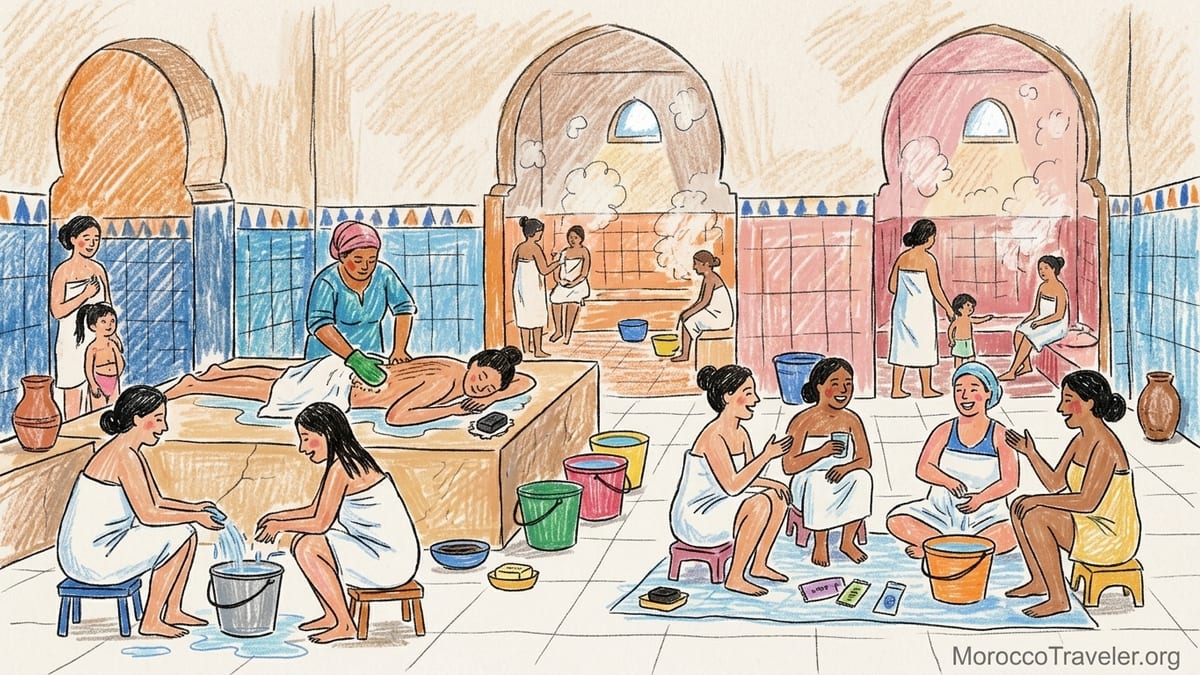
Before my first hammam, my mental image was shaped by glossy hotel photos: empty marble rooms, rose petals on hot stone, a single serene guest lounging in a white robe. Locals I spoke with in Marrakech gently laughed at that. For them, the hammam is closer to a weekly deep-clean and social catch-up than a quiet temple of wellness. Friends described women chatting over buckets, children running between mothers and aunts, elderly regulars sitting on low stools pouring hot water over themselves, and a level of nudity that was simply practical rather than glamorous.
My concerns were more practical. I worried about privacy and how much of my body I would need to uncover. I wondered about hygiene in busy neighborhood bathhouses, about the heat and humidity if I found saunas uncomfortable, and about communication since my Moroccan Arabic is patchy and my French basic. I also had no idea what to bring beyond a swimsuit and shampoo. At the same time, every Moroccan I asked insisted that I should try it at least once, and several foreign travelers told me the scrub was the softest their skin had ever felt.
Ultimately I decided to experience three different layers of the hammam world in Marrakech. First I tried a simple neighborhood hammam just outside the medina, the type that charges locals around 15 to 40 dirhams for entry and about 30 to 70 dirhams extra for a professional scrub if requested. Then I booked a visitor-friendly medina spa where a hammam with scrub starts around 250 to 500 dirhams with products included. Finally, I splurged at a luxury hotel spa, where a full hammam ritual with massage can run from around 1,300 to over 1,600 dirhams. Experiencing all three back to back showed me how much of the ritual stays the same and what changes as you go up in comfort and price.
In all cases, the core of the experience was identical: black soap, hot steamy rooms, a kessa glove, repeated rinsing with buckets or showers, and an attendant who seemed able to remove an entire layer of my past life from my skin. What varied was the atmosphere, the level of handholding, the language support and just how pampered I felt at the end.
Step by Step: Inside a Traditional Neighborhood Hammam
My first hammam was a neighborhood spot recommended by a riad staff member, in a residential street about fifteen minutes on foot from Jemaa el Fna. From the outside it looked like a simple entrance in a pinkish wall, with a small sign in Arabic and a low doorway. Inside, there was a tiny tiled reception area where a man collected payment and a woman directed female guests to the women’s side. Entry for me was 25 dirhams, and I rented a thin plastic mat and a bucket for a few dirhams more. At the desk they also sold basic savon noir black soap, kessa exfoliating gloves and single-use shampoo sachets at a modest markup, the same items Moroccans buy in the souk for just a few dirhams.
The changing room was basic but busy, more like an old locker room than a spa: benches along the walls, hooks, women of all ages chatting in rapid Moroccan Arabic. Most women stripped down to underwear while some older regulars were completely nude, wrapping a thin cloth only when moving between rooms. I wore opaque bikini bottoms and kept a light sports bra on, which attracted zero interest. Modesty here was practical rather than prudish; no one was looking at me. I put my valuables in a small daypack and kept it close to me in the changing area on the staff’s advice, as there were no lockers.
Inside, the hammam itself unfolded as a series of three connected rooms: warm, hotter and hottest. The first was around body temperature, perhaps the mid 30s Celsius, and the air smelled faintly of steam, soap and the wood fire that heats the water. The hottest room felt closer to 45 degrees, with dense humidity that fogged my vision slightly. The walls and floor were tiled, the light dim, and the main sounds were water splashing and women talking over the echo. It was not silent or serene, but it felt surprisingly relaxed and communal.
A local attendant, the kessala, motioned for me to sit directly on my plastic mat against the wall. She spoke some French and a few words of English. She handed me a bucket of warm water from a tap, and I began by pouring several bowls over myself to acclimatize. She then scooped a handful of black soap from a plastic tub and worked it all over my arms, back, legs and torso. The soap itself was smooth, dark and slightly sticky, made from olive paste with a faint eucalyptus smell. After ten minutes of sitting in the steam to let the soap work, she returned with the kessa glove and the real, slightly intimidating part began.
The Reality of the Scrub: Intense but Transformative
The kessa glove looks innocent enough, like a coarse mitt that might be used for dry brushing. In the heat of the hammam, in the hands of someone who has done this thousands of times, it becomes a serious exfoliation tool. The kessala sat me down, braced my arm with one hand, and began to scrub in long, firm strokes from wrist to shoulder. The pressure was several steps above a home body scrub, somewhere between a vigorous sports massage and a sandpaper buffing. On parts of my body where my skin is sensitive, like the inner arms and upper chest, it bordered on uncomfortable without quite tipping into real pain.
Within seconds, rolls of greyish dead skin began to peel away visibly. This was both satisfying and slightly horrifying. The kessala worked methodically across my body, repositioning me wordlessly: one arm, then the other, back, shoulders, legs, tops and soles of the feet. She occasionally checked my face to read whether she was going too hard and adjusted the pressure a little when I involuntarily gasped on a tender area. The entire scrub lasted maybe 15 to 20 minutes but felt longer because I was so aware of each stroke. For this service I paid the equivalent of around 50 dirhams directly to her afterward as a supplement to my entry fee.
After the scrub, she rinsed me thoroughly with bucket after bucket of hot and then lukewarm water. At no point did I feel rushed, although the room was quite full. The floor was very wet and a bit slippery, so I was glad I had brought sturdy rubber flip-flops from home instead of the flimsy plastic ones on sale nearby. I then moved back into the slightly cooler middle room to apply my own shampoo and conditioner, and the kessala offered to apply a simple ghassoul clay mask for an extra fee. I accepted; she mixed the clay with warm water into a thick paste, smoothed it along my legs and arms, left it briefly until it dried slightly, then rinsed it off with more buckets of water.
All in, I spent about 90 minutes from arrival to leaving the changing room. When I stepped back into the cool night air of Marrakech, my skin felt noticeably lighter, almost squeaky clean, and very pink. There was no robe, no herbal tea, no quiet relaxation room at this neighborhood hammam. Instead, there was the feeling of having been let into a weekly ritual shared by grandmothers and toddlers alike, at a cost that barely equaled a cafe breakfast in the medina.
Trying a Medina Hammam: Hammam Mouassine and Similar Spots
For my second experience, I wanted more structure and English-speaking staff, so I booked a mid-range medina spa. In the Mouassine district of the old city, close to the historic mosque and fountain complex, Hammam Mouassine and several similar venues occupy beautifully restored buildings that bridge tradition and comfort. Current price surveys in Marrakech put such medina spas around 250 to 500 dirhams for a visitor hammam with scrub, sometimes more if a massage is included or if the venue is especially design-focused.
Arriving at my chosen medina hammam felt more like entering a small boutique hotel than a public bath. A receptionist checked my reservation, confirmed my chosen package, and offered mint tea while I filled out a simple form about preferences and any skin sensitivities. The basic hammam and scrub package was around 350 dirhams and included black soap, a kessa glove, shampoo and a simple moisturizer, with the option to add a 30-minute massage for an additional 250 dirhams or so, based on current advertising in late 2026.
The changing room here was softly lit, with individual lockers and padded benches. A thick cotton robe and disposable paper underwear were provided, though I chose to wear my own bikini bottoms. My hammam attendant introduced herself in English, explained the sequence and reassured me that I could ask her to reduce pressure at any time during the scrub. That short briefing did a lot to calm the leftover nerves from my first experience.
Inside, the hammam rooms were hotter and more perfumed than the neighborhood bathhouse but less crowded. The initial room felt around the high 30s Celsius, the warmest chamber slightly above 40 degrees but tempered by occasional cool water poured over the marble floor. There were only three other guests, each with their own attendant, and quiet instrumental music played softly in the background. My attendant applied a generous layer of eucalyptus-scented black soap and left me lying on a warm stone platform to relax for ten minutes, occasionally pouring warm water over my feet and legs so the soap did not dry completely.
Scrub, Rinse, Massage: The Spa Version
The scrub here used the same kessa glove and the same basic technique as the neighborhood hammam, but the pressure was slightly more controlled. My attendant checked in verbally several times, asking if the pressure was good, and backed off on bony areas like my shins when I hesitated. The setting made a big difference emotionally. The steam was less dense, the lighting more flattering, the air filled with orange blossom and eucalyptus. Instead of balancing plastic buckets in a crowded room, I lay flat on a wide marble slab while she rinsed me using built-in taps and a polished brass bowl.
Once the dead skin had been sloughed away, she applied a ghassoul clay mask perfumed gently with rose water to my arms, legs and back, and wrapped me lightly in a cotton sheet while it did its work. The clay had a cooling effect that balanced the residual heat, a welcome contrast for someone like me who does not enjoy extended sauna time. After rinsing again, she washed my hair with a simple argan-oil shampoo and guided me to a tiled bench in a slightly cooler room where I sipped water and felt the post-scrub floatiness begin.
I had also added a 30-minute argan oil massage to my package. In many Marrakech medina spas, this type of combined hammam and massage costs somewhere between 350 and 550 dirhams according to recent price comparisons, depending on exact duration and brand positioning. My massage took place in a low-lit treatment room off the main hammam area. It was not a deep-tissue sports massage, more a slow, flowing sequence designed to soothe rather than untangle serious knots. For a first-timer slightly on edge after an intense scrub, this felt exactly right.
By the time I changed back into my street clothes, I had spent about two hours in the spa. I left with noticeably smoother skin, a faint scent of orange blossom on my hair, and the feeling that I had finally experienced the hammam as many visitors imagine it: structured, cared for, unhurried, and cushioned from the sometimes overwhelming medina outside.
Luxury Hotel Hammams: What You Really Pay For
My final hammam in Marrakech was the type you see in magazine editorials, at one of the city’s palace hotels. La Mamounia and Royal Mansour, among others, offer hammam rituals that have become experiences in their own right. Recent spa menus show traditional hammam sessions of about 60 minutes at La Mamounia from around 1,300 dirhams, while signature hammam rituals at Royal Mansour appear in brochures from 1,600 dirhams and upward, especially when combined with extended massages or hair and body treatments.
From the moment I entered the hotel spa, I understood the price difference. The reception area resembled an art gallery, with high ceilings, perfumed air and staff who seemed to know my name before I said it. Check-in felt more like arriving for a discreet medical appointment than a spa treatment, with a more detailed discussion of preferences and any health concerns. I chose a mid-range hammam ritual combined with a 45-minute massage, which, based on current pricing at comparable Marrakech palace hotels, would typically run well above 2,000 dirhams.
The hammam suite itself was private, with its own steam room, heated marble platform, shower and resting alcove. Instead of paper underwear, there were soft cotton garments and a thick robe. The black soap was infused with neroli and presented in a small ceramic bowl. The kessa glove was new and given to me afterward to take away. My therapist explained each step in fluent English, checked the room temperature and asked if I preferred less or more heat. The steam was gentler here than in the neighborhood hammam, kept steady rather than allowed to build to a peak, perhaps out of consideration for guests who are unused to such heat.
The scrub in this setting felt thorough but less relentless than my first neighborhood experience. The therapist modulated her pressure with clinical precision, avoiding any hint of discomfort. After the main exfoliation, she applied a body mask with mineral-rich clay and botanical oils, wrapped me in light towels and guided me into a short period of quiet rest. The session concluded with a full-body massage using warmed argan oil and essential oils tailored to my choice of “relaxing” or “energizing.” When I finally emerged into the spa’s relaxation lounge with its trays of dried fruit and herbal tea, nearly three hours had passed.
The obvious question is whether this is worth the cost. For a typical traveler, the price of a palace hammam could equal several nights in a comfortable riad, several restaurant meals or an entire day trip to the Atlas Mountains. What you buy with that money is not a fundamentally different ritual but privacy, extremely high hygiene standards, meticulous comfort and a level of service where nothing feels confusing. For a special occasion, or for someone anxious about public nudity, the luxury hotel option can be a reassuring way to experience the hammam without sensory overload.
What to Wear, What to Bring and How Gender Separation Works
Across all three experiences, the question that had worried me most in advance, what to wear, turned out to be simpler than I expected. In neighborhood hammams, most women were in dark, practical underwear: full briefs and simple bras, sometimes only briefs. Men in their section tended to wear simple boxer shorts or fitted swim trunks. Bikinis were fine for visitors as long as they were not overly revealing, and sports bras worked well. In the medina spa and hotel hammams, disposable underwear and robes were provided and guests could keep as much or as little on as they wished under the guidance of their therapist.
Gender segregation in Marrakech’s public hammams is strict. Many neighborhood baths have completely separate entrances and operating hours for men and women, and you will not mix inside. In tourist-oriented medina hammams, couples can often book a private room together, particularly in riad spas that market themselves to international guests, while still being attended by a therapist of the same gender as each guest. Luxury hotels often offer both private couples’ hammam suites and entirely separate men’s and women’s facilities.
As for what to bring, I was glad I had followed local advice. In neighborhood hammams, I brought my own flip-flops, a non-transparent plastic bag for wet items, a small bottle of shampoo and conditioner, a basic bar of soap in case the black soap felt too strong for my face, a quick-drying towel, and a bottle of water. In most public hammams you can buy savon noir, a kessa glove and sometimes ghassoul clay at the entrance, though you will often pay a little more than in the souk. In mid-range and luxury spas, products and towels are usually included in the package price, so you mainly need swimwear, if required, and perhaps a hairbrush for afterward.
Reservations are essential at medina spas and hotel hammams, especially in high season. Same-day bookings are sometimes possible on quiet weekdays, but for weekends or holiday periods it is safer to book a day or two ahead of time through your riad or directly with the spa. Neighborhood hammams, by contrast, generally do not take reservations. You simply turn up during the gender-appropriate hours with your kit, pay at the desk, and find a place on the tiled floor or bench.
Money Matters: Realistic Prices, Packages and Tipping
For a first-time visitor, pricing can be confusing because headline rates often only cover entry or a minimal service. In Marrakech’s neighborhood hammams, the average foreign visitor today can expect to pay somewhere between 20 and 40 dirhams for basic entry. A professional scrub from an attendant will usually cost another 30 to 70 dirhams, sometimes paid at reception, sometimes handed directly to the kessal or tayaba afterward. Adding a simple massage on-site, where available, can raise the total to around 100 to 150 dirhams, still significantly less than even a mid-range spa.
In visitor-oriented medina hammams such as those clustered around Mouassine, Bab Doukkala and Dar el Bacha, recent surveys in 2026 show hammam and scrub packages most often priced between about 250 and 500 dirhams. A combined hammam plus 30 to 60 minute massage usually falls in the 350 to 700 dirham range depending on exact duration, whether oils and masks are branded or organic, and how many guests share the room. Many riad spas promote several tiers, such as a basic “Beldi” hammam with black soap for roughly 300 dirhams, a slightly longer Berber ritual with clay mask for a little more, and a “Royal” hammam approaching 500 dirhams, each adding a layer of service or product.
At palace hotels like La Mamounia, Royal Mansour or similar five-star properties, hammam prices jump sharply. A 60-minute signature hammam can start around 1,300 to 1,600 dirhams, with extended combination rituals plus massages, facials or hair treatments reaching 2,000 to well over 3,000 dirhams. These rates typically include high-end products, private facilities, and extensive relaxation time before and after the core ritual. Service charges may be added to the final bill at some international chains, and this is usually clearly indicated on the spa menu.
Tipping etiquette follows local norms. In neighborhood hammams, a cash tip of 20 to 50 dirhams handed directly to the person who scrubbed or massaged you is both appreciated and expected if you have received more than basic access to the hot rooms. In medina spas, a service charge may be built into the price, but therapists still commonly receive tips of around 10 to 15 percent of the treatment cost, often handed in cash at reception or placed in a box. In luxury hotels, staff will discreetly accept similar percentages, though guests sometimes add more for complex, multi-hour rituals. If you are unsure, your riad or hotel reception can advise on what is appropriate at the venue you have chosen.
Is a Moroccan Hammam Suitable for Everyone?
Having now experienced three types of hammam in quick succession, I can say that the ritual can be adapted to a wide range of comfort levels, but it is not for everyone. The combination of heat, humidity, physical exfoliation and partial nudity can be intense, particularly in crowded public hammams where there is little separation between guests. Travelers who are highly sensitive to heat, have very reactive skin, or feel anxious in enclosed steamy environments may find the experience challenging. In such cases, a medina spa or hotel hammam with controllable temperature and the option to request a gentler scrub is likely to be a better fit.
For guests with mobility issues, the practical layout matters. Neighborhood hammams often have wet, uneven floors, few handrails and low doorways, and guests sit directly on the ground or very low steps. Moving between rooms and standing for multiple rinses can be difficult if you have balance problems or limited leg strength. Medinas spas and hotel hammams are generally better equipped, with non-slip surfaces, benches, grab bars and staff who can assist if asked, but not every venue is fully accessible. When booking, it is worth asking the spa directly about steps, seating height and whether an attendant can help you move safely between the different stages.
Sensitive skin is another consideration. The traditional kessa scrub is intentionally vigorous, designed for people who visit weekly and have built up a tolerance. If you have conditions like eczema, psoriasis, recent sunburn or very thin skin, discuss this frankly with your therapist and consider either skipping the scrub entirely or limiting it to less affected areas. Many medina and hotel spas offer a “soft” hammam that focuses more on warm water, gentle black soap cleansing and a light exfoliation, which can be a soothing compromise.
Because everyone’s health situation is different, it is impossible to make blanket recommendations. If you have known heart or blood pressure conditions, are pregnant, or have been advised to avoid saunas or steam rooms, speak with your medical provider before planning a hammam visit. On-site spa staff can adjust temperatures and durations, but they cannot provide individual medical advice. In my own case, with no underlying conditions but a general dislike of extreme heat, I found that keeping my sessions in the hotter rooms under fifteen minutes at a time and requesting lukewarm water for rinses made the experience enjoyable rather than overwhelming.
The Takeaway
Looking back, the hammam I would choose again tomorrow depends entirely on my mood and budget. For a quick reset after a long travel day, I would happily return to a clean neighborhood hammam with a trusted kessala. The price is modest, the scrub is serious and the atmosphere has an authenticity that no designer spa can replicate. But I would only do this again with at least a basic sense of the local etiquette, a clear recommendation from someone I trust and realistic expectations about noise, nudity and simplicity.
If I were traveling with a friend who was nervous about the whole idea but curious, I would steer us to a mid-range medina hammam, perhaps in the Mouassine or Dar el Bacha area, where staff are used to first-timers, explanations are clear, and products and towels are included. The cost is higher than a public hammam but still accessible, and the environment feels tailored to visitors without losing the essence of the ritual. For a special celebration in Marrakech, I can see the appeal of saving up for a palace hammam, but I would treat it as I would a fine-dining splurge: memorable, luxurious and not essential to understanding the culture.
For anyone still hesitant about booking their first hammam, my advice is simple. Decide first how much structure and privacy you need to feel comfortable. If the idea of sitting on the floor in a room full of strangers half-dressed in underwear fills you with dread, start with a spa. Bring more than you think you need in terms of modest swimwear and your own flip-flops and towel. Eat lightly beforehand, drink plenty of water, and be ready to say clearly if the scrub feels too intense. Remember that the attendants do this every day, with clients of all shapes, ages and backgrounds, and that your self-consciousness is far greater in your mind than in theirs.
Once you have surrendered, in a controlled way, to the heat and the exfoliation, the payoff can be remarkable. The combination of thorough cleansing, enforced time away from your phone, and the intimate but professional care of another person produces a sense of physical and mental reset that lingered for days afterward. My own skin stayed softer than I can remember for nearly a week, and my initial anxiety was replaced with a quiet, surprised pride at having stepped into a tradition that has shaped daily life in Moroccan cities for centuries.
FAQ
Q1. Do I have to be completely naked in a Moroccan hammam?
In most neighborhood hammams in Marrakech, women wear underwear and men wear shorts or underwear, while in spas and hotel hammams you can usually keep bikini-style swimwear or disposable underwear on. Full nudity is not required in tourist-focused venues, and you can always ask your therapist what is appropriate if you are unsure.
Q2. How hot does it actually get inside the hammam?
Public hammam hot rooms in Marrakech often feel around the low to mid 40s Celsius with very high humidity, while medina and hotel spas tend to keep steam rooms slightly cooler and can usually adjust the temperature. If you struggle with heat, let staff know and ask to sit in the warmest room for shorter periods with more frequent cool rinses.
Q3. What should I bring with me to a traditional neighborhood hammam?
For a public hammam, bring non-slip flip-flops, a quick-drying towel, modest underwear or swimwear, a small plastic mat if not rented on-site, your own shampoo and conditioner, and a bag for wet clothes. You can buy black soap, a kessa glove and sometimes ghassoul clay at the entrance or in nearby shops, but having your own set in advance can make the process less stressful.
Q4. How much should I expect to pay for a hammam in Marrakech?
As of late 2026, basic entry at a neighborhood hammam is usually between about 20 and 40 dirhams, with a professional scrub adding roughly 30 to 70 dirhams. Visitor-oriented medina hammams typically charge around 250 to 500 dirhams for a hammam and scrub, and 350 to 700 dirhams for a combined hammam and massage, while palace hotel hammams often start around 1,300 dirhams and can cost several thousand dirhams for elaborate rituals.
Q5. Is the exfoliating scrub painful?
The traditional kessa scrub is intense and can feel rough, especially on sensitive areas, but it should not be truly painful. In neighborhood hammams attendants may push a little harder by default, while spa and hotel therapists are more likely to ask about pressure and adjust it. If it feels too strong, say something immediately by asking for “less strong” or “softer” pressure.
Q6. How clean are Moroccan hammams?
Cleanliness varies by venue. Well-run neighborhood hammams wash down the tiled floors and benches regularly, and the constant flow of hot water and soap keeps surfaces flushed, but the setting is basic. Medina spas and hotel hammams generally have higher visible hygiene standards, including private or semi-private rooms, fresh linens and new kessa gloves or mitts. If hygiene is a major concern for you, choose a reputable spa or hotel hammam.
Q7. Do I need to book in advance?
Public hammams usually do not take reservations, so you can simply turn up during the correct hours for your gender. For medina hammams and hotel spas, especially in Marrakech’s busy seasons, it is strongly recommended to book at least a day or two ahead, particularly if you want a specific time slot, therapist gender, or a combined hammam and massage package.
Q8. How long does a hammam session take from start to finish?
A straightforward visit to a neighborhood hammam with self-washing and a professional scrub typically takes between one and one and a half hours. A structured medina spa hammam with scrub usually lasts between 60 and 90 minutes, and if you add a massage the total time can stretch to two hours or more. Palace hotel hammam rituals combined with massages and relaxation time often occupy half a morning or afternoon.
Q9. Is it okay to go to a hammam if I have sensitive skin?
If you have sensitive or reactive skin, you can still experience a hammam, but you should communicate clearly with staff and possibly choose a gentler option. Ask for a soft or reduced-pressure scrub, avoid exfoliation on areas affected by conditions like eczema or recent sunburn, and consider booking a spa where therapists are used to adapting traditional rituals for different skin types. When in doubt, seek advice from a medical professional before your trip.
Q10. What is your single best tip for someone nervous about their first hammam?
Choose a visitor-friendly medina hammam or reputable hotel spa for your first time, and tell your therapist openly that you are nervous and would like a gentler, more guided experience. Arriving with clear expectations, modest swimwear, your own flip-flops and enough time so you do not feel rushed goes a long way toward turning initial anxiety into one of the most memorable and satisfying experiences of your trip to Morocco.