


Those first few hours after you land in Morocco set the tone for your entire trip. The airports can feel chaotic, taxi drivers enthusiastic, and the word "medina" suddenly becomes very real when your driver stops at a city gate and explains he cannot go any farther. This guide walks you step by step through arrival at Morocco’s four main gateways – Marrakech Menara, Casablanca Mohammed V, Fez-Saïss and Agadir Al Massira – so you can clear immigration, get cash and data, and reach your hotel or riad with minimal stress.
What To Expect On Arrival In Morocco
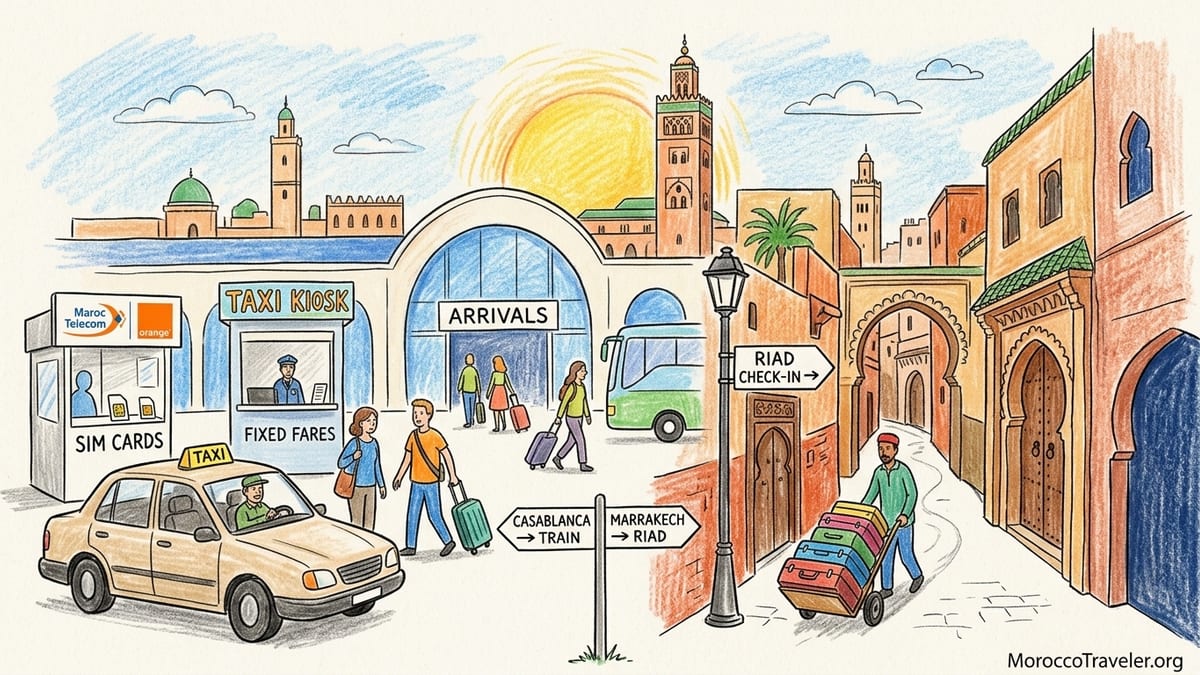
Whether you land in Marrakech, Casablanca, Fez or Agadir, the sequence is similar. You disembark, follow signs for Arrivals and Passport Control, queue at immigration, collect your bags and then pass customs into the public arrivals hall. Immigration officers will ask for your passport, your first night’s address and sometimes a contact number. They enter these into the national police system and stamp your passport with up to 90 days’ stay. Keep a photo of your hotel name and address ready on your phone to speed this up, especially if it is a riad in the medina with a long Arabic name.
After passport control you collect baggage, where luggage carts are generally free. Customs is usually a simple walk through the green channel unless you are bringing large amounts of equipment or commercial goods. Once you step into the arrivals hall, you will find ATMs, bank exchange counters, official taxi stands, car rental desks and, in the larger airports, kiosks for Maroc Telecom, Orange Maroc and inwi selling local SIM cards. This is the best moment to get cash and a local number before facing taxi negotiations outside.
Moroccan airports often feel crowded because family and friends are allowed into the public arrivals area. You may be approached by unofficial drivers or people offering to “help” with luggage or SIM cards. In all four airports covered in this guide, you are safer using official services clearly marked by airport signage, uniforms and fixed counters. Keep walking until you see an official bank, mobile operator or taxi kiosk rather than responding to the first offer you hear.
Late at night, airports can feel very different. Lights are dimmer, some exchange counters and cafés may close, and prebooked drivers or official taxis might be the only realistic options. If your flight lands after about 22:00, especially if you are heading to an old medina or travelling solo, a prearranged transfer from your hotel or a reputable company is often worth the premium for safety and simplicity.
Money, SIM Cards and eSIMs on Arrival
Morocco’s official currency is the dirham (MAD), a restricted currency that you obtain after arrival. In the arrivals halls at Marrakech, Casablanca, Fez and Agadir you will find ATMs from major Moroccan banks. Using an ATM usually gives a better rate than exchanging cash at the first counter you see, though your home bank may charge fees. Many travelers withdraw an initial 1000 to 1500 MAD to cover the first taxi, small purchases and tips, then use ATMs again in town as needed. Keep smaller notes when possible, since taxis and porters rarely have change for 200 MAD notes.
All four airports have at least basic mobile coverage desks for Maroc Telecom, Orange Maroc and inwi, although opening hours can vary, particularly late at night or in the low season. Physical prepaid SIM packages change often, but as of late 2026 a typical tourist bundle from these operators offers about 10 to 20 GB of data valid for 7 to 30 days, often with some local call credit included. Activation is done on the spot. Staff will ask to photograph your passport, register the SIM in your name and insert or scan the card in your phone to check that mobile data is working before you leave the counter.
Coverage and performance differ slightly among the three major networks. Maroc Telecom has the broadest coverage, which matters if you plan to visit rural areas or drive through the Atlas Mountains. Orange Maroc and inwi generally provide good 4G in cities like Marrakech, Casablanca, Fez and Agadir, but may have weaker signal in remote valleys and desert fringes. For most city-focused trips, any of the three will be fine. If you plan long train or bus journeys or self-drive adventures, many locals still favor Maroc Telecom for its reach outside cities.
Travel eSIMs have become popular with visitors who prefer to land connected. Several international providers now offer Morocco-inclusive or North Africa regional data eSIMs, which you can install before you depart. These typically provide data only, without a Moroccan phone number, and can cost more per gigabyte than a local SIM bought at the airport or in town. A practical combination is to arrive with a travel eSIM already active for immediate messaging and maps, then buy a local physical SIM once you clear arrivals for cheap local calls and better rural coverage. Dual-SIM phones make it easy to keep both active, with the eSIM as backup and the local SIM as your main data line.
Marrakech Menara Airport: Buses, Taxis and Riads in the Medina
Marrakech Menara Airport sits about 6 kilometres from the historic medina, a drive of roughly 15 to 25 minutes depending on traffic. Inside the arrivals hall, after customs, you will see ATMs, bank exchange counters and often stands from Maroc Telecom, Orange and inwi. Once you step outside, ignore anyone shouting “taxi” near the door and instead look for the clearly signed official taxi kiosk or counter, which the airport introduced to bring some order to fares. Recent local guidance suggests daytime prices from the airport to the medina are around 70 to 100 MAD when booked at the official desk, with night fares about 50 percent higher.
The airport bus is a useful alternative if your accommodation is near one of its stops. The dedicated shuttle, which many travelers still call the “Number 19” bus, runs between the airport and central Marrakech, including stops near Jemaa el-Fna and the train station. Recent reports place the one-way fare at about 30 MAD per person, with services roughly every 20 to 30 minutes during the day. The bus is slower than a taxi, but it is predictable and avoids haggling. You pay the driver on board in cash and should keep your luggage close, as storage space is limited when the bus is busy.
Ordinary city taxis also serve the airport. These are usually beige petit taxis, which by law are supposed to use a meter, although airport trips often operate on fixed or semi-fixed pricing. Official fare boards posted near the rank list reference prices, but drivers might still ask for more, particularly late at night or if they sense confusion. To avoid drama, it is worth walking to the official taxi counter inside the terminal if it is open, where you can pay in advance by card and receive a ticket with your destination printed. If you do take a taxi directly from the rank, agree on the total price in dirhams before loading your bags.
Many visitors to Marrakech stay in riads located deep inside the pedestrian medina. Cars and taxis cannot enter most of these alleys. Your driver will instead drop you at the nearest accessible gate or square, such as Bab Doukkala, Bab Taghzout or Place Jemaa el-Fna. Before you travel, ask your riad to send precise walking directions from a named gate and, where possible, to arrange a porter who can meet you with a handcart. A typical tip for a porter helping with suitcases through narrow lanes is around 20 to 40 MAD depending on distance and weight. For late-night arrivals, it is worth paying your riad to organize a full door-to-door transfer so you are not left wandering dark alleys with luggage.
Casablanca Mohammed V Airport: Trains, Taxis and onward Connections
Casablanca Mohammed V International Airport is Morocco’s main intercontinental hub and the country’s only airport with an integrated railway station. After immigration and customs, you follow the signs to the underground train station located beneath Terminal 1. The station connects directly to Casa Voyageurs and Casa Port, Casablanca’s central rail hubs, and to intermediate suburban stops like Bouskoura, Facultés and L’Oasis. According to official railway information updated in 2026, trains between the airport and Casa Port generally run once an hour, typically around the 50th minute, from early morning until roughly 22:50, with a journey time of about 45 minutes to Casa Voyageurs and a little under an hour to Casa Port.
Fares for this airport train remain one of the best values in Moroccan transport. Recent published tariffs put second class at around 50 MAD and first class at about 70 MAD for the airport to Casa Voyageurs or Casa Port. Tickets are sold at staffed counters and machines inside the station. Trains have luggage racks, air conditioning and separate first and second class carriages. If you are continuing on to other cities like Rabat, Tangier, Fez or Marrakech, it often makes sense to ride the airport train to Casa Voyageurs, then transfer to a mainline or high-speed Al Boraq train. Allow at least 30 to 45 minutes buffer between the scheduled arrival of your airport train and your onward departure, as immigration and baggage can sometimes be slow.
Taxis are available outside every terminal, with a clearly marked official rank. White grand taxis serve destinations across Greater Casablanca and beyond. A taxi to central Casablanca usually costs in the region of 200 to 300 MAD by day, depending on the exact neighborhood, and more at night. Drivers almost never use the meter for airport trips, so negotiate a firm price before setting off and clarify whether the quoted fare includes the entire vehicle and luggage. For long-distance trips direct from the airport, such as to Rabat or El Jadida, ask your hotel or a local contact for a realistic rate in advance so you can push back against inflated starting offers.
Casablanca’s airport is large and can feel bureaucratic, especially with multiple security checks and passport controls. Fortunately, the presence of the train station makes the onward journey straightforward for most travelers. Inside the terminal you will find branches of Maroc Telecom, Orange and inwi, along with major car rental agencies clustered in the arrivals area or directly connected to the parking structure. Rental cars are a practical option if you plan a self-drive circuit of the Atlantic coast or interior, but for a first evening in Morocco, the combination of train plus short city taxi is usually simpler than picking up a hire car when you are jet-lagged.
Fez-Saïss Airport: Straightforward Arrivals and Compact Transfers
Fez-Saïss Airport is smaller and more manageable than Marrakech or Casablanca, which many first-time visitors appreciate. After clearing immigration and customs you step directly into a compact arrivals hall with ATMs, at least one currency exchange desk and often a small counter or kiosk for local SIMs. Because this is a regional airport with fluctuating traffic, dedicated mobile operator desks are not always open late at night, but you should have no problem finding data once you reach the city if airport options are limited.
Official taxis operate from a designated rank outside the terminal under the supervision of the airport authority. Information published by Morocco’s airport operator and supplemented by recent traveler reports suggests that taxis charge a fixed or semi-fixed fare from the airport into Fez, commonly around 100 to 130 MAD to reach the medina or the central train station. Rides take about 25 to 35 minutes depending on traffic. Drivers often try to gather several passengers going in roughly the same direction, but you can insist on a private ride if you prefer, at the posted individual rate for the car. As elsewhere, agree on the total price in advance and have small bills ready.
There is also an inexpensive public bus connection linking the airport with the city. The long-standing Bus 16 route runs between Fez-Saïss Airport and the main train station in town, where you can connect to petit taxis for specific neighborhoods or to trains onward to Meknes, Rabat or Casablanca. The bus stop sits a short walk to the right as you exit the terminal. Schedules and prices vary, but travelers commonly report fares significantly under 10 MAD per person, making this an ultra-budget option for solo backpackers arriving during daylight hours. Buses can be crowded and offer limited luggage space, so they are less comfortable for families or if you arrive late in the evening.
Most visitors to Fez stay in riads inside the car-free medina, particularly in districts like Talaa Kebira and Batha. Taxi drivers will bring you to one of the main gates such as Bab Bou Jeloud or Bab Rcif and then indicate that they cannot drive inside. Before you arrive, ask your riad which gate is best, what the taxi fare from the airport should be, and whether they can send someone to meet you. Many riads arrange a porter with a handcart who waits at the gate with a sign. This service is especially valuable in Fez, where the medina’s slopes and stairs make dragging wheeled suitcases difficult, especially at night.
Agadir Al Massira Airport: Beach Transfers, Buses and Taxis
Agadir Al Massira Airport serves Morocco’s main Atlantic beach resort area. It lies roughly 25 to 30 kilometres from Agadir city, with a transfer time of 30 to 45 minutes by road. In the arrivals hall you will find a few ATMs, money exchange counters and basic car hire desks. Compared to Marrakech or Casablanca there are usually fewer mobile operator kiosks, so if airport SIM desks are closed when you land, you can easily buy Maroc Telecom, Orange or inwi SIMs later in Agadir’s city centre.
For a long time taxis were the only realistic transfer option, but Agadir now has an official airport bus connection operated by Agadir Mobilite. Known as the AeroBus or line AE, this shuttle links the airport with central Agadir via the coastal hotel zone and towns such as Inezgane and Ait Melloul. Official documentation from Agadir Mobilite states that the AeroBus runs roughly once an hour, covers about 27 kilometres and charges 50 MAD for a one-way ticket or 80 MAD for a return ticket valid for 15 days. The bus stops at a series of signed points in town, including a central stop near the Vallée des Oiseaux area, which is convenient for many hotels.
Taxis remain popular, particularly for travelers with surfboards or large luggage heading to resorts like Taghazout, Tamraght or Imi Ouaddar. Official airport taxis are typically beige or off-white and wait in a line outside the terminal. Published information and recent anecdotal reports suggest a typical fare of roughly 200 to 300 MAD for a private taxi from the airport to central Agadir, more if you continue further up the coast. Always confirm the exact destination and total price before the driver loads your bags, and clarify whether the fare is per car or per person, since some drivers try to operate shared pricing schemes even when there is just your group in the vehicle.
Car rental is attractive in Agadir if you plan to explore multiple surf beaches and coastal villages over a few days. Several international brands and local agencies operate desks at the airport. Inspect vehicles carefully for scratches and have any existing damage noted on the contract. Many companies require a credit card deposit and may place a hold of several thousand dirhams. If you arrive late in the evening, consider whether you really want your first Moroccan driving experience to be in the dark on unfamiliar roads. For a first night, a prebooked transfer direct to your hotel, followed by a relaxed car rental the next morning in town, is often more enjoyable.
Communicating With Riads and Handling Check-In
Riad stays are one of the highlights of Morocco, but they also complicate arrival logistics. Most riads in Marrakech and Fez lie inside narrow, pedestrian-only lanes where cars cannot enter. When you book, send your flight number and arrival time to the riad and ask two specific questions: which city gate or meeting point a taxi should use, and whether they can arrange a transfer that includes a porter right to the door. Many riads send instructions such as “Ask the driver for Bab Doukkala, then call us so we can meet you at the pharmacy on the corner.” Save these directions to your phone in case your data connection is slow when you land.
Language can be another barrier. In large cities, many hotel and riad staff speak English and French, but taxi drivers may speak only Moroccan Arabic with a little French. Having your riad’s name written clearly, along with its phone number, helps enormously. If your driver seems unsure, ask them to call the riad, pass them your phone or request that they drop you at the named gate so the riad can guide you the rest of the way on foot. During busy nights in the medinas, crowds and motorbikes can make walking with suitcases disorienting, so do not be shy about asking locals or shopkeepers to point you to a specific alley; a small tip of 10 to 20 MAD is appreciated if someone walks you a long distance.
When you check into a hotel or riad, Moroccan law requires staff to register you with the local authorities. They will take your passport, often photocopy the ID page and your entry stamp, and in larger hotels you may be asked to fill out a registration form with your address back home and contact details. Most properties return passports promptly, but if they need to keep them for a short period for police reporting, ask when you can collect them and set a reminder. Some riads request a damage deposit or a hold on your card, particularly if you booked via online platforms that allow pay-on-arrival. Make sure you understand whether this is a pre-authorization or a real charge and ask for a receipt.
Payment practices vary. Many riads prefer cash for final settlement, even if they took your card details to guarantee the booking. In major cities, mid-range and upscale hotels increasingly accept international cards without surcharge. If you are paying in cash, confirm the total in advance, including any city tax, which is usually quoted per person per night and added on top of the room price. Keep smaller bills available for tips to porters and housekeeping during your stay, as changing large notes inside the medina can be difficult.
First-Arrival Checklist and Comparison of the Four Airports
A simple mental checklist makes your first hours in Morocco smoother. After you land, focus first on immigration and baggage. Once you are in the arrivals hall, get cash from a reputable ATM or bank counter, then decide whether to purchase a local SIM immediately or rely on roaming or an eSIM until you reach town. Take a moment to check the official information boards showing taxi tariffs or bus details before stepping outside. If you have a prebooked transfer, locate your driver, who should usually be waiting with a sign showing your name in the public arrivals area. If no one is there, wait near the designated meeting point and connect to airport Wi-Fi or your mobile data to contact the company.
Each airport has its own best-value transfer option. In Casablanca, the airport train is usually the smartest choice for anyone heading into the city or onward by rail. In Marrakech, the shuttle bus can be great for budget travelers whose hotels are near its stops, while the official taxi counter simplifies things for those happy to pay a bit more. In Fez, the compact size of the airport and the reasonably priced taxis make arrival simple, though adventurous travelers might opt for the city bus to save money. In Agadir, the AeroBus offers a predictable schedule and clear pricing, while taxis work well for those heading directly to resorts up and down the coast.
For a quick comparison, consider four basic questions for each airport: where the main public transport leaves from, how much it costs to reach the city center, how long it takes and what to watch out for. In Casablanca, the train leaves from the underground station beneath Terminal 1, costs around 50 to 70 MAD and takes about an hour to Casa Port. In Marrakech, the shuttle bus stops outside the terminal and charges around 30 MAD to reach central points in about 25 to 30 minutes, while taxis from the official counter cost in the 70 to 100 MAD range to the medina. In Fez, buses are cheaper but slower and less frequent, while taxis cost roughly 100 to 130 MAD and take about half an hour. In Agadir, the AeroBus charges 50 MAD one way with a travel time around 45 minutes, compared to a taxi at roughly 200 to 300 MAD for a quicker, direct ride.
Transport arrangements also vary by time of day. The Casablanca airport train operates on an hourly pattern from early morning until late evening, but not overnight, so passengers on red-eye flights may need to rely on taxis or private transfers. Airport buses in Marrakech, Fez and Agadir tend to follow daytime and evening schedules, sometimes stopping before midnight. Taxis are available 24 hours at all four airports, but drivers may ask for significantly higher fares after about 21:00 or 22:00. If your flight is scheduled to land in the small hours, prearranging a transfer through your hotel is usually the most reliable plan.
When to Choose a More Expensive Prearranged Transfer
There are situations where paying extra for a prearranged hotel or private transfer is genuinely worthwhile. Solo travelers arriving late at night in Marrakech or Fez, particularly those staying deep in the medina, often find that a driver holding their name at the exit doors is worth far more than the price difference over a standard taxi. The arranged driver knows the riad, understands exactly which gate to use, calls the property on arrival and waits while a porter or staff member comes to lead you through the alleys. This can turn a potentially stressful midnight arrival into a smooth, almost choreographed experience.
Families with children, older travelers and anyone carrying bulky or expensive equipment also benefit from private transfers. In Casablanca, for example, if you land with surfboards, musical instruments or professional camera gear, going straight from Terminal 2 to a prebooked van may feel safer and simpler than wrestling with train connections. The vehicle will be sized for your luggage, and you avoid tight transfers, crowded platforms and the risk of leaving a bag behind. While the cost might be 300 to 600 MAD depending on distance and group size, shared among several people it can still be reasonable.
In Agadir, surfers heading straight to villages north of the city often arrange direct transfers from the airport with their surf camp or guesthouse. These rides might cost more than a taxi to Agadir plus a second taxi onward, but they eliminate haggling and provide door-to-door service. The same reasoning applies in Fez if your riad sits deep in a hilly part of the medina; paying for a door-to-door transfer that includes a porter avoids confusion and heavy lifting after a long flight.
Whatever method you choose, always confirm the total price by message or email before you travel and keep a screenshot handy. Ask explicitly whether the quote is per car or per person, whether it includes airport parking fees and what happens if your flight is delayed by immigration queues. Reputable companies will monitor flight times and adjust pickup without extra charges for moderate delays. Taking a few minutes to clarify these details before you fly removes the most common sources of frustration in those crucial first hours in Morocco.
FAQ
Q1. How long does it usually take to get through immigration in Morocco?
At the major airports it can be as quick as 15 to 20 minutes during quiet periods, but at busy times or when several flights arrive together it can stretch to an hour or more, so allow extra time if you need to catch a train or onward connection.
Q2. Is it better to get cash from an ATM or a currency exchange counter at the airport?
ATMs from major Moroccan banks generally offer competitive rates, but your home bank may charge fees; many travelers withdraw an initial 1000 to 1500 MAD at the airport ATM and use exchange counters only if machines are out of service or their card is not accepted.
Q3. Can I rely on a travel eSIM in Morocco or should I buy a local SIM card?
A travel eSIM is convenient for immediate connectivity and short city stays, but a local physical SIM from Maroc Telecom, Orange Maroc or inwi usually provides more data for the price and better rural coverage, so many visitors use both if their phone supports dual SIM.
Q4. How much should I expect to pay for a taxi from Marrakech Menara Airport to the medina?
Based on recent official guidance and local sources, a daytime ride booked through the airport’s official taxi counter typically costs around 70 to 100 MAD to the medina, with night fares roughly 50 percent higher; always confirm the price before departure.
Q5. How does the train from Casablanca Mohammed V Airport to the city work?
The airport has a station beneath Terminal 1 with hourly trains to Casa Voyageurs and Casa Port from early morning to late evening, with second class tickets around 50 MAD and first class around 70 MAD, and a travel time of roughly 45 to 60 minutes depending on the station.
Q6. What is the cheapest way to get from Fez-Saïss Airport to the city?
The public bus that links the airport with Fez’s main train station is usually the cheapest option, with fares reported well under 10 MAD, but it is slower and less frequent than taxis, which cost around 100 to 130 MAD for a 25 to 35 minute ride to the medina.
Q7. Does Agadir Al Massira Airport have a regular bus into town?
Yes, the AeroBus service operated by Agadir Mobilite runs roughly every hour between the airport and central Agadir, charging about 50 MAD for a one-way ticket or 80 MAD for a return ticket valid for 15 days, with a journey time of around 45 minutes depending on traffic.
Q8. How should I handle arriving at a riad inside a pedestrian medina where taxis cannot enter?
Ask the riad in advance which gate or square the taxi should use and whether they can send a porter or staff member to meet you; the driver will drop you at the agreed gate, you call the riad or meet the porter there, and tip 20 to 40 MAD for luggage assistance depending on distance.
Q9. What passport and personal details do Moroccan hotels and riads usually ask for at check-in?
Accommodation must register guests with the authorities, so they typically take your passport to copy the ID page and entry stamp, and may ask for your home address, email and phone number, plus a signature on a registration form, returning the passport once the process is complete.
Q10. When is a prearranged hotel transfer really worth paying for?
Prearranged transfers are especially worthwhile for late-night arrivals, solo travelers, families with children, guests staying deep in the medinas of Marrakech or Fez, or anyone carrying bulky or valuable luggage, because they provide a driver who knows your accommodation, clear pricing agreed in advance and often a porter to guide you the final steps.