


I thought visiting Morocco during Ramadan would simply mean slightly quieter streets during the day and a few special dinners at night. Instead, traveling from Casablanca to Marrakech, Rabat and Fes while most of the country was fasting reshaped almost every part of my trip. It did not ruin the experience, but it demanded more flexibility, more planning and a different rhythm than I had imagined when I booked my flights.
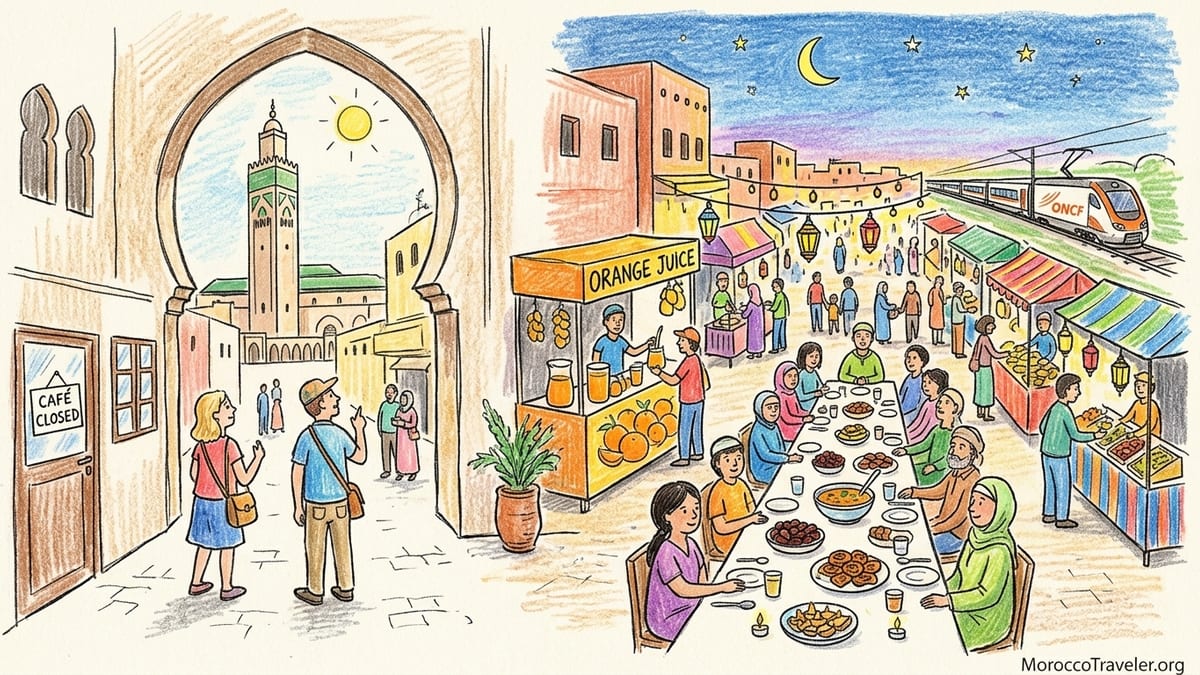
Setting the Scene: Expectations vs Reality in a Ramadan Year
My trip ran across most of Ramadan in 2026, which in Morocco began on the evening of 18 February and continued until around 19 March, according to the official moon‑sighting announcement. That meant roughly thirty days when Muslims abstained from food and drink between dawn and sunset, while daily life, working hours and transportation adapted to that schedule. I knew the basics of Ramadan from home, but I had never tried to cross a country while almost everyone around me was fasting.
Before arriving in Casablanca, I pictured myself slipping into the rhythm easily. I imagined long, lazy café mornings, normal sightseeing in the heat of the day and then joining locals for festive iftar dinners after dark. I read reassuring comments saying that “tourist areas stay open” and assumed that as long as I was near a medina or a popular square, I would always find a snack or a coffee.
The reality was more nuanced. Tourist‑oriented businesses did make an effort to stay open, especially in places like Marrakech’s medina or around the Corniche in Casablanca, but the energy and availability of services changed dramatically between sunrise and sunset. Some museums shortened hours during Ramadan, such as the Marrakech Museum, which specifically warns that hours are reduced during the holy month, and several smaller sites simply closed earlier than posted or shut for extended lunch breaks. Restaurants and cafes shifted their focus toward preparing for iftar rather than serving daytime diners. None of this made the country shut down, but it did mean my usual spontaneous style of travel became a daily logistical puzzle.
I also underestimated how the social and emotional atmosphere would affect me. Traveling as a non‑Muslim in a Muslim‑majority country during Ramadan meant constantly being aware of people around me who were tired, hungry and sometimes short on patience by late afternoon. It was not hostile, but it was a more intense, inward‑focused Morocco than the one I had seen on previous trips in other months.
The Daily Rhythm: When Sightseeing Works and When It Does Not
The most important lesson I learned was that Ramadan flips the practical day for travelers. Sightseeing before 10:00 in the morning often worked well. Fajr and suhoor finished before sunrise, so by 9:00 staff were back on duty, if a bit bleary‑eyed, and monuments were relatively quiet. In Rabat, I visited the Hassan Tower and the Mausoleum of Mohammed V at around 9:30 and had the site almost to myself. Security guards were relaxed, the light was soft and there was none of the midday heat that makes those open courtyards oppressive later.
Between roughly 13:00 and late afternoon, though, things sagged. In Marrakech, I walked to the Marrakech Museum just after lunch one day and found the ticket staff clearly ready to close earlier than the usual late afternoon schedule. The museum’s own information notes that Ramadan hours are shorter and advises visitors to come early in the day. That pattern repeated in Fes at several madrasas: the posted closing times were often optimistic compared with what actually happened once fasting fatigue set in.
Evenings after iftar could swing either way. In Casablanca and Rabat, major boulevards stayed busy late into the night with families strolling, kids playing and snack carts doing brisk business. In the medina of Marrakech, the area around Jemaa el Fna went from hushed in late afternoon to roaringly alive about an hour after sunset, with street performers, orange juice sellers and grills firing up. If I timed it right, I could explore souks and squares in a magical twilight atmosphere. If I misjudged it, I either arrived while everyone was breaking the fast and shops were shuttered, or I stayed out so late that public transport and petit taxis became patchier.
The upshot is that sightseeing was not impossible during Ramadan, but it demanded a clear plan. I learned to front‑load my days with key museums and historic sites in the early morning, accept a slower middle of the day and then pick one evening activity instead of trying to do everything at once.
Food, Cafés and the Awkwardness of Eating When Others Are Fasting
Daytime dining was where my expectations collided hardest with reality. In theory, non‑Muslims in Morocco are not required by law to fast, and it is not illegal for tourists to eat during the day. In practice, eating or drinking conspicuously in public while everyone around you is fasting is considered discourteous in most settings. In larger cities I did find a handful of cafés and international hotel restaurants quietly open, but even there the staff often kept blinds partially drawn or tucked foreign diners into back corners.
In Casablanca, the area around the business district had several Western‑style cafés that continued serving food at lunchtime to office workers who were not fasting and to foreigners. Prices were typical for a big city, roughly 40 to 55 Moroccan dirhams for a coffee and pastry or closer to 90 to 120 dirhams for a simple lunch plate. Inside, the atmosphere was muted, with people talking softly and staff discreetly avoiding any display of food near the windows. When I stepped outside with a takeaway sandwich, I folded it into my bag and waited to eat until I was back in my hotel room.
In the medina of Marrakech, it was a different story. Many local eateries that I remembered as bustling at lunchtime during earlier trips were closed during the day in Ramadan or only offered takeaway bread. A couple of rooftop restaurants that catered almost entirely to tourists stayed open, but the menus were limited and staff were clearly saving their energy for the massive iftar rush. I once turned up at 16:00 hoping for a late lunch and was gently but firmly told the kitchen would only reopen for the evening meal.
Those evening meals, however, were memorable. Many restaurants offered fixed iftar menus with the classic spread: dates, harira soup, chebakia pastries, boiled eggs and then a main dish like tajine or grilled meat, often with tea and juice included. At one mid‑range riad in Marrakech, the iftar menu during Ramadan 2026 was priced around 220 to 260 dirhams per person, while a more upscale hotel restaurant on the edge of the medina charged closer to 400 to 450 dirhams for a more elaborate buffet. At a luxury property outside the city, a family‑style tray that served six to eight people was advertised at about 650 dirhams, comparable to press information released by high‑end hotels for their Ramadan offerings. These were not budget meals, but they felt like an event, with Moroccan families and travelers breaking the fast side by side.
Transport and Long‑Distance Transfers on a Ramadan Schedule
Transportation was the second major area where Ramadan reshaped my plans. Morocco’s national rail operator, ONCF, regularly announces a special Ramadan timetable that shifts some departures to align with shorter working days and iftar. In recent years that has included adjustments to Al Boraq high‑speed trains, extra late‑evening services after sunset and altered peak‑hour patterns on regional lines. Announcements for Ramadan 1446 and 1447 highlighted trains leaving just before dawn, a denser service in the early afternoon and extra departures around 22:00 after iftar.
In practice, that meant that some of the midday departures I would usually choose between Casablanca, Rabat and Fes were either moved slightly earlier or later. I once misread the Ramadan schedule and arrived at Casa Voyageurs station assuming there was a midafternoon Al Atlas train to Fes, only to discover that particular slot had been pulled forward so staff could get home before iftar. The station information desk pointed me to a later train that would arrive in Fes close to midnight instead.
Even when trains ran, the atmosphere around them shifted. The last services before sunset were packed with commuters racing home, and tempers occasionally flared when trains were crowded or slightly delayed. During one early evening journey from Rabat Agdal to Marrakech, the carriage felt drowsy and silent until about half an hour before Maghrib. Then, as the sun dipped, someone produced a box of dates, another shared a bottle of water and suddenly the entire compartment joined in an impromptu mini‑iftar as the call to prayer chimed faintly from mobile phones. It was one of the most moving travel moments I have experienced, and it happened purely because I was on a train in Ramadan.
On routes not served directly by train, such as onward connections with Supratours buses to Essaouira or Agadir, the effect was similar. There were usually services, but I had to be careful about departure times that overlapped with sunset or very late at night. I made a conscious choice to avoid long intercity journeys on the first and last days of Ramadan, when services can be particularly crowded, and I built in more buffer time for transfers in case schedules were altered with relatively short notice, something ONCF explicitly reserves the right to do in its general conditions.
Shopping, Souks and the Split Personality of Moroccan Cities
Shopping during Ramadan divided the day into two distinct worlds. In the mornings, souks in Marrakech and Fes opened, but business felt slower. Shopkeepers chatted quietly, drank water discreetly inside their stalls if they were exempt from fasting and were generally more relaxed about sales. I found that early‑day browsing was actually pleasant. Negotiations over carpets and ceramics were still earnest, but the hard‑sell edge was dulled by the general fatigue.
By early afternoon, many smaller, local‑oriented shops pulled down their shutters. In Fes el Bali, I walked through entire lanes of hardware and clothing stalls that were almost entirely closed between about 14:00 and 17:00. A few places stayed open, especially those that sold essentials for iftar such as dates, bread and sweets. Touristy areas near major monuments remained more active, since guides still needed somewhere to bring their small groups, but the overall sensation was of a city conserving its energy.
After dark the transformation was striking. In Rabat’s medina, side streets that had been quiet an hour earlier burst into life with stalls selling fresh juice, grilled sardines, fried fish sandwiches and mountains of chebakia. Families arrived en masse in their best clothes, and traders seemed to get a second wind. Price bargaining sometimes became sharper, but it felt more playful. Evening shopping in Ramadan was less about ticking off a list and more about soaking up the atmosphere while I slowly picked out a few items I genuinely wanted.
It is important to note that not everything closes during Ramadan. Supermarkets in modern malls, international fashion chains and pharmacies usually adhere to posted hours, perhaps with minor adjustments. In Casablanca’s large shopping centers, I could buy groceries or toiletries throughout the day and into the evening. The contrast between those climate‑controlled, globally familiar spaces and the drowsy, fasting medina outside was a constant reminder that Morocco in Ramadan is not a single, uniform experience, but a mosaic of overlapping rhythms.
Cultural Expectations: Courtesy, Law and How to Behave
One of my early worries was whether I might accidentally break a law by drinking water or eating in public. In Morocco, the key distinction is between cultural etiquette and actual legal rules. There have been public debates about a law that can penalize Muslims who break the fast in public without valid reason, but visiting non‑Muslims are not required by law to fast. Hotels, some cafés and international restaurants continue to serve food and drink during the day, and no one checked my religion at the door.
That said, courtesy matters. In more conservative neighborhoods and smaller towns, locals strongly prefer that people do not eat, drink or smoke in public during daylight in Ramadan. Out of respect, I kept a bottle of water in my bag and took discreet sips in quiet corners rather than walking down the street swigging. When I needed lunch, I chose indoor settings, sat away from windows and avoided ordering alcohol entirely until after Ramadan ended. Alcohol sales in Morocco are already regulated, and during Ramadan many outlets that normally serve it either suspend service or restrict it to discreet hotel bars.
Dress expectations are subtly stricter during Ramadan, particularly in the evenings when families go out together. There is no legal requirement for foreigners to dress a certain way, but shoulders and knees covered felt like the minimum respectful standard. On one warm evening in Marrakech, I noticed locals staring disapprovingly at tourists in very short shorts in Jemaa el Fna, not because anyone wanted a confrontation but because the gap between local and visitor norms was so glaring on a sacred month’s night.
Guides and hosts were surprisingly patient in explaining these nuances. In Rabat, a museum attendant gently asked a fellow visitor to finish a snack in the courtyard off to the side rather than inside the exhibition rooms during fasting hours, framing it as a simple request for respect rather than a rule. That summed up the tone: there are lines you should not cross, but as a foreign guest you are more likely to be guided than punished if you show good faith and adapt.
The Emotional Side: Frustrations and Unexpected Joys
Traveling during Ramadan was not always comfortable. There were days when I felt frustrated at how hard it was to find an open café at midday, or how early I had to finish museum visits before staff quietly began closing gates ahead of the posted schedule. On one particularly hot afternoon in Fes, I found myself light‑headed from dehydration because I had underestimated how many shops and stalls would be shuttered and I had not refilled my water bottle in time. I ended up knocking on the door of a small guesthouse where I was not staying and asking if I could buy water. The owner refused my money and pressed a cold bottle into my hand with a smile, but I left feeling ashamed that my poor planning had put me in that position.
I also struggled with the late nights. Many of the most atmospheric experiences in Ramadan happen after iftar and even after the later night prayer, when families linger in squares until midnight or beyond. I am an early riser when I travel, so trying to enjoy the vibrant late‑night street life and still be alert for a 9:00 museum opening was difficult. More than once I had to choose between staying out for another cup of mint tea under lantern‑lit trees or preserving enough energy for the next morning’s train.
Yet some of my best memories of Morocco come specifically from this Ramadan trip. Sharing that impromptu mini‑iftar on a crowded train, watching a baker in Fes pull trays of chebakia from the oven while neighbors queued with handwritten lists, or sitting on a rooftop in Marrakech as the entire city seemed to hold its breath just before sunset were experiences tied directly to the holy month. One evening in Casablanca, a family at a neighboring table noticed I was alone and insisted I join them for iftar, passing me plates of soup, dates and homemade pastries without a hint of self‑congratulation. Hospitality in Morocco is generous at the best of times, but during Ramadan it felt amplified.
If I had traveled only in a neutral month, I would have had an easier, more predictable trip, but I would also have missed that glimpse into how deeply Ramadan shapes social life, generosity and community in Morocco.
Who Should Visit in Ramadan and How I Would Plan It Next Time
After a full month on the road, I came away convinced that visiting Morocco during Ramadan is not for everyone. If this is your first time in the country and you want maximum flexibility for café culture, daytime food and late‑afternoon sightseeing, you will probably prefer coming in another period. Families with young children who need regular meals and snacks may find the restricted daytime dining especially stressful. Travelers on very tight, fixed itineraries with many long transfers might also find the adjusted train and bus schedules too constraining.
On the other hand, if you are more interested in cultural immersion than checking off a list of attractions, Ramadan can be a rich time to visit. You need patience, but you gain access to powerful scenes of social and religious life that you will not see as vividly outside the holy month. Evening walks through medinas, invitations to iftar, and witnessing how an entire city quiets at sunset then springs back to life can be worth the inconvenience for some travelers.
If I were to plan another Ramadan trip in Morocco, I would organize it differently. I would pick a smaller number of bases, perhaps Casablanca, Rabat and one inland city such as Fes or Marrakech, instead of trying to cover as many places as possible. That would reduce the number of long transfer days when schedules and crowds are both more unpredictable. I would build in more rest, accepting that afternoons are a time for reading in the riad courtyard or sitting in a shaded park rather than racing from sight to sight.
I would also budget more intentionally for evening meals, knowing that iftar menus at mid‑range places can run from around 200 to 400 dirhams per person, and I would book the most important ones in advance, especially on weekends when local families also like to go out. Finally, I would download up‑to‑date Ramadan timetables for trains as soon as they are released, check museum and monument hours by phone a day or two before visiting, and keep snacks discreetly packed in my bag for long days when dining options shrink unexpectedly.
The Takeaway
My month in Morocco during Ramadan was both more challenging and more rewarding than I had anticipated. The altered daily rhythm affected almost everything, from when museums opened to how trains were scheduled and where I could find a sandwich at midday. It required a degree of planning and cultural sensitivity that I had not fully factored into my original itinerary.
At the same time, traveling in Ramadan gave me access to a Morocco of candlelit courtyards at iftar, sleepy midafternoons, and late‑night streets humming with families in their finest clothes. It showed me not just the country’s monuments and landscapes, but its social heartbeat during one of the most significant periods of the year.
If you value spontaneity, full daytime services and wine with dinner every night, you will probably be happier visiting outside Ramadan. If you are willing to adapt your habits, eat most of your memorable meals after dark and accept some logistical hiccups, a Ramadan trip can offer a perspective on Morocco that is hard to match at any other time.
Knowing what I know now, I would still visit Morocco again during Ramadan, but I would do it more slowly, with more deliberate planning, and with the humility to recognize that for most people around me this is not a tourist season but a sacred time that I am merely passing through as a guest.
FAQ
Q1. Is it illegal for tourists to eat or drink in public during Ramadan in Morocco?
It is not illegal for non‑Muslim tourists to eat or drink during the day, but consuming food, drink or cigarettes openly in the street is considered disrespectful in many areas. It is better to eat indoors, in hotel restaurants or discreet cafés that remain open.
Q2. Are all tourist sites and museums closed during Ramadan?
No, many museums and monuments stay open, but hours are often reduced or shifted. Some places, such as the Marrakech Museum, explicitly shorten their opening times during Ramadan, so it is wise to check a day or two in advance and visit early in the morning.
Q3. Do trains and buses still run normally in Ramadan?
Trains and buses continue operating, but ONCF and bus companies usually adopt special Ramadan timetables with slightly different departure times and extra evening services after iftar. You should always verify schedules close to your travel date and allow more buffer time for connections.
Q4. Will I be able to find food during the day?
You can find food, but options are more limited than outside Ramadan. International hotels, some cafés in business districts and a few tourist‑oriented restaurants remain open for lunch, while many local eateries close until sunset. Carrying snacks and water and planning around known open places makes the days much easier.
Q5. Is nightlife completely dead during Ramadan?
Conventional nightlife such as bars and clubs is very subdued, but street life after iftar is lively. Medinas fill with families, food stalls and late‑night shoppers, and large squares like Jemaa el Fna in Marrakech or the Corniche in Casablanca can feel more animated than at other times of year.
Q6. Should I change how I dress when visiting during Ramadan?
You do not need to follow a dress code by law, but modest clothing is strongly appreciated, especially in the evenings. Covering shoulders and knees, avoiding very tight or revealing outfits and carrying a light scarf for religious sites is a good guideline for both men and women.
Q7. Is it a good idea to travel with children during Ramadan in Morocco?
It is possible, but it can be challenging. Limited daytime dining, later mealtimes and crowded evening streets may be hard for younger children. Families who do come in Ramadan tend to stay in comfortable accommodations, keep itineraries simple and rely more on hotel restaurants for predictable meals.
Q8. How does Ramadan affect prices for hotels and tours?
Hotel prices in larger cities may not change dramatically, but some riads and tour operators adjust their offerings, adding special iftar meals or night tours. Those extras can increase your overall budget, while some daytime tours may be shorter or canceled due to staff fasting.
Q9. Can I book special iftar experiences as a visitor?
Yes. Many riads, restaurants and hotels offer set iftar menus, and some organize special Ramadan evenings with live music or storytelling. It is best to reserve ahead, especially on weekends, and to understand that these meals often have fixed menus at set prices.
Q10. If I prefer to avoid Ramadan, how can I check the dates before booking?
Ramadan shifts earlier each year, so before booking flights you should look up the projected Ramadan dates for your intended travel year and remember that Morocco follows local moon‑sighting announcements. If you want to minimize overlap, plan either several weeks before the expected start or a week or two after the expected end.