

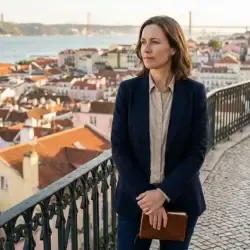
On a warm April evening in 2025, in the maze of Marrakech’s medina near Bab Doukkala, I realised my solo trip to Morocco had crossed an invisible line from “challenging” to “fundamentally not OK.” I had left my riad just before sunset to buy water and a snack. Within five minutes a man fell into step beside me, commenting on my body in French and English. I ignored him, turned down a side alley I knew led to my guesthouse, and picked up the pace. He stayed with me for several minutes, cutting off my attempts to change direction, laughing when I told him “no” in French and Arabic. When I stopped to let him pass, he stopped too, leaned in close enough that I could smell the alcohol on his breath, and said quietly, “No police here.” In that moment, the crowd noise faded and I felt very aware that I was a woman, alone, with no easy exit.
When One Incident Changes an Entire Trip
I got away that night by walking straight into a random hotel reception, telling the receptionist in clipped English that I was being followed, and asking them to call my riad. The man waited outside for a few minutes, pacing in front of the glass doors, before finally disappearing into the alley. The receptionist arranged a staff member to walk me back. It was a short, silent walk, but it changed the rest of my time in Marrakech. I stopped going out after dark alone, cancelled a dinner reservation across town, and began checking every reflection in shop windows to see if anyone was behind me.
This was not my first difficult encounter on that trip, but it was the one that shifted my mindset from “this is part of travel in a conservative country” to “my personal safety feels compromised.” I had already spent time in Rabat and Tangier, and I was planning to move on to Fez and Essaouira. I had travelled solo across North Africa and the Middle East before, and I know how to dress modestly, deflect catcalls and keep my guard up. In Morocco, those precautions were not enough to prevent situations that left me shaken and, at times, genuinely scared.
Morocco is not one-dimensional. Alongside that night outside Bab Doukkala, I have memories of women in Rabat steering me to the correct tram stop, a family in Tangier insisting I sit with them on the ferry, and a teenage girl in Essaouira quietly telling off a group of boys who would not stop staring. But the harassment and pressure I encountered, mostly from men who knew they were unlikely to be challenged, are a serious part of the story. Pretending otherwise does a disservice to women who are trying to make informed choices.
Marrakech: A City That Never Lets You Drop Your Guard
I began and ended my trip in Marrakech. The first time I arrived, I landed at Marrakech Menara Airport and opted for the official taxi counter inside the terminal instead of haggling outside. Fixed fares from the airport into the old city were updated in 2024 and the board behind the counter listed daytime prices around the equivalent of 12 to 15 euros for the medina, depending on the exact area. I paid in dirhams, received a printed ticket, and was assigned a petit taxi. Even with an official slip in hand, my driver tried to add a “luggage fee” on arrival that was not written anywhere. When I refused and pointed to the ticket, he laughed, shrugged and walked off, muttering under his breath.
That combination of structure and opportunism defined my days in Marrakech. In the daytime around Jemaa el Fna, I could walk alone in long trousers, a loose shirt and scarf without feeling physically unsafe, but almost never left alone. Men called out in English, French, Spanish and sometimes Italian. Some were garden-variety tourist touts, but others quickly crossed lines: comments about my body, offers of “Berber boyfriend,” or the persistent, circling presence of men who would reappear street after street. Twice I was grabbed by the wrist by women trying to force henna on my hand, only releasing me when I raised my voice and walked firmly into the street.
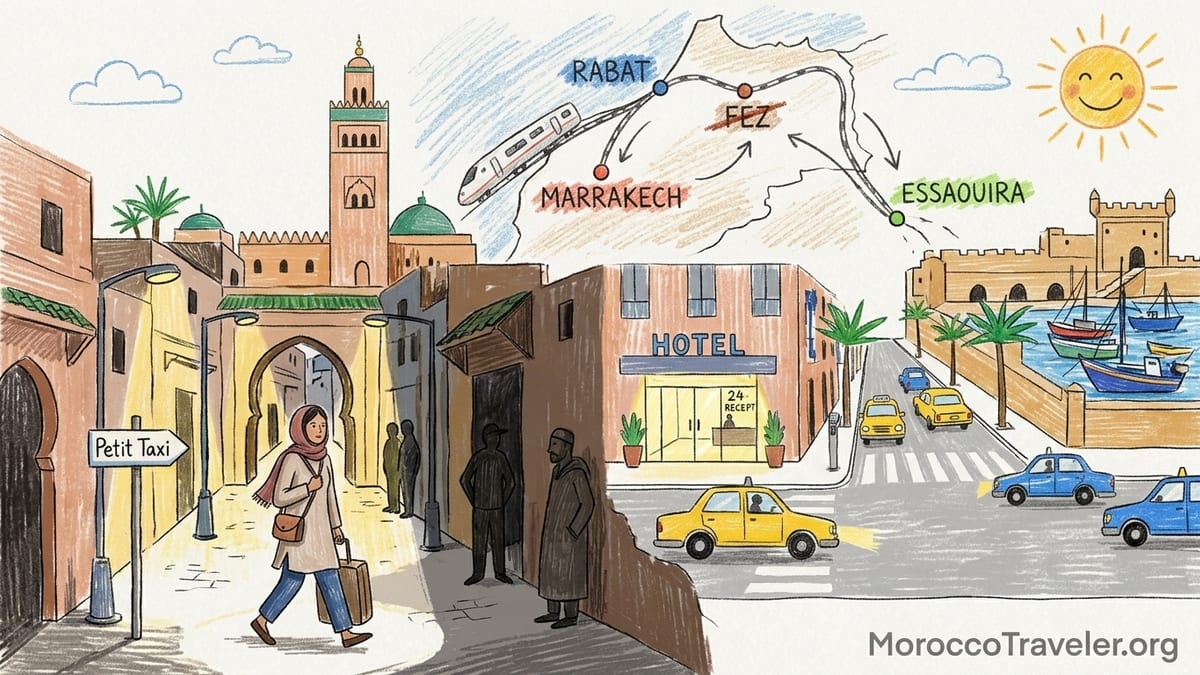
After that Bab Doukkala incident, I moved from a riad deep in the medina to a mid-range hotel in Gueliz, the newer part of the city. It cost me about 30 percent more per night, but the trade-off was clear. I could step out to a café without navigating unlit alleys, flag a petit taxi from a wide boulevard, and walk into a lobby staffed 24 hours a day. Even so, several taxi rides at night involved raised voices over the meter. Despite the legal requirement to use meters in city taxis, more than once a driver insisted the meter was “broken” and quoted an inflated flat fare. I learned to negotiate before getting in, to carry small bills, and to be ready to get out and look for another taxi if I felt cornered.
Fez and Rabat: Two Very Different Realities
When I first planned this trip, Fez was at the top of my must-see list. The medieval medina, the tanneries, the sense of history lodged in every alley had been romanticised in a dozen travel memoirs. By the time I reached Rabat, after a few days in Marrakech, I had already read multiple recent accounts from solo women online warning that Fez had been the most stressful stop, with intense hassle and more aggressive behaviour than elsewhere. That echoed older and newer reports I saw: women describing being followed through the medina, repeatedly having “guides” ignore firm refusals, and feeling trapped in narrow lanes with no easy way to disengage.
Those accounts were not mine, because I ultimately decided to skip Fez on this particular trip. That was not an easy call. I had a non-refundable riad booking and a pre-booked train. But by Rabat I was already exhausted from pushing back against low-level harassment. I knew that Fez’s medina is less immediately legible than Marrakech and that many alleys dead-end. I also knew that some women solved that by hiring licensed local guides through their riads, paying the equivalent of around 25 to 40 euros for a half-day walking tour to keep unsolicited “helpers” at bay. In the end, the stories of being repeatedly boxed in, tugged at, or deliberately misdirected were enough for me to sacrifice my booking fee and re-route to Essaouira instead.
Rabat, by contrast, was where my shoulders finally dropped a little. I stayed in a small hotel steps from the light-rail line, not in the medina itself. I walked to the Kasbah of the Udayas in the late afternoon without attracting more than the occasional curious glance. Groups of teenage boys were present, but they were absorbed in their own lives. The harassment did not vanish, but it shifted from constant noise to intermittent static. When a man tried to strike up an insistent conversation near the Oudayas viewpoint, a nearby elderly woman shook her head at him and waved me over to stand beside her and her granddaughter. That intervention, subtle but firm, was telling. In Rabat I felt that bystanders were slightly more willing to discourage behaviour that made a solo woman uncomfortable.
Tangier and Essaouira: Coastal Contrasts and the Myth of the “Safe Haven”
Before arriving in Morocco, I had been reassured by travellers who described Tangier and Essaouira as “easier” for solo women. To an extent, that matched my experience, but the word “easier” hides nuance. In Tangier, I stayed near the port, within walking distance of the kasbah. The mix of local families, Spanish day-trippers and business travellers created a slightly more cosmopolitan street atmosphere. I still received comments walking alone along Avenue Mohammed VI after dark, but they felt less charged than in Marrakech. One evening a group of young men trailed me for two blocks, speculating in French about whether I was “Scandinavian” and what that might mean, before peeling off when I stepped into a busy café and simply stayed there until they lost interest.
Essaouira, where I ended my trip, did feel like a pressure valve. The compact medina, sea breeze and visible presence of solo backpackers and kite surfers made it easier to relax. There was harassment, but it was sporadic rather than relentless. Boys shouted “hey beautiful” or “spice girl” as I walked to the ramparts, but many vendors accepted “no thank you” and moved on. At the same time, I met a Canadian woman at my guesthouse who had just come from Fez and described being groped in a crowded alley when she tried to push past a group of men blocking the way. A day later, a British woman told me she had loved Marrakech but hated Essaouira because a man followed her from the port to her hotel, only backing off when she firmly told him she was married and gestured to an imaginary husband behind her.
Those conversations matter because they underline a crucial point: there is no truly “safe” city where harassment magically disappears for women. Patterns exist. Many recent solo female trip reports describe Fez and parts of Marrakech as particularly intense and Essaouira and Rabat as more manageable. At the same time, official Canadian and UK travel advisories explicitly note that women travelling alone in Morocco may experience forms of harassment and verbal abuse in public spaces, regardless of destination. Some women leave Morocco with glowing reviews and say they were barely bothered. Others arrive with strong travel experience in places often labelled “difficult” and still come away feeling shaken. My own reality sat somewhere in between, tipped toward the negative by a few specific encounters that I cannot, in good faith, dismiss as cultural misunderstandings.
What the Official Advice Says, and What Women Actually Report
Government travel advisories tend to use measured language, but the through-line is hard to miss. Updated advice from the United Kingdom notes that women, especially those travelling alone, may receive unwanted attention in Morocco and warns that unofficial guides can be persistent around major tourist sites. The United States describes Morocco as a place where travellers should exercise increased caution and points out that women may want to travel with companions when possible and be prepared to ignore street harassment rather than engage. Canadian guidance similarly states that solo women can face harassment and verbal abuse, particularly in busy urban areas. Australian advice has described harassment of women and girls in public places as “common” in Moroccan cities.
Those are sober, diplomatic words. The firsthand accounts fill in the emotional texture behind them. In online forums and recent articles, women describe being followed through the Marrakech medina despite repeated refusals, being cornered by groups of teenage boys in Fez, or having unsolicited “guides” accompany them for entire afternoons and then demand payment. Some report never feeling truly in danger, but deeply uncomfortable all the same. Others recount specific incidents of groping, being kissed against their will, or being subjected to graphic sexual comments in broad daylight. There are also plenty of positive stories: women who spent weeks criss-crossing the country with no more than the occasional catcall, who emphasise the kindness of families, or who say they felt safer in Morocco than in parts of Europe or North America.
It is tempting for tourism boards and some travellers to elevate the positive narratives and dismiss the negative ones as bad luck or poor preparation. I do not accept that framing. My own preparation was extensive. I speak passable French, read up on local norms, and had already navigated cities like Cairo and Amman without serious incident. I dressed conservatively and stayed sober. None of that prevented the man in Marrakech from leaning in and reminding me there were “no police here” as he blocked my path, or the taxi driver in Tangier who locked the doors and tried to double the agreed fare until I raised my voice and threatened to call the hotel. Precautions lower risk; they do not erase the power imbalance a solo woman faces when a man decides that her discomfort is irrelevant.
Accommodation, Arrival Times and the Real Cost of Feeling Safer
Looking back over my itinerary, the shape of my days changed dramatically depending on where I slept and how I arrived. In Marrakech, my first riad was inside the medina, reached through a series of alleys that felt charming at noon and claustrophobic after dark. It was priced around what many consider “mid-range,” roughly the equivalent of 60 to 80 euros per night for a private en-suite room. That price did not include any escort from the main square and it assumed a comfort level with navigating unmarked lanes. When I arrived in the late evening, my driver could not take me directly to the door, and a group of boys immediately appeared to “help” in exchange for a tip, shouting to each other and jostling as we walked. I spent that first night listening to the echo of voices in the alley and calculating how early I needed to get up to avoid walking out in the dark.
By contrast, in Rabat and later in Gueliz, I chose small hotels on well-lit streets with clear vehicle access. They were often a little more expensive on paper, but the intangible value was immense. I could ask reception to call a trusted taxi, step out under streetlights instead of into a shadowy passage, and arrive after sunset without needing an escort. That is a form of safety that rarely appears in glossy budget breakdowns. A woman staying outside the medina and paying for private airport transfers at around 20 to 25 euros per ride may easily spend hundreds more over a two-week trip than someone taking shared taxis and budget riads. For me, those were increasingly non-negotiable costs once I understood how vulnerable I felt when stepping out of a dark doorway into a near-empty alley.
Arrival time matters too. My roughest arrivals were late-night ones when I was tired, disoriented and visibly alone with luggage. When I landed back in Marrakech at the end of the trip, I deliberately booked an afternoon flight, arranged a private transfer in advance through my hotel, and confirmed by message that the driver would meet me inside the arrivals hall with my name on a sign. That service cost about the same as two or three restaurant meals, but I stepped into the car without needing to negotiate a fare or fend off unofficial drivers. For a man, that might be a nice-to-have. As a woman who had already been followed and cornered, it felt essential.
Guides, Group Tours and How They Change the Equation
I travelled independently throughout this trip, booking trains and buses myself and organising day trips directly with local operators. There were moments, particularly mid-way through, when I regretted that decision. In more than one city I met women on small-group tours who were having an entirely different experience of Morocco. A British traveller in my Essaouira guesthouse was on an 11-day “Treasures of Morocco” itinerary marketed specifically to women, run by a well-known international company. Her days were tightly structured, transfers were handled by private minibuses, and licensed guides accompanied the group in Fez and Marrakech. She told me that she still heard catcalls, but the presence of a group and a local guide meant she was never the only target and never entirely alone in a narrow alley.
Women-only group tours are no longer a niche. Companies like Intrepid Travel, among others, now run female-led departures in Morocco that emphasise visits to women-owned cooperatives and stays in riads vetted for safety and location. Prices for these kinds of trips typically start at a couple of thousand US dollars or more for around 8 to 12 days, not including flights. That is a steep cost compared with backpacking independently, but for some women it is the difference between visiting Morocco and crossing it off the list entirely. Talking to participants, I heard more frustration about aggressive selling and bargaining fatigue than about harassment or fear.
Private day guides are a middle ground. In cities like Fez and Marrakech, many riads can arrange licensed guides for a half or full day. Women I spoke to who used them often described the experience as transformative. Having a guide meant unsolicited “helpers” were easier to brush off, routes through the medina could avoid particularly problematic alleys, and interactions with shopkeepers were framed as part of an organised tour rather than a woman wandering alone. It is not a magic shield; guides are not bodyguards, and not all take harassment seriously. But in a context where some men test boundaries precisely because a woman appears unaccompanied, the presence of a local professional can reduce how exposed you feel.
Precautions Help, But They Do Not Guarantee Safety
There is a familiar script around women travelling in places like Morocco: dress modestly, walk with purpose, avoid alcohol, cover your hair, do not go out late, ignore catcalls, wear a fake wedding ring. I did most of those things. I wore loose trousers and long-sleeved tops, carried a scarf, and kept my hair covered in more conservative neighbourhoods. I avoided crowded bars and did not drink. I practised my firm “no thank you” in French and Arabic. None of those choices prevented the harassment I experienced. Sometimes they seemed to make no difference at all to men who had decided that my visible foreignness outweighed any attempt to blend in.
The narrative that confident body language and modest clothing can somehow neutralise harassment is comforting, but it is not accurate. I met women in Morocco who dressed far more conservatively than I did, including those who wore headscarves and long coats, and still endured catcalls, intrusive questions about their relationship status, and being followed. I also met women who dressed less conservatively and reported mostly positive experiences. What changed most between us was not our hemlines or confidence levels, but where we stayed, how much we could afford to outsource logistics, and the randomness of the men we encountered.
That does not mean precautions are pointless. They matter in the sense that they can reduce the number of low-level interactions that escalate. Choosing a room on a higher floor with a solid lock, booking transfers through accommodation, learning a handful of phrases to shut down offers, and carrying a charged phone with local emergency numbers all contribute to a sense of agency. But they do not erase the fundamental reality that a woman walking alone in a crowded medina or a quiet side street remains more vulnerable than the men who approach her. Telling women that harassment only happens if they fail to follow a list of rules is, in effect, a way of blaming them when those rules fail.
Practical Steps If You Decide To Go Anyway
Many women will still choose to visit Morocco solo, and some will have overwhelmingly positive trips. If I were advising a friend who had decided to go, the first topic would be transport. From major airports, I would recommend either using the official taxi counters where fares are posted or arranging a private transfer in advance through your accommodation. Ask in writing what the approximate cost will be and how you will identify the driver. Within cities, use metered petit taxis during the day where possible, but agree on the fare before getting in if the meter is mysteriously unavailable. At night, especially if you are alone, consider asking your hotel or riad to call a trusted driver and to note the taxi number as an extra layer of accountability.
If you feel harassed or threatened, your immediate goal is to get to a place where other adults are present and where someone has a stake in helping you. That might be a hotel lobby, a restaurant, a pharmacy or even a police post if you can see one. In my Bab Doukkala incident, walking into a random hotel saved me from being further isolated. It is worth learning the word for police and help in the local languages, but even without them, walking directly up to a receptionist or shopkeeper and making eye contact sends a clear signal that you want distance from the person following you. Some women I spoke to also found it useful to loudly address the harasser in English or French in front of others, making the behaviour visible rather than silently absorbing it.
Reporting incidents formally is more complicated. In theory, you can report harassment or assault to local police. In practice, responses vary, and the prospect of navigating a complaint in a foreign language within a male-dominated institution can be daunting. If something serious happens, contacting your embassy or consulate can provide guidance on next steps and, in some cases, direct assistance. Travel insurers often require a police report if you are claiming for theft or assault, so documenting what happened as soon as you feel safe is important. If nothing else, writing down details like time, place, taxi number, and descriptions of the people involved creates a record that may help you process the experience later, even if no formal action is taken.
The Takeaway
Morocco is a place of real beauty and generosity, but my experience as a solo woman was marked by a level of harassment and unease that I cannot responsibly downplay. I met kind people and saw remarkable landscapes, and I also had moments when my heart raced and my exit routes narrowed because a man decided that my boundaries were negotiable. Other women have had gentler journeys here. Some have had worse. That spectrum should not be smoothed out into a bland reassurance that “it is fine if you are confident” nor into a blanket condemnation that no woman should ever go.
If you are reading this as a woman considering Morocco solo, my honest view is that this is an intermediate to advanced destination in terms of emotional labour. You may find yourself fielding unwanted attention multiple times a day, budgeting extra for private transfers and better-located hotels, and making trade-offs about where you go and when. If that feels like too much, there is no shame in deciding that you will only visit with a trusted companion or on a small-group tour where the logistical and emotional load is shared. Wanting to feel reasonably safe is not a failure of bravery.
For myself, if I ever return to Morocco, I would not repeat this itinerary. I would arrive in daylight on a pre-booked private transfer, avoid staying deep in the Marrakech or Fez medinas, and choose hotels on main streets or in newer districts with reliable 24-hour reception. I would likely join a reputable small-group or women-focused tour for the Fez and desert segments, accepting the extra cost as the price of being able to focus on the country rather than on constant defence. I would still walk alone in Rabat or Essaouira during the day, but I would draw a firmer line about going out alone after dark in the older quarters.
Most importantly, I would enter Morocco with my eyes fully open, refusing both the glossy minimisation of its challenges and the fatalistic notion that harassment is simply the price of admission. Women deserve better than that trade. Until the gap between official advice, lived experience and accountability on the ground narrows, solo female travel in Morocco will remain, for many of us, less about adventure and more about endurance than it should be.
FAQ
Q1. Is Morocco safe for solo female travellers?
Morocco is not uniformly unsafe, but solo female travellers do face a higher risk of harassment, verbal abuse and pressure from touts, especially in busy medinas like Marrakech and Fez. Many women complete trips without serious incidents, yet enough report feeling persistently uncomfortable or occasionally threatened that it is important to treat safety as a central planning concern rather than an afterthought.
Q2. Which Moroccan cities feel most challenging for women travelling alone?
Based on my experience and recent accounts I have read, Marrakech and Fez tend to feel most intense because of dense medinas, aggressive selling and persistent unsolicited guides. Essaouira and Rabat often feel more manageable, with harassment that is more sporadic than constant, while Tangier sits somewhere in between. That said, negative or positive experiences can happen in any city, so there are no guarantees.
Q3. Does dressing modestly significantly reduce harassment in Morocco?
Dressing modestly can reduce some forms of attention, but it does not eliminate harassment. I wore loose clothing that covered my arms and legs and still encountered repeated catcalls, following and intrusive comments. I also met conservatively dressed women who had similar experiences. Clothing choices are part of a risk-reduction strategy, but they are not a protective shield.
Q4. Should I avoid staying in the medina as a solo woman?
Staying in a medina riad can be atmospheric but often involves walking through narrow, poorly lit alleys and relying on unofficial “helpers” when you first arrive. As a solo woman, I felt much safer in accommodations with direct street access, clear signage and 24-hour reception, even if they were less photogenic. If you do choose a medina stay, consider arriving in daylight, arranging an escort from the main gate and budgeting for taxis so you are not walking back late at night.
Q5. Are taxis safe for solo female travellers at night?
Most taxi rides are uneventful, but some drivers refuse to use meters, inflate fares or make unwanted conversation. I felt safer when hotels or riads called trusted drivers and noted the taxi number. At night, I tried to avoid hailing taxis on very quiet streets and always agreed on a fare or confirmed that the meter would be used before getting in. If a driver behaves inappropriately, asking to stop in a busy, well-lit area gives you an exit.
Q6. Is it worth paying for private transfers and guides?
In my view, yes. Private airport transfers and hotel-arranged drivers cut down on stressful negotiations when you are most vulnerable with luggage. Licensed local guides, especially in Fez and Marrakech, can shield you from unsolicited “helpers” and navigate routes that feel safer. These services add significantly to the overall cost of a trip, but they can also be the difference between feeling constantly on edge and having the bandwidth to actually enjoy where you are.
Q7. How do I handle persistent unsolicited guides or touts?
I found that a firm but calm refusal, repeated without engaging in long explanations, worked better than humour or politeness. Phrases like “no guide,” “I am meeting friends” or “I have an appointment” delivered in French, Arabic or English, combined with steady walking, helped in some cases. When someone refused to back off, I stepped into a shop, café or hotel lobby and asked staff to intervene or simply waited until the person gave up.
Q8. What should I do if I feel unsafe in the street?
Your priority is to move towards people and places with a clear structure, such as hotels, restaurants, pharmacies or police posts. Do not hesitate to walk straight into a random hotel reception and explain that you are being followed or harassed. Staff are often willing to let you sit in the lobby, call your accommodation or arrange a taxi. Making the situation visible to others can discourage a harasser more effectively than trying to outwalk him alone.
Q9. Is it better to visit Morocco on a women-focused group tour?
For many women, yes. Women-focused or small-group tours centralise logistics, use vetted accommodations and provide the built-in safety of numbers and local guides. They are significantly more expensive than backpacking independently, but they often lead to a much lower emotional load. If you are anxious about harassment yet still want to see Morocco, a women-focused group tour can be a pragmatic compromise.
Q10. If you went back to Morocco, what would you do differently as a solo woman?
I would skip deep medina stays, arrive only in daylight, book private airport transfers as standard, and choose hotels on main streets with reliable reception. I would likely join a reputable women-focused or small-group tour for Fez and the desert and reserve solo exploring for places where I felt more supported, such as Rabat or Essaouira. Above all, I would budget more money and time specifically for safety-related choices, rather than treating them as optional extras.