


On my first morning in Fez, I spent forty confused minutes trying to find my riad inside the medina. Google Maps insisted I was inside a building, a young boy offered to “show me the way” for a tip, and every alley looked identical. Two weeks later, in Marrakesh, I joined an official medina walking tour. The guide stopped in the exact kinds of lanes where I had once spun in circles and calmly explained the logic of the street layout, the history behind the tanneries, and which “cooperative” shops were genuine and which were commission traps. That contrast between wandering alone and walking the same spaces with a guide defined my month in Morocco.
Trying Morocco Both Ways: How My Trips Were Set Up
I traveled in Morocco twice in recent years. The first time, I went fully independent, using trains and buses between cities, staying in budget and midrange riads that I booked myself, and relying on my limited French and basic Darija phrases for everything from taxis to street food. The second time, I experimented with layers of organized help. I hired licensed city guides in Fez and Marrakesh, joined shared group excursions to the Ourika Valley and the Ouzoud Falls, and arranged a private driver for a three day loop from Marrakesh through the High Atlas and desert edge towns near Merzouga.
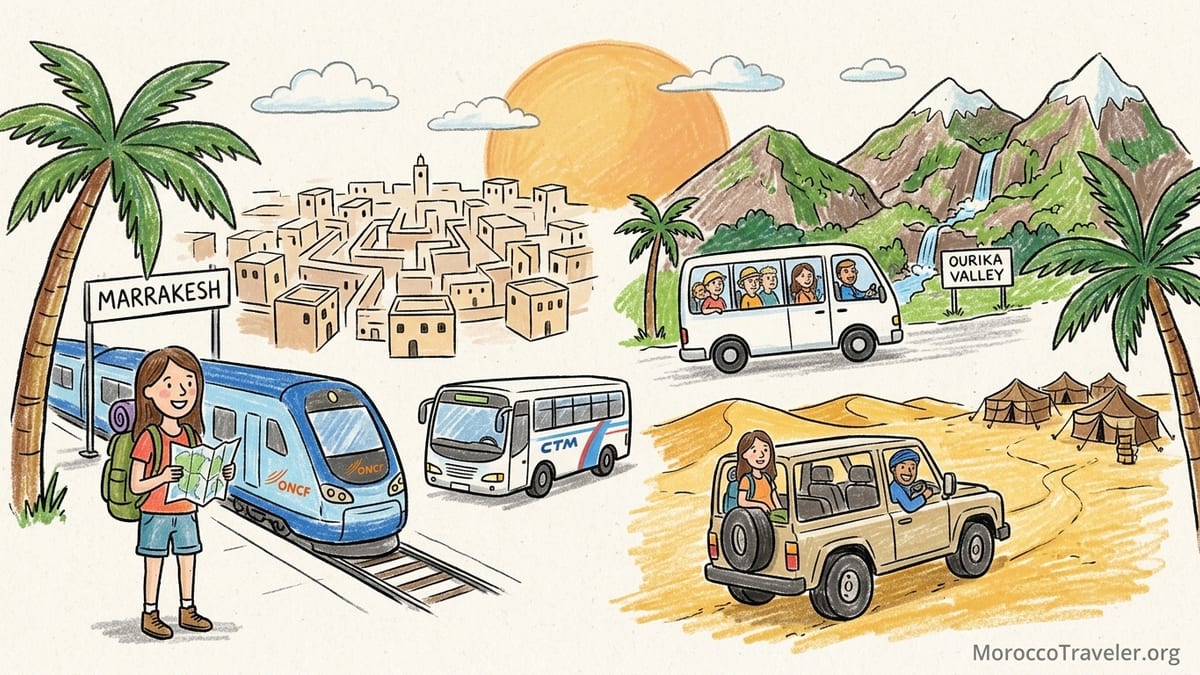
Those two approaches created four distinct ways of traveling. First was pure independent travel built around ONCF trains and CTM or Supratours buses. Second was independent travel with local city guides for a day or half day in complex historic centers. Third was signing up for shared outings, such as full day excursions from Marrakesh to the Atlas Mountains or Essaouira. Fourth was booking a private driver for a multi day trip that combined several remote areas that were difficult to reach by public transport in limited time.
Because I repeated some of the same routes, I could see clearly where doing everything solo worked best and where paying for expertise, a car and a fixed schedule gained real value. The contrast was most obvious in three areas. Navigating the medinas of Fez and Marrakesh, reaching smaller mountain and desert towns, and handling logistics during small schedule changes or minor crises.
Money also felt very different across these four approaches. On the independent leg I tracked every ticket, tajine and shared taxi fare. On the guided sections, I had to separate what was genuinely included in the price and what I was quietly pushed to spend through shopping stops, suggested lunches and out of pocket extras like monument tickets that were not always made clear up front.
Completely Independent: Trains, Buses and Finding My Own Way
Traveling independently in Morocco works surprisingly well for city to city journeys. The national rail operator, ONCF, links major cities such as Casablanca, Rabat, Fez, Meknes, Tangier and Marrakesh. On one leg, I took a second class ONCF train from Casablanca to Marrakesh. Booking at the station the day before, I paid the equivalent of a modest restaurant meal for a four hour journey in a clean, air conditioned compartment. Seats were assigned, luggage storage was easy, and staff on the platform were helpful in French and basic English.
Buses filled the gaps where rail lines did not reach. Companies such as CTM and Supratours run intercity coaches covering towns like Chefchaouen, Ouarzazate and Essaouira. Buying a ticket for Chefchaouen in Tangier, I queued at the station window, chose a departure, and had a printed ticket within minutes. The bus left close to on time and luggage was tagged and stowed. The only real challenge was that popular routes could sell out a day ahead, so on my second trip I became more disciplined about buying tickets as soon as I arrived in a new town.
Inside cities, moving independently meant a constant dance with petit taxis and my phone map. In Marrakesh, I regularly walked from the medina to the new city and back again, but at night or in summer heat I used taxis. Official city taxis are supposed to use meters, and I learned quickly to ask for the meter in French. When drivers refused, I had to negotiate a flat fare before getting in. The difference in cost between an agreed, fair meter ride and an inflated tourist price was often the equivalent of a good street meal, which matters on a longer trip.
The freedom of independent travel is hard to beat. I could linger over tea on the terrace of a riad in Fez, detour into a random neighborhood bakery, or skip a museum when I felt tired. When a fellow traveler in Chefchaouen mentioned a great viewpoint for sunset, I could simply rearrange my evening. The trade off was mental load. I was constantly checking schedules, looking up station locations, and double checking whether the person who had just offered help in the medina was genuinely kind or hoping for a tip.
Hiring Local City Guides: The Medinas Through Local Eyes
After getting repeatedly lost inside the medinas of Fez and Marrakesh, I decided to hire licensed local guides on my second trip. In Fez el Bali, the old city is a dense maze of alleys, stairways and covered markets that can feel disorienting even for experienced travelers. In the morning, I arranged a half day tour through my riad. The guide met me in the courtyard, wore an official badge, and explained the route before we stepped outside.
The difference became clear within minutes. Places that had been anonymous doorways on my solo wanderings turned out to be caravanserais, theological schools or traditional fondouks still used by artisans. At the tanneries, where I had previously climbed to a random rooftop terrace and been pressured to buy leather goods, the guide led me to a vantage point arranged in advance. He made it explicit that I was not required to buy anything and kept the visit focused on how the dye pits, drying racks and traditional processes worked.
In Marrakesh, I booked another half day medina tour. The guide navigated calmly through Djemaa el Fna square, down side streets to the Bahia Palace, and into quieter quarters near the Mellah. He pointed out where some shops paid commissions and suggested specific places for argan oil, ceramics and textiles that were more transparent about prices. He also helped me interpret small cultural situations. When a shopkeeper brought out tea, the guide quietly told me that this was pure hospitality in that particular context, not a sign that I had committed to a major purchase.
Costs for these local guides were modest compared with the value they added. In Fez and Marrakesh, current rates for licensed, private half day walking tours often fall around the price of a midrange dinner for two, depending on language and whether you book directly through your riad or a city tourism office. Some guides prefer to be paid in cash at the end of the tour. Monument tickets and refreshments are usually extra. For me, these were well spent travel funds. I still had freedom in the afternoons to wander alone, but the morning context turned the medina from an exhausting puzzle into a more understandable living city.
Shared Group Excursions: Convenience, But At A Cost
Shared day tours from Marrakesh are heavily promoted in riads and agencies. On my first visit, I joined a group excursion to the Ourika Valley. The advertised price included round trip transport in a minibus, a guide for the hike to waterfalls, and free time in a riverside village. In reality, the day began with a series of hotel pickups that took nearly an hour, followed by a stop at a roadside argan oil cooperative that was clearly set up for shopping. The demonstration of oil making was informative, but time there replaced some of the valley time that had attracted me in the first place.
Once in the mountains, our group was handed over to a local hiking guide. The walk itself was enjoyable, but the pace was dictated by the slowest walkers and there was limited opportunity to wander off the main path for photos or quiet moments. At lunch, the driver steered everyone to a specific restaurant, which had solid food but prices higher than similar spots nearby. There was no formal pressure, but the combination of a prearranged stop and a group schedule made it awkward to say no and look for alternatives.
I tried a similar shared tour to Ouzoud Falls on my second trip to see if the experience would differ. Again, the included elements were transport from Marrakesh in a minibus and a local guide at the falls. The price felt attractive when comparing it to renting a car alone, yet the same patterns appeared. Commissioned shopping stops, a long lunch break at a partner restaurant, and a schedule that could not be adjusted even when the group was ready to leave.
From a budgeting perspective, these shared tours can still make sense for solo travelers or pairs without the confidence or desire to navigate public buses and transfers into the countryside. The fixed per person price gives certainty about transport costs, and entrance fees are sometimes included. However, travelers should read the fine print to check whether lunches, monument tickets and tips are included, and be aware that part of the business model relies on a portion of the day being spent in places that pay commissions on group spending.
Private Drivers and Multi Day Journeys: Access To The Remote
For my second journey, I wanted to see more remote areas between Marrakesh and the edge of the Sahara without rushing on overnight buses. I arranged a private car with a driver for three days and two nights, traveling from Marrakesh across the Tizi n Tichka pass, stopping near Ait Benhaddou and Ouarzazate, and continuing towards the desert camps near Merzouga. Rather than a fully packaged tour, I chose a service that provided only the car, fuel and driver. I booked my own guesthouses and desert camp, and handled my own meals and local sightseeing.
The practical difference compared with public transport was huge. Instead of fitting my plans around fixed bus departures, we could leave Marrakesh just after sunrise to avoid traffic on the pass, stop for photos whenever the landscape opened up, and linger in small Amazigh villages on the southern side of the Atlas. When we decided on a roadside cafe that looked appealing, the driver simply pulled over. When a stretch of mountain road narrowed or the weather changed, I was grateful to be with someone who knew local driving norms and could communicate with police checkpoints.
A full service private tour on this route usually bundles the driver, car, hotels or guesthouses, one night in a desert camp, some dinners and breakfasts, and occasionally camel rides or specific guided visits. Prices for multi day packages can vary widely based on the standard of accommodation and group size. Lower cost options often use simpler guesthouses with shared meals, while higher priced versions include boutique riads and more elaborate desert camps. In contrast, hiring only the driver and booking everything else myself meant more work up front, but it kept my daily cost lower than an equivalent packaged tour while preserving flexibility over where to stay.
Compared with shared excursions, the absence of enforced shopping stops was striking. Over three days, our only nonessential pause was at a roadside craft shop where the driver made clear that browsing was optional. Most time went into scenery and villages rather than showrooms. When roadworks caused a minor delay, we shifted the day’s order of stops to reach my chosen guesthouse in late afternoon. That kind of real flexibility is difficult to achieve on larger group tours.
How Each Style Affected Freedom, Safety, Connection And Cost
Looking back across these four approaches, the trade offs cluster around freedom, navigation, interactions, safety, spending and time at attractions. Traveling completely independently, I had maximum freedom. I could change my plan daily, choose slow travel days when I felt tired, and avoid places that felt overcrowded. That same freedom required constant navigation work and decision making. In Fez, for example, finding my riad on the first night involved asking three different shopkeepers for directions and navigating offers of “friendship guiding” in exchange for tips.
Hiring local city guides for a morning or full day added structure exactly where I needed it. In the medinas of Fez and Marrakesh, where alleys can loop back on themselves, a guide prevented wasted time and frustration. Safety concerns were more about orientation and petty hassle than serious crime, but walking with a guide reduced unwanted attention. It also deepened historical understanding. Hearing about the evolution of the madrasa system while standing in a courtyard, or having tile patterns explained, made those places more memorable in a way I could not have achieved alone just by reading a guidebook.
Shared group excursions offered convenience and reduced the need to interpret rural transport options, which can involve a mix of regional buses and shared grand taxis. For solo travelers who are nervous about figuring out routes to hiking areas or waterfalls, that peace of mind has value. The downsides I felt most strongly were reduced freedom to set the pace at sights and the time diverted into commission based shopping stops or partner restaurants. Even when the overall price looked good, I spent extra on drinks and snacks at places chosen for the group.
Private drivers on multi day routes provided a middle ground between pure independence and fully packaged tours. I had freedom to choose hotels, control starting times most days, and negotiate detours, while delegating the stress of driving on unfamiliar roads and handling checkpoints. Costs were higher per day than using only public buses and trains, but lower than many packaged tours that included the same route plus markups for bundled accommodation and activities. For first time visitors who want to see both cities and the desert within a week, this approach can strike an effective balance.
What Is Actually Included: Current Examples And A Seven Day Budget
When comparing guided and independent travel, it is crucial to examine what is included in the price. A medina walking guide in Fez or Marrakesh typically includes guiding services only. Entrance fees to monuments, drinks and tips are paid separately. In my experience, that kept the upfront cost transparent. For group excursions from Marrakesh, the advertised price usually covers transport and a basic guiding service at the main sight. Hotel pickups, lunches, boat rides at waterfalls or camel rides, and entrance fees may or may not be included, so travelers should check carefully during booking.
Multi day private driver arrangements range from bare transport, where you pay for your own hotels and food, to all inclusive packages covering almost every element apart from some lunches and personal purchases. In one case, I compared a three day arranged Sahara tour that included a driver, two nights of accommodation including one in a tented camp, several dinners and breakfasts, and selected activity stops along the way, with the cost of hiring only a driver and booking my own riads and camp. The self arranged option came out lower, but only because I chose moderately priced guesthouses and skipped certain bundled stops that did not interest me.
To make this more concrete, consider three simplified seven day itineraries centered on Marrakesh and Fez. In the first scenario, a traveler relies entirely on independent transport such as ONCF trains and intercity buses, stays in modest but comfortable riads, eats at a mix of cafes and street stalls, and pays entrance fees and occasional taxis separately. A second traveler uses the same base but adds paid local guides in Fez and Marrakesh and one or two shared day tours. A third traveler books a largely organized package that bundles city tours, a desert excursion, most transport and much of the accommodation and food into one price.
Actual numbers will vary depending on season, comfort level and detailed choices, but the pattern is clear. Fully independent travel spreads costs across many small daily decisions and usually comes out lowest if you are willing to do planning work and accept some discomfort. Independent travel with selected guiding adds a modest premium on a few key days in exchange for richer context and easier navigation. Fully organized trips compress the planning work into a single decision and can be good value when time is short and expectations are aligned, but they also bring fixed schedules, some shopping stops and less flexibility to skip included meals or accommodations that do not appeal once you arrive.
Where I Would Go It Alone Again, And Where I Would Pay For Help
After trying Morocco both ways, I would happily travel independently again between the major cities. Booking ONCF trains from Casablanca to Rabat or from Tangier to Fez felt straightforward. Using intercity buses to reach Chefchaouen or Essaouira was also manageable, especially after learning to buy tickets a day in advance on popular routes. Within cities, I enjoyed negotiating petit taxi rides, walking between the medina and newer districts, and finding my own street food. For these elements, I did not feel that an organized package added enough value to justify the extra structure.
In large medinas, I would still build in at least one guided morning early in my stay. Fez in particular rewarded that investment. A guide turned what had felt like a swirl of alleys and competing shop calls into a more navigable city. In Marrakesh, a guided visit to major sights such as the Bahia Palace, Saadian Tombs and certain museum complexes gave helpful framing, after which I was content to wander independently. I would not, however, want to be on a fully guided schedule for every hour inside the medina. Part of the joy of Morocco comes from unscripted moments that only happen when you step away from a group.
In the mountains and on desert approaches, I would again pay for structured help. I do not regret a single dirham spent on having a professional driver handle the Tizi n Tichka road in variable weather. The peace of mind of not driving on unfamiliar mountain passes, the ability to stop in small villages, and the capacity to adapt when minor delays occurred were all worth the premium over buses. For hiking days, I would be comfortable organizing my own trip if I had time to research public transport and local conditions. If I were short on time, I would instead look for smaller group or semi private excursions with clear information about what is and is not included.
Where I became more critical was with large, low cost group day tours that filled days with lengthy hotel pickups and shopping stops. If I travel to Morocco again, I will favor either independent trips or small group options with a transparent itinerary, and I will ask directly about any scheduled shop or workshop visits before booking. In some cases, I may choose to hire a local taxi for the day with a clearly agreed price rather than join a big group, simply to regain control of my schedule even at a similar overall cost.
The Takeaway
Morocco rewards both independent travelers and those who prefer organized assistance. The country has a reasonably developed train and bus network, abundant city taxis and a wide range of riads that can be booked directly. With patience and some basic language preparation, it is entirely possible to move between cities, find accommodation and explore many sights on your own. That route gives maximum freedom, the lowest overall cost, and the greatest number of unscripted encounters with locals.
At the same time, selective use of guides and drivers can transform difficult days into some of the most rewarding parts of a trip. In complex medinas, a licensed local guide adds context, reduces stress and helps travelers avoid missteps. On longer journeys into the Atlas Mountains or towards the desert edge, a trusted driver brings safety, flexibility and access to places where public transport would be slow or uncertain. The key is to choose when to pay for that help and to be clear about what is included so that guided days feel like a conscious investment, not a series of surprises.
For my future trips, I plan to keep booking my own trains and buses between cities, arranging my own accommodation and wandering independently in many neighborhoods. I will continue to hire city guides for half days in Fez and other historically dense towns early in my stay. In the countryside, I will lean towards private or very small group arrangements when crossing major passes or covering long distances within a short time. For large, low cost group excursions that build in shopping stops and rigid schedules, I will think carefully before signing up.
Ultimately, the right mix depends on your appetite for planning, your comfort with ambiguity and your budget. My experience has taught me that I do not need a fully organized tour to feel safe or informed in Morocco, but I do benefit greatly from targeted expertise in specific situations. Travelers who recognize that distinction can design a trip that combines the best of independent discovery and knowledgeable local support.
FAQ
Q1. Is it safe to travel independently in Morocco as a first time visitor?
Independent travel in Morocco can be safe for many visitors who stay aware of their surroundings, choose reputable accommodation and use common sense with valuables. Most issues that travelers encounter are related to minor scams, overcharging or unwanted guiding rather than serious crime. In busy medinas, keeping phones and wallets secure and avoiding isolated alleys at night reduces risk, and first time visitors often feel more at ease after spending the first day on a guided walk.
Q2. Do I need to book trains and long distance buses in advance?
For major routes and popular dates, it is wise to book ONCF trains and intercity buses at least a day in advance, especially in high season or around holidays. Tickets can often be purchased at stations or through local agents, and some services offer online booking. Less busy routes can sometimes be booked on the day of travel, but planning ahead provides more choice of departure times and seating.
Q3. Are local medina guides worth the cost?
Local medina guides can be very good value, especially in cities like Fez and Marrakesh where historic quarters are complex and full of small details. A half day with a licensed guide can turn a confusing maze into an understandable city, reduce unwanted attention from unofficial guides and help visitors find authentic workshops and viewpoints. Travelers who enjoy deep historical context and efficient routes usually find this money well spent.
Q4. How can I avoid commission heavy shopping stops on tours?
Before booking a tour, ask clearly whether there will be scheduled stops at shops or cooperatives and how much time will be spent there. Smaller group or private tours are often more flexible and may be willing to skip such stops entirely. Once on a tour, it is acceptable to browse without buying and to stay polite but firm if you are not interested in making purchases.
Q5. What should I check before hiring a private driver?
When hiring a private driver, travelers should confirm in writing what is included in the daily rate, such as fuel, road tolls and parking. It is also wise to clarify driving hours, language abilities, insurance cover and whether the driver expects commissions from particular hotels or shops. Asking for recommendations from your riad or from other travelers can help you find reliable drivers who focus on service rather than commissions.
Q6. Can I reach the Sahara desert edge using only public transport?
It is possible to reach towns near the desert edge using a series of buses and shared taxis, but it can take more time and require multiple transfers. For travelers with limited days, using a private driver or an organized excursion for the desert segment can make the journey more comfortable and predictable. Those with more time and flexibility can explore public transport options but should be prepared for long travel days.
Q7. How do guided group day tours from Marrakesh usually work?
Guided group day tours from Marrakesh typically start with hotel pickups in a minibus, followed by a drive to a main site such as a valley, waterfall or coastal town. A local guide may lead a walk, and there is often a set stop for lunch, sometimes at a partner restaurant. The return journey brings everyone back to the city in late afternoon or evening. While convenient, these tours run on fixed schedules and may include shopping visits.
Q8. Is it better to book a complete Morocco package or arrange things myself?
The choice depends on how much planning you enjoy and how much flexibility you want. Complete packages bundle transport, accommodation, some meals and guided visits into one price, which simplifies logistics but reduces spontaneity. Arranging things yourself takes more time, yet allows you to adapt the trip as you go and usually lowers costs, especially for travelers comfortable using trains, buses and local taxis.
Q9. How much should I tip guides and drivers in Morocco?
Tipping practices vary, but many travelers choose to tip city guides an amount roughly in line with a small percentage of the tour cost when they are satisfied. For drivers on multi day journeys, a modest daily tip given at the end of the trip is common, adjusted for service quality and trip length. Small tips for hotel staff or porters are also appreciated, particularly when they provide extra assistance with luggage or directions.
Q10. What is the best mix of independent and guided travel for a one week trip?
For a one week trip, many visitors find a mixed approach works well. Spending some days independently in cities such as Marrakesh or Fez, combined with one or two half days with local guides and either a small group or private excursion to the mountains or desert edge, offers both freedom and support. This balance allows travelers to experience everyday Moroccan life while benefiting from local expertise at key moments.