


Morocco is still a cash-first country, even as card terminals and online booking platforms spread quickly in major cities. If you arrive with only a credit card and a vague idea of what a dirham is worth, it is easy to overpay, get caught by bad exchange rates, or feel lost when someone suggests a tip or asks you to “discuss the price.” This guide uses up-to-date information and real examples to show how to handle Moroccan dirhams confidently, from your first ATM withdrawal to your last taxi ride back to the airport.
Understanding the Moroccan dirham and basic conversions
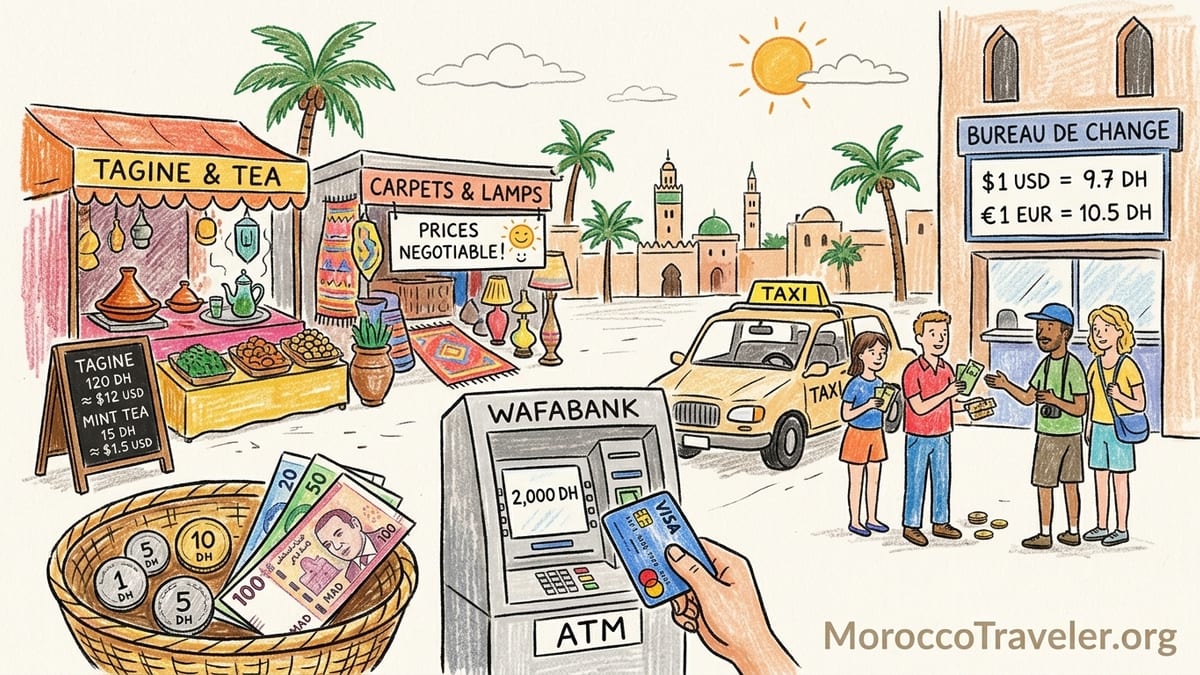
The Moroccan dirham, written as MAD or DH, is the only legal currency for everyday payments in Morocco. Notes commonly used in daily life are 20, 50, 100 and 200 dirhams, with coins of 1, 2, 5 and 10 dirhams, plus a few smaller santime coins that you will mostly see as small change in local shops and cafés. Prices are nearly always displayed in dirhams, although in some tourist areas sellers may casually mention rough equivalents in euros or dollars to help visitors understand the cost.
The dirham is considered a “closed” currency, which means it is not freely traded outside Morocco. In practice, visitors usually cannot buy Moroccan cash at home before their trip and foreign exchange offices abroad rarely accept leftover dirhams. Most travelers therefore get their first dirhams from an ATM or exchange office after landing in cities like Casablanca, Marrakech, Tangier or Agadir. Unused dirhams can usually be exchanged back into foreign currency at Moroccan banks or authorised exchange counters before departure, provided you show ATM slips or exchange receipts as proof of origin.
Because live exchange rates move daily, it is best to check a trusted currency converter close to your travel date. In late October 2026, the official reference rate from Bank Al Maghrib puts 1 US dollar at roughly 9.7 dirhams, so a simple mental shortcut for American visitors is to think of 10 dirhams as about 1 US dollar. That means a 25 dirham espresso in a modern Marrakech café is around 2.50 dollars, and a 120 dirham tagine in a midrange restaurant is roughly 12 dollars. Travelers from the eurozone can use a similar rule of thumb and treat 1 euro as a little over 10 dirhams, which makes price comparisons straightforward.
Although rules on currency import and export are written strictly, enforcement is focused on large sums and financial crime, not tourists with small amounts of cash. Official information states that foreign visitors should not import or export substantial amounts of dirhams, and various authorities refer to an allowed “pocket money” level of only a few thousand dirhams. In practice, carrying a modest leftover amount when you depart, such as 500 to 1,000 dirhams for future visits, does not usually create problems at the airport, but you should not treat the dirham as a currency you can withdraw in bulk to change abroad later.
Where cash is king and where cards work well
In large cities such as Casablanca, Rabat, Marrakech, Tangier and Agadir, card acceptance has grown steadily. Midrange and upscale hotels, modern riads, international chain restaurants and supermarkets in areas like Marrakech’s Gueliz or Casablanca’s Maarif typically accept Visa and Mastercard. Many boutique restaurants that cater to international visitors, from rooftop terraces overlooking Jemaa el Fna in Marrakech to seafront bistros in Essaouira, will present a bill that you can settle by chip-and-PIN card. Car-rental offices in airport terminals, high-end spas, and large tour operators that run desert excursions commonly accept card payments as well.
However, away from these modern pockets, Morocco still runs heavily on cash. Inside historic medinas, especially in Marrakech, Fes and Chefchaouen, smaller restaurants, snack stands, juice vendors, corner groceries, traditional hammams and many guesthouses expect payment in cash. A 10 dirham glass of fresh orange juice on Jemaa el Fna, a 5 dirham mint tea in a local café, or a 40 dirham street-side sandwich is unlikely to be payable by card. Small family-owned riads might accept card for the room bill, but ask for cash for extras such as laundry or locally arranged transfers.
Taxis are another area where cash remains almost universal. Petit taxis within cities usually have no card terminals and expect passengers to pay the metered fare or agreed price in coins and small notes. If you negotiate a 25 dirham ride across town in Casablanca or pay 50 to 70 dirhams for a late-night trip from Marrakech medina to the Palmeraie, that transaction will be cash-based. Some ride-hailing apps are present in big cities and may be linked to cards, but you should never rely solely on them, especially late at night or in smaller destinations.
Once you move into rural areas and the desert, cash becomes even more important. Small inns in the Ourika Valley, mountain gîtes in the High Atlas, roadside stalls on the way to the Sahara, and family-operated auberges near Merzouga often quote prices in dirhams and expect cash on checkout. While a few desert camps and tour companies allow online deposits by card before you arrive, the balance is frequently requested in cash on site. For that reason, travelers planning to spend several days outside major cities should withdraw enough dirhams beforehand in hubs like Marrakech, Ouarzazate or Agadir, where ATMs and bank branches are easy to find.
Using ATMs and exchange offices without losing money
For most visitors, the easiest way to get dirhams is to use an ATM with an international Visa or Mastercard debit or credit card. Moroccan ATMs are widespread in cities, airports and larger towns, and official guidance from tourism and banking authorities confirms that internationally branded cards are widely accepted. In recent years virtually all major Moroccan banks have started charging a local fee for withdrawals with foreign cards. Travel resources that monitor these fees report typical charges of roughly 20 to 40 dirhams per withdrawal, which is in addition to any fee your own bank may apply. ATMs display the local fee on screen before you confirm, so you can cancel and try another bank if the cost seems high.
Withdrawal limits also matter because they affect how often you pay those fixed fees. Many Moroccan ATMs owned by large networks still limit foreign cards to around 2,000 dirhams per withdrawal, but some banks, including Attijariwafa and BMCI according to several recent traveler reports, allow up to 8,000 dirhams in one transaction. If your home bank charges a fee per withdrawal, it can be cheaper to make fewer, larger withdrawals at higher-limit machines than many small ones at 2,000 dirhams each. In all cases, it is worth telling your home bank about your trip in advance so they do not block your card when they see Moroccan transactions.
A common trap at both ATMs and card terminals in Morocco is dynamic currency conversion. When the screen asks whether you want to be charged in your “home currency” (for example, US dollars or euros) instead of dirhams, choosing your home currency applies a rate chosen by the local bank or terminal provider. Independent tests and financial advisories consistently show that this rate can be several percent worse than the one your card network would use. The safer option is to decline conversion, choose to be charged in dirhams, and let your own bank or card provider perform the exchange at its usual rate.
Currency-exchange offices are the main alternative to ATMs. In big cities, official bureaux de change compete vigorously, especially in areas around Marrakech’s main square, Tangier’s port, and Casablanca’s central districts. These counters publish buy and sell rates on electronic boards or printed posters. Around late 2026, when the central rate stands near 9.7 dirhams per US dollar, you might see exchange offices buying dollars for a little under that figure and selling them for a bit more, effectively charging a few percent spread as their profit. Exchanging crisp, high-denomination foreign notes tends to get the best treatment, so bringing modern $50 or $100 bills or recent 50 and 100 euro notes can slightly improve your practical rate.
As a rule of thumb, travelers with modern low- or no-foreign-fee bank cards usually find that withdrawing cash from an ATM in dirhams and declining any on-screen conversion provides a rate close to the mid-market level, even after paying the local ATM fee. Those who carry cash to exchange should compare rates at a couple of authorised offices in town rather than changing at the first kiosk in the arrivals hall, where margins are often wider. Whichever route you choose, always keep exchange receipts and ATM slips, as you may need them to convert surplus dirhams back into foreign currency at the airport bank when you leave.
Why small notes and coins matter so much
Morocco is a country of small everyday payments, and having the right change makes life smoother. Many typical transactions fall between 5 and 50 dirhams: a short tram ride in Casablanca, a street-side msemen pancake in Fes, a bottled water at a highway rest stop, or a simple breakfast in a medina café. If you arrive with only 200 dirham notes from the ATM, small vendors may struggle to break them, particularly early in the day before they have built up change. That can lead to awkward moments where a stall holder hesitates, disappears to ask neighboring shops for change, or simply tells you they cannot sell you a 6 dirham pastry because you only have a large note.
Taxi rides are one of the clearest examples of why coins and small notes are useful. A daytime petit taxi fare in cities like Rabat or Fes often comes to 7 to 15 dirhams when using the meter. If you hand over a 50 or 100 dirham note at the end of the journey, the driver might genuinely not have enough change. In some cases this results in a small loss for you when you shrug and say “keep it,” effectively turning extra change into an involuntary tip. Keeping a stack of 10 and 20 dirham notes, along with a handful of coins, allows you to pay exact or nearly exact amounts and tip deliberately instead of by accident.
Small denominations are also essential for tipping and bargaining. Leaving a 5 or 10 dirham coin for a café server, handing a porter a 10 or 20 dirham thank-you for carrying luggage up a riad’s narrow staircase, or giving a guide a 50 dirham gratuity after a short tour feels appropriate and practical only if you have the right-sized notes. Trying to break a 200 dirham note in order to leave a tiny tip can cause embarrassment or make you skip the gesture altogether. When you first withdraw cash, it is therefore wise to ask the teller or exchange clerk to include some smaller notes, and to break a few larger ones early in larger shops or supermarkets where change is plentiful.
Finally, small notes reduce the financial impact if a wallet or money belt is lost. Many experienced travelers keep the majority of their cash locked in accommodation safes or hidden pouches and carry a modest amount of mixed notes for the day. If that day’s supply consists largely of 20s and 50s rather than 200s, losing it hurts less. In crowded zones like Marrakech’s central square or busy markets in Casablanca, it is easier to keep your wallet out only briefly to pay a 15 dirham snack when you already hold an appropriate note between your fingers.
Tipping in Morocco: realistic amounts for everyday situations
Service staff salaries in Morocco are modest by international standards, and tipping is an established part of the tourism economy. However, it is not compulsory in the way of a service charge, and tips are normally appreciated rather than demanded. Instead of relying on rigid percentages, it is more practical to think in terms of modest fixed-dirham amounts that match real prices on the ground and to adapt slightly for exceptional service or upscale venues.
In cafés and casual eateries where locals might pay 10 to 20 dirhams for a coffee or 40 to 60 dirhams for a simple meal, it is common to leave the small coins from your change or round the bill up by a few dirhams. For example, on a 38 dirham bill for tea and pastries in a Marrakech medina café, handing over 40 dirhams and letting the server keep the change is normal. In midrange restaurants that cater to tourists, where a main dish might cost 90 to 140 dirhams and a full meal with drinks for two can reach 250 to 350 dirhams, leaving something in the area of 20 to 50 dirhams in cash on the table is widely seen as fair if service is friendly and efficient. If the bill already lists a clearly marked service charge, any additional tip is discretionary.
Hotel tipping practices vary by standard. Porters in city hotels and traditional riads typically appreciate 10 to 20 dirhams per bag, especially if stairs are involved. Housekeeping staff might be left a daily envelope of around 20 to 40 dirhams in midrange and upscale properties. In more luxurious resorts where nightly room rates run far higher, guests sometimes give somewhat more, but there is no strict rule. When a concierge spends time arranging last-minute train tickets or a hard-to-find desert excursion, a separate thank-you of 50 to 100 dirhams acknowledges the effort.
For guides and drivers, tips reflect the length and style of the service. On a two-hour group walking tour of a medina priced around 150 to 250 dirhams per person, individual tips of 30 to 60 dirhams are typical where the guide has been engaging and informative. For a full-day private excursion, such as a day trip from Marrakech to the Ourika Valley or Essaouira, where the driver-guide fee might be several hundred dirhams per traveler, a gratuity in the region of 100 to 200 dirhams per day for the car (not per person) is common when you are satisfied. Hammam attendants who provide scrubbing or massage often receive 20 to 50 dirhams each on top of the posted treatment price, given directly in cash when you dress.
Taxi tipping is modest. When using a metered petit taxi, rounding the fare up to the next whole 5 dirhams is a simple default, so a 13 dirham ride may become 15 dirhams. If you negotiate a fixed fare in advance, for example 70 dirhams for a late evening ride to the airport, there is no obligation to add more unless the driver has gone out of their way to help with luggage or a language barrier. In those cases, rounding up by 5 or 10 dirhams is kind but not mandatory. Across all these situations, remember that tipping norms are flexible; locals themselves sometimes tip less than visiting tourists, so you should treat suggestions as guides rather than unbreakable rules.
Bargaining and fixed prices: knowing when to negotiate
Haggling is part of daily life in many Moroccan markets, but not every price is negotiable. In traditional souks and medina shops that sell handicrafts, leather goods, carpets, lamps, ceramics or souvenirs, the initial price quoted to a foreign visitor is often an opening move in a bargaining process. For example, a brass lamp might be offered at 800 dirhams in a Marrakech stall, with an unspoken expectation that the sale might settle at perhaps half or two-thirds of that after a friendly exchange. Vendors anticipate some back-and-forth, and walking away politely is considered a normal tactic rather than an insult.
At the same time, many parts of the Moroccan economy run strictly on fixed prices. Supermarkets, modern pharmacies, tram and train tickets, intercity bus companies, petrol stations, and most restaurants with printed menus do not expect customers to negotiate. Trying to bargain over a 12 dirham bottle of water in a supermarket or a 150 dirham set lunch in a restaurant with a clearly printed card will only cause confusion or embarrassment. In midrange riads and hotels, nightly room rates may be somewhat flexible in the off-season for walk-in guests, but once you have booked through a platform or agency, the price is effectively fixed unless you are adding extra services.
Taxis occupy a grey area between bargaining and fixed tariffs. In principle, petit taxis inside cities should use the meter, and in places like Casablanca, Rabat and Fes many do, at least during the day. When the meter is running, you pay what it shows, plus perhaps a small rounding up. However, in heavily touristed areas or late at night, some drivers switch off the meter and propose a flat amount instead. In these cases you can counteroffer politely, with both sides usually converging quickly on a figure that feels acceptable. For example, if a driver in Marrakech asks for 80 dirhams to go from the medina to the train station and you know the typical metered fare is closer to 20 to 30 dirhams, answering with 40 or 50 dirhams may lead to agreement or encourage you to try another taxi.
Guided excursions and multi-day tours add another layer of negotiation. When booking in advance through international platforms or well-known agencies, prices for desert trips, cooking classes or hiking packages tend to be fixed and quoted in euros, dollars or dirhams. If you arrange tours locally, especially in medina travel agencies or directly with drivers near main squares, there is often room to discuss what is included and what the final amount will be. Agreeing clearly on the total price in dirhams, the duration, itinerary, and any included meals before paying a deposit will avoid disputes later. Even then, most travelers find that any final adjustment is marginal compared with the overall cost of accommodation and transport.
Deposits, refunds and keeping track of your payments
As Morocco’s tourism sector modernises, many accommodations and tour operators use online systems that request card details or small deposits in advance. It is increasingly common to pay a first night’s deposit by card to secure a riad in Fes or a coastal guesthouse in Essaouira, with the remainder payable in cash at checkout. Likewise, desert camps or private transfer companies sometimes ask for a partial prepayment through international gateways, then expect the balance in dirhams upon arrival. Reading booking conditions carefully is essential, because policies on cancellations, changes and refunds vary widely between properties.
Refund practices deserve particular attention when you pay in foreign currency. If you book a Marrakech riad in dollars on a global platform and later cancel, the refund usually returns to your card in your own currency, but fluctuations in the dirham’s reference rate against the dollar can mean you get back slightly more or less than you originally paid. When you settle a deposit locally in dirhams, any refund may also be processed in dirhams, leaving your bank to reconvert the amount at its current exchange rate. Keeping email confirmations and printed or digital receipts makes it easier to check that what returns to your account matches what you are owed.
For on-the-ground payments, a simple habit is to photograph important receipts or keep a running note on your phone that lists major outlays in both dirhams and your home currency. After paying a 1,200 dirham bill for a camel trek in the Sahara, noting that this was about 120 dollars at your mental 10-to-1 rate helps you track your daily expenses and spot if a later card statement shows a much higher converted amount, which might indicate that dynamic currency conversion was applied without your consent.
Some Moroccan businesses still request cash-only deposits, especially for informal arrangements such as reserving a driver for a day or holding a room in a small rural inn. In these cases, giving a modest deposit that you can afford to lose, such as 100 to 300 dirhams, and requesting a handwritten note with the date, amount and service description is prudent. If you later change plans, you may not always recover that money, so avoid large cash advances unless you are dealing with an established company or you are already on site and satisfied with what is offered.
First-day cash checklist and payment strategies by budget
Arriving prepared for your first 24 hours in Morocco prevents rushed decisions at poor exchange rates. Before your flight, contact your bank to confirm that your cards are authorised for Morocco and ask about foreign-transaction and ATM fees. Install your banking app so you can quickly freeze a card if needed. On arrival, ignore informal money-changers and head to an ATM from a major bank or an authorised exchange counter inside the terminal. Withdraw or exchange enough to cover your first taxi or train, your first night’s accommodation if you plan to pay cash, and meals for a day or two. For many visitors, this might mean starting with the equivalent of 100 to 200 US dollars in dirhams.
Once you have cash, break at least one 200 dirham note at a café, supermarket or train ticket counter to get smaller notes. Check a live converter to reinforce your mental rule of thumb, such as thinking “my 200 dirham note is roughly 20 dollars” so that prices feel less abstract. For transport into town, ask at the official taxi rank or information desk about typical fares to avoid overpaying. When you pay the driver, try to use a combination of 20, 50 and 100 dirham notes rather than your last remaining 200, especially if your fare is modest.
Budget travelers, such as backpackers and students, can minimise costs by relying primarily on debit card ATM withdrawals in dirhams, always declining dynamic currency conversion and taking out slightly larger amounts at higher-limit machines to spread fixed fees over more cash. Paying for accommodation directly in dirhams, particularly in guesthouses that offer better rates for cash than for card, can save a few percent. Eating in local cafés and street stalls, using metered petit taxis or public transport, and keeping a close eye on small purchases prevents your daily budget from being drained by impulse buys in tourist shops.
Midrange travelers who stay in riads and boutique hotels might prefer a mixed approach. Using a no-foreign-fee credit card for larger, secure payments such as hotel bills, domestic flights, train tickets and prebooked tours offers strong consumer protection and a competitive exchange rate. At the same time, carrying a daily cash wallet of perhaps 300 to 500 dirhams for meals, taxis, tips and small souvenirs keeps you flexible in medinas and rural areas where cards are not accepted. Dividing cash between two different spots in your luggage or clothing adds a layer of safety without complicating your day.
Luxury travelers staying in international-brand hotels and booking high-end experiences may find that they can run many expenses through cards, from spa treatments to private guides. Even so, cash remains useful for spontaneous experiences, from tipping musicians at a rooftop bar to buying artisanal goods in small workshops. Using a premium credit card that combines strong insurance, purchase protection and low foreign fees makes sense at this level of spending. For large discretionary purchases like carpets or jewellery, consider paying by card at reputable shops where written invoices and clear refund or shipping policies are standard, and where the price you negotiate in dirhams is then charged via a proper terminal rather than as a handwritten IOU.
The Takeaway
Using money confidently in Morocco is less about memorising rules and more about understanding how dirhams fit into everyday life. The key points are straightforward. The Moroccan dirham is a closed currency that you will almost always obtain after arrival, and treating 10 dirhams as roughly equivalent to 1 US dollar or 1 euro is a useful mental shortcut. Cash remains vital in medinas, taxis, small eateries, hammams and rural areas, while cards work increasingly well in city hotels, modern restaurants and at many tour operators.
ATMs provide convenient access to dirhams but now charge local fees for foreign cards, so making sensible-sized withdrawals at higher-limit machines and always choosing to pay in dirhams rather than your home currency will keep extra costs under control. Official bureaux de change offer a credible alternative when you carry cash to convert, especially if you compare a couple of counters and keep your receipts. Keeping a healthy supply of small notes and coins smooths taxi rides, market purchases and tipping, and protects you from accidentally turning lack of change into an unplanned gift.
On the cultural side, moderate tipping and friendly bargaining are part of the travel experience, not traps to fear. A few dirhams left in a café, a modest thank-you for hotel staff, and clear but polite negotiation over taxis and souvenirs go a long way. Fixed prices in supermarkets, public transport and restaurants with printed menus should be respected. When booking or paying deposits, reading conditions carefully and keeping records will help you understand what happens if plans change. With these principles in mind, you can focus less on the mechanics of money and more on the colours, sounds and flavours that brought you to Morocco in the first place.
FAQ
Q1. Can I get Moroccan dirhams before I arrive in Morocco?
Some banks outside Morocco can order dirhams, but because the currency is effectively closed and not widely traded abroad, many cannot. Most visitors plan to withdraw cash from an ATM or use an official exchange counter after landing.
Q2. How much cash should I carry on an average day?
This depends on your style of travel, but many visitors find that carrying the equivalent of 30 to 60 US dollars in mixed dirham notes is enough for meals, taxis, entrance fees and tips, while leaving larger reserves safely stored at their accommodation.
Q3. Are credit cards safe to use in Moroccan shops and hotels?
In established hotels, riads, chain supermarkets and well-known restaurants, card terminals are standard and generally considered safe. As elsewhere, it is wise to keep your card in sight when paying and to review your statements for any unexpected charges.
Q4. What should I do if an ATM in Morocco offers to charge me in my home currency?
Choose to be charged in dirhams instead. Allowing the machine to convert into your home currency usually applies a weaker exchange rate and increases the total cost of your withdrawal.
Q5. Is it rude not to tip in Morocco?
Tips are appreciated but not legally required. In many situations, a small gratuity such as rounding up a café bill or leaving a modest amount for hotel staff is seen as polite recognition rather than an obligation.
Q6. How can I tell when it is appropriate to bargain?
Bargaining is expected in traditional markets and souvenir shops, especially for items without price tags. In supermarkets, pharmacies, transport tickets and restaurants with printed menus, prices are normally fixed and should be paid as marked.
Q7. What is a fair tip for a full-day private tour?
If you are happy with the service on a full-day private excursion, a tip in the region of 100 to 200 dirhams for the vehicle or guide is a common range, adjusted up or down based on the group size and your budget.
Q8. Can I take leftover dirhams home and use them on my next trip?
You can usually leave the country with a modest amount of dirhams without issue, but exchanging large sums outside Morocco is difficult. Many travelers keep a small amount for next time and convert any significant surplus back into foreign currency before departure.
Q9. Is it better to pay my hotel in cash or by card?
Paying by card can offer good exchange rates and purchase protection, while some smaller hotels and riads may give slightly better prices for cash. It is worth asking politely about any difference, then choosing the option that suits your budget and comfort level.
Q10. What should I do if a taxi driver refuses to use the meter?
If the driver will not switch on the meter, agree a fare in dirhams before getting in, using your knowledge of typical prices as a guide. If the proposed amount feels unreasonably high, thank them and look for another taxi.