


I remember the exact moment Marrakech stopped being an idea in my head and became a place under my feet. The automatic doors at Menara Airport slid open, warm evening air rushed in, and the orderly lines of passport control dissolved into a low, constant hum of taxi touts, families, and luggage wheels on pavement. I had read plenty of guides before flying in, but as I stepped toward the taxi rank with my printed hotel address in French and Arabic, I realised that very little of what I had imagined about my first 48 hours here was going to match the reality.
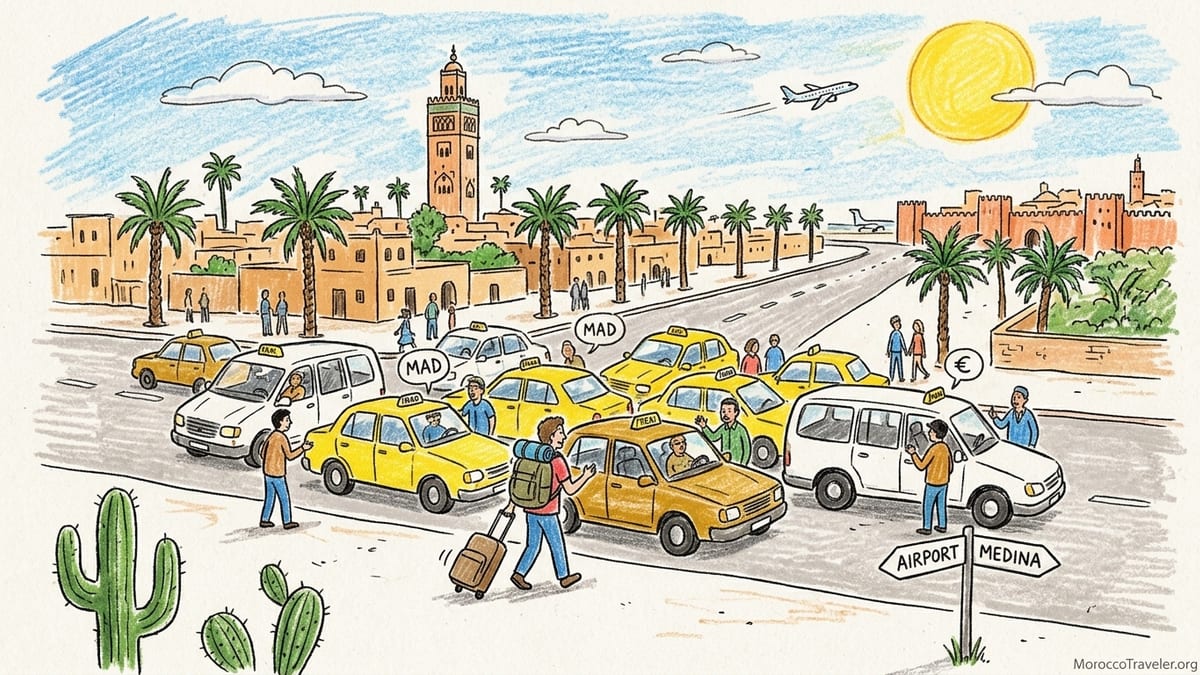
Landing in Marrakech: From Airport Calm to Taxi Confusion
I arrived at Marrakech Menara Airport in the late afternoon, when the light was still soft but the heat felt thick. The terminal itself was calm and surprisingly modern: geometric glass, clean signage, and air conditioning that made me briefly forget I was about to walk into North African summer. Passport control was slow but orderly, and baggage came out on time. The first hint of how my next two days would go came right after customs, when I walked into arrivals and saw three things in quick succession: an ATM with a small queue, a kiosk selling local SIM cards, and a line of men asking "Taxi?" before I had even adjusted my backpack.
Before the trip I had read that there was an airport bus into town for around 30 dirhams return and that petit taxis into the medina should be somewhere between roughly 70 and 150 dirhams depending on distance and negotiation. The reality at 6 pm on a busy evening was a little messier. The official taxi kiosk inside the terminal quoted me 150 dirhams straight to my riad near Jemaa el Fnaa for a private car, which technically matched the posted range but still felt like a big jump from the prices I had in my notes. Outside, drivers hovered at the barriers, offering slightly lower prices in cash but without receipts or any visible meter.
Jet-lagged and not ready to bargain, I did exactly what I now tell people not to do. I half-heartedly tried to negotiate in English, waved my printed address around, and ended up agreeing to 180 dirhams with a driver who promised to "go direct, door to door". It was not a ruinous overpay by any means, but it set a tone for my first 48 hours: small misunderstandings, a little extra spending, and plenty of learning on the fly.
The ride itself was my first real look at Marrakech. We left the airport along a wide boulevard lined with palms and low ochre buildings, then moved into heavier traffic where scooters wove between cars with a confidence I did not yet understand. From the back seat I could see glimpses of gardens and hotel facades in the Hivernage district, then the walls of the old medina rising ahead in deep terracotta. By the time we reached the edge of the pedestrian zone, there was no chance of "door to door"; we stopped at a small square packed with other taxis, and my driver waved vaguely toward a tangle of alleys, assuring me my riad was "five minutes, straight ahead".
First Steps into the Medina: Expectations Versus Reality
In my head, the medina of Marrakech was a kind of warm, sepia-toned maze: narrow streets with donkeys, hanging lanterns, and the smell of spices. That turned out to be partly true, but I was not prepared for how intense those narrow streets would feel with a suitcase in hand and no clear sense of direction. The lane from the taxi drop-off into my part of the medina was barely wide enough for two people to walk side by side. Motorbikes squeezed past inches from my arm, small carts rattled over uneven cobblestones, and overhead the sky vanished behind satellite dishes and electrical cables.
My riad was in the southern part of the medina, about a ten-minute walk from Jemaa el Fnaa, close to one of the busy arteries that lead to the square. On paper that sounded convenient: central, walkable, right in the "real" old city. In practice, at least for the first evening, it meant dragging my suitcase through packed alleys where I could not stop to check my phone without blocking traffic. Every time I slowed down to search the blue dot on my map, someone would approach me with a question that sounded like a statement: "You want square?" or "Riad where?" It was rarely aggressive, but it was relentless.
The first time I got properly turned around, I followed a hand gesture from a teenage boy who pointed me down a side alley with such certainty that I assumed he must know the place. Ten minutes later we arrived at an entirely different riad, and the situation unfolded in one of those small, awkward travel vignettes. The boy expected a tip for "guiding" me, the staff at the wrong riad tried to reorient me on the map, and I finally backtracked to the main lane feeling foolish and slightly embarrassed. By the time I reached my actual riad, I had already spent extra on the taxi and handed over a modest tip for the unsolicited detour.
Inside the riad, everything changed. The door shut, the noise dropped, and the chaos of the alley felt suddenly far away. The central courtyard was all carved plaster, zellige tiles and a small plunge pool that caught the last light from the open roof. Mint tea arrived without being asked. My room looked inward, not outward, so there were no street views, only white walls and a wooden door with an oversized key. That first evening, the contrast between medina noise and riad calm was the most surprising thing about Marrakech: two parallel worlds separated by a single wooden door.
Jemaa el Fnaa and the Night Soundtrack of the City
After a quick shower and a mental reset, I made what felt like the obvious decision for a first evening: walk to Jemaa el Fnaa. On the map, it was a simple route, a near-straight line from my riad up through the medina. On the ground, that line bent around stalls, scooters, and sudden dead ends where a construction barrier blocked what had been a through alley the week before. I got there eventually, following the flow of people more than my GPS.
The square itself was bigger and louder than anything I had anticipated. During the day, Jemaa el Fnaa is busy, but in the evening it fills with layers of activity: food stalls sending up smoke from grills, orange juice stands lit like small stages, drummers forming circles of sound, and storytellers surrounded by tight groups of listeners. I had expected something atmospheric and maybe a little theatrical. What I found was a working public space where locals and visitors were crammed together under harsh white bulbs and the smell of grilled meat, frying dough, and exhaust.
Money disappeared faster than I realised that first night. There was the fresh orange juice that looked like it should cost almost nothing but added up when I did not confirm the price first. There was the henna artist who began drawing on my hand before we had finished discussing whether I even wanted henna. There was dinner at one of the central grill stands where the food was decent but the add-ons I had not explicitly refused kept appearing on the table and then on the bill. None of these interactions felt like outright scams, yet together they turned what I had imagined as a cheap, casual first-night wander into a surprisingly expensive introduction.
The sensory intensity did not stop when I went back to the riad. The calls to prayer wrapped around the medina at different times from different mosques, often carried on the wind in ways my ears could not predict. Motorbikes buzzed in the alleys well into the night. Somewhere nearby, a rooftop bar played a mix of Moroccan pop and international hits. None of it felt unsafe, but it made sleep fitful that first evening. I had assumed the medina would go quiet after midnight; instead, it felt like someone simply turned the volume down a few notches.
Day One Proper: Getting Lost, Then Calling in a Guide
I had dedicated my first full day to "just wandering" the medina, a romantic plan that did not hold up well against reality. My loose list included exploring the souks around Jemaa el Fnaa, visiting the Koutoubia area from the outside, and, if I had any energy left, possibly making it to Bahia Palace. On paper, it was modest. On the ground, it was ambitious for a first-timer still learning how long it actually takes to move through the old city.
The morning souks were less overwhelming than the night market but still a lot to absorb. I found myself constantly fighting the urge to look up at the wooden ceilings and coloured light filtering through slats while also dodging carts and bikes. My navigation app worked only partially; GPS in those narrow lanes is approximate at best. Several times I thought I was walking in a straight line toward the same landmark, only to pop out at an entirely new gate or small square.
By midday I had spent a couple of hours walking in circles and had done very little actual "seeing" beyond trying not to get in anyone's way. That was the turning point when I decided to hire a licensed local guide for an afternoon introductory walk. I went back to my riad, asked the receptionist if they could arrange a certified guide for a few hours starting at 2 pm, and within half an hour I had a confirmed rate in dirhams and a name.
The difference was immediate. With a guide, the medina shifted from a stressful maze to a legible city. We walked past the Koutoubia Mosque, where he explained the history from the outside, and then into sections of the souks I had tried and failed to navigate alone. He pointed out the working areas that are less polished than the tourist rows: metalworkers shaping lanterns behind piles of scrap, dyers hanging bright yarn over alleyways, and small neighborhood bakeries baking communal bread. Every so often he would pause in a quiet corner to show me how to use a tall minaret or a particular gate as an anchor in my mental map.
That afternoon we visited the Ben Youssef Madrasa and its surrounding area. Entry to the madrasa itself for foreign adults was listed at 50 dirhams when we arrived, paid in cash at the official ticket window near the entrance. Inside, the building was a cool, geometric contrast to the heat outside: a main courtyard with a shallow pool, carved cedar galleries, and intricate zellige tile work on almost every surface. Without the guide I might have admired the patterns and moved on. With him, I learned to spot small details like the difference between Quranic inscriptions and purely decorative calligraphy, and how the layout once functioned as a student residence.
Bahia Palace, Queues, and the Reality of Timed Visits
On my second morning I decided to tackle Bahia Palace, one of the most recommended sights in Marrakech. It opens in the morning and, according to the official information checked before my visit, foreign adult tickets cost 100 dirhams, with lower prices for Moroccan residents and children. I left the riad later than planned, hoping that mid-morning would somehow be less busy. It was not.
The walk from my riad in the southern medina to Bahia Palace looked short on the map, but again the medina stretched time. By the time I reached the palace entrance, the line already extended out into the sun. There was a single queue for same-day entry and a small cluster of people confused about online tickets and tour group access. Waiting to buy a ticket took around 25 minutes, which would have been fine if I had worn a hat and brought water. I had done neither, assuming, wrongly, that "palace visit" meant mostly shaded spaces and quick entry.
Inside, Bahia Palace was every bit as beautiful as the photos suggest, with inner courtyards, painted wooden ceilings, and carved plaster that rewarded slow looking. What surprised me was how much the experience depended on timing. Certain rooms were so full of tour groups that I shuffled shoulder-to-shoulder through spaces that were clearly designed as private residences and quiet gardens. In others, there were brief lulls when I could stand in the center of a tiled courtyard and almost feel the building as it might have been. Realistically, in high season you should plan at least two hours from leaving your hotel to exiting the palace, once you account for walking, queuing, buying tickets and the actual visit.
This was also the morning when I fully understood how quickly attraction fees, unofficial guiding, and small extras can add up in Marrakech. Between Bahia Palace, the previous day's madrasa visit, and various tips, I had spent more in 24 hours on entry fees and guiding than I had planned for the entire three days. None of those individual prices were unreasonable on their own, but I had underestimated how many different people I would pay small amounts to in the course of simply moving through the medina.
Food, Money and Small Surprises in the First 48 Hours
Food in Marrakech during those first 48 hours was both wonderful and unexpectedly strategic. My best meal happened almost by accident, at a small family restaurant just off a side street near the Ben Youssef area. It was not on any list I had saved. I walked in because the menu was written in both French and Arabic, there were locals eating tagine at midday, and the owner greeted me briefly before returning to his conversation instead of trying to pull me in. For the equivalent of a modest sit-down lunch, I had a slow-cooked chicken and preserved lemon tagine with bread, olives and mint tea. It set a benchmark for the rest of the trip.
By contrast, several meals close to Jemaa el Fnaa felt more transactional. On my first night, the grill stand where I ate did not display prices as clearly as I would have liked. When I forgot to confirm the cost of each dish before ordering, the final bill grew with extras like salads and bread that I had assumed were included. Later in the stay, when I did the same walk with more confidence, I chose stalls that posted clear prices in dirhams and asked calmly for a written total before agreeing. The experience changed entirely.
Money management was another learning curve. I had withdrawn a moderate amount of dirhams at the airport ATM, but contactless card payments were less common in the medina than I had expected. Entry fees for places like Ben Youssef Madrasa and some small museums were cash-only at the door. Taxis insisted on cash even when they quoted prices in euros as well as dirhams. Tipping guides, porters, and the young men who materialise the moment they see a lost-looking visitor all chipped away at my wallet in 10 and 20 dirham notes.
What surprised me most was not the cost itself but the speed. Two days into my stay, I found myself heading to another ATM earlier than planned, not because the city was excessively expensive, but because I had underestimated how much smaller, informal payments shape the rhythm of a visit to Marrakech. If I could redo those first 48 hours, I would arrive with a clearer cash strategy, a mental budget for tips and small services, and a firmer idea of where I was willing to say no.
How My Riad’s Location Helped and Hindered My Stay
My riad's location in the southern part of the medina, about a ten-minute walk from Jemaa el Fnaa, had looked ideal on a map. It promised immersion, authenticity and proximity to the main square. In some ways, it delivered exactly that. I could step out the door in the morning and be in the thick of local life within seconds: kids going to school, shopkeepers rolling up metal shutters, bakers sliding flatbreads into communal ovens. Walking to Bahia Palace or deeper into the souks did not require any transport at all.
At the same time, the very things that made the location feel authentic also made some parts of my first 48 hours unnecessarily stressful. Arriving with luggage and no sense of orientation, the labyrinth of lanes was more intimidating than charming. Each time I came back after dark in those early days, I had to concentrate on recognising landmarks in alleys that looked almost identical. The last stretch to the riad involved a very narrow turn where motorbikes often accelerated to climb a small slope, and I felt like I was always pressing myself into a wall to let them pass.
Talking to other travellers I met on the rooftop, I realised how different their first 48 hours had felt depending on where they were staying. A couple based on the edge of the medina near Bab Doukkala had easier access to taxis and could reach the new town on foot without navigating quite as intense a maze. Another pair staying in the modern Gueliz district described a softer landing entirely, with wide sidewalks, more familiar cafés, and taxis dropping them right at the hotel door before they dipped into the medina as a day trip.
If I were planning again, I would still choose a riad in or near the medina, but I would pay closer attention to where exactly it sits relative to a main gate or a larger thoroughfare. Being within a short, straightforward walk of a taxi-accessible point can make a huge difference, particularly if you are arriving in the evening or with heavier bags. In my case, the location proved excellent once I had internalised the route, but those first 24 hours would have been easier with one fewer layer of complexity between the airport and my bed.
What Really Fits into 48 Hours in Marrakech
Looking back, my original mental itinerary for the first 48 hours was completely unrealistic. Before arriving, I optimistically thought I might see Jemaa el Fnaa at sunset, wander the souks, visit Koutoubia, Bahia Palace, Ben Youssef Madrasa, and possibly even squeeze in Majorelle Garden, all while leaving plenty of time to "just soak up the atmosphere". In reality, the combination of narrow streets, heat, crowds, and constant micro-decisions meant that each activity took far longer than it looked on paper.
In my actual first two days, I managed an evening in Jemaa el Fnaa, several unguided hours in the souks, an afternoon with a licensed guide including a visit to Ben Youssef Madrasa, and a dedicated morning at Bahia Palace. I walked past the Koutoubia Mosque area more than once and used it as an orientation point, but I never tried to explore it in depth. Majorelle Garden, with its timed online tickets and distance from the medina, was clearly a half-day project of its own, and I quickly realised it belonged to a longer stay, not to my already crowded first 48 hours.
That time compression was not only about queues or distances. It was also about mental bandwidth. Marrakech during a first visit demands a level of attention that slowly becomes easier with familiarity, but in the beginning every crossing, every interaction and every street choice requires active thought. I found that I enjoyed the city far more when I accepted that two or three substantial experiences in a day were enough, leaving space for getting lost, unplanned café stops and the occasional retreat to the riad when the noise became too much.
If you want your first two days in Marrakech to feel rich but not rushed, it is better to think in terms of zones rather than checklists. One half-day for Jemaa el Fnaa and the surrounding souks, one for a major monument like Bahia Palace or Ben Youssef Madrasa, and one for a guided orientation walk already fill a realistic 48-hour window. Anything beyond that is a bonus, not a baseline expectation.
My Revised 48-Hour Plan for Marrakech
Knowing what I know now, here is how I would structure my first 48 hours in Marrakech if I could step back through those airport doors and start over from the moment the warm air hit my face.
First, I would pre-arrange my arrival logistics more carefully. Instead of improvising at the taxi rank, I would either book a reputable private transfer in advance for a fixed price in dirhams or, if I wanted to save money, plan to take the airport bus into the city and walk from a known drop-off point like Jemaa el Fnaa to a riad with clear walking directions. In both cases, I would ask my accommodation for the nearest spot where a car can legally stop and, if offered, pay the modest fee for a porter sent by the riad to meet me there and walk me in.
Second, I would adjust the rhythm of day one. After checking in and taking a short break in the riad, I would spend the late afternoon doing a very limited loop: from the riad to Jemaa el Fnaa, a circuit of the main square and the Koutoubia area, then an early dinner at a sit-down restaurant slightly removed from the most intense cluster of food stalls. I would treat the evening as reconnaissance rather than a full-scale market exploration, watching how the square shifts from day to night and getting comfortable with the basic routes back to my bed before the alleys fill completely.
On the morning of day two, instead of trying to "just wander" immediately, I would begin with a pre-booked, licensed guide for a three to four hour medina orientation walk. I would ask specifically for a route that includes practical elements: where to find reliable ATMs, good streets to return to at night, and landmarks useful for navigation. If possible, I would combine that walk with a visit to either Ben Youssef Madrasa or another single monument in the same area, paying the current entry fee directly at the door and making sure I carried enough small notes for tips and incidentals.
The afternoon of day two would be left intentionally lighter. If energy and heat allowed, I would choose between Bahia Palace or a quieter stretch of the souks, but not both. For Bahia, I would aim to arrive close to opening or later in the afternoon when large groups begin to thin, expect to pay the official foreign visitor price, and bring water, a hat and patience for the queue. If I were too tired for another big sight, I would instead sit on a shaded rooftop with a view over the medina, spend time watching how the city moves, and accept that Majorelle Garden, Yves Saint Laurent Museum, or any longer excursions belong to a later day in a longer stay.
Finally, I would set a clear daily budget that includes not just attraction fees and meals, but also the quiet drip of tips, guiding and small services. For many visitors, that might mean mentally assigning a specific amount in dirhams each day for "friction" costs and being willing to say no to offers of help that are not really needed. Doing so is not about avoiding generosity; it is about keeping the first 48 hours from becoming a blur of small financial surprises that overshadow the extraordinary architecture, food and street life that make Marrakech so compelling.
FAQ
Q1. Is it better to stay inside the medina or in the new town for a first visit?
For a first 48 hours, staying in or near the medina gives you the most atmosphere and easy access to major sights, but can feel intense on arrival. If you are nervous about narrow alleys and noise, a hotel just outside the walls or in Gueliz with simple access to taxis may provide a softer landing while still allowing you to visit the medina during the day.
Q2. How much should I expect to pay for a taxi from the airport to the medina?
Recent travellers report that official prices from the airport to the medina typically fall in the range of roughly 70 to 150 dirhams for a standard taxi, depending on time of day, exact drop-off point and negotiation. At the official airport taxi stand you will usually see posted fixed fares; if you prefer to negotiate directly outside, agree the amount clearly in dirhams before getting in and expect to pay in cash.
Q3. Do I really need a guide to explore the medina?
You can absolutely walk the medina on your own, but many first-time visitors find that booking a licensed guide for an introductory half-day makes a big difference. A good guide will help you understand the layout, point out quieter cut-throughs, and explain customs around photographing people, entering religious spaces and bargaining, which makes later solo exploration far more relaxed.
Q4. How much cash should I carry during my first two days?
Even if your hotel and some restaurants accept cards, it is wise to carry enough cash for taxis, tips, small snacks and entry fees that are still cash-only at the door. For a typical first 48 hours, many visitors are comfortable withdrawing the equivalent of a couple of hundred euros in dirhams, then topping up as needed, while keeping most notes in a money belt or secure pocket and using a smaller wallet for day-to-day payments.
Q5. Is Jemaa el Fnaa safe to visit at night?
Jemaa el Fnaa is busy and lively after dark, and many visitors of all ages walk there in the evening without problems. The main things to watch for are pickpocketing in dense crowds, persistent vendors and services you did not clearly request, such as unsolicited henna or paid photos with animals. Keeping valuables secure, setting boundaries politely but firmly, and avoiding flashy displays of money or electronics go a long way toward a comfortable experience.
Q6. How long do I need for Bahia Palace and Ben Youssef Madrasa?
For Bahia Palace, plan at least two hours door to door from a central riad, once you include walking, queuing for tickets and the visit itself. For Ben Youssef Madrasa, many people spend around an hour inside after reaching the entrance, longer if they are interested in the details of the architecture or are visiting as part of a guided walk through the surrounding neighbourhood.
Q7. Can I fit Majorelle Garden into my first 48 hours?
It is technically possible, but doing so often makes the first two days feel rushed. The garden uses timed entry tickets purchased in advance, and it sits outside the medina, meaning you need to allow time for taxis or other transport, security checks and the visit itself. For most travellers, Majorelle works better as part of a third or fourth day once the basic medina orientation is already in place.
Q8. What surprised you most about the noise levels in Marrakech?
The biggest surprise was how constant and layered the noise felt in the medina. Motorbikes, calls to prayer, rooftop music, market voices and metal shutters all blend into a soundtrack that rarely goes completely quiet, even late at night. Staying in a riad with inward-facing rooms helps a lot, but light sleepers may appreciate earplugs, especially in the first few nights while adjusting.
Q9. How did you handle getting lost in the medina?
In the beginning I relied too heavily on phone maps, which do not always work well between high walls. What helped more was using major landmarks like Jemaa el Fnaa and Koutoubia as anchors, noting distinctive shopfronts or corners on my usual route, and asking for directions only from shopkeepers or families rather than people who approached me in the street hoping for a guiding tip.
Q10. If you had to choose just two structured activities for a first 48 hours, what would they be?
If I had to limit myself, I would choose a licensed half-day medina orientation walk that includes one key monument such as Ben Youssef Madrasa, and a separate dedicated visit to Bahia Palace or another major historic site. Combined with unstructured time on Jemaa el Fnaa and simple wandering in the souks, those two activities provide a strong first impression without overwhelming the senses or the schedule.