

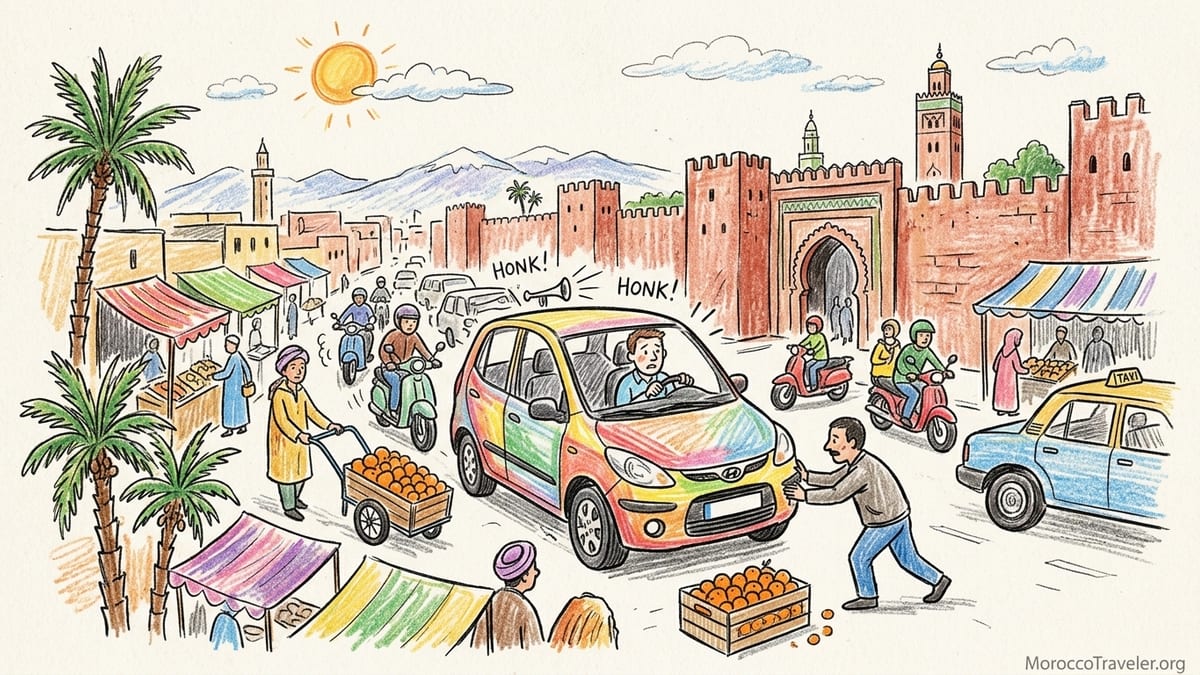
The first time I drove a rental car into Marrakech, I was so sure I had cracked Morocco. I had prebooked a compact automatic from a reputable brand, plotted the route to my riad inside the medina and even downloaded offline maps. Ninety minutes later I was still circling the same stretch of road, sweat running down my back, horns screaming around me as scooters brushed past my wing mirrors and Google Maps cheerfully insisted I should drive straight into a lane clearly full of people, donkeys and market stalls. When I finally abandoned the car in a guarded dirt lot at the edge of the old city, the attendant shrugged and told me the same sentence I have since heard from countless locals: “A car is for leaving Marrakech, not for staying in it.”
How My Marrakech Driving Plan Fell Apart
My plan looked sensible on paper. I landed at Marrakech Menara Airport, walked past the taxis and went straight to the airport car rental desks, where the big international names like Avis, Hertz and Europcar sit alongside Moroccan companies. I signed for a small automatic, around 280 to 350 dirhams per day off season including the basic mandatory insurance according to recent airport rental comparisons in 2026, and set off toward the medina feeling quietly pleased with myself.
The first cracks appeared as soon as I left the airport roundabout and joined the city traffic. Marrakech roads are not lawless, but they are intense. Motorbikes and scooters swarm between lanes, pedestrians cross wherever there is space and delivery handcarts appear without warning. Traffic lights and lane markings exist, yet locals interpret them more flexibly than most first-time visitors expect. Within minutes I realised that “normal” European city driving experience had not prepared me for the sheer density and informality of the flow.
The real breaking point came at the edge of the medina. My riad’s address looked precise online, but the last streets are pedestrian. Recent local driving guides are clear that Marrakech’s historic core is largely closed to cars, with only a few access roads around its perimeter and near certain gates. I, however, learned this the hard way. My navigation app sent me repeatedly into progressively narrower alleys until a shopkeeper stepped into the road, shook his head and told me there was no way through. Behind me, horns began to build. In front, a stream of scooters used every available gap. I had nowhere to turn around. It took twenty embarrassed minutes, a lot of hand signals and a stranger physically guiding my bumper past a crate of oranges to get back out.
I finally gave up and left the car in a guarded parking lot just outside Bab Doukkala gate, paying around 40 dirhams for 24 hours, and walked with my luggage to the riad. I had driven less than 7 kilometres, aged about 7 years and already regretted not simply taking a taxi into town and collecting a car later for the rest of the trip.
Why Driving Inside Marrakech Is So Much Harder Than It Looks
Most first-time visitors underestimate how different Marrakech feels behind the wheel compared with the way it appears on a map. On satellite view, the city offers broad boulevards like Avenue Mohammed V and clear ring roads. In practice, you are sharing those same arteries with taxis that stop abruptly to pick up passengers, mopeds riding inches from your bumper and cyclists who treat red lights as suggestions. It is not that drivers are reckless, more that they operate on a highly local, improvisational understanding of the rules that outsiders lack.
The medina is the biggest trap. Traditional riads cluster in car-free lanes where vehicle access usually stops at one of the historic gates or at wider feeder roads. If your accommodation is “in the medina,” you almost certainly cannot drive to the front door. Many riads will send a porter with a cart to meet you at a nearby gate or square, but only if you ask in advance. I arrived imagining I could park on a quiet side street outside the door. Instead, I spent nearly an hour looping one-way systems, being waved back by police from restricted streets and repeatedly funnelling into dead ends full of pedestrians.
Parking is its own learning curve. Official advice and local blogs point visitors toward guarded open-air lots close to medina gates and to underground car parks in districts like Guéliz and Hivernage. In reality, you often encounter improvised curbside arrangements overseen by self-appointed guardians who direct you into tight gaps and expect a small fee, say 5 to 10 dirhams for a short stay. It is usually perfectly safe, but confusing at first, especially when three different men claim to be “responsible” for the same row of cars. Without local context, it feels chaotic and opaque.
Add to this the regular police checkpoints on main roads into and out of Marrakech, where officers may ask to see your driving licence, rental contract and passport. They are usually businesslike rather than hostile, but if you do not have the right documents or you are not sure what the speed limit was back there, the conversation quickly becomes stressful. After two days of this, I realised that the car was more of a liability inside the city than a convenience.
Understanding Moroccan Roads: Motorways vs Mountain Routes
Here is the nuance many first timers miss: Morocco’s main motorways are, on the whole, modern, well surfaced and straightforward to drive. The toll network linking cities like Casablanca, Rabat, Tangier, Marrakech and Agadir uses dual carriageways with central barriers, clear signage in Arabic and French and frequent service areas. Official speed limits are usually around 120 kilometres per hour on motorways, about 100 on main national roads and 60 within towns, although you should always check local signs. Toll booths work like those in southern Europe: you take a ticket, then pay in cash or card when you exit, with a run like Marrakech to Casablanca costing the equivalent of roughly 60 to 80 dirhams at recent published rates.
Once you leave the motorways and larger national roads, things change. The routes across the High Atlas, such as the road over Tizi n Tichka pass between Marrakech and Ouarzazate, or through the Rif between Tangier and Chefchaouen, are spectacular but also slow and demanding. Surfaces can shift from smooth asphalt to patched, potholed stretches within a few kilometres. You share narrow bends with trucks, grand taxis and livestock. Rockfall and roadworks are not unusual after heavy rain. Driving these roads is not necessarily unsafe, but it is tiring, and distances that look short on a map take far longer than navigation apps initially estimate.
On the approach to many towns and villages, roadside speed cameras or police with radar guns are common. Travel advisories specifically warn that foreign drivers are frequently stopped for speeding at the entrance and exit of built-up areas. Fines are often paid in cash on the spot, and while amounts are not astronomical, they add both cost and anxiety. In the mountains, night driving is strongly discouraged by multiple governments’ travel advice because of poor lighting, unmarked edges and animals on the road. After one dusk-to-dark arrival into a small Atlas village, dodging unlit carts on a road with no guardrail, I resolved to plan every future leg so that I reached my next stop by mid-afternoon.
In short, the motorway from Marrakech to Casablanca might feel easier than a French autoroute, but the secondary roads that lead you to desert gorges or remote kasbahs require the same concentration as an Alpine pass. Morocco is not a single, uniformly “dangerous” or “easy” driving destination. It is a patchwork, and first-time visitors often misjudge where on that spectrum their planned route really sits.
The Fine Print: Deposits, Insurance and Hidden Rental Costs
My second major shock came not on the road but at the rental desk. The attractive day rate I had booked online ballooned as the agent walked me through the contract. In Morocco, as recent rental terms from brands like Avis and regional operators make clear, three figures matter far more than the headline price: the security deposit, the insurance excess and the cost of reducing that excess.
One 2026 set of published terms for a major brand at Marrakech Menara shows a standard deposit hold between roughly 15,500 and 30,000 dirhams on your card, depending on car category, if you stick with only the basic mandatory coverage. Opt for their full protection package, and the deposit drops to about 2,000 dirhams, but you pay a significant daily surcharge. Local companies sometimes advertise “no deposit” deals: in practice, these usually mean you pay more per day and accept a high excess, or you buy an additional waiver that caps your liability. It is vital to understand whether “full insurance” really means a zero excess, or just reduces it slightly.
Fuel policies also vary. Some airport agencies operate full-to-full, where you return the tank at the same level, which is straightforward. Others use a pre-purchase system or charge high refuelling fees if you come back even a bar short, something travellers often discover only in the final invoice. Mileage limits can appear in contracts for cheaper categories, especially with newer local brands. If you are planning a week-long loop from Marrakech through the Atlas and back via the coast, your total distance can easily exceed 1,000 kilometres, so an apparently generous cap of 150 kilometres per day might not actually be enough.
Automatic cars are another underestimated issue. While availability has improved, especially in tourist centres like Marrakech and Casablanca, manuals still dominate the fleets. Searches for automatic compact SUVs for a week in shoulder seasons often show prices 20 to 40 percent higher than similar manuals, with stock explicitly labelled “limited availability.” If you only drive automatic at home, you should book as early as possible and be prepared to pay extra. Turning up at the counter hoping that “they will surely find something” is a recipe for either disappointment or a stressful last-minute switch to a manual in heavy traffic.
Finally, damage documentation in Morocco demands attention. Most companies walk you around the car at pick-up, but the pace is brisk and the lighting in airport garages is not always ideal. Several travellers report disputes over pre-existing scratches or chips, especially on bumpers and windscreens, when they return the vehicle. The only real protection is to take high-resolution photos and short videos of every panel, the roof and the interior at collection, ideally with a timestamp, and insist that even minor imperfections are written into the contract diagram before you drive away.
Licences, International Permits and Police Checkpoints
Before my trip, I skimmed an online forum, noted that “you can drive in Morocco on your home licence” and moved on. The reality is more nuanced and depends both on your nationality and on who is asking to see your documents. Official travel advisories and international driving permit issuers agree that visitors should carry both a valid national driving licence and an International Driving Permit based on the relevant road traffic conventions when driving in Morocco. Some countries, like Australia, explicitly state that both documents are required. Others are less categorical, but rental agencies increasingly include an IDP in their conditions.
In practice, many rental counters in 2026 seem to accept a standard plastic card licence from North America or the European Union without complaint, especially for short tourist bookings. However, police checkpoints are a different matter. Officers checking documents on intercity roads are fully within their rights to ask for an IDP, and several travellers have reported being lectured or fined for not carrying one, even if the rental company had been satisfied. The small cost and minor bureaucracy of obtaining an IDP at home is trivial compared with the hassle of debating legality at the roadside in a language you may not speak well.
There are also strict expectations about what you carry in the vehicle. Recent official guidance mentions a requirement to have a warning triangle and reflective vest in case of breakdowns or accidents. Inspect the boot at pick-up to confirm these are present. You should also have the car’s registration document and insurance papers, usually provided in a folder by the agency, as police may ask for them in addition to your licence and passport. Failing to produce the correct paperwork is one of the easiest ways to turn a routine stop into a stressful event.
After my third checkpoint in two days on the road south of Marrakech, during which an officer took a long, slow walk around the car before letting me go, I understood why so many experienced visitors now recommend hiring a driver for at least some legs of a Morocco itinerary. It is not that the system is hostile to foreigners. It is simply that the cognitive load of juggling unfamiliar road rules, variable enforcement and shifting paperwork expectations quickly adds up.
The Real Cost: Seven Days With a Car vs Trains, Buses and Drivers
When I added up the numbers after that first trip, I realised that my “independence” had not even been particularly economical. Using recent 2026 pricing from well-known agencies at Marrakech Menara as a guide, a modest automatic compact with air conditioning and basic insurance runs in the region of 280 to 400 dirhams per day in shoulder season. Across seven days, that is somewhere around 2,000 to 2,800 dirhams before fuel, deposit holds and any extra insurance.
Add to this at least 600 to 900 dirhams in fuel for a week that includes Marrakech to Essaouira and back, or a loop into the Atlas, plus around 200 to 300 dirhams in motorway tolls if you include sections like Marrakech to Casablanca or Rabat. Guarded parking near medina gates at 30 to 50 dirhams per night for several nights in Marrakech and perhaps in Fes or Chefchaouen adds another 200 to 300 dirhams. If you choose a zero excess or reduced excess package to avoid a huge deposit hold, that may add 80 to 150 dirhams per day. It is easy for a realistic seven-day car budget to reach somewhere between 3,500 and 4,500 dirhams, and that assumes no fines, no damage and no surprise admin fees.
Compare this with long-distance public transport. Morocco’s national rail operator runs comfortable trains between Marrakech, Casablanca, Rabat, Tangier and Fes, with reported second-class fares between major cities often in the 80 to 250 dirham range, and the high-speed line between Casablanca and Tangier priced higher but still competitive. Long-distance buses operated by companies such as CTM and Supratours connect cities and many smaller towns, with typical fares for routes like Marrakech to Essaouira or Marrakech to Agadir usually falling roughly between 80 and 150 dirhams one way depending on class and date of booking.
Even if you upgrade occasionally to a private transfer or driver for more complex legs, you may still come out ahead. Recent quotes that travellers share for a full-day private driver with vehicle between Marrakech and the Atlas valleys or a one-way trip to Essaouira often fall somewhere in the broad range of 900 to 1,400 dirhams, depending on vehicle type and season. Shared grand taxis between nearby cities are cheaper again, though less comfortable. Once you tally a week that mixes trains for long stretches, buses for medium hops and a couple of targeted private-driver days, a reasonably comfortable non-driving budget can match or undercut the cost of a rental car without the same stress or risk.
Of course, the equation changes for families or groups of four who can split costs, or for itineraries that zigzag through rural regions with limited public transport. Yet for a typical first-timer doing a circuit of major cities and a few popular excursions, the assumption that “a car will automatically be cheaper and more flexible” often does not survive close scrutiny.
The Strategy I Wish I Had Used: Explore Marrakech First, Then Collect the Car
If I could rewrite that first trip, I would change only one structural decision: I would not rent a car from the moment I landed. The most practical strategy for Marrakech, echoed by multiple independent driving guides, is straightforward. Spend your initial days in the city car-free, staying either inside the medina or in nearby districts like Guéliz or Hivernage, and walk or use taxis. Then, when you are ready to head to Essaouira, the Atlas or the desert, collect a rental car from a city office near a main road, away from the densest traffic, and drive straight out.
Having tried both approaches now, the benefits are obvious. Inside Marrakech, almost everything a first-time visitor wants to see sits within or just outside the medina. Taxis are cheap by international standards, with short rides across town often costing what many Europeans would pay simply to flag a cab. The new town’s avenues are easy to navigate on foot once you get your bearings. Instead of waking each morning worrying about whether your car is still where you left it and whether you will manage to get it out of its space, you wake, step into the alley and go.
When the time comes to leave, you can choose a rental office near Guéliz or another modern district, where streets are wider and parking lots more obvious. That avoids the worst of the old town tangle. You collect the car after breakfast, load up at the curb and within minutes you are on the road to Essaouira or the High Atlas without having tried to thread through market alleys at rush hour. Returning the car at the end of the road trip can be similarly simplified by dropping it at an airport location as you depart, or at a city depot that does not require plunging back into the medina.
This approach also helps with budgeting. By removing three urban days from your rental period, you might cut your car bill by nearly half while also avoiding parking charges and several days of depreciation risk in cramped lots. You still enjoy the freedom of stopping at coastal viewpoints or village markets on the wider journey, but you sidestep the section of Marrakech driving that frustrates so many first-time visitors.
When Self‑Driving in Morocco Is Worth the Hassle
After all this, it might sound as if I am urging you to avoid Moroccan roads entirely. I am not. Some of my best memories from that trip came behind the wheel, once I finally escaped the city. Driving along the coast from Essaouira toward Agadir with the Atlantic on my right and argan forests on my left, stopping spontaneously at roadside grills for fresh fish, would have been far more complicated by bus. Exploring the small valleys off the main route into the High Atlas, pulling over whenever a viewpoint or a village market caught my eye, gave me a sense of the country’s texture that is hard to access from a fixed-route coach.
Self-driving is particularly rewarding if you are heading to regions where buses are infrequent and trains do not reach, such as certain parts of the Anti-Atlas, lesser-visited oases or rural stretches of the Rif. It also makes sense if you are a group sharing costs, comfortable taking turns behind the wheel and used to driving in southern Europe, North Africa or the Middle East. In those cases, the flexibility to adjust your schedule for weather, photography or unexpected side trips is worth both the financial and mental overhead.
Where I would now draw the line is at using a car as a default for everything. For city-to-city hops along the rail corridor between Tangier, Rabat, Casablanca and Marrakech, the convenience and calm of the train wins for me every time. For first-time navigation into tight old cities like Fes and Marrakech, I would now unhesitatingly choose a prebooked riad transfer or taxi rather than attempt to follow GPS instructions through alleys that barely fit a donkey cart. And for long, tiring single-day hauls through the mountains, such as Marrakech to Merzouga, I would seriously consider a shared tour or private driver, keeping my limited driving energy for shorter, scenic segments instead.
Morocco rewards curiosity and flexibility. A hire car can serve that impulse beautifully in the right context, but it is not a magic key to the whole country, and inside Marrakech in particular it can quickly feel like a liability. Understanding that distinction before you book is the difference between a road trip that expands your freedom and one that starts with a panicked three-point turn in front of an amused crowd of shopkeepers.
The Takeaway
If my first attempt at driving in Marrakech taught me anything, it is that inconvenience is not evenly distributed. I chose to carry every burden at once: a rental contract bristling with unfamiliar clauses, a large credit-card hold, an automatic car in a mostly manual market, an address in the pedestrianised medina and my very first Moroccan kilometres conducted in peak-city traffic. In hindsight, it is no surprise that I ended up frazzled and convinced I had made a terrible mistake.
On my next trip, I did almost everything differently. I stayed car-free in Marrakech for three days, then collected an automatic from a Guéliz office on the morning I left for the coast. I had already secured an International Driving Permit, read the small print about deposits and excesses, and budgeted for motorway tolls and guarded parking. I planned each day so that I avoided driving mountain roads after dark. I photographed every inch of the car at pick-up and return. The difference in stress level was night and day.
Mistakes I will not repeat include assuming I can drive to the door of a riad inside any Moroccan medina, underestimating the impact of a large deposit hold on my travel budget, and treating Marrakech like just another European city break where I can casually park on a side street for free. I also will not again ignore the value of public transport and private drivers for specific legs where local expertise reduces both risk and effort.
If you are renting a car in Morocco for the first time, think of self-driving as one tool among several, not the default. Use trains and buses where they are strong, hire local drivers for the trickiest stretches and save your own time behind the wheel for the parts of the country where quiet roads, open landscapes and unscheduled stops will genuinely enrich your trip. With that mindset, a Moroccan road trip can be exhilarating instead of exhausting.
FAQ
Q1. Do I really need an International Driving Permit to rent a car in Morocco?
Many renters get a car with only their home licence, especially from Europe or North America, but several countries’ official advisories and permit issuers state that an International Driving Permit should accompany your national licence in Morocco. Police at checkpoints may also expect to see one, so carrying an IDP is strongly recommended even if a rental desk does not insist.
Q2. Is driving in Marrakech as chaotic as people say?
Traffic inside Marrakech, particularly around the medina, feels intense for most first-time visitors. Scooters weave through gaps, lane discipline is loose and many streets in the old city are pedestrian or too narrow for cars. It is manageable for confident urban drivers, but considerably more stressful than most medium-sized European cities.
Q3. Can I drive my rental car directly to my riad in the medina?
In most cases, no. The historic core of the medina is largely pedestrian, with only a few wider access streets. You will usually park near a gate or square and walk the final distance, sometimes with a porter arranged by your riad.
Q4. How big are the typical rental deposits and insurance excesses?
Recent published terms from major brands show deposit holds from about 15,000 to 30,000 dirhams for basic coverage on standard cars, reduced to around 2,000 dirhams if you buy a full protection package. Local companies may offer lower deposits or “no deposit” deals but often with higher daily prices or different excess structures.
Q5. Are Morocco’s roads generally unsafe for tourists?
Morocco’s main motorways and many national roads are modern and straightforward, with clear signage and regular service stations. The greater challenges lie on mountain routes and rural secondary roads, where sharp bends, variable surfaces and animals on the road demand slower speeds and more concentration. It is not universally unsafe, but conditions vary widely.
Q6. How do motorway tolls and speed limits work?
On tolled motorways you normally take a ticket at the entrance and pay in cash or card when exiting, with costs depending on distance and class of vehicle. Typical speed limits are around 120 kilometres per hour on motorways, about 100 on main roads and 60 within towns, but you must follow local signs and slow at village entrances, where radar controls are common.
Q7. Is it easy to find automatic rental cars in Morocco?
Automatic cars are available, especially at major airports and in big cities like Marrakech and Casablanca, but they are less common than manuals and often cost 20 to 40 percent more for the same class. Availability can be limited in busy periods, so advance booking is important if you cannot drive a manual.
Q8. How does the cost of a week’s car rental compare to public transport?
A realistic seven-day rental of a compact automatic with fuel, tolls, parking and sensible insurance can reach roughly 3,500 to 4,500 dirhams. A mix of trains, long-distance buses and one or two targeted private-driver days can be similar or cheaper for a solo traveller or couple, though a full car of four people will often find renting more economical.
Q9. What is the smartest way to combine Marrakech with a road trip?
A practical strategy is to explore Marrakech itself without a car, staying in or near the medina and using taxis and walking. Then collect a rental from a city or airport office on the day you leave for destinations like Essaouira, the Atlas or the desert, and return it before reentering dense city traffic at the end of your road trip.
Q10. What should I check when collecting and returning a rental car?
At collection, verify the fuel level, mileage limits, deposit amount and insurance excess, and confirm that safety items like a reflective vest and warning triangle are present. Photograph the exterior and interior from all angles, including the roof and wheel rims, and have any damage marked on the contract. On return, refuel according to the policy, arrive during office hours if possible, request a quick inspection in your presence and keep all paperwork and photos until your deposit hold is fully released.