


Morocco’s Atlantic coast offers three very different holidays within a few hours of each other. Over several trips I have bounced between Essaouira’s fortified medina and wind-battered bay, Agadir’s long resort strip, and Taghazout’s surfy village of barefoot backpackers and yoga decks. This is a firsthand comparison of how they really feel on the ground, what you can expect to pay in 2026, and which one I would actually book again with my own money.
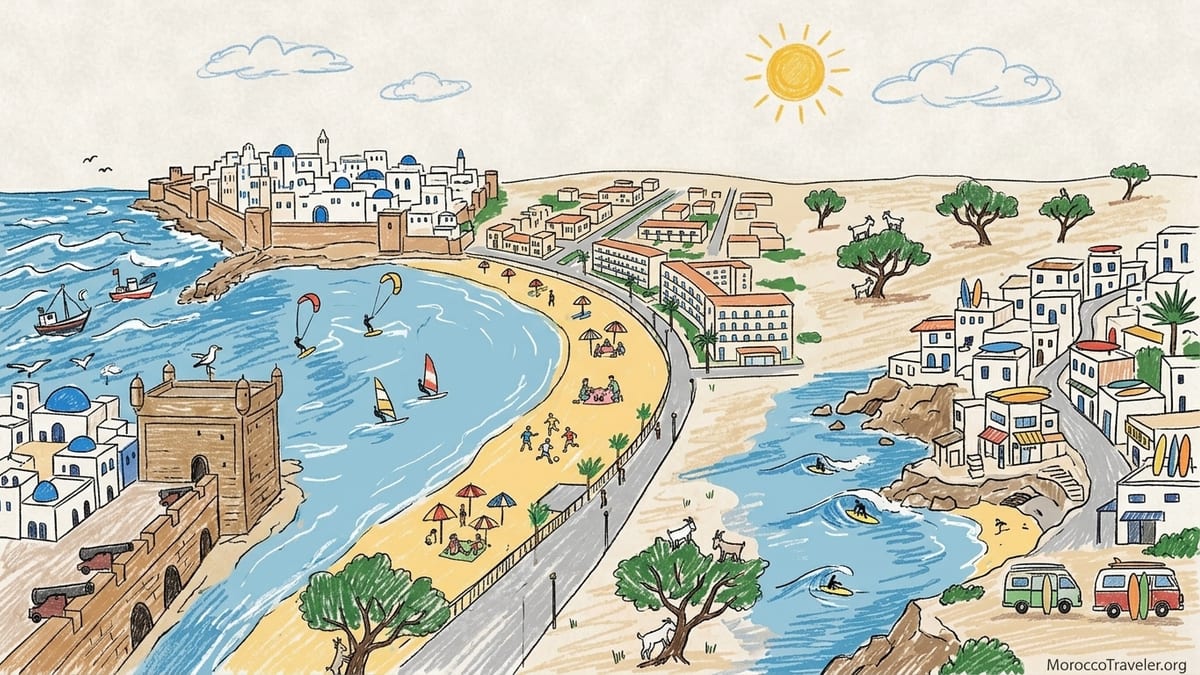
First Impressions: Three Very Different Atlantic Holidays
Landing in Morocco, these three places are often bundled together in the same sentence, but they deliver very different moods. Essaouira feels immediately historic. You step off the Supratours or CTM coach almost at the city walls and within minutes you are walking under stone arches into a compact medina framed by cannons and Atlantic spray. Fishing boats clatter in the harbor, seagulls scream overhead and the air smells of sardines and seaweed mixed with espresso and grilled cumin-scented fish.
Agadir, by contrast, is modern and horizontal. The 1960 earthquake erased most of the old town, so you arrive into a low-rise city of broad avenues, shopping malls and an almost uninterrupted curve of beige sand fronted by large hotels. The focus is not history but an easy, package-ready beach holiday where you can walk the promenade at sunset, duck into a café for ice cream and be back at an all-inclusive buffet in minutes.
Taghazout, 19 kilometers north of Agadir, feels smaller and more improvised. Vans with boards on the roof edge around tight corners above the sea, and every second building seems to be a surf shop, café or budget lodge. Here the soundtrack is wax being rubbed onto boards and the hiss of point breaks rolling down the line. It is not polished. There are unfinished buildings, junky lots and plenty of scruffy charm. But if you care more about waves and community than turn-down service, it can be addictive.
On a single trip you can experience all three. On my last circuit I travelled from Marrakech to Essaouira by coach, then onward by shuttle and shared taxi to Agadir and Taghazout, watching the landscape shift from argan tree hills to wide coastal plains. The journeys themselves have become part of how I judge each destination.
Beach, Water and Wind: What It Really Feels Like Outside
Essaouira’s beach is large, wild and often windy. The bay curves for several kilometers from the harbor down to the dunes near Diabat. The sand is compact enough for long walks and even horse or camel rides, and at low tide it feels huge. The trade-off is that a northeasterly wind blows much of the year, kicking up sand and chop. In October, air temperatures are pleasantly mild but the sea is Atlantic-cool, often around the high teens Celsius according to local surf operators. For a twenty-minute swim I have found it bracing but doable without a wetsuit; for longer sessions most people pull on neoprene.
This wind shapes expectations. I have met visitors who arrived in Essaouira imagining a still, palm-fringed resort bay, only to spend their beach days wrapped in hoodies behind café windbreaks. For kiteboarders and windsurfers that same breeze is gold, especially towards the middle and southern end of Plage Tagharte where the wind is cleaner. For sunbathers and families wanting toddlers to potter at the shoreline in calm water, it can feel disappointing. The trade-off is atmosphere: the combination of spray, fortifications and sky makes even a short beach walk feel elemental.
Agadir generally feels warmer and more resort-friendly. The long, shallow beach shelves gently and the water is somewhat softer and less wind-battered than Essaouira, which is why you see entire football games and family picnics along the sand. In spring and autumn I have happily swum here without a wetsuit for longer stretches. The promenade is cleaned regularly, beach clubs rake their sections and bins are frequent, so litter tends to be more under control than in smaller towns.
Taghazout’s beaches are more fragmented. The original village clings to a rocky section of coast, so the sandy stretches are a mix of smaller coves and the more open bay to the north near Anchor Point and Panorama. The water is similar in temperature to Agadir but the mood is different: there is almost always a surf class paddling around in the white water and more boards than lilos. On some days the water can look less pristine than in a big resort city. The area has a long-running reputation for occasional stomach upsets among surfers, which many locals blame on water quality. On my last visit I avoided swallowing water and stuck to well-reviewed cafés, and I stayed healthy, but I still would not call Taghazout’s ocean feel pristine.
Surf, Lessons and Watersports: Where to Get in the Water
If your ideal holiday is built around waves, these three destinations separate themselves quickly. Taghazout is the most obviously surf-focused. The coastline around the village is lined with famous point breaks like Anchor Point, Panorama and Hash Point, and in suitable winter swells advanced surfers talk about rides that can link sections for long distances. In the village itself, surf schools cluster along the main street, ranging from tiny outfits with a few soft-tops to established brands that run full camps with guiding, yoga and meals.
As of 2026, a typical stand-alone group surf lesson in Taghazout runs around 250 to 400 Moroccan dirhams for a two-hour session, including board and wetsuit, according to local pricing comparisons. That equates to roughly 25 to 40 euros. Multi-day camp packages marketed towards European beginners usually start around the low hundreds of euros for a week including accommodation, breakfasts, most lunches, daily transport to whichever beach is best and coaching. I have found it easy to turn up in town and book from one day to the next rather than committing everything months in advance.
Essaouira’s bay is better known for kitesurfing and windsurfing because of that ever-present wind. On my last stay I split time between classic surfing and wind-powered sessions. Surf schools here often shuttle learners to Sidi Kaouki, a more open sandy beach about 25 kilometers south, which picks up swell and offers softer, sand-bottom waves. A morning there usually includes transport from Essaouira, equipment and a group lesson for a similar price band to Taghazout, often somewhere in the 300 to 500 dirham range depending on the season and exact inclusions. For kitesurfing, several centers line the main bay, and once the afternoon thermal wind fills in, their canopies speckle the sky.
Agadir itself has surfable waves but is less of a hardcore surf hub than the breaks north and south. Many visitors who base themselves in Agadir book day trips to Tamraght, Taghazout or farther beaches with surf schools that offer hotel pick-up and drop-off. A common pattern I have seen among friends is to stay in a comfortable midrange Agadir hotel with a pool and restaurants, then let a surf school handle the logistics of boards, wetsuits and choosing the right beach each day. If you care more about reliable surf than about having a broad menu of restaurants and nightlife, though, you will likely gravitate towards Taghazout or Essaouira instead.
Accommodation on the Ground: Riads, Resorts and Surf Lodges
In Essaouira, the most satisfying stays I have had were in traditional riads tucked inside the medina. These are multi-story houses built around central courtyards, often with roof terraces that look out over flat roofs and the sea. Prices in 2026 for a comfortable, atmospheric midrange riad room with breakfast generally fall somewhere between 500 and 900 dirhams per night for a couple, based on rates displayed this autumn. Budget travelers can find simpler guesthouses for less, sometimes around the 300 to 400 dirham mark, while design-forward boutique riads go much higher. The main practical consideration is access. Cars cannot enter most of the medina, so you will likely need to roll your bag over cobbles for a few minutes from the gate.
Agadir is where large resort-style hotels dominate. Long, low complexes back directly onto the beach, often with gated gardens, multiple pools and all-inclusive wristbands. On recent checks, four-star resorts with half-board or all-inclusive options frequently advertise from the equivalent of 80 to 150 euros per night for two people, with big seasonal swings. This can represent very good value when you factor in buffets, kids’ activities and pool access. The downside is that some properties feel interchangeable and insulated from Moroccan life. It is possible to spend several days almost entirely inside your resort bubble, which some families appreciate and some independent travelers find sterile.
Taghazout’s accommodation scene leans towards small-scale surf lodges, basic guesthouses and a growing handful of smarter boutique hotels just outside the original village. Classic surf houses stack simple en-suite rooms above communal lounges and rooftop terraces where breakfast, sunset tea and, often, post-surf video analysis happen. Shared-room packages are commonly bundled into week-long surf and yoga deals, while private rooms without activities can remain under 600 to 900 dirhams per night depending on finish and season. In the original village streets, soundproofing can be thin, so light sleepers should ask about street noise and rooftop gatherings before booking.
Across all three, my main dislikes have been practical rather than dramatic. In Essaouira, some riads have beautiful but dark ground-floor rooms with little natural light. In Agadir, a few older resorts show their age in worn furnishings and buffet fatigue after several nights. In Taghazout, I have had rooms where the bathroom plumbing felt overwhelmed at busy times and where early-morning surf van departures meant doors banging at dawn. None of these were trip-ruining, but they are the sorts of details that separate a dreamy stay from a merely adequate one.
Food, Evenings and Atmosphere After Dark
Essaouira is my favorite of the three for eating and wandering at night. The medina is compact enough to feel manageable but big enough to reward aimless detours. Seafood stalls near the harbor grill that morning’s catch, and simple places inside the walls serve tajines, grilled sardines and bowls of harira soup at fair prices. There is a growing cluster of more polished bistros and wine bars tucked behind unmarked doors, where you can find dishes like seared fish with local vegetables and a glass of Moroccan wine. Even in high season, the mood in the alleyways feels more strolling than rowdy. Street lighting can be dim, but I have generally felt comfortable walking alone in the central lanes by early evening, keeping normal city awareness.
Agadir’s evenings center on the promenade and hotel entertainment. Families push strollers up and down the seafront, stopping for churros or ice cream. Beachfront cafés serve mocktails, mint tea and pastries. Inside the larger resorts, scheduled shows, live music and kids’ mini-discos provide structure, which many parents appreciate after an active day. Outside the seafront, Agadir has a more workaday Moroccan city energy, with shawarma spots, patisseries and shisha lounges, but the overall nightlife feels more dispersed than in cities like Marrakech or Casablanca. If you are looking for late bars and nightclubs, you can find them, but they tend to be away from the water.
Taghazout’s evenings are softer and smaller. After sunset surf sessions, people drift to simple cafés for tagines or burgers, or climb back to their lodge terraces to share couscous bowls and stories. Alcohol is less visible than in Essaouira or Agadir, though some places quietly serve beer or wine. Instead, the social life orbits around early starts and exhausted bodies. By 23:00, many rooftops are quiet, and the loudest sounds are Atlantic waves and the occasional dog. On the downside, waste management remains uneven; on my last visit, some backstreets and empty lots collected rubbish, which slightly undercut the romance of starry rooftop views.
In all three destinations, café culture is strong. I have often spent an hour in each simply lingering over mint tea, watching families walk by and absorbing the pacing of local life. For couples, that slow café time can be as important as any formal attraction.
Getting There and Around: Transport From Marrakech and Agadir Airports
For most visitors, journeys start in Marrakech or Agadir. To reach Essaouira from Marrakech, the most straightforward option is the intercity coach. Companies like Supratours and CTM run direct services in around two and a half to three hours on a flat, well-maintained road through argan country. Recent fare checks put standard one-way tickets in roughly the 100 to 130 dirham range per person, booked in advance online or at bus offices. Coaches from Marrakech usually depart near the main railway station and arrive beside or very close to Essaouira’s medina walls, which keeps onward taxi costs low.
Travelers on tighter budgets or seeking more flexibility can also use shared grand taxis. At Marrakech’s main taxi stands, drivers fill long-distance shared taxis seat by seat towards Essaouira, with typical prices per seat reported in the low hundreds of dirhams depending on negotiation, with the option to pay for the entire car if you want to leave immediately. Private transfers booked online from Marrakech to Essaouira are widely advertised from around the equivalent of 80 to 120 euros per vehicle for up to three or four passengers, a sensible choice for late-night arrivals or families with luggage.
Agadir has its own international airport, so many travelers land there directly for resort stays. From Agadir airport to the beachfront hotels, expect a taxi or private transfer to cost somewhere in the 200 to 300 dirham band based on recent local operator quotes, with a journey of around 30 to 40 minutes depending on traffic. From Agadir city to Taghazout, you can take local buses, shared taxis or pre-arranged shuttles. Surf-focused transport companies advertise fixed-price shuttles on common routes such as Agadir to Taghazout or Essaouira to Taghazout, with sample fares in 2026 in the ballpark of 10 to 20 euros per person for scheduled minivans.
Moving between the three coastal spots does not require a rental car, but having one does change how you use them. On one trip I rented a small car for a week out of Agadir and appreciated the ability to chase morning offshore winds or sheltered afternoon coves without worrying about taxi negotiation. On another trip I relied entirely on coaches and shuttles and still managed fine, at the cost of slightly more timetable watching and fewer spontaneous detours to roadside viewpoints or goat-filled argan trees.
Seasons and Who Each Place Suits Best
The best time to visit depends heavily on what you want to do. For surf-focused trips, the wider coastline between Essaouira and Taghazout tends to come into its own from roughly October through April, when Atlantic swells are more consistent and bigger. During this period, water temperatures hover in the mid to high teens Celsius, so most surfers wear full wetsuits, usually around 3/2 mm thickness. Agadir’s bay can still have smaller, friendlier waves for beginners in this period, while the points near Taghazout and stretches near Essaouira and Sidi Kaouki offer more power.
For conventional sun-and-swim beach holidays, late spring and early autumn are sweet spots. Around May and June, and again in September, air temperatures are warm without the most intense Saharan heat, and the sea feels manageable for long swims, especially around Agadir. Essaouira still has its trademark wind, but the sunshine and medina atmosphere can more than compensate if you treat the beach as a backdrop rather than a place to lie all day. Deep summer around Agadir can reach uncomfortable highs, particularly inland, although the sea breeze takes the edge off along the coast.
In terms of traveler types, I would rank the three destinations differently. For couples, my personal order is Essaouira first, then Taghazout, then Agadir. Essaouira’s mix of intimate riads, photogenic streets and good restaurants just feels more romantic. Taghazout comes second for surf-loving couples who are happy to trade polish for shared dawn patrols and barefoot dinners. Agadir works for couples who want a straightforward, low-effort resort stay, but it feels less distinctively Moroccan in its central beachfront zone.
For families, especially with younger children, Agadir moves to the top. The gentle beach, plentiful family rooms and kids’ clubs inside resorts make logistics simple. Essaouira can be a good second choice for culture-minded families who value walkable streets and manageable medina size over pool complexes, as long as they accept that the wind might curtail classic bucket-and-spade days. Taghazout sits third for families, largely because of its steeper village lanes, intermittent pavements and accommodation that is sometimes geared more to adults on surf camps than to small kids with strollers.
For surfers, Taghazout clearly wins, with Essaouira second and Agadir a distant third. The density of surf schools, breaks and like-minded travelers around Taghazout and its neighboring villages creates an easy ecosystem for both beginners and intermediates. Independent travelers who like a mix of culture, moderate surf and city wandering, however, might prefer Essaouira’s more varied offer and its better transport links to Marrakech.
What I Actually Liked and Disliked
Across multiple trips, certain patterns have stood out strongly enough that I now plan around them. In Essaouira, I love the medina scale, the way Atlantic light hits the whitewashed walls and blue doors, and the feeling of stepping from the hum of the souks out onto the ramparts in a few minutes. I have enjoyed having breakfast on riad rooftops with gulls banking overhead and then walking straight to the harbor to watch boats unload the morning catch. My key dislikes are the sandblasting effect on the main beach on very windy days and the occasional pushiness of touts near the harbor when cruise day-trippers are in town.
In Agadir, I appreciate how easy everything is. If you want a classic week of sun, a big pool, a predictable buffet and minimal logistical thinking, it is hard to beat. On one stay, a relative who rarely travels felt immediately at ease there in a way they did not in chaotic Marrakech. Personally, though, I find Agadir’s central resort strip a little anonymous after a few days. Many restaurants cater primarily to package tourists, menus blur together and it is possible to forget you are in Morocco until you leave the beachfront bubble and find a local market or neighborhood café. When I stay in Agadir now, I treat it as a base for day trips rather than a main attraction.
Taghazout is where my feelings are most mixed. The surf culture, sunsets and easy social contact between travelers can be wonderful. I have had memorable days where I surfed mellow morning peelers at Panorama, napped over lunch, then took a sunset yoga class on a rooftop deck. On the other hand, the village’s growing pains show in inconsistent waste collection, occasional construction noise and stories of stomach bugs that circulate among visiting surfers. I now choose my accommodation there carefully, prioritizing places that are transparent about hygiene, have good reviews for cleanliness and are honest about noise levels.
One unexpected positive across all three has been how easy it is to meet people if you want to. In riads in Essaouira, shared breakfasts often turn into impromptu sightseeing partnerships. In Agadir resorts, poolside conversations with neighboring families or couples can lead to shared taxis or restaurant tips. In Taghazout, the natural icebreaker of asking how the waves were that day opens most social doors.
The Takeaway
If I had to pick one Moroccan coastal escape that best matches my own travel style, it would be Essaouira. I would return there for four to five nights, staying inside the medina in a midrange riad with a sunny roof terrace and walking access to both the harbor and the nearest kite and surf schools. With my own money, I would happily spend again on a couple of organized surf or kitesurf sessions that include transport to Sidi Kaouki on good days, as well as on an upgraded dinner or two at one of the medina’s better bistros.
I would still include the others in future trips, but with clearer roles. From Essaouira, I might continue down the coast to Taghazout for three or four nights of focused surfing and rooftop yoga, specifically booking a lodge with strong cleanliness reviews, quiet hours and in-house coaching. I would budget for several days of lessons or board rental in that 250 to 400 dirham per day band and set money aside for a reliable shuttle back to Agadir or Marrakech at the end.
Agadir I would treat either as a gentle soft landing after a flight or as an easy base for traveling companions who want a resort feel. For a mixed group of surfers and non-surfers, I could imagine two or three nights in a comfortable beach hotel with a good pool, letting the surfers disappear on day trips north while others enjoy deckchairs and promenade walks. I would not personally allocate my whole Moroccan coastal trip to Agadir, but I can see its appeal for tired parents or first-time visitors.
Ultimately, the “best” Moroccan coastal escape depends less on objective rankings and more on where you are in your travel life. If you crave character and culture with some wind-ruffled sea, Essaouira is hard to beat. If your priority is an uncomplicated and family-friendly resort beach, Agadir fits the bill. If you want your days to revolve around tides, swells and yoga mats, Taghazout will keep calling you back. Knowing what each offers, and what each lacks, is the key to building a trip that feels like the right kind of escape rather than a compromise.
FAQ
Q1. Is Essaouira, Agadir or Taghazout better for a first trip to Morocco?
For a first trip, Essaouira is often the most balanced choice, with a walkable medina, manageable size, seaside atmosphere and enough tourist infrastructure to feel comfortable without losing its sense of place.
Q2. Can I swim comfortably without a wetsuit in these destinations?
In late spring to early autumn many visitors swim without wetsuits in Agadir and Taghazout. In Essaouira the water feels cooler and windier, so short dips are common without neoprene while longer sessions are usually more comfortable with a light wetsuit.
Q3. How much should I budget for surf lessons in Taghazout or Essaouira?
In 2026, group surf lessons with board and wetsuit typically cost around 250 to 400 dirhams per person for a two-hour session in Taghazout, with similar price bands in Essaouira and Sidi Kaouki depending on the school and season.
Q4. Is Agadir’s resort area very different from the rest of the city?
Yes. The beachfront strip is dominated by large hotels, a landscaped promenade and tourist-oriented restaurants, while neighborhoods away from the sea feel more like a regular Moroccan city with local markets and cafés.
Q5. Do I need to rent a car to visit all three places on one trip?
No. Coaches, shuttles and shared taxis link Marrakech, Essaouira, Agadir and Taghazout effectively. Renting a car gives more freedom to chase specific beaches and viewpoints but is not essential for most itineraries.
Q6. Which destination is best for families with small children?
Agadir usually works best for families thanks to its gentle beach, broad pavements, resort pools and kids’ clubs. Essaouira comes second for culture-minded families, while Taghazout is more suited to families with older children comfortable in a surf-focused environment.
Q7. Is the wind in Essaouira really a problem for beach holidays?
It can be if your main goal is calm sunbathing. Often the wind picks up by late morning and can blow sand around, which is great for kitesurfers but less pleasant for lying on a towel all day.
Q8. How many nights should I spend in each destination?
A balanced coastal trip could be four to five nights in Essaouira, three or four nights in Taghazout for focused surfing or yoga, and two or three nights in Agadir as a soft landing or resort-style rest.
Q9. Are there good options for vegetarian or vegan travelers?
All three destinations now offer some vegetarian and vegan dishes, especially in tourist areas, with Essaouira and Taghazout having a noticeable number of cafés that highlight plant-based bowls, salads and tagines alongside traditional fare.
Q10. Is it safe to walk around these places at night?
In central areas of Essaouira, along Agadir’s main promenade and in the core streets of Taghazout, I have generally felt comfortable walking at night while keeping normal urban precautions, such as avoiding very dark, empty backstreets and not displaying valuables.