


My first real encounter with Morocco did not begin at a hotel reception desk. It began at a wooden door in Marrakech’s medina, barely wide enough for two people, with no neon sign and no car in sight. It was close to midnight when my taxi dropped me at the edge of the old city. The driver pointed down a narrow lane crowded with parked scooters and said the name of my riad with a shrug. A staff member appeared from the shadows, took one of my bags and led me through a quiet maze of alleys that no car could ever enter. A few turns later, he knocked twice on an unmarked door. The noise of the medina faded as it swung open and I stepped into another world.
Arriving At A Riad: Crossing The Threshold From Chaos To Calm
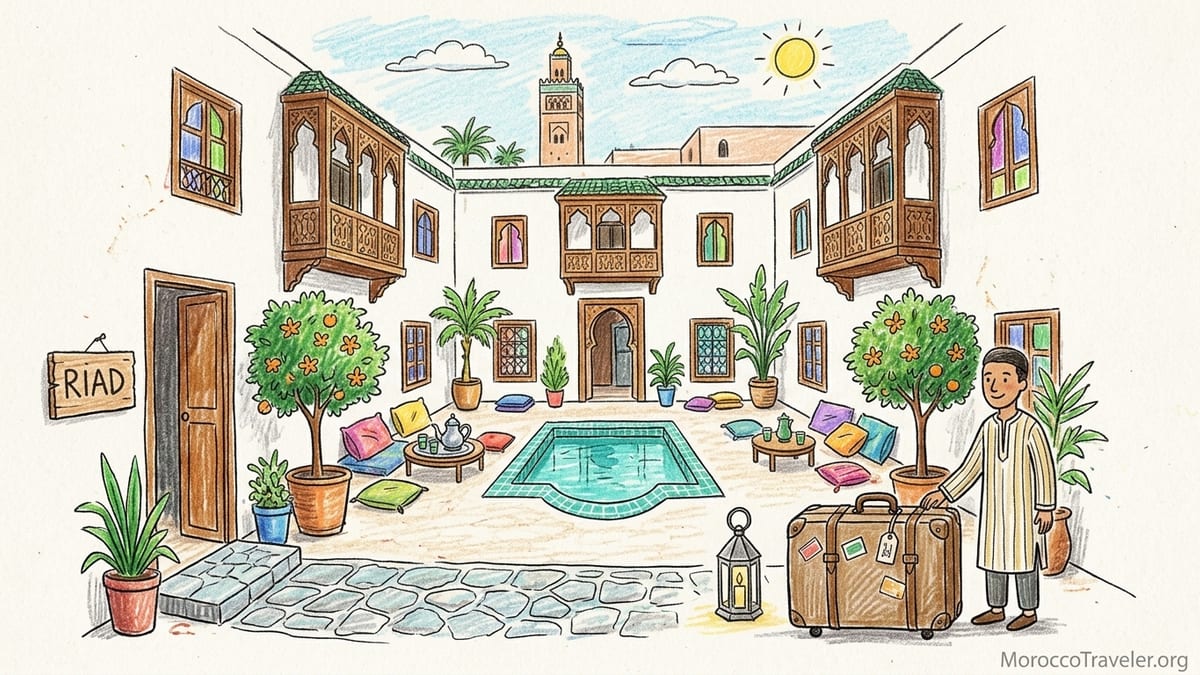
Inside Riad Anjar in Marrakech, the first sound I noticed was water. In the courtyard, a small turquoise pool reflected carved cedar balconies and whitewashed walls. The tiled floor was cool underfoot and the air smelled faintly of orange blossom. This is the classic riad experience: an inward-facing house wrapped around a courtyard, designed for privacy and shade rather than street presence. The city stays outside. My room was up two flights of stairs, past alcoves lit by lanterns and cushions scattered around low tables where breakfast would be served the next morning.
The practical side of this romance arrived with my luggage. From the taxi drop-off near Mouassine, it took around seven minutes on foot to reach the riad, and there were two short sections of uneven cobblestones. Pulling a rolling suitcase was possible but awkward. I was grateful that the riad had arranged a porter-style escort, something many medina properties now offer for a small fee when guests arrive late at night or with heavy bags. It meant I could focus on landmarks instead of worrying I would never find the same wooden door again.
At check in, there was no long counter or room queue. Instead, the manager invited me to sit in the courtyard with a glass of mint tea while she copied my passport details. Breakfast and local city tax were explained, and I was asked roughly what time I preferred to eat in the mornings so the small team could plan around it. This pattern of personal welcome repeated itself in other riads I stayed in across Morocco: a handful of rooms, a courtyard or patio as the social heart, and staff who quickly learned my name and daily rhythm.
Within minutes of dropping my bags in the room, I was standing on the rooftop terrace. Riad Anjar’s terrace looks over the tiled roofs of the medina, with the Koutoubia minaret visible in the distance. The air was cooler than down in the streets, and I understood why many riads describe the roof as a second living room. In summer, guests move between the shaded courtyard and breezy terrace. In winter, breakfasts may shift downstairs to avoid the morning chill.
Rooms, Comfort And The Fine Print Of Riad Living
My superior double room at Riad Anjar had a queen bed, air conditioning, heating, an en suite bathroom and a window that opened onto the internal courtyard rather than the street. When I booked directly on a previous trip in late 2023, I paid about 95 euros per night, including breakfast but excluding the per-person city tax. Recent listings for similar rooms at the same property in 2026 show average prices around 100 to 105 US dollars per night for two people, again with breakfast included but taxes and city fees added on top. The jump reflects a mix of seasonal demand and wider price rises in Marrakech.
Sleeping comfort in riads is influenced by three things: the mattress, sound insulation and climate control. The mattress quality at Riad Anjar and at a smaller Fez riad I stayed in later on my trip was comparable to a mid-range European hotel, firm but not hard. Sound was more of a trade-off. With rooms clustered around a courtyard, you may hear other guests coming and going, or breakfast being set up downstairs if you are a light sleeper in a first-floor room. In exchange, you are mostly sheltered from street noise. In Marrakech, the call to prayer reached my room as a distant echo rather than a full-volume loudspeaker.
Heating and air conditioning matter more than many first-time visitors realise. Marrakech can reach well over 40 degrees Celsius in high summer, while winter mornings can be close to freezing. Riads like Anjar advertise individual air conditioning units that also function as heaters, and thick traditional walls help keep interiors cool. In Fez, my medina guesthouse had effective air conditioning but only a small portable heater; the tiled floors stayed icy in January, and I was glad I had packed warm socks and layers. When comparing riads and hotels online, I now read guest reviews carefully for details about actual room temperature, not just the presence of a unit on the wall.
I have also had disappointments. In Essaouira, a budget riad room I booked for around 45 euros looked much brighter in the listing than in real life. The courtyard photograph had been taken at midday with every lantern blazing; in person, my ground-floor room felt permanently dim and the small internal window could not be opened. The staff were kind, but I cut my stay short by one night and moved to a slightly more expensive oceanfront hotel outside the medina walls where the room matched the photos more accurately. It reinforced my rule to scan reviews for recurring mentions of dark rooms, noisy courtyards or misleading images before committing.
Stairs, Rooftops, Pools And Luggage: The Hidden Logistics
Most traditional riads in Marrakech, Fez and Essaouira rise two or three floors around a central courtyard, and almost none have lifts. In all of the riads I stayed in, including Riad Anjar and a small family-run Fez property, my room was accessible only by stairs. These were usually tiled, fairly narrow and sometimes uneven, although there were handrails. Carrying a small backpack was easy; carrying a 23-kilogram suitcase up two flights was not. Staff will often help, but if you have knee issues or mobility limitations, this design is a serious consideration.
The rooftop terrace, often reached by one final steep staircase, is part of what makes riad living special. In Marrakech, breakfasts on the terrace came with views of storks circling the city walls and the morning call to prayer washing over the rooftops. In Fez, my riad’s roof looked straight onto the tangle of lanes below and across to the green tile roofs of several madrasas. Yet these same roofs can be breezy and cold in winter and very hot in July and August. Some riads offer shaded pergolas or small plunge pools on the terrace, while others simply lay out sun loungers.
Courtyard pools also vary. At Riad Anjar, the pool is a small but usable rectangle in the middle of the courtyard, large enough for a quick dip after a day in the souks but not for laps. One Fez riad I toured while researching did not have a swimming pool at all, just a decorative tiled fountain that could not be used for bathing. Listings sometimes use the word “pool” generously, so I treat photos as evidence and check written descriptions or reviews for clarifications such as “plunge pool” or “ornamental basin.”
Luggage access is where the differences between medina riads and conventional hotels become most obvious. Riads inside the old city are usually located along lanes too narrow for cars. Airport transfers normally drop guests at one of the main gates or small squares, from where it can be a five to fifteen minute walk. If you arrive in daylight with a small suitcase, this feels like part of the adventure. If you land on a delayed flight just before midnight, with two large rolling bags, crowded alleys and occasional broken paving stones can be more stressful than romantic. In contrast, conventional hotels in districts such as Gueliz in Marrakech, the Corniche in Casablanca or central Agadir almost always have direct car access, porters and lifts from the lobby to your floor.
How Riads Compare With Conventional Hotels And Boutique Properties
To understand the difference in feel, it helps to contrast my Marrakech riad stay with a later night at a modern hotel near Casablanca’s city centre. In Casablanca I booked a well-known international chain property that cost roughly 130 US dollars per night for a standard double room with breakfast. The room was larger than any riad room I had, with a desk, blackout curtains, strong soundproofing and central air conditioning. The shower pressure and hot water supply were excellent. There was an on-site bar, a gym and a full-size rooftop pool. Yet I could have been in almost any major city in the world; the only clues to Morocco were design details and the inclusion of msemen pancakes on the breakfast buffet.
The contrast in atmosphere was even sharper when I moved from a Fez riad to a boutique hotel in Rabat’s Hassan district. The boutique hotel, in a renovated townhouse just outside the medina, blended both worlds. It had around twenty rooms, a staffed front desk, a small elevator and a clear car drop-off on a paved street. My room opened to the outside rather than an internal courtyard, and noise from passing trams was more noticeable. Breakfast was served in a ground-floor restaurant as a small buffet combined with cooked-to-order eggs. I paid around 110 euros per night including breakfast in spring. The feel was of a small hotel with personality rather than a full riad immersion.
When choosing between riads and hotels, I think in practical categories. For sleeping comfort, conventional hotels usually win on sound insulation and predictable climate control. For privacy, it depends on layout; some riads have only a handful of rooms and feel almost like a private house, while others with fifteen or more rooms can be surprisingly busy. Breakfast at riads tends to be table service with fresh bread, jams, pancakes, eggs on request and coffee brought individually, whereas hotels rely more on buffets. That said, large hotels may cater better to specific dietary needs if you contact them in advance.
Service patterns are also different. In riads, I often dealt with the same two or three staff members throughout my stay, who helped with restaurant bookings, laundry and taxi reservations, and shared personal recommendations. Service was highly personal but occasionally slow when the team was handling multiple guest requests at once. In conventional hotels, service was more anonymous but also more structured, with a dedicated concierge, housekeeping team and 24-hour reception always staffed. I seldom had to wait, but I did not feel any particular human story behind the building.
Kasbah Guesthouses And Desert Camps: Morocco Beyond The Medina
Morocco’s traditional accommodation is not limited to riads. During a ten-day circuit that combined Marrakech with the High Atlas and the Agafay stone desert, I spent nights in a kasbah guesthouse and in a low-impact desert camp. The kasbah property, in the Ourika Valley, had thick earthen walls, tower-like corners and panoramic views over terraced fields. My room was simply furnished with Berber rugs, a firm double bed and an en suite bathroom. There was no television, and Wi-Fi only functioned in the common areas. I paid roughly 150 euros per night, including breakfast and dinner for two.
The experience there was about landscape rather than interior design. Mornings began with breakfast on a terrace overlooking the valley, and evenings ended with tagines served by the fireplace. Heating came from wall units and, on cooler nights, from the thermal mass of the walls themselves. Accessibility was decent: while there were some steps, the main rooms were on only two levels, and car access reached the gate of the property directly. For travellers who like the look of riads but want more open views and easier car access, kasbah guesthouses in the Atlas Mountains or near Ouarzazate offer a compelling alternative.
Desert camps, such as those in the Agafay area south of Marrakech or in the dunes near Merzouga, add another layer to the comparison. The camp where I stayed in Agafay combined permanent canvas structures with solid bathrooms, a shared dining tent and a small plunge pool. I paid just under 180 euros for one night for two people, including dinner, breakfast and a shared sunset camel walk. Temperatures dropped quickly after sunset, and although there were blankets and small heaters in the tent, it felt cooler than any riad room in winter. Sound carried differently too: instead of medina noise or courtyard conversations, I fell asleep to the wind and the occasional bark of a dog in the distance.
Compared to riads and hotels, desert camps usually offer less privacy in terms of sound isolation, since canvas walls are thinner than masonry. Bathrooms can be private but compact, and hot water supply is sometimes limited to certain hours. There is also usually no air conditioning. However, car access is typically straightforward via 4x4 vehicles arranged by the camp, and luggage is handled for you. For many visitors, one or two nights in a desert camp paired with time in a riad and a night in a coastal or city hotel creates a well-rounded Morocco itinerary.
Prices, Hidden Costs And The Guest-Review Details That Matter
Looking back over several trips, my riad stays in Marrakech, Fez and Essaouira have ranged from about 45 euros per night for a simple room in low season to around 110 euros per night for a superior double during busier months, almost always including breakfast but not local tourist taxes. Traditional hotels in Casablanca and Rabat have cost between roughly 100 and 140 US dollars per night for a standard double room with breakfast. Boutique kasbah properties and desert camps have been higher, often from 150 to 200 euros per night including dinner.
Beyond headline rates, there are three cost areas to watch. The first is city tax, which in many Moroccan destinations is collected per person per night and can add a notable amount to the total bill over a longer stay. The second is service charges on in-house dinners or extras. In some riads I found dinner prices comparable to or slightly higher than mid-range restaurants nearby, with optional service charges either clearly listed on the menu or added at around 10 percent. In one Essaouira riad, a substantial service fee on a set dinner surprised several guests who mentioned it in their reviews. The third is airport and luggage transfers; some riads offer fixed-price transfers that include a porter to guide you from the medina drop-off point, while others point you towards public taxis and expect you to manage the last stretch yourself.
Guest reviews are the best defence against disappointment, but they need to be read strategically. For riads, I pay close attention to comments about arrival and location, such as how long it takes to walk from the taxi drop-off, whether the route feels safe at night, and whether the property is easy to find. I also read references to noise from the courtyard, the street or nearby prayer calls, especially if I am travelling with light sleepers. Mentions of damp, poor heating in winter or weak air conditioning in summer are red flags. Repeated praise for staff, breakfasts and cleanliness is a good sign.
For conventional hotels and boutique properties, I look more at reports of maintenance and service consistency: are rooms as clean as the photos suggest, are lifts reliable, are there issues with hot water or billing? When comparing rates, I check whether breakfast is included, whether parking is free or paid, and how flexible the cancellation policy is. In Morocco, where plans can change due to weather, transport strikes or personal preference, being able to adjust a booking without large penalties is valuable.
It is worth noting that photographs, especially of riads, are often taken from the most flattering angles at optimal times of day. A plunge pool might appear larger than it is, or a standard double room might be shown with doors fully open and no luggage present. This does not mean properties are dishonest, but it does mean that cross-checking images with guest-uploaded photos and recent comments about room size, light and layout is wise. Where I ignored minor complaints about gloominess in favour of beautiful professional photography, I tended to regret it once I arrived.
Who Each Option Suits: Couples, Families, Solo Travellers And Older Visitors
For couples, riads in Marrakech, Fez and Essaouira offer the most atmospheric stays. A superior double room with breakfast in a well-reviewed riad can feel like a private retreat, especially if you choose a property with fewer than twelve rooms and a quiet courtyard. Rooftop dinners under lanterns and courtyard plunge pools are undeniably romantic. However, couples who are light sleepers or who value hotel-style amenities such as gyms, larger pools and room service until late might prefer a boutique hotel in districts like Gueliz in Marrakech or the marina area in Agadir, possibly adding a single night in a riad for the experience.
Families need to think carefully about space and supervision. Some riads offer family suites or interconnected rooms, but open staircases, courtyard pools and low railings on rooftop terraces can be challenging with younger children. In my experience, families with children under eight often seemed more relaxed in resort-style hotels on the coast or in Agadir, where there were kids’ pools, play areas and lifts, and where pushing a stroller along flat pavements was easier than navigating medina alleys. Older children and teenagers, on the other hand, often appeared fascinated by the maze-like medinas and rooftop views, and many families I met were happily split between a few nights in a riad and a few in a modern hotel.
Solo travellers will find advantages in both styles. In riads, the small scale and personal interaction can make it easier to ask for advice, join a shared excursion or simply have someone notice if you do not come down to breakfast. The trade-off is that privacy is more porous and you may feel more visible than in a large hotel. For solo visitors who prefer anonymity or who are working remotely and need absolute quiet at night, a business-class hotel near the city centre may be more comfortable. Budget-conscious solo travellers can find very good value in smaller riads in Marrakech and Fez, especially outside peak holiday periods, with private en suite rooms and breakfast often priced well below similar-quality hotel rooms.
For older visitors and people with mobility limitations, the choice is often shaped by access rather than price. Many medina riads involve several unavoidable steps between the street and the room, and even the prettiest courtyard cannot compensate for daily discomfort or risk of falls. In these cases, I suggest looking for ground-floor rooms in riads (and confirming there are no additional steps inside), or choosing boutique hotels just outside the medina walls with lifts and direct car access. In Rabat, for example, staying in a small hotel near the Hassan district allowed easy taxi drop-offs while still being a short ride from the old town. Similarly, in Marrakech, hotels along the edge of the medina or in Gueliz can reduce walking distances while allowing visits to the souks during the day.
Choosing A Mix For A Ten-Day Trip To Morocco
If I were planning a ten-day Morocco itinerary for a first-time visitor, based on my own experiences, I would blend accommodation types rather than commit to just one. I would begin with three nights in a riad in Marrakech’s medina, somewhere within a short walk of a main gate or square to simplify arrivals and departures. A property with around eight to twelve rooms, a rooftop terrace and a real plunge pool would balance atmosphere with comfort. Booking airport transfers directly through the riad, including a porter or escort from the medina drop-off point, would be non-negotiable, especially for evening landings.
Next, I would spend two or three nights in a kasbah guesthouse in the Atlas Mountains, such as in the Ourika Valley or near Toubkal, choosing a property with heating, good mountain views and included dinners. This stage provides fresh air and a slower pace after the intensity of the medina, while still keeping a traditional architectural feel. Car access and fewer stairs make it easier on the legs, and clear horizons replace city rooftops. Returning via Marrakech or heading toward the coast, I would add one or two nights in a desert camp near Agafay or, with more travel time, near Merzouga, accepting simpler infrastructure in exchange for open sky, silence and star-filled nights.
The final two to three nights I would reserve for a conventional hotel or polished boutique property in a coastal city such as Essaouira, Agadir or Casablanca, or in Rabat if onward train travel is involved. This section of the trip is for strong showers, predictable hot water, easy luggage handling and perhaps a larger swimming pool. It also acts as a decompression chamber, especially if your flight home leaves early in the morning, as hotels in modern districts tend to be closer to main roads and offer reliable transfer services at fixed times.
Personally, the nights that stay with me most vividly are still those in the riads: the echo of footsteps on tiles, the filtered morning light in a courtyard, the rooftop views in the cool of evening. Yet when my suitcase feels too heavy or my knees have had enough stairs, I am grateful for lifts, car-accessible entrances and the anonymity of hotel corridors. A balanced trip recognises that both styles have something valuable to offer.
FAQ
Q1. Are Moroccan riads usually more expensive than hotels?
Riads span a wide range of prices. In cities like Marrakech and Fez you can find simple riads that are cheaper than many hotels, as well as high-end designer riads that cost more than international chains. In my own bookings, mid-range riads with superior double rooms and breakfast were often slightly less expensive than modern four-star hotels in Casablanca or Rabat, especially outside peak holiday dates.
Q2. Can cars reach the door of most riads in the medina?
No. In Marrakech, Fez and many older quarters, taxi and private cars generally stop at main gates or small squares. From there, reaching a riad typically involves a walk of five to fifteen minutes through narrow alleys. Some properties are closer to the gates and easier to access, but very few have a car right at the door. It is worth asking the riad exactly how far the walk is and whether they can arrange someone to meet you on arrival.
Q3. How many stairs should I expect in a riad?
Most riads have at least one full flight of stairs between the ground floor and first-floor rooms, and another flight up to the roof terrace. Stairs are often narrower and steeper than in modern hotels, and there is almost never a lift. If you have mobility issues or heavy luggage, request a ground-floor room in advance or consider a hotel or kasbah guesthouse with easier access.
Q4. Do riads have proper heating and air conditioning?
Many mid-range and higher-end riads in popular cities have individual air conditioning units that also function as heaters, helped by thick masonry walls that hold temperature. However, not all budget properties offer strong heating in winter, and tiled floors can stay cold. When booking, check recent guest comments on room temperature in the season you will visit and confirm with the property if reliable heating or cooling is essential for you.
Q5. Is breakfast better in a riad or a hotel?
Breakfast in riads is usually served at the table, often in the courtyard or on the roof, with fresh bread, pastries, pancakes, jams, yoghurt and eggs made to order. It can feel more personal and relaxed. Hotels tend to offer larger buffets with more variety, which may be helpful for families or those with specific dietary needs. Preference largely depends on whether you value atmosphere and personal service or choice and speed.
Q6. Are kasbah guesthouses and desert camps suitable for first-time visitors?
Yes, provided you know what to expect. Kasbah guesthouses in the Atlas Mountains are a comfortable way to experience rural landscapes with solid walls, proper beds and included meals, though facilities may be simpler than in city hotels. Desert camps are more adventurous, with canvas or semi-permanent structures, cooler nights and less sound insulation. For first-time visitors, combining a riad stay with one or two nights in a kasbah or camp can create a memorable but still manageable itinerary.
Q7. What should I look for in guest reviews before booking a riad?
Focus on recent comments about arrival logistics, noise levels, heating and air conditioning, cleanliness and the accuracy of photos. Mentions of staff helpfulness, clear directions from taxi drop-off points and reliable airport transfers are especially useful. Repeated complaints about dark rooms, poor sound insulation or hidden service charges are reasons to consider other options.
Q8. Are riads a good choice for families with young children?
They can be, but parents need to consider safety and space. Many riads have open staircases, low railings on roof terraces and unguarded courtyard pools. Families with toddlers or very young children may find resort-style hotels or modern properties with lifts and fenced pools more relaxing. Older children often enjoy riads, particularly when there is a rooftop terrace and when rooms are close together.
Q9. How should older travellers or guests with limited mobility choose where to stay?
Older travellers or those with mobility limitations should prioritise properties with minimal stairs, lifts and direct car access. This usually means boutique hotels or modern properties just outside the medina, or kasbah guesthouses with ground-level rooms and documented access routes. If choosing a riad, confirm that there is a suitable ground-floor room and ask the property to describe the route from the taxi drop-off to your door.
Q10. What mix of accommodation works best for a ten-day Morocco trip?
Based on my own trips, a balanced ten-day itinerary might include three nights in a medina riad for atmosphere and walkable access to historic sights, two or three nights in a kasbah guesthouse in the mountains, one or two nights in a desert camp, and two or three nights in a modern hotel or boutique property in a coastal or administrative city. This combination gives you the intimacy and charm of traditional architecture, the drama of landscapes and the practical comforts of contemporary hotels at the beginning or end of your journey.