


On a clear spring morning in Marrakech I left the pink city and headed toward the High Atlas with a very specific question in mind: how “serious” is a Mount Toubkal trek compared with a simple walk from Imlil through Amazigh villages. Over several days, and with the help of local guides and guesthouse owners, I experienced both ends of that spectrum. What follows is a ground-level account of the road up from Marrakech, the trails I actually walked, meals I shared, and the checkpoints I passed, so you can decide whether your own Atlas experience should be a relaxed day out or a demanding summit push.
From Marrakech to Imlil: The Road Into the High Atlas
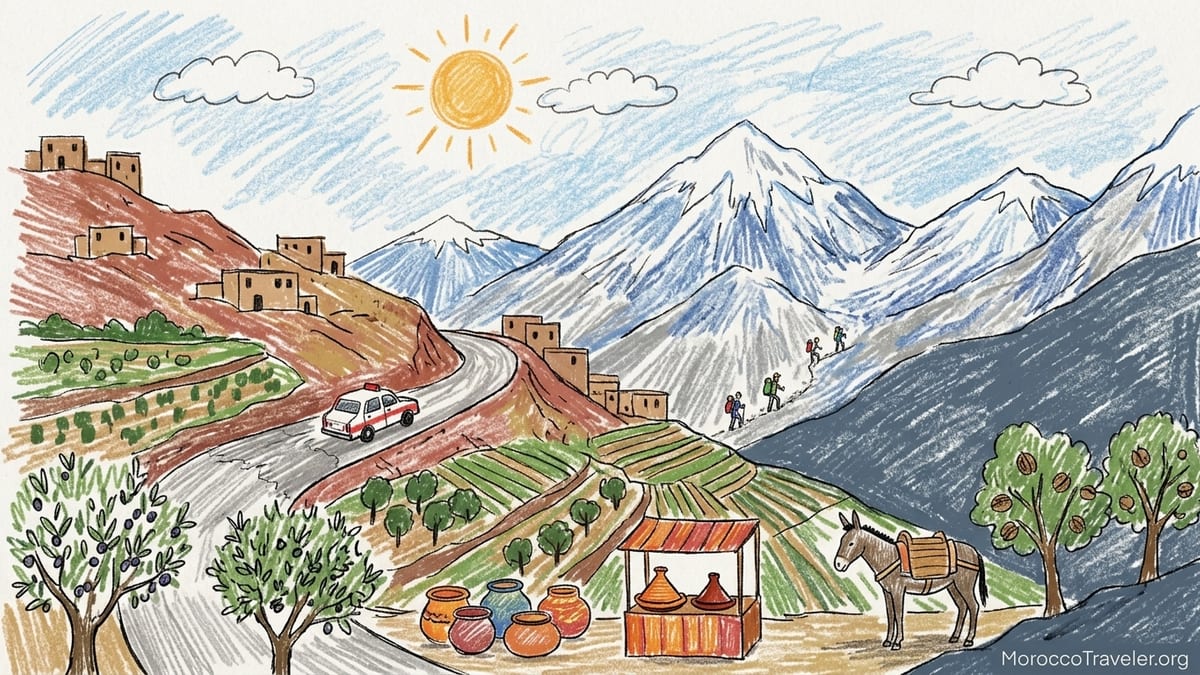
Leaving central Marrakech just after 8 a.m., the first half hour felt almost suburban. The taxi threaded through city traffic and out onto a fast paved road that pointed directly toward a hazy gray wall of mountains. As the concrete faded, roadside stalls took over: stacks of pottery, tagines, and oranges, and later the nurseries that line the approach to the foothills with rows of olive and fruit trees for sale. It took around an hour to reach the market town of Asni, where the road turned more decisively into the hills. Here the first snow-streaked ridges of the High Atlas came fully into view and the air felt a few degrees cooler.
Beyond Asni the character of the journey changed. The highway narrowed to a winding mountain road, patched in places after past winters and the 2023 earthquake, with concrete barriers edging steep drops to the valley below. Our driver slowed for tight bends and occasional rock debris. Villages clung to the hillsides, built from the same reddish earth that they sat on, with terraced fields of barley and apple orchards stepping down to the river. Short stops became part of the rhythm; in one village women in bright scarves were selling flatbread and fresh goat cheese, and our driver bought some for the road, handing back a piece drizzled with olive oil for me to try.
By the time we entered Imlil, roughly 65 kilometers and about 1.5 to 2 hours from Marrakech depending on traffic, the city already felt a long way behind. The altitude here is around 1,740 meters, and I could feel it in the lighter air and cooler breeze even in late spring. The taxi pulled into an open parking area next to walnut trees and irrigation channels, where mules waited with wooden saddles to carry luggage up the steep lanes. From this point on, the road ended and everything became a question of how far and how high you wanted to walk.
Expectation shifted too. On the drive up I had been picturing a single “Toubkal trail,” as many brochures present it, but watching day-trippers in jeans shuffle along the valley track while rope-coiled trekkers shouldered heavy packs made it obvious that “going to Imlil” can mean anything from a village stroll to a borderline mountaineering trip.
Staying in Imlil: Guesthouses, Meals and Amazigh Hospitality
For my first night I stayed at a small Amazigh-run guesthouse high on the slope above central Imlil, a style of accommodation that is typical of the valley. Reaching it involved a ten-minute uphill walk on a stony path that passed between stone houses and walnut trees. Inside, the rooms were simple but solid: thick walls, tiled floors, and heavy wool blankets folded in piles against any possible nighttime chill. On the rooftop terrace, metal tables overlooked the entire Imlil bowl, with the main Toubkal valley stretching away to the south.
Lunch that day set the tone for valley-level walking. We ate on the terrace: a tomato and cucumber salad, a lamb and vegetable tagine still bubbling when the lid came off, and mint tea poured from a height into small glasses. Prices in October 2026 for this sort of home-cooked set meal tended to be in the range of 80 to 120 Moroccan dirhams per person, depending on whether meat was included. What mattered more than the exact number was that the money went directly to the family running the guesthouse, something every local I spoke to encouraged visitors to prioritize while the region continues to balance tourism with post-earthquake reconstruction.
Conversation with the host, an experienced mountain guide, was my first real education in the layers of hiking around Imlil. Pointing across the valley he traced three different routes with his hand. One was a gentle contouring trail between villages that rarely climbed more than a couple hundred meters. Another was a steeper path to a high pass used for overnight treks. The last arrow of his palm followed the valley floor deep into Toubkal National Park toward the refuges and the 4,167 meter summit itself. His message was clear: “Imlil walks” and “Toubkal treks” share a starting point and scenery, but not difficulty, conditions, or risk.
That evening, as the temperature dropped quickly after sundown to single digits Celsius, the difference between day visitors and overnight guests also became obvious. Those returning to Marrakech climbed into their vehicles and disappeared into the dusk. Those staying pulled extra layers over shoulders, gathered around tagines in dining rooms that smelled of woodsmoke and cumin, and talked to guides about routes for the following day.
Easy Walking from Imlil: Village Paths and Half-Day Excursions
The next morning I set out on the kind of walk that many people associate with an “Atlas Mountains excursion” from Marrakech. With a local Amazigh guide, we left Imlil on a wide track shaded by walnut and cherry trees, crossed an irrigation channel on a simple concrete bridge, and began a gradual climb toward the village of Aroumd. This took about 40 minutes, roughly matching what local and international sources describe, but without any sense of rushing. Along the way, we passed children walking to school and farmers leading mules loaded with sacks of fodder between terraced fields.
Trail conditions on this route were straightforward: compacted earth, scattered stones, and occasional short steeper sections where I used my hands for balance. Good trainers or light hiking shoes were enough, and I saw several families walking with children. The maximum altitude gain from Imlil to Aroumd is in the region of 150 to 200 meters, and the walking felt more like a countryside ramble than a mountain expedition. In late spring the temperature hovered around 18 to 22 degrees Celsius during the day, cool enough that a light windproof layer felt comfortable in the shade.
In Aroumd we stopped for tea at a family home that also functions as a gite for trekkers on multi-day routes. The living room had low sofas around the walls and patterned carpets underfoot, with windows that framed the valley like a painting. As we ate fresh bread with olive oil and honey, the owner explained that many of their guests still imagined the Aroumd walk and the Toubkal approach as versions of the same experience. In reality, the village path sees a mixture of day-trippers and trekkers warming up, while the Toubkal trail beyond the national park checkpoint requires a guide and much more preparation.
For a full Imlil-based day without going near the refuges, another option I walked later is a loop that follows mule paths between several Amazigh villages on the valley slopes, often sold by agencies in Marrakech as a “Berber villages hike.” Over five hours we crossed orchards, passed small irrigation channels, and stopped in a family home for a tagine lunch. Hiring a private local guide for such a day, directly in Imlil or through an established guesthouse, generally cost in the region of 400 to 600 dirhams for the group in 2026, sometimes a little more if transport from Marrakech was included. Importantly, no special equipment was required beyond robust footwear, sun protection, and a basic day pack.
Stepping Up: Overnight Treks and Life Between Guesthouses and Refuges
To understand the middle ground between casual valley walks and a full summit push, I joined a two-day trek that climbed well above the villages but stopped short of Toubkal’s top. We left Imlil in the late morning with a guide and a mule carrying our overnight bags, heading toward a high pass that local operators use as a waypoint for non-summit itineraries. The first hours felt similar to the valley paths, but as we moved deeper into the park the trail narrowed and steepened, zigzagging up dusty slopes scattered with loose stones.
By mid-afternoon we were above 2,500 meters, with the valley far below and only patches of juniper and rock underfoot. I noticed my breathing deepen on steeper sections, a reminder that altitude was beginning to play a role even though we were still well below the Toubkal refuges. Temperatures at this height were distinctly cooler. While Marrakech was near 28 degrees Celsius, the air on the ridge sat closer to 15 degrees in the sun and dipped sharply in the shade. Here a light down jacket and gloves, which had been dead weight in my pack at lower elevations, became useful.
We spent the night in a stone-built gite above a smaller village. Conditions were basic but comfortable: shared dorm-style rooms with bunk beds, thick blankets, and simple shared bathrooms. Dinner came as soup, a generous chicken and vegetable tagine, fruit, and mint tea. On this kind of trek, food and accommodation are typically bundled, and my total cost via a local operator was broadly in line with published sample rates of around 70 to 100 euros equivalent per person for a two-day, one-night supported trek, covering the guide, mule, meals, and gite stay. Prices vary by season and group size, so these figures are best seen as indicative rather than universal.
This level of trekking still did not require any technical gear, but it did demand a solid level of fitness and comfort with walking several hours a day on uneven, sometimes steep ground. The trail infrastructure here consists of historic mule paths and simple waymarkers rather than manicured hiking tracks. Loose scree, narrow traverses, and the possibility of quick weather changes all added layers of seriousness that a short valley stroll does not have. It felt like real mountain travel, but still within reach of relatively fit hikers who prefer not to tackle the summit.
Climbing Toubkal: Checkpoints, Refuges and a Very Different Commitment
The final step up the ladder is the classic two-day Toubkal ascent from Imlil, which involves both bureaucratic and physical differences from the walks described above. Since late 2018, in response to a high-profile crime near Imlil, authorities have enforced mandatory use of a licensed guide for those attempting Toubkal and other high routes inside the national park. On the main trail beyond the village of Aroumd there are checkpoints where officers check passports and record guide details; hikers without a recognized guide can be turned back. These controls remained firmly in place in 2026 according to both local agencies and recent trekkers.
On my own Toubkal attempt we left Imlil before 9 a.m., passed through Aroumd, and reached the first checkpoint where our guide presented his license and our passports. The trail became a steady ascent on a combination of well-trodden earth and increasing stretches of rock and scree. After around four to five hours of walking, with roughly 1,200 meters of elevation gain, we reached the main refuge zone at just over 3,200 meters. Here two neighboring mountain refuges, one Moroccan-run and one linked historically to a French alpine club, provide dormitory accommodation, meals, and basic facilities for hundreds of climbers in the busy months.
Conditions in the refuges were a clear step down in comfort from valley guesthouses. Dorm rooms packed double- and triple-tier bunks close together, and reports from 2025 and 2026 describe cold nights, limited hot water, and very simple shared toilets. When I stayed, the practical routine mattered more than the ambiance: find a bunk, change into dry layers, drink as much water as possible, and eat the hearty dinner of soup, couscous or pasta, and fruit included in the half-board rate. Recent price information suggests that a dorm bed with dinner and breakfast at one of the refuges tends to fall in the ballpark of 300 to 400 dirhams per person, subject to seasonal updates from the hut wardens.
Summit day itself started around 4 a.m. under headlamps in near-freezing air even in late spring. The route climbed steeply from the refuges up a rough, loose slope of rock and dust, before traversing higher ridges with increasing exposure. At this point there is no constructed path, just a braided web of boot tracks through scree. Above roughly 3,800 meters, I found each step noticeably harder, with my heart pounding and my pace slowing to a measured rhythm. Wind on the ridge added a biting wind chill that pushed the perceived temperature below zero. In clear conditions we reached the metal summit pyramid at 4,167 meters roughly four hours after leaving the refuge.
This was mountain terrain in every sense. Above the refuges there is no infrastructure other than cairns and the route knowledge of local guides. In summer, most trekkers manage in sturdy hiking boots with warm clothing, while in winter and early spring snow and ice often cover the upper slopes. In those colder months, local guides and mountaineering bodies emphasize the need for crampons, an ice axe, and sound winter skills in addition to the legal guide requirement. The same mountain that can feel crowded and comparatively accessible in dry September can become a serious alpine outing in January.
Regulations, Safety and the Reality of Post-Earthquake Reconstruction
Every conversation about Toubkal in 2026 circles back to safety and regulations. The Royal Gendarmerie and park authorities continue to enforce the guide requirement for the Toubkal summit and several other high passes in the area. Practically, this means that a fully self-guided summit attempt is not an option for foreign visitors. It is, however, still entirely possible to walk many of the lower valley routes around Imlil without a guide, provided you stay short of the checkpoints and are comfortable navigating mountain paths.
Guide costs vary. Booking a private certified guide for a two-day Toubkal ascent directly in Imlil through the official guide bureau or a reputable guesthouse often comes out in the approximate range of 1,000 to 1,500 dirhams for the guide per day, which can be shared between several people. Package tours sold online from Marrakech that include transport, guide, refuge booking, meals, and often mules may cost noticeably more, but they remove most of the organizational friction. My own choice was a middle path: arranging the guide and refuge through a local Imlil-based agency while handling my own equipment and clothing.
The 2023 earthquake, which hit Al Haouz province hard, remains an important backdrop but not the central story of most treks. On the ground in 2026 I saw sections of road and some village houses that had clearly been rebuilt or reinforced, and heard from guesthouse owners about family members whose homes were still under repair in outlying hamlets. At the same time, daily life in Imlil itself was very much in motion, with shops open, guides meeting clients, and work continuing on improved road surfaces and drainage. Responsible visitors are encouraged to avoid treating damaged buildings as photo opportunities, and instead to support reconstruction indirectly by staying in local guesthouses and hiring local services rather than outside-owned companies that keep revenue in the cities.
Weather is another safety pillar. Even in late spring, conditions can shift quickly from warm sunshine to cold wind and cloud on the higher ridges. Autumn offers some of the most stable trekking weather, with generally clear skies and moderate temperatures. Winter, by contrast, can bring deep snow and sustained sub-zero temperatures above the refuges, turning an already challenging walk into a climb that belongs to experienced mountaineers with proper gear and a specialized guide. Whatever the season, anyone considering Toubkal should think of it as a 4,000 meter summit rather than an extension of a Marrakech day trip.
Choosing Between Day Trips, Self-Arranged Visits and Supported Treks
After experiencing both easy Imlil walks and the Toubkal ascent, the spectrum of options felt far clearer. At the gentlest end is the classic Marrakech-to-Imlil day tour. These usually include hotel pickup, a 1.5 to 2 hour drive to Imlil, a few hours of guided walking between villages, lunch in an Amazigh home, and the return journey in late afternoon. For visitors short on time, or those who want a taste of mountain scenery without committing to overnight stays or altitude, this is an excellent option. You can walk in trainers, carry only a light day bag, and be back in Marrakech in time for dinner on the square.
Stepping slightly deeper, a self-arranged one or two night stay in Imlil without any plan to summit opens up another style of trip. In this model, you organize your own transport to Imlil by private taxi or shared vehicle, book a guesthouse in the village, and then talk directly with local guides about suitable walks each day. This is what I did for part of my stay, and it allowed for a flexible mix of solo strolls on obvious paths and guided walks on more complex routes. Costs are spread between accommodation, meals and guide fees rather than bundled into a single package, and the pace of life slows to match the valley.
At the committed end sit the multi-day supported treks and summit expeditions. Whether you join a group trek from abroad or hire a local Imlil agency, these trips resemble small expeditions: porters or mules carry group gear, meals are provided in guesthouses or refuges, and the itinerary is fixed to account for altitude, distance and hut reservations. Daily walking times can range from five to nine hours, and participants need to be fit, properly equipped, and mentally prepared for basic accommodation and variable weather. My Toubkal climb, folded into a longer stay in the valley, felt like a distinct chapter rather than a simple “upgrade” to a village hike.
The key is to recognize that simple walking around Imlil does not require the same fitness, equipment or winter skills as climbing Toubkal. If you feel comfortable walking five hours on uneven ground and enjoy cultural immersion more than physical challenge, a village-focused visit will likely satisfy you fully. If, on the other hand, you already hike regularly, are curious about high altitude, and are willing to accept discomfort in exchange for a summit, a supported Toubkal trip might be worth the additional training, cost and complexity.
Packing, Seasons and Practical Gear Choices
Living through both kinds of experiences in a short span made packing choices feel less abstract. For valley walks and a relaxed Imlil stay, my essentials were solid walking shoes, breathable clothing, a sun hat, sunglasses, and a light fleece or sweater for the evenings. A small day pack with water, snacks, and a basic first aid kit was enough for most outings below 2,500 meters in late spring and autumn. Guesthouses supplied heavy blankets, so a sleeping bag was unnecessary at village level.
For the Toubkal ascent I added more serious gear: high-ankle hiking boots with good tread, trekking poles to manage the long descent on scree, a warm insulated jacket, gloves, and a hat that covered my ears. Above the refuges, layered clothing was vital. I wore a moisture-wicking base layer, a mid-layer fleece, and a windproof shell on summit day, adjusting as we climbed and the wind picked up on exposed ridges. Even in dry summer conditions, carrying a lightweight waterproof made sense in case of sudden storms.
Seasonality plays a major role in planning. Spring and autumn generally balance milder temperatures with lower chances of heavy snow on the main trail, although patches of snow can linger around the summit into May in some years. Summer brings warmer weather but also strong sun exposure and occasional afternoon storms at altitude. Winter transforms Toubkal into a serious alpine climb. In those months crampons, an ice axe, and knowledge of how to use them safely become as important as warm layers and a good headlamp. Local winter guides report that, in addition to the legal guide requirement, authorities may check for appropriate gear before allowing summit attempts.
Refuge accommodation also affects packing. Nights at 3,200 meters are cold year-round, and while the refuges provide blankets, many trekkers prefer to bring a compact sleeping bag liner for extra warmth and hygiene. Earplugs and a headlamp make crowded dorms more manageable. It is also wise to carry some high-energy snacks from Marrakech, as shop prices near the refuges are understandably higher than in the city and stock can be limited in quieter periods.
The Takeaway
Looking back on my time in the High Atlas, the contrasts are what stay with me. I remember the unhurried lunches on Imlil terraces, watching clouds snag on ridges while shepherds moved across distant slopes. I remember easy laughter with Amazigh hosts over mint tea, and the calm rhythm of valley paths where the biggest challenge was stepping aside for a mule train. Those days felt spacious and human-scaled, rooted in village life as much as in landscape.
I also remember the Toubkal summit day: the crunch of frozen scree underfoot in the pre-dawn dark, the silent line of headlamps climbing above the refuge, and the moment when the first sun hit the metal summit frame and revealed serried ranks of mountains falling away on all sides. It was exhilarating and demanding, a genuine 4,000 meter experience that left my legs and lungs well used. By the time we descended back to Imlil that afternoon, my appreciation for the simpler valley walks had grown rather than diminished.
If I had to choose just one experience to repeat, it would be a two-day mountain stay based in Imlil and a nearby village gite rather than another immediate summit push. I would arrive from Marrakech and stay at least two nights, spend one full day on a long village-to-village walk with a local guide, and another exploring shorter paths or simply sitting on a terrace watching light and weather change on the peaks. For me this strikes the right balance between physical effort, cultural connection, and the unhurried texture of Atlas life.
For travelers drawn to high summits and already comfortable on demanding mountain terrain, a Toubkal ascent remains an excellent objective, provided you respect the regulations, hire a qualified local guide, and pack as if for a real high-altitude trek rather than an extended city excursion. For everyone else, the good news is that the Atlas Mountains around Imlil offer deeply rewarding experiences long before you ever lace your boots for the summit trail.
FAQ
Q1. How long is the drive from Marrakech to Imlil, and what are the road conditions like?
The drive from central Marrakech to Imlil is roughly 65 kilometers and usually takes between 1.5 and 2 hours by private car or taxi. The first section is on a good paved road to Asni, while the final stretch is a narrower mountain road with bends, some repaired sections, and occasional minor rockfall, so drivers take it slowly but it is generally passable year-round outside of severe weather.
Q2. Do I need a licensed guide for all hikes around Imlil?
You are required to have a licensed guide for the Mount Toubkal summit route and certain higher trails inside Toubkal National Park, and there are checkpoints that enforce this. For lower valley walks between villages around Imlil and Aroumd, many visitors walk independently, although hiring a local guide is still recommended if you are unfamiliar with mountain terrain or want cultural context.
Q3. How difficult is a typical Imlil village walk compared with the Toubkal summit trek?
A typical Imlil village walk involves three to five hours of walking on mule paths with modest altitude gain, usually below 2,500 meters, and is manageable for reasonably active people in trainers. The Toubkal summit trek involves more than 2,000 meters of total elevation gain spread over two days, rough and sometimes steep scree above 3,200 meters, cold temperatures, and possible snow in shoulder seasons, so it requires higher fitness, better equipment, and greater mountain experience.
Q4. What kind of accommodation can I expect in Imlil and at the Toubkal refuges?
In Imlil and nearby villages you will find family-run guesthouses and gites with private or shared rooms, thick blankets, hot meals, and rooftop terraces overlooking the valley. At the Toubkal refuges the accommodation is dormitory-style with closely spaced bunks, shared bathrooms, limited hot water, and simple meals included in half-board rates, designed more for practicality at altitude than for comfort.
Q5. What are realistic guide and trek prices for the High Atlas in 2026?
In 2026, hiring a local guide directly in Imlil for a day walk around the villages often costs in the range of 400 to 600 dirhams for the group, while a two-day Toubkal trek with guide, refuge booking, and basic support typically runs to several thousand dirhams depending on group size and services included. All-inclusive packages bought through international operators or city-based agencies can cost more, but specific prices vary, so it is best to request a written quote from a reputable local provider.
Q6. When is the best season to hike around Imlil and to climb Toubkal?
Spring and autumn are generally the most comfortable seasons for both village hikes and Toubkal treks, with moderate temperatures and more stable weather. Summer offers longer days but can be hot at lower elevations and very sunny on exposed slopes, while winter brings snow and sustained cold above the refuges, turning the Toubkal route into a serious alpine climb suitable mainly for well-equipped mountaineers with winter skills.
Q7. What should I pack for a simple Imlil day hike versus a Toubkal summit attempt?
For a simple Imlil day hike, pack sturdy walking shoes or trainers, comfortable clothing, a light fleece or jacket, sun protection, water, snacks, and a small day pack. For a Toubkal summit attempt add high-ankle hiking boots, warm layers including an insulated jacket, hat and gloves, trekking poles, a headlamp, and in winter crampons and an ice axe, plus any personal medication and high-energy food you prefer.
Q8. Is it safe to travel to Imlil after the 2023 earthquake?
By late 2026, Imlil and the main approach roads were open, guesthouses and shops were operating, and trekking activities had resumed, although reconstruction work continues in parts of Al Haouz province. Travelers are encouraged to follow current travel advisories, respect any local restrictions, and support the region by staying in locally owned accommodation and hiring local guides rather than treating damaged areas as attractions.
Q9. Can beginners with no mountain experience climb Toubkal?
Beginners in good physical condition can sometimes reach the Toubkal summit in summer with a qualified guide, but they should be aware that it is a demanding 4,000 meter peak with long days, significant altitude gain, and basic refuge conditions. Those new to mountain travel often benefit from starting with one or two days of easier walks around Imlil to get used to the terrain before deciding whether to commit to a summit attempt.
Q10. How long should I stay in Imlil if I want both culture and some hiking?
A stay of two to three nights in Imlil works well for many travelers who want a mix of village life and walking without rushing. This allows one full day for a longer guided hike between Amazigh villages, another for shorter independent walks or relaxation on guesthouse terraces, and, if desired, enough time to slot in a Toubkal summit or a higher pass trek with proper rest on either side.