


On paper, the classic 3-day, 2-night Sahara tour from Marrakech to Merzouga sounds irresistible: cross the High Atlas, wander Aït Benhaddou, sleep in the Dadès Valley, ride camels into the dunes of Erg Chebbi, watch the sunrise, and be back in Marrakech in time for your next tagine. But after doing this exact loop myself and checking my tickets, GPS logs and camp receipts against what was advertised, I came away convinced that the famous three-day Sahara package, whether from Marrakech or Fez, deserves far more scrutiny than it usually gets.
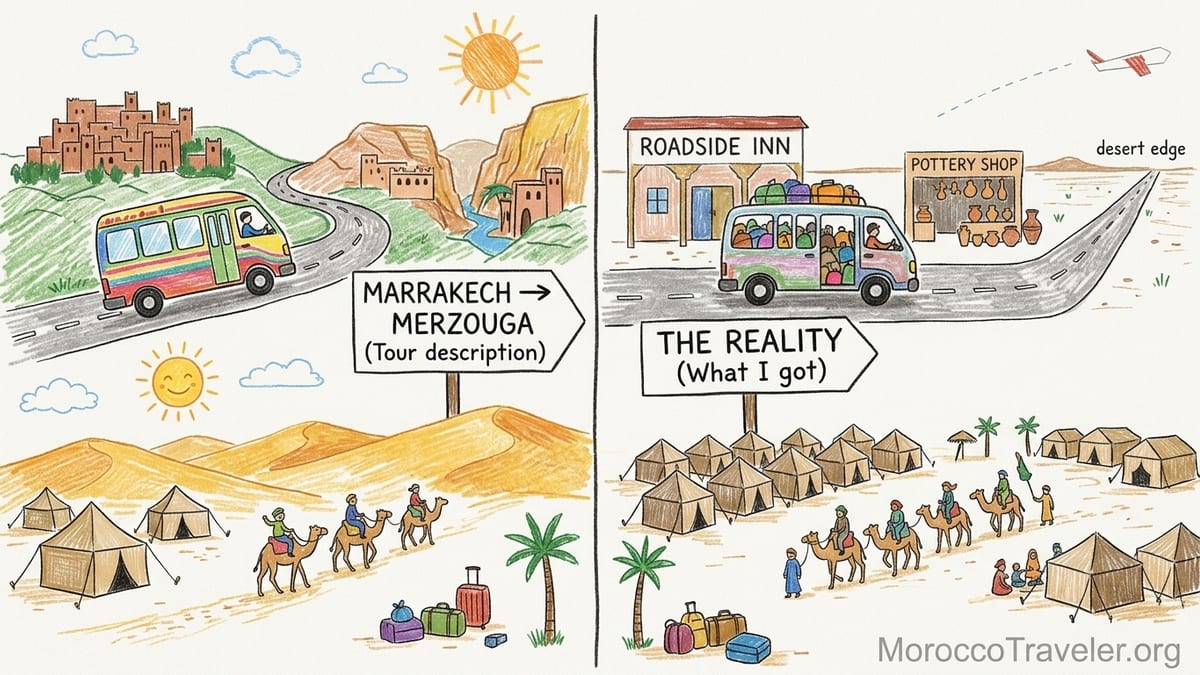
The Exact Tour I Booked Versus What Was Delivered
For this critique, I am referring to a very typical, widely sold 3-day Marrakech to Merzouga shared tour that closely mirrors what multiple Moroccan operators now offer. One representative example is the “Shared 3-Day Marrakech to Merzouga Desert Tour” marketed by several agencies with almost identical wording and routes. At the time of my trip, an almost carbon-copy itinerary was sold from Marrakech for about 95 to 120 euros per person in a shared minibus, with daily departures and an advertised upgrade to a “luxury camp” in Erg Chebbi available for an extra fee. Similar packages today still advertise shared departures from around 95 euros, with private versions climbing above 180 euros per person depending on group size and camp category.
The departure point in my case was central Marrakech, with riad pick-up in the medina specified between 7:00 and 7:30 a.m. The advertised itinerary matched what you now see on many tour descriptions: Day 1, Marrakech to Dadès via the Tizi n’Tichka Pass, Aït Benhaddou, Ouarzazate and the Dadès Gorges; Day 2, Dadès to Merzouga via Todra Gorge and Tinghir, arriving at Erg Chebbi for a camel ride and overnight in the dunes; Day 3, sunrise in the desert and a long drive back to Marrakech. The brochure promised an air-conditioned minibus, guided kasbah visit, one night in a hotel or guesthouse in the Dadès area, one night in a desert camp with private bathroom, hot water and electricity, and “plenty of stops for photos and breaks.”
What I actually experienced diverged in several important ways. The minibus was indeed air conditioned, but cramped for the number of passengers and luggage. The pick-up time stretched to nearly 8:15 a.m. as we shuttled around the medina collecting guests. The guided visit of Aït Benhaddou was more of a brisk walk with a mandatory pottery shop stop. The supposed three-star hotel in Dadès was closer to a basic roadside inn. Most significantly, the “luxury” desert camp did not match the photos in the listing, and the real time we spent in the dunes amounted to much less than the marketing implied.
I kept my own rough log with timestamps and distances. My notes line up closely with the driving times operators now acknowledge in their FAQs: roughly 8 to 10 hours of road time on the first and third days and 4 to 6 hours on the second day, depending on traffic and stops. That ratio between road and desert is at the heart of why I think the standard 3-day Sahara tour deserves serious criticism.
How the Hours Really Break Down: Driving vs. Desert
Most 3-day tours from Marrakech to Merzouga now acknowledge that the route involves long driving days. Several reputable operators state in their tour descriptions or FAQs that day three can involve up to 10 hours of driving from Erg Chebbi back to Marrakech, including short rest stops. One popular agency that runs a very similar itinerary even spells this out in its shared group tour description, advising that travelers who dislike long drives consider a 4- or 5-day version of the route instead.
On my trip, day one started at about 8:15 a.m. once everyone was on board and ended around 7:00 p.m. when we finally checked into a basic hotel in the Dadès Valley. Subtracting about 1 hour for lunch near Ouarzazate, 30 minutes of brief photo stops and 45 minutes actually walking in Aït Benhaddou, that still left a solid 9 hours of being inside the vehicle or standing at the side of the road. Day two began around 8:30 a.m. and reached Merzouga at about 5:15 p.m. After subtracting roughly 45 minutes at Todra Gorge and another 1.5 hours combined for lunch and rest stops, we were again looking at more than 6 hours of road time.
The supposed highlight, the dunes of Erg Chebbi, turned out to be the shortest part. From the moment we reached the Merzouga edge of the sand to the time we left for Marrakech the next morning, I clocked just over 14 hours in the desert area, and only about 3 of those were actually on the dunes: a 60 to 75 minute camel ride at sunset, some time sitting on the ridge for photos, then another 30 to 40 minutes at sunrise. The rest of the “desert” experience was spent inside a camp surrounded by other camps, with music and generators humming late into the night.
When you lay it out plainly, the 3-day Marrakech loop is closer to a long-distance road trip with a thin slice of dunes attached. Multiple recent independent travelers have made a similar observation, pointing out that the loop works on paper but that in practice it is “mostly driving,” with just one evening and one early morning in the sand and very little margin for delays or bad weather. That does not mean the road itself is not interesting the High Atlas, the Dadès Valley and Todra Gorge are scenic and worth seeing but it does mean that anyone imagining a long, quiet desert retreat will probably be disappointed.
Rushed Sights, Tourist Stops and Opaque Meal Costs
The itinerary lists a series of evocative stops: the Tizi n’Tichka Pass, Aït Benhaddou, Ouarzazate, Skoura, Dadès, Todra Gorge, Tinghir and finally Merzouga. In reality, on a three-day schedule those names become hashtags more than genuine visits. Our stop at the Tizi n’Tichka viewpoint was no more than a quick five-minute photo op. In Aït Benhaddou we had roughly 45 minutes inside the ksar after walking across the riverbed and climbing to the top. The guide moved quickly and there was little time to wander side alleys, linger at viewpoints or understand much of the site’s history.
Ouarzazate and its famous film studios appeared mostly as background scenery from the window. We pulled into a large roadside restaurant complex geared entirely to tour buses. There was no menu, just a fixed three-course lunch at a set price that felt high for Morocco. Our driver collected orders on the bus in advance, which made it clear there was a commission relationship at work. This pattern repeated in the Dadès area and again on the way to Merzouga. While the food itself was acceptable, the lack of choice and the markups chipped away at the advertised value of the tour, which did not include lunches or drinks.
The brochures and online listings typically state that breakfast and dinner are included on nights one and two, while lunches, drinks, snacks and some entrance fees are extra. In practice, the combination of isolated roadside restaurants and bundled group menus made it difficult to opt out or find an alternative, especially when the bus stopped at only one venue each time. This left many travelers feeling coerced into expensive meals several times a day, something that rarely appears in the glossy marketing copy. Over three days, the real cost of those lunches and drinks can rival the base price of the tour itself.
The same dynamic applied to some of the shopping stops. In one small town before Todra Gorge, the bus pulled into a carpet and handicraft cooperative where we were given a short presentation on Berber weaving, then steered into rooms full of rugs and textiles. There was no pressure in a hostile sense, but it was clear that this visit existed to funnel groups into buying, not to provide genuine cultural exchange. Similarly, near Merzouga, a promise of a “Berber music stop” led to a staged performance with musicians who then walked around the group with a tip basket. None of these extras are necessarily bad on their own, but they crowd a schedule that is already tight and push the whole experience further from what most people expect when they book a desert adventure.
Accommodation Gaps and the Reality of “Luxury” Camps
Accommodation is where the disconnect between marketing and reality became most obvious. The booking page described the first night’s stay in the Dadès area as a “3-star hotel or traditional guesthouse with private bathroom and heating.” The building we checked into was a simple roadside auberge with shared walls so thin that conversations next door were clearly audible. My room did have a private bathroom, but the hot water fluctuated and the small electric heater struggled to take the edge off the cold mountain air after dark. The decor was basic and clean enough, but very far from the atmospheric riad photos shown in the promotional images.
The second night in the desert was sold as a “luxury camp” upgrade. The photos on the booking site showed isolated white canvas tents scattered across high dunes, each with ensuite bathrooms, proper beds with high-quality linens, carpets on the sand, bedside lamps and solar-powered electricity. The reality was a camp aligned in straight rows in a shallow hollow surrounded by other camps. A 4x4 brought our luggage to the site while we rode camels, which was a positive detail that did match the description. The tent contained a double bed and two single mattresses on the floor. There was an attached bathroom area with a flush toilet and a simple shower. Electricity came from a generator that switched off around midnight.
While some of that corresponds broadly with the idea of “luxury,” several details did not match. The bedding was thinner and older than pictured, with no extra blankets initially provided even though nighttime temperatures dropped close to freezing in late autumn. The shower water was only lukewarm, and because multiple tents shared the same limited supply, there were periods when no hot water was available at all. The floor was dusty and the zips on the tent door did not close fully, letting sand and cold air in. The camp perimeter was dotted with other camps and faint road noise could be heard. In other words, this was an upgraded camp compared with a very basic option, but not genuinely luxurious in the sense implied by the photos.
Recent camp listings from various operators now typically differentiate between “standard” and “luxury” camps by promising private bathrooms, thicker mattresses, more space and better meals at the higher level. A number of them also now explicitly mention luggage transport by 4x4, electricity in the tents during certain hours and optional heating for a supplement. These are positive steps, but traveler reviews still frequently highlight mismatches between the category booked and the facilities provided. Before booking anything labeled “luxury,” it is worth asking blunt questions about bathroom type (ensuite or shared, Western toilet or squat), water temperature, whether there is any form of tent heating in winter, what hours electricity is available, how far the camp is from the nearest road and how many neighboring camps share the same area of dunes.
Comfort, Communication and the Minibus Marathon
The minibus used on our tour was a standard 17-seat vehicle with air conditioning and seatbelts. With 16 passengers and one guide-driver, every seat was occupied and bags were piled in the rear and occasionally in the aisle. For city transfers, this would be fine. For three days of mountain passes, roadworks and long straight stretches, it became a test of endurance. Legroom was tight, the suspension creaked over potholes and the air conditioning struggled in the heat of the Draa region.
Several current tour descriptions now mention that shared 3-day tours are operated in minibuses with up to 17 passengers and that private tours can be arranged for smaller groups in more spacious 4x4s or minibuses. That clarity is welcome, but it still does not communicate what 8 to 10 hours a day in a full minibus actually feels like. The High Atlas roads are winding and in some sections still under repair, leading to slow progress and motion sickness for some travelers. On my first day, at least three passengers felt unwell and needed extra stops, which in turn increased the total travel time.
Communication from the operator was another weak point. The booking confirmation contained only a broad outline of the itinerary and a short note about departure time. Details such as approximate arrival times, expected driving hours, meal price ranges, the exact standard of the Dadès hotel and the real duration of the camel ride were not provided until we were already on the road, and often only in response to repeated questions. When asked directly about how long we would be on camels, the driver gave a vague “maybe one and a half hours, depending on the group,” which turned into closer to 60 minutes in practice.
On the return day, the lack of firm timing became more stressful. Different passengers had evening flights and train departures booked from Marrakech and Fez. While our driver did his best to reassure everyone, the reality of a 10-hour road journey meant that any delay could have serious knock-on effects. In the end we pulled into Marrakech after 8:30 p.m., later than the rough “around 7 p.m.” mentioned at the start of the trip. Thankfully no one missed a connection, but the margin was slimmer than most people were comfortable with. This is one of the main reasons why, in hindsight, I believe the 3-day schedule is too tight for what it tries to accomplish.
Camel Welfare, Walking Options and 4x4 Alternatives
The standard 3-day Sahara tour almost always features a sunset camel ride from the edge of the dunes to the camp and a sunrise ride back. For many travelers, this is the iconic moment of the trip. Yet camel welfare on these high-volume routes deserves much more attention than it usually gets in marketing materials. On my tour, the camels appeared in generally good condition, but I noticed a few with visible rub marks from saddles and one animal that limped slightly as it walked. The camel boys were efficient but not particularly focused on checking how each animal was doing, and the pressure to get dozens of people mounted and moving before sunset was palpable.
Animal welfare organizations that monitor working animals in tourism often highlight the importance of limiting loads, providing adequate rest and water, and ensuring that saddles and ropes do not cause sores. On busy evenings in high season, a single caravan of camels might carry two dozen tourists into the dunes within a narrow window of light, and multiple caravans from neighboring camps will do the same. That volume of traffic on the same routes can contribute to overworked animals if operators are not proactive about rest days and veterinary care. Some camps and agencies now state that they follow specific welfare guidelines and allow travelers to choose a 4x4 transfer instead of a camel ride. It is worth actively seeking those out.
If you are concerned about riding animals, you can ask to walk alongside the camels for at least part of the route or to take a 4x4 to a point near the camp and then walk the last section on foot. Several camps in the Erg Chebbi area already quietly accommodate such requests, especially for guests with back problems or mobility issues. These alternatives are rarely highlighted in glossy brochures, but they exist and are a reasonable way to enjoy the dunes without contributing to potential overuse of camels.
Another under-discussed aspect is the actual time you get on the dunes for sunrise and sunset. Marketing photos often show tiny human figures on vast, untouched ridges of sand, implying serene solitude. The reality around popular camps is that sunset ridges can resemble a busy viewpoint, with guests from multiple camps clustered on the same slopes taking photos. The light is still beautiful and the desert still impressive, but it is important to calibrate expectations. If a more remote, quieter experience matters to you, you may want to target smaller camps that are based farther from the road or to devote extra days to reach less visited areas such as Erg Chigaga with private transport.
Marketing Photos vs. Real Desert Time and Surroundings
Perhaps the biggest disconnect between marketing and reality on my 3-day tour was the way photos framed the camp location and the duration of the dune experience. The booking page showcased sunrise and sunset images taken from high, isolated ridges, with no sign of neighboring camps, tracks or other groups. The camp tents appeared scattered loosely over open sand. In person, the camp sat in a shallow bowl of dunes with other camps visible in multiple directions and a cluster of parked 4x4s within walking distance behind a sand ridge.
The sunset experience felt shorter and more constrained than it looked online. We mounted our camels a bit after 6 p.m., paused briefly for photos halfway up a ridge, then continued to a higher viewpoint where we watched the sun drop for maybe 20 minutes before being ushered down to the camp as dusk fell. In the morning, wake-up was around 6:30 a.m., with about 10 minutes on a ridge as the light brightened and another 30 to 40 minutes riding back. Taken together, sunrise and sunset accounted for less than 90 minutes of actual time on elevated dunes. The rest of the “time in the desert” was spent in or around the camp itself, whose central courtyard was lit and filled with music until near midnight.
Recent independent reviews of various Erg Chebbi camps echo this pattern. Travelers often enjoy the spectacle of the dunes but comment that the experience feels more like a quick photo shoot than an immersive desert stay, especially on tightly scheduled 3-day packages where there is no free afternoon to wander or sit quietly among the sands. Some reviewers note that a second night in the desert, or even just an extra daytime in Merzouga, allowed them to climb dunes on their own, sit in silence away from the drums and talk with staff at a more relaxed pace.
In my own case, I found myself wishing for exactly that: a full unstructured afternoon after arrival and another quiet morning before leaving, instead of arriving just in time for sunset and leaving right after breakfast. That kind of slower rhythm is very difficult to achieve on a standard 3-day loop from Marrakech or Fez, which has to cover roughly 900 to 1,000 kilometers of road within a rigid timeframe.
Three vs. Four vs. Five Days, and Shared vs. Private
Having done the standard three-day tour, I would now only recommend it to travelers who are extremely short on time, have a strong tolerance for long road days and are fully aware that the dunes themselves will represent only a small fraction of the overall experience. For most visitors, a four- or five-day itinerary delivers a much better balance between driving and genuine time in the desert and valleys, even though headline prices look higher at first glance.
Several reputable operators that run almost identical 3-day Marrakech to Merzouga routes now also advertise 4-day and 5-day versions that follow the same general path but insert extra nights. A common 4-day pattern adds either a second night in Merzouga or a more leisurely return route with an overnight stop in the Draa Valley or Ouarzazate. This reduces the brutal 10-hour day three drive and gives you at least one full afternoon in or near the dunes without being rushed. A 5-day tour might split both the outbound and return legs into shorter segments and offer an additional valley stay, for example combining a night in Skoura or Agdz with a second night in the desert.
Cost comparisons can be misleading if you only look at the base price. A shared 3-day tour from Marrakech with standard camp tends to start around the low 100 euros per person range, not including lunches, drinks or optional activities like quad biking. A 4-day or 5-day tour with private transport and upgraded camp may easily exceed double that figure. However, once you add up the out-of-pocket costs on a budget 3-day package expensive fixed-menu lunches, drinks, tips, quad rides, possible room heating surcharges in winter the total narrows. For couples or small groups, a private 4x4 or minibus split between three or four people can deliver far greater comfort and flexibility without a proportional increase in actual daily spending.
The difference shared vs. private also shows up in how stops are handled. On my shared tour, timing at Aït Benhaddou, Todra Gorge and along the valleys was dictated by the group average and the need to reach the next overnight stop before dark. Private tours, by contrast, can adjust departure times, stop more often for spontaneous photos, detour through side roads in the palm groves or linger longer in a kasbah or village if you connect with a local guide. That flexibility becomes more meaningful as the number of days increases, because you are no longer trying to compress an entire region into a rushed three-day loop.
Essential Questions to Ask Before You Book
After comparing my own experience with current itineraries and recent reviews, I have come to believe that travelers need to interrogate 3-day Sahara tour offers more closely. A few targeted questions, asked before you pay a deposit, can dramatically increase your chances of getting the experience you think you are buying.
First, ask for a realistic breakdown of daily driving hours, including approximate departure and arrival times for each day. If an operator will not commit to a range for day one and day three in particular, that is a red flag. Second, insist on specifics about the vehicle: how many seats, how many passengers they usually put in a shared group, whether everyone is guaranteed a seat with a headrest and seatbelt, and whether air conditioning is used throughout the journey.
Third, request the exact names, photos and star rating (if any) of the hotel or guesthouse in the Dadès or Todra area and of the desert camp, along with confirmation of bathroom type, hot water availability, electricity hours and whether any form of heating is provided in winter. Ask where the camp sits in relation to the road and other camps and how luggage is transported to the tents. Fourth, ask exactly how long the camel ride will last at sunset and sunrise, and whether there are 4x4 or walking alternatives if you are concerned about animal welfare or comfort.
Finally, clarify which meals are included and what typical lunch venues cost. Ask if there will be any shopping stops or paid “cultural visits” along the way and whether those are optional. An operator that answers these questions straightforwardly and in writing is far more likely to deliver a transparent experience than one that brushes them off with “do not worry, everything is included” or “it depends on the group.”
The Takeaway
My 3-day Sahara tour from Marrakech delivered a condensed glimpse of southern Morocco: flashes of kasbah walls in Aït Benhaddou, the dramatic curves of the Dadès road, sheer cliffs in Todra Gorge and the soft light of sunrise over the Erg Chebbi dunes. Those moments were real and memorable. Yet they were wrapped in two and a half days of hard driving, rushed monument visits, commission-driven restaurant and shopping stops, and accommodation that fell short of the promises made online.
If your dream is simply to “touch the desert” and you are prepared for a bus-heavy itinerary, a 3-day loop can serve as an introduction. But if you imagine long, quiet hours on the dunes, time to sit with a book as the light changes, or slow conversations over tea with camp staff and valley families, the standard three-day package from Marrakech or Fez is the wrong tool for the job. A four- or five-day journey, ideally with private or small-group transport and clear, honest information about accommodation and driving times, will cost more up front but offer far more value in terms of experience.
The Sahara is not just a backdrop for sunset photos and camel silhouettes. It is a vast, fragile landscape and a living home for the communities that border it. Respecting that reality means giving it the time it deserves. If you can stretch your schedule and budget enough to move beyond the classic three-day dash, you are far more likely to come away with the kind of desert encounter you imagined when you first saw those golden dune photos on your screen.
FAQ
Q1. Is a 3-day Marrakech to Merzouga tour worth it if I am short on time?
For travelers with very limited time who understand that most of the trip will be driving, a 3-day tour can be a workable way to see the dunes briefly. You will get one sunset, one sunrise and a night in a desert camp, but the majority of your hours will be spent in a vehicle with rushed stops at sights along the way.
Q2. How many hours of driving should I realistically expect on a 3-day Sahara tour?
On the standard loop between Marrakech and Merzouga you should expect around 8 to 10 hours of road time on the first day, 4 to 6 hours on the second day and another 8 to 10 hours on the third day, including rest and meal stops. Exact times vary with traffic, roadworks and group pace, but you should plan for long days in the vehicle.
Q3. What is the real difference between standard and luxury desert camps?
Standard camps usually offer simple tents or rooms with shared or very basic private bathrooms, thin mattresses and limited hot water. So-called luxury camps typically add ensuite bathrooms, better bedding, more space, nicer decor and sometimes heating or air conditioning. However, not all “luxury” labels match reality, so it is essential to ask for clear details and recent photos before you book.
Q4. Are the camel rides ethical and can I avoid riding if I prefer?
Camel welfare varies by operator. Some camps care well for their animals while others work them hard to meet high tourist demand. If you are concerned, choose operators that acknowledge welfare policies, observe the condition of the camels on arrival and do not hesitate to refuse a ride if something looks wrong. Many camps can arrange a 4x4 transfer or allow you to walk alongside the camels instead.
Q5. How much extra should I budget for meals and activities on a 3-day tour?
Lunches, drinks and optional activities like quad biking are usually not included in the base tour price. Depending on where you eat and what you order, you may spend a significant additional amount over three days. Fixed-menu tourist restaurants on the route often charge noticeably more than local eateries, so ask about typical prices in advance and bring extra cash.
Q6. Will I really have time to enjoy Aït Benhaddou and Todra Gorge on a 3-day itinerary?
You will likely visit both, but the time will be limited. Many 3-day tours allow roughly 45 minutes to an hour inside Aït Benhaddou and a similar brief window at Todra Gorge. These visits are usually enough for a quick walk and photos but not for in-depth exploration, especially when larger groups move at the pace of the slowest members.
Q7. Is a 4-day or 5-day tour significantly better than a 3-day tour?
Yes, in most cases adding one or two extra days transforms the experience. A 4-day itinerary can reduce the longest driving days and give you at least one unhurried afternoon in or near the dunes. A 5-day trip can spread out the journey further, add more varied overnight stops and offer more flexible time in valleys and villages along the way.
Q8. Should I choose a shared group tour or pay extra for a private tour?
Shared tours are cheaper and can be sociable, but they involve fixed schedules, full minibuses and limited flexibility at stops. Private tours cost more per person, especially for couples, yet they offer more comfortable vehicles, the ability to adjust departure times and photo stops, and easier customization of where you stay and how long you spend in each place.
Q9. How can I check whether a camp’s photos genuinely match its location and facilities?
Ask the operator for the exact camp name, then search for recent traveler photos and reviews that are not promotional. Look closely at details like bathroom fixtures, bedding, tent spacing and views from the camp. If the marketing images show completely empty dunes but reviews mention nearby camps and vehicle tracks, calibrate your expectations or choose another option.
Q10. What key questions should I ask a tour operator before paying a deposit?
You should ask about daily driving hours, group size, vehicle type, the exact names and standards of your hotel and desert camp, bathroom and heating details, luggage transport, meal inclusions and typical lunch prices, camel ride duration and any 4x4 alternatives, and whether there will be shopping stops or optional paid activities. Clear, specific answers will help you avoid unwelcome surprises once you are already on the road.