


Morocco is one of North Africa’s easiest countries to cross overland, but choosing between trains, buses, rental cars and private drivers can still feel confusing. The country now has a modern high-speed rail line, a dense network of conventional trains, and nationwide coach companies reaching deep into the mountains and desert. At the same time, driving yourself opens up remote valleys and coastal corners that public transport simply does not reach. This guide brings together the latest information on routes, fares and practicalities so you can plan how to move between Morocco’s cities, coasts, mountains and Sahara gateways with confidence.
Understanding Morocco’s Big Picture Transport Network
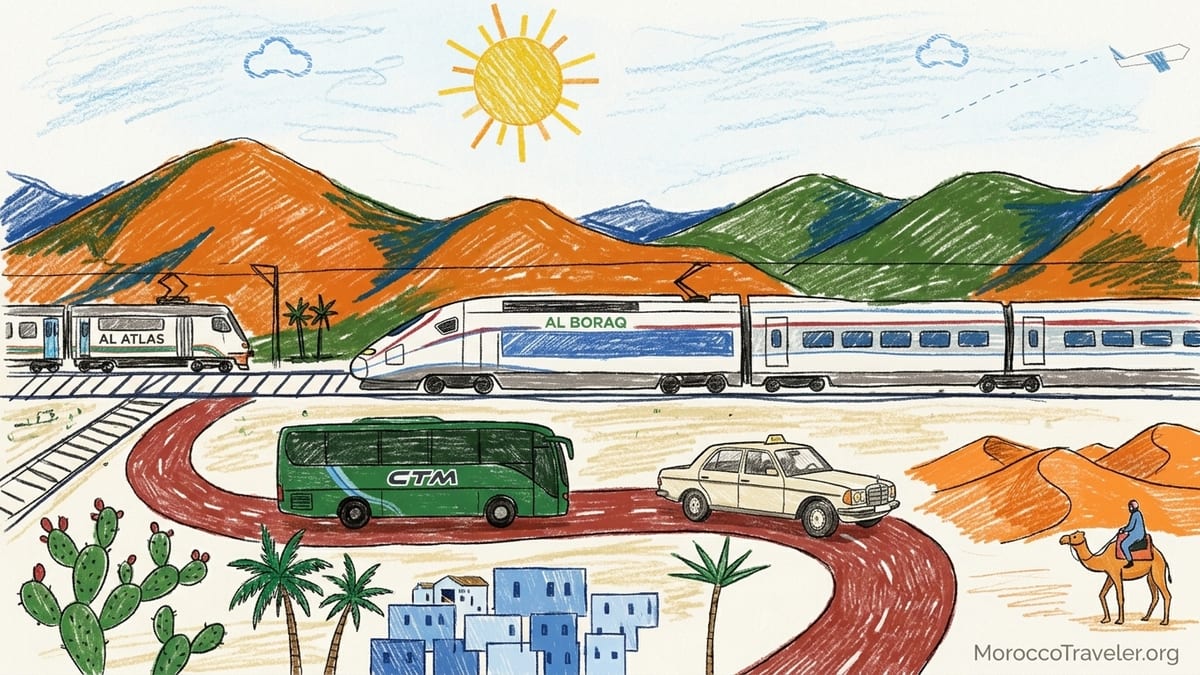
Morocco’s intercity transport is built around a spine of ONCF railway lines linking Tangier, Rabat, Casablanca, Meknes, Fez and Marrakech, combined with long-distance buses that take over where the tracks end. Official ONCF figures indicate a network of a little over 2,200 kilometres of track, with the busiest corridor between Fez, Rabat and Casablanca continuing south to Marrakech. Trains handle the bulk of passenger movements between the main cities, while buses, grand taxis and private transfers cover secondary towns, mountain villages and desert hubs.
The high-speed Al Boraq service between Tangier and Casablanca has transformed north–south travel times. Current journey times published in late October 2026 show Tangier to Rabat Agdal in about 1 hour 20 minutes and Tangier to Casablanca Voyageurs in around 2 hours 10 minutes, with several departures a day from early morning to evening. Fares on this corridor can range roughly from under 100 Moroccan dirhams in second class on discounted advance fares to above 200 dirhams in first class on busy days, with all seats reserved.
Conventional intercity trains branded Al Atlas connect Casablanca and Rabat with Fez, Meknes and Marrakech, plus branching lines toward Oujda, Nador, Safi and other regional centres. Fez to Marrakech is typically a through Al Atlas service via Meknes, Rabat and Casablanca, with journey times often around 6 and a half to 7 hours depending on the timetable in force. In practice, this means you can leave Fez after breakfast and reach Marrakech by late afternoon without changing.
Beyond the rails, national coach operators such as CTM and Supratours link destinations without passenger rail access. Agadir on the Atlantic coast, Chefchaouen in the Rif mountains and Merzouga on the Sahara fringe are among the best-known places where you will switch from train to bus or private road transport. For example, travellers reaching Merzouga from Marrakech or Fez usually combine an ONCF ticket with a Supratours coach that completes the final stretch into the desert village.
ONCF Trains and Al Boraq: When the Railway Works Best
ONCF trains are generally the most comfortable and time-efficient way to move between Morocco’s largest cities. The network is centred on Tangier, Rabat, Casablanca, Fez, Meknes and Marrakech, with modern stations at each. Al Boraq high-speed trains run on dedicated tracks between Tangier and Kenitra before continuing on upgraded lines to Rabat Agdal and Casablanca Voyageurs. Conventional Al Atlas trains continue south to Marrakech and east toward Fez, Meknes and Oujda, while rapid shuttle services circulate between Casablanca and Rabat.
For a concrete example, consider a trip from Casablanca to Tangier. Taking Al Boraq, you can expect journey times slightly above 2 hours, with air-conditioned carriages, reserved seating and luggage racks at each end of the coach. Sample fares published this month show second-class tickets on this route ranging roughly from about 100 to around 220 dirhams depending on departure and how early you buy, with first-class seats priced higher. Tickets are sold at station counters and machines and through ONCF’s official online channels, generally released up to roughly three months ahead, although seasonal timetable updates can mean some dates open closer to travel.
Between Rabat, Fez, Meknes and Marrakech, conventional Al Atlas trains offer regular direct or semi-direct services. A typical Fez to Rabat Agdal journey takes approximately 2 hours 30 minutes, while Fez to Casablanca is often around 4 hours and Fez to Marrakech around 6 and a half hours, with variations according to intermediate stops and works. Trains on these routes usually offer both first and second class, air conditioning and basic onboard services, though catering can be limited, so many travellers bring snacks and water from the station.
Rail is particularly attractive for longer hauls that follow the north–south axis: Tangier to Marrakech via Casablanca, Fez to Marrakech, and Rabat to Tangier on Al Boraq. It saves significant time compared with buses, is more spacious and predictable than grand taxis, and avoids the stress of driving long distances on unfamiliar roads. If your itinerary focuses on cities such as Tangier, Rabat, Casablanca, Meknes, Fez and Marrakech, you can comfortably rely on trains for most intercity segments and use taxis or occasional buses to reach nearby towns.
Where Trains Do Not Reach: Agadir, Chefchaouen, Merzouga and Beyond
Several major Moroccan destinations have no passenger rail service at all, which is crucial for planning. Agadir is one of the largest cities without a railway station. Travellers usually approach it from Marrakech by road, either by CTM or Supratours coach along the motorway corridor or by rental car over the High Atlas foothills. Travel time by coach is typically around 3 to 4 hours, and plans for a future high-speed extension from Marrakech toward Agadir are still at an early stage and not yet open to passengers.
Chefchaouen, the famous blue town in the Rif mountains, has no train station either. The usual railheads for Chefchaouen are Tangier, Tetouan or Fez. Many visitors take a train to Tangier Ville, then continue by CTM bus or a grand taxi to Chefchaouen in around 3 to 4 hours depending on traffic and the chosen route. Others come from Fez, using a CTM or other intercity bus for the roughly 4 to 5 hour run across the Rif. Because of winding mountain roads, trains would not be faster here even if tracks existed, so buses dominate.
Merzouga, on the edge of the Erg Chebbi dunes, is the most prominent desert hub without railway access. The nearest rail-connected towns lie far to the north and west, so ONCF cooperates with Supratours coaches that feed into the rail network. A current timetable published in September 2026 notes a direct Supratours bus from Marrakech to Merzouga leaving in the morning and arriving in the evening, roughly a 12-hour journey including stops. From Fez, travellers often ride a Supratours or other coach overnight toward Merzouga, or break the journey in Midelt or Errachidia.
Other rail-free areas include much of the Atlantic and Mediterranean coastline beyond the main cities, and many mountain valleys in the High Atlas and Anti-Atlas ranges. Coastal towns such as Essaouira and Taghazout, mountain centres like Imlil or Todra Gorge, and desert settlements around Zagora and M’Hamid are all reached by bus, shared taxi, private transfer or self-drive. When your itinerary includes several of these locations in one trip, you will likely combine one or two ONCF segments with a patchwork of road-based options.
Long-distance Buses, Grand Taxis and Domestic Flights
Long-distance buses are the workhorses of Moroccan travel, filling the gaps left by the railway. CTM, still the most widely recognised national operator, and Supratours, closely linked to ONCF, both run modern, air-conditioned coaches with seat reservations, designated luggage holds and ticketed baggage handling. Recent fare examples show routes such as Marrakech to Essaouira priced in the region of 80 to 120 dirhams per person one way on CTM, with journey times around 3 hours. CTM tickets can be purchased at agency counters, bus stations and through official online platforms; Supratours tickets are often sold together with train tickets when you book combined rail–coach itineraries.
On bus travel, luggage is weighed or visually assessed and loaded in the underfloor hold, sometimes with a small fee for large suitcases payable at a separate luggage counter. Hand luggage travels with you in the cabin. Comfort varies less than in many countries: most CTM and Supratours fleets now feature reclining seats, air conditioning and onboard toilets on longer routes. Smaller regional companies may be cheaper but usually offer older buses, more stops and less predictable timetables. For popular tourist segments like Marrakech–Essaouira or Fez–Chefchaouen, it is advised to buy tickets at least a day or two in advance in high season.
Grand taxis and petit taxis plug local and regional gaps. Petit taxis are small city cabs, usually metered in larger cities such as Casablanca, Rabat and Tangier, and used for hops between stations, medinas and hotels. Grand taxis are shared intercity vehicles, often older Mercedes sedans or modern people carriers, that wait at stands and depart once full, usually six passengers in older cars or fewer in newer minivans. A ride from Marrakech to Essaouira in a shared grand taxi might cost from around 70 dirhams per person at recent reported rates, with about 2 and a half to 3 hours on the road. You can also charter the whole vehicle for a negotiated flat price if you prefer to travel privately or at a specific time.
Domestic flights are a niche but useful option for very long journeys or tight schedules. Royal Air Maroc and Air Arabia operate internal routes linking Casablanca and other hubs to cities such as Tangier, Fez, Agadir, Oujda, Dakhla and Laayoune, although frequencies and routes change seasonally. For instance, flights between Marrakech Menara and Casablanca Mohammed V run multiple times per day, providing a fast connection for international transfers even though a rail link plus Al Boraq would also be feasible. On the other hand, for a trip like Casablanca to Dakhla in the far south, flying can save more than a full day of overland travel.
Driving and Car Rental: Freedom, Costs and Pitfalls
Renting a car in Morocco gives maximum flexibility for exploring remote coastlines, mountain valleys and scattered desert kasbahs, but it comes with responsibilities and costs that are important to understand. Most international and local agencies are present in the main airports and cities, and typical rental contracts for a compact manual car often involve a daily base rate plus a security deposit blocked on your card. Security holds of several thousand dirhams are common, with the exact figure depending on insurance coverage and agency policy. Automatic cars are increasingly available but remain fewer than manuals and are usually priced higher per day.
Insurance terms deserve careful attention. Basic rates often include mandatory third-party liability but carry a high excess for damage to the rental car itself. Collision damage waivers sold by rental companies can reduce the excess but may still leave several thousand dirhams at risk. Independent excess insurance from specialist providers can be a cost-effective alternative if you plan a longer trip or regular rentals. When comparing quotes, check whether windscreens, tyres and underbody are covered, as these are common exclusions, particularly relevant if you plan to drive on gravel or minor roads near desert areas.
On the road, Morocco’s main motorways between Tangier, Rabat, Casablanca, Marrakech and Agadir are modern toll roads. Toll booths accept cash in dirhams and increasingly bank cards. Driving from Marrakech to Agadir, for example, you can expect to pay a series of tolls amounting to several dozen dirhams for a one-way trip, depending on the latest tariff tables. Fuel prices fluctuate but, at recent levels, filling a compact car’s tank typically costs a few hundred dirhams, with petrol slightly more expensive than diesel. Stations are frequent along motorways and main highways but more spaced out in mountain and desert regions, where topping up whenever you can is wise.
Parking is generally easy outside the busiest city centres. Most newer hotels offer secure parking or arrangements with nearby guarded lots, where attendants charge modest fees for day and overnight stays. Inside historic medinas such as those in Fez or Marrakech, driving is rarely practical and often prohibited on the narrowest lanes. Streets are confusing, heavily pedestrianised and sometimes restricted to residents or delivery vehicles. Many visitors who attempt to drive right up to a riad door find themselves navigating congested alleys, sudden dead ends and informal attendants. A better strategy is to park on the edge of the medina in a supervised car park and continue on foot or by handcart porter.
Comparing Key Routes: Essaouira, Chefchaouen, Ouarzazate and Merzouga
Marrakech to Essaouira is one of Morocco’s classic journeys and a good illustration of transport choices. By CTM or Supratours coach, the journey typically takes about 3 hours, with fares around 80 to 120 dirhams per person in late 2026. Buses are comfortable, use the main road via Chichaoua and often include a short break. Shared grand taxis from Marrakech’s west-side taxi rank can be slightly faster if traffic is light, taking around 2 and a half hours, with per-seat prices that recent guides list from roughly 70 dirhams. Renting a car gives you full flexibility to stop at argan cooperatives or viewpoints, and fuel plus motorway-free driving can keep costs moderate, especially if shared among two or more travellers.
Fez to Chefchaouen requires leaving the rails behind. One common route is to travel by CTM coach, taking approximately 4 to 5 hours through the Rif mountains. Fares reported in autumn 2026 cluster around a few dozen dirhams per person, though exact amounts depend on schedule and season. Alternatively, some travellers piece together a journey with a train to Ouazzane or another regional centre and then a series of grand taxis, but this usually adds complexity rather than saving time. For groups of three or four, hiring a private driver or taxi for the full Fez–Chefchaouen road leg can become cost-competitive against individual coach seats and offers hotel-to-hotel convenience.
The road from Marrakech to Ouarzazate crosses the High Atlas via the Tizi n’Tichka pass and is notorious for its curves and changing weather. Supratours and other coach operators schedule around 4 hours for the journey, with some timetables in 2026 listing departures at 08:00 and arrivals mid-afternoon. Fares sit somewhere in the range of typical intercity bus pricing, so expect a moderate cost per person. Self-driving this route demands confidence on mountain roads, patience behind slower vehicles and readiness for fog, rain or occasional snow in winter. Many travellers who are unsure about mountain driving choose a private transfer or a shared minibus tour for this segment, so that they can enjoy scenery without the stress of hairpin bends.
Fez to Merzouga is one of the longest overland transits most visitors attempt. Supratours and other companies offer overnight coaches that depart Fez in the evening and arrive in Merzouga or nearby Hassi Labied the next morning, after roughly 10 to 12 hours with stops. Representative fares are higher than shorter legs but still generally cheaper than two days of car rental once fuel, insurance and potential one-way fees are considered. Some travellers, particularly families, prefer to split the journey by renting a car for two or three days, overnighting in Midelt or Errachidia and reaching Merzouga in daylight. In that scenario, a private driver with a comfortable vehicle can also make sense, since the cost spreads across several passengers and days.
Budgets and When Public Transport, Rental Cars or Private Drivers Win
Exact costs depend on the season, exchange rates and booking patterns, but some broad budget comparisons can help decision-making. For a solo traveller, public transport is usually the clear winner on price. A one-way Al Boraq ticket from Tangier to Casablanca in second class can cost well under the equivalent of 25 euros at current fare ranges, while a CTM coach between Marrakech and Essaouira might add another 10 euros or so. In contrast, a single-day rental of even a small car plus fuel, tolls and parking will often exceed the combined price of several intercity train and bus rides.
For couples, the calculation is more balanced. Two Al Boraq or AL Atlas tickets plus a pair of coach fares may still undercut a rental car for short city-to-city hops, especially if you focus on the rail corridor between Tangier, Rabat, Casablanca, Fez and Marrakech. However, once you add detours such as Essaouira, the Ourika Valley or the Dades Gorge, a rental car’s flexibility starts to compensate for its higher base cost. Over ten days, a compact manual car at a moderate daily rate, shared between two, can rival the cost of several one-way taxis plus multiple bus tickets, while adding the freedom to stop spontaneously and stay in off-route guesthouses.
Families of three, four or more often find that private vehicles become cost-effective. Buying four Al Boraq tickets from Tangier to Casablanca and four CTM seats from Marrakech to Essaouira soon adds up, especially in peak periods. In contrast, chartering a private driver for a day between Marrakech and Ouarzazate or Fez and Chefchaouen may cost significantly more in absolute terms than two coach tickets, but divided across four travellers it can approach the combined price of public transport while delivering door-to-door convenience, luggage assistance and a tailored schedule. The tipping point varies, but as a rule of thumb, when three or more people are travelling together on routes without fast rail, it pays to request quotes from reputable drivers or agencies.
Private drivers also come into their own where safety, comfort or time matter more than the lowest possible fare. Mountain passes in winter, late-night arrivals to unfamiliar cities and complex multi-stop desert circuits are all situations where a professional driver can reduce stress and risk. For example, a family landing in Marrakech in the evening and needing to reach a riad in the medina may prefer to pre-book a transfer rather than negotiate taxis after a long flight. Similarly, travellers heading from Merzouga to Ouarzazate with limited days left may choose a private car that can make short sightseeing stops and still arrive on time for an evening in town.
Recommended Transport Strategies for Different Itineraries
For short city breaks of around three or four days, the simplest approach is to let trains and taxis do almost all the work. If you are flying into Casablanca and focusing on Rabat and Tangier, combine Al Boraq segments between the three cities and use petit taxis within each. A weekend in Marrakech lends itself to airport transfers plus walking and petit taxis inside the city, perhaps adding one day trip on a CTM coach or organised transfer to Essaouira or the Ourika Valley. There is little reason to rent a car only for a compact city stay, given medina traffic limitations and parking challenges.
On a ten-day itinerary that combines cities, coast and desert, a mixed strategy is often best. One pragmatic sequence is to fly into Tangier, ride Al Boraq to Rabat and Casablanca, then continue by Al Atlas to Marrakech. From Marrakech, you might use CTM or Supratours to reach Essaouira for two nights, returning to Marrakech to join an organised desert tour that includes private vehicle transport to Ouarzazate and Merzouga and back. Another approach is to start in Casablanca, visit Rabat and Fez by train, then take a coach or private transfer to Chefchaouen, and finally continue by bus to Tangier for a flight out. In each case, trains handle the long legs between major cities, while buses, tours and transfers cover more remote stretches.
For longer road trips of two weeks or more that emphasise landscapes, kasbahs and coastal villages, a rental car or long-term private driver becomes increasingly attractive. A loop starting in Marrakech could lead over the Tizi n’Tichka pass to Ouarzazate, through the Dades and Todra Gorges, onward to Merzouga for a night in the dunes, then north via Midelt and Azrou to Fez and Meknes, before turning west to Rabat and Casablanca and finally back to Marrakech. While it is technically possible to piece this route together with a mosaic of buses and taxis, a car or driver allows you to choose lesser-known stops, boutique guesthouses outside main towns and quiet photography points that public transport does not reach.
Even on an extended road trip, it is worth combining modes where it makes sense. Some travellers, for instance, start with several days of train-based city travel between Tangier, Rabat, Casablanca and Fez to adjust to the country, then pick up a rental car only for the section between Fez and the desert, dropping it off in Marrakech to avoid driving through large urban areas at the end. Others book a private driver solely for demanding passes such as Marrakech–Ouarzazate while handling flatter, straighter segments themselves. Thinking of Morocco as a toolkit of trains, coaches, taxis, rental cars and drivers, rather than an all-or-nothing choice, usually produces the most comfortable and cost-effective plan.
The Takeaway
Getting around Morocco is less about finding a single best mode of transport and more about matching each stretch of your route to the option that fits it best. ONCF trains and the Al Boraq high-speed line excel between major cities like Tangier, Rabat, Casablanca, Fez, Meknes and Marrakech, offering speed, comfort and relatively low fares. Long-distance buses from CTM, Supratours and other operators reach vital destinations without rail access, including Essaouira, Agadir, Chefchaouen, Ouarzazate and the desert gateways around Merzouga, usually at accessible prices and decent comfort levels.
Car rentals and private drivers add another dimension, opening up mountain passes, hidden kasbahs and quiet coastal towns that would be time-consuming to reach by public transport alone. They are rarely the cheapest solutions for solo travellers focused on the rail corridor, but can become cost-competitive and worthwhile for couples planning complex itineraries and for families seeking door-to-door convenience and safety. By combining up-to-date information on timetables and fares with a realistic look at driving conditions and logistics, you can assemble a transport plan that turns moving between Morocco’s regions into a memorable part of the journey rather than a chore.
FAQ
Q1. Do I need to book Al Boraq and other ONCF trains in advance?
While you can sometimes buy tickets on the day, it is safer to book Al Boraq and long-distance Al Atlas trains in advance for popular dates, especially weekends and holidays, because all Al Boraq seats are reserved and cheaper fare tiers can sell out.
Q2. How much should I budget for a typical intercity train journey?
As a rough guide in late 2026, second-class fares for medium to long Al Atlas and Al Boraq journeys often fall somewhere between a few dozen and a bit over 200 dirhams, depending on distance, demand and how early you book, while first class costs more.
Q3. Are CTM and Supratours buses safe and comfortable for long distances?
Both CTM and Supratours operate modern, air-conditioned coaches and adhere to scheduled routes, making them among the safest and most comfortable options for long-distance bus travel in Morocco compared with smaller regional companies.
Q4. Can I rely on online timetables and tickets for buses and trains?
Official ONCF and major bus company sites provide up-to-date timetables and online booking, but schedules can change for seasonal reasons or engineering works, so it is wise to reconfirm close to travel and, for key journeys, to buy tickets a day or two in advance at stations.
Q5. Is driving in Morocco difficult for visitors?
Driving on motorways and main highways is generally straightforward for experienced drivers, but city traffic, mountain passes and rural night driving can be challenging, so it is important to be cautious, avoid tight schedules and consider private drivers for sections you do not feel comfortable handling.
Q6. Do I need an international driving permit to rent a car?
Many rental agencies accept a valid licence from your home country for short stays, but some recommend or require an international driving permit in addition, so it is prudent to obtain one before travel and carry both documents.
Q7. Is it a good idea to drive into medinas like Fez and Marrakech?
Driving inside historic medinas is usually a bad idea because streets are narrow, crowded and often restricted, so it is better to park in a supervised lot on the edge and walk or use porters to reach your accommodation.
Q8. When does hiring a private driver make financial sense?
Hiring a private driver can become cost-effective when three or more people travel together on routes without fast rail, or when you tackle complex, mountainous or multi-stop segments where saved time and reduced stress justify the higher daily rate.
Q9. How do I handle luggage on buses and trains?
On trains, you keep bags with you in overhead racks or luggage zones at carriage ends, while on intercity buses, larger suitcases are checked into the underfloor hold, sometimes with a small fee, and you keep valuables and essentials in a small daypack onboard.
Q10. Are domestic flights worth considering inside Morocco?
Domestic flights are worth considering for very long north–south journeys or when your schedule is tight, particularly to far-flung destinations such as Dakhla or Laayoune, but for most city pairs within the rail and motorway corridor, trains and coaches remain more economical and environmentally lighter choices.