


When I first booked Morocco, I imagined a single, archetypal city of ochre walls, snake charmers and maze-like alleys. Instead, my days in Marrakech and my later trip to Fez felt like two different countries that just happened to share a king and a cuisine. Both cities surprised me, sometimes exhausted me and often delighted me, but not in the same ways. Looking back on my real experiences on the ground, certain memories keep pulling me more strongly in one direction than the other.
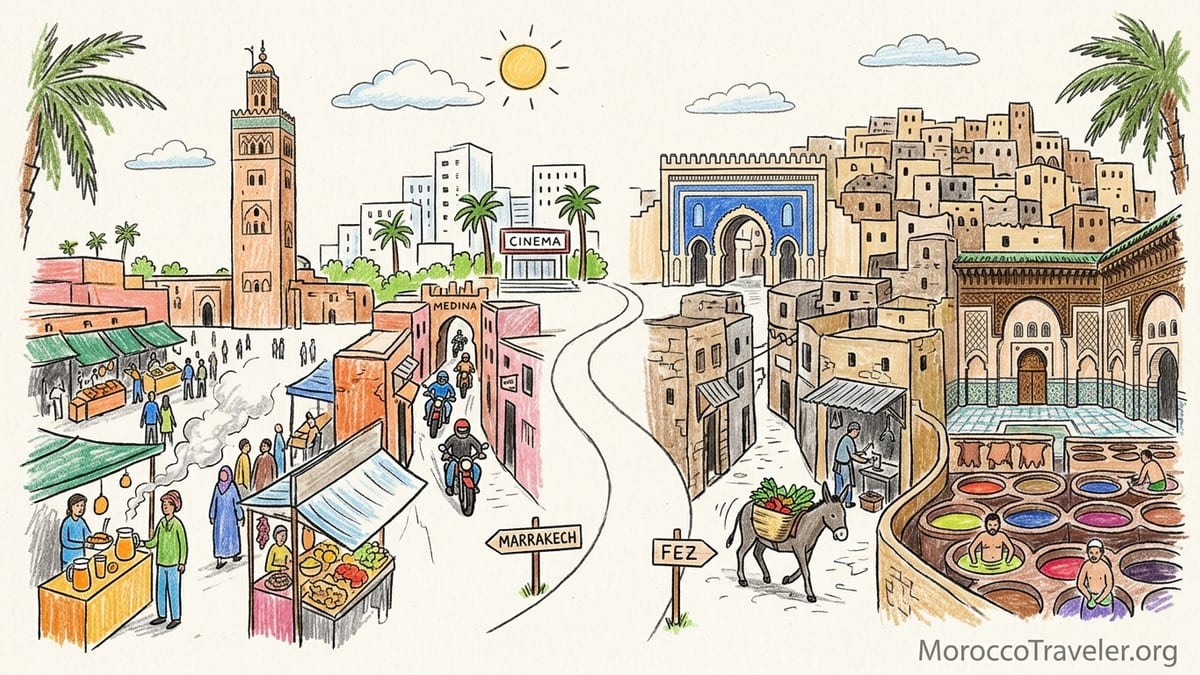
Before Arrival: Expectations vs Reality in Two Very Different Cities
Before I saw either city, Marrakech existed in my head as a cliché. I pictured Jemaa el Fnaa as one endless postcard of orange juice stalls and storytellers, with easy day trips to the desert and luxury riads waiting serenely behind heavy wooden doors. Fez, in contrast, sounded to me like the “serious” choice. Friends who love history insisted it was more authentic, more traditional and more intense. I expected beauty in both, but I braced for Fez to be harder work.
That is not quite how it played out. Marrakech was more overwhelming than I expected, especially around Jemaa el Fnaa at night, but it also felt surprisingly cosmopolitan. Stepping into the modern districts around Gueliz after a few hours in the souks felt like changing countries. Fez, on the other hand, felt less showy and more enclosed. Its medina, Fes el Bali, is a stone bowl of lanes wrapped around hills, and once you are inside, the modern world almost disappears. It was intense, yet oddly calmer than Marrakech because there are no motorbikes racing through the narrowest alleys.
My assumptions about ease and comfort were challenged too. I had expected Marrakech to be simpler for a first-time visitor and for Fez to demand guides and constant negotiating. In practice, I found Marrakech easier to understand on a map but more draining in day-to-day interactions. Fez was geographically confusing, but the people I dealt with one-on-one, from riad staff to workshop owners, often came across as more patient and less aggressively sales-focused.
By the time I left Morocco, both cities had given me moments of frustration and many more of genuine joy. The question of which one I would actually return to, and how I would divide my limited vacation nights, turned out to be much more nuanced than the reputation of either place suggested.
Marrakech on the Ground: Jemaa el Fnaa, Souks and Modern Contrast
My first real contact with Marrakech came within an hour of landing at Menara Airport, which sits roughly 5 kilometers from the city center. I skipped the airport taxi kiosks and took the airport bus that runs during the day, paying about 30 dirhams in cash and watching the low, ochre city draw closer. The bus dropped me near the old town, and a short walk brought me into the chaos of Jemaa el Fnaa for the first time.
By late afternoon, Jemaa el Fnaa was already loud. Drummers hammered out overlapping rhythms, orange juice sellers called out prices, and smoke from grilled meats drifted in from the food stalls setting up for the evening. As the sun went down, the square shifted again. Henna artists unrolled plastic stools, men with monkeys and snakes worked the edges, and the roar from the clustered food stalls rose into a single, thick sound. It felt theatrical and fun, but also heavily performed for visitors. Waiters walked beside me for ten or fifteen meters, menus in hand, insisting, “You promised me, my friend,” after I had only made eye contact.
The souks leading away from Jemaa el Fnaa were my first taste of Moroccan shopping pressure. At first, the calls of “Where are you from?” and “Looking is free!” felt friendly. After half an hour of politely declining every offer of argan oil and lamps, my shoulders were tight. When I finally stopped at a stall to buy a simple pair of leather slippers, the initial price was more than triple what I had paid two days earlier in a fixed-price cooperative outside town. Haggling could be entertaining, but it was also energy-consuming, especially when I already knew roughly what a fair price should be.
What surprised me in Marrakech was how quickly I could escape that intensity. A fifteen-minute taxi ride took me into Gueliz, the modern district. One evening I sat on a terrace there eating a burger next to a table of local students and office workers, streetlights glowing on broad avenues. Later, I walked past international fashion brands, a supermarket and a cinema. It felt less like a storybook and more like an ordinary, functioning Moroccan city, which I appreciated after the theatre of Jemaa el Fnaa.
Fez in Focus: Medina Depth, Bab Bou Jeloud and the Tanneries
My arrival in Fez was different in every respect. Fes Saiss Airport lies roughly 13 to 15 kilometers south of the city. At the taxi stand outside the terminal, an official board listed fixed fares. The posted rate for Fez, labeled as a round-trip price, was around 120 dirhams, and my driver confirmed a one-way rate to the medina that felt reasonable for the distance. There is also a public bus, number 16, that connects the airport with the train station in town, but for my late arrival the taxi was the sensible choice.
The first glimpse of Fes el Bali, the old medina, came at Bab Bou Jeloud, the Blue Gate. The gate itself, with blue tilework on one side and green on the other, felt like a portal. Beyond it, the main street dove into a canyon of shops and smells. There were sizzling kebabs, piles of spices, and bakeries sliding flatbreads in and out of open ovens. Donkeys clattered past loaded with crates of vegetables. Unlike in Marrakech, there were no motorcycles weaving through the tightest parts of the medina, and that alone made walking here far less stressful.
My most vivid memory of Fez is the moment the Chouara Tannery opened up below me. After following a young man from a leather shop, mint sprig pressed under my nose, I stepped onto a terrace that looked directly over the circular dye pits. Dozens of men stood waist-deep in white lime or bent over pools of yellow, red and brown. The smell was sharp and animal, though less overwhelming than guidebooks had led me to expect. Access to the terrace itself did not involve an official ticket. Instead, the expectation was that visitors might buy something or leave a small tip, perhaps 10 to 20 dirhams, for the shop that provided the view.
Fez’s medina felt less like a stage set and more like a living organism. I watched a brass worker hammering designs into a tray in a tiny workshop down a side alley, sparks flickering in the dim light. At a woodworking shop, older men carved cedar boxes as teenagers sanded them smooth. In the religious heart of the medina, ornate madrasas such as Bou Inania and Al Attarine were calm pockets of geometry, with carved cedar, zellij tiles and pools that mirrored the surrounding arches. Unlike in Marrakech, my strongest experiences here involved fewer crowds and more repetition of daily work rhythms.
Riads, Rooms and Service: Where I Slept and How It Felt
In both cities, I stayed in traditional riads, but the experiences were noticeably different. In Marrakech, my riad sat about a ten-minute walk north of Jemaa el Fnaa, down alleys that twisted abruptly left and right. The exterior door opened onto a blank wall, then into a cool, tiled courtyard with an orange tree at its center and just eight guest rooms around it. My room had tadelakt walls, a firm double bed and a compact bathroom with a walk-in shower. Nightly rates sat in the mid-range band, hovering around the equivalent of 90 to 110 US dollars, including a simple breakfast of flatbread, jam, yogurt, olives and strong coffee on the roof terrace.
The service in that Marrakech riad was warm but slightly brisk. The staff were used to first-timers who needed maps, restaurant recommendations and negotiating tips. When I asked about getting to Bahia Palace early, the manager laid out a plan involving a 15-minute walk if I left just after breakfast and reassured me that the staff could call a trusted taxi if I preferred. They also arranged a half-day walking tour with a licensed guide, which ended up being my most relaxed day in the city because I did not have to think about directions or prices.
My Fez riad was tucked deep inside the medina, a roughly ten-minute walk from Bab Bou Jeloud. Getting there the first night involved being met at the gate by a porter with a handcart, who loaded my bag and led the way. Without him, I would have struggled to find the unmarked door. Inside, the building opened into a much higher central hall. Stained glass windows cast color on zellij tiles, and cedar balconies rose two floors above the courtyard. The room itself was slightly larger than in Marrakech, with thick plaster walls that kept it cool. My rate was lower, in the range of 60 to 80 US dollars per night including breakfast.
Service in Fez felt more personal. On my second morning, the owner noticed my worried expression over the map and offered to walk me to the start of my route towards the madrasas. He pointed out landmarks I could use to find my way back: a bakery with an open oven, a small fountain, a particular bend in the alley. When I returned each afternoon, mint tea appeared almost without asking. The riad also helped arrange a local guide for a morning focused on workshops and the tanneries. The level of handholding was higher, but so was the sense that the staff were genuinely invested in guests not feeling lost or taken advantage of.
Landmarks, Crowds and How Each City Feels to Explore
In Marrakech, my sightseeing days revolved around a cluster of major monuments near the old town. Bahia Palace was the highlight. It opens around 9 in the morning and closes in the late afternoon, and arriving near opening time made a real difference. I paid the posted ticket price in cash, stepped through the gate and emerged into courtyards filled with orange trees and fountains. The carved wooden ceilings and colorful tiles were every bit as beautiful as photos suggested, especially before the tour groups arrived and filled the corridors.
Ben Youssef Madrasa, another of Marrakech’s showpiece sites, offered a similarly rich mix of tile, stucco and cedar carving around a central courtyard. Exploring its upper-level student rooms gave me a tangible sense of how densely scholars once lived and studied there. Around these monuments, the surrounding alleys were busy but manageable if I paid attention to motorbikes cutting through. Navigation was simpler than in Fez because the city is flatter and the medina somewhat more grid-like, though “grid-like” is very relative here.
Fez’s major sights felt more interwoven with everyday life. Bab Bou Jeloud is a landmark, but two steps beyond it, you are already in the market. Bou Inania Madrasa and Al Attarine Madrasa are historic highlights, but you arrive at them by threading through streets where people are shopping for soap, vegetables and school supplies rather than souvenirs. The climb up to the Marinid Tombs outside the medina gives a wide-angle view of Fes el Bali, with its sea of flat roofs and the tannery smoke rising in the distance, but even that walk passes residential areas where children shout “Bonjour” and then run away giggling.
As for crowds, Marrakech concentrated them. Bahia Palace and Jemaa el Fnaa were the densest places I visited in either city. Fez’s crowds felt more spread out and more local. There were certainly clusters of tourists near Chouara Tannery and the more famous madrasas, but I did not feel constantly targeted as a customer in the same way I did in the lanes off Jemaa el Fnaa. The main navigation problem in Fez was not other people but the sheer vertical and mental maze of the medina. Dead-end alleys forced me to backtrack often. I learned to accept getting lost as part of the day and to ask shopkeepers for directions in very small stages.
Food, Shopping, Guides and Budget: The Practical Side
Eating in Marrakech ranged from simple to polished. My most memorable meal there was on a rooftop terrace not far from the Koutoubia Mosque, where I ordered a chicken and preserved lemon tagine and watched the minaret darken against the evening sky. The tagine cost the equivalent of around 9 or 10 US dollars, including bread and olives. At the other end of the spectrum, I ate in the food market at Jemaa el Fnaa, where grilled brochettes and salads for one came to roughly half that. The food was satisfying but the constant calls to sit, eat, and choose one stall over another made lingering uncomfortable.
In Fez, I remember meals more for their context than their presentation. One lunchtime I squeezed onto a bench in a tiny spot where workers were eating harira soup and hard-boiled eggs dusted with cumin. The total bill was less than 3 US dollars equivalent, and the owner smiled when he saw me fumble in my limited French to ask what everyone else was having. Dinner in the riad, on the night I arrived, was a slow-cooked lamb with prunes served under ornate metal lanterns, priced more like a mid-range Western restaurant but with far more atmosphere.
Shopping across both cities left distinct impressions. In Marrakech’s souks, the range of goods was broader and brighter: brass lamps, painted ceramics, rugs, argan products and all manner of souvenirs. Prices started high, and bargaining was part show, part sport. In Fez, I found more focus on traditional crafts that felt anchored to specific neighborhoods, such as copper work, wood carving and leather. At the tannery-adjacent shops, I saw jackets and bags being stitched in corners while salesmen quoted prices that could drop significantly after a few minutes of negotiation. I did feel less theatrical pressure here. The expectation to tip for tannery views was clear but modest, and I found that a firm, polite “No, thank you” was accepted more easily.
Guides shaped my experience too. In Marrakech, my half-day with a licensed guide helped me understand the stories behind Bahia Palace, Ben Youssef Madrasa and the Jewish quarter, but it also meant being steered through certain shops that clearly had commission arrangements. In Fez, the guide arranged by my riad felt more like a cultural translator. He walked me through residential lanes I would not have entered alone, explained the function of neighborhood ovens and fountains, and deliberately avoided the more pushy tourist shops. At the end of the morning, I paid an agreed fee in cash, which was reasonable given the time and access.
Two-Day Realistic Schedules: How I Actually Spent My Time
If you have only two full days in Marrakech, the pattern of my own stay worked well. On day one, I started with a riad breakfast, then walked to Bahia Palace for opening time around 9 in the morning to enjoy the quieter courtyards and softer light. From there, I visited a nearby historic house and then made my way back towards Jemaa el Fnaa for a midday orange juice and lunch on a rooftop. The afternoon was reserved for getting lost in the covered souks, with a mental note of key landmarks near the square so I could find my way back. After a short rest in the riad, I returned to Jemaa el Fnaa after dark to soak up the food stalls and performers for an hour before retreating again to the relative peace of my room.
On day two in Marrakech, I hired a guide for a structured morning, visiting Ben Youssef Madrasa and several smaller religious and civic sites. After tipping the guide, I took a taxi to Gueliz to experience the modern part of the city. There I found a cafe with good coffee and watched everyday life instead of tourist commerce. Late afternoon brought me back towards the medina for one last walk around the Koutoubia Mosque and the city walls before dinner at a quieter restaurant on the edge of the old town, where the servers did not need to shout to be heard.
My two days in Fez had a different rhythm. On my first full day, I walked from the riad to Bab Bou Jeloud with the owner, who pointed out the route. From there, I followed the main street downhill, stopping at a bakery, then at Bou Inania Madrasa when it opened. I spent almost an hour there just studying tiles and calligraphy. Wandering onward, I visited several small workshops, then stopped for a bowl of harira and bread near a local market. In the afternoon, a riad-arranged guide led me to the dyers’ souk and then to a leather shop terrace overlooking Chouara Tannery.
On my second day in Fez, I climbed up to the Marinid Tombs in the morning. The path was straightforward, though the last section was steep. From the top, the entire medina spread below, a jumble of rooftops, minarets and satellite dishes under pale light. After descending, I visited Al Attarine Madrasa and a small museum housed in a restored fondouk. My final afternoon was free for last-minute shopping and photo wandering, followed by an early dinner back at the riad to avoid trying to navigate the labyrinth after dark.
Architecture, Culture, Food, Photography and First-Time Ease
Architecturally, Marrakech dazzled me most at the scale of its monuments. The vast courtyard of Bahia Palace and the interior of Ben Youssef Madrasa are both spectacular expressions of Moroccan craftsmanship. The city’s modern districts also show a more contemporary side, with apartment blocks, wide boulevards and new hotels. Fez impressed differently. Its madrasas are more compact but exquisitely detailed, and the way the medina is draped over hillsides, with tiny lanes and sudden open spaces, offers constant visual interest.
Culturally, both cities are deeply Moroccan, yet they cater to visitors in distinct ways. Marrakech is used to high volumes of tourists, package groups and short stays. English was widely spoken in the areas where I stayed, and many businesses seemed designed around the expectations of foreign guests. Fez felt more rooted in its own rhythms. French and Arabic dominated, and while people working in tourism spoke English, there was less sense of the city reshaping itself for outsiders. That made some interactions slower but gave me a stronger feeling of having stepped into someone else’s lived environment rather than a stage.
For food, if I had to choose based solely on my own meals, Fez edges ahead. The cooking in both cities relies on similar foundations, but in Fez I consistently found dishes that felt more home-style, whether in my riad or in tiny street spots frequented by workers. Marrakech absolutely has excellent restaurants, including higher-end options in Gueliz, but those required more advance research and slightly higher budgets. Photography is a closer call. Marrakech offers bold colors, dramatic squares and iconic sights, especially around Jemaa el Fnaa and Bahia Palace. Fez, on the other hand, has an almost infinite variety of textured backstreets, viewpoints like the Marinid Tombs and the visual drama of the tanneries. From behind my camera, Fez gave me more layered, less predictable frames.
For budget-conscious travelers, both cities can be kept relatively affordable, but accommodation and restaurant prices in Marrakech’s prime areas felt slightly higher overall. Transport from the airport was more straightforward in Marrakech thanks to the regular airport bus, while in Fez the choice between the public bus and a fixed-fare taxi mattered more, particularly late at night. In terms of first-time convenience, Marrakech probably wins. Its compact core, clear focal points and abundance of tourist infrastructure make it easier to plan. Fez demands a little more resilience, especially with navigation, but rewards that effort with deeper immersion.
The Takeaway: Which City I Would Return To and What I Would Change
So which Moroccan city did I enjoy more, and which would I visit again? Based on my real days on the ground, Fez left the deeper mark. Marrakech gave me intensity, spectacle and a strong sense of being in a global destination. Fez gave me a slower burn: conversations with riad staff, the quiet of medersa courtyards, the shock of color at the tanneries and the satisfaction of eventually recognizing my way back to the riad without help.
Next time, if I had one week in Morocco, I would probably spend two nights in Marrakech and four in Fez, leaving one night flexible for a smaller town in between. Two nights in Marrakech would let me revisit Jemaa el Fnaa, return to Bahia Palace at a calm hour and enjoy another evening in Gueliz without feeling rushed. Four nights in Fez would give me space to take a guided day into the surrounding hills or nearby towns, revisit favorite corners of the medina and simply sit on a rooftop watching the light move across the maze below.
I would also change how I approach each city. In Marrakech, I would stay slightly farther from Jemaa el Fnaa to reduce noise and hustle at my doorstep, and I would book a trusted guide for my first half-day to get grounded, then explore independently afterward. I would set clearer personal rules about when to engage with salespeople and when to walk on without guilt. In Fez, I would again lean on my riad staff for arrival logistics, including arranging a porter from the gate, but I would venture out alone more often once I had a few key routes memorized.
Ultimately, there is no single winner because the two cities scratched different travel itches. For architecture and iconic sights, Marrakech was unbeatable during the golden hours. For culture, everyday food, photography and budget depth, Fez came out ahead. If I had to choose only one to revisit, I would choose Fez, not because it is easier, but because it made me work a little harder and then rewarded me for it in ways that have stayed with me long after the last mint tea cooled.
FAQ
Q1. Is Marrakech or Fez better for a first trip to Morocco?
For a first trip, I found Marrakech easier to navigate, with clearer focal points like Jemaa el Fnaa and Bahia Palace, while Fez felt more immersive but demanded more patience with its maze-like medina.
Q2. Which city felt more intense in terms of crowds and sales pressure?
Marrakech felt more intense overall, especially around Jemaa el Fnaa and the nearby souks, where sales pitches were louder and more persistent than what I experienced in Fez.
Q3. How did riad prices compare between Marrakech and Fez?
On my trips, mid-range riads near the Marrakech medina cost roughly 90 to 110 US dollars per night, while comparable riads in Fez were closer to 60 to 80 US dollars including breakfast.
Q4. Which city was easier to reach from the airport?
Practically speaking, Marrakech was easier because of the regular airport bus to the city for about 30 dirhams, while in Fez I relied on a fixed-fare taxi from Fes Saiss Airport to the medina.
Q5. Where did I find better food experiences?
I enjoyed food in both cities, but Fez stood out for simple, hearty meals in local spots and home-style dinners in the riad, while Marrakech excelled more with researched, mid-range and upscale restaurants.
Q6. Which landmarks exceeded my expectations?
Bahia Palace and Ben Youssef Madrasa in Marrakech were more beautiful than photos suggested, and in Fez the Chouara Tannery terraces and the quiet elegance of Bou Inania and Al Attarine madrasas were highlights.
Q7. Was it safe to walk around the medinas alone?
In both cities, I felt broadly safe walking during the day, though in Marrakech I stayed more alert for motorbikes, while in Fez my main concern was not safety but getting thoroughly lost in the narrow lanes.
Q8. Did I need a guide in either city?
I did not strictly need a guide, but in both cities a half-day with a licensed guide improved my understanding; in Marrakech it helped structure sightseeing, and in Fez it opened doors to workshops and easier tannery access.
Q9. Which city offered better photography opportunities?
Marrakech offered more dramatic, postcard-style shots in places like Jemaa el Fnaa and Bahia Palace, while Fez rewarded patience with layered street scenes, rooftop views and powerful images at the tanneries.
Q10. If I return to Morocco, how would I divide my time between Marrakech and Fez?
Based on my experiences, I would likely spend two nights in Marrakech for the main sights and atmosphere, and four nights in Fez to explore the medina more deeply and take a nearby day trip.