


Many first-time visitors to Morocco imagine that any “desert tour” will take them to the same towering golden dunes. In reality, Agafay, Zagora, Erg Chigaga and the Erg Chebbi dunes near Merzouga offer four very different experiences. Choosing the wrong one can mean spending days in a minibus without ever seeing the huge dunes you had in mind, or paying extra for remoteness you did not really want. This guide compares the main Moroccan desert options, prices and routes so you can match your expectations, budget and available time to the right Sahara adventure.
Understanding Morocco’s Four Main Desert Experiences
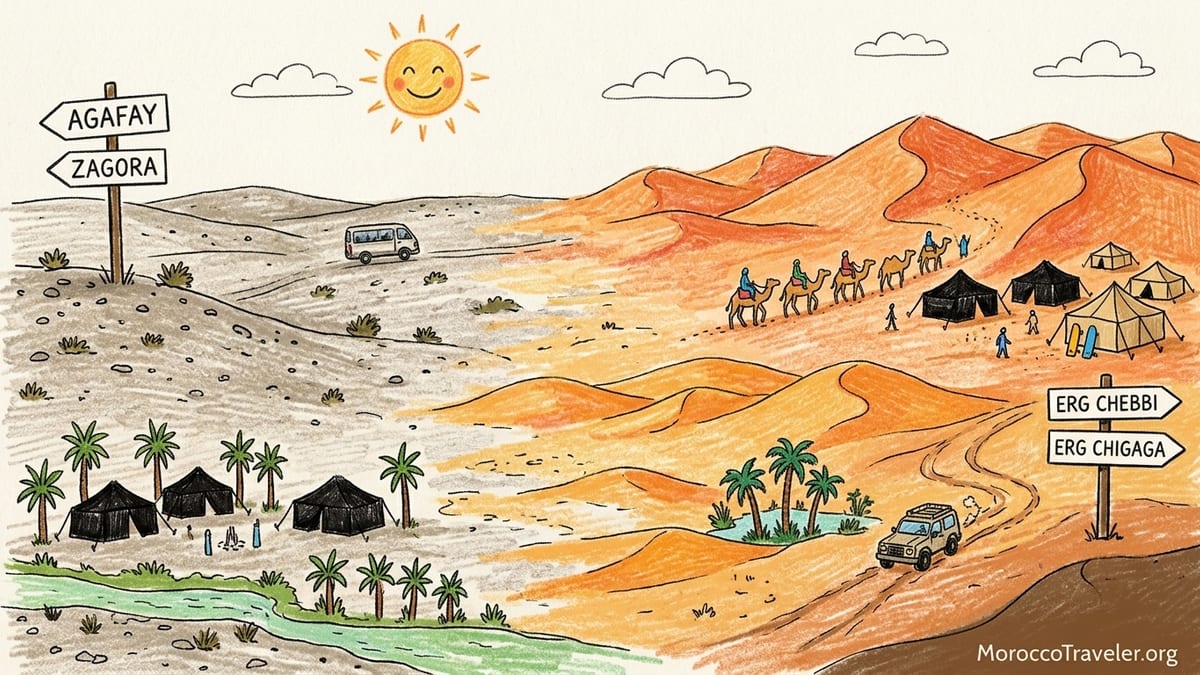
Morocco’s most marketed “desert” trips cluster around four names: Agafay, Zagora, Erg Chigaga and Erg Chebbi near Merzouga. Agafay is not part of the Sahara at all but a stony, semi-desert landscape about 45 minutes from Marrakech, often sold as a sunset camel ride and dinner. Zagora is a desert town on the Drâa Valley route a long day’s drive from Marrakech, with low dune fields nearby that are smaller than the iconic images many travelers hold in their minds. Erg Chigaga and Erg Chebbi are the two true major dune seas, or ergs, in Morocco. Erg Chebbi lies by the village of Merzouga in the far east, and Erg Chigaga spreads south of M’Hamid in the deep south.
These four destinations differ sharply in travel time, dune size, comfort level and cost. From Marrakech, Merzouga and Erg Chebbi are roughly 560 kilometers away and usually require at least three days round trip, while Zagora lies closer at around 360 kilometers, which is why two-day tours focus there. Agafay, by contrast, can be reached in under an hour on a half-day or evening excursion. Operators sometimes blur these distinctions in short tour descriptions, which is how travelers end up on a rocky plateau outside Marrakech thinking they are in the “Sahara.” It is essential to understand what each place actually offers before you book.
Another important difference lies in how you get there. Agafay excursions typically use standard vehicles or minibuses from Marrakech, while Erg Chigaga requires a 4x4 for the final off-road section beyond M’Hamid because the dunes are not accessible by paved road. Erg Chebbi and Zagora lie close enough to paved roads that even budget shared minibuses can reach camel meeting points on the edge of the sand. This directly affects both the feeling of remoteness and the price you pay.
Distances, Travel Times and Minimum Trip Lengths
For most travelers, the key decision is how many days to allocate to the desert. Road distances in Morocco are long, mountain passes are slow, and some desert gateways such as Merzouga are effectively a full day’s drive from Marrakech or Fez. Tourism and local transport information indicates that Marrakech to Merzouga via the High Atlas and Dades or Todra Gorges is around 560 kilometers and typically takes 9 to 10 hours of driving, often broken up with scenic and meal stops. From Fez, the drive to Merzouga is also around 9 hours, usually done in a single day on shared tours or split over two days on private itineraries.
By comparison, Marrakech to Zagora is about 360 kilometers and can be driven in roughly 6 to 7 hours, which permits a common two-day loop: out across the High Atlas on day one with a night in the dunes near Zagora, and back to Marrakech on day two. Several agencies advertise 2-day shared tours between around 70 and 90 euros per person, including minibus transport, simple camp accommodation, camel rides and half-board meals. These are among the cheapest ways to include a “real” desert night with sand underfoot during a short Marrakech stay.
Erg Chigaga lies further still, beyond Zagora and M’Hamid, with the final 60 or more kilometers on piste tracks that require a 4x4. This makes the journey slower and usually spreads it over three to four days from Marrakech, with overnight stops around the Drâa Valley and possibly in the town of Foum Zguid on the return. Tour examples show three-day Erg Chigaga loop prices from Marrakech starting around 400 euros per person in small 4x4 groups, with four-day versions spreading the drive more comfortably and sometimes lowering the per-day cost on group departures.
Agafay sits in a different category. The stone desert starts about 30 kilometers from Marrakech and most experiences run as half-day quad bike excursions, afternoon pool and dinner packages or sunset camel rides with a meal. These trips last four to eight hours door-to-door, cost from about 25 to over 100 euros per person depending on whether you choose a shared budget camp or a luxury resort-style property, and do not require an overnight unless you want the atmosphere of a tented camp close to the city.
Landscape and Dune Scale: What You Will Actually See
If you dream of classic Sahara scenes with rolling dunes taller than houses, the choice between rocky plateau, low dunes and major ergs matters. Agafay is a stony, rolling desert with pale hills and views toward the High Atlas peaks, but no sand sea. It can feel striking at sunset, especially when camp lanterns flicker on and music starts around fire pits, yet the ground under your feet is gravel and rock. It works well for those who simply want desert-like scenery near Marrakech and perhaps a camel photo at dusk without long road journeys.
Zagora’s surrounding landscapes mix palm-filled stretches of the Drâa Valley with patches of sand and small dunes, often at places like Tinfou closer to the main road. These dunes are much lower and smaller in scale than the towering crests of Erg Chebbi or Erg Chigaga. Shared minibus tours from Marrakech commonly offer an evening camel ride of about an hour into such a dune field, a night in a fixed camp just behind the first ridges, and a sunrise ride back. It feels like the edge of the desert rather than the deep Sahara, but the open sky, stars and campfire atmosphere can be memorable, especially on a tight schedule.
Erg Chebbi near Merzouga offers Morocco’s most accessible large dune sea. The sand rises in smooth ridges up to around 150 meters high in places, and there are many camps tucked just inside the erg, reachable by short camel rides from the road. This is the scene most people imagine when they picture a Sahara trip in Morocco. Activities such as sandboarding, quad biking and 4x4 tours across the dunes are widely available once you arrive at the edge of Erg Chebbi. Because the dunes lie so close to Merzouga’s hotels and auberges, you can choose between staying in a fixed building and going into a tented camp for only one night, or spending consecutive nights out in the sand.
Erg Chigaga, south of M’Hamid, is the other major erg in the country and is often described by local operators and travelers as wilder and more remote than Erg Chebbi. It spreads over a broader area, and the absence of a paved road into the dunes helps keep camp numbers lower. Reaching it requires a 4x4 transfer of one to two hours across desert tracks and dry lakebeds, so once the engine is switched off in camp, you truly feel far from towns and traffic. The dunes are high and expansive, with ridge-top sunset walks that give long views in every direction. For travelers who value a sense of remoteness and fewer neighboring camps, Chigaga has strong appeal.
Transport Types, Comfort Levels and Typical Inclusions
Morocco’s desert tours fall into two broad transport categories: shared minibuses and private or small-group 4x4s. The classic budget circuits from Marrakech to Zagora or Merzouga use 16 to 20 seat minibuses. A typical shared two-day Zagora tour at around 70 to 90 euros per person covers pick-up in Marrakech, Atlas mountain crossing, stops at sites such as Aït Benhaddou for photos, the camel rides at sunset and sunrise, one night in a basic camp and dinner plus breakfast. Lunches on the road, drinks and any extra activities like quad biking are paid separately.
Three-day shared minibus tours from Marrakech to Merzouga usually cost somewhere between about 100 and 200 euros per person, depending on comfort level and how close to departure you book. Inclusions generally cover transport, one night in a mid-range hotel or guesthouse in Dades or near Todra Gorge, one night in a desert camp by Erg Chebbi, camel rides at sunset and sunrise and dinners and breakfasts on both nights. Some “standard” packages place guests in large, simple camps, while “luxury” versions upgrade the final night to tents with private bathrooms and more refined meals. Airlines such as Ryanair now fly from Errachidia, which some travelers combine with a one-way desert tour starting or ending in Merzouga, though at added cost.
Erg Chigaga trips from Marrakech rarely use large buses for the whole route. Instead, most operators rely on 4x4 vehicles from Ouarzazate, Zagora or earlier, with three-day tours from Marrakech starting around 400 euros per person for small groups when sharing a vehicle. These usually include a night along the Drâa Valley and a night in a camp within the Chigaga dunes, with dinners and breakfasts, camel rides and sometimes sandboarding gear provided. Because of the off-road component, fuel and vehicle wear are greater, which keeps prices higher than comparable Merzouga packages.
Agafay falls at the other end of the spectrum. A basic sunset camel ride and dinner from Marrakech can cost as little as 25 to 50 euros per person in a shared group, including transport and a set-menu meal. More upscale properties near the stone desert advertise pool access day passes plus lunch or dinner and optional quad or buggy rides, costing upwards of 80 to 150 euros per person. In most Agafay offers, soft drinks, alcoholic beverages and some activities are charged as extras, while shared return transfers from central Marrakech may or may not be included in the advertised price.
Shared Minibus vs Private 4x4 and Camp Standards
The choice between a budget shared minibus and a private or small-group 4x4 shapes more than comfort; it affects the number and quality of stops you make along the way. Shared tours from Marrakech to Merzouga or Zagora tend to follow a set timetable, with limited time at places such as Aït Benhaddou, Ouarzazate film studios or Todra Gorge. The minibus must reach the desert by late afternoon so that everyone can mount camels before sunset. Private 4x4 itineraries cost more but allow detours, extra photography stops, or lingering over mint tea in a kasbah along the Drâa Valley.
Camp standards also vary. At the budget end, “standard” desert camps around Zagora and Merzouga usually consist of rows of simple canvas or goat-hair tents with shared toilet blocks and basic solar lighting. Bedding and blankets are provided, but in winter months from November to February nights can be cold, and heating is uncommon in the cheapest tents. Advertised prices almost always include dinner and breakfast, but hot showers may be limited by water tanks, and electricity is often restricted to communal tents in the evening.
Mid-range and luxury camps, now numerous around Erg Chebbi and appearing near Erg Chigaga and Agafay, offer larger tents with proper beds, high-quality linens, carpets, private bathrooms and, in some cases, wood-burning stoves or gas heaters. Prices for such camps, especially when reached via private 4x4 tours, can push multiday desert trips into the several hundred euro per person range. Travelers report that three-day Marrakech to Merzouga tours with one luxury camp night and one comfortable guesthouse night commonly cost the equivalent of a few hundred euros per person when arranged privately.
Whatever class you choose, review what the price includes. Genuine tour descriptions will spell out whether both camel rides, dinners and breakfasts, campfire entertainment, sandboarding and the transfer to and from your riad are covered. Extras often include lunches on the road, drinks, tipping, optional quad biking or buggy rides, and in winter, supplementary payments for tent heating. If a price looks significantly lower than competitors, check whether it omits key elements such as the camel trek or uses a roadside auberge instead of a proper camp in the dunes.
Responsible Alternatives to Camel Riding
Camel or dromedary treks are a hallmark of Moroccan desert tours, but not everyone is comfortable riding animals for recreation. Some travelers have mobility issues, while others simply prefer not to use camels in tourism. Fortunately, several alternatives exist that still deliver a strong sense of the desert. In Merzouga and Erg Chebbi, many camps can be reached directly by 4x4 from the village. Instead of joining the caravan, you ride in a vehicle over the first lines of dunes, then walk the final stretch on foot with your guide. You still arrive at sunset, watch the colors change on the sand and sleep under the stars, but with no animal riding involved.
At Erg Chigaga, where camels traditionally carry guests into remote camps, there is often the option to complete the off-road approach entirely by 4x4. Once based in camp, you can hike up nearby dunes, join guided walks that explain desert plants and nomad life, or participate in sandboarding, which involves sliding down dunes on a board or sled. Camps that take sustainability seriously may limit engine use near the dunes or focus activities on silent experiences such as walking and stargazing rather than quad bikes and buggies.
In Zagora and Agafay, where the dune fields are smaller or the terrain is rocky, you can opt out of camel rides altogether. In Agafay, for example, it is common to spend the afternoon relaxing by a pool, taking a short walk across the stony hills for sunset photos and then enjoying dinner in a tented restaurant. In Zagora, you can request a vehicle transfer directly to camp, walk out to the nearest dune ridge, and sit to watch the sky shift from orange to deep indigo. When booking, simply state clearly that you do not wish to ride camels; most reputable operators will adjust the plan without issue.
A growing number of agencies position their packages as “responsible desert tours,” highlighting smaller group sizes, lower noise impact and respect for local communities. If this is important to you, look for descriptions that mention hiring local guides from villages near Merzouga, M’Hamid or Zagora, using permanent camps that manage waste properly, and avoiding driving on fragile dunes except where necessary.
Key Routes: Aït Benhaddou, Ouarzazate, Todra Gorge and the Drâa Valley
Most desert tours from Marrakech share the first leg of the journey: a winding climb over the High Atlas via the Tizi n’Tichka pass. Beyond this, the routes diverge. Two-day Zagora tours and Erg Chigaga expeditions generally follow the road through Ouarzazate and on into the Drâa Valley, passing palm oases, mudbrick ksour and the long ribbon of the Drâa River. Overnight stops might be made in Agdz, Zagora or smaller villages such as Tagounite on longer itineraries. This southern route emphasizes oasis culture and the historic caravan road toward the deep Sahara.
Merzouga and Erg Chebbi trips usually turn east after Ouarzazate toward Skoura, the Valley of a Thousand Kasbahs and the Dades and Todra Gorges. Three-day Marrakech to Merzouga tours often spend the first night in a guesthouse in Dades Gorge, with time for a short walk among the rock formations in the afternoon. On day two, the road continues through Tinghir and up into Todra Gorge, where sheer limestone walls flank a narrow riverbed. After a lunch stop, groups drive on to reach Merzouga by late afternoon, then transfer by camel or 4x4 into the dunes.
Aït Benhaddou, a fortified ksar of earthen houses near Ouarzazate, appears on many Zagora, Merzouga and Chigaga itineraries. Shared minibus tours typically allow an hour or two here, while private drivers can give you longer to climb to the granary at the top and take in the view over the Ounila Valley. Ouarzazate itself hosts film studios and a kasbah and serves as the main crossroads for southern desert routes. Some travellers break their journey there overnight, especially when heading further to Erg Chigaga.
Understanding these route variations helps you choose a tour that suits your wider Morocco itinerary. For example, if you are particularly keen to hike in Todra Gorge, a Merzouga-based trip from Marrakech or a one-way circuit from Fez to Merzouga to Marrakech makes sense. If your interest lies more in palm oases, mudbrick villages and a sense of the old caravan roads, a Zagora or Erg Chigaga itinerary via the Drâa Valley might be more rewarding. In both cases, the desert night is only part of the journey story; the landscapes on the road can be highlights in their own right.
Cost Comparison: Two-Day Zagora, Multi-Day Merzouga, Erg Chigaga and Agafay
Prices change with seasons and exchange rates, but recent examples from Moroccan tour operators and traveler reports paint a clear cost hierarchy. At the budget end, shared two-day Zagora tours from Marrakech cluster between about 70 and 90 euros per person, including minibus transport, one camp night with dinner and breakfast, and camel rides. Private two-day trips on the same route, using a dedicated driver and better accommodation, may cost several times that amount, especially if starting from coastal cities such as Agadir.
Shared three-day Marrakech to Merzouga tours typically start around 100 to 150 euros per person for basic camps and shared bathrooms, rising to 200 euros or more for itineraries that include a “luxury” night in Erg Chebbi with private en-suite tents. One-way private circuits between Marrakech, Merzouga and Fez, using smaller vehicles and higher-end accommodation, can reach well into four-figure sums for two people, particularly once you add in extra nights in gorges or kasbahs along the way.
Erg Chigaga trips, almost always involving a 4x4 approach, sit slightly higher in average cost for a similar number of days. Three-day 4x4 circuits from Marrakech that include one night in a Drâa Valley guesthouse and one night in a Chigaga camp are advertised from around 400 euros per person when sharing a vehicle with a small group. Four-day versions, which reduce daily driving hours, can sometimes lower the per-day rate and feel less rushed, especially if you want more time in the dunes. Solo travelers joining fixed-date departures may access lower per-person prices than those booking a private 4x4 only for themselves.
Agafay, being close to Marrakech, has a separate price logic. Simple sunset camel and dinner outings in shared groups can run from about 25 to 50 euros per person, with hotel pick-up sometimes included. Upmarket desert lounges, boutique camps and luxury hotel-run experiences can charge 70 euros or more for dinner and activities and higher amounts for overnight stays with breakfast and pool access. Drinks, certain activities like quad biking, and in some cases the transfer itself may be priced separately, so read the fine print before assuming a quoted fee is all-inclusive.
Decision Guide: Matching Destinations to Your Available Time
With all these variables, it helps to think in terms of how many days you can devote to the desert and what type of dunes or landscapes you want to prioritize. If you have only two days starting and ending in Marrakech, and do not want extremely long days in the vehicle, then a Zagora loop is the only practical option for a genuine night on sand. You will cross the High Atlas, visit Aït Benhaddou briefly and sleep in low dunes that give a first taste of the Sahara, accepting that the scenery is less dramatic than the images from Merzouga. If even this feels too rushed, then Agafay as an evening excursion allows a sample of desert atmosphere without a pre-dawn departure or night away from your Marrakech base.
Travelers with three days can realistically reach Merzouga and Erg Chebbi from Marrakech on a shared minibus tour, spending one night in the Dades or Todra region and one night in a camp in the big dunes. The trade-off is that the schedule is packed, with long driving hours on two of the three days. Those who prefer a slower rhythm might instead use three days to focus on Erg Chigaga, accepting higher cost in exchange for wilder dunes and fewer other tourists, or even stretch to a three-day one-way route between Fez and Merzouga if their wider itinerary supports it.
With four or five days to play with, you can start to combine deeper desert time with more thorough exploration of gorges or the Drâa Valley. For example, a four-day loop from Marrakech to Merzouga could include unhurried walks in both Dades and Todra, two nights in or near the dunes, and a less compressed drive back across the Atlas. A four or five-day Erg Chigaga expedition might spend extra time in oasis villages near Zagora, add a second night in the dunes or return via a different route through Foum Zguid and Lake Iriki. If you are traveling with children or older relatives, this extra time makes the experience more comfortable.
Below is a simple decision table summarizing which desert destination works best for typical time frames and priorities described in this article.
Two days from Marrakech: Best suited to a Zagora loop for a budget-friendly first desert night with small dunes, or to staying based in Marrakech and adding a sunset or overnight Agafay experience if you prefer to minimize driving.
Three days from Marrakech: Best for a Merzouga and Erg Chebbi shared tour if you want big dunes on a tighter budget, or an entry-level Erg Chigaga expedition if you prioritize remoteness and are willing to pay more.
Four days from Marrakech: Allows either a slower, more comfortable Erg Chebbi circuit with extra time at Dades or Todra Gorge, or a fuller Erg Chigaga journey with an additional oasis night and more time on desert tracks.
Five days or more: Opens up deeper combinations, such as circuits that include both Merzouga and Erg Chigaga, or a Fez to Merzouga to Marrakech one-way trip that links northern imperial cities with the Sahara in a single overland journey.
FAQ
Q1. Is Agafay a real Sahara desert like Merzouga or Erg Chigaga?
Agafay is a stony semi-desert near Marrakech, with rocky hills and views of the Atlas Mountains, but it does not have the large sand dunes found at Erg Chebbi near Merzouga or Erg Chigaga. It works well for a quick desert-style evening with camels or quad biking, but travelers seeking classic dune landscapes should look to Merzouga or Chigaga.
Q2. How long does it take to drive from Marrakech to Merzouga and back?
The journey between Marrakech and Merzouga typically involves around 9 to 10 hours of driving in each direction, usually broken up with scenic and meal stops. This is why most round-trip Merzouga tours from Marrakech last at least three days, with one night in the Dades or Todra region and one night in a desert camp in the Erg Chebbi dunes.
Q3. What is realistically included in a two-day Zagora tour price?
Recent examples of shared two-day Zagora tours at about 70 to 90 euros per person from Marrakech normally include minibus transport, hotel or riad pick-up, an evening camel ride into small dunes, one night in a basic desert camp, dinner and breakfast, and a sunrise camel ride back. Lunches, drinks, tips and optional extras such as quad biking or entry to some attractions are usually paid separately.
Q4. Do I need to ride a camel to stay in a desert camp?
No. In many camps near Merzouga and in Agafay you can arrive by 4x4 or regular vehicle and walk the last short distance on foot, while at Erg Chigaga or Zagora some operators offer fully vehicle-based access to camp followed by guided walks on the dunes. If you prefer not to ride animals, state this clearly when booking so your operator can adjust the transfers and activities accordingly.
Q5. How do Erg Chebbi and Erg Chigaga compare in terms of crowds and remoteness?
Erg Chebbi near Merzouga is the most accessible major dune sea, with many camps and activities and a lively atmosphere during peak seasons. Erg Chigaga is reached via off-road 4x4 tracks beyond M’Hamid and tends to feel quieter and more remote, with fewer neighboring camps and a stronger sense of being deep in the desert. Both have large dunes, but Chigaga requires more travel time and usually costs more.
Q6. Are desert tours from Fez different from those starting in Marrakech?
Desert tours from Fez to Merzouga usually drive south through Midelt and Ziz Valley in a single long day, spend one or more nights by Erg Chebbi and then either return to Fez or continue to Marrakech via the Dades and Todra Gorges. The focus is almost always on Merzouga and Erg Chebbi rather than Zagora or Agafay, and trips are often built as one-way overland journeys between imperial cities.
Q7. What should I check about camp comfort before booking?
Ask whether you will stay in a standard or luxury tent, if bathrooms are shared or private, whether there is heating in winter, and what bedding is provided. Confirm that dinner and breakfast are included, clarify if there will be electricity in your tent, and check if sandboarding or music around the campfire are part of the package or optional extras.
Q8. How cold does it get in the desert at night, and is heating included?
From roughly November to February, night temperatures in the desert can drop close to freezing, especially in Merzouga and Erg Chigaga. Standard budget tents often rely on thick blankets but do not include heaters, while mid-range and luxury camps may offer gas heaters or wood stoves in tents, sometimes with an extra fee. Always ask in advance and pack warm layers regardless of the season.
Q9. Is an Agafay dinner or overnight stay worth it if I also plan to visit Merzouga?
If your itinerary already includes a multi-day Sahara trip to Merzouga or Erg Chigaga, an additional Agafay outing may feel more like a dining experience than a new landscape. However, some travelers enjoy Agafay at the start or end of their trip as an easy evening out of the city, particularly if staying in Marrakech for several nights and wanting a relaxed dinner with desert-style views.
Q10. What questions should I ask a tour operator before paying?
Before confirming, ask which desert you are going to and how far it is, how many hours you will drive each day, whether the dunes are large or small, what level of camp you will stay in, exactly what meals and activities are included, how many people will share your vehicle, whether camel riding is optional, and what common extra costs to expect. Clear answers to these points help ensure that the desert experience you book matches the one you imagine.