

In my feed, Chefchaouen looked like an empty dreamscape of blue alleys: a place where time had paused long enough for one traveler and one cat to have an entire staircase to themselves. That is not the city I met when I finally wound my way up into the Rif Mountains this year. What I found was more complicated: beautiful in flashes, crowded in its most famous corners, and increasingly shaped by the very images that drew me there.
The Instagram Promise: Empty Blue Alleys and Mountain Calm
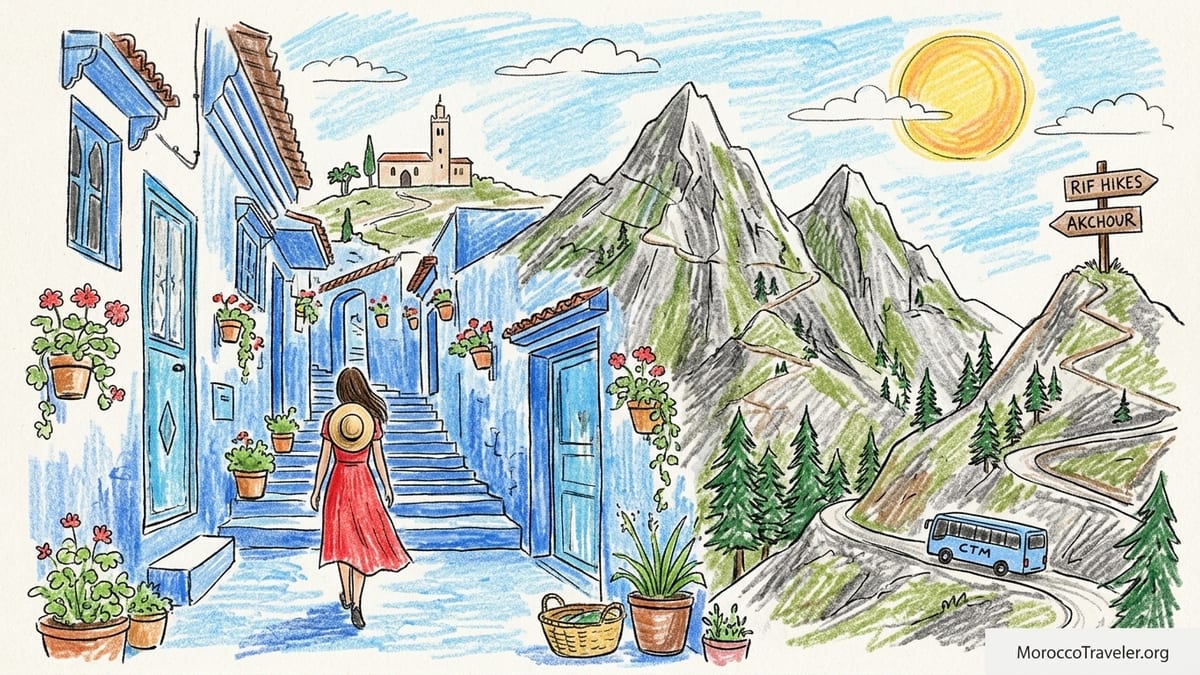
Before I arrived, my idea of Chefchaouen was built almost entirely from photographs. The same frames appeared again and again: a narrow alley painted in dense, layered blues with no one in sight; a staircase decorated with potted geraniums; a woman in a floaty dress turning a corner; a rooftop terrace with terracotta chimneys and a panoramic Rif mountain backdrop at golden hour. These images create a promise of tranquility, of a medina that somehow escaped the hassle and noise of other Moroccan cities.
On social media, the blue looks almost impossibly uniform, as if the entire old town is dipped in cobalt from ground to rooftop. Streets appear spotless. Doors are perfectly distressed, never peeling. There are no shop signs, no delivery carts, no roosters, no plastic buckets of paint. It is a curated vision that suggests you can wander for hours and still stumble on untouched photographic corners, all with the snow-creased peaks of Talassemtane National Park rising silently in the background.
This promise is powerful enough that travelers routinely rearrange itineraries to fit Chefchaouen in. On my train up from Rabat, two separate couples told me they were skipping Meknes and Volubilis to make time for “the blue city.” One had booked a long day trip from Tangier specifically to recreate a staircase shot they had saved on Instagram. By the time I arrived, I was carrying not just my backpack but a fair amount of visual expectation.
I still think those photographs are not exactly lies. They are just very tight crops of a much busier, more commercial, and more lived-in place than a 9:15 a.m. Instagram post ever admits.
The Reality on the Ground: Crowds, Staged Corners and Repetition
My first morning in Chefchaouen, I walked straight to one of the “famous” alleys: a steep run of steps with bluewashed walls, low arches, and painted flowerpots cascading down the side. In the square image that had been saved on my phone, the alley was empty. In real life, at 9:30 a.m. on a shoulder-season weekday, there were already three small queues of people waiting to take turns, each group quietly negotiating who would get the staircase to themselves for thirty seconds.
The scene felt less like stumbling into a medina and more like joining a line at a pop-up installation. Two local men had laid out carpets and props at the base of the steps and were renting traditional woven hats for quick photos. They were not aggressive, and their prices were modest compared with larger cities, but the result was clear: this was a micro set built to match the photo travelers already had in their heads. Walk a few minutes in any direction and the pattern repeated. A blue doorway dressed with borrowed rugs and lanterns, a window framed by painted baskets, another staircase reconstructed in three or four variations.
As I explored further, the repetition became striking. Whole alleys seemed redesigned around the camera frame, with pots and benches placed where a tripod might stand. Corners that did not photograph as easily were quieter and often scruffier: electric cables looping haphazardly across facades, patches of bare concrete, doors half painted or stained by winter rain. These were the parts of Chefchaouen that Instagram rarely shows, even though they make up a large share of what you actually walk through between one famous corner and the next.
The crowds deepen this disconnect. On certain lanes near the main square of Place Uta el Hammam, it felt as if nearly every second person was there to take or to pose in a shot. There is nothing inherently wrong with that, but it shapes the mood. If you are imagining contemplative empty alleys, the reality of mentally timing your photo between the couple in the red dress and the family with the stroller can feel jarring.
How Much of Chefchaouen Really Looks Like the Photos?
It is natural to ask whether the blue streets are a small Instagram bubble or a truthful reflection of the wider medina. After several days of walking loops across the hillside, I would put it this way: perhaps one third of the old town feels like the iconic images, another third is blue but workaday and less polished, and the final third is a standard Moroccan mountain town where the paint is patchy and the practicalities of life outweigh aesthetics.
The highest concentration of photogenic lanes runs between Place Uta el Hammam, the Kasbah walls, and the upper residential quarters that face the Rif ridgeline. Here the blues are refreshed regularly, and you will find those curved doorways and irregular steps you have seen online. Even in these areas, though, the feeling changes depending on time of day. Early mornings, especially outside of peak summer, you can indeed catch quieter moments when locals are sweeping in front of houses and shops are still shuttered. By late morning, tour groups begin to funnel through, and by mid-afternoon in high season some alleys feel like slow-moving corridors.
Farther from the core, around the busier lower streets and the road that leads up from the CTM bus station, the city looks more like any other small urban center in northern Morocco. There are hardware stores, modest bakeries, and concrete facades where the blue has flaked off in chunks, showing layers of previous repaintings. If you climb toward the Spanish Mosque for sunset, you pass entire stretches where the paint is only partial, broken by brick outcrops and raw stone. None of this is ugly, exactly, but it does not match the uninterrupted cobalt dream that Instagram tends to suggest.
What does match is the setting. No amount of saturation editing can fake the way Chefchaouen sits cupped between steep shoulders of the Rif. From almost any rooftop terrace you can see the pale limestone faces of the surrounding peaks catching morning and evening light. In this sense, the city feels larger and more dramatic in real life than it often appears in tight portrait shots, provided you can look up from the alleyway hunt long enough to notice.
Shops, Cafes and the Economics of a Blue Brand
Tourism is not just present in Chefchaouen; it is now one of the town’s defining realities. Around the main square, entire streets are lined with near-identical souvenir shops: handira-inspired cushions, painted tagines, magnet sets in fifty shades of blue, and the same woven hats that appear in countless photos. Negotiations here are friendlier than in some larger cities I have visited, but this is not a traditional souk environment oriented toward local residents. It is a retail zone designed for visitors who arrive with a suitcase and a camera.
There is a similar commercial logic at work in many of the most photographed alleys. I counted at least half a dozen doorways where a small wooden sign requested a few dirhams in exchange for photos, or where the shopkeeper gently but clearly expected that anyone lingering for a mini shoot would at least step inside and buy something. In one spot, a woman managing an elaborately decorated staircase told me openly that she spends a significant portion of her earnings on repainting and flowers because “people come here from Instagram,” and they will move on quickly if the spot no longer matches the online image.
The cafe scene mirrors this emphasis on views and visuals. Rooftop terraces ring the medina, each promising a “panoramic” or “best sunset” experience. On my visit, a basic mint tea on a central terrace cost roughly 15 to 20 dirhams, modest by European standards but on the higher side for a simple drink in a small Moroccan town. A few places I tried focused more on picture-ready presentations than on thoughtful menus. A widely recommended spot served a breakfast plate that photographed beautifully but relied on supermarket bread and a tiny pot of processed cheese. When I deliberately stepped one or two streets away from the main square and chose more ordinary-looking cafes, I paid less and ate better, albeit without the sweeping Instagram skyline.
None of this makes Chefchaouen a bad place to visit, but it does change the tone. If you arrive expecting a laid-back mountain village that happens to be photogenic, the density of tourist-targeted commerce in the very heart of the medina can come as a surprise. It feels closer to a compact resort town that has painted its center a single color and then learned, very quickly, how to monetize that choice.
Getting There: The Long Road from Fez, Tangier and Beyond
Part of assessing whether Chefchaouen is “worth it” is acknowledging the sheer amount of road time involved. The town has no train station, and the nearest mainline tracks run through Tangier and Fez, which means every visit includes at least a couple of hours by road. From Tangier, the distance is roughly 115 to 120 kilometers on the N2, and the CTM bus takes around 2 hours 15 minutes to 2 hours 35 minutes between stations, depending on the stop in Tétouan. Shared grand taxis cover a similar distance in about 2 hours once they depart, though you may wait while seats fill.
From Fez, the commitment is greater. The road distance sits around 190 to 200 kilometers, and even in good conditions the bus or a private transfer will take close to 4 hours in each direction. On the day I traveled toward Chefchaouen from Fez, we left just after 8:00 a.m. and did not step into the medina until almost midday, between a rest stop and slow sections of winding mountain road. For anyone spacing a short Morocco itinerary, this means Chefchaouen can easily consume the better part of a full day simply in transit.
Organized day trips from Tangier or Fez reflect this reality. A typical group excursion from Tangier might depart around 8:00 a.m., reach Chefchaouen late morning, offer four or five hours of guided and free time in the medina, and return to Tangier by early evening. Privately arranged transfers tend to cost at least the equivalent of several CTM tickets, sometimes significantly more, but they shave off waiting time and deliver you closer to your accommodation instead of leaving you with the uphill walk from the bus station with your luggage.
From elsewhere in northern Morocco, such as Rabat or Casablanca, Chefchaouen usually enters the itinerary as part of a larger multi-day loop with overnight stays and other stops. In those cases, the marginal cost of including it is lower, but the hours in the vehicle still add up. When I look back on my own route choices, I am aware that every hour spent dozing in a bus seat between Fez and Chefchaouen was an hour not spent wandering Fez’s old medina or exploring the Atlantic coast.
Day Trip or Overnight: What Do You Really Gain?
Given the distances, the most common dilemma I heard from other travelers in my guesthouse was whether Chefchaouen deserves a day trip or an overnight stay. Tour operators advertise day visits from Tangier and Fez with glossy shots of the blue alleys and quick walking tours. I met one couple in my riad who had done exactly that. Their verdict was blunt: “It was pretty, but we spent more time in the car than in the city.” They had about four hours of usable time in Chefchaouen, which disappeared quickly in a guided loop, a quick lunch, and a rush to claim a few classic photo spots before heading back.
Staying at least one night shifts the experience. With an overnight, you can be in the alleys before most tours arrive in the morning and again after they have departed in the early evening. Some of my favorite moments were at these off-peak times: watching children play in the streets near the river, hearing the layered calls to prayer echo across the valley at sunset from the Spanish Mosque, and seeing local families reclaim the main square once day-trippers had gone. The blue walls felt less like a stage set and more like a backdrop to actual life.
Costs will, of course, vary over time and by season, but during my stay I found that a simple, clean double room in a family-run guesthouse a few minutes’ walk uphill from Place Uta el Hammam could be booked for roughly what a guided day tour from Tangier charged per person. In other words, if you are two people and have one night to spare, an overnight can be as cost-effective as two individual day-trip seats while giving you double the usable time in the city and a quieter experience.
That said, not every traveler can or wants to commit an extra night. If your entire Morocco stay is a short break clustered around a city like Tangier, a day trip is the only realistic way to see Chefchaouen at all. In that case, it is important to calibrate expectations: you are buying the chance to walk the famous blue lanes and take a handful of photos, not to settle into the slower rhythms of a mountain town.
Beyond the Blue Walls: Kasbah, Crafts and the Rif Landscape
The surprise of Chefchaouen, for me, was that its most worthwhile aspects were not necessarily the alleys that dominate social media. The compact Kasbah in the main square, with its ochre walls standing in deliberate contrast to the surrounding blues, offers a calm garden interior and a small ethnographic museum. Climbing the Kasbah tower gives a different, more layered view of the town, where the gradients of blue, whitewashed roofs, satellite dishes, and looming Rif ridges create a more honest portrait than any single alley shot.
Certain local crafts also stand out once you step past the more generic souvenir stalls. In a small weaving cooperative up a side street, I spent nearly an hour talking with a man whose family has produced striped wool blankets for generations. His shop did not photograph as dramatically as the staged doorways, but the blankets he unfolded had weight, irregularity, and color combinations that reflected regional tastes rather than trends imported from Marrakech. Compared with some other Moroccan cities, Chefchaouen still retains small pockets where craft production is real and not only a demonstration for visitors, although you need to look for them.
The deeper reward, however, lies outside the town. From Chefchaouen, the hills rise quickly toward Talassemtane National Park, a protected area that covers close to 590 square kilometers and preserves rugged limestone peaks, deep gorges, and cedar forests. The slopes visible from the medina hint at this landscape, but it is only when you step onto one of the trails that you understand why hikers and slow travelers speak warmly of the Rif. On a day walk from the town into the lower foothills, I saw almost as many shepherds and farmers as I did other tourists, a marked contrast to the choreography of the blue alleys.
The now-famous Akchour waterfalls, roughly 30 to 45 kilometers from Chefchaouen depending on the route, are part of this same environment. A shared grand taxi from the town, when available, can reach the village of Akchour in about an hour, with an additional hike on foot needed to reach the cascades themselves. Here, too, social media has amplified a once-quiet destination into a very popular outing, with weekend crowds and improvised riverside cafes. Yet in the early morning, walking along the river with only the sound of water and birds, I felt more of the calm I had expected from Chefchaouen itself.
Tourism Pressure and Environmental Concerns
When a small mountain town acquires a global social-media identity, impacts follow. In Chefchaouen, the first and most immediate is pressure on basic infrastructure. The narrow streets were not built for constant flows of visitors, and neither were the town’s waste and water systems. Rubbish is more visible on the outskirts and in the surrounding countryside than in the carefully maintained central alleys. Plastic bottles and snack wrappers show up along some of the trails leading out of town and around popular viewpoints such as the path to the Spanish Mosque.
Akchour and parts of Talassemtane National Park face similar tensions. As more visitors come for the waterfalls and canyon hikes, local authorities and residents have responded with informal parking areas, simple riverside food stalls, and expanded taxi operations. These provide vital income in a region that has long struggled economically, but they also concentrate foot traffic on fragile riverbanks and increase the volume of litter. On my hike along the river, I noticed both encouraging signs, such as families packing out their trash, and discouraging ones, like abandoned picnic remnants tucked under rocks.
Water use is another concern, though much harder to evaluate on a short visit. Maintaining Chefchaouen’s intense palette of blues requires frequent repainting and washing, and the popularity of rooftop guesthouses and terrace cafes adds demand for showers, laundry, and hospitality services in a town that relies heavily on mountain water sources. Locals I spoke to were pragmatic. Tourism brings income and jobs that did not exist twenty years ago, but many also expressed concern that visitors sometimes treat Chefchaouen as a backdrop rather than a living place whose resources have limits.
None of these issues should single out Chefchaouen as uniquely problematic; they mirror patterns seen in other picturesque destinations worldwide. However, the compactness of the town and the visual focus on a few key streets mean that any strain shows up quickly. If you decide to visit, it is worth supporting businesses that demonstrate care for their surroundings and being thoughtful about your own footprint, whether that means carrying a reusable water bottle, choosing locally run accommodations, or resisting the urge to leave painted marks or stickers in pursuit of your own “unique” shot.
The Takeaway: Is Chefchaouen Worth the Detour?
So, after the queues for staircases, the long road hours, and the mix of real town and curated set, do I think Chefchaouen is worth visiting? My answer is a cautious yes, with significant asterisks. If you are traveling primarily for photography, especially if you enjoy composing detailed shots and can wake early enough to claim the streets before the tours arrive, Chefchaouen will likely reward you. The concentration of blue architecture in a tight, walkable area is still striking, and there are angles and quiet corners left if you have the patience to wait for them.
If you are a slow traveler who likes to dig beneath the surface, an ideal stay would be two or three nights. That gives you time to see the medina beyond its most famous alleys, climb to the Spanish Mosque, linger over tea as the light moves across the valley, and take at least one day for a walk in the surrounding Rif or a trip to Akchour. Used this way, Chefchaouen becomes a base to explore a particular cultural and natural landscape, not just a blue checkbox between Fez and Tangier.
Where I hesitate is for travelers with very limited time, especially those trying to squeeze Chefchaouen into a packed itinerary as a single day trip from Fez or Tangier. If you only have, say, five or six days in northern Morocco, the hours spent on winding roads to reach and leave Chefchaouen are significant. In some cases, that time might be more richly spent deepening your experience in fewer hubs. Fez’s medina offers layers of history and craftsmanship that no blue alley can replace, while Tangier combines Atlantic light, literary echoes, and a gradually evolving cafe culture. Nearby Tetouan remains far less visited internationally yet holds an atmospheric old town of its own and quicker access to quieter stretches of Mediterranean coast.
For nature-focused travelers, the calculation is similar. If your real goal is hiking in the Rif and spending time in wild landscapes, you could reasonably base yourself in Chefchaouen and venture into Talassemtane National Park and Akchour. Alternatively, with a car and some research, you might design a route that prioritizes the park and surrounding villages over the blue streets, treating Chefchaouen as one stop among several rather than the centerpiece. In that scenario, the city’s fame becomes a useful transport and services hub rather than the primary destination.
In the end, Chefchaouen did not match the dreamy stillness of the photos that first put it on my map, but it offered something more honest: a small mountain town negotiating its own image in real time. If you arrive understanding that the blue alleys are both beautiful and busy, that many of the most shared corners are staged, and that the real heart of the region lies as much in its landscapes and everyday life as in its saturated facades, then yes, Chefchaouen can deserve the journey. Just make sure you are going for more than a staircase.
FAQ
Q1. Is Chefchaouen really as blue as it looks on Instagram?
In the central alleys around Place Uta el Hammam and the upper medina, many streets are indeed heavily bluewashed and look similar to what you see online, especially in tight frames. However, a significant part of the town is less polished, with patchy paint, exposed concrete, and more ordinary facades, so the overall impression is more mixed than the photos suggest.
Q2. How long does it take to get to Chefchaouen from Tangier and Fez?
From Tangier, it is roughly 115 to 120 kilometers by road, with buses and shared taxis usually taking a little over two hours in each direction in normal traffic. From Fez, the distance is closer to 190 to 200 kilometers, and you should expect around four hours on the road each way, which makes same-day visits from Fez a long travel commitment.
Q3. Is a day trip to Chefchaouen worth it, or should I stay overnight?
If you only want to see the famous blue alleys and take a few photos, a day trip from Tangier can work, though you will spend almost as long in transit as in the town itself. Staying at least one night lets you experience quieter early mornings and evenings without crowds and generally offers a more relaxed and rewarding visit.
Q4. Are the blue alleys overcrowded all day?
The most photographed spots become busy from late morning through mid-afternoon, especially in peak seasons and on weekends, and you may have to queue briefly for certain staircases or doorways. Early mornings and evenings are noticeably calmer, and stepping a few streets away from the main photo routes also makes a difference.
Q5. Is Chefchaouen expensive compared with other Moroccan cities?
Everyday costs such as simple meals and tea are higher than in many smaller Moroccan towns but still moderate compared with major European cities. Tourist-oriented cafes and souvenir shops around the main square charge a premium, while family-run guesthouses and cafes a little farther from the busiest streets often offer better value.
Q6. What else is there to do besides taking photos in the blue streets?
Beyond the alleys, you can visit the Kasbah and its small museum, explore less touristed neighborhoods, and use the town as a base for walks in the Rif Mountains. Many travelers also make day trips to Akchour for waterfall hikes and to nearby areas inside Talassemtane National Park.
Q7. Is Chefchaouen a good base for hiking in the Rif Mountains?
Chefchaouen works well as a practical base, with accommodations, food options, and transport connections that make it easy to arrange guided or independent hikes. Trails toward Talassemtane National Park and the Akchour valley are reachable in about an hour or less by local transport, giving hikers several day-walk options.
Q8. How crowded are the Akchour waterfalls and nearby trails?
The popularity of Akchour has grown quickly, so weekends and holidays can bring many visitors, particularly near the lower pools and riverside cafes. If you start early in the morning or visit on a weekday, you are more likely to find quieter stretches of trail and more space at viewpoints.
Q9. Are there environmental concerns related to tourism in Chefchaouen and Akchour?
Yes, increased visitor numbers have added pressure on waste management, water resources, and fragile riverbank environments around popular sites. Litter around some viewpoints and sections of trail is visible, so choosing responsible operators and packing out your own trash can help reduce impact.
Q10. Should I prioritize Chefchaouen over Tangier, Tetouan or other northern destinations?
If your main goal is capturing blue-street photography or combining light hiking with a distinctive-looking town, Chefchaouen is a strong choice. If you are more interested in coastal culture, architecture, and broader urban life, cities like Tangier or Tetouan, or a trip focused on quieter parts of the Rif and Mediterranean coast, may be a better use of limited time.