


Morocco looks compact on the map, but travel days can be long. Marrakech to Fez is around seven hours by train, and the classic loop that tries to squeeze Marrakech, Fez, Chefchaouen, the Sahara and the Atlantic coast into a single week often means more time in a van than on the ground. This guide lays out three genuinely different Morocco itineraries for 7, 10 and 14 days, keeping daily transfers realistic and explaining when it makes sense to accept a long drive for a bucket-list sight like the Sahara.
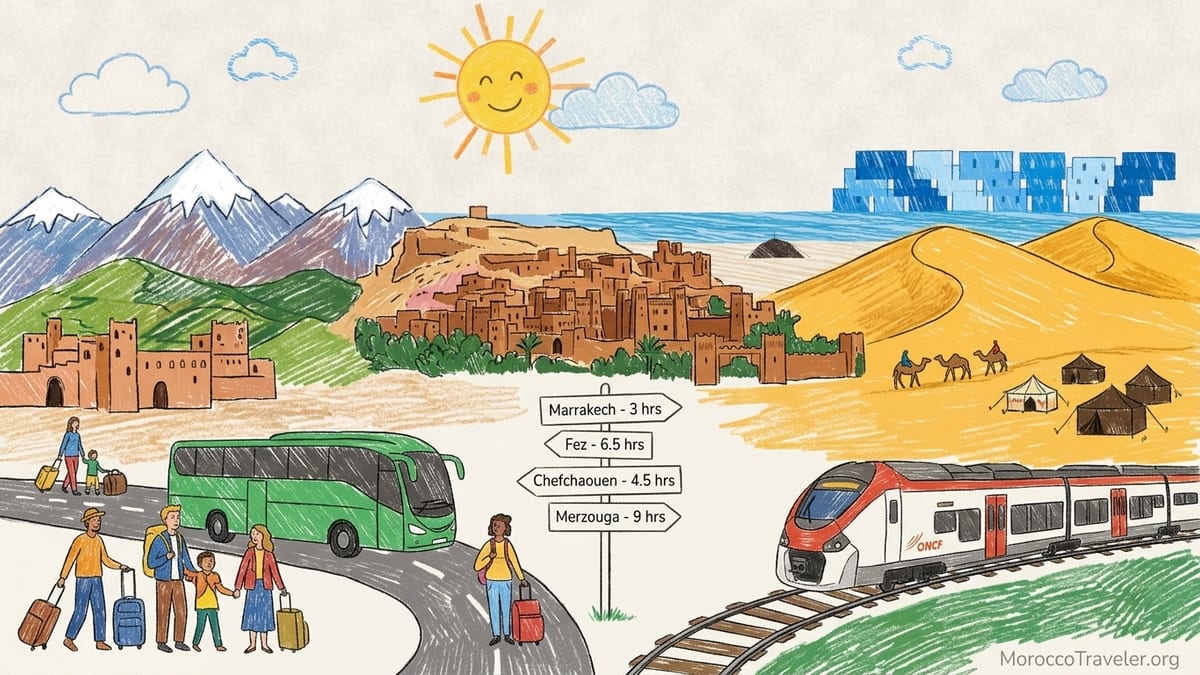
How Far Is Everything Really? Key Distances and Transport Basics
Morocco’s highlights are spread across mountain ranges, desert plateaus and two long coasts. On paper, Marrakech to Fez is about 530 kilometers. In practice that is roughly 6.5 to 7.5 hours by ONCF train depending on the service, or eight hours by road with breaks. Casually plotting Marrakech, Fez, Chefchaouen, Merzouga in the Sahara and Essaouira on the Atlantic into a seven-day loop often leads to at least three days of five to nine hours in transit, which most travelers underestimate when looking at a map.
Rail is excellent on the main north-south spine from Tangier through Rabat and Casablanca to Marrakech, with air-conditioned ONCF trains linking Marrakech to Casablanca in about 2 hours 45 minutes and Casablanca to Rabat or Fez in 1 to 3.5 hours depending on the route and stops. Fez and Meknes sit on the classic mainline to the east, while cities such as Essaouira, Chefchaouen and Merzouga in the Sahara are reached by bus, shared taxi or private driver rather than train.
Coach companies CTM and Supratours run modern intercity buses with assigned seats and luggage handling on popular routes. Typical fares in late 2026 on routes like Marrakech to Essaouira or Agadir are roughly 100 to 135 Moroccan dirhams per person one way, with travel times of about 3 hours including a rest stop. These services are more comfortable than most informal grand taxis and significantly cheaper than private transfers, which is why many independent travelers mix trains and buses within one itinerary.
Private drivers are the flexible but more expensive option, particularly important for routes that chain together the High Atlas, desert and remote gorges. Recent quotes collected in 2025 and 2026 for an English-speaking driver with a modern vehicle often fall between 1,200 and 2,500 dirhams per day depending on distance, route and season, with multi-day desert circuits priced by the trip. Travelers on a tight budget will generally lean on trains and intercity buses, while those with higher budgets or mobility needs may prefer a private driver for at least the off-rail segments.
Seven-Day Itinerary: Marrakech, High Atlas and Essaouira
This one-week route keeps your circle small, focusing on Marrakech, a taste of the High Atlas and downtime on the Atlantic coast in Essaouira. It avoids the Sahara, which realistically demands at least two long travel days from Marrakech and will eat too much of a seven-day schedule for most visitors.
Day 1: Arrive in Marrakech | Transfer time: 20 to 30 minutes by taxi from the airport to the medina or Gueliz. Spend the afternoon exploring Jemaa el Fna and the surrounding souks, with three to four hours of gentle sightseeing. Base yourself in a riad inside the medina near the main square or in quieter quarters such as Riad Zitoun or Bab Doukkala. Dinner in the medina, budgeting roughly 120 to 200 dirhams per person at a midrange restaurant, plus around 70 dirhams for an airport taxi into town.
Day 2: Marrakech Sights | No intercity travel. Dedicate six to eight hours to key sites such as Bahia Palace, Ben Youssef Madrasa, the Secret Garden and the Majorelle Garden in the modern Gueliz district. Entry fees to major monuments typically range from around 60 to 150 dirhams per person, with combined daily entrance costs of roughly 250 to 350 dirhams if you include multiple attractions. Base again in the Marrakech medina, eating lunch in Gueliz cafes around the Majorelle area and dinner back near your riad.
Day 3: High Atlas Day Trip | Drive time: About 1.5 to 2 hours each way from Marrakech to popular High Atlas villages such as Imlil. You can hire a private driver for the day from Marrakech, which recent travelers often pay somewhere between 900 and 1,500 dirhams for a small group, or join a small-group excursion for a lower per-person cost. Spend four to five hours walking valley paths or short trails around Imlil, lunching in a guesthouse terrace with views of snow-dusted peaks in winter or green valleys in spring. Return to your Marrakech base for the evening with a total daily spend including transport, lunch and tips in the region of 700 to 1,200 dirhams per person depending on group size.
Day 4: Marrakech to Essaouira | Road time: Around 3 hours by CTM or Supratours bus, which both operate several daily departures between the Marrakech bus station area near the railway hub and Essaouira’s seaside terminal just outside the medina walls. Recent fares sit around 100 to 130 dirhams per person one way. Including boarding, a highway rest stop and arrival, allow half a day for the transfer. Spend the late afternoon strolling Essaouira’s blue-and-white medina and ramparts. Base in a riad inside the old town close to Bab Marrakech or in a small hotel overlooking the beach. Meals in Essaouira’s medina or harbor fish grills average around 90 to 180 dirhams per person for dinner.
Day 5: Essaouira at Leisure | No intercity travel. Give yourself five to six hours of light exploration and downtime. Wander the harbor and Portuguese fortifications, browse the small galleries and craft shops, then head to the wide sandy beach for a walk or beginner-friendly surf session. Surf schools along the beachfront often quote lesson prices around 300 to 400 dirhams for a half-day including board and wetsuit. With lunches in beachside cafes and a relaxed dinner in the medina, plan on a daily budget of roughly 500 to 900 dirhams per person excluding accommodation.
Day 6: Essaouira Back to Marrakech | Road time: 3 hours back to Marrakech by bus, or about the same by private transfer if you prefer door-to-door convenience to your riad or hotel. If you take a morning bus, you can spend the afternoon revisiting favorite souks or relaxing in a hammam in Marrakech. Traditional neighborhood hammams are inexpensive, often under 100 dirhams for the entry and scrub, while more spa-style hammams in riads or hotels typically cost several hundred dirhams or more per person. Overnight again in the Marrakech medina or in the modern city if your flight leaves early.
Day 7: Departure from Marrakech | Transfer time: 20 to 30 minutes to the airport. If you have several hours before your flight, visit a site you missed earlier or linger over a final rooftop breakfast. Budget 70 to 120 dirhams for a taxi to the airport and allow at least two hours before departure for check-in and security, more for peak-season flights to Europe.
Seven Days with Fez and the Desert: A Faster Alternative
Some travelers are committed to both Fez and a Sahara camp even with only a week. That is possible, but it requires accepting long transfers and sacrificing slow time in each city. The following outline assumes one internal flight or a night train to avoid losing a full day between Fez and Marrakech.
Day 1: Marrakech or Fez Arrival | To save time, it is often smarter to arrive in Fez and depart from Marrakech or the reverse. If you land in Fez first, spend three to four hours getting your bearings in the medieval medina and checking into a riad near Bab Bou Jeloud or in the quieter Andalusian quarter. Dinner in the medina should be budgeted at roughly 120 to 200 dirhams per person. This open-jaw approach reduces your backtracking and aligns better with the desert route that runs between Fez and Marrakech.
Day 2: Fez to Merzouga (Sahara) | Road time: Often 8 to 9 hours including breaks for lunch and photos over the Middle Atlas passes and Ziz Valley. Most travelers join a small-group 2- or 3-day desert tour that includes this transfer, with current prices commonly in the 1,500 to 2,500 dirham range per person for basic to midrange options that include transport, an overnight in a roadside hotel and one night in a desert camp with dinner and breakfast. Because the drive is long, actual sightseeing is mostly scenic stops along the way, with an hour or so in cedar forests and viewpoints.
Day 3: Merzouga Desert Camp | No long intercity moves. Spend the morning resting at a guesthouse by the dunes, then take a late-afternoon 4x4 ride or camel trek to a desert camp for sunset. Most packages include a few hours of gentle walking on the sand, music after dinner and basic sandboarding. You will sleep in a fixed desert camp, with midrange operations providing private tents with en-suite bathrooms. Camps often charge extra for quad biking or extended 4x4 excursions, commonly from around 400 to 700 dirhams per person.
Day 4: Merzouga to Dades or Ouarzazate | Road time: Around 5 to 6 hours to the Dades Gorges area, or 7 hours to Ouarzazate via the Todra Gorge. Sightseeing time is usually limited to a one- to two-hour walk in the gorge and short photo stops. Overnight in a guesthouse in the Dades valley or a hotel in Ouarzazate town. Dinner at the accommodation is common and typically included in midrange tour prices; otherwise expect 100 to 180 dirhams per person.
Day 5: Ouarzazate / Dades to Marrakech via Aït Benhaddou | Road time: 4 to 5 hours from Ouarzazate to Marrakech, not including stops. Most tours include around 1.5 to 2 hours at Aït Benhaddou, the famous UNESCO-listed ksar seen in many films. A small entry fee is charged to access some parts of the site, with recent tickets in the region of a few dozen dirhams per person. Cross the High Atlas via the Tizi n’Tichka pass before descending to Marrakech. Overnight in a medina riad and budget a full day of roughly 700 to 1,200 dirhams per person for meals, guide tips and small extras if you are on a private circuit.
Day 6: Marrakech | After two intensive driving days, keep sightseeing flexible. Focus on one or two key sites such as Bahia Palace and the Majorelle Garden, leaving time for rest in a rooftop cafe. Plan on six hours of light touring and shopping. Base again in the medina, with meals near Jemaa el Fna or in Gueliz. Daily spending excluding accommodation in Marrakech for a midrange traveler typically lands in the 500 to 900 dirham range depending on restaurant choices.
Day 7: Departure | Use any remaining time for last-minute shopping, then transfer to the airport. If you need to return to Fez instead, consider a domestic flight rather than a daytime road journey; fares and schedules vary widely by season and should be checked close to travel.
Ten-Day Classic Circuit: Marrakech, Desert, Fez and the North
With ten days you can complete a classic loop from Marrakech through the High Atlas, Aït Benhaddou, the desert around Merzouga, then up to Fez and on to Rabat or Tangier with sensible overnight stops. You will still have a couple of long days on the road, but you gain more time in Fez and at least one night on the Atlantic or Mediterranean.
Day 1: Arrive in Marrakech | Transfer 20 to 30 minutes by taxi to your riad in the medina or a hotel in Gueliz. Spend three hours in the souks and Jemaa el Fna. Plan on 70 to 120 dirhams for the airport taxi and around 150 to 250 dirhams per person for dinner if you choose a midrange restaurant.
Day 2: Marrakech to Aït Benhaddou via High Atlas | Road time: Around 4.5 to 5.5 hours including stops over the Tizi n’Tichka pass. Hiring a private driver or joining a small tour allows two to three hours of sightseeing at Aït Benhaddou in the afternoon. The ksar is partially free to wander, but access to some restored sections is ticketed. Stay overnight in a guesthouse facing the old village or in nearby Ouarzazate, where midrange hotels and restaurants cluster along the main road. Expect a daily budget of about 800 to 1,200 dirhams per person including meals and shared transport.
Day 3: Aït Benhaddou to Dades or Todra Gorge | Road time: Roughly 4 to 5 hours of driving through the Skoura palm groves and the Valley of the Roses to reach the Dades Gorges, or about 5 hours if you continue to the Todra Gorge. Plan on at least two hours for short walks and viewpoints in one of the gorges. Overnight in a small hotel along the Dades valley road or in a Todra guesthouse. Dinner is usually eaten at the accommodation and often bundled into half-board prices. Budget around 600 to 1,000 dirhams per person for the day, more if you are on an exclusive private tour.
Day 4: Dades / Todra to Merzouga (Sahara) | Road time: Around 4 to 5 hours to Merzouga. The afternoon is free at your desert-side guesthouse, followed by a 4x4 transfer or camel ride out to your Sahara camp for sunset. The structured part of the day occupies about four to six hours including transfers and sunset activities. A midrange tented camp with dinner and breakfast can cost from roughly 700 to 1,500 dirhams per person, with basic camps and more luxurious options above and below that band.
Day 5: Merzouga to Midelt or Azrou | Road time: 5 to 6 hours north through the Ziz Valley and Middle Atlas. Break the journey to Fez in a town such as Midelt or in a rural guesthouse near Azrou. This split keeps you from doing a 9- to 10-hour haul in a single day. Sightseeing is limited to scenic stops and short walks, around two hours in total. Overnight in a small hotel or guesthouse; dinner is again usually taken on site. Daily costs including transport, meals and small extras often run 600 to 1,000 dirhams per person depending on your vehicle arrangement.
Day 6: Midelt / Azrou to Fez | Road time: 3 to 4 hours, leaving you a half-day to explore Fez. Spend three to four hours getting oriented in the Fez el Bali medina with a licensed guide. Many guides quote half-day fees in the range of 300 to 600 dirhams per group, excluding tips. Base yourself in a traditional riad within the medina walls, ideally near taxi-accessible gates such as Bab Bou Jeloud or Bab Rcif to simplify arrival with luggage. Evening meals in Fez’s medina restaurants often cost around 120 to 220 dirhams per person.
Day 7: Fez | No intercity transfer. Devote at least six hours to Fez’s key sights: the tanneries, the Bou Inania Madrasa, Nejjarine Museum of Wooden Arts and Crafts and the Andalusian quarter. Entry fees for individual monuments can add up to 150 to 250 dirhams. Allow time for shopping in artisan workshops. With lunch, coffee stops and dinner, midrange travelers should expect to spend 500 to 900 dirhams per person today beyond accommodation.
Day 8: Fez to Rabat or Tangier | If you want a relaxed coastal stop before leaving Morocco, head for Rabat or Tangier. Rail is your best option. ONCF trains connect Fez to Rabat in roughly 3.5 hours with at least one change on some services, and to Tangier in around 4.5 to 5.5 hours depending on the route. Second-class fares on medium-distance routes in 2026 generally fall in a broad band from about 120 to 250 dirhams per person, with first class higher. Allocate half a day for the train and two to three hours for a first walk through your chosen city. Base in Rabat’s medina or the Ville Nouvelle, or in Tangier’s old town above the port.
Day 9: Rabat or Tangier | Spend four to six hours sightseeing. In Rabat, focus on the Kasbah of the Udayas, Hassan Tower and Chellah ruins. In Tangier, explore the kasbah, the Grand Socco and perhaps take a short taxi ride to Cap Spartel and the Caves of Hercules. Taxi rides within either city are usually inexpensive by European standards, with meters in the low tens of dirhams for short hops. Daily non-lodging costs typically land in the range of 500 to 900 dirhams per person including meals and attraction tickets.
Day 10: Departure via Casablanca, Tangier or Rabat | Use trains to reach your international departure point. Tangier’s high-speed link to Casablanca trims travel time on that stretch to around two hours on the dedicated fast line, while Rabat sits directly on the main Casablanca to Tangier and Marrakech axes. Plan at least half a day for the final positioning leg and arrival procedures at the airport, plus rail tickets in the region of 150 to 300 dirhams depending on class and distance.
Fourteen-Day Slow Journey: Cities, Desert and Coast
With two full weeks you can take a deep dive into Morocco at a much more forgiving pace. The 14-day route below uses an open-jaw flight plan, arriving in Tangier or Casablanca and departing from Marrakech or vice versa, to avoid backtracking and limit overland times while still covering the Sahara, Fez, Chefchaouen, the imperial capitals and either the Atlantic or Mediterranean coast.
Day 1: Arrive in Casablanca or Tangier | If you arrive in Casablanca, spend the afternoon visiting the Hassan II Mosque and the Atlantic corniche. Guided mosque tours carry an entry fee, so two or three hours here may cost several hundred dirhams including tickets and a taxi from your hotel. Tangier arrivals can head straight into the medina and kasbah, with three to four hours of gentle exploration. Base in a city-center hotel or riad near the medina in either place.
Day 2: Casablanca / Tangier to Rabat | Rail time: Around 1 to 1.5 hours from Casablanca to Rabat, or about the same from Tangier with the fastest trains and slightly longer on conventional services. Fares vary by class but are moderate by European standards. Spend the afternoon visiting the Kasbah of the Udayas and Hassan Tower, allowing four hours for a relaxed exploration. Overnight in Rabat’s medina or in the Ville Nouvelle near the tram line, with daily spending on meals and tickets around 500 to 800 dirhams per person.
Day 3: Rabat to Meknes | Rail time: Roughly 2 to 2.5 hours from Rabat to Meknes on the main ONCF line toward Fez. After arrival, spend two to three hours exploring Bab Mansour, the old granaries and the compact medina. Base in a riad in the old town or a simple hotel in the new city. Evening meals will generally fall in the 80 to 180 dirham range per person for local restaurants.
Day 4: Meknes and Volubilis | Use a half-day to visit the Roman ruins of Volubilis and the nearby hill town of Moulay Idriss. Most travelers hire a taxi from Meknes for the round trip, with informal quotes in recent years commonly somewhere around several hundred dirhams for the car for a half-day depending on negotiation. Spend two to three hours at Volubilis itself, then return to Meknes for another night.
Day 5: Meknes to Fez | Rail time: About 45 minutes to 1 hour by local train. Use the rest of the day for your first walk through Fez’s medina, checking into a riad near accessible gates. Keep sightseeing light, perhaps three hours in the late afternoon. Plan daily non-lodging expenses in the 500 to 900 dirham range for meals, small purchases and local taxis.
Day 6: Fez | Dedicate a full day to Fez with a licensed guide in the morning and free time in the afternoon. Six to seven hours of sightseeing will cover the core religious schools, the tanneries and craft districts. Entry tickets to individual sites plus guiding fees and meals can comfortably take a midrange traveler to a daily spend of 700 to 1,200 dirhams per person before accommodation.
Day 7: Fez to Chefchaouen | Road time: 3.5 to 4.5 hours by bus or private transfer. There is no direct train to Chefchaouen, so most visitors either use a CTM coach or hire a driver. Expect half a day for the transfer and two to three hours for a first wander through the blue lanes of the medina. Base in a guesthouse on the medina slopes but keep in mind the steep steps; travelers with heavy luggage may prefer accommodations closer to the main square. Dinner in small rooftop restaurants usually costs around 80 to 150 dirhams per person.
Day 8: Chefchaouen | Allow at least six unrushed hours to enjoy the town. Popular activities include a gentle hike to the Spanish Mosque viewpoint above town, browsing artisan shops and relaxing in cafes around Plaza Uta el-Hammam. No long transfers today means your spending centers on meals, snacks and small purchases, often 400 to 800 dirhams per person depending on shopping.
Day 9: Chefchaouen to Fez or Tangier | If your onward desert route starts from Fez, return there in 4 to 5 hours by bus or private driver. Alternatively, for an itinerary that loops south later, you may transfer to Tangier in roughly 2.5 to 3.5 hours. In either case, keep the rest of the day light with a three-hour stroll or dinner in the medina. Overnight in your chosen hub city.
Day 10: Fez to Midelt or Azrou | Begin your approach to the Sahara with a manageable 4- to 5-hour drive into the Middle Atlas, overnighting in Midelt or near Azrou. This positions you comfortably for a shorter road day into the desert tomorrow compared with driving from Fez in a single push. Meal options are mainly guesthouse dinners and simple roadside cafés; plan on a combined spend around 400 to 800 dirhams per person excluding any private driver fee.
Day 11: Midelt / Azrou to Merzouga Desert | Road time: 4 to 5 hours to Merzouga. Arrive by early afternoon, relax at your auberge and then transfer to your desert camp for sunset. Budget a solid four to six hours for the structured part of the day including transfers, sunset, dinner and camp activities. Camp packages with dinner and breakfast can range widely, but midrange travelers should expect costs similar to those mentioned earlier: a few hundred to over a thousand dirhams per person depending on comfort level.
Day 12: Merzouga to Dades or Ouarzazate | Road time: around 5 to 6 hours westward, with one to two hours in the Todra or Dades Gorges. Overnight in the gorge area or in Ouarzazate. With lunch, dinner and small entry fees, plan on 600 to 1,000 dirhams per person for daily spending in addition to transport costs.
Day 13: Ouarzazate via Aït Benhaddou to Marrakech | Road time: roughly 4 to 5 hours to Marrakech, plus 1.5 to 2 hours at Aït Benhaddou. Arrive in Marrakech by late afternoon and settle into a medina riad in quieter quarters like Mouassine or Bab Doukkala if you prefer less noise than near Jemaa el Fna. Evening meals in the medina for midrange travelers usually come to 150 to 250 dirhams per person. The combination of High Atlas scenery and ksar visit makes this a highlight day even though it involves a solid road stretch.
Day 14: Marrakech | Your final full day is deliberately open. Spend five to seven hours between Bahia Palace, the Secret Garden, the souks and a modern cafe in Gueliz, or book a hammam and spa session. This slower finale absorbs any small delays earlier in the trip. Non-lodging expenses will typically match other Marrakech days, in the 500 to 1,000 dirham bracket depending on experiences chosen.
Open-Jaw Flights, Getting Around and Daily Budgets
Open-jaw flights, where you arrive in one Moroccan city and depart from another, are extremely helpful for the 10- and 14-day itineraries in particular. For instance, arriving in Tangier and flying out of Marrakech, or starting in Casablanca and finishing in Tangier, removes several hundred kilometers of backtracking and can save a full day of travel. Many major airlines serving Morocco sell these multi-city tickets at only a modest premium over simple returns, although exact price differences fluctuate with season and demand.
Independent transport combining trains and intercity buses is usually the best value for budget-conscious and midrange travelers. ONCF trains on popular corridors like Casablanca to Marrakech or Fez to Rabat offer reserved seating, air conditioning and a choice of first and second class. Buying tickets at stations is straightforward, while early booking through official sales channels can occasionally unlock modest discounts on some routes. On non-rail segments such as Marrakech to Essaouira or Fez to Chefchaouen, CTM and Supratours operate comfortable coaches with luggage stored below, and stations are generally central or within a short taxi ride of the medinas.
Private drivers come into their own for compact groups following the desert routes outlined above. A family or small group of friends splitting a full-day driver fee of somewhere in the range of 1,200 to 2,000 dirhams for a standard vehicle can find that only slightly more expensive per person than bus tickets and local taxis, while significantly more convenient. It is important to confirm whether fuel, tolls and the driver’s accommodation and meals are included in the quoted price, to avoid surprise surcharges mid-trip.
Guided packages bundle transport, guiding, accommodation and some meals into a single price. Desert circuits from Marrakech or Fez of 3 days and 2 nights that include Merzouga and a Sahara camp typically sell from the low thousands of dirhams per person for simple shared tours, to several times that for private, higher-end experiences. Fully guided ten- or fourteen-day private itineraries that match the routes here often run into the thousands of euros for a couple once quality riads, a driver-guide, desert camp and entrance fees are all wrapped in. This option suits travelers who value simplicity and handholding over squeezing every dirham.
Which Route Fits You? Pace, Interests and Tolerance for Long Drives
The three itineraries above suit different travel styles and thresholds for long transfer days. The seven-day Marrakech, Atlas and Essaouira route is best for first-timers who want an immersive taste of Moroccan city and coastal life without intense drives. Your longest transfer there is around three hours by bus between Marrakech and Essaouira, and only one day excursion in the High Atlas reaches two hours each way. Daily sightseeing runs at a gentle five to seven hours, leaving time for terrace coffees and hammams.
The compressed seven-day route with Fez and the desert is attractive to travelers with strong bucket lists who are willing to accept back-to-back six- to nine-hour road days. It suits younger or more resilient visitors who prioritize a night under Saharan stars over slow city time. If you dislike long van rides or know that fatigue limits your enjoyment, this version is likely too rushed. Financially, the desert package and added internal transport lift the daily budget well above a purely Marrakech-and-coast week.
The ten-day classic circuit balances ambition and rest more effectively. You still have a couple of demanding travel days, particularly crossing between the desert and Fez, but over ten days the ratio of experiences to transfers feels reasonable for many visitors. This itinerary suits travelers who want both Marrakech and Fez, a Sahara night and at least one northern or Atlantic city, but who are not ready or able to allocate a full two weeks.
The fourteen-day slow journey is designed for those who prefer depth to speed and value the ability to respond to weather, energy levels and spontaneous invitations. It is particularly good for culturally curious travelers interested in the contrasts between imperial cities, small mountain towns and different coasts. With two weeks, you can usually keep individual road legs under six hours and insert extra nights when desired, at the cost of a higher overall trip budget and more time away from home.
Route Comparison Table
7 Days: Marrakech, High Atlas & Essaouira | Style: Relaxed introduction focused on one major city, a mountain day trip and a laid-back coastal town. | Longest transfer: about 3 hours one way. | Best for: First-timers, families, travelers who dislike long drives. | Typical daily non-flight budget (midrange, excluding accommodation): around 500 to 1,000 dirhams per person depending on activities and transport choices.
7 Days with Fez & Desert | Style: Fast-paced highlight reel with Fez, a Sahara camp and Marrakech. | Longest transfer: up to 8 to 9 hours by road on the Fez to Merzouga segment. | Best for: Ambitious travelers seeking a bucket-list desert night and not minding long drives and fewer hours in each city. | Typical daily non-flight budget (midrange): higher than the previous route, often 800 to 1,400 dirhams per person because of desert package costs and extra transport.
10 Days: Marrakech, Desert, Fez & North | Style: Classic loop including High Atlas, desert, Fez and either Rabat or Tangier. | Longest transfer: 6 to 7 hours on some desert segments, broken with one overnight. | Best for: Travelers wanting the key imperial cities plus the Sahara, who accept some long days but want time to catch their breath in Fez and the north. | Typical daily non-flight budget (midrange): around 700 to 1,300 dirhams per person.
14 Days: Slow Cities, Desert & Coast | Style: Comprehensive cross-country journey linking Casablanca or Tangier, Rabat, Meknes, Fez, Chefchaouen, the desert and Marrakech at a measured pace. | Longest transfer: usually capped around 5 to 6 hours on desert days. | Best for: Culturally curious travelers with time to spare, couples and friends who want a blend of cities, small towns and landscapes and who would rather add depth than new pins on the map. | Typical daily non-flight budget (midrange): similar band to ten days but multiplied across more days, with scope to economize on some extra nights.
FAQ
Q1. Is it realistic to visit Marrakech, Fez, Chefchaouen, the Sahara and Essaouira in one week?
It is technically possible, but it usually means at least three very long road days of six to nine hours each, leaving you with rushed visits in every destination. For most travelers, choosing either the desert or the full northern loop within a week will be much more enjoyable.
Q2. How many days do I really need for a Sahara desert experience from Marrakech or Fez?
The most workable minimum is 3 days and 2 nights from either Marrakech or Fez, including one night in a roadside hotel and one in a Sahara camp. Anything shorter tends to be extremely rushed and dominated by driving.
Q3. Are Moroccan trains comfortable and safe for tourists?
ONCF trains on the main routes are generally modern, air-conditioned and widely used by local travelers and visitors alike. First class offers more space and reserved seating, while second class is more economical but can be busy at peak times.
Q4. Should I book a private driver or rely on public transport for these itineraries?
If you are sticking mainly to cities with rail links, trains and intercity buses will usually be sufficient and good value. For desert routes and multi-stop journeys through rural areas, a private driver adds flexibility and saves time, especially for small groups who can share the cost.
Q5. How far in advance should I book desert camps and drivers?
For peak seasons such as spring and autumn, booking your desert camp and any multi-day driver a few months in advance is wise, especially for midrange and higher-end options. In quieter months, a few weeks may be enough but availability can still tighten around public holidays.
Q6. Where are the best areas to stay in Marrakech and Fez for first-time visitors?
In Marrakech, many visitors like riads in the medina near Jemaa el Fna, Mouassine or Bab Doukkala for a balance of atmosphere and access. In Fez, riads near Bab Bou Jeloud or Bab Rcif make arrivals with luggage and meeting guides easier while keeping you inside the historic center.
Q7. What is a realistic daily budget for midrange travel in Morocco, excluding flights?
For the itineraries in this guide, a midrange traveler can often plan on roughly 500 to 1,300 dirhams per person per day, depending on how often they use private drivers, take guided tours or book desert camps and spa experiences.
Q8. Do I need to speak French or Arabic to use trains and buses?
It helps to know a few phrases, but ticket offices, station signage and bus platforms in major cities usually include French and often some English. Many staff are used to assisting non-French speakers, especially on popular tourist routes.
Q9. Is it better to fly in and out of the same city or use open-jaw flights?
Open-jaw flights, such as arriving in Casablanca or Tangier and departing from Marrakech or the reverse, let you follow a logical overland route without backtracking. This is particularly valuable on 10- and 14-day trips where you want to maximize time on the ground.
Q10. How should I pace my days to avoid travel fatigue in Morocco?
Try to alternate long transfer days with lighter sightseeing days and avoid stacking multiple six- to nine-hour drives back to back whenever possible. Building at least one “easy” day after each major road leg helps you enjoy markets, meals and chance encounters instead of simply recovering from the journey.