

Morocco sits at the crossroads of Europe, Africa and the Atlantic, with landscapes that range from wave-washed Atlantic beaches to cedar forests, high Alpine-style passes and apricot-coloured Saharan dunes. For a first visit, it helps to understand that Marrakech, Fez, Casablanca, Rabat, Tangier, Chefchaouen, Essaouira, Agadir, the Atlas Mountains and the Sahara are distinct regions with different climates, atmospheres and travel logistics, rather than one interchangeable “Morocco experience.” This guide sets out the essentials for planning a first trip, from entry rules and budgets to realistic routes, seasons and safety basics.
Key Regions and How They Differ
Marrakech is Morocco’s most famous city break, a busy inland trading hub framed by palm groves and the High Atlas Mountains. Its historic medina, centered on Djemaa el Fna and the Koutoubia Mosque, is dense, noisy and visually rich, with boutique riads hidden behind blank walls. Days are often hot and dry, especially from late spring to early autumn, so many visitors build their itinerary around shady courtyards, rooftop terraces and evening wandering once the heat eases.
Fez, several hundred kilometers to the northeast, offers a more traditional, conservative atmosphere. Fez el Bali, the oldest part of the city, is a warren of steep alleys that feels older and more intense than Marrakech, with famous tanneries, theological colleges and craft workshops. Where Marrakech has a strong focus on design hotels and restaurant terraces, Fez is more about medersa tiles, religious history and artisanal heritage, making it particularly appealing for travelers interested in Islamic architecture and traditional crafts.
Casablanca and Rabat sit on the Atlantic and feel markedly more modern. Casablanca is the commercial capital, with wide boulevards, shopping centers and the oceanfront Hassan II Mosque, one of the few major mosques in the country that non-Muslims can visit on guided tours. Rabat is the political capital, calmer and more orderly, with a compact medina, the Oudaya kasbah above the river Bouregreg and embassy districts that give a sense of contemporary, administrative Morocco rather than historic souk life.
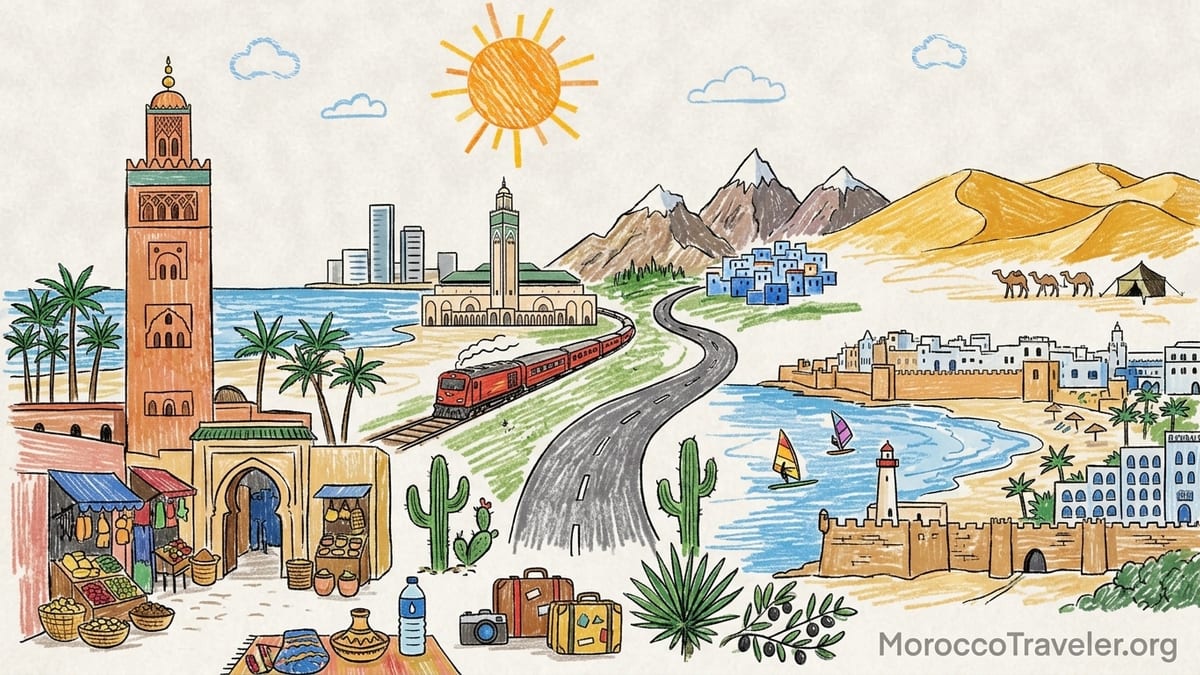
Tangier, at the Strait of Gibraltar, has a Mediterranean-facing setting and a long history of international influence. Its renovated waterfront, hillside medina and proximity to Europe give it a slightly more cosmopolitan and coastal feel compared with inland cities. Chefchaouen, in the Rif Mountains to the south of Tangier, is a small hill town known for its blue-painted alleys, slower pace and cooler air. Essaouira and Agadir on the Atlantic are beach-focused: Essaouira combines historic ramparts with windsurf and kitesurf culture, while Agadir offers long sandy beaches, large resort hotels and a milder climate, often several degrees cooler than Marrakech in summer. Inland, the Atlas Mountains provide hiking villages, oases and passes; further east and south, areas around Merzouga and M’Hamid reach into the Sahara, where travelers come for multi-day camel treks and desert camps rather than city life.
How Long to Spend and Classic First-Time Routes
For a first trip, most international travelers find that 7 to 10 days is the minimum needed to combine at least one major city with either the coast, the mountains or the edge of the Sahara. With about a week, a practical route might be to fly into Marrakech, spend three days exploring the medina and nearby sights such as the Majorelle Garden, then add an overnight High Atlas village stay in Imlil and two nights in Essaouira before flying home from Marrakech or Casablanca. This keeps road transfers to an average of three hours per travel day and avoids rushing.
With 10 to 14 days, it becomes realistic to link central and northern Morocco. For example, travelers might arrive in Casablanca, visit the Hassan II Mosque, move by train to Rabat for a night, then continue by train to Fez for three or four days. From there, a private transfer could cross the Middle Atlas via Ifrane and Midelt to an overnight or two-night stay near Merzouga on the Sahara fringe, before looping back through the Todra and Dades valleys and over the Tizi n’Tichka pass into Marrakech. This style of itinerary usually involves two or three longer driving days of six to eight hours, which are easier to manage over a two-week trip.
Slow travelers with three weeks or more can add the north and extra coastal time. One common pattern is to begin in Tangier, move by bus or train to Chefchaouen for several days of walking and photography, then continue to Fez, the Sahara, the Atlas and finally Marrakech and Essaouira. Another option is a primarily coastal journey between Tangier, Rabat, Casablanca, El Jadida, Essaouira and Agadir, with inland side-trips rather than long desert drives. For first-time visitors who want to minimize internal travel while still experiencing Moroccan variety, combining Marrakech, a day or two in the Atlas and four days on the coast around Essaouira or Agadir offers a manageable balance.
Families or travelers who prefer to unpack less often might choose to base themselves in just two locations for a 7 to 10 day trip, such as Marrakech plus Essaouira, or Fez plus Chefchaouen. From each base, day trips can reach waterfalls, hill villages or beaches, using private drivers or pre-booked excursions instead of frequent hotel changes. This approach can be especially useful for visitors who are new to North African medinas and want time to adjust gradually.
Arrival Airports, Travel Times and Getting Around
Morocco’s main international gateways are Casablanca Mohammed V International Airport, Marrakech Menara, Rabat-Salé, Tangier Ibn Battuta, Fez Saïss and Agadir Al Massira. Many long-haul flights from North America and the Gulf arrive into Casablanca, which has extensive connections to cities such as New York, Montreal and Doha. European visitors have a wider choice of direct services into Marrakech, Fez, Tangier and Agadir. For first-time visitors planning a multi-city route, it is often efficient to book an open-jaw ticket, for example arriving in Casablanca and departing from Marrakech, or arriving in Tangier and departing from Marrakech.
Within the country, the national rail operator ONCF runs intercity trains on a north–south line linking Tangier, Rabat, Casablanca and Marrakech, and an east–west line linking Oujda and Nador with Fez and the Atlantic corridor. Typical daytime journey times on the main line include Casablanca to Marrakech in roughly 2 hours 45 minutes and Rabat to Fez in about 3 hours, with air-conditioned carriages and a choice of first and second class seating. High-speed Al Boraq trains between Tangier and Casablanca cut the Tangier to Rabat journey to around 1 hour 20 minutes, making it practical to land in Tangier and reach central Morocco by rail the same day.
Coaches and shared “grand taxis” connect cities and rural areas that are not on the railway network, such as Chefchaouen, the High Atlas valleys and desert regions. A typical example would be the CTM or Supratours coach from Marrakech to Essaouira, which takes around 3 hours and is a common way for independent travelers to reach the Atlantic coast. Longer road legs include Marrakech to Merzouga, often broken into two days with an overnight in the Dades Valley, and Fez to Merzouga, which usually takes a full day with stops at Ifrane and Midelt. First-time visitors who do not want to self-drive often arrange these desert segments with a private driver or small-group tour, especially in winter when mountain passes can be affected by snow.
In cities, options include petit taxis that operate on meters within fixed zones, app-based ride services in some urban areas and city buses. Walking remains the primary way to navigate old medinas, many of which are pedestrianized or have alleys too narrow for cars. Travelers with mobility challenges should be aware that medinas like Fez el Bali involve hills, uneven steps and limited vehicle access, while newer districts and seafront promenades in cities such as Rabat, Casablanca and Agadir are generally more accessible with wider pavements.
Which Regions Fit Your Travel Style
For culture and history, the strongest concentration lies in the imperial cities of Marrakech, Fez, Rabat and Meknes, along with medieval medinas in Tetouan and Essaouira. Visitors interested in religious and architectural sites often prioritize Fez for its theological colleges and tanneries, Marrakech for its palaces and gardens, and Rabat for the Hassan Tower and the Chellah archaeological site. Tangier adds layers of 20th-century literary history and international influence, while Chefchaouen offers photogenic streets rather than major monuments.
For beaches and water sports, Essaouira and Agadir are the two most common bases. Essaouira’s town beach lies just beyond its old ramparts and attracts kitesurfers due to reliable Atlantic winds, while nearby Diabat has more open stretches of sand. Agadir offers a long bay lined with hotels, beach clubs and promenades, and nearby Taghazout and Tamraght have become centers for surf camps. Families frequently choose Agadir for its resort infrastructure and calmer medina experience, combining pool time with day trips to Paradise Valley or the Souss Massa National Park.
Hikers and nature travelers often focus on the High Atlas and Middle Atlas. Villages such as Imlil are gateways for treks to Jebel Toubkal, North Africa’s highest peak, and for lower-level walking through terraced valleys. The Middle Atlas around Azrou and Ifrane offers cedar forests and cooler air in summer. Desert regions around Merzouga and M’Hamid cater to visitors who want to ride camels at sunset, sleep in tented camps and photograph sand dunes. These experiences involve long travel days from the main cities, so they are best added to itineraries of at least 8 to 10 days.
For food-focused travel, Marrakech and Fez offer the greatest variety of restaurants, from traditional communal couscous and tagine houses to modern bistros and rooftop venues. Casablanca has a growing dining scene, especially along the corniche, where seafood restaurants serve Atlantic fish and shellfish. In coastal towns, grilled sardines, sea bream and squid are common, and markets often have simple stalls where locals order the catch of the day by weight. Travelers with specific dietary needs, such as vegetarian or gluten-free diets, usually find the widest range of options in larger cities and tourist centers, while in rural areas menus can be more limited and benefit from advance communication with hosts.
Entry Rules, Visas, Passports and Money
Morocco’s visa policy combines visa-free entry for many nationalities with an eVisa and electronic travel authorization system for others. Citizens of a long list of countries, including the United States, Canada, most European Union states, the United Kingdom, Australia, New Zealand, Japan and several Gulf states, can generally enter visa-free for tourism for stays of up to 90 days. Citizens of other countries may need to apply in advance for a visa, an eVisa or an electronic authorization through the official Acces Maroc portal. Because the list of exempt and eVisa-eligible nationalities is updated periodically, travelers should always refer to current guidance from Moroccan consulates or the Acces Maroc site before booking flights.
Regardless of nationality, visitors are expected to hold a passport that is valid for at least six months beyond their date of entry and has at least one or two blank pages for stamps. On arrival, immigration officers stamp passports and often ask for the first address in Morocco, which can be a hotel, riad or the contact details of a host. Travelers who plan to stay longer than 90 days must investigate residency or long-stay options well in advance; extending a tourist stay beyond 90 days within Morocco is complex and not guaranteed.
The currency is the Moroccan dirham (MAD), which is a closed currency. ATMs are widely available in cities, airports and many larger towns, and they are the easiest way for visitors to obtain cash on arrival. International debit and credit cards are accepted in many hotels, larger restaurants and shops, especially in Casablanca, Rabat, Marrakech, Fez, Tangier and Agadir, but smaller guesthouses, market stalls and rural businesses often prefer cash. Currency exchange counters at airports and in central city locations offer exchange services, but rates and fees vary, so many travelers withdraw moderate amounts from ATMs instead of bringing large quantities of foreign cash.
Typical ATMs have daily withdrawal limits that vary by bank, so visitors who expect to use cash heavily for things such as shopping and tips sometimes spread withdrawals across different days or cards. Contactless payments are increasingly common in supermarkets, chains and modern cafes, but less so in traditional souk shops. It is a good idea to keep a mix of small notes and coins for taxis, market snacks and porter tips, as drivers and small vendors do not always carry change for large notes.
Costs, Connectivity and Daily Practicalities
Overall costs in Morocco are moderate by Western European and North American standards, but they depend strongly on travel style. Recent traveler budget analyses suggest that a low-budget independent traveler might spend roughly 350 to 500 MAD per day excluding international flights, covering a bed in a basic guesthouse, simple restaurant meals and local transport. A midrange traveler staying in comfortable riads or hotels, eating at a mix of local and midrange restaurants and using a combination of trains, coaches and occasional private transfers may find a realistic range between about 900 and 1,400 MAD per person per day. Luxury travelers staying in high-end riads or international brand hotels, booking private drivers and guided tours and dining at top-end restaurants often see daily costs from 2,200 MAD per person upwards.
Concrete examples help illustrate this spread. In 2026, many city guesthouses advertise double rooms in simple but clean riads from around 350 to 600 MAD per night, while midrange boutique riads in Marrakech or Fez commonly sit between 800 and 1,500 MAD per night for a double room, often including breakfast. International five-star hotels in Casablanca, Marrakech and Rabat frequently charge 2,000 to 3,500 MAD or more per night. In casual local eateries, a basic tagine or grilled meat plate can cost around 40 to 80 MAD, while a meal at a midrange restaurant with starters and mains might be around 150 to 250 MAD per person, with higher prices in upscale rooftop venues and hotel restaurants.
Mobile connectivity is generally good in cities and along major roads. Local SIM cards are sold by major operators at airports and in city shops, usually requiring a passport to register. Visitors commonly buy prepaid data packages for navigation and messaging. For example, a package offering several gigabytes of data valid for a couple of weeks may cost the equivalent of a few hundred dirhams, substantially cheaper than roaming fees for many international plans. Many hotels, cafes and riads provide Wi-Fi, though speeds can vary, particularly in older buildings with thick walls or in mountain and desert accommodations that rely on limited infrastructure.
Tipping is customary but usually modest. In cafes, rounding up the bill or adding a few dirhams is common, while in restaurants a tip of around 5 to 10 percent is often appreciated if service is not already included. Hotel staff such as porters and housekeeping commonly receive small cash tips in the range of 10 to 20 MAD for assistance with bags or extended stays. Guides and drivers on private excursions or multi-day tours usually receive larger tips based on the length of service and group size, discussed at the end of the trip. Travel insurance that covers medical care, cancellations and theft is strongly recommended, since foreign visitors are expected to pay for treatment in private clinics or hospitals and then claim from their insurer.
Climate, Seasons and When to Go
Morocco’s climate varies notably between the Atlantic coast, inland plains, mountains and desert, so the best time to visit depends on the chosen regions. Coastal cities such as Casablanca, Rabat, Essaouira and Agadir are moderated by the ocean. In summer, Agadir is typically several degrees cooler by day than Marrakech, which sits inland and can experience daytime highs well above 35 degrees Celsius in July and August. Winter on the coast is mild and damp, with daytime temperatures often around the high teens or low twenties Celsius, making it suitable for sightseeing and beach walks but less reliable for sunbathing compared with peak summer.
Inland cities such as Marrakech and Fez have more pronounced seasonal swings. Winter days are often pleasantly cool to mild, while nights can be chilly, especially in older houses without central heating. Spring (March to May) and autumn (late September to early November) are generally considered the most comfortable periods for city touring, with warm days and cooler evenings. Summer heat can be intense, particularly in Marrakech, so many visitors in July and August plan around early morning and evening activities, with midday breaks in shaded courtyards or air-conditioned interiors.
In the Atlas Mountains, altitude brings cooler temperatures and a distinct winter season. Higher passes and peaks, including the Tizi n’Tichka road between Marrakech and Ouarzazate and the Toubkal region above Imlil, can see snow from late autumn to early spring. This makes winter and early spring attractive for landscapes and lowland trekking but may complicate road travel or high-altitude hikes, which require local guidance and appropriate gear. Summer in mountain villages can be very pleasant, with daytime warmth and cooler nights, attracting both international visitors and Moroccans escaping city heat.
The Sahara fringe around Merzouga and M’Hamid is driest and experiences the greatest day–night and seasonal contrasts. Autumn and spring are popular times for desert trips, offering warm days and cooler nights. In midwinter, daytime temperatures can still be comfortable, but nights in desert camps may drop close to freezing, so travelers need warm layers. In high summer, daytime heat in the desert can be extreme, and some visitors opt for shorter camel rides at sunrise or sunset combined with nights in air-conditioned accommodations near, rather than within, the dunes.
Accommodation and Transport Choices
Morocco’s signature accommodation type is the riad, a traditional townhouse built around an internal courtyard or garden. Riads are most common in medinas such as Marrakech and Fez, where they have been converted into guesthouses ranging from simple, family-run places with a handful of rooms to upscale boutique properties with plunge pools, hammams and full-service restaurants. A stay in a riad offers proximity to the medina and an atmospheric setting, but it can involve walking through alleyways with limited vehicle access, narrow staircases and occasional noise from nearby rooftops or prayer calls.
Conventional hotels, including international brands, are found both in medinas and in newer neighborhoods. They often provide easier vehicle access, elevators and more standardized amenities such as larger pools or business facilities. In resort areas like Agadir, many hotels function as full-service beach resorts, while in cities such as Casablanca and Rabat, high-end hotels target business travelers with meeting spaces and modern fitness centers. In rural areas and the mountains, accommodation often takes the form of guesthouses or auberges, which can be simple but hospitable, sometimes with shared bathrooms and set-menu dinners.
For transport, trains are usually the most comfortable way to move between major cities on the ONCF network. First-class carriages offer assigned seating, air conditioning and, on some routes, quieter compartments, while second class is cheaper and can be busy at peak times. Buses operated by companies such as CTM and Supratours cover routes beyond the rails, with luggage stored underneath the coach and assigned seats. Private transfers are widely used for point-to-point journeys, especially to and from airports, mountain villages and the desert. Many small-group desert tours include transport, meals and accommodation in a package, which can simplify logistics for first-time visitors.
Self-drive rental cars are available at airports and in major cities, and they suit travelers who are comfortable with local driving conditions and want flexibility in rural regions. Highways between major cities are generally in good condition, and toll roads exist on some main routes. However, driving within old medinas is not practical, parking can be limited near historic centers, and local driving styles and road signage may be challenging for some visitors. For a first trip focused on cities, coast and a guided desert excursion, many travelers choose to combine trains and coaches with pre-booked transfers rather than renting a car for the entire stay.
Cultural Expectations, Safety and Insurance
Morocco is a majority Muslim country, and cultural norms reflect this. In most urban areas, visitors will see a mix of traditional and modern dress, and there is no legal dress code for tourists. However, modest clothing that covers shoulders and knees is generally appreciated, especially away from beach resorts, in rural communities and when visiting religious or family-oriented neighborhoods. Swimwear is accepted on hotel and resort beaches and pools, but topless sunbathing is not appropriate. Non-Muslims are not permitted to enter most functioning mosques, with some exceptions such as the Hassan II Mosque in Casablanca, which offers organized guided tours.
During Ramadan, the Islamic month of fasting, many Muslims do not eat or drink between sunrise and sunset. Tourist-oriented restaurants, hotels and some cafes continue to serve food in daylight hours, while others may adjust their schedules. Travelers visiting during Ramadan can expect altered opening times, quieter mornings and busier evenings when families gather to break the fast. Being discreet about eating and drinking in public during daylight outside tourist zones is considered respectful. Alcohol is available in licensed venues such as some hotels, bars and restaurants, but it is less visible than in many Western countries.
In terms of safety, Morocco is considered one of the more stable destinations in the region, and violent crime against tourists is relatively uncommon. Petty theft and scams do occur, especially in crowded medinas and around major sights, so standard urban precautions apply: keep an eye on bags and phones, use hotel safes where available and be cautious of unsolicited offers of guidance that later result in pressure for payment. Licensed guides can be booked through hotels or official tourist offices in major cities. Women travelers, including those traveling alone, do visit Morocco in large numbers; some report occasional unwanted attention or comments, which are usually best handled by ignoring and moving on or by staying near busier streets and reputable venues.
Health care in larger cities includes both public hospitals and private clinics. Private facilities are often preferred by international visitors but expect payment on the spot, either directly or via proof of travel insurance. For this reason, comprehensive travel insurance that covers medical treatment, evacuation, theft and cancellations is important. Tap water quality varies by region; many visitors choose to drink bottled or filtered water, especially outside major cities, and to avoid ice in less formal establishments. Routine vaccinations should be up to date, and travelers with specific health concerns may wish to consult a travel clinic before departure. As conditions can change, especially regarding public health measures, checking recent travel advisories from your home country shortly before departure is advisable.
Booking Checklist and Common First-Time Questions
Planning a first trip to Morocco is more straightforward when broken into steps. After choosing a broad route and dates, travelers should first confirm entry requirements and ensure their passport validity meets Moroccan rules. The next priorities are booking international flights, reserving the first few nights of accommodation, especially in popular cities such as Marrakech and Fez, and deciding whether to include a guided desert excursion or mountain stay that requires advance arrangements. Once the core structure is in place, trains and long-distance coaches can be booked closer to travel dates, though high-demand routes and departure times may merit earlier reservations.
Practical preparations include arranging travel insurance, deciding whether to purchase a local SIM card or rely on roaming, and planning how to access money, typically with a combination of bank cards and cash. Travelers who expect to make frequent card payments may wish to notify their bank of travel dates to avoid blocks. It can also be useful to learn a few basic words of Moroccan Arabic or French for greetings, directions and politeness, as these are widely used in daily interactions. Packing choices should account for regional and seasonal variation, combining layers for cool evenings in the mountains or desert with lighter clothing for warm city days and coastal sun.
The following questions reflect some of the most common concerns for first-time visitors, with concise answers that can help firm up plans.
FAQ
Q1. Is Morocco suitable for a first trip outside Europe or North America?
Morocco is a popular first non-European destination because it combines good infrastructure and a range of accommodations with a culturally different environment. First-time visitors who stick to well-known routes such as Casablanca, Rabat, Marrakech, Fez, Essaouira and Agadir usually find transport manageable and safety comparable to many big cities elsewhere, provided they take normal urban precautions.
Q2. Do I need a visa to visit Morocco as a tourist?
Many nationalities, including citizens of the European Union, the United Kingdom, the United States, Canada, Australia, New Zealand and several others, can currently enter visa-free for tourism for up to 90 days. Other nationalities may need to apply for an eVisa, an electronic authorization or a traditional visa in advance. Because these lists can change, you should check the latest information from the official Acces Maroc portal or a Moroccan consulate for your specific passport before booking.
Q3. What daily budget should I plan in Moroccan dirhams?
A backpacker staying in simple guesthouses, eating mainly at local cafes and using public transport might manage on roughly 350 to 500 MAD per day. A midrange traveler staying in comfortable riads or hotels, eating at a mix of local and midrange restaurants and using some private transfers may want to plan around 900 to 1,400 MAD per person per day. For a trip centered on upscale riads or international five-star hotels with frequent private tours and fine dining, 2,200 MAD or more per person per day is a realistic starting point.
Q4. Is it better to stay in a riad or a hotel?
Riads offer an atmospheric experience with courtyards, rooftop terraces and direct access to medina streets, which many first-time visitors find memorable. However, they can involve more stairs, less uniform amenities and more ambient noise than modern hotels. Conventional hotels and resorts tend to provide easier access by car, more standardized facilities and sometimes larger pools or children’s areas. Many travelers choose riads in medinas such as Marrakech or Fez and switch to hotels or resorts on the coast or in Casablanca and Rabat.
Q5. Can I drink alcohol in Morocco?
Alcohol is available but regulated. Licensed hotels, bars and some restaurants in cities and resort areas serve beer, wine and spirits, and larger supermarkets in some cities have alcohol sections. Many smaller local eateries, especially in conservative areas and old medinas, do not serve alcohol. Drinking in the street is not appropriate, and public drunkenness is frowned upon. Travelers who do not drink alcohol will find a wide variety of fresh juices, mint tea and soft drinks.
Q6. How reliable is public transport between major cities?
The train network between Tangier, Rabat, Casablanca, Marrakech and Fez is generally reliable and comfortable, with air-conditioned carriages and frequent departures on the main routes. High-speed trains connect Tangier with Casablanca, shortening travel times along the Atlantic corridor. Coaches operated by major companies extend coverage to towns without rail service, and many routes can be booked in advance. Delays can occur, as anywhere, but for most visitors trains and intercity buses form the backbone of intercity travel.
Q7. Is Morocco safe for solo and female travelers?
Many solo and female travelers visit Morocco each year and complete their trips without serious problems. The main issues reported tend to be minor harassment, overcharging attempts or unwanted offers of help in tourist areas. Choosing centrally located accommodations with good reviews, using registered guides for complex medinas and sticking to well-lit, busier streets at night can help. As in any destination, staying aware of surroundings, limiting displays of valuables and trusting instincts about people and places are important.
Q8. When is the best time to visit the Sahara desert in Morocco?
The most comfortable periods for visiting desert areas such as those around Merzouga and M’Hamid are typically spring and autumn, when days are warm without extreme heat and nights are cool. Winter offers clear skies and quiet dunes but can bring very cold nights, especially in tented camps, requiring warm clothing. High summer can be extremely hot during the day, so some travelers avoid this period or plan very short dawn and dusk visits rather than extended midday activities.
Q9. What should I wear to respect local customs?
There is no strict dress code for tourists, but modest clothing that covers shoulders and at least to the knee is generally appreciated away from pools and beaches. Lightweight long trousers, midi or long skirts and tops with sleeves work well in most situations. Swimwear is appropriate at hotel pools and resort beaches but less so in town centers or rural villages. A light scarf can be useful for women for sun protection and occasional extra coverage, though it is not required by law.
Q10. Can I use my mobile phone and get data easily?
Yes. Coverage is good in cities and along major roads, and local SIM cards are easy to buy at airports and in city shops with a passport. Prepaid packages with several gigabytes of data are usually affordable compared with international roaming, and many hotels and cafes provide Wi-Fi. In remote mountain areas and deep desert, coverage may be patchy or absent, so travelers should not rely entirely on mobile data in those locations.