


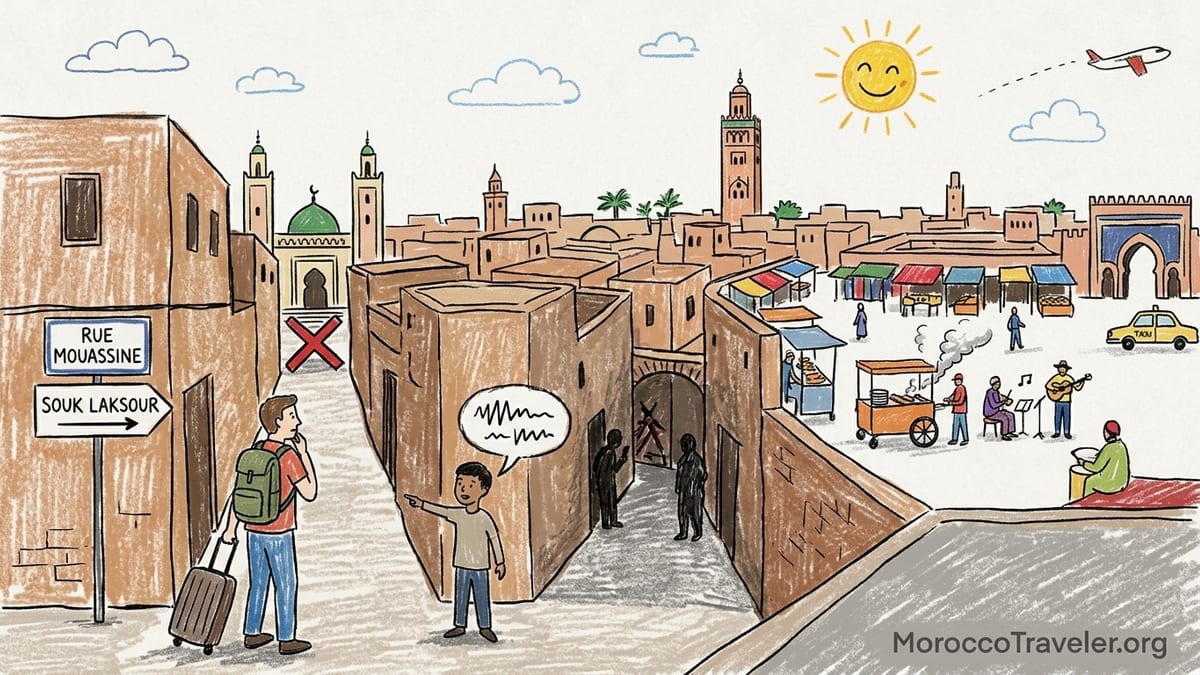
By my second night in Marrakech, the walk from Jemaa el-Fnaa back to my riad near Bab Laksour had gone from exhilarating to something I quietly dreaded. The turning point came on a dim stretch just past the Mouassine Mosque, when a teenager stepped into my path, spread his arms wide and declared, “This way is closed, only for prayer. Follow me, I show you.” Ten minutes, three unnecessary alleyway detours and a raised voice later, I had my first full encounter with the “fake guide” economy that thrives in parts of the Marrakech medina. It changed the way I felt about the city for the rest of my stay.
When “This Way Is Closed” Became My Breaking Point
The incident started innocently. I was following Google Maps along Rue Mouassine, heading toward Souk Laksour to reach my riad. A boy of maybe 16 stepped out, pointed at the lane ahead and said in English, “Street closed, only mosque, you cannot. Your riad is that way.” I had already read warnings about this exact line, but in the semi-darkness, dragging a cabin bag and with motorbikes clipping past my elbow, I hesitated. That brief wobble was all he needed.
He walked ahead briskly, waving for me to follow. Each time I slowed, he insisted, “No problem, five minutes, I bring you front door.” He steered me away from the main artery, down a side alley, then another. Within four or five turns, the sound of the main souk had faded. When we reached a dead end, he doubled back and I realized we were looping in a rough circle. My riad’s blue dot on the map was now further away, not closer.
When I finally stopped and said, “I’ll manage from here, thank you,” the tone flipped instantly. “You pay now,” he snapped. “I take you long way for your security. You give 200 dirhams.” Two more boys appeared from the shadows, not overtly threatening, but close enough to make the lane feel very narrow. I pulled 50 dirhams from my wallet and said quietly, “This is what I have for help, shukran.” There was swearing, eye-rolling and a parting shot of “Next time stay in hotel,” but they took it. I walked away, heart racing, painfully aware that I had just funded the very behaviour that makes the medina harder for everyone.
The worst part was not the money. Fifty dirhams is roughly the price of a simple meal. What stayed with me was the way the encounter corroded my trust. For the rest of the week, every genuine “Can I help you?” set my shoulders on edge. I started refusing assistance even when I was properly lost. The medina’s maze, which I had found thrilling on my first afternoon, began to feel like a system designed to turn confusion into cash.
Fake Guides, Closed Streets and Manufactured Confusion
The “this way is closed” script is not unique to my walk that night. Recent travel blogs, Reddit trip reports and even mainstream newspapers describe almost identical encounters around Bab Doukkala, Bab Laksour, and the lanes feeding into Jemaa el-Fnaa. In most stories, a young man claims that the street or gate ahead is closed for prayer, construction or a special event, then offers to “help” you to your riad or to an attraction like the tanneries, only to demand payment at the end, sometimes as high as 200 dirhams or more.
What makes this pattern particularly corrosive is that the lie always begins with something that could be plausible. Marrakech’s old town does have mosques whose immediate doorways are not open to non-Muslims, and prayer times do shape daily life. Gates can close for security or maintenance. When you are new in town, dead tired from travel and surrounded by unfamiliar sounds, the claim that “this alley is closed now” is just believable enough to seed doubt. Once you accept the premise, you are already halfway into the scam.
Morocco actually regulates tour guides through national laws and decrees that require training, exams and official licensing. Licensed guides are meant to carry visible ID issued by the Ministry of Tourism and often wear a lanyard or badge while working. By contrast, the teenagers who chase tourists at the medina gates typically have no visible identification. They may present themselves as “from your riad,” “student guides,” or “municipality helpers,” yet any offer that starts unsolicited in the street and immediately steers you off your route is a red flag.
Local authorities are not blind to the problem. Moroccan media has reported police crackdowns in Jemaa el-Fnaa and surrounding streets, with arrests of unlicensed “guides” and street hustlers after videos of aggressive behaviour went viral. Those efforts show that this is not normal or officially tolerated. But enforcement is intermittent, and the financial incentive in a city that lives from tourism is powerful. For every fake guide taken off the square, there always seems to be another teenager ready to step into the gap at dusk.
Unwanted Help, Aggressive Selling and the Emotional Tax on Visitors
The fake-guide ecosystem is only one part of a broader pattern that can turn Marrakech from a sensory feast into an emotional grind. In and around Jemaa el-Fnaa, I repeatedly encountered “assistance” that arrived uninvited and came with an implicit price tag. A man would grab the handle of my suitcase and walk three metres, then refuse to release it until I tipped. A boy would point wordlessly down an obvious lane, then hold his palm out. None of these gestures were violent, but the constant low-level pressure felt like a tax on every moment of disorientation.
Souvenir stalls in the covered souks added another layer. Bargaining is expected in Morocco; it can even be fun in the right headspace. But in some parts of the medina, the starting prices and tactics slide from hard sell into something closer to entrapment. In one carpet shop off Souk Semmarine, a seller led me into a back room “just to see Berber designs, no obligation.” Tea arrived, carpets multiplied across the floor and the door quietly nudged closer to shut. The first quoted price for a small rug was the equivalent of several hundred euros, several times what similar items sell for through well-reviewed fixed-price cooperatives elsewhere in Morocco. Leaving without buying meant enduring a good ten minutes of dramatic sighing, guilt-laced lines about “feeding my family” and an attempt to shame me for “wasting time.”
Food stalls on Jemaa el-Fnaa present their own version of this game. Multiple recent visitor accounts describe being lured to a particular stand by a friendly waiter and a cheap-looking menu, only to find extra plates of starters, bread and sauces appearing on the table unasked, then turning up on the bill at inflated prices. Others recount being quoted one price verbally and presented with a bill almost double. When you are surrounded by noise and movement, arguing over line items in the dark with four waiters standing over you can feel more intimidating than the sum in question.
Individually, each of these incidents might be brushed off as an annoyance. Collectively, they create a mental environment where you are constantly scanning for the trick instead of engaging with the place. The real cost is not simply a few hundred dirhams skimmed at the margins. It is the way suspicion edges into every interaction, blurring the line between the minority who exploit tourists and the many Marrakech residents who are simply trying to earn a living honestly.
Taxis, Detours and the Price of Not Knowing the Rules
Marrakech taxis deserve special mention because they shape your first and last impressions of the city. The journey from Marrakech Menara Airport into the medina is only about 3 kilometres in distance, yet travellers report a bewildering range of prices. Some official tourism information still cites public guidance in the region of 70 to 100 dirhams for the airport to city centre ride, depending on time of day, while private transfer companies advertise prebooked fixed fares around 150 to 200 dirhams per car to the medina. Forum discussions from 2025 and 2026, including input from locals, suggest that a fair metered fare inside the city for a small “petit taxi” ride is usually in the 15 to 30 dirham range, rising for longer cross-town trips.
In practice, many visitors never see a meter. On my own arrival, the driver at the airport rank waved away my request to use one and instead wrote “300” on his hand, tapping his chest and repeating “night price, many bags.” It was early evening and I had one backpack. When I declined and walked back toward the terminal, the price dropped in stages to 200, then 150. Even at 150 dirhams, I later realized, I had probably overpaid compared to what a local would expect to pay from the airport counter or with a metered petit taxi picked up just outside the airport zone.
Within the city, the pattern continued. From the medina edge at Bab Laksour to the modern district of Gueliz, a driver quoted 80 dirhams flat for a ride that, on the meter, would likely have cost under 30. Another insisted his meter was broken, gesturing at the dashboard. Only when I reached for the door handle and said, “I’ll take another taxi, thank you,” did a second car pull up whose driver agreed to use the meter without fuss.
The same lack of transparency appears in “detour” offers. Several times, taxi drivers proposed a stop at “a very good cooperative” on the way to Jardin Majorelle or the Palmeraie, explaining that I did not have to buy but “just look.” In reality, such detours usually end at commission-based shops where prices are padded to cover everyone’s cut. Saying no firmly at the outset is essential. If you agree to a stop, understand that the driver is almost certainly earning a commission on whatever you spend inside.
None of this is unique to Marrakech; inflated taxi fares and commission shuttles are a feature of tourist cities worldwide. But in a destination that markets itself heavily on hospitality and where public messaging insists taxi rates are regulated, the disconnect between official guidance and curbside reality can be jarring. Knowing your rough numbers in advance, and being prepared to walk away, is one of the simplest ways to protect both your wallet and your mood.
How Constant Pressure Warps Your Sense of People
What bothered me most after a week in Marrakech was not any single scam or overcharge. It was the way constant low-level pressure rewired my instincts. By day two, I found myself assuming that every stranger who approached me in the medina wanted something. When an older man in a djellaba stopped me near Bab Doukkala and gently pointed to the phone in my back pocket, indicating it was about to fall, my first reaction was suspicion. It took me a few seconds to register that he had not asked for money, not tried to steer me anywhere, just quietly helped.
This is the collateral damage of the informal tourist economy. A small group of hustlers recruits entire categories of people into a traveller’s mistrust file. Young men loitering by the gates become “fake guides” before they open their mouths. Anyone who speaks good English must be on the make. Children who run alongside you in the souk are brushed off as little scammers in training. It is an unfair narrative, and locals know it. More than once, when I gently pushed back on a taxi quote or refused henna in the square, another Marrakech resident later told me, with a mixture of embarrassment and frustration, “Not all of us are like that. They make problems for everyone.”
Online, Moroccan commenters express the same ambivalence. In threads where tourists describe being hassled or overcharged, locals frequently reply to condemn aggressive behaviour and to share their own experiences of being targeted when they look “too foreign” or are out late at night. At the same time, some point out the economic context: a city where tourism is a major employer and where the difference between an average monthly wage and what a tourist carries in a wallet or phone is stark. None of this justifies intimidation. But acknowledging the pressures at play can help visitors stay firm on boundaries without dehumanizing the people in front of them.
For me, the shift came once I began to separate unsolicited approaches from interactions I initiated. If I walked up to a stall, made eye contact and asked a question, I treated whatever followed as a normal commercial exchange, bargaining included. If someone approached me out of nowhere with “Where are you from?” or “Your street is closed,” I defaulted to a polite but immovable “No, thank you” and kept walking. That simple rule allowed me to relax a little with the people I chose to engage, instead of letting a handful of hustlers define the entire city.
Practical Ways to Navigate the Medina Without Losing Your Nerve
Despite my rocky introduction, I would still encourage people to explore Marrakech independently, with caveats. The medina is a UNESCO-listed historic centre for a reason. When you are not being steered or shouted at, wandering its lanes can feel like stepping into a living museum of architecture and craft. The key is to stack the odds in your favour with a few habits that take some of the chaos out of the equation.
On arrival, consider asking your riad to book a transfer that includes a staff member meeting you at the edge of the medina. Many riads will send a porter with a cart to meet guests at a known taxi drop-off point such as Bab Laksour, Bab Doukkala or Koutoubia Mosque. You may pay a little more than hailing a random cab, but you also sidestep the stressful combination of heavy bags, narrow alleys and fake guides swirling around new arrivals.
When you do walk, download offline maps and save your riad’s location, plus a nearby landmark like a mosque or gate. If someone tells you a street is closed, stop under a light, check the map and look for other pedestrians. In my experience, locals will continue straight ahead without hesitation if there is no real closure. A calm “La, shukran” (No, thank you) and a confident stride forward is usually enough to end the interaction. If a person physically blocks your path, step wide around them and repeat the phrase without engaging in argument.
In Jemaa el-Fnaa, decide before you enter what you want from the experience. If you simply want to soak up the atmosphere, you can do so from the perimeter terraces of cafes where you pay for a drink and watch from above. If you choose to eat at a food stall, pick one where you can see prices clearly on a menu and confirm, before ordering, what is included in the price. When extra plates arrive unasked, send them back immediately with a smile and a shake of the head. For henna, only sit with women who display a clear price list and agree on a design size; if someone grabs your hand uninvited and starts applying paste, pull back firmly before any work is done.
As for taxis, the least stressful formula I found was to ask the driver, before getting in, “Compteur, s’il vous plaît?” If he agrees and the meter works, ride. If he refuses, either negotiate a price that you are comfortable with, grounded in what a typical meter fare would be for that distance, or step back and wait for another car. When a driver proposes a “shopping stop,” say clearly, “No stops, direct to [destination],” and repeat as needed. Marrakech is big enough that you rarely have to accept the first offer.
Independent Exploration vs Hiring a Reputable Guide
After my first two days of mixed experiences, I booked a licensed guide for a half-day medina tour through my riad. The cost was approximately the same as what I had already lost to overpaying for taxis, a “helpful” direction and a regretful meal. That guided morning shifted the balance of my trip enough that, in hindsight, I wish I had done it on day one.
A licensed guide in Marrakech should be able to show an official badge with their name and registration number. Many have spent months in training and must pass exams on local history, culture and languages. Walking with my guide, we passed the same medina gates where I had been hassled the previous evening. Not a single fake guide approached us. In the souks, sellers greeted my guide by name, and while they still tried to make sales when we entered shops, the tone was notably more relaxed. Prices started closer to reality, and I felt free to say no without being cornered.
Financially, a private licensed guide for a half day in 2026 commonly costs the equivalent of a mid-range dinner for two in Marrakech, while small-group walking tours can be cheaper per person. When you weigh that against the potential cost of three or four bad taxi rides, one inflated carpet purchase and a couple of stressful confrontations, the math can favour hiring a professional, especially for your first full day in town. You are paying not just for information but for a buffer between you and the more predatory parts of the medina economy.
That said, a guide is not a magic shield. Some work on commission with particular shops, which can subtly shape your itinerary. If you prefer to avoid this, make your preferences clear at the start: tell your guide you are more interested in history and architecture than in shopping, and be explicit that you do not want to visit carpet or herb shops unless you ask. A good guide will respect this and still help you decode the city, explaining, for example, which areas of the souk are known for quality leather, which for metalwork, and where fixed-price artisan centres operate under official oversight.
By the second half of my stay, I blended the two approaches. Once I had a mental map from walking with a guide, I ventured out alone in the early morning and late afternoon, when the medina felt calmer and the pressure lighter. At those times, I rediscovered some of the magic that had been buried under my defensive posture: the way sunlight spills through wooden lattice into dust motes, the smell of fresh bread from an unmarked communal oven, the quiet patience of an elderly calligrapher painstakingly painting a name in Arabic script. Having that foundation made the city feel less like a gauntlet.
The Takeaway
Marrakech is not ruined by scams, but parts of the medina experience can be. My own visit was defined, more than I wanted to admit at the time, by a handful of young men who saw disorientation as an income stream and by some taxi drivers and stallholders who treated first-time visitors as walking wallets. Those behaviours are real, recurring and widely documented. They deserve to be called out, not shrugged off as “just part of the culture.”
At the same time, they are not the whole story. Away from the tightest tourist choke points, I found quieter lanes where neighbours greeted each other by name and barely glanced at me. In the Mellah, the old Jewish quarter, a shopkeeper spent twenty minutes explaining spice blends with no expectation that I would buy more than a small bag of ras el hanout. In the Palmeraie, a family-run stable arranged a short horse ride that ended with mint tea under a palm tree, without a single extra fee tacked on.
If I were planning a second trip to Marrakech, I would make a few changes. I would arrange an airport transfer through my accommodation and ask to be met at a gate with a porter. I would book a half-day licensed guide for my first morning to understand the layout and to learn the phrases and strategies that help deflect unwanted attention. I would time my independent medina walks for early morning and late evening, avoiding the midday crush in Jemaa el-Fnaa when pressure is highest. And I would give myself explicit permission to take breaks outside the old town in Gueliz or the gardens whenever my patience began to fray.
Most importantly, I would remind myself that saying no is not rude when it protects your boundaries, and that it is possible to hold two truths at once: that some people in Marrakech aggressively exploit tourists, and that many others are warm, honest and proud of their city. Travelling with that nuance in mind is the best safeguard I know against letting a few bad actors steal both your money and your capacity for wonder.
FAQ
Q1. How can I tell if a Marrakech guide is legitimate?
Legitimate guides in Marrakech are licensed by Moroccan authorities and carry an official identification badge with their name and registration number, often worn on a lanyard. You will usually be introduced to them through a hotel, riad or established tour operator rather than being approached randomly in the street.
Q2. What should I do if someone in the medina says my street is closed and offers to help?
Stay calm, check your map and look at where other pedestrians are going. If locals are walking normally in that direction, the street is almost certainly open. Say “La, shukran” (No, thank you) and continue on your original route without engaging in conversation or following the person.
Q3. Is it safe to walk back to my riad at night in Marrakech?
Many visitors do walk at night in the central medina without physical danger, but the level of hassle from fake guides and touts can increase after dark. If you feel uncomfortable, arrange for your riad to send someone to meet you at a nearby gate or taxi stand, or take a taxi to a well-lit landmark close to your accommodation.
Q4. How much should a taxi cost from Marrakech airport to the medina?
Official guidance and recent traveller reports suggest that reasonable fares from Marrakech Menara Airport to medina drop-off points are typically in the low hundreds of dirhams per car, while metered rides within the city are normally much cheaper, often under 30 dirhams for short hops. Because practices change and some drivers refuse to use the meter, it is wise to confirm the current indicative fare with your accommodation or the airport taxi counter before you travel.
Q5. How can I avoid being overcharged in Jemaa el-Fnaa food stalls?
Choose a stall where prices are clearly displayed, confirm what is included in the price before you sit down, and refuse extra plates you did not order as soon as they appear. If there is a dispute over the final bill, stay polite but firm, pay what matches the displayed prices and agreed items, and be prepared to walk away if onlookers or staff try to escalate with theatrics.
Q6. Is bargaining expected in the Marrakech souks, and how do I do it without conflict?
Bargaining is a normal part of shopping in the souks. Start by offering around half of the first price if it seems inflated, then move gradually toward a middle point you are comfortable with. Keep the tone light, smile, and be prepared to walk away; if a seller becomes angry or aggressive, it is better to end the interaction and leave than to push for a “win.”
Q7. Should I hire a guide for my first day in Marrakech?
Hiring a reputable licensed guide for a half day on your first full day can significantly reduce stress, help you understand the medina’s layout and shield you from some of the more persistent touts. While it is an extra cost, many travellers find that it pays off in fewer mistakes, more context and a more relaxed experience overall.
Q8. What is the best way to handle children or teenagers who demand money after giving directions?
If you did not ask for help, you are not obliged to pay. A firm “No money, shukran” and walking away is acceptable. If you did accept genuine help and feel safe, a small tip is fine, but avoid handing over large sums, as this reinforces the behaviour that creates pressure for other visitors.
Q9. Are all areas of the Marrakech medina equally intense?
No. The streets immediately around Jemaa el-Fnaa and the main tourist arteries through the souks tend to have the most aggressive selling and fake-guide activity. Quieter residential lanes, parts of the Mellah and some areas near less touristed gates can feel far more relaxed, especially in the early morning.
Q10. What precautions would you personally take on a return visit to enjoy Marrakech more?
On a return visit, I would arrange airport transfers through my accommodation, book a licensed guide for my first morning, avoid peak hours in Jemaa el-Fnaa, and plan daily breaks outside the medina. I would also be quicker to say “no” to unsolicited help while making space to engage more fully with people and places I chose myself.