

My first reminder that “cheap Morocco” is often a myth came before I had even left Marrakech airport. I had prebooked what was advertised online as a 100 dirham “fixed price” taxi to my riad in the medina. The booking page showed a reassuring total of 100 MAD, plus a line in small grey text that read “local supplements may apply.” At the arrivals exit, the driver walked me to the taxi stand, then pointed at a laminated board of official tariffs: 100 MAD for the ride, a 20 MAD airport supplement, 20 MAD for luggage and, because it was after 8 p.m., a 50 percent night surcharge. The “100 dirham airport transfer” had quietly become 200 MAD. It was not an outright scam, but it set the tone for a week in Morocco in which headline prices and final bills rarely matched.
Why Morocco Has a Reputation for Being Cheap
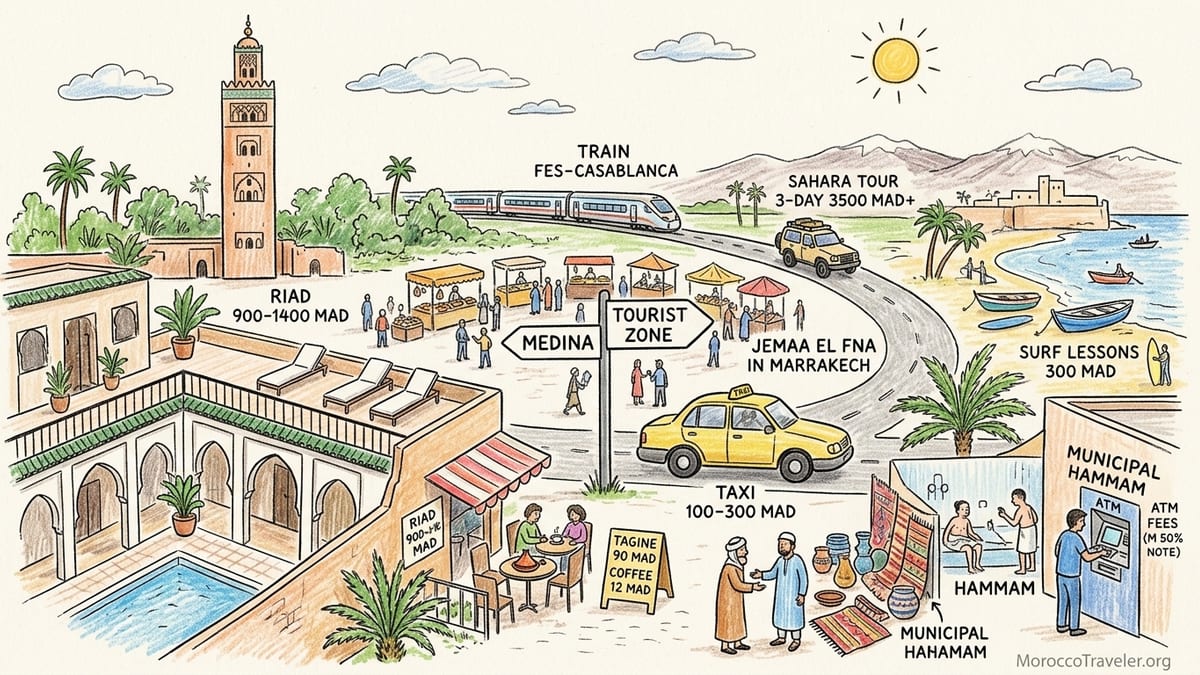
Morocco’s image as a budget destination is not entirely unfounded. On paper, some everyday costs are low by Western European or North American standards. A coffee at a neighborhood cafe in Marrakech or Fez still often runs around 8 to 12 MAD, and a simple set lunch of tagine, salad and bread at a place used by local office workers might cost 40 to 70 MAD in late 2026. Intercity trains between hubs such as Casablanca, Rabat, Fez and Tangier are subsidized and can be very good value when booked in second class. A daytime official taxi from Marrakech Menara airport to the medina is posted at about 100 MAD, with a modest supplement at night, according to recent local guides to the city’s transport options in 2026.
These are the prices many travelers see quoted in blog posts and social media reels that still promote Morocco as “a country where you can live on 20 dollars a day.” They usually focus on what an independent traveler might pay if they always chose the cheapest option, ate where locals eat, shared taxis, avoided alcohol and skipped organized tours. In reality, most visitors splurge selectively, value their time and comfort and rely on tourist-facing businesses for at least part of their stay. This is where the gap between Morocco’s low local income levels and the tourist economy becomes obvious.
The Moroccan dirham is a partially managed currency and has seen periods of inflation on consumer goods and services over the past few years. As a result, many guidebooks, older blog posts and even some recent advertising copy have not fully caught up with price rises. A tagine that once cost 50 MAD in a tourist restaurant might now be 90 or 100 MAD. A classic three-day private Sahara tour marketed a few years ago around the 1,800 MAD mark per person is now far more likely to sit between about 2,800 and 3,500 MAD once all inclusions are counted.
None of this means Morocco is suddenly a high-cost destination, but it does make the old assumption that “Morocco is cheap by default” misleading. The country can still feel affordable, yet for travelers who lean on private drivers, boutique riads and guided experiences, the final bill often looks more like a midrange Mediterranean holiday than a backpacker bargain.
Sticker Shock in Marrakech: Taxis, Riads and Eating Near the Square
Marrakech is usually the first place where visitors collide with the two parallel economies that run through modern Moroccan tourism. On the one hand, you have the city of ordinary life: residential districts, local cafes and canteens, small grocery shops and municipal hammams. On the other hand, there is the city presented to tourists: the medina riads with plunge pools, rooftop cocktail bars overlooking the Koutoubia minaret, food stalls and restaurants around Jemaa el Fna and the polished boutiques in the lanes leading off the square.
Take airport transfers. Local transport specialists who track fares in 2026 describe an official taxi price of around 100 MAD from Marrakech Menara to the medina by day, with roughly 50 percent added at night. On the street, however, visitors regularly report initial quotes of 200 to 300 MAD from drivers, especially right outside the terminal or near major squares. Some hotels now sidestep this by selling their own “private transfer” in the 150 to 250 MAD range, often described as a flat rate but with small-print caveats for late arrivals or extra luggage. For a solo traveler who expected a cheap bus ride on arrival, these are not ruinous sums but they are significantly higher than the image of a “few coins for a taxi” that still circulates online.
Riad prices in Marrakech illustrate the same spread between budget expectations and what many visitors actually book. Platforms that aggregate riad listings show basic double rooms in the medina from under 300 MAD per night in the off-season, usually without a pool, with simple decor and sometimes shared bathrooms. At the same time, the more atmospheric midrange riads with central courtyards, small plunge pools and well-reviewed breakfasts commonly price their standard rooms around 700 to 1,200 MAD per night for two people in late 2026, with higher rates in peak periods. Properties that market heavily to international guests, include airport transfers and feature rooftop restaurants can climb closer to or above 2,000 MAD.
Meals near Jemaa el Fna have undergone a similar shift. Local guides and restaurant surveys published in 2026 describe basic grilled meat or tagine stalls on and around the square advertising dishes from about 50 to 80 MAD, but many travelers report that plates of mixed grills, seafood or “special menus” quickly run past 120 MAD per person once bread, olives, tea and service are added. Some stalls show one laminated menu to attract passersby, then produce another with higher prices when the bill comes, a practice criticized in local and international coverage and in numerous traveler reports. A sit-down restaurant with a terrace view of the square and a license to serve alcohol may easily charge 100 to 150 MAD for a main course and 50 to 70 MAD for a glass of wine.
Fez, Chefchaouen and the Coast: Local Prices vs Tourist Reality
Move away from Marrakech and the pattern repeats with local life remaining relatively affordable while tourist zones become steadily more expensive. Fez is a good example. In the new town, a plate of roast chicken with salad or a hearty bean stew can often be found for around 40 to 60 MAD in late 2026, and fresh-pressed orange juice around 8 to 10 MAD. In the heart of the Fez el Bali medina, however, restaurants aimed squarely at visitors routinely set tagines at 90 to 120 MAD and charge extra for bread and small starters, even when they are brought unrequested. Rooftop venues with photo-friendly views over the sea of roofs and minarets often layer on a service charge of 10 to 15 percent, noted only in small print at the bottom of the menu.
Accommodation in Fez spans a wide range, but the pattern mirrors Marrakech. Simple guesthouses and small riads away from the busiest medina alleys sometimes start under 300 MAD for a basic double room including breakfast, especially outside school holidays and religious festivals. Well-located riads with restored traditional decor, inner courtyards and English-speaking staff now commonly quote between 600 and 1,000 MAD for similar dates, with more luxurious suites climbing well above that. Many packages include a set dinner on at least one night, which can be good value if clearly priced, but some travelers only discover the true cost of those dinners at checkout.
Chefchaouen, the blue-painted mountain town that dominates social media feeds, is often described as cheap. It can be, if you stay in a plain pension off the main lanes and eat at local snack bars selling sandwiches in the 20 to 30 MAD range and plates of couscous or tagine for around 50 to 70 MAD. Yet that same traveler who arrives specifically to photograph the blue medina is drawn to cafes and rooftop terraces looking over the painted alleys. Recent menus collected by independent travel writers show coffees around 20 MAD, smoothies around 30 to 40 MAD and main dishes at 80 to 110 MAD in these locations, plus a service charge. Souvenir shops selling ceramics, leather and textiles often quote “tourist prices” significantly above what similar items cost in less famous cities, betting that visitors will not have a benchmark.
On the Atlantic coast, places such as Essaouira and Agadir have also seen tourist-facing prices rise. Beachfront cafes in Essaouira now frequently set grilled fish platters around 120 to 160 MAD and cocktails above 80 MAD. Surf lessons marketed in English for small groups typically advertise prices somewhere in the region of 250 to 400 MAD for a half-day session, sometimes including board and wetsuit rental but not always explicitly listing that on the booking page. Budget travelers who imagined “cheap surf town prices” often discover that these coastal destinations, while still affordable compared with some European resorts, operate on an international tourist scale rather than a local Moroccan one.
Desert Tours, Private Drivers and the Hidden Costs in Fine Print
Nowhere is the gap between the idea of Morocco as a very cheap destination and the reality of modern tourism more evident than on Sahara trips. The classic three-day, two-night tour from Marrakech to the Erg Chebbi dunes near Merzouga is advertised by many agencies as a signature experience. Recent examples from Moroccan tour operators show per-person prices for private versions often in the range of several hundred euros or a few thousand dirhams, depending on group size and comfort. Group tours can be cheaper, but even there, the fine print matters.
The inclusions and exclusions list is where costs multiply. Many operators include transport in an air-conditioned vehicle, one night in a simple hotel in the Dades Valley or similar, one night in a desert camp with dinner and breakfast, and the camel ride to the dunes. What is far less consistently included is lunch on any of the three days, bottled water throughout the trip, drinks with dinners, sandboarding or quad biking, entrance fees to certain kasbahs and gorges and tips for drivers and camp staff. Several itineraries simply state “meals not mentioned, drinks and personal expenses not included.” Travelers who budget only for the headline tour price may find themselves adding 80 to 150 MAD per day for lunches, 30 to 60 MAD for bottled water and soft drinks, and further amounts if they opt into optional activities.
Private transfers, whether for desert tours or shorter hops between cities, are another cost that inflates budgets quickly. In a country with limited long-distance public bus and train coverage to remote areas, many travelers choose to hire a driver for a day or several days. Daily rates for certified tourist transport vehicles with an English-speaking driver frequently run to several hundred dirhams or more, before fuel and any overnight costs for the driver are added. A couple traveling this way comfortingly assumes they are in a “cheap country,” but by the time they factor in private vehicle rental, fuel, lunches and midrange accommodation, their daily spend rivals that of road trips in southern Europe.
Price transparency is often weaker than it could be. Some booking pages give a broad range such as “from X dirhams per person” with a note that the final quote depends on group size and dates. Others use foreign currency pricing without clearly indicating how exchange rates and transaction fees might affect non-European guests. Optional extras such as upgraded desert camps, en suite bathrooms, camel ride extensions at sunrise or hotel pickups in areas outside the city center are sometimes only priced after a booking inquiry, making it harder to compare offers. This does not mean operators are acting dishonestly, but it does make the true cost of the “cheap desert adventure” harder to pin down.
There are also examples of legitimate premium pricing that should not be lumped together with unfair markups. Highly rated, low-impact desert camps that limit guest numbers, pay fair wages, truck out waste and use larger tents with proper bedding and heating understandably cost more than minimal-service bivouacs that rely on volume. When a camp discloses its environmental measures, group size limits and included services, and sets out a clear per-night rate, higher prices reflect real costs rather than tourist naivety. The difficulty for travelers is distinguishing these from operators that advertise “luxury” in marketing copy while quietly charging extra for everything from hot showers to confirmed dune-side tents.
Hammams, Guides, Surf Lessons and Souvenirs: Where the Money Goes
A closer look at common holiday experiences in Morocco reveals how easily small gaps between expectation and reality accumulate. Traditional hammams are a classic example. Municipal or neighborhood hammams used by locals can still be very inexpensive, often charging well under 50 MAD for entry and a basic scrub. Tourists are welcome at some of these, although they must usually bring or rent their own soap, bucket and scrub mitt. In contrast, “spa hammams” attached to riads or luxury hotels frequently market packages to foreign guests in the 400 to 800 MAD range per person, including black soap scrub, massage and relaxation time. The service may be excellent, and many visitors enjoy the experience, but it is far removed from the idea of a “cheap local bathhouse.”
Official guides in medina cities such as Marrakech and Fez are another frequent point of confusion. Licensed guides have set daily or half-day rates that are competitive by international standards, and many offer good value for in-depth historical or cultural tours. However, unlicensed touts who approach visitors in the street often open with vague phrases about “free guiding” or “pay whatever you like” and later demand specific sums. Even among licensed guides, commission-based shopping stops at particular carpet workshops, leather tanneries or argan oil cooperatives remain common. Guides may not always volunteer that the prices in those shops are substantially above what a bargaining local would pay elsewhere.
Surf lessons along the Atlantic coast sit on a similar spectrum. In smaller towns and beaches that cater to domestic holidaymakers, board rental and lessons can be relatively modestly priced. In well-known surf spots marketed heavily to European visitors, international-style surf camps and schools have emerged, with packages priced closer to Southern European standards than to Moroccan wages. A traveler lured by images of cheap, endless waves may still find good value compared with home, but less of a bargain than expected.
Souvenirs also illustrate how quickly costs can spiral without a reference point. In artisan quarters away from the main tourist alleys, basic hand-painted bowls, simple leather slippers or woven baskets might start around a few tens of dirhams. In the heaviest footfall lanes of Marrakech or Chefchaouen, the same items may be offered for several times that amount to first-time visitors. Hard bargaining is part of the cultural script, but it confuses many travelers who are keen to pay a fair price without feeling manipulated. The repeated dance of dramatic first price, exaggerated counter-offer and theatrical walk-away can leave both sides frustrated.
Money, Cards, ATMs and the Cost of Paying
On top of visible prices, the structure of the Moroccan banking and payments system affects how much visitors really spend. The Moroccan dirham is a closed currency, which means most travelers rely on airport exchanges and local ATMs. Some banks charge per-withdrawal fees for foreign cards, often displayed on-screen only at the last confirmation step. Combined with charges from home banks, each ATM withdrawal can cost several euros or more in fixed and percentage fees, effectively adding a quiet surcharge to everyday spending.
Card acceptance has improved in many hotels, riads and higher-end restaurants, but cash remains dominant in small shops, taxis, markets and many midrange eateries. When cards are accepted, some businesses apply a small, often informal surcharge for credit card payments, especially on lower-value bills. Dynamic currency conversion is another pitfall: payment terminals may offer to convert the bill to the traveler’s home currency at a less favorable rate, again adding hidden costs. Choosing to pay in dirhams and letting one’s own bank handle the conversion is usually cheaper, but the option is not always clearly explained.
Tipping expectations also contribute to the sense that Morocco is more expensive than it first appears. Service staff in cafes and restaurants generally appreciate small tips of a few dirhams, and guides, drivers and hotel staff often rely on gratuities to supplement wages. On desert tours, some operators hint at or suggest specific amounts in advance, but many leave it vague, leading to uncertainty and awkwardness at the end of a multi-day trip. For a solo traveler or couple, tips for drivers, guides and camp staff over several days can easily reach a few hundred dirhams, which may feel high relative to the advertised base price of the tour.
For those using ride-hailing apps or local equivalents where they exist, the issue of cash versus card can resurface. App-based fares can be lower and more transparent than street taxis, but drivers sometimes request cash to avoid platform commissions or card processing. Visitors who arrive with the assumption that they can put almost everything on a credit card, as they might in parts of Europe or North America, may end up making more cash withdrawals than planned.
Two Seven-Day Budgets: Modest vs Midrange Morocco
To understand how Morocco moves from “cheap” to “surprisingly expensive,” it helps to look at two realistic seven-day scenarios using late 2026 price patterns. These are approximate examples rather than strict budgets, but they illustrate the gap between a modest approach and a more typical midrange holiday.
In the modest scenario, a solo traveler splits time between Marrakech, Fez and a coastal stop reachable by bus or train. They stay in simple guesthouses or basic riads at around 300 to 400 MAD per night, including breakfast. Over seven nights, that is roughly 2,100 to 2,800 MAD. They rely on trains and intercity buses between cities and use metered or shared taxis where possible inside cities, averaging perhaps 70 to 100 MAD per day on transport, or 500 to 700 MAD over a week. For food, they mostly eat at local cafes and snack bars, with occasional street food and self-catered items from markets, averaging something like 120 to 180 MAD per day, so around 900 to 1,250 MAD.
This traveler might take one paid guided walking tour, a visit to a hammam at a modest price point and entrance to a handful of monuments, together adding perhaps 600 to 900 MAD over the week. Occasional coffees in more scenic spots, small souvenirs and tips might add another 500 to 800 MAD. Altogether, this modest but comfortable week for one person comes out somewhere in the region of maybe 4,600 to 6,500 MAD, excluding flights and any large shopping. It is not ultra-cheap by the standards of old guidebook claims, but it compares favorably with many European city breaks.
In the midrange scenario, imagine a couple who split seven nights between Marrakech, a desert tour and a night or two by the coast. They choose atmospheric riads in or near the medina with small pools and well-reviewed breakfasts at around 900 to 1,400 MAD per night. Over seven nights, accommodation alone might therefore run to roughly 6,300 to 9,800 MAD. They book a private or very small group three-day Sahara trip from Marrakech that includes transport, one night in a valley hotel and one in a desert camp, at a total price for the two of perhaps several thousand dirhams once extras, lunches and tips are accounted for.
For daily meals, this couple blends local lunches with more tourist-oriented dinners in rooftop restaurants or places serving alcohol. Their food and drink might average 350 to 550 MAD per day between them, or around 2,450 to 3,850 MAD over the week. Airport transfers arranged through riads, a few private city tours, hammam sessions at riad spas and surf lessons or activities on the coast could easily add another 2,500 to 4,000 MAD. Small souvenirs, cafe stops in scenic locations and cumulative tipping across guides, drivers and staff would likely contribute an extra few hundred to over a thousand dirhams.
All told, this reasonably comfortable midrange week for two, excluding flights, might fall somewhere in the ballpark of perhaps 16,000 to upwards of 22,000 MAD or more, depending on exact choices. Converted back into euros, pounds or dollars, it no longer looks like a shoestring destination. Instead it resembles a midrange holiday in southern Europe, albeit with longer distances and different experiences.
The Takeaway
Morocco remains an engaging, often good-value destination, but not the bargain playground that older travel lore suggests. Everyday local life can still be relatively inexpensive, particularly in neighborhoods and towns that see fewer international visitors. Yet most people who travel to Morocco want more than the cheapest guesthouse and the lowest possible food bill. They want time-saving transfers, medina riads with character, guided insight into complex historic quarters, nights in the Sahara and meals with a view. These are exactly the parts of the trip where prices have risen fastest and where price transparency is often weakest.
The expenses that tend to be genuinely worth paying for are those that add depth, safety or real quality to the experience. A licensed city guide who answers questions patiently, steers you away from commission-heavy shops and respects your pace is often good value, even if the fee initially feels high. A carefully run desert camp that limits numbers, treats staff well and is clear about what is included can be worth a premium over the cheapest “desert experience” that leaves visitors crowded and rushed. A well-maintained riad that invests in training staff, maintaining its historic fabric and paying local artisans fairly justifies a higher nightly rate compared with the least expensive beds in town.
On the other hand, there are upgrades that are easier to skip. Prearranged airport transfers at double the official taxi rate, rooftop restaurant tables that charge significantly more for only marginally better food, vague “luxury” labels on tours or riads that do not explain where the extra money goes and pushy souvenir shopping stops that exist largely to fund commissions are all worth questioning. Travelers prepared to walk a few streets away from main squares, read menus carefully, ask in advance about surcharges and check recent reports from other visitors often find better value without constant penny-pinching.
Keeping Morocco good value without turning the trip into an exhausting hunt for the lowest possible price comes down to a few habits. Decide where comfort, time-saving and expertise matter most to you and allocate budget there. For many, that might mean paying for a high-quality desert camp, a couple of excellent guided days in the medina and riads that feel like calm havens, while accepting simpler meals and public transport in between. Withdraw cash in larger, less frequent amounts to reduce ATM fees, pay in dirhams rather than using dynamic currency conversion and ask clearly about what is included before confirming tours or spa packages. Above all, arrive with expectations calibrated not to the Morocco of old backpacker tales, but to a modern country whose tourist economy now runs closer in cost to other sought-after Mediterranean destinations.
FAQ
Q1. Is Morocco still a cheap destination in 2026?
Morocco can be affordable, especially if you use public transport, eat at local cafes and choose simple guesthouses, but most tourist-facing experiences now feel more midrange than ultra-cheap.
Q2. Why are taxi and transfer prices in Marrakech so confusing?
There is an official tariff from the airport to the medina, but drivers often ask for more, and some hotels and agencies sell private transfers at higher flat rates, which creates a wide range of prices.
Q3. How much should I budget per day as a modest solo traveler?
A realistic late 2026 estimate for a modest but comfortable solo trip using trains, local eateries and basic guesthouses might be in the region of several hundred dirhams per day, excluding shopping.
Q4. Are desert tours from Marrakech good value?
They can be, but only if you read what is included. Many three-day Sahara trips exclude lunches, drinks, some entrance fees and tips, so the final cost is higher than the headline price suggests.
Q5. Do I need to bargain for everything in Morocco?
You will bargain in markets for souvenirs and sometimes for unmetered taxis, but fixed prices are increasingly common in supermarkets, many restaurants, official taxis at airports and rail and bus tickets.
Q6. How expensive are riads compared with ordinary hotels?
Simple riads can be affordable, yet the atmospheric properties popular with tourists often sit in a midrange bracket, with nightly rates comparable to boutique hotels in southern Europe.
Q7. What are typical prices for meals in touristy areas?
In busy districts of Marrakech, Fez or Chefchaouen, main dishes in tourist restaurants often run from around several dozen to over a hundred dirhams, with drinks and service added on top.
Q8. Is card payment widely accepted in Morocco?
Cards are accepted in many hotels, riads and higher-end restaurants, but you still need cash for taxis, markets, small cafes and some tours, and you should watch for ATM and conversion fees.
Q9. How much should I tip guides and drivers?
There is no fixed rule, but on multi-day tours many travelers tip drivers and guides a noticeable amount that can reach a few hundred dirhams in total, depending on service and budget.
Q10. What is the best way to keep Morocco good value without constant haggling?
Focus your spending on experiences that matter to you, choose clear, well-reviewed services, check what is included before booking and accept slightly simpler options in areas where you care less about upgrades.